

The DOI matches its Crossref record; 61 of the 61 references it cites were found in a registry or an index.
Cognitive deficits in problematic internet use: meta-analysis of 40 studies
Open accessAbstract
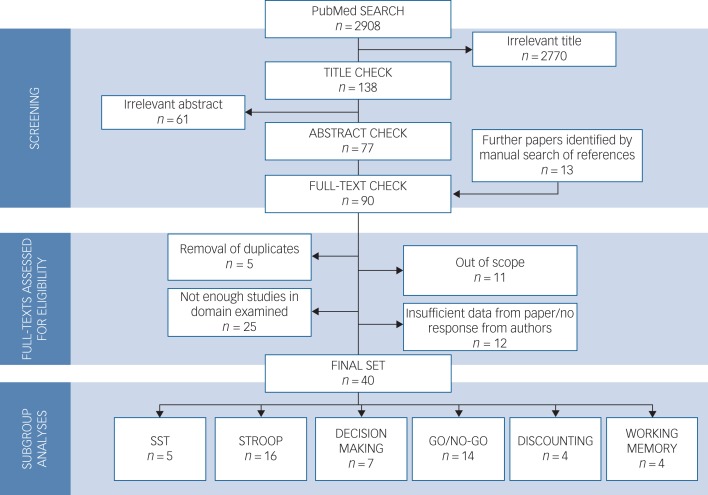
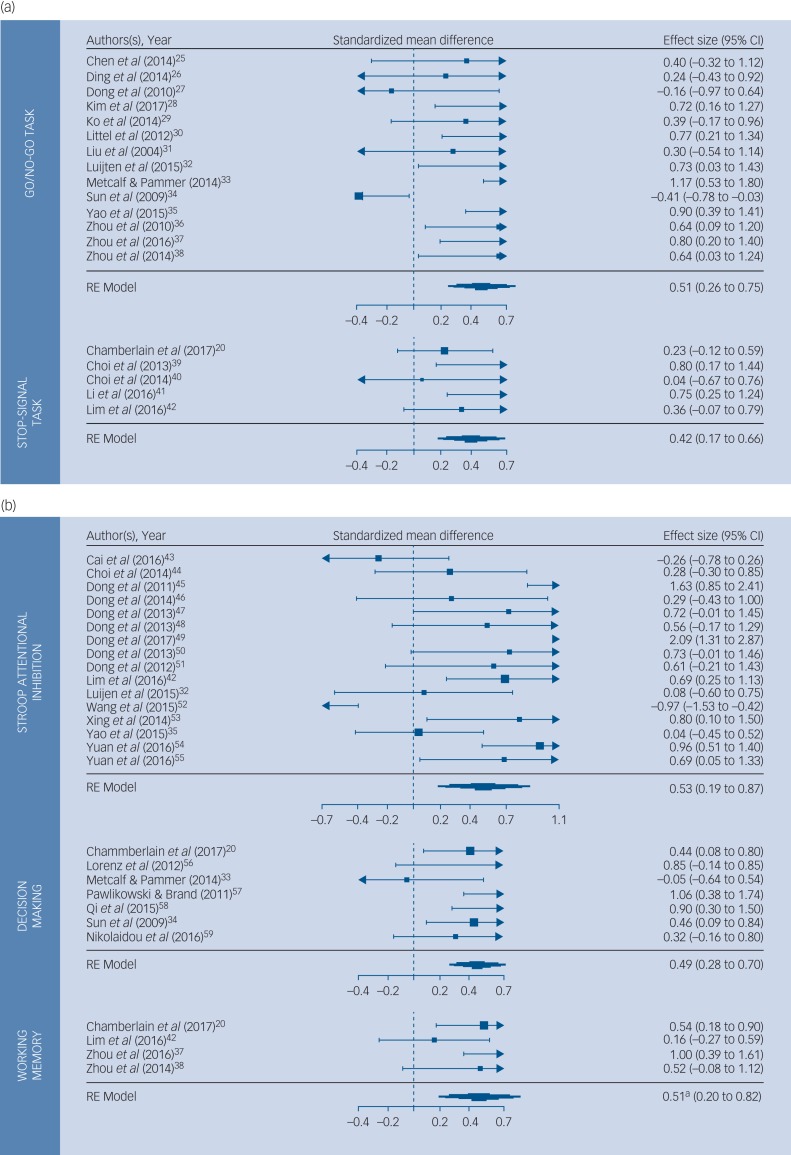
BACKGROUND: Excessive use of the internet is increasingly recognised as a global public health concern. Individual studies have reported cognitive impairment in problematic internet use (PIU), but have suffered from various methodological limitations. Confirmation of cognitive deficits in PIU would support the neurobiological plausibility of this disorder. AIMS: To conduct a rigorous meta-analysis of cognitive performance in PIU from case-control studies; and to assess the impact of study quality, the main type of online behaviour (for example gaming) and other parameters on the findings. METHOD: A systematic literature review was conducted of peer-reviewed case-controlled studies comparing cognition in people with PIU (broadly defined) with that of healthy controls. Findings were extracted and subjected to a meta-analysis where at least four publications existed for a given cognitive domain of interest. RESULTS: The meta-analysis comprised 2922 participants across 40 studies. Compared with controls, PIU was associated with significant impairment in inhibitory control (Stroop task Hedge's g = 0.53 (s.e. = 0.19-0.87), stop-signal task g = 0.42 (s.e. = 0.17-0.66), go/no-go task g = 0.51 (s.e. = 0.26-0.75)), decision-making (g = 0.49 (s.e. = 0.28-0.70)) and working memory (g = 0.40 (s.e. = 0.20-0.82)). Whether or not gaming was the predominant type of online behaviour did not significantly moderate the observed cognitive effects; nor did age, gender, geographical area of reporting or the presence of comorbidities. CONCLUSIONS: PIU is associated with decrements across a range of neuropsychological domains, irrespective of geographical location, supporting its cross-cultural and biological validity. These findings also suggest a common neurobiological vulnerability across PIU behaviours, including gaming, rather than a dissimilar neurocognitive profile for internet gaming disorder. DECLARATION OF INTEREST: S.R.C. consults for Cambridge Cognition and Shire. K.I.'s research activities were supported by Health Education East of England Higher Training Special interest sessions. A.E.G.'s research has been funded by Innovational grant (VIDI-scheme) from ZonMW: (91713354). N.A.F. has received research support from Lundbeck, Glaxo-SmithKline, European College of Neuropsychopharmacology (ECNP), Servier, Cephalon, Astra Zeneca, Medical Research Council (UK), National Institute for Health Research, Wellcome Foundation, University of Hertfordshire, EU (FP7) and Shire. N.A.F. has received honoraria for lectures at scientific meetings from Abbott, Otsuka, Lundbeck, Servier, Astra Zeneca, Jazz pharmaceuticals, Bristol Myers Squibb, UK College of Mental Health Pharmacists and British Association for Psychopharmacology (BAP). N.A.F. has received financial support to attend scientific meetings from RANZCP, Shire, Janssen, Lundbeck, Servier, Novartis, Bristol Myers Squibb, Cephalon, International College of Obsessive-Compulsive Spectrum Disorders, International Society for Behavioral Addiction, CINP, IFMAD, ECNP, BAP, the World Health Organization and the Royal College of Psychiatrists. N.A.F. has received financial royalties for publications from Oxford University Press and payment for editorial duties from Taylor and Francis. J.E.G. reports grants from the National Center for Responsible Gaming, Forest Pharmaceuticals, Takeda, Brainsway, and Roche and others from Oxford Press, Norton, McGraw-Hill and American Psychiatric Publishing outside of the submitted work.
Overview
The claims and statistics of this paper haven’t been checked yet.
Run the check — free, no account needed. It reads the open-access text and checks the sources it cites.
Integrity signals
Registry
Cites
Statistics
Figures
Verification
Claims the paper makes
The claims and statistics of this paper haven’t been checked yet.
Run the check — free, no account needed. It reads the open-access text and checks the sources it cites.
Claims other papers make about this one
Each is checked against this paper’s own text: does it say what the citing paper says it does?
In the citing paper
“Research on PIU has exposed compelling evidence regarding its detrimental effects on critical cognitive faculties such as working memory and decision-making (Ioannidis et al., 2019).”
From From tools to threats: a reflection on the impact of artificial-intelligence chatbots on cognitive health (2024) · cites this paper as Ioannidis et al., 2019
In the citing paper
“Problematic Internet use was associated with deficits in decision making that were assessed on the Iowa Gambling Task, Balloon Analogue Risk Task (BART), Cambridge Gambling Task, and Game of Dice Task ( 18 ).”
From Neurocognitive function among individuals with problematic social media use (2026) · cites this paper as [18]
Self-check
Percentages, sums and reported differences re-computed from the paper’s own numbers.
The self-check needs the paper’s full text.
Citations
Cites
Bias in meta-analysis detected by a simple, graphical test
Egger, M., Smith, G. D., Schneider, M., & Minder, C. (1997) · BMJ · doi:10.1136/bmj.315.7109.629 · Cited by 56,722
Meta-analysis of Observational Studies in Epidemiology<SUBTITLE>A Proposal for Reporting</SUBTITLE>
Stroup, D. F. (2000) · JAMA · doi:10.1001/jama.283.15.2008 · Cited by 20,623
Duval, S., & Tweedie, R. (2000) · Biometrics · doi:10.1111/j.0006-341x.2000.00455.x · Cited by 14,099
Internet Addiction: The Emergence of a New Clinical Disorder
YOUNG, K. S. (1998) · CyberPsychology & Behavior · doi:10.1089/cpb.1998.1.237 · Cited by 5,513
Kardefelt-Winther, D. (2014) · Computers in Human Behavior · doi:10.1016/j.chb.2013.10.059 · Cited by 2,519
Brand, M., Young, K. S., Laier, C., Wölfling, K., & Potenza, M. N. (2016) · Neuroscience & Biobehavioral Reviews · doi:10.1016/j.neubiorev.2016.08.033 · Cited by 2,416
Issues for DSM-V: Internet Addiction
Block, J. J. (2008) · American Journal of Psychiatry · doi:10.1176/appi.ajp.2007.07101556 · Cited by 1,385
Internet addiction: a systematic review of epidemiological research for the last decade
Kuss, D., Griffiths, M., Karila, L., & Billieux, J. (2014) · Current Pharmaceutical Design · doi:10.2174/13816128113199990617 · Cited by 1,374
Modification in the Proposed Diagnostic Criteria for Internet Addiction
Beard, K. W., & Wolf, E. (2001) · CyberPsychology & Behavior · doi:10.1089/109493101300210286 · Cited by 1,019
Problematic internet use: Proposed classification and diagnostic criteria
Shapira, N. A., Lessig, M. C., Goldsmith, T. D., Szabo, S. T., Lazoritz, M., Gold, M. S., & Stein, D. J. (2003) · Depression and Anxiety · doi:10.1002/da.10094 · Cited by 771
Research works printed but not linked: 2
- 2013, Diagnostic and Statistical Manual of Mental Disorders (DSM-5)
- Gackenbach, 1998, Psychology and the Internet. Intrapersonal, Interpersonal, and Transpersonal Implications
Cited by
Sorted by citations
Brand, M., Wegmann, E., Stark, R., Müller, A., Wölfling, K., Robbins, T. W., & Potenza, M. N. (2019) · Neuroscience & Biobehavioral Reviews · doi:10.1016/j.neubiorev.2019.06.032 · Cited by 2,126
Fineberg, N. A., Menchón, J. M., Hall, N., Dell’Osso, B. M., Brand, M., Potenza, M. N., Chamberlain, S. R., Cirnigliaro, G., Löchner, C., Billieux, J., et al. (2022) · Comprehensive Psychiatry · doi:10.1016/j.comppsych.2022.152346 · Cited by 276
Self-citationCurrent interpretations of the I-PACE model of behavioral addictions
Brand, M., Müller, A., Wegmann, E., Antons, S., Brandtner, A., Müller, S. M., Stark, R. M., Steins‐Loeber, S., & Potenza, M. N. (2025) · Journal of Behavioral Addictions · doi:10.1556/2006.2025.00020 · Cited by 224
Can internet use become addictive?
Brand, M. (2022) · Science · doi:10.1126/science.abn4189 · Cited by 183
Neurobiology of cue-reactivity, craving, and inhibitory control in non-substance addictive behaviors
Antons, S., Brand, M., & Potenza, M. N. (2020) · Journal of the Neurological Sciences · doi:10.1016/j.jns.2020.116952 · Cited by 187
Wegmann, E., Müller, S. M., Turel, O., & Brand, M. (2020) · Scientific Reports · doi:10.1038/s41598-020-60819-4 · Cited by 145
León Méndez, M., Padrón, I., Fumero, A., & Marrero, R. J. (2024) · Neuroscience & Biobehavioral Reviews · doi:10.1016/j.neubiorev.2024.105572 · Cited by 148
“In addition, IA and SPA have been widely studied and recognised as important impairments, with a substantial body of literature exploring their impact on mental health and cognition (Daniyal et al., 2022; Ioannidis et al., 2019; Seki et al., 2019).”
BackgroundThorell, L. B., Burén, J., Ström Wiman, J., Sandberg, D., & Nutley, S. B. (2024) · European Child & Adolescent Psychiatry · doi:10.1007/s00787-022-02130-3 · Cited by 132
Pettorruso, M., Valle, S., Cavic, E., Martinotti, G., Giannantonio, M. D., & Grant, J. E. (2020) · Psychiatry Research · doi:10.1016/j.psychres.2020.113036 · Cited by 140
Self-citationBrand, M., Rumpf, H., King, D. L., Potenza, M. N., & Wegmann, E. (2020) · Current Opinion in Psychology · doi:10.1016/j.copsyc.2020.04.006 · Cited by 106
Dergaa, I., Ben Saad, H., Glenn, J. M., Amamou, B., Ben Aissa, M., Guelmami, N., Fekih-Romdhane, F., & Chamari, K. (2024) · Frontiers in Psychology · doi:10.3389/fpsyg.2024.1259845 · Cited by 93
Ioannidis, K., Taylor, C., Holt, L., Brown, K., Löchner, C., Fineberg, N. A., Corazza, O., Chamberlain, S. R., Román-Urrestarazu, A., & Czabanowska, K. (2021) · Neuroscience & Biobehavioral Reviews · doi:10.1016/j.neubiorev.2021.03.005 · Cited by 91
Self-citationA meta-analysis of technology use and cognitive aging
Benge, J. F., & Scullin, M. K. (2025) · Nature Human Behaviour · doi:10.1038/s41562-025-02159-9 · Cited by 103
Tanhan, F., ÖZOK, H. İ., Kaya, A., & Yıldırım, M. (2023) · Current Psychology · doi:10.1007/s12144-023-04242-8 · Cited by 85
Wei, D., Chan, L. S., Du, N., Hu, X., & Huang, Y. (2024) · Addictive Behaviors · doi:10.1016/j.addbeh.2024.108044 · Cited by 80
Time for a true display of skill: Top players in League of Legends have better executive control
Li, X., Huang, L., Li, B., Wang, H., & Han, C. (2020) · Acta Psychologica · doi:10.1016/j.actpsy.2020.103007 · Cited by 70
Addiction Research Unit: Affective and cognitive mechanisms of specific Internet‐use disorders
Brand, M., Müller, A., Stark, R. M., Steins‐Loeber, S., Klucken, T., Montag, C., Diers, M., Wolf, O. T., Rumpf, H., Wölfling, K., et al. (2021) · Addiction Biology · doi:10.1111/adb.13087 · Cited by 64
Solly, J. E., Hook, R. W., Grant, J. E., Cortese, S., & Chamberlain, S. R. (2021) · Molecular Psychiatry · doi:10.1038/s41380-021-01315-7 · Cited by 63
Self-citationKlugah‐Brown, B., Zhou, X., Pradhan, B., Zweerings, J., Mathiak, K., Biswal, B. B., & Becker, B. (2021) · Addiction Biology · doi:10.1111/adb.12997 · Cited by 59
Problematic Internet Use among Adolescents 18 Months after the Onset of the COVID-19 Pandemic
Paulus, F. W., Joas, J., Gerstner, I., Kühn, A., Wenning, M., Gehrke, T., Burckhart, H., Richter, U., Nonnenmacher, A., Zemlin, M., et al. (2022) · Children · doi:10.3390/children9111724 · Cited by 61
Castro‐Calvo, J., Cervigón-Carrasco, V., Ballester‐Arnal, R., & Giménez‐García, C. (2021) · Addictive Behaviors Reports · doi:10.1016/j.abrep.2021.100345 · Cited by 59
Shutzman, B., & Gershy, N. (2022) · Computers in Human Behavior · doi:10.1016/j.chb.2022.107559 · Cited by 56
Kakul, F., & Javed, S. (2023) · Asian Journal of Social Health and Behavior · doi:10.4103/shb.shb_209_22 · Cited by 53
Prevalence and Risk Factors of Internet Addiction among Hungarian High School Students
Kapus, K., Nyulas, R., Nemeskéri, Z., Zádori, I., Muity, G., Kiss, J., Feher, A., Fejes, É., Tibold, A., & Fehér, G. (2021) · International Journal of Environmental Research and Public Health · doi:10.3390/ijerph18136989 · Cited by 49
Internet Addiction and Burnout in A Single Hospital: Is There Any Association?
Tóth, G. E., Kapus, K., Hesszenberger, D., Pohl, M., Kósa, G., Kiss, J., Pusch, G., Fejes, É., Tibold, A., & Fehér, G. (2021) · International Journal of Environmental Research and Public Health · doi:10.3390/ijerph18020615 · Cited by 57
Tereshchenko, S. Y. (2023) · World Journal of Psychiatry · doi:10.5498/wjp.v13.i5.160 · Cited by 75
Zhang, K., Li, P., Zhao, Y., Griffiths, M. D., Wang, J., & Zhang, M. X. (2023) · Psychology Research and Behavior Management · doi:10.2147/prbm.s414625 · Cited by 46
Levelink, B., van der Vlegel, M., Mommers, M., Gubbels, J. S., Dompeling, E., FERON, F. J. M., Aa, D., Hurks, P. P. M., & Thijs, C. T. (2020) · Journal of Attention Disorders · doi:10.1177/1087054720953897 · Cited by 54
To What Extent is Internet Activity Predictive of Psychological Well-Being?
Lippke, S., Dahmen, A., Gao, L., Guza, E., & Nigg, C. R. (2021) · Psychology Research and Behavior Management · doi:10.2147/prbm.s274502 · Cited by 48
Rautela, S., & Sharma, S. (2022) · Journal of Information Communication and Ethics in Society · doi:10.1108/jices-06-2021-0057 · Cited by 65
Müller, S. M., Wegmann, E., García Arias, M., Bernabéu Brotóns, E., Marchena Giráldez, C., & Brand, M. (2021) · Comprehensive Psychiatry · doi:10.1016/j.comppsych.2021.152228 · Cited by 42
Cognitive Correlates in Gaming Disorder and Social Networks Use Disorder: a Comparison
Wegmann, E., & Brand, M. (2020) · Current Addiction Reports · doi:10.1007/s40429-020-00314-y · Cited by 46
Liu, Y., Jin, C., Zhou, X., Chen, Y., Ma, Y., Chen, Z., Zhang, T., & Ren, Y. (2024) · Scientific Reports · doi:10.1038/s41598-024-74132-x · Cited by 43
Liu, Y., Yin, J., Xu, L., Luo, X., Liu, H., & Zhang, T. (2025) · The Journal of Genetic Psychology · doi:10.1080/00221325.2025.2462595 · Cited by 39
Moretta, T., & Wegmann, E. (2025) · Addictive Behaviors Reports · doi:10.1016/j.abrep.2025.100603 · Cited by 52
Liu, Y., Jin, C., Zhou, X., Chen, Y., Ma, Y., Chen, Z., Zhang, T., & Ren, Y. (2024) · Archives of Psychiatric Nursing · doi:10.1016/j.apnu.2024.10.019 · Cited by 38
Wang, Q., Zhang, J., & Xiao, M. (2025) · Scientific Reports · doi:10.1038/s41598-025-88140-y · Cited by 36
Xu, C., Ellefson, M. R., Ng, F. F., Wang, Q., & Hughes, C. H. (2020) · Journal of Experimental Child Psychology · doi:10.1016/j.jecp.2020.104929 · Cited by 34
Chetty-Mhlanga, S., Fuhrimann, S., Eeftens, M., Basera, W., Hartinger, S. M., Dalvie, M. A., & Röösli, M. (2020) · Environmental Research · doi:10.1016/j.envres.2020.109315 · Cited by 40
Delineating adaptive esports involvement from maladaptive gaming: a self-regulation perspective
Brevers, D., King, D. L., & Billieux, J. (2020) · Current Opinion in Psychology · doi:10.1016/j.copsyc.2020.07.025 · Cited by 37
In-game Social Interaction and Gaming Disorder: A Perspective From Online Social Capital
Heng, S., Zhao, H., & Wang, M. (2021) · Frontiers in Psychiatry · doi:10.3389/fpsyt.2020.468115 · Cited by 39
Müller, S. M., Antons, S., Schmid, A. M., Thomas, T. A., Kessling, A., Joshi, M., Krikova, K., Kampa, M., Mallon, L., Schmidt, L. D., et al. (2025) · American Journal of Psychiatry · doi:10.1176/appi.ajp.20240486 · Cited by 32
Jelleli, H., Aissa, M. B., Kaddech, N., Saidane, M., Guelmami, N., Bragazzi, N. L., Bonsaksen, T., Fekih‐Romdhane, F., & Dergaa, I. (2024) · BMC Psychology · doi:10.1186/s40359-024-01736-3 · Cited by 38
Canale, N., Pancani, L., Pivetta, E., Moretta, T., Marino, C., Buodo, G., Vieno, A., Dalmaso, M., & Billieux, J. (2022) · Comprehensive Psychiatry · doi:10.1016/j.comppsych.2022.152356 · Cited by 34
Yang, H.-M., & Kim, H. (2021) · International Journal of Environmental Research and Public Health · doi:10.3390/ijerph18115774 · Cited by 31
Problematic internet use profiles and psychosocial risk among adolescents
Pontes, H. M., & Macur, M. (2021) · PLoS ONE · doi:10.1371/journal.pone.0257329 · Cited by 40
Soares, L. S., Thorell, L. B., Barbi, M., Crisci, G., Nutley, S. B., & Burén, J. (2023) · Journal of Behavioral Addictions · doi:10.1556/2006.2023.00007 · Cited by 30
Fan, T., Twayigira, M., Song, L., Luo, X., Huang, C., Gao, X., & Shen, Y. (2023) · Frontiers in Public Health · doi:10.3389/fpubh.2023.1172109 · Cited by 31
Müller, S. M., Antons, S., Wegmann, E., Ioannidis, K., King, D. L., Potenza, M. N., Chamberlain, S. R., & Brand, M. (2023) · Neuroscience & Biobehavioral Reviews · doi:10.1016/j.neubiorev.2023.105271 · Cited by 29
Self-citationMilasauskiene, E., Burkauskas, J., Podlipskytė, A., Király, O., Demetrovics, Z., Ambrasas, L., & Steiblienė, V. (2021) · Frontiers in Psychology · doi:10.3389/fpsyg.2021.685137 · Cited by 31
Tiego, J., Löchner, C., Ioannidis, K., Brand, M., Stein, D. J., Yücel, M., Grant, J. E., & Chamberlain, S. R. (2019) · BMC Psychiatry · doi:10.1186/s12888-019-2352-8 · Cited by 33
Self-citationDong, G., Wang, Z., Dong, H., Wang, M., Zheng, Y., Ye, S., Zhang, J., & Potenza, M. N. (2020) · Journal of Behavioral Addictions · doi:10.1556/2006.2020.00065 · Cited by 29
Lo, C. K. M., Yu, L., Cho, Y. W., & Chan, K. L. (2020) · International Journal of Environmental Research and Public Health · doi:10.3390/ijerph18010086 · Cited by 29
Marciano, L., Schulz, P. J., & Camerini, A.-L. (2021) · Computers in Human Behavior · doi:10.1016/j.chb.2021.106731 · Cited by 33
Bai, W., Cai, H. X., Wu, S., Zhang, L., Feng, K.-X., Li, Y., Liu, H., Du, X., Zeng, Z.-T., Lu, C.-M., et al. (2022) · Translational Psychiatry · doi:10.1038/s41398-022-01893-2 · Cited by 34
Khanbabaei, S., Abdollahi, M. H., & Shahgholian, M. (2021) · Personality and Individual Differences · doi:10.1016/j.paid.2021.111280 · Cited by 26
Carlo, F. D., Vicinelli, M. C., Pettorruso, M., Risio, L. D., Migliara, G., Baccolini, V., Trioni, J., Grant, J. E., Dell’Osso, B. M., & Martinotti, G. (2023) · Comprehensive Psychiatry · doi:10.1016/j.comppsych.2023.152446 · Cited by 30
Self-citationShin, D., Choi, A., Lee, J., Chung, S. J., Kim, B., Park, M., Jung, M. H., Kim, D., & Choi, J. (2019) · Journal of Clinical Medicine · doi:10.3390/jcm8081102 · Cited by 25
Prevalence and Risk Factors of Internet Addiction among Hungarian High School Teachers
Toth, G., Kapus, K., Hesszenberger, D., Pohl, M., Kósa, G., Kiss, J., Pusch, G., Fejes, É., Tibold, A., & Fehér, G. (2021) · Life · doi:10.3390/life11030194 · Cited by 29
Affective and cognitive processes involved in behavioral addictions
Wegmann, E., & Brand, M. (2021) · Addictive Behaviors · doi:10.1016/j.addbeh.2021.106885 · Cited by 28
Effectiveness of multimodal psychotherapeutic intervention for internet gaming disorder
Sharma, M. K., Anand, N., Tadpatrikar, A., Marimuthu, P., & Narayanan, G. (2022) · Psychiatry Research · doi:10.1016/j.psychres.2022.114633 · Cited by 29
Slow-Wave EEG Activity Correlates with Impaired Inhibitory Control in Internet Addiction Disorder
Qi, Y., Liu, Y., Yan, Z., Hu, S., Zhang, X., Zhao, J. L., Turel, O., & He, Q. (2022) · International Journal of Environmental Research and Public Health · doi:10.3390/ijerph19052686 · Cited by 27
Moshel, M. L., Warburton, W., Batchelor, J., Bennett, J. M., & Ko, K. Y. (2023) · Neuropsychology Review · doi:10.1007/s11065-023-09612-4 · Cited by 33
Müller, S. M., Schiebener, J., Brand, M., & Liebherr, M. (2021) · Cognitive Processing · doi:10.1007/s10339-021-01029-2 · Cited by 28
Jang, J. H., Chung, S. J., Choi, A. R., Lee, J. Y., Kim, B., Park, M., Park, S., & Choi, J. (2021) · Journal of Clinical Medicine · doi:10.3390/jcm10112293 · Cited by 23
Problematic usage of the internet and cognition
Ioannidis, K., Grant, J. E., & Chamberlain, S. R. (2022) · Current Opinion in Behavioral Sciences · doi:10.1016/j.cobeha.2022.101104 · Cited by 23
Self-citationLee, J., Choi, C.-H., Park, M., Park, S., & Choi, J. (2022) · Psychological Medicine · doi:10.1017/s0033291722000137 · Cited by 22
Thomas, C. L., Ingels, D. J., Kazmi, M. A., Ohu, E. A., Belle, C., & Spitzmueller, C. (2022) · Computers in Human Behavior · doi:10.1016/j.chb.2022.107247 · Cited by 21
Antons, S., Müller, S. M., Neumann, P., Müller, A., & Steins-Loeber, S. (2023) · Current Addiction Reports · doi:10.1007/s40429-023-00517-z · Cited by 21
Hökby, S., Alvarsson, J., Westerlund, J., Carli, V., & Hadlaczky, G. (2025) · PLOS Global Public Health · doi:10.1371/journal.pgph.0004262 · Cited by 29
Neural mechanisms of behavioral addiction: An ALE meta-analysis and MACM analysis
Li, Z., He, Q., Elhai, J. D., Montag, C., & Yang, H. (2025) · Journal of Behavioral Addictions · doi:10.1556/2006.2024.00082 · Cited by 18
Stanciu, D., & CĂLUGĂR, A. (2022) · Computers in Human Behavior · doi:10.1016/j.chb.2022.107365 · Cited by 25
Facets of Impulsivity in Gaming Disorder: a Narrative Review
Müller, S. M., Antons, S., & Brand, M. (2023) · Current Addiction Reports · doi:10.1007/s40429-023-00522-2 · Cited by 20
Ma, X., Wang, M., Zhou, W., Zhang, Z., Ni, H., Jiang, A., Zheng, Y., Du, X., Potenza, M. N., & Dong, G. (2024) · Journal of Behavioral Addictions · doi:10.1556/2006.2024.00011 · Cited by 18
Theoretical models of types of problematic usage of the Internet: when theorists meet therapists
Brand, M., Potenza, M. N., & Stark, R. M. (2022) · Current Opinion in Behavioral Sciences · doi:10.1016/j.cobeha.2022.101119 · Cited by 17
Tseng, Y.-H., Chao, H.-H., & Hung, C. (2022) · Children · doi:10.3390/children9060798 · Cited by 20
Altered Resting-State Network in Adolescents with Problematic Internet Use
Siste, K., Pandelaki, J., Miyata, J., Oishi, N., Tsurumi, K., Fujiwara, H., Murai, T., Nasrun, M. W. S., Wiguna, T., Bardosono, S., et al. (2022) · Journal of Clinical Medicine · doi:10.3390/jcm11195838 · Cited by 21
Chen, C., Yang, C., Nie, Q., & Teng, Z. (2023) · School Psychology Review · doi:10.1080/2372966x.2023.2263812 · Cited by 19
Liu, L., Yao, Y., Fang, X., Xu, L., Hu, M.-J., Zhang, J., & Potenza, M. N. (2024) · Journal of Behavioral Addictions · doi:10.1556/2006.2024.00023 · Cited by 19
Ioannidis, K., Tiego, J., Lutz, N. M., Omrawo, C., Yücel, M., Grant, J. E., Löchner, C., & Chamberlain, S. R. (2023) · Comprehensive Psychiatry · doi:10.1016/j.comppsych.2023.152366 · Cited by 17
Self-citationPaschke, K., Cloes, J.-O., & Thomasius, R. (2023) · SUCHT - Zeitschrift für Wissenschaft und Praxis / Journal of Addiction Research and Practice · doi:10.1024/0939-5911/a000810 · Cited by 16
Psychological processes linking problematic smartphone use to sleep disturbance in young adults
Peltz, J. S., Bodenlos, J. S., Kingery, J. N., & Abar, C. C. (2023) · Sleep Health · doi:10.1016/j.sleh.2023.05.005 · Cited by 18
Decision making and executive functions in problematic pornography use
Müller, S. M., & Antons, S. (2023) · Frontiers in Psychiatry · doi:10.3389/fpsyt.2023.1191297 · Cited by 17
Ioannidis, K., Redden, S. A., Valle, S., Chamberlain, S. R., & Grant, J. E. (2019) · CNS Spectrums · doi:10.1017/s1092852919001019 · Cited by 15
Self-citationChoi, J., Han, C.-K., & Kang, S. (2022) · Child Indicators Research · doi:10.1007/s12187-022-09934-4 · Cited by 14
Tseng, Y., Su, Y.-K., Chou, W., Miyakoshi, M., Tsai, C., Li, C., Lee, S.-Y., & Wang, L. (2024) · IEEE Transactions on Neural Systems and Rehabilitation Engineering · doi:10.1109/tnsre.2024.3363756 · Cited by 14
Gao, L., Gan, Y., Whittal, A., Yan, S., & Lippke, S. (2020) · Journal of Medical Internet Research · doi:10.2196/16468 · Cited by 14
Context-switching in short-form videos: What is the impact on prospective memory?
Barton, N., & Smyth, M. (2025) · Memory · doi:10.1080/09658211.2025.2521076 · Cited by 23
Problematic internet use and safety behavior: The moderating role of safety climate
Ghasemi, F., Aghaei, H., & Nikravesh, A. (2022) · PLoS ONE · doi:10.1371/journal.pone.0279767 · Cited by 13
Broadband Internet and Cognitive Functioning*
Ackermann, K., Churchill, S. A., & Smyth, R. (2023) · Economic Record · doi:10.1111/1475-4932.12757 · Cited by 12
Raj, K., Segrave, R. A., Verdejo‐García, A., & Yücel, M. (2022) · Addictive Behaviors · doi:10.1016/j.addbeh.2022.107600 · Cited by 10
Moshel, M. L., Warburton, W., Thomasius, R., & Paschke, K. (2025) · Journal of Medical Internet Research · doi:10.2196/68571 · Cited by 18
Solly, J. E., Grant, J. E., & Chamberlain, S. R. (2022) · Current Opinion in Behavioral Sciences · doi:10.1016/j.cobeha.2022.101158 · Cited by 12
Self-citationLiu, W., Huang, J., Li, Y., Gao, X., Xu, Z.-Y., & Li, Y.-H. (2025) · Frontiers in Psychology · doi:10.3389/fpsyg.2025.1517489 · Cited by 11
Neurocognitive impairment in addiction: A digital tool for executive function assessment
Balconi, M., Losasso, D., Balena, A., & Crivelli, D. (2022) · Frontiers in Psychiatry · doi:10.3389/fpsyt.2022.955277 · Cited by 11
A Mixture Modeling of the Predictors of Internet Addiction: Cognition and Dissociation
Eşkısu, M., Boysan, M., & Çam, Z. (2023) · Psychological Reports · doi:10.1177/00332941221149180 · Cited by 11
Internet Addiction in University Students – Czech study
Milková, E., Kaliba, M., & Ambrožová, P. (2022) · Journal on Efficiency and Responsibility in Education and Science · doi:10.7160/eriesj.2022.150204 · Cited by 13
Müller, S. M., Wegmann, E., Arias, M. G., Brotóns, E. B., Giráldez, C. A. M., & Brand, M. (2022) · Brain Sciences · doi:10.3390/brainsci12020201 · Cited by 13
The Reward Deficiency Syndrome and Links with Addictive and Related Behaviors
Kótyuk, E., Potenza, M. N., Blum, K., & Demetrovics, Z. (2021) · Springer eBooks · doi:10.1007/978-3-030-67928-6_3-1 · Cited by 10
Harren, N., & Walburg, V. (2022) · Journal of Technology in Behavioral Science · doi:10.1007/s41347-022-00280-4 · Cited by 11
Metadata
- Authors
- Ioannidis, K., Hook, R., Goudriaan, A. E., Vlies, S., Fineberg, N. A., Grant, J. E., & Chamberlain, S. R.
- Affiliations
- University of Cambridge (GB)
- Amsterdam UMC Location University of Amsterdam (NL)
- Cambridgeshire and Peterborough NHS Foundation Trust (GB)
- University of Hertfordshire (GB)
- University of Chicago (US)
- Corresponding author
- Ioannidis, Konstantinos
- ORCID
- Venue
- British Journal of Psychiatry
- Publisher
- Royal College of Psychiatrists
- Published
- 2019-02-20
- Volume
- 215
- Issue
- 5
- Pages
- 639-646
- ISSN
- 0007-1250 (ISSN-L)
- 1472-1465
- PMC
- PMC6949138
- OpenAlex
- W2914811992
- Cited by
- 246
- References
- 61
- Citations by year
- 2026: 48 · 2025: 52 · 2024: 30 · 2023: 34 · 2022: 34 · 2021: 26 · 2020: 15 · 2019: 7
- FWCI
- 5.35
- Type
- journal article
- Language
- en
- Open access
- hybrid
- doi.org
- Locations
- The British Journal of Psychiatry (publishedVersion, cc-by)
- Europe PMC (PubMed Central) (publishedVersion, cc-by)
- PubMed Central (publishedVersion, cc-by)
- PubMed (publishedVersion)
- ePrints Soton (University of Southampton) (acceptedVersion)
- Pure Amsterdam UMC (acceptedVersion, cc-by)
- University of Hertfordshire Research Archive (University of Hertfordshire) (acceptedVersion)
- University of Hertfordshire Research Archive (University of Hertfordshire) (submittedVersion)
- Data Archiving and Networked Services (DANS) (submittedVersion, other-oa)
- Funders
- Bristol-Myers Squibb
- Wellcome Trust (110,049/Z/15/Z, 110049)
- Jazz Pharmaceuticals
- National Institute for Health and Care Research
- Department of Health and Social Care
- University of Hertfordshire
- ZonMw (91713354)
- Universiteit van Amsterdam
- European College of Neuropsychopharmacology
- Servier
- H. Lundbeck A/S
- Pritzker School of Medicine
- Medical Research Council
- Topics
- Social Sciences › Sociology and Political Science › Impact of Technology on Adolescents
- Social Sciences › Psychology › Clinical Psychology › Gambling Behavior and Treatments
- Social Sciences › Psychology › Clinical Psychology › Sexuality, Behavior, and Technology
- Keywords
- problematic internet use, internet gaming disorder, cognitive impairment, inhibitory control, decision-making, working memory, Stroop task, stop-signal task, go/no-go task, online games, neurobiological vulnerability, cross-cultural validity, comorbidities, case-control study, study quality, cognitive bias modification, cognitive flexibility, executive function
- MeSH terms
- Internet Use, Cognition, Cognition Disorders, England, Humans, Behavior, Addictive, Internet, Cognitive Dysfunction
About these checks
Registry, retraction, Cites and statistics results are computed, not judged, with one exception: a printed reference that no index lists is read once by a model before it counts as a citation error. Claims are extracted by a model and kept only when their quote appears verbatim in the text; each cited source is then checked, with a model’s help, for whether it says what the claim relies on. Those verdicts can be wrong — read the claim’s quote and the cited source before relying on one.
Statistics and arithmetic are recomputed, not judged.
Confidence bands are shown only for fields calibrated on our annotated test set. None is calibrated yet, so no band is shown.
What counts as a claim ›How we measure confidence ›How we check this ›
Are you an author, or do you see a problem with this page? Request a review
