

The DOI matches its Crossref record; 19 of the 19 references it cites were found in a registry or an index; none of the 10 sources its claims cite is checked for support yet.
Fasting vs Nonfasting, Dose-adjusted Levothyroxine Ingestion in Hypothyroidism: A Randomized Clinical Trial
Open accessAbstract
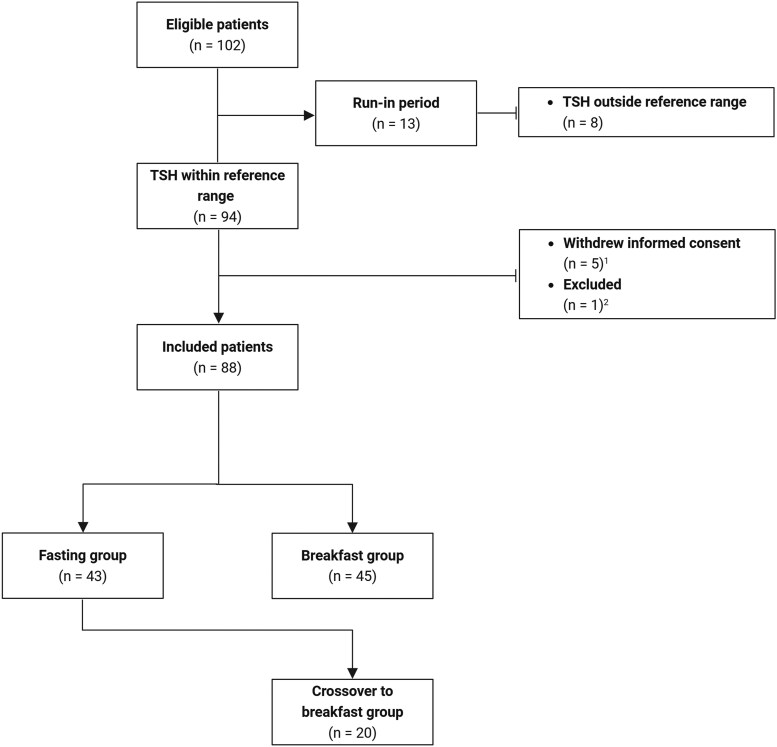
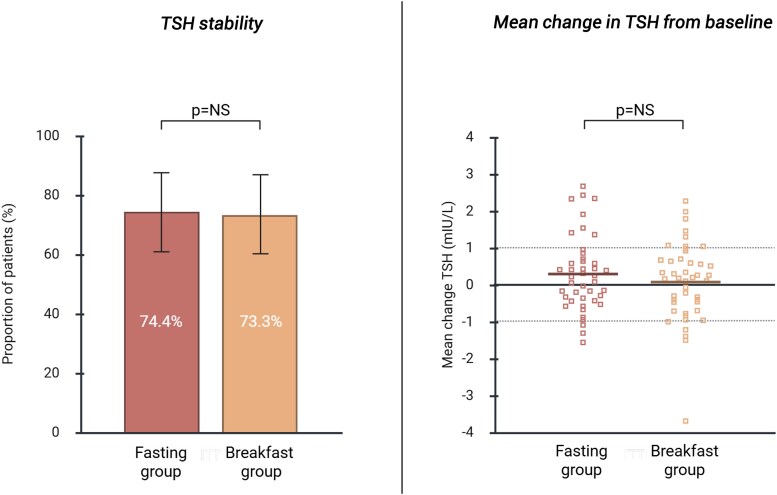
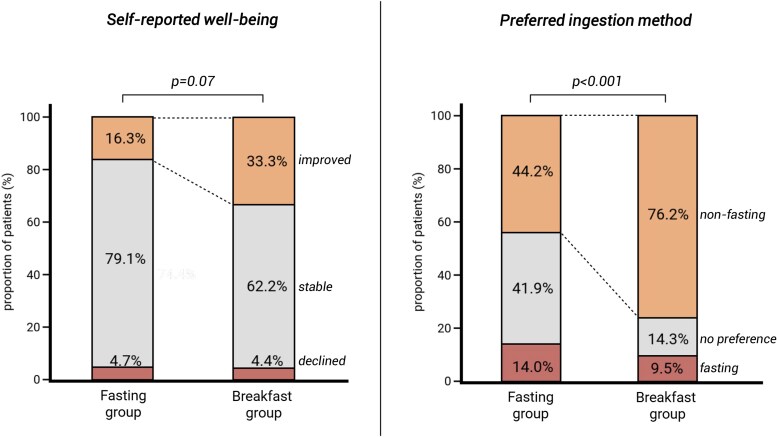
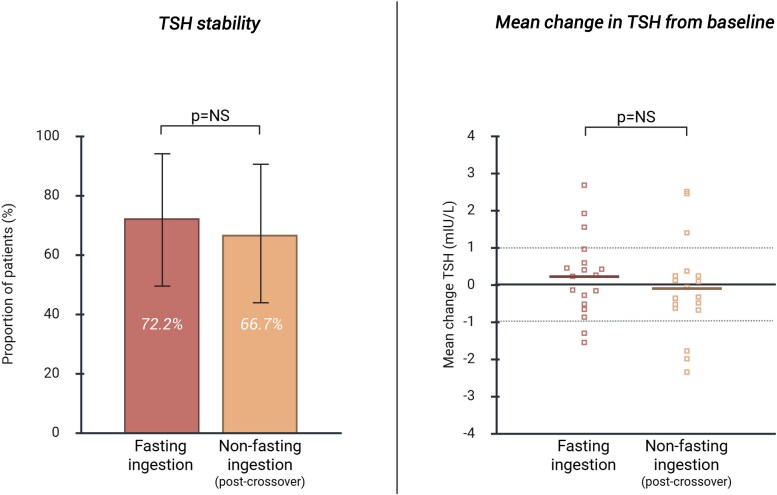
Abstract Introduction Levothyroxine (LT4) is recommended for intake in a fasting state to optimize absorption. However, fasting intake is often burdensome and may reduce adherence. In a previous questionnaire study, we observed a strong patient preference for taking LT4 with breakfast. Therefore, we conducted a randomized controlled trial to evaluate whether nonfasting LT4 intake—accompanied by a 15% dose increase—could maintain TSH stability compared to fasting LT4 intake. Methods Adults with well-controlled hypothyroidism were randomized to fasting or dose-adjusted, breakfast LT4 intake. TSH, free T4, and total T3 were measured every 6 weeks, followed by LT4 dose adjustment if needed. The primary outcome was TSH stability, defined as 2 consecutive values within the reference range and a maximum ±1 mIU/L change from baseline. Patients were followed until TSH stability was reached, with a maximum of 24 weeks. After the initial study period, patients in the fasting group were invited to cross over to nonfasting intake, with similar follow-up. Results Eighty-eight patients (80.7% female, median age 62y [interquartile range: 49-69]) were randomized to fasting (n = 43) or breakfast intake (n = 45). TSH stability was comparable between groups: 74.4% [95% confidence interval (CI): 61.0-88.0%] in the fasting vs 73.3% (95%CI: 60.0-87.0%) in the breakfast group (P = not significant). Similar findings were observed in the crossover group. The breakfast group reported greater improvement in self-reported well-being (33.3% vs 16.3%, P = .07) and a stronger preference for nonfasting intake (76.2% vs 44.2%, P < .001). By the end of the study, 88.9% chose to continue nonfasting intake. Conclusion LT4 ingestion with breakfast with a 15% dose increase maintained TSH stability and improved patient well-being. Given the strong patient preference, this patient-centered approach may offer a viable alternative to fasting administration.
Overview
CoChat Summary
TL;DR
In adults with well-controlled hypothyroidism, taking levothyroxine with breakfast after a 15% dose increase maintained TSH stability comparable to fasting intake. Patients reported better well-being and strongly preferred nonfasting ingestion, with 88.9% choosing to continue it.
Key findings
- TSH stability was comparable between fasting and breakfast groups: 74.4% (95% CI 61.0-88.0%) vs 73.3% (95% CI 60.0-87.0%), P = not significant; median time to stability was 12 weeks in both groups.
- Mean TSH change from baseline to study completion did not differ: 0.27 ± 1.02 mIU/L in the fasting group vs 0.29 ± 1.02 mIU/L in the breakfast group (P = NS).
- Self-reported well-being improved in 33.3% of the breakfast group vs 16.3% of the fasting group (P = .07), and preference for nonfasting intake was stronger in the breakfast group: 76.2% vs 44.2% (P < .001).
- By study end, 88.9% (56/63) of the breakfast group chose to continue nonfasting intake; in the crossover group, 77.8% (14/18) preferred breakfast ingestion, and no adverse events were observed.
Methods
- Open-label, single-center randomized clinical trial at Zuyderland Medical Center in The Netherlands; 88 adults with hypothyroidism were randomized 1:1 to fasting LT4 (n = 43) or breakfast LT4 with a 15% dose increase (n = 45).
- Patients had well-controlled hypothyroidism, were aged ≥ 18 years, received LT4 ≥ 1.0 mcg/kg, ate breakfast ≥ 5 days/week, and had 2 consecutive TSH levels within reference range before participation; follow-up occurred every 6 weeks up to 24 weeks, with dose adjustment if needed.
- Primary outcome was TSH stability, defined as 2 consecutive TSH values within reference range and a maximum ± 1 mIU/L change from baseline; secondary outcomes included self-reported well-being, preferred ingestion regimen, and willingness to continue, with a crossover phase for fasting-group completers and ThyPRO-39 QoL assessment.
Limitations
- Stated: the single-center study had a relatively small sample size and did not meet the threshold for a noninferiority trial; limited sample size and short follow-up precluded subgroup analyses, long-term effects, and conclusions for pregnancy, high-risk thyroid carcinoma, or heart failure.
- Stated: the population consisted of relatively well-controlled patients already receiving LT4 therapy, so future research should assess nonfasting LT4 ingestion in newly diagnosed patients.
- Evident: the trial was open-label, so patients and investigators knew group allocation, and well-being/preference outcomes were patient-reported, which may be susceptible to bias.
Model-written summary. Check it against the paper before relying on it.
Integrity signals
Registry
Cites
Statistics
Figures
Verification
Claims the paper makes
0 Valid · 0 Not valid · 8 Not checked · 13 Own results and interpretations
A result the paper reports from its own data — it cites no other source for it, so there is none to check. The quote shows it is in the paper.
In the paper
“Moreover, 56 out of 63 (88.9%) patients in the breakfast group chose to continue nonfasting ingestion after the study.”
plain- Asserted: passes — The authors put it forward as true.
- Checkable: passes — It can be checked against evidence.
- Load-bearing: unclear — It is unclear whether the paper’s conclusions depend on it.
- Based: passes — The paper gives a reason why it holds.
A conclusion the paper draws from its own results — it cites no other source for it, so there is none to check. The quote shows it is in the paper.
In the paper
“Given the strong patient preference, this patient-centered approach may offer a viable alternative to fasting administration.”
hedgedstates a possible causen = 45- Asserted: passes — The authors put it forward as true.
- Checkable: passes — It can be checked against evidence.
- Load-bearing: passes — The paper’s conclusions depend on it.
- Based: passes — The paper gives a reason why it holds.
A check of a cited source is scheduled, or we don’t hold its full text yet; the claim is checked once it runs.
In the paper
“Additionally, 25% of patients reported skipping breakfast altogether to meet the fasting condition.”
What the sources say
- Not checked yetcites [5] Willems, 2024, Breakfast habits in patients using levothyroxine: patient experiences and preferences, J Endocr Soc source
A check is scheduled.
plain- Asserted: passes — The authors put it forward as true.
- Checkable: passes — It can be checked against evidence.
- Load-bearing: unclear — It is unclear whether the paper’s conclusions depend on it.
- Based: passes — The paper gives a reason why it holds.
- Not checked yet
A check of a cited source is scheduled, or we don’t hold its full text yet; the claim is checked once it runs.
In the paper
“we observed a strong patient preference for taking LT4 with breakfast (5)”
What the sources say
- Not checked yetcites [5] Willems, 2024, Breakfast habits in patients using levothyroxine: patient experiences and preferences, J Endocr Soc source
A check is scheduled.
boosted- Asserted: passes — The authors put it forward as true.
- Checkable: passes — It can be checked against evidence.
- Load-bearing: passes — The paper’s conclusions depend on it.
- Based: passes — The paper gives a reason why it holds.
- Not checked yet
A check of a cited source is scheduled, or we don’t hold its full text yet; the claim is checked once it runs.
In the paper
“in a previous questionnaire study conducted by our research group, 50% of patients reported that delaying breakfast was burdensome (5).”
What the sources say
- Not checked yetcites [5] Willems, 2024, Breakfast habits in patients using levothyroxine: patient experiences and preferences, J Endocr Soc source
A check is scheduled.
plain- Asserted: passes — The authors put it forward as true.
- Checkable: passes — It can be checked against evidence.
- Load-bearing: passes — The paper’s conclusions depend on it.
- Based: passes — The paper gives a reason why it holds.
- Not checked yet
7 references still to check
A free account verifies the references that are still open.
- Probably not a substantial claim. 13
- It may state two separate claims as one. 5
Self-check
Percentages, sums and reported differences re-computed from the paper’s own numbers.
Each contradiction between two passages listed here was confirmed by an independent check.
Rated minor: it would not touch a result — a value no result rests on, a p-value that stays on the same side of the significance level, or a conflict that is clerical, resolved elsewhere in the paper, or outside its own findings.
In the paper
§ Primary Outcome · p. 3
“Mean change in TSH levels from baseline to study completion did not differ between the fasting and breakfast groups (absolute change in TSH: 0.27 ± 1.02 mIU/L and 0.29 ± 1.02 mIU/L respective ly”
§ Discussion · p. 4
“no significant difference in the change in TSH levels (0.27 ± 1.02 mIU/L vs 0.29 ± 1.02 mIU/L) between the breakfast and fasting groups, respectively.”
Rated minor: it would not touch a result — a value no result rests on, a p-value that stays on the same side of the significance level, or a conflict that is clerical, resolved elsewhere in the paper, or outside its own findings.
In the paper
§ Patient-reported Outcomes · p. 4
“56 out of 63 (88.9%) patients in the breakfast group chose to continue nonfasting ingestion after the study.”
§ Study Population · p. 3
“Patients were random ized into the fasting group (n = 43) or the breakfast group (n = 45).”
Citations
Cites
The Colorado Thyroid Disease Prevalence Study
Canaris, G. J., Manowitz, N. R., Mayor, G., & Ridgway, E. C. (2000) · Archives of Internal Medicine · doi:10.1001/archinte.160.4.526 · Cited by 2,824
Jonklaas, J., Bianco, A. C., Bauer, A. J., Burman, K. D., Cappola, A. R., Celi, F. S., Cooper, D. S., Kim, B. W., Peeters, R. P., Rosenthal, M. S., et al. (2014) · Thyroid® · doi:10.1089/thy.2014.0028 · Cited by 1,928
Self-citationTiming of levothyroxine administration affects serum thyrotropin concentration
Bach-Huynh, T.-G., Nayak, B., Loh, J., Soldin, S., & Jonklaas, J. (2009) · The Journal of Clinical Endocrinology & Metabolism · doi:10.1210/jc.2009-0860 · Cited by 198
Gastrointestinal malabsorption of thyroxine
Virili, C., Antonelli, A., Santaguida, M. G., Benvenga, S., & Centanni, M. (2019) · Endocrine Reviews · doi:10.1210/er.2018-00168 · Cited by 164
Aspects of the absorption of oral L-thyroxine in normal man
Wenzel, K. W., & Kirschsieper, H. E. (1977) · Metabolism · doi:10.1016/0026-0495(77)90121-4 · Cited by 151
Development of a Short Version of the Thyroid-Related Patient-Reported Outcome ThyPRO
Watt, T., Bjorner, J. B., Groenvold, M., Cramon, P., Winther, K. H., Hegedüs, L., Bonnema, S. J., Rasmussen, Å. K., Ware, J. E., & Feldt-Rasmussen, U. (2015) · Thyroid · doi:10.1089/thy.2015.0209 · Cited by 132
Vita, R., Saraceno, G., Trimarchi, F., & Benvenga, S. (2013) · Endocrine · doi:10.1007/s12020-012-9772-2 · Cited by 91
Levothyroxine interactions with food and dietary supplements – a systematic review
Wiesner, A., Gajewska, D., & Paśko, P. (2021) · Pharmaceuticals · doi:10.3390/ph14030206 · Cited by 85
Cappelli, C., Pirola, I., Daffini, L., Formenti, A., Iacobello, C., Cristiano, A., Gandossi, E., Agabiti Rosei, E., & Castellano, M. (2016) · Thyroid · doi:10.1089/thy.2015.0422 · Cited by 80
Serum Thyrotropin Levels Following Levothyroxine Administration at Breakfast
Perez, C. L. S., Araki, F. S., Graf, H., & de Carvalho, G. A. (2013) · Thyroid · doi:10.1089/thy.2012.0435 · Cited by 63
Cited by
Treatment-refractory hypothyroidism: Don’t just increase the dose
Sweis, N. W. G., & Mammen, J. S. (2026) · Cleveland Clinic Journal of Medicine · doi:10.3949/ccjm.93a.25100 · Cited by 1
van Twist, D. J. L., Willems, J. I. A., & Tummers-de Lind van Wijngaarden, R. F. A. (2026) · The Journal of Clinical Endocrinology & Metabolism · doi:10.1210/clinem/dgag128 · Cited by 1
Self-citationVirili, C., Trimboli, P., & Centanni, M. (2026) · The Journal of Clinical Endocrinology & Metabolism · doi:10.1210/clinem/dgag127 · Cited by 1
Levothyroxine and Patient Adherence, Can Breakfast Sweeten the Pill?
Osinga, J. A. J. (2026) · Clinical Thyroidology · doi:10.1177/23299711261425098
Razvi, S. (2026) · Current Medical Research and Opinion · doi:10.1080/03007995.2026.2740285
Metadata
- Authors
- Willems, J. I. A., van Twist, D. J. L., Helmich, F., Sluiter, T., Medici, M., Peeters, R. P., & Tummers-de Lind van Wijngaarden, R. F. A.
- Affiliations
- Zuyderland Medisch Centrum (NL)
- Erasmus MC (NL)
- Department of Internal Medicine, Zuyd Thyroid Center, Zuyderland Medical Center , 6162 BG Sittard-Geleen ,
- Corresponding author
- Willems, Jeresa I A
- Venue
- The Journal of Clinical Endocrinology & Metabolism
- Publisher
- The Endocrine Society
- Published
- 2025-12-23
- Volume
- 111
- Issue
- 4
- Pages
- 938-944
- ISSN
- 0021-972X (ISSN-L)
- 1945-7197
- PMC
- PMC13017094
- OpenAlex
- W7116999898
- Semantic Scholar
- d533e59a2bd4a1910a25a46d2f291335a98a2e0f
- Cited by
- 6
- References
- 19
- Citations by year
- 2026: 6
- FWCI
- 3.05
- Type
- journal article
- Language
- en
- Open access
- hybrid
- doi.org
- Licence
- Locations
- The Journal of Clinical Endocrinology & Metabolism (publishedVersion, cc-by)
- PubMed (publishedVersion)
- PubMed Central (publishedVersion, cc-by)
- EUR Research Repository (Erasmus University Rotterdam) (submittedVersion, cc-by)
- Topics
- Health Sciences › Medicine › Endocrinology, Diabetes and Metabolism › Thyroid Disorders and Treatments
- Health Sciences › Medicine › Surgery › Thyroid and Parathyroid Surgery
- Health Sciences › Medicine › Family Practice › Medication Adherence and Compliance
- Keywords
- levothyroxine, hypothyroidism, dose adjustment, free thyroxine, patient preferences, medication adherence, patient-centered care, self-reported well-being
- MeSH terms
- Aged, Dose-Response Relationship, Drug, Fasting, Female, Follow-Up Studies, Humans, Hypothyroidism, Male, Middle Aged, Thyrotropin, Thyroxine, Cross-Over Studies, Hormone Replacement Therapy, Breakfast
About these checks
Registry, retraction, Cites and statistics results are computed, not judged, with one exception: a printed reference that no index lists is read once by a model before it counts as a citation error. Claims are extracted by a model and kept only when their quote appears verbatim in the text; each cited source is then checked, with a model’s help, for whether it says what the claim relies on. Those verdicts can be wrong — read the claim’s quote and the cited source before relying on one.
A language model drew the claims from the paper on 2026-11-13, under version 3 of the claim definition (model deepseek-v4.1-flash, prompt extract-v3).
A second model labelled each claim on 2026-11-13 (model jev-1.13-20260917, definition revision gold-guideline-v0.2).
Statistics and arithmetic are recomputed, not judged.
Confidence bands are shown only for fields calibrated on our annotated test set. None is calibrated yet, so no band is shown.
What counts as a claim ›How we measure confidence ›How we check this ›
Are you an author, or do you see a problem with this page? Request a review
How to cite
Cite CoChat for the checks on this page, and the paper for its own findings.
- This page
- CoChat. (2026). Citation check: Fasting vs Nonfasting, Dose-adjusted Levothyroxine Ingestion in Hypothyroidism: A Randomized Clinical Trial. https://app.cochat.ai/papers/10.1210/clinem/dgaf686
- The paper
- Willems, J. I. A., van Twist, D. J. L., Helmich, F., Sluiter, T., Medici, M., Peeters, R. P., & Tummers-de Lind van Wijngaarden, R. F. A. (2026). Fasting vs Nonfasting, Dose-adjusted Levothyroxine Ingestion in Hypothyroidism: A Randomized Clinical Trial. The Journal of Clinical Endocrinology & Metabolism. https://doi.org/10.1210/clinem/dgaf686
Data sources
Bibliographic data: Semantic Scholar, OpenAlex, Crossref.
Contains information from the Semantic Scholar Academic Graph Datasets, made available under the ODC Attribution License (ODC-BY 1.0).
Semantic Scholar’s data is described in: Kinney, R., et al. (2023). The Semantic Scholar Open Data Platform. arXiv:2301.10140.
