

The DOI matches its Crossref record; 12 of the 12 references it cites were found in a registry or an index.
Breakfast Habits in Patients Using Levothyroxine: Patient Experiences and Preferences
Abstract
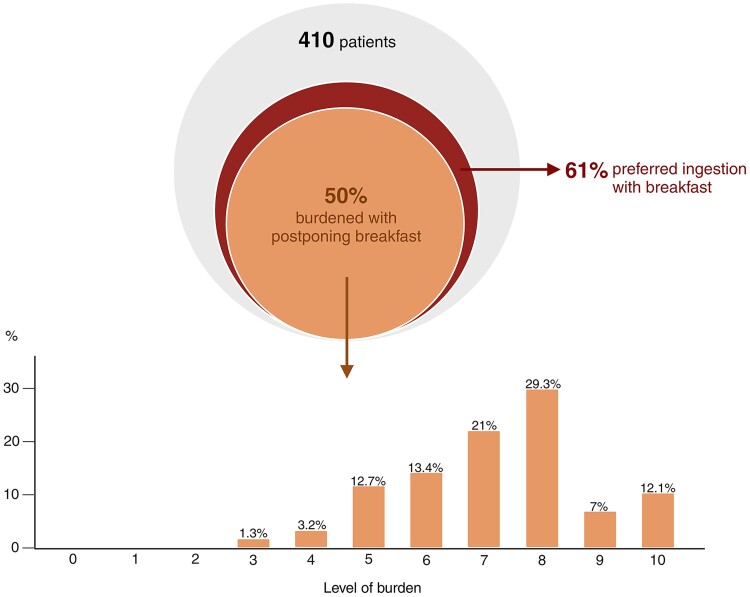
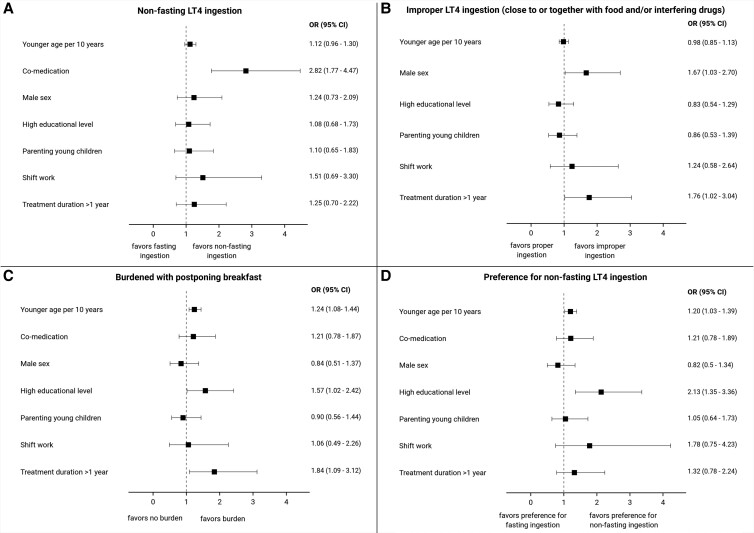
Background: Levothyroxine (LT4) is recommended to be ingested in a fasting state, 30-60 minutes before breakfast to avoid interactions with food and drugs. In clinical practice, we noticed that this instruction may be inconvenient for patients. Therefore, we aimed to evaluate patient experiences and preferences concerning the recommended fasting administration of LT4. Methods: Patients using LT4 were invited to complete a questionnaire. Regression analyses were performed to identify patient characteristics associated with taking LT4 close to or together with food and/or interfering drugs, feeling burdened with postponing breakfast, and preferring nonfasting LT4 ingestion. Results: Of 463 invited patients, 410 completed the questionnaire (88.6%). Of these, 76.8% was female and median age was 57 years (interquartile range: 43-67). Nearly all patients (97.3%) reported to have received instruction on fasting LT4 ingestion, but only 30% adhered to this. Nonfasting LT4 intake was associated with use of co-medication (odds ratio [OR], 2.82; 95% CI, 1.77-4.47), treatment duration >1 year (OR, 1.76; 95% CI, 1.02-3.04), and male sex (OR, 1.67; 95% CI, 1.03-2.70). Approximately half of the patients reported being burdened with postponing breakfast and the majority (60.5%) expressed their preference for nonfasting LT4 ingestion. Interestingly, 25% omitted breakfast and 13.4% forgot their medication because of the fasting requirement. Furthermore, the majority (68.2%) of patients that used interfering drugs stated not to be instructed to separate these drugs from LT4. Conclusion: This study highlights the burden associated with fasting LT4 ingestion, leading to nonadherence, irregular LT4 intake, and omitting breakfast. Given the clear preferences towards nonfasting LT4 ingestion, further research into alternative nonfasting administration methods is warranted.
Overview
The claims and statistics of this paper haven’t been checked yet.
Run the check — free, no account needed. It reads the open-access text and checks the sources it cites.
Integrity signals
Registry
Cites
Statistics
Figures
Verification
Claims the paper makes
The claims and statistics of this paper haven’t been checked yet.
Run the check — free, no account needed. It reads the open-access text and checks the sources it cites.
Claims other papers make about this one
Each is checked against this paper’s own text: does it say what the citing paper says it does?
In the citing paper
“Our previous questionnaire study of 410 patients treated with LT4 found that 25% regularly skipped breakfast and 13% forgot their medication due to fasting requirements, while 61% preferred nonfasting ingestion (5).”
From Fasting vs Nonfasting, Dose-adjusted Levothyroxine Ingestion in Hypothyroidism: A Randomized Clinical Trial (2026) · cites this paper as [5]
In the citing paper
“Additionally, 25% of patients reported skipping breakfast altogether to meet the fasting condition.”
From Fasting vs Nonfasting, Dose-adjusted Levothyroxine Ingestion in Hypothyroidism: A Randomized Clinical Trial (2026) · cites this paper as [5]
In the citing paper
“in a previous questionnaire study conducted by our research group, 50% of patients reported that delaying breakfast was burdensome (5).”
From Fasting vs Nonfasting, Dose-adjusted Levothyroxine Ingestion in Hypothyroidism: A Randomized Clinical Trial (2026) · cites this paper as [5]
In the citing paper
“we observed a strong patient preference for taking LT4 with breakfast (5)”
From Fasting vs Nonfasting, Dose-adjusted Levothyroxine Ingestion in Hypothyroidism: A Randomized Clinical Trial (2026) · cites this paper as [5]
Self-check
Percentages, sums and reported differences re-computed from the paper’s own numbers.
The self-check needs the paper’s full text.
Citations
Cites
Jonklaas, J., Bianco, A. C., Bauer, A. J., Burman, K. D., Cappola, A. R., Celi, F. S., Cooper, D. S., Kim, B. W., Peeters, R. P., Rosenthal, M. S., et al. (2014) · Thyroid® · doi:10.1089/thy.2014.0028 · Cited by 1,928
Self-citationTiming of levothyroxine administration affects serum thyrotropin concentration
Bach-Huynh, T.-G., Nayak, B., Loh, J., Soldin, S., & Jonklaas, J. (2009) · The Journal of Clinical Endocrinology & Metabolism · doi:10.1210/jc.2009-0860 · Cited by 198
Gastrointestinal malabsorption of thyroxine
Virili, C., Antonelli, A., Santaguida, M. G., Benvenga, S., & Centanni, M. (2019) · Endocrine Reviews · doi:10.1210/er.2018-00168 · Cited by 164
Development of a Short Version of the Thyroid-Related Patient-Reported Outcome ThyPRO
Watt, T., Bjorner, J. B., Groenvold, M., Cramon, P., Winther, K. H., Hegedüs, L., Bonnema, S. J., Rasmussen, Å. K., Ware, J. E., & Feldt-Rasmussen, U. (2015) · Thyroid · doi:10.1089/thy.2015.0209 · Cited by 132
Vita, R., Saraceno, G., Trimarchi, F., & Benvenga, S. (2013) · Endocrine · doi:10.1007/s12020-012-9772-2 · Cited by 91
Levothyroxine interactions with food and dietary supplements – a systematic review
Wiesner, A., Gajewska, D., & Paśko, P. (2021) · Pharmaceuticals · doi:10.3390/ph14030206 · Cited by 85
Cappelli, C., Pirola, I., Daffini, L., Formenti, A., Iacobello, C., Cristiano, A., Gandossi, E., Agabiti Rosei, E., & Castellano, M. (2016) · Thyroid · doi:10.1089/thy.2015.0422 · Cited by 80
Serum Thyrotropin Levels Following Levothyroxine Administration at Breakfast
Perez, C. L. S., Araki, F. S., Graf, H., & de Carvalho, G. A. (2013) · Thyroid · doi:10.1089/thy.2012.0435 · Cited by 63
Vaisman (2014) · PubMed · doi:10.3275/8810 · Cited by 49
Cappelli, C., Castello, R., Marini, F., Paoletta, A., Marchetti, M., Saullo, M., Cristiano, A., Pirola, I., Gandossi, E., Ferlin, A., et al. (2018) · Frontiers in Endocrinology · doi:10.3389/fendo.2018.00699 · Cited by 43
Research works printed but not linked: 10
- Taylor, 2014, Falling threshold for treatment of borderline elevated thyrotropin levels—balancing benefits and risks: evidence from a large community-based study, JAMA Intern Med, 174, 32, 10.1001/jamainternmed.2013.11312 · DOI · Paper page
- la Cour, 2021, Risk of over- and under- treatment with levothyroxine in primary care in Copenhagen, Denmark, Eur J Endocrinol, 185, 673, 10.1530/EJE-21-0485 · DOI · Paper page
- Canaris, 2000, The Colorado thyroid disease prevalence study, Arch Intern Med, 160, 526, 10.1001/archinte.160.4.526 · DOI · Paper page
- The EuroQol Group, 1990, EuroQol-a new facility for the measurement of health-related quality of life, Health Policy, 16, 199, 10.1016/0168-8510(90)90421-9 · DOI · Paper page
- McMillan, 2016, Comorbidities, concomitant medications, and diet as factors affecting levothyroxine therapy: results of the CONTROL surveillance project, Drugs R& D, 16, 53, 10.1007/s40268-015-0116-6 · DOI · Paper page
- Van Rossum, 2020, The Diet of the Dutch Results of the Dutch National Food Consumption Survey 2012-2016, Rijksinstituut voor Volksgezondheid en Milieu RIVM, 10.21945/RIVM-2020-0083 · DOI
- Rong, 2019, Association of skipping breakfast with cardiovascular and all-cause mortality, J Am Coll Cardiol, 73, 2025, 10.1016/j.jacc.2019.01.065 · DOI
- St-Onge, 2017, Meal timing and frequency: implications for cardiovascular disease prevention: a scientific statement from the American Heart Association, Circulation, 135, e96, 10.1161/CIR.0000000000000476 · DOI · Paper page
- Guglielmi, 2018, Shift from levothyroxine tablets to liquid formulation at breakfast improves quality of life of hypothyroid patients, Endocr Metab Immune Disorders—Drug Targets, 18, 235, 10.2174/1871530318666180125155348 · DOI · Paper page
- Fallahi, 2021, L-T4 therapy in enteric malabsorptive disorders, Front Endocrinol, 12, 626371, 10.3389/fendo.2021.626371 · DOI
Cited by
Willems, J. I. A., van Twist, D. J. L., Helmich, F., Sluiter, T., Medici, M., Peeters, R. P., & Tummers-de Lind van Wijngaarden, R. F. A. (2026) · The Journal of Clinical Endocrinology & Metabolism · doi:10.1210/clinem/dgaf686 · Cited by 6
Self-citation
Metadata
- Authors
- Willems, J. I. A., van Twist, D. J. L., Luu, I. H. Y., Bianchi, R., Peeters, R. P., & Tummers-de Lind van Wijngaarden, R. F. A.
- Affiliations
- Department of Internal Medicine, Zuyd Thyroid Center, Zuyderland Medical Center , 6162 BG Sittard-Geleen ,
- Academic Center for Thyroid Diseases, Department of Internal Medicine, Erasmus Medical Center , 3015 GD Rotterdam ,
- ORCID
- Venue
- Journal of the Endocrine Society
- Publisher
- The Endocrine Society
- Published
- 2024-10-21
- Volume
- 8
- Issue
- 12
- ISSN
- 2472-1972
- PMC
- PMC11544310
- Cited by
- 3
- References
- 12
- Language
- en
About these checks
Registry, retraction, Cites and statistics results are computed, not judged, with one exception: a printed reference that no index lists is read once by a model before it counts as a citation error. Claims are extracted by a model and kept only when their quote appears verbatim in the text; each cited source is then checked, with a model’s help, for whether it says what the claim relies on. Those verdicts can be wrong — read the claim’s quote and the cited source before relying on one.
Statistics and arithmetic are recomputed, not judged.
Confidence bands are shown only for fields calibrated on our annotated test set. None is calibrated yet, so no band is shown.
What counts as a claim ›How we measure confidence ›How we check this ›
Are you an author, or do you see a problem with this page? Request a review
How to cite
Cite CoChat for the checks on this page, and the paper for its own findings.
- This page
- CoChat. (2026). Citation check: Breakfast Habits in Patients Using Levothyroxine: Patient Experiences and Preferences. https://app.cochat.ai/papers/10.1210/jendso/bvae180
- The paper
- Willems, J. I. A., van Twist, D. J. L., Luu, I. H. Y., Bianchi, R., Peeters, R. P., & Tummers-de Lind van Wijngaarden, R. F. A. (2024). Breakfast Habits in Patients Using Levothyroxine: Patient Experiences and Preferences. Journal of the Endocrine Society. https://doi.org/10.1210/jendso/bvae180
Data sources
Bibliographic data: Semantic Scholar, OpenAlex, Crossref.
Contains information from the Semantic Scholar Academic Graph Datasets, made available under the ODC Attribution License (ODC-BY 1.0).
Semantic Scholar’s data is described in: Kinney, R., et al. (2023). The Semantic Scholar Open Data Platform. arXiv:2301.10140.
