

Maturation in Serum Thyroid Function Parameters Over Childhood and Puberty: Results of a Longitudinal Study
Open accessThe DOI matches its Crossref record; 30 of the 30 references it cites were found in a registry or an index.
Abstract
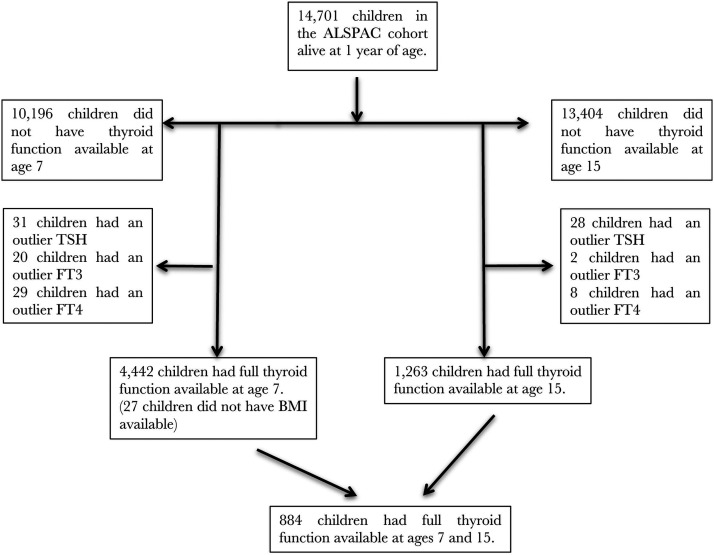
Context: Serum thyroid hormone levels differ between children and adults, but have not been studied longitudinally through childhood. Objective: To assess changes in thyroid-stimulating hormone (TSH) and thyroid hormone levels over childhood and their interrelationships. Design: Cohort study. Setting: The Avon Longitudinal Study of Parents and Children, a population-based birth cohort. Participants: A total of 4442 children who had thyroid function measured at age 7, and 1263 children who had thyroid function measured at age 15. Eight hundred eighty-four children had measurements at both ages. Main Outcome Measures: Reference ranges for TSH, free tri-iodothyronine (FT3), free thyroxine (FT4), their longitudinal stability, and interrelationships. Results: Children at age 7 years had a higher FT3 [6.17 pmol/L, standard deviation (SD) 0.62] than children at age 15 (5.83 pmol/L, SD 0.74); P < 0.0001 with 23.2% of children at age 7 having FT3 above the adult reference range. Higher FT3 levels at age 7 in boys (P = 0.0001) and girls (P = 0.04) were associated with attainment of a more advanced pubertal stage at age 13. TSH was positively associated with FT3 at age 7 and age 15 even after adjusting for confounders. In contrast, TSH was negatively associated with FT4. Conclusions: There are substantial changes in TSH and thyroid hormone levels over childhood, in particular for FT3, which appear to relate to pubertal readiness. Our data provide increased insight into the evolution of the pituitary-thyroid axis over childhood and may have implications for determining optimal ranges for thyroid hormone replacement in children.
Overview
The claims and statistics of this paper haven’t been checked yet.
Free: it reads the open-access text and checks the first 5 claims that cite a source we can check. Create a free account to check every claim.
Integrity signals
Registry
Cites
Statistics
Figures

Verification
Claims the paper makes
The claims and statistics of this paper haven’t been checked yet.
Free: it reads the open-access text and checks the first 5 claims that cite a source we can check. Create a free account to check every claim.
Claims other papers make about this one
Each is checked against this paper’s own text: does it say what the citing paper says it does?
The cited source doesn’t support the claim as written.
In the citing paper
“Furthermore, in children and adults with an intact HPT axis, fT3 levels do not correlate with TSH levels (and in children they show a positive rather than the negative correlation seen with fT4) (11,87).”
From Evidence-Based Use of Levothyroxine/Liothyronine Combinations in Treating Hypothyroidism: A Consensus Document (2021) · cites this paper as [87]
Checked by a reasoning model — may be wrong.
Experimental — accuracy not yet measuredThe cited source doesn’t support the claim as written.
In the citing paper
“Cross-sectional studies generally show higher TSH upper limits in younger children (<5 years) compared with older children (≥5 years), with a gradual decline in TSH concentration towards adult age (15-18 years), 119-124 and lower FT3 with higher increases in FT4 concentrations from age 4 years.[125][126][127][128]”
From Hypothyroidism (2024) · cites this paper as [124]
Checked by a reasoning model — may be wrong.
Experimental — accuracy not yet measuredThe source backs part of the claim, not all of it — or backs it for a different population, condition or comparison.
In the citing paper
“Around 25% of normal children have an fT3 level above the adult reference range (87).”
From Evidence-Based Use of Levothyroxine/Liothyronine Combinations in Treating Hypothyroidism: A Consensus Document (2021) · cites this paper as [87]
Experimental — accuracy not yet measuredThe source backs part of the claim, not all of it — or backs it for a different population, condition or comparison.
In the citing paper
“fT3 levels in childhood correlate positively with fat mass and age of onset of puberty, whereas fT4 (or TSH) levels have no such correlation (87)”
From Evidence-Based Use of Levothyroxine/Liothyronine Combinations in Treating Hypothyroidism: A Consensus Document (2021) · cites this paper as [87]
Experimental — accuracy not yet measuredThe source backs part of the claim, not all of it — or backs it for a different population, condition or comparison.
In the citing paper
“Furthermore, in children and adults with an intact HPT axis, fT3 levels do not correlate with TSH levels (and in children they show a positive rather than the negative correlation seen with fT4) [11, 87].”
From Evidence-Based Use of Levothyroxine/Liothyronine Combinations in Treating Hypothyroidism: A Consensus Document (2021) · cites this paper as [87]
Experimental — accuracy not yet measured
14 more claims about this paper
Create a free account to see every claim other papers make about this one.
Self-check
Percentages, sums and reported differences re-computed from the paper’s own numbers.
The self-check needs the paper’s full text.
Citations
Cites
Boyd, A., Golding, J., Macleod, J., Lawlor, D. A., Fraser, A., Henderson, J., Molloy, L., Ness, A., Ring, S., & Davey Smith, G. (2013) · International Journal of Epidemiology · doi:10.1093/ije/dys064 · Cited by 2,996
Self-citationCohort Profile: The Avon Longitudinal Study of Parents and Children: ALSPAC mothers cohort
Fraser, A., Macdonald-Wallis, C., Tilling, K., Boyd, A., Golding, J., Davey Smith, G., Henderson, J., Macleod, J., Molloy, L., Ness, A., et al. (2013) · International Journal of Epidemiology · doi:10.1093/ije/dys066 · Cited by 2,494
Self-citationMechanisms of thyroid hormone action
Brent, G. A. (2012) · Journal of Clinical Investigation · doi:10.1172/jci60047 · Cited by 1,244
Bath, S. C., Steer, C. D., Golding, J., Emmett, P., & Rayman, M. P. (2013) · The Lancet · doi:10.1016/s0140-6736(13)60436-5 · Cited by 733 · cited 1×
“Furthermore, all individualswere froma small region of the UK that has been shown to be borderline iodine deficient (31).”
BackgroundAndersen, S., Pedersen, K. M., Bruun, N. H., & Laurberg, P. (2002) · The Journal of Clinical Endocrinology & Metabolism · doi:10.1210/jcem.87.3.8165 · Cited by 686
Saravanan, P., Chau, W. ‐., Roberts, N., Vedhara, K., Greenwood, R., & Dayan, C. M. (2002) · Clinical Endocrinology · doi:10.1046/j.1365-2265.2002.01654.x · Cited by 514 · cited 1×
“Individuals on levothyroxine have a higher FT 4 and a lower FT 3 than euthyroid individuals despite having similar TSH levels (26 – 28).”
BackgroundSelf-citationA Review of the Clinical Consequences of Variation in Thyroid Function Within the Reference Range
Taylor, P. N., Razvi, S., Pearce, S. H., & Dayan, C. M. (2013) · The Journal of Clinical Endocrinology & Metabolism · doi:10.1210/jc.2013-1315 · Cited by 274
Self-citationTriiodothyronine Levels in Athyreotic Individuals During Levothyroxine Therapy
Jonklaas, J. (2008) · JAMA · doi:10.1001/jama.299.7.769 · Cited by 216
Hadlow, N. C., Rothacker, K. M., Wardrop, R., Brown, S. J., Lim, E. M., & Walsh, J. P. (2013) · The Journal of Clinical Endocrinology & Metabolism · doi:10.1210/jc.2012-4223 · Cited by 203
Kapelari, K., Kirchlechner, C., Högler, W., Schweitzer, K., Virgolini, I., & Moncayo, R. (2008) · BMC Endocrine Disorders · doi:10.1186/1472-6823-8-15 · Cited by 203 · cited 1×
“…is narrow intraindividual variation in thyroid hormone parameters compared with interindividual variation (9), increased variance and ranges in thyroid hormone levels have been observed throughout childhood, and adult reference intervals may not be universally applicable to children (10 – 12).”
Background
Cited by
Jonklaas, J., Bianco, A. C., Cappola, A. R., Celi, F. S., Fliers, E., Heuer, H., McAninch, E. A., Moeller, L. C., Nygaard, B., Sawka, A. M., et al. (2021) · Thyroid® · doi:10.1089/thy.2020.0720 · Cited by 172
“fT3 levels in childhood correlate positively with fat mass and age of onset of puberty, whereas fT4 (or TSH) levels have no such correlation (87), suggesting that circulating T3 levels may have different functions to T4.”
Self-citationTaylor, P. N., Medici, M. M., Hubalewska-Dydejczyk, A., & Boelaert, K. (2024) · The Lancet · doi:10.1016/s0140-6736(24)01614-3 · Cited by 128
“124,130 Overall, there is considerable variation between reference ranges by the platform used and age, with we ight, sex, and genetic architecture also having an effect.”
Self-citationJonklaas, J., Bianco, A. C., Cappola, A. R., Celi, F. S., Fliers, E., Heuer, H., McAninch, E. A., Moeller, L. C., Nygaard, B., Sawka, A. M., et al. (2021) · European Thyroid Journal · doi:10.1159/000512970 · Cited by 78
Self-citationTaylor, P. N., Lansdown, A., Witczak, J., Khan, R., Rees, A., Dayan, C. M., & Okosieme, O. (2023) · Thyroid Research · doi:10.1186/s13044-023-00149-5 · Cited by 72
“A study in elderly Dutch men showed no age-related changes in TSH and FT4 but reported lower FT3 levels together with an increase in reverse T3 (rT3) with age [89].”
BackgroundMethodInfluentialSelf-citationHypothyroidism after radiation exposure: brief narrative review
Reiners, C., Дрозд, В., & Yamashita, S. (2020) · Journal of Neural Transmission · doi:10.1007/s00702-020-02260-5 · Cited by 62
The association between thyroid function biomarkers and attention deficit hyperactivity disorder
Albrecht, D., Ittermann, T., Thamm, M., Grabe, H. J., Bahls, M., & Völzke, H. (2020) · Scientific Reports · doi:10.1038/s41598-020-75228-w · Cited by 33
Prenatal dioxin exposure and thyroid hormone levels in the Seveso second generation study
Warner, M., Rauch, S. A., Ames, J., Mocarelli, P., Brambilla, P., Signorini, S. G., & Eskenazi, B. (2020) · Environmental Research · doi:10.1016/j.envres.2020.109280 · Cited by 26
“Second, we reran models limiting the analysis to participants who were 13 years or older at the time of blood draw, and then to 18 years or older at the time of blood draw, to minimize the potential impact of thyroid hormone variability observed at younger ages and prepuberty (Taylor et al. 2017).”
MethodGunapalasingham, G., Frithioff-Bøjsøe, C., Lund, M. A. V., Hedley, P. L., Fonvig, C. E., Dahl, M., Pedersen, O., Christiansen, M., Hansen, T., Lausten-Thomsen, U., et al. (2019) · Scandinavian Journal of Clinical and Laboratory Investigation · doi:10.1080/00365513.2019.1581945 · Cited by 23
“TSH, fT3, fT4, and pubertal development stage [6,31].”
BackgroundChanges in Thyroid Function Across Adolescence: A Longitudinal Study
Campbell, P. J., Brown, S. J., Kendrew, P., Lewer, M., Lim, E. M., Joseph, J., Cross, S. M., Wright, M. J., Martin, N. G., Wilson, S. G., et al. (2020) · The Journal of Clinical Endocrinology & Metabolism · doi:10.1210/clinem/dgz331 · Cited by 22
“In the only previous well-powered, longitudinal study to include adolescents, participants were studied at age 7 and 15 years (12).”
BackgroundResultInfluentialCombination Thyroid Hormone Replacement; Knowns and Unknowns
Taylor, P. N., Eligar, V., Muller, I., Scholz, A., Dayan, C., & Okosieme, O. (2019) · Frontiers in Endocrinology · doi:10.3389/fendo.2019.00706 · Cited by 21
Self-citationPersistent Organic Pollutant Exposure and Thyroid Function among 12-Year-Old Children
Tillaut, H., Monfort, C., Giton, F., Warembourg, C., Rouget, F., Cordier, S., Lainé, F., Gaudreau, É., Garlantézec, R., Saint‐Amour, D., et al. (2022) · Neuroendocrinology · doi:10.1159/000528631 · Cited by 23
van Iersel, L., Xu, J., Potter, B. S., Conklin, H. M., Zhang, H., Chemaitilly, W., van Santen, H. M., & Merchant, T. E. (2019) · The Journal of Clinical Endocrinology & Metabolism · doi:10.1210/jc.2019-00539 · Cited by 16
Lafontaine, N., Campbell, P. J., Castillo-Fernandez, J. E., Mullin, S., Lim, E. M., Kendrew, P., Lewer, M., Brown, S. J., Huang, R.-C., Melton, P. E., et al. (2021) · The Journal of Clinical Endocrinology & Metabolism · doi:10.1210/clinem/dgaa975 · Cited by 17
“In the present study, most participants were studied during adolescence, a period of developmental change, during which circulating fT3 levels are higher than in adults (38, 62), and it is possible that the observed association between fT3 and DNAm of DOT1L is relevant to pubertal development.”
BackgroundWang, Y., He, D., Fu, C., Dong, X., Jiang, F., Su, M., Xu, Q., Huang, P., Wang, N., Chen, Y., et al. (2021) · Frontiers in Endocrinology · doi:10.3389/fendo.2021.653680 · Cited by 15
Inherited Selenocysteine Transfer RNA Mutation: Clinical and Hormonal Evaluation of 2 Patients
Geslot, A., Savagner, F., & Caron, P. J. (2021) · European Thyroid Journal · doi:10.1159/000518275 · Cited by 12
Omuse, G., Kawalya, D. E., Mugaine, P., Chege, A., & Maina, D. (2023) · BMC Endocrine Disorders · doi:10.1186/s12902-023-01367-6 · Cited by 12
“years of age even after adjusting for possible confounders [20].”
BackgroundSuzuki, S., Suzuki, S., Iwadate, M., Matsuzuka, T., Shimura, H., Ohira, T., Furuya, F., Suzuki, S., Yasumura, S., Yokoya, S., et al. (2022) · Thyroid · doi:10.1089/thy.2022.0327 · Cited by 11
“In general, TSH and fT3 levels in male participants were higher than those in female participants, while the differences in fT4 levels were small or controversial during childhood and adolescence.(4,5,7,24,32,33,35) In the present study, the level of logTSH decreased and plateaued at 16 years of age in female particip…”
BackgroundLegakis, I., Adamopoulos, D., Stamatiou, I., Gryparis, A., & Chrousos, G. P. (2019) · Thyroid · doi:10.1089/thy.2018.0134 · Cited by 8
“…antibody. and hypothyroidism and for monitoring thyroid replacement therapy, because of their high sensitivity. fT4 levels are also essential, since they directly reflect hormone production by the thyroid gland (11), and fT3 serum concentration appears to influence the onset of puberty (12).”
Inostroza-Mondaca, M., Valdés, O., Ramírez‐Campillo, R., & Granacher, U. (2025) · Scientific Reports · doi:10.1038/s41598-025-24024-5 · Cited by 7
“Moreover, prepubertal youth exhibit insufficient circulating anabolic hormones to develop muscle hypertrophy 50–54 .”
Wheeler, E., Choy, K. W., Chin, L. K., Wijeratne, N. G., McNeil, A. R., Yen, T., Matthews, S. J., Deam, D. R., Lu, Z. X., Loh, T. P., et al. (2019) · Scientific Reports · doi:10.1038/s41598-019-55690-x · Cited by 6
Richardson, T. G., Urquijo, H., Howe, L. J., Hawkes, G., DePaolo, J. S., Damrauer, S. M., Frayling, T. M., & Smith, G. D. (2025) · European Journal of Epidemiology · doi:10.1007/s10654-025-01203-2 · Cited by 4
Michalaki, M. A., Mamali, I., Tsekouras, A., Vlassopoulou, B., Anastasiou, E., Koukkou, E. G., Vagenakis, A. G., Sakellaropoulos, G. C., Georgopoulos, N. A., Rashitov, M. M., et al. (2018) · HORMONES · doi:10.1007/s42000-018-0056-y · Cited by 3
Free triiodothyronine/free thyroxine ratio in children with congenital hypothyroidism
Sydlik, C., Dubinski, I., Bechtold, S. M., & Schmidt, H. (2022) · Endocrine Connections · doi:10.1530/ec-22-0032 · Cited by 3
Prenatal arsenic speciation and thyroid hormone levels during pregnancy and adolescence
Llop, S., Lönnqvist, J., López-Espinosa, M.-J., Murcia, M., Santa-Marina, L., Ballester, F., Irizar, A., Braeuer, S., Esplugues, A., Lozano, M., et al. (2026) · Environmental Research · doi:10.1016/j.envres.2026.123773 · Cited by 2
Konishi, A., Ueda, K., Okamoto, N., Ida, S., Etani, Y., & Kawai, M. (2025) · Clinical Endocrinology · doi:10.1111/cen.15236 · Cited by 1
“Additionally, there was evidence that thyroid hormone levels change with age in the general paediatric population [9, 10].”
Pérez, S. E. M., Pérez, I. M. M., Suárez, R. M., González, J. M. V., & Hernández, A. M. G. (2025) · Endocrines · doi:10.3390/endocrines6030039 · Cited by 2
“Additionally, and closely related to TSH, free T4 also showed a significant contribution to the adjusted model, maintaining a relevant association with skeletal maturation despite its more modest effect [77].”
Yang, L., Sato, M., Saito‐Abe, M., Miyaji, Y., Sato, C., Nishizato, M., Kumasaka, N., Mezawa, H., Yamamoto‐Hanada, K., Ohya, Y., et al. (2023) · Clinical Pediatric Endocrinology · doi:10.1297/cpe.2022-0068 · Cited by 1
“Notably, the Avon Longitudinal Study of Parents and Children reported a negative relationship between TSH and fT4 levels at 7 yr of age (4).”
BackgroundResultInterprétation d'un bilan thyroïdien limite chez l'enfant (après 3 ans)
Petit, I. (2021) · Perfectionnement en Pédiatrie · doi:10.1016/s2588-932x(21)00140-6
Thyroid Hormones Interpretation in Children with Juvenile Idiopathic Arthritis
Eremciuc, R., GAIDARJI, O., Nikitina, I. L., & Revenco, N. (2023) · World Congress on Medical Physics and Biomedical Engineering, September 7 - 12, 2009, Munich, Germany · doi:10.1007/978-3-031-42775-6_52
Factors and level of physical performance of schoolchildren aged 13–14 years
Криволапчук, И. А., Chernova, M. B., Сухецкий, В. К., & Chicherin, V. P. (2024) · Бюллетень Восточно-Сибирского научного центра Сибирского отделения Российской академии медицинских наук · doi:10.29413/abs.2024-9.3.3
Kumar, S., Vij, I., Biswas, M., Belle, V. S., & Prabhu, K. (2025) · Indian Journal of Clinical Biochemistry · doi:10.1007/s12291-025-01352-x
Iodine deficiency in the first pregnancy trimester and intelligence in adolescence
Keestra, S., Königs, M., van Welie, N., Dreyer, K., Oosterlaan, J., Mijatovic, V., Roseboom, T. J., & Finken, M. J. J. (2026) · European Journal of Nutrition · doi:10.1007/s00394-026-03955-3
“Creatinine-adjusted urinary iodine excretion is a ratio that is a widely used proxy for 24-h iodine excretion in epidemiological studies and pro - vides a reliable estimate of iodine status [ 32 , 39–41 ].”
Clinical Characteristics and Thyroid Findings in Children with Isolated Premature Adrenarche
Aka, S., Koçyiğit, Ş., Abalı, S., & Semiz, S. (2026) · Children · doi:10.3390/children13091221
“Evidence from longitudinal population-based studies indicates that children with higher thyroid hormone levels tend to enter puberty earlier, raising the possibility that thyroid hormones may contribute to the regulation of developmental timing [11,12].”
Caci, H. M., & Caron, P. (2026) · Frontiers in Endocrinology · doi:10.3389/fendo.2026.1915311
Metadata
- Authors
- Taylor, P. N., Sayers, A., Okosieme, O., Das, G., Draman, M. S., Tabasum, A., Abusahmin, H., Rahman, M., Stevenson, K., Groom, A., Northstone, K., Woltersdorf, W., Taylor, A., Ring, S., Lazarus, J. H., Gregory, J. W., Rees, A., Timpson, N., & Dayan, C. M.
- Affiliations
- University of Bristol (GB)
- Southmead Hospital (GB)
- Cwm Taf University Health Board (GB)
- Cardiff University (GB)
- University Hospital of Wales (GB)
- University Hospitals Bristol NHS Foundation Trust (GB)
- Royal United Hospital (GB)
- Corresponding author
- Taylor, Peter N.
- ORCID
- Venue
- The Journal of Clinical Endocrinology & Metabolism
- Publisher
- The Endocrine Society
- Published
- 2017-05-01
- Volume
- 102
- Issue
- 7
- Pages
- 2508-2515
- ISSN
- 0021-972X (ISSN-L)
- 1945-7197
- PMC
- PMC5505201
- OpenAlex
- W2611099807
- Cited by
- 34
- References
- 30
- Citations by year
- 2026: 4 · 2025: 5 · 2024: 2 · 2023: 4 · 2022: 3 · 2021: 5 · 2020: 5 · 2019: 5 · 2018: 1
- FWCI
- 2.38
- Type
- journal article
- Language
- en
- Open access
- hybrid
- doi.org
- Licence
- cc-by
- Locations
- The Journal of Clinical Endocrinology & Metabolism (publishedVersion, cc-by)
- PubMed Central (publishedVersion, cc-by)
- PubMed (publishedVersion)
- Explore Bristol Research (publishedVersion, cc-by)
- ORCA Online Research @Cardiff (Cardiff University) (submittedVersion)
- Funders
- Wellcome Trust (102215/2/13/2))
- Cardiff University
- University of Bristol (102215/2/13/2)
- Medical Research Council (102215, 102215/2/13/2)
- Topics
- Health Sciences › Medicine › Endocrinology, Diabetes and Metabolism › Thyroid Disorders and Treatments
- Health Sciences › Medicine › Endocrinology, Diabetes and Metabolism › Growth Hormone and Insulin-like Growth Factors
- Health Sciences › Health Professions › Medical Laboratory Technology › Clinical Laboratory Practices and Quality Control
- Keywords
- thyroid function, thyroid-stimulating hormone, free triiodothyronine, free thyroxine, childhood, puberty, pubertal stage, pituitary-thyroid axis, longitudinal change, reference values, Avon Longitudinal Study of Parents and Children
- MeSH terms
- Adolescent, Age Factors, Child, Child Development, Female, Humans, Longitudinal Studies, Male, Puberty, Reference Values, Thyroid Function Tests, Thyroid Gland, Thyroid Hormones, Thyrotropin, Thyroxine, Triiodothyronine, Cohort Studies, Linear Models
About these checks
Registry, retraction, Cites and statistics results are computed, not judged, with one exception: a printed reference that no index lists is read once by a model before it counts as a citation error. Claims are extracted by a model and kept only when their quote appears verbatim in the text; each cited source is then checked, with a model’s help, for whether it says what the claim relies on. Those verdicts can be wrong — read the claim’s quote and the cited source before relying on one.
Statistics and arithmetic are recomputed, not judged.
Confidence bands are shown only for fields calibrated on our annotated test set. None is calibrated yet, so no band is shown.
What counts as a claim ›How we measure confidence ›How we check this ›
Are you an author, or do you see a problem with this page? Request a review
Data sources
Bibliographic data: Semantic Scholar, OpenAlex, Crossref.
Contains information from the Semantic Scholar Academic Graph Datasets, made available under the ODC Attribution License (ODC-BY 1.0).
Semantic Scholar’s data is described in: Kinney, R., et al. (2023). The Semantic Scholar Open Data Platform. arXiv:2301.10140.
