

Perampanel for tonic-clonic seizures in idiopathic generalized epilepsy: A randomized trial
Open accessThe DOI matches its Crossref record; 31 of the 32 references it cites were found in a registry or an index.
Abstract
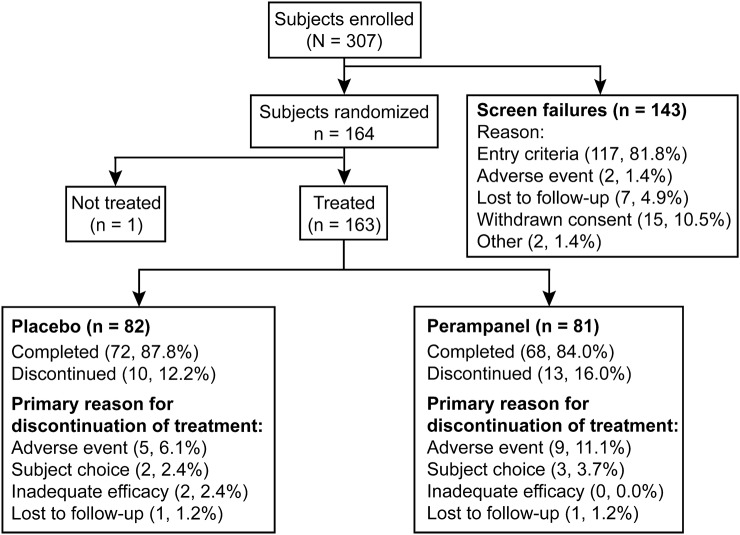
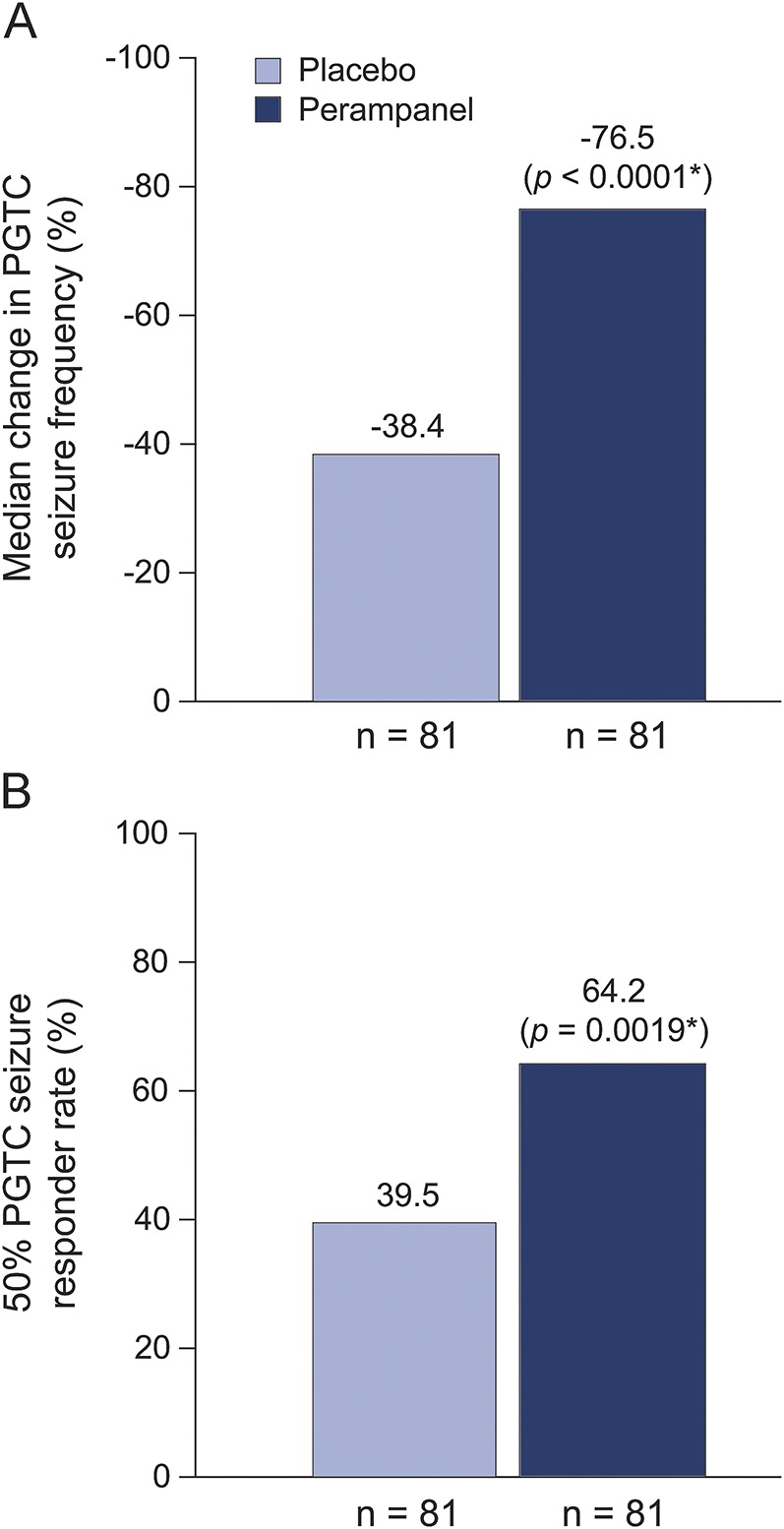
OBJECTIVE: To assess efficacy and safety of adjunctive perampanel in patients with drug-resistant, primary generalized tonic-clonic (PGTC) seizures in idiopathic generalized epilepsy (IGE). METHODS: In this multicenter, double-blind study (ClinicalTrials.gov identifier: NCT01393743; funded by Eisai Inc.), patients 12 years or older with PGTC seizures and IGE were randomized to placebo or perampanel during a 4-week titration period (perampanel up titrated from 2 to 8 mg/d, or highest tolerated dose) and 13-week maintenance period. The primary endpoint was percent change in PGTC seizure frequency per 28 days (titration plus maintenance vs baseline). The key secondary endpoint (primary endpoint for European Union registration) was 50% PGTC seizure responder rate (patients achieving $50% reduction in PGTC seizure frequency; maintenance vs baseline). Treatment-emergent adverse events were monitored. RESULTS: Of 164 randomized patients, 162 comprised the full analysis set (placebo, 81; perampanel, 81). Compared with placebo, perampanel conferred a greater median percent change in PGTC seizure frequency per 28 days (238.4%vs 276.5%; p , 0.0001) and greater 50%PGTC seizure responder rate (39.5% vs 64.2%; p 5 0.0019). During maintenance, 12.3% of placebo treated patients and 30.9%of perampanel-treated patients achieved PGTC seizure freedom. For the safety analysis (placebo, 82; perampanel, 81), the most frequent treatment-emergent adverse events with perampanel were dizziness (32.1%) and fatigue (14.8%). CONCLUSIONS: Adjunctive perampanel was well tolerated and improved control of drug-resistant PGTC seizures in patients with IGE. CLASSIFICATION OF EVIDENCE: This study provides Class I evidence that adjunctive perampanel reduces PGTC seizure frequency, compared with placebo, in patients with drug-resistant PGTC seizures in IGE.
Overview
The claims and statistics of this paper haven’t been checked yet.
Free: it reads the open-access text and checks the first 5 claims that cite a source we can check. Create a free account to check every claim.
Integrity signals
Registry
Cites
Statistics
Figures
Verification
Claims the paper makes
The claims and statistics of this paper haven’t been checked yet.
Free: it reads the open-access text and checks the first 5 claims that cite a source we can check. Create a free account to check every claim.
Claims other papers make about this one
Each is checked against this paper’s own text: does it say what the citing paper says it does?
The source backs part of the claim, not all of it — or backs it for a different population, condition or comparison.
In the citing paper
“In some studies, perampanel has been demonstrated to reduce seizure frequency by 76.5%.”
From State of the Art and Challenges in Epilepsy—A Narrative Review (2023) · cites this paper as [48]
Experimental — accuracy not yet measuredThe source backs part of the claim, not all of it — or backs it for a different population, condition or comparison.
In the citing paper
“Other antiepileptics such as Lamotrigine, Levetiracetam, and Topiramate have shown efficacy in first generalized tonic-clonic seizures not controlled by a first or additional monotherapy [48].”
From State of the Art and Challenges in Epilepsy—A Narrative Review (2023) · cites this paper as [48]
Experimental — accuracy not yet measuredThe source backs part of the claim, not all of it — or backs it for a different population, condition or comparison.
In the citing paper
“In cases with idiopathic generalized epilepsy, approximately 35% of them will require adjuvant therapy.”
From State of the Art and Challenges in Epilepsy—A Narrative Review (2023) · cites this paper as [48]
Experimental — accuracy not yet measured
Self-check
Percentages, sums and reported differences re-computed from the paper’s own numbers.
The self-check needs the paper’s full text.
Citations
Cites
Ryvlin, P., Nashef, L., Lhatoo, S. D., Bateman, L. M., Bird, J., Bleasel, A., Boon, P., Crespel, A., Dworetzky, B. A., Høgenhaven, H., et al. (2013) · The Lancet Neurology · doi:10.1016/s1474-4422(13)70214-x · Cited by 1,135
Combined analysis of risk factors for SUDEP: Combined SUDEP Analysis
Hesdorffer, D. C., Tomson, T., Benn, E., Sander, J. W., Nilsson, L., Langan, Y., Walczak, T. S., Beghi, E., Brodie, M. J., Hauser, A., et al. (2011) · Epilepsia · doi:10.1111/j.1528-1167.2010.02952.x · Cited by 501
Adjunctive perampanel for refractory partial-onset seizures: Randomized phase III study 304
French, J. A., Krauss, G. L., Biton, V., Squillacote, D., Yang, H., Laurenza, A., Kumar, D., Rogawski, M. A., Campanille, V., Floridia, J., et al. (2012) · Neurology · doi:10.1212/wnl.0b013e3182635735 · Cited by 479
Self-citationRandomized phase III study 306: Adjunctive perampanel for refractory partial-onset seizures
Krauss, G. L., Serratosa, J. M., Villanueva, V., Endziniene, M., Hong, Z., French, J., Yang, H., Squillacote, D., Edwards, H. B., Zhu, J., et al. (2012) · Neurology · doi:10.1212/wnl.0b013e318254473a · Cited by 431
Self-citationFrench, J. A., Krauss, G. L., Steinhoff, B. J., Squillacote, D., Yang, H., Kumar, D., & Laurenza, A. (2013) · Epilepsia · doi:10.1111/j.1528-1167.2012.03638.x · Cited by 423
Self-citationA randomized, placebo-controlled study of topiramate in primary generalized tonic-clonic seizures
Biton, V., Montouris, G. D., Ritter, F., Riviello, J. J., Reife, R., Lim, P., Pledger, G., & the Topiramate YTC Study Group (1999) · Neurology · doi:10.1212/wnl.52.7.1330 · Cited by 295 · cited 1×
“In a study of topiramate (n5 80), again, many patients were experiencing seizures not typically seen in IGE (tonic seizures [n5 19] or atypical absence seizures [n5 6]).(27) One important consideration for the treatment of seizures associated with IGE is the potential for improving control of PGTC seizures while exace…”
BackgroundSteinhoff, B. J., Ben‐Menachem, E., Ryvlin, P., Shorvon, S., Kramer, L., Satlin, A., Squillacote, D., Yang, H., Zhu, J., & Laurenza, A. (2013) · Epilepsia · doi:10.1111/epi.12212 · Cited by 268 · cited 1×
“in patients with drug-resistant, partial-onset seizures, across which the most frequent AEs were dizziness, fatigue, headache, irritability, and somnolence, as reported here.(9) Some AEs of special interest appeared more frequently with perampanel than placebo, including AEs relating to hostility/aggression, which is…”
ResultSelf-citationHesdorffer, D. C., Tomson, T., Benn, E., Sander, J. W., Nilsson, L., Langan, Y., Walczak, T. S., Beghi, E., Brodie, M. J., Hauser, W. A., et al. (2012) · Epilepsia · doi:10.1111/j.1528-1167.2011.03354.x · Cited by 261
Cited by
French, J. A., Lawson, J. A., Yapici, Z., Ikeda, H., Polster, T., Nabbout, R., Curatolo, P., de Vries, P. J., Dlugos, D. J., Berkowitz, N., et al. (2016) · The Lancet · doi:10.1016/s0140-6736(16)31419-2 · Cited by 764
Self-citationManford, M. (2017) · Journal of Neurology · doi:10.1007/s00415-017-8394-2 · Cited by 299
“Perampanel has been found to be effective as an add-on for refractory generalized epilepsy with tonic–clonic seizures [114].”
BackgroundEpilepsy, Antiepileptic Drugs, and Aggression: An Evidence-Based Review
Brodie, M. J., Besag, F., Ettinger, A. B., Mula, M., Gobbi, G., Comai, S., Aldenkamp, A. P., & Steinhoff, B. J. (2016) · Pharmacological Reviews · doi:10.1124/pr.115.012021 · Cited by 288
“…versus 4.9% with placebo; using just narrow SMQ terms (i.e., AEs very likely to be related to aggression or hostility), the rates were 2.5% with perampanel and 0% with placebo (French et al., 2015). d. Observational/Open-Label Studies with Aggression Data Extracted from Side-Effect Reporting.”
BackgroundInfluentialThe Pharmacoresistant Epilepsy: An Overview on Existent and New Emerging Therapies
Fattorusso, A., Matricardi, S., Mencaroni, E., Dell'Isola, G. B., Di Cara, G., Striano, P., & Verrotti, A. (2021) · Frontiers in Neurology · doi:10.3389/fneur.2021.674483 · Cited by 269
“The approved use of PER for primary generalized tonic-clonic (PGTC) seizures was based on a double-blind randomized placebo-controlled trial (study 332) that provides ILAE Class I evidence of reduced seizure frequency in refractory idiopathic generalized epilepsy (study 332) (85, 86).”
MethodIonotropic Glutamate Receptors in Epilepsy: A Review Focusing on AMPA and NMDA Receptors
Hanada, T. (2020) · Biomolecules · doi:10.3390/biom10030464 · Cited by 249
Drug development for refractory epilepsy: The past 25 years and beyond
Golyala, A., & Kwan, P. (2017) · Seizure · doi:10.1016/j.seizure.2016.11.022 · Cited by 188
Neuropharmacology of Antiseizure Drugs
Hakami, T. (2021) · Neuropsychopharmacology Reports · doi:10.1002/npr2.12196 · Cited by 172
An Updated Overview on Therapeutic Drug Monitoring of Recent Antiepileptic Drugs
Jacob, S., & Nair, A. B. (2016) · Drugs in R&D · doi:10.1007/s40268-016-0148-6 · Cited by 171
“Stiripentol (STP) has been granted orphan drug status by EMEA for PGTCS in 2001 and approved additionally for the treatment of severe myoclonic epilepsy in infancy (SMEI) or Dravet’s syndrome [15, 16].”
BackgroundThe Role of Glutamate Receptors in Epilepsy
Chen, T.-S., Huang, T.-H., Lai, M.-C., & Huang, C.-W. (2023) · Biomedicines · doi:10.3390/biomedicines11030783 · Cited by 168
Villanueva, V., Garcés, M., López‐González, F. J., Osorio, X. R., Toledo, M., Salas‐Puig, J., Cuevas, M. G., Campos, D., Serratosa, J. M., Giráldez, B. G., et al. (2016) · Epilepsy Research · doi:10.1016/j.eplepsyres.2016.08.001 · Cited by 133
Hansen, C. C., Ljung, H., Brodtkorb, E., & Reimers, A. (2018) · Behavioural Neurology · doi:10.1155/2018/2064027 · Cited by 124
“2015 [76] RCT, t = 32–54 weeks n = 162 patients (man age: 28.”
Steinhoff, B. J., Klein, P., Klitgaard, H., Laloyaux, C., Moseley, B. D., Ricchetti-Masterson, K., Rosenow, F., Sirven, J. I., Smith, B., Stern, J. M., et al. (2021) · Epilepsy & Behavior · doi:10.1016/j.yebeh.2021.107939 · Cited by 118
“Data from the phase 3, double-blind, controlled trials of PER reported BAEs associated with hostility/aggressive behavior (‘‘narrow-and-broad” standardized MedDRA queries [SMQ] terms) in 11.8% of patients with focal epilepsy and 18.5% of patients with primary generalized tonicclonic seizures (PGTCS) in idiopathic gene…”
BackgroundInfluentialPerampanel in routine clinical use in idiopathic generalized epilepsy: The 12‐month GENERAL study
Villanueva, V., Montoya, J., Castillo, A., Mauri-Llerda, J. Á., Giner, P., López‐González, F. J., Piera, A., Villanueva‐Hernández, P., Bertol, V., García-Escrivá, A., et al. (2018) · Epilepsia · doi:10.1111/epi.14522 · Cited by 118
“26–30 The phase III perampanel trial in IGE included few patients with myoclonic or absence seizures, so the effect of perampanel on these seizure types could not be determined.(14) The aim of our study was to collect data to analyze the tolerability and effectiveness of perampanel across different seizure types in a…”
BackgroundInfluentialGlutamatergic Mechanisms in Glioblastoma and Tumor-Associated Epilepsy
Lange, F., Hörnschemeyer, M. F., & Kirschstein, T. (2021) · Cells · doi:10.3390/cells10051226 · Cited by 109
“Since the non-competitive AMPAR antagonist, perampanel (PER), has been developed to treat patients with partial and generalized seizures [69,70], this compound has attracted much interest in treating glioma-associated seizures due to the hypothesis that glutamate released from glioma cells could not only activate surr…”
BackgroundPerampanel: Does it have broad‐spectrum potential?
Potschka, H., & Trinka, E. (2018) · Epilepsia · doi:10.1111/epi.14456 · Cited by 92
“More recently, perampanel was approved for PGTC seizures based on ILAE class I evidence of reduced seizure frequency compared with placebo in patients with refractory PGTC seizures in idiopathic generalized epilepsy (study 332).(62) In this study, the diagnosis was independently confirmed by reviewers from the Epileps…”
BackgroundMethodSelf-citationPerampanel in routine clinical use across Europe: Pooled, multicenter, observational data
Rohracher, A., Zimmermann, G., Villanueva, V., Garamendi, Í., Sander, J. W. A. S., Wehner, T., Shankar, R., Ben‐Menachem, E., Brodie, M. J., Pensel, M. C., et al. (2018) · Epilepsia · doi:10.1111/epi.14520 · Cited by 90
“Perampanel is approved for add‐on treatment of people aged ≥12 years with refractory focal seizures(5) and with primary generalized tonic–clonic seizures in idiopathic generalized epilepsy.(6) To assess the effectiveness of perampanel, many centers have collected and published data from clinical records of people pres…”
Self-citationVossler, D. G., Knake, S., O'Brien, T. J., Watanabe, M., Brock, M. A., Steiniger‐Brach, B., Williams, P., & Roebling, R. (2020) · Journal of Neurology Neurosurgery & Psychiatry · doi:10.1136/jnnp-2020-323524 · Cited by 85
“Median percent reduction in PGTCS frequency (−77.92% 22 The placebo responses seen in this trial were relatively high (median percent reduction in PGTCS frequency: −43.24%; 50% responder rate: 46.3%; observed seizure freedom rate: 13.2%).”
BackgroundInfluentialSelf-citationEfficacy and tolerability of perampanel in ten patients with Lafora disease
Goldsmith, D., & Minassian, B. A. (2016) · Epilepsy & Behavior · doi:10.1016/j.yebeh.2016.06.041 · Cited by 78
Challenges in the clinical development of new antiepileptic drugs
Franco, V., French, J. A., & Perucca, E. (2015) · Pharmacological Research · doi:10.1016/j.phrs.2015.11.007 · Cited by 82
Self-citationPerampanel, an AMPA receptor antagonist: From clinical research to practice in clinical settings
Tsai, J.-J., Wu, T., Leung, H., Desudchit, T., Tiamkao, S., Lim, K. S., & Dash, A. (2017) · Acta Neurologica Scandinavica · doi:10.1111/ane.12879 · Cited by 74
Efficacy and tolerability of antiseizure drugs
Hakami, T. M. (2021) · Therapeutic Advances in Neurological Disorders · doi:10.1177/17562864211037430 · Cited by 74
Perampanel in 12 patients with Unverricht‐Lundborg disease
Crespel, A., Gélisse, P., Tang, N. P. L., & Genton, P. (2017) · Epilepsia · doi:10.1111/epi.13662 · Cited by 70
“Recommended pharmacologic options include valproate (VPA), piracetam (PIR) usually at high doses, levetiracetam (LEV), topiramate, zonisamide, and clonazepam (CNZ),5 whereas the effect of brivaracetam has been inconclusive.6 Other antiepileptic drugs (AEDs) may have aggravating effects, for example, phenytoin7 or lamo…”
BackgroundVillanueva, V., D'Souza, W. J., Goji, H., Kim, D. W., Liguori, C., McMurray, R., Najm, I., Santamarina, E., Steinhoff, B. J., Vlasov, P. N., et al. (2021) · Journal of Neurology · doi:10.1007/s00415-021-10751-y · Cited by 71
Self-citationGenetic generalized epilepsies in adults — challenging assumptions and dogmas
Vorderwülbecke, B. J., Wandschneider, B., Weber, Y. G., & Holtkamp, M. (2021) · Nature Reviews Neurology · doi:10.1038/s41582-021-00583-9 · Cited by 75
Lin, K., Lin, J., Chou, M.-L., Hung, P., Hsieh, M.-Y., Chou, I., Lim, S., Wu, T., & Wang, H.-S. (2018) · Epilepsy & Behavior · doi:10.1016/j.yebeh.2018.06.033 · Cited by 70
“Perampanel has been widely licensed and approved for adjunctive treatment of focal seizures, with or without secondarily generalized seizures, and for primary generalized tonic– clonic seizures in patients with epilepsy aged ≥12 years [20, 21].”
AMPA receptors and perampanel behind selected epilepsies: current evidence and future perspectives
Bonaventura, C. D., Labate, A., Maschio, M. C. E., Meletti, S., & Russo, E. (2017) · Expert Opinion on Pharmacotherapy · doi:10.1080/14656566.2017.1392509 · Cited by 70
Regulation of AMPA Receptor Trafficking by Protein Ubiquitination
Widagdo, J., Guntupalli, S., Jang, S. E., & Anggono, V. (2017) · Frontiers in Molecular Neuroscience · doi:10.3389/fnmol.2017.00347 · Cited by 68
“Indeed, a highly potent non-competitive AMPAR antagonist, perampanel, has been used clinically to treat patients with partial-onset and tonic-clonic seizures (French et al., 2012, 2015).”
BackgroundGil‐Nagel, A., Бурд, С. Г., Toledo, M., Sander, J. W. A. S., Лебедева, А. В., Patten, A. R., & Laurenza, A. (2017) · Seizure · doi:10.1016/j.seizure.2017.10.015 · Cited by 65
Self-citationTreatment and care of women with epilepsy before, during, and after pregnancy: a practical guide
Nucera, B., Brigo, F., Trinka, E., & Kalss, G. (2022) · Therapeutic Advances in Neurological Disorders · doi:10.1177/17562864221101687 · Cited by 71
Self-citationAbou-Khalil, B. W. (2016) · CONTINUUM Lifelong Learning in Neurology · doi:10.1212/con.0000000000000289 · Cited by 82
Role of cerebral glutamate in post-stroke epileptogenesis
Nicolo, J., O'Brien, T. J., & Kwan, P. (2019) · NeuroImage Clinical · doi:10.1016/j.nicl.2019.102069 · Cited by 63
Self-citationFogarasi, A., Flamini, R. J., Milh, M., Phillips, S. E., Yoshitomi, S., Patten, A. R., Takase, T., Laurenza, A., & Ngo, L. Y. (2020) · Epilepsia · doi:10.1111/epi.16413 · Cited by 62
“3 7 (15) 1 (8) 0 (0) 3 (27) 4 (11) 7 (15) NA 7 (14)”
InfluentialSelf-citationPerampanel in the treatment of focal and idiopathic generalized epilepsies and of status epilepticus
Strzelczyk, A., Willems, L. M., Willig, S., Rosenow, F., & Bauer, S. (2015) · Expert Review of Clinical Pharmacology · doi:10.1586/17512433.2015.1091303 · Cited by 61
“However, other AEDs, such as felbamate, lamotrigine, phenobarbital, topiramate and zonisamide, have also partial effects on glutamate receptors [6].”
BackgroundMethodInfluentialSuicidality Risk of Newer Antiseizure Medications: A Meta-analysis
Klein, P., Devinsky, O., French, J. A., Harden, C. L., Krauss, G. L., McCarter, R., & Sperling, M. R. (2021) · JAMA Neurology · doi:10.1001/jamaneurol.2021.2480 · Cited by 64
Self-citationAntiepileptic drugs in development pipeline: A recent update
Kaur, H., Kumar, B., & Medhi, B. (2016) · eNeurologicalSci · doi:10.1016/j.ensci.2016.06.003 · Cited by 64
State of the Art and Challenges in Epilepsy—A Narrative Review
Manole, A., Sirbu, C., Mititelu, M., Vasiliu, O., Lorusso, L., Sirbu, O., & Ionita Radu, F. (2023) · Journal of Personalized Medicine · doi:10.3390/jpm13040623 · Cited by 93
“Other antiepileptics such as Lamotrigine, Levetiracetam, and Topiramate have shown efficacy in first generalized tonic–clonic seizures not controlled by a first or additional monotherapy [48].”
BackgroundChallenges in the Clinical Development of New Antiepileptic Drugs
Schwabe, S. (2002) · Therapeutic Drug Monitoring · doi:10.1097/00007691-200202000-00014 · Cited by 53
The Pharmacology and Toxicology of Third-Generation Anticonvulsant Drugs
LaPenna, P., & Tormoehlen, L. M. (2017) · Journal of Medical Toxicology · doi:10.1007/s13181-017-0626-4 · Cited by 57
Sleep-disordered breathing in epilepsy: epidemiology, mechanisms, and treatment
Sivathamboo, S., Perucca, P., Velakoulis, D., Jones, N. C., Goldin, J., Kwan, P., & O'Brien, T. J. (2018) · SLEEP · doi:10.1093/sleep/zsy015 · Cited by 56
Self-citationEfficacy and tolerability of perampanel as a first add-on therapy with different anti-seizure drugs
Santamarina, E., Bertol, V., Garayoa, V., García-Gómara, M. J., Garamendi, Í., Giner, P., Aranzábal, I., Piera, A., Arcos, C., Esteve, P., et al. (2020) · Seizure · doi:10.1016/j.seizure.2020.09.026 · Cited by 52
Use of perampanel in children and adolescents with Lennox–Gastaut Syndrome
Auvin, S., Dozières‐Puyravel, B., Iléa, A., & Delanöe, C. (2017) · Epilepsy & Behavior · doi:10.1016/j.yebeh.2017.05.036 · Cited by 51
“The effectiveness of perampanel in these settings has been established in a series of phase III trials, [6,7] supported by open and real-world studies [8–12].”
Is seizure frequency variance a predictable quantity?
Goldenholz, D. M., Goldenholz, S. R., Moss, R., French, J. A., Lowenstein, D. H., Kuzniecky, R., Haut, S. R., Cristofaro, S., Detyniecki, K., Hixson, J., et al. (2018) · Annals of Clinical and Translational Neurology · doi:10.1002/acn3.519 · Cited by 51
“Clinical trials in epilepsy have suffered from steadily rising placebo response rates over the past several decades(1) typically ranging 4–27%(2) but recently reaching as high as 40%.(3) This can translate into unsuccessful trials, and subsequent increasing trial development costs.”
BackgroundSelf-citationZhang, H., & Bramham, C. R. (2020) · Frontiers in Synaptic Neuroscience · doi:10.3389/fnsyn.2020.00026 · Cited by 52
Levinthal, D. J. (2016) · Clinical and Translational Gastroenterology · doi:10.1038/ctg.2016.55 · Cited by 51
Willems, L. M., Bertsche, A., Bösebeck, F., Hornemann, F., Immisch, I., Klein, K. M., Knake, S., Kunz, R., Kurlemann, G., Langenbruch, L. M., et al. (2018) · Frontiers in Neurology · doi:10.3389/fneur.2018.00569 · Cited by 51
Pharmacological Treatment of Drug-Resistant Epilepsy in Adults: a Practical Guide
Brodie, M. J. (2016) · Current Neurology and Neuroscience Reports · doi:10.1007/s11910-016-0678-x · Cited by 52
Perampanel (Fycompa): A Review of Clinical Efficacy and Safety in Epilepsy.
Greenwood, J., & Valdes, J. (2016) · PubMed · Cited by 49
Operto, F. F., Pastorino, G. M. G., Mazza, R., Bonaventura, C. D., Matricardi, S., Verrottı, A., Carotenuto, M., Viggiano, A., Coppola, G., & Elia, M. (2020) · Epilepsy & Behavior · doi:10.1016/j.yebeh.2019.106879 · Cited by 47
Targeting Ionotropic Glutamate Receptors in the Treatment of Epilepsy
Celli, R., & Fornai, F. (2020) · Current Neuropharmacology · doi:10.2174/1570159x18666200831154658 · Cited by 51
“Perampanel 2-(2-oxo-1-phenyl-5-pyridin-2-yl-1,2-dihydropyridin-3-yl)benzonitrile, a potent, selective, and orally-active AMPA receptor NAM, has been approved by FDA and EMA for the treatment of focal epilepsy and generalized tonic-clonic epilepsy [102-106].”
BackgroundKwok, C. S., Johnson, E. L., & Krauss, G. L. (2017) · CNS Drugs · doi:10.1007/s40263-017-0480-6 · Cited by 46
“It was also effective and approved for treating primary generalized epilepsy with tonic–clonic seizures [28].”
BackgroundSelf-citationPractice Update: Review of Anticonvulsant Therapy
Chong, D. J., & Lerman, A. M. (2016) · Current Neurology and Neuroscience Reports · doi:10.1007/s11910-016-0640-y · Cited by 49
Stimulus-induced Epileptic Spike-Wave Discharges in Thalamocortical Model with Disinhibition
Fan, D., Liu, S., & Wang, Q. (2016) · Scientific Reports · doi:10.1038/srep37703 · Cited by 44
Toledano, R., García‐Morales, I., Parejo‐Carbonell, B., Jiménez‐Huete, A., Herrera‐Ramirez, D., Hernández, A. N. G., Loro, F. A., Santamarina, E., Toledo, M., de Luna, J. O. R., et al. (2020) · Epilepsia · doi:10.1111/epi.16548 · Cited by 43
“Maintenance dose, mg, median (IQR) 4 (4-6) 6 (4-6) 4 (4-4)”
Renfroe, J. B., Mintz, M., Davis, R. L., Ferreira, J. A., Dispoto, S., Ferry, J., Umetsu, Y., Rege, B., Majid, O., Hussein, Z., et al. (2019) · Journal of Child Neurology · doi:10.1177/0883073819827407 · Cited by 43
Self-citationTrinka, E., Lattanzi, S., Carpenter, K., Corradetti, T., Nucera, B., Rinaldi, F., Shankar, R., & Brigo, F. (2021) · CNS Drugs · doi:10.1007/s40263-021-00831-y · Cited by 43
Self-citationEfficacy and tolerability of perampanel in pediatric patients with Dravet syndrome
Yoshitomi, S., Takahashi, Y., Yamaguchi, T., Imai, K., Ishii, A., Hirose, S., & Inoue, Y. (2019) · Epilepsy Research · doi:10.1016/j.eplepsyres.2019.02.014 · Cited by 41
Temporal lobe epilepsy: A never-ending story
Abarrategui, B., Mai, R., Sartori, I., Francione, S., Pelliccia, V., Cossu, M., & Tassi, L. (2021) · Epilepsy & Behavior · doi:10.1016/j.yebeh.2021.108122 · Cited by 41
Perversi, F., Costa, C., Labate, A., Lattanzi, S., Liguori, C., Maschio, M. C. E., Meletti, S., Nobili, L., Operto, F. F., Romigi, A., et al. (2023) · Frontiers in Neurology · doi:10.3389/fneur.2023.1182304 · Cited by 40
“The magnitude of reduction in the frequency of myoclonic seizures was not higher than placebo, and the greater reduction in absence seizures in the PER group compared with placebo was not statistically significant (26, 27).”
BackgroundResultInfluentialMohammad, H., Sekar, S., Wei, Z., Moien‐Afshari, F., & Taghibiglou, C. (2018) · Molecular Neurobiology · doi:10.1007/s12035-018-1230-6 · Cited by 40
Deficiency of AMPAR–Palmitoylation Aggravates Seizure Susceptibility
Itoh, M., Yamashita, M., Kaneko, M., Okuno, H., Abe, M., Yamazaki, M., Natsume, R., Yamada, D., Kaizuka, T., Suwa, R., et al. (2018) · Journal of Neuroscience · doi:10.1523/jneurosci.1590-18.2018 · Cited by 40
“Perampanel (Fycompa), the only approved AMPAR antagonist for epilepsy, is clinically applied to treat patients with partial or generalized tonic-clonic seizures (Hibi et al., 2012; French et al., 2015; Kato et al., 2016; Faulkner, 2017).”
BackgroundPina-Garza, J. E., Rosenfeld, W. E., Saeki, K., Villanueva, V., Yoshinaga, H., Patten, A. R., Williams, B., & Malhotra, M. (2020) · Epilepsy & Behavior · doi:10.1016/j.yebeh.2019.106876 · Cited by 39
“Adjunctive perampanel has previously demonstrated efficacy and safety in a number of Phase II and Phase III, randomized double-blind, placebo-controlled trials in adolescent and adult patients with uncontrolled partial-onset seizures, with or without secondarily generalized (SG) seizures [20–24], or idiopathic general…”
BackgroundSelf-citationPost‐translational palmitoylation of ionotropic glutamate receptors in excitatory synaptic functions
Hayashi, T. (2020) · British Journal of Pharmacology · doi:10.1111/bph.15050 · Cited by 41
“Perampanel (Fycompa), the only approved AMPA receptor antagonist for epilepsy, is clinically applied to treat patients with partial or gener- alized tonic–clonic seizures (Faulkner, 2017; French et al., 2015; Hibi et al., 2012; Kato et al., 2016).”
BackgroundAntiepileptic Drug Selection According to Seizure Type in Adult Patients with Epilepsy
Kim, H., Kim, D. W., Lee, S., Byun, J., Seo, J.-G., No, Y. J., Kang, K. W., Kim, D., Kim, K. T., Cho, Y. W., et al. (2020) · Journal of Clinical Neurology · doi:10.3988/jcn.2020.16.4.547 · Cited by 42
Carreño, M., & Fernández, S. (2016) · Current Treatment Options in Neurology · doi:10.1007/s11940-016-0402-9 · Cited by 44
Prospective audit with adjunctive perampanel: Preliminary observations in focal epilepsy
Brodie, M. J., & Stephen, L. J. (2015) · Epilepsy & Behavior · doi:10.1016/j.yebeh.2015.11.002 · Cited by 38
“More recently, given positive results in a phase III study, its license has been extended for use as add-on therapy for primary generalized tonic–clonic seizures [5].”
InfluentialSwiderska, N., Tan, H. J., Rajai, A., Silwal, A., Desurkar, A., & Martland, T. (2017) · Seizure · doi:10.1016/j.seizure.2017.08.014 · Cited by 40
Toledo, M., Mostacci, B., Bosak, M., Jędrzejczak, J., Thomas, R. H., Salas‐Puig, J., Biraben, A., & Schmitz, B. (2020) · Journal of Neurology · doi:10.1007/s00415-020-09809-0 · Cited by 38
The effect of Perampanel on EEG spectral power and connectivity in patients with focal epilepsy
Lanzone, J., Ricci, L., Tombini, M., Boscarino, M., Mecarelli, O., Pulitano, P., Lazzaro, V. D., & Assenza, G. (2021) · Clinical Neurophysiology · doi:10.1016/j.clinph.2021.05.026 · Cited by 38
Tolerability and efficacy of perampanel in children with refractory epilepsy
Heyman, E., Lahat, E., Levin, N., Epstein, O., Lazinger, M., Berkovitch, M., & Gandelman‐Marton, R. (2016) · Developmental Medicine & Child Neurology · doi:10.1111/dmcn.13362 · Cited by 37
Add-on perampanel in Lance–Adams syndrome
Steinhoff, B. J., Bacher, M., Kurth, C., Staack, A. M., & Kornmeier, R. (2016) · Epilepsy & Behavior Case Reports · doi:10.1016/j.ebcr.2016.05.001 · Cited by 36
“In addition, PER was approved for the treatment of patients with primary generalized tonic – clonic seizures because superiority over placebo was shown in a randomized controlled trial [7].”
Wechsler, R. T., Yates, S. L., Messenheimer, J. A., Leroy, R. F., Beller, C., & Doty, P. (2016) · Epilepsy Research · doi:10.1016/j.eplepsyres.2016.12.015 · Cited by 36
“…levetiracetam, topiramate and perampanel are currently approved for the treatment of seizures associated with PGE in the United States or European Union (Brown, 2016; French et al., 2015; Glauser et al., 2013), with some evidence also supporting the use of zonisamide (Rheims and Ryvlin, 2014).”
BackgroundSelf-citationKetogenic Diet Therapies for Seizures and Status Epilepticus
McDonald, T. J. W., & Cervenka, M. C. (2020) · Seminars in Neurology · doi:10.1055/s-0040-1719077 · Cited by 36
New anti-seizure medication for elderly epilepsy patients - a critical narrative review
Rohracher, A., Kalss, G., Kuchukhidze, G., Neuray, C., Leitinger, M., Höfler, J., Kreidenhuber, R., Rossini, F., Volna, K., Mauritz, M., et al. (2020) · Expert Opinion on Pharmacotherapy · doi:10.1080/14656566.2020.1843636 · Cited by 37
Self-citationPerampanel monotherapy for the treatment of epilepsy: Clinical trial and real-world evidence
Yamamoto, T., Gil‐Nagel, A., Wheless, J. W., Kim, J. H., & Wechsler, R. T. (2022) · Epilepsy & Behavior · doi:10.1016/j.yebeh.2022.108885 · Cited by 37
“In another study of patients with newly diagnosed FOS or GTCS, 73.0% and 72.8% of patients were seizure free for 6 months at the last evaluated dose with levetiracetam or carbamazepine, respectively [25].”
MethodInfluentialSelf-citationAssenza, G., Nocerino, C., Tombini, M., Gennaro, G. D., D’Aniello, A., Verrotti, A., Marrelli, A., Ricci, L., Lanzone, J., Lazzaro, V. D., et al. (2021) · Frontiers in Neurology · doi:10.3389/fneur.2021.630366 · Cited by 35
“Perampanel is efficacious in genetic generalized epilepsies (4), thus suggesting its role in inhibiting cortico-subcortical synchronization pathways favoring a diffuse increase in cortical excitability.”
BackgroundLavu, A., Aboulatta, L., Abou-Setta, A. M., Aloud, B. M., Askin, N., Rabbani, R., Shouman, W., Zarychanski, R., & Eltonsy, S. (2022) · Seizure · doi:10.1016/j.seizure.2022.09.020 · Cited by 35
Dynamics of AMPA receptors regulate epileptogenesis in patients with epilepsy
Eiro, T., Miyazaki, T., Hatano, M., Nakajima, W., Arisawa, T., Takada, Y., Kimura, K., Sano, A., Nakano, K., Mihara, T., et al. (2023) · Cell Reports Medicine · doi:10.1016/j.xcrm.2023.101020 · Cited by 39
“Furthermore, perampanel, a selective non-competitive antagonist of AMPARs, decreased seizure frequency.(32,33) However, the dynamics of AMPARs in living patients with epilepsy have not been elucidated due to the lack of technology to visualize and quantify the density of AMPARs in the living human brain.”
BackgroundImpact of Antiseizure Medications on Appetite and Weight in Children
Buraniqi, E., Dabaja, H., & Wirrell, E. C. (2022) · Pediatric Drugs · doi:10.1007/s40272-022-00505-2 · Cited by 35
Modern management of juvenile myoclonic epilepsy
Brodie, M. J. (2016) · Expert Review of Neurotherapeutics · doi:10.1080/14737175.2016.1179113 · Cited by 34
Irelli, E. C., Cocchi, E., Morano, A., Gesche, J., Caraballo, R. H., Lattanzi, S., Strigaro, G., Catania, C., Ferlazzo, E., Pascarella, A., et al. (2023) · JAMA Neurology · doi:10.1001/jamaneurol.2023.3400 · Cited by 33
Chung, S. S., Williams, B., Dobrinsky, C., Patten, A. R., Yang, H., & Laurenza, A. (2017) · Epilepsy & Behavior · doi:10.1016/j.yebeh.2017.06.038 · Cited by 33
“At the completion of the Titration Period, patients entered the 13-week Maintenance Period on the last dose level achieved at the end of the Titration Period and continued taking this dose once daily for the duration of the Maintenance Period unless adjustments were deemed necessary by the investigator [4].”
BackgroundMethodResultInfluentialSelf-citationRecent progress of 1,3,4‐oxadiazoles as anticonvulsants: Future horizons
Nazar, S., Siddiqui, N., & Alam, O. (2020) · Archiv der Pharmazie · doi:10.1002/ardp.201900342 · Cited by 33
Current role of perampanel in pediatric epilepsy
Liso, P. D., Moavero, R., Coppola, G., Curatolo, P., Cusmai, R., Sarro, G. D., Franzonı, E., Vigevano, F., & Verrotti, A. (2017) · The Italian Journal of Pediatrics/Italian journal of pediatrics · doi:10.1186/s13052-017-0368-6 · Cited by 32
“There is only one multicenter, randomized, double-blind, placebo-controlled study performed to evaluate the efficacy and tolerability of perampanel in patients aged 12 years and older with primary generalized tonic clonic seizures in idiopathic generalized epilepsies [21].”
BackgroundThe neuroprotective effect of perampanel in lithium-pilocarpine rat seizure model
Wu, T., Ido, K., Osada, Y., Kotani, S., Tamaoka, A., & Hanada, T. (2017) · Epilepsy Research · doi:10.1016/j.eplepsyres.2017.06.002 · Cited by 31
“That may explain why PER confers greater seizure control in patients with secondary generalization and primary generalized tonicclonic seizure in clinical use (Steinhoff et al., 2013; French et al., 2015).”
ZDHHC8 critically regulates seizure susceptibility in epilepsy
Yang, Q. Z., Zheng, F., Hu, Y., Yang, Y., Li, Y., Chen, G., Wang, W., He, M., Zhou, R., Ma, Y., et al. (2018) · Cell Death and Disease · doi:10.1038/s41419-018-0842-0 · Cited by 31
Self-citationNiespodziany, I., Rigo, J., Moonen, G., Matagne, A., Klitgaard, H., & Wolff, C. (2017) · Epilepsia · doi:10.1111/epi.13890 · Cited by 30
“in epilepsy patients.(13) This supports the hypothesis that the behavioral adverse effects, observed in a subgroup of patients exposed to LEV,(14) may at least partly derive from its inhibition of AMPA receptors.”
ResultFirst add‐on perampanel for focal‐onset seizures: An open‐label, prospective study
Kim, J. H., Kim, D. W., Lee, S. K., Seo, D. W., Lee, J. W., Park, H. J., & Lee, S. (2019) · Acta Neurologica Scandinavica · doi:10.1111/ane.13197 · Cited by 30
Proposal for an updated seizure classification framework in clinical trials
Steriade, C., Sperling, M. R., DiVentura, B. D., Lozano, M., Shellhaas, R. A., Kessler, S. K., Dlugos, D., & French, J. A. (2022) · Epilepsia · doi:10.1111/epi.17120 · Cited by 30
Self-citationEmerging Antiepileptic Drugs for Severe Pediatric Epilepsies
Mudigoudar, B. D., Weatherspoon, S. E., & Wheless, J. W. (2016) · Seminars in Pediatric Neurology · doi:10.1016/j.spen.2016.06.003 · Cited by 31
Retrospective study of perampanel efficacy and tolerability in myoclonic seizures
Gil-López, F., Montoya, J., Falip, M., Aparicio, J., López‐González, F. J., Toledano, R., Gil‐Nagel, A., Molins, A., García, I., Serrano-Castro, P. J., et al. (2018) · Acta Neurologica Scandinavica · doi:10.1111/ane.12931 · Cited by 29
Shorvon, S. D., Bermejo, P. E., Gibbs, A. A., Huberfeld, G., & Kälviäinen, R. K. (2018) · Epilepsy & Behavior · doi:10.1016/j.yebeh.2018.01.039 · Cited by 29
Morano, A., Fattouch, J., Albini, M., Casciato, S., Fanella, M., Basili, L. M., Viganò, A., Manfredi, M., Giallonardo, A. T., & Bonaventura, C. D. (2018) · Journal of the Neurological Sciences · doi:10.1016/j.jns.2018.04.017 · Cited by 28
Willems, L. M., Bauer, S., Rosenow, F., & Strzelczyk, A. (2019) · Expert Opinion on Pharmacotherapy · doi:10.1080/14656566.2019.1637420 · Cited by 28
Patterns and prognostic markers for treatment response in generalized epilepsies
Gesche, J., Hjalgrim, H., Rubboli, G., & Beier, C. P. (2020) · Neurology · doi:10.1212/wnl.0000000000010644 · Cited by 28
Does accounting for seizure frequency variability increase clinical trial power?
Goldenholz, D. M., Goldenholz, S. R., Moss, R., French, J. A., Lowenstein, D. H., Kuzniecky, R., Haut, S. R., Cristofaro, S., Detyniecki, K., Hixson, J., et al. (2017) · Epilepsy Research · doi:10.1016/j.eplepsyres.2017.07.013 · Cited by 28
Self-citationIntractable Generalized Epilepsy: Therapeutic Approaches
Hwang, S., Stevens, S. J., Fu, A. X., & Proteasa, S. V. (2019) · Current Neurology and Neuroscience Reports · doi:10.1007/s11910-019-0933-z · Cited by 28
Wu, T., Ido, K., Ohgoh, M., & Hanada, T. (2019) · Epilepsy Research · doi:10.1016/j.eplepsyres.2019.03.011 · Cited by 29
de Biase, S., Gigli, G. L., Nilo, A., Romano, G., & Valente, M. (2018) · Expert Opinion on Drug Metabolism & Toxicology · doi:10.1080/17425255.2019.1560420 · Cited by 27
The role of the TNFα-mediated astrocyte signaling pathway in epilepsy
Chen, R., Xue, G., & Hölscher, C. (2021) · Acta Epileptologica · doi:10.1186/s42494-021-00059-9 · Cited by 32
“Perampanel is used for partial-onset and tonic-clonic seizures [46, 47].”
BackgroundGoji, H., & Kanemoto, K. (2019) · Seizure · doi:10.1016/j.seizure.2019.02.009 · Cited by 28
Metadata
- Authors
- French, J. A., Krauss, G. L., Wechsler, R. T., Wang, X.-F., DiVentura, B., Brandt, C., Trinka, E., O'Brien, T. J., Laurenza, A., Patten, A., & Bibbiani, F.
- Affiliations
- The Royal Melbourne Hospital (AU)
- From NYU Comprehensive Epilepsy Center (J.A.F.), New York, NY; Johns Hopkins Hospital (G.L.K.), Baltimore, MD; Idaho Comprehensive Epilepsy Center (R.T.W.), Boise, ID; The First Affiliated Hospital of Chongqing Medical University (X.-F.W.), China; The Epilepsy Study Consortium (B.D.), Herndon, VA; Bethel Epilepsy Center (C.B.), Bielefeld, Germany; Department of Neurology (E.T.), CDK, Paracelsus Medical University and Centre for Cognitive Neuroscience, Salzburg, Austria; Departments of Medicine and...
- Corresponding author
- French, Jacqueline A.
- ORCID
- Venue
- Neurology
- Published
- 2015-09-15
- Volume
- 85
- Issue
- 11
- Pages
- 950-957
- ISSN
- 0028-3878 (ISSN-L)
- 1526-632X
- PMC
- PMC4567458
- OpenAlex
- W1862220344
- Semantic Scholar
- 73f2df58b14c84ccb09e37a5670e4a3e9099a59c
- Cited by
- 329
- References
- 32
- Citations by year
- 2026: 10 · 2025: 26 · 2024: 20 · 2023: 26 · 2022: 39 · 2021: 39 · 2020: 43 · 2019: 23 · 2018: 25 · 2017: 34 · 2016: 37 · 2015: 6
- FWCI
- 27.57
- Type
- journal article
- Language
- en
- Open access
- hybrid
- doi.org
- Licence
- cc-by-nc-nd
- Locations
- Neurology (publishedVersion, cc-by-nc-nd)
- Europe PMC (PubMed Central) (publishedVersion, cc-by-nc-nd)
- PubMed Central (publishedVersion, cc-by-nc-nd)
- PubMed (publishedVersion)
- Minerva Access (University of Melbourne) (submittedVersion, cc-by-nc-nd)
- Funders
- American Epilepsy Society
- Pfizer
- GlaxoSmithKline
- Sanofi
- Biogen
- Sunovion
- Ultragenyx Pharmaceutical
- GW Pharmaceuticals
- Acorda Therapeutics
- Supernus Pharmaceuticals
- SK Life Science
- Upsher-Smith
- European Commission
- Austrian Science Fund
- Eisai
- Bundesministerium für Wissenschaft und Forschung
- EVER Neuro Pharma
- H. Lundbeck A/S
- Epilepsiatutkimussäätiö
- Epilepsy Society
- National Institutes of Health
- UCB Pharma
- Cilag
- Topics
- Health Sciences › Medicine › Clinical Neurology › Epilepsy research and treatment
- Health Sciences › Medicine › Pediatrics, Perinatology and Child Health › Pharmacological Effects and Toxicity Studies
- Health Sciences › Medicine › Physiology (medical) › Diet and metabolism studies
- Keywords
- perampanel, idiopathic generalized epilepsy, primary generalized tonic-clonic seizures, drug-resistant epilepsy, adjunctive antiepileptic therapy, seizure frequency, seizure freedom, adverse events, dizziness, fatigue
- MeSH terms
- Adolescent, Adult, Aged, Aged, 80 and over, Anticonvulsants, Child, Dose-Response Relationship, Drug, Double-Blind Method, Drug Therapy, Combination, Epilepsy, Generalized, Female, Humans, Male, Middle Aged, Nitriles, Pyridones, Seizures, Treatment Outcome, Young Adult
About these checks
Registry, retraction, Cites and statistics results are computed, not judged, with one exception: a printed reference that no index lists is read once by a model before it counts as a citation error. Claims are extracted by a model and kept only when their quote appears verbatim in the text; each cited source is then checked, with a model’s help, for whether it says what the claim relies on. Those verdicts can be wrong — read the claim’s quote and the cited source before relying on one.
Statistics and arithmetic are recomputed, not judged.
Confidence bands are shown only for fields calibrated on our annotated test set. None is calibrated yet, so no band is shown.
What counts as a claim ›How we measure confidence ›How we check this ›
Are you an author, or do you see a problem with this page? Request a review
Data sources
Bibliographic data: Semantic Scholar, OpenAlex, Crossref.
Contains information from the Semantic Scholar Academic Graph Datasets, made available under the ODC Attribution License (ODC-BY 1.0).
Semantic Scholar’s data is described in: Kinney, R., et al. (2023). The Semantic Scholar Open Data Platform. arXiv:2301.10140.
