

Perampanel for tonic-clonic seizures in idiopathic generalized epilepsy: A randomized trial
Open accessThe DOI matches its Crossref record; 31 of the 32 references it cites were found in a registry or an index.
Abstract
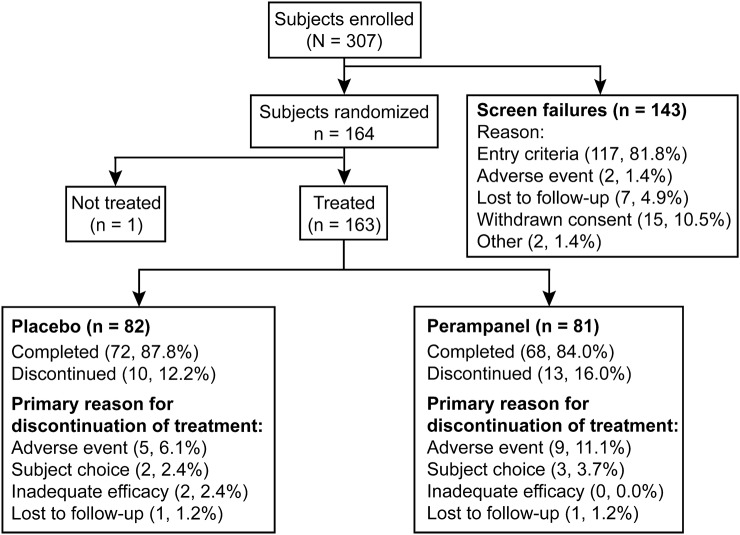
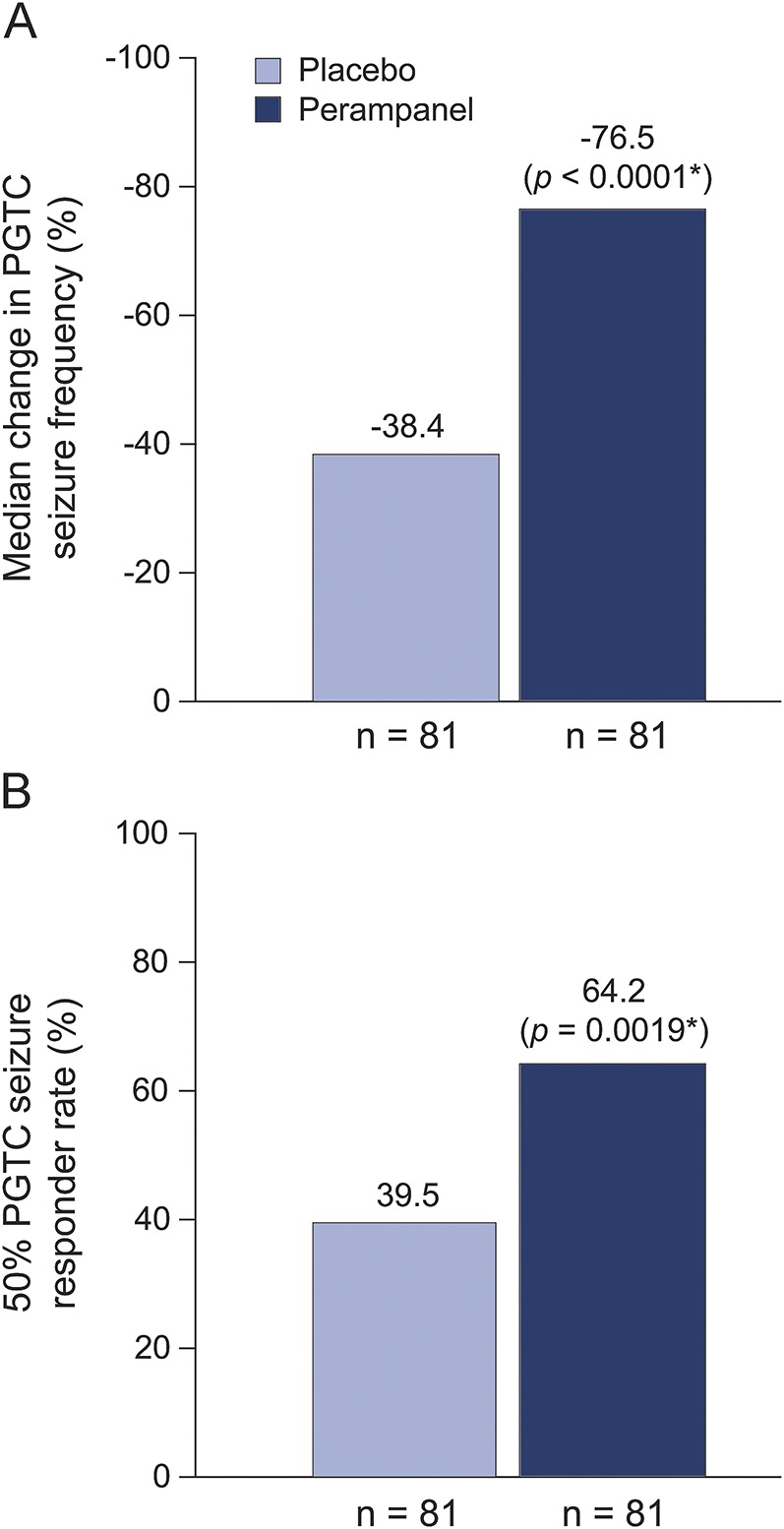
OBJECTIVE: To assess efficacy and safety of adjunctive perampanel in patients with drug-resistant, primary generalized tonic-clonic (PGTC) seizures in idiopathic generalized epilepsy (IGE). METHODS: In this multicenter, double-blind study (ClinicalTrials.gov identifier: NCT01393743; funded by Eisai Inc.), patients 12 years or older with PGTC seizures and IGE were randomized to placebo or perampanel during a 4-week titration period (perampanel up titrated from 2 to 8 mg/d, or highest tolerated dose) and 13-week maintenance period. The primary endpoint was percent change in PGTC seizure frequency per 28 days (titration plus maintenance vs baseline). The key secondary endpoint (primary endpoint for European Union registration) was 50% PGTC seizure responder rate (patients achieving $50% reduction in PGTC seizure frequency; maintenance vs baseline). Treatment-emergent adverse events were monitored. RESULTS: Of 164 randomized patients, 162 comprised the full analysis set (placebo, 81; perampanel, 81). Compared with placebo, perampanel conferred a greater median percent change in PGTC seizure frequency per 28 days (238.4%vs 276.5%; p , 0.0001) and greater 50%PGTC seizure responder rate (39.5% vs 64.2%; p 5 0.0019). During maintenance, 12.3% of placebo treated patients and 30.9%of perampanel-treated patients achieved PGTC seizure freedom. For the safety analysis (placebo, 82; perampanel, 81), the most frequent treatment-emergent adverse events with perampanel were dizziness (32.1%) and fatigue (14.8%). CONCLUSIONS: Adjunctive perampanel was well tolerated and improved control of drug-resistant PGTC seizures in patients with IGE. CLASSIFICATION OF EVIDENCE: This study provides Class I evidence that adjunctive perampanel reduces PGTC seizure frequency, compared with placebo, in patients with drug-resistant PGTC seizures in IGE.
Overview
The claims and statistics of this paper haven’t been checked yet.
Free: it reads the open-access text and checks the first 5 claims that cite a source we can check. Create a free account to check every claim.
Integrity signals
Registry
Cites
Statistics
Figures
Verification
Claims the paper makes
The claims and statistics of this paper haven’t been checked yet.
Free: it reads the open-access text and checks the first 5 claims that cite a source we can check. Create a free account to check every claim.
Claims other papers make about this one
Each is checked against this paper’s own text: does it say what the citing paper says it does?
The source backs part of the claim, not all of it — or backs it for a different population, condition or comparison.
In the citing paper
“In some studies, perampanel has been demonstrated to reduce seizure frequency by 76.5%.”
From State of the Art and Challenges in Epilepsy—A Narrative Review (2023) · cites this paper as [48]
Experimental — accuracy not yet measuredThe source backs part of the claim, not all of it — or backs it for a different population, condition or comparison.
In the citing paper
“Other antiepileptics such as Lamotrigine, Levetiracetam, and Topiramate have shown efficacy in first generalized tonic-clonic seizures not controlled by a first or additional monotherapy [48].”
From State of the Art and Challenges in Epilepsy—A Narrative Review (2023) · cites this paper as [48]
Experimental — accuracy not yet measuredThe source backs part of the claim, not all of it — or backs it for a different population, condition or comparison.
In the citing paper
“In cases with idiopathic generalized epilepsy, approximately 35% of them will require adjuvant therapy.”
From State of the Art and Challenges in Epilepsy—A Narrative Review (2023) · cites this paper as [48]
Experimental — accuracy not yet measured
Self-check
Percentages, sums and reported differences re-computed from the paper’s own numbers.
The self-check needs the paper’s full text.
Citations
Cites
Ryvlin, P., Nashef, L., Lhatoo, S. D., Bateman, L. M., Bird, J., Bleasel, A., Boon, P., Crespel, A., Dworetzky, B. A., Høgenhaven, H., et al. (2013) · The Lancet Neurology · doi:10.1016/s1474-4422(13)70214-x · Cited by 1,135
Combined analysis of risk factors for SUDEP: Combined SUDEP Analysis
Hesdorffer, D. C., Tomson, T., Benn, E., Sander, J. W., Nilsson, L., Langan, Y., Walczak, T. S., Beghi, E., Brodie, M. J., Hauser, A., et al. (2011) · Epilepsia · doi:10.1111/j.1528-1167.2010.02952.x · Cited by 501
Adjunctive perampanel for refractory partial-onset seizures: Randomized phase III study 304
French, J. A., Krauss, G. L., Biton, V., Squillacote, D., Yang, H., Laurenza, A., Kumar, D., Rogawski, M. A., Campanille, V., Floridia, J., et al. (2012) · Neurology · doi:10.1212/wnl.0b013e3182635735 · Cited by 479
Self-citationRandomized phase III study 306: Adjunctive perampanel for refractory partial-onset seizures
Krauss, G. L., Serratosa, J. M., Villanueva, V., Endziniene, M., Hong, Z., French, J., Yang, H., Squillacote, D., Edwards, H. B., Zhu, J., et al. (2012) · Neurology · doi:10.1212/wnl.0b013e318254473a · Cited by 431
Self-citationFrench, J. A., Krauss, G. L., Steinhoff, B. J., Squillacote, D., Yang, H., Kumar, D., & Laurenza, A. (2013) · Epilepsia · doi:10.1111/j.1528-1167.2012.03638.x · Cited by 423
Self-citationA randomized, placebo-controlled study of topiramate in primary generalized tonic-clonic seizures
Biton, V., Montouris, G. D., Ritter, F., Riviello, J. J., Reife, R., Lim, P., Pledger, G., & the Topiramate YTC Study Group (1999) · Neurology · doi:10.1212/wnl.52.7.1330 · Cited by 295 · cited 1×
“In a study of topiramate (n5 80), again, many patients were experiencing seizures not typically seen in IGE (tonic seizures [n5 19] or atypical absence seizures [n5 6]).(27) One important consideration for the treatment of seizures associated with IGE is the potential for improving control of PGTC seizures while exace…”
BackgroundSteinhoff, B. J., Ben‐Menachem, E., Ryvlin, P., Shorvon, S., Kramer, L., Satlin, A., Squillacote, D., Yang, H., Zhu, J., & Laurenza, A. (2013) · Epilepsia · doi:10.1111/epi.12212 · Cited by 268 · cited 1×
“in patients with drug-resistant, partial-onset seizures, across which the most frequent AEs were dizziness, fatigue, headache, irritability, and somnolence, as reported here.(9) Some AEs of special interest appeared more frequently with perampanel than placebo, including AEs relating to hostility/aggression, which is…”
ResultSelf-citationHesdorffer, D. C., Tomson, T., Benn, E., Sander, J. W., Nilsson, L., Langan, Y., Walczak, T. S., Beghi, E., Brodie, M. J., Hauser, W. A., et al. (2012) · Epilepsia · doi:10.1111/j.1528-1167.2011.03354.x · Cited by 261
Cited by
Items 201–300 of 334
Real‐world evaluation of perampanel effectiveness in Japanese adolescents with epilepsy
Inoue, Y., Sumitomo, K., Matsutani, K., & Ishii, M. (2022) · Epileptic Disorders · doi:10.1684/epd.2022.1454 · Cited by 9
“Data for paediatric and adolescent patients were collected in randomized trials [8-12] and real-world data are also available [13-16]; however, there is a scarcity of information from large samples of adolescents treated in routine clinical settings in Asia.”
BackgroundPotential of cenobamate as a broad-spectrum antiseizure medication
Melnick, S. M., Misra, S. N., Kamin, M., Ferrari, L., & Glenn, K. (2025) · Expert Opinion on Pharmacotherapy · doi:10.1080/14656566.2025.2517352 · Cited by 8
“Doses used in other PGTC seizure studies were either at or lower than the maximum indicated dose in the prescribing information [8,11,78–83].”
Kim, J. S., Kim, W. S., Sung, W. Y., & Woo, H. (2024) · Epilepsy & Behavior · doi:10.1016/j.yebeh.2024.109740 · Cited by 8
“Studies analyzing pooled safety data from phase 3 double-blind controlled clinical trials have reported that hostility/aggression-associated behavioral adverse events occur in 11.8 % of patients with focal epilepsy and 18.5 % of patients with idiopathic generalized epilepsy [13,23].”
BackgroundInfluentialMiyazaki, T., Takayama, Y., Iwasaki, M., Hatano, M., Nakajima, W., Ikegaya, N., Yamamoto, T., Tsuchimoto, S., Kato, H., & Takahashi, T. (2022) · Brain Communications · doi:10.1093/braincomms/fcac023 · Cited by 8
Retention Rate and Efficacy of Perampanel with a Slow Titration Schedule in Adults
Basheikh, M., & Sadler, R. M. (2020) · Canadian Journal of Neurological Sciences / Journal Canadien des Sciences Neurologiques · doi:10.1017/cjn.2020.174 · Cited by 8
Mir, A., Alghamdi, A., Alotaibi, W., Samreen, D., Alotaibi, M., Albaradie, R., & Bashir, S. (2022) · Epileptic Disorders · doi:10.1684/epd.2022.1439 · Cited by 8
Colleran, N., Connor, T., & Brien, J. J. O. (2017) · Seizure · doi:10.1016/j.seizure.2017.08.007 · Cited by 8
Hao, L., Li, X., Wang, Z., Du, P., Yin, S., Kambe, N., & Qiu, R. (2024) · The Journal of Organic Chemistry · doi:10.1021/acs.joc.4c01636 · Cited by 7
Russian experience with perampanel in routine clinical practice
Va, K., Belyaev, O. V., Vlasov, P. N., Жидкова, И. А., Volkov, I. V., Дмитренко, Д. В., Karas, A. Y., Казенных, Т. В., Miguskina, O. I., Moskvicheva, A. V., et al. (2016) · Neurology neuropsychiatry Psychosomatics · doi:10.14412/2074-2711-2016-1s-11-17 · Cited by 7
Pina-Garza, J. E., Villanueva, V., Rosenfeld, W. E., Yoshinaga, H., Patten, A. R., & Malhotra, M. (2022) · Epilepsy & Behavior · doi:10.1016/j.yebeh.2022.108901 · Cited by 7
Self-citationWinter, Y., Sandner, K., Vieth, T., Melzer, N., Klimpe, S., Meuth, S. G., & Groppa, S. (2022) · CNS Drugs · doi:10.1007/s40263-022-00954-w · Cited by 7
Tremblay, G., Barghout, V. E., Patel, V., Tsong, W., & Wang, Z. (2017) · Epilepsy & Behavior · doi:10.1016/j.yebeh.2016.12.029 · Cited by 7
“Safety and efficacy of perampanel was demonstrated in patients with POS, with or without secondarily generalized seizures, in 3 phase III studies [27–29] and a subsequent open-label extension [30], as well as in patients with PGTCS in 1 phase III study [31] and subsequent open-label extension.”
BackgroundYamagishi, H., Osaka, H., Muramatsu, K., Kojima, K., Monden, Y., Mitani, T., Asakura, Y., Wakae, K., Nagai, K., & Tajima, T. (2024) · Scientific Reports · doi:10.1038/s41598-024-82014-5 · Cited by 6
Kim, D. W., Kim, J. H., Lee, S. K., Lee, S., Lee, J. W., Kim, M., & Seo, D. (2022) · Journal of Epilepsy Research · doi:10.14581/jer.22002 · Cited by 6
“The efficacy and safety of perampanel was demonstrated in pivotal clinical trials of patients with refractory focal-onset seizures(4-6) or drug-resistant, primary generalized tonic-clonic seizures in idiopathic generalized epilepsy.(7) Epileptic seizures, including secondary generalized seizures, are often refractory…”
BackgroundSteinhoff, B. J., Goldmann, T., Kockelmann, E., Winter, Y., & for the PERPRISE Study Group (2023) · Epilepsia Open · doi:10.1002/epi4.12869 · Cited by 6
“For example, a Phase III study of adjunctive perampanel in patients with drug-resistant GTCS had a target dose of 8 mg/ day, 14 and a 2014 study of a German clinic's first experiences with perampanel in patients reported a mean dose of 8.8 mg/day (range, 4–14 mg/day).”
BackgroundInfluentialStrzelczyk, A., Maschio, M. C. E., Pensel, M. C., Coppola, A., Takahashi, S., Izumoto, S., Trinka, E., Cappucci, S., Sáinz‐Fuertes, R., & Villanueva, V. (2024) · Neurology and Therapy · doi:10.1007/s40120-024-00618-5 · Cited by 6
Self-citationClassic antiepileptic drugs under fire, and new options emerge
Elger, C. E. (2016) · Nature Reviews Neurology · doi:10.1038/nrneurol.2016.1 · Cited by 6
Phase IV PROVE study: Perampanel in real-world clinical care of pediatric patients with epilepsy
Moretz, K., Wheless, J. W., dos Santos, C. C., Segal, E. B., Lancman, M. E., Patten, A. R., & Malhotra, M. (2024) · European Journal of Paediatric Neurology · doi:10.1016/j.ejpn.2024.02.008 · Cited by 6
Self-citationRinaldi, F., & Maria, G. D. (2018) · International Journal of Epilepsy · doi:10.1055/s-0038-1675546 · Cited by 6
Consensus statement for the management of generalized tonic‐clonic seizures in Spain
Gil‐Nagel, A., Carriles, J. C. Á., Bermejo, P. E., Carreño, M., García‐Morales, I., Peñas, J. J. G., López‐González, F. J., Ruiz-Falcó, M. L., Sánchez, J. C., & Tato, C. (2019) · Acta Neurologica Scandinavica · doi:10.1111/ane.13169 · Cited by 6
Montoya, J., Monica, D. R., & Albert, D. C. (2020) · Epilepsy Research · doi:10.1016/j.eplepsyres.2020.106378 · Cited by 6
Bioequivalence of perampanel fine granules and tablets in healthy Japanese subjects
Shiba, S., Sekino, H., Ishiba, K., Yasuda, S., Inoue, S., Kotaka, K., Reyderman, L., & Uchida, N. (2020) · International Journal of Clinical Pharmacology and Therapeutics · doi:10.5414/cp203781 · Cited by 6
Recent Advances in the Management of Seizures in Children
Besag, F., Vasey, M. J., & Chin, R. (2025) · Pediatric Drugs · doi:10.1007/s40272-025-00710-9 · Cited by 7
“A single RCT in which percent change from baseline in primary generalised tonic–clonic seizures was the primary efficacy outcome [100] reported a decrease of 76.5% with PER compared with 38.4% with placebo ( p 0.0001).”
InfluentialGlobal trends in research of glutamate in epilepsy during past two decades: A bibliometric analysis
Wang, W., Gao, R., Ren, Z., Yang, D., Sun, K., Li, X., & Yan, S. (2022) · Frontiers in Neuroscience · doi:10.3389/fnins.2022.1042642 · Cited by 5
Wu, T., Kim, D. W., Alsaadi, T. M., Goji, H., Kanemoto, K., Chinvarun, Y., Dash, A., Cappucci, S., & Villanueva, V. (2024) · Journal of the Neurological Sciences · doi:10.1016/j.jns.2024.123173 · Cited by 5
Usefulness of perampanel as initial monotherapy in children with non-lesional focal epilepsy
Kanemura, H., Miyasato, Y., Tomi, Y., & Sano, F. (2025) · Epilepsy & Behavior Reports · doi:10.1016/j.ebr.2025.100743 · Cited by 5
“…disability; FSIQ, full-scale intelligent quotient; FLE, frontal lobe epilepsy; SBS, secondary bilateral synchrony; FMS, focal motor seizure; FIAS, focal impairment awareness seizure; FBTCS, focal to bilateral tonic-clonic seizure. hepatic function seen with CBZ or valproate sodium [9 – 11].”
D’Aniello, A., Giallonardo, A. T., Tinuper, P., Mecarelli, O., Aguglia, U., Assenza, G., Gambardella, A., Canevini, M. P., Scifo, R., Meletti, S., et al. (2025) · Epilepsia Open · doi:10.1002/epi4.70068 · Cited by 5
“6,8,17,18,28 Approximately 42% of patients discontinued from the study; similar rates of discontinuation were seen in other observational studies conducted in the USA, such as the real-world PROVE study (Study 506 [NCT03208660]) 29 and the open-label, Phase IV ELEVATE study (Study 410…”
Self-citationLaliberté, F., Duh, M. S., Barghout, V. E., Germain, G., Frech, F. H., Plauschinat, C. A., Lejeune, D., Malhotra, M., & Faught, E. (2021) · Epilepsy & Behavior · doi:10.1016/j.yebeh.2021.107927 · Cited by 5
Resnick, T., Patten, A. R., Ngo, L. Y., & Malhotra, M. (2022) · Epilepsy & Behavior · doi:10.1016/j.yebeh.2021.108528 · Cited by 5
“The approval of adjunctive perampanel for the treatment of FOS, with or without FBTCS, and GTCS was based on four randomized, double-blind, placebo-controlled Phase III studies in patients (aged 12 years) with FOS, with or without FBTCS (Studies 304 [NCT00699972], 305 [NCT00699582], and 306 [NCT00700310]) [8–10], or w…”
Self-citationYoshida, S., Amamoto, M., Takahashi, T., Tomita, I., Yuge, K., Hara, M., Iwama, K., Matsumoto, N., & Matsuishi, T. (2022) · Clinical Case Reports · doi:10.1002/ccr3.5811 · Cited by 5
Omatsu, H., Watanabe, T., Kira, R., Ishiba, K., Patten, A. R., Takase, T., & Ngo, L. Y. (2023) · Seizure · doi:10.1016/j.seizure.2023.06.004 · Cited by 5
Self-citationElosua‐Bayés, I., Abraira, L., Fonseca, E., Lallana, S., Campos, D., López‐Maza, S., Quintana, M., Santamarina, E., Salas‐Puig, J., & Toledo, M. (2024) · Epilepsy & Behavior · doi:10.1016/j.yebeh.2024.110158 · Cited by 5
Saipetch, C., Sachs, E., & Haneef, Z. (2016) · Neurology Clinical Practice · doi:10.1212/cpj.0000000000000288 · Cited by 5
“3% in the placebo group during the 13-week maintenance period.(16) Perampanel’s long half-life of 106 hours allows once-daily dosing.”
Vlasov, P. N., Va, K., Жидкова, И. А., Дмитренко, Д. В., Рудакова, И. Г., Danilova, T. V., Kalinin, V. A., Grebenyuk, O. V., Герцен, А. П., Журавлев, Я. С., et al. (2020) · Neurology neuropsychiatry Psychosomatics · doi:10.14412/2074-2711-2020-3-47-55 · Cited by 5
HLAs associated with perampanel-induced psychiatric adverse effects in a Korean population
Jang, Y., Kim, T., Moon, J., Yang, T., Kim, K. T., Park, B.-S., Lim, J., Jun, J., Lee, S., Jung, K., et al. (2020) · Scientific Reports · doi:10.1038/s41598-020-70601-1 · Cited by 5
Mehndiratta, M. M., Gulhane, M., Jabeen, S. A., Patten, A. R., Dash, A., & Malhotra, M. (2020) · Epilepsia Open · doi:10.1002/epi4.12448 · Cited by 5
Self-citationAdjunctive perampanel therapy for patients with epileptic spasms
Matsuura, R., Hamano, S., Ikemoto, S., Daida, A., Takeda, R., Horiguchi, A., Hirata, Y., Koichihara, R., & Kikuchi, K. (2022) · Pediatrics International · doi:10.1111/ped.15364 · Cited by 5
Recent advances in epilepsy management
Ernst, L. D. L., & Boudreau, E. A. (2016) · Current Opinion in Anaesthesiology · doi:10.1097/aco.0000000000000376 · Cited by 5
Boontoterm, P., Sakoolnamarka, S., Urasyanandana, K., & Fuengfoo, P. (2024) · Journal of Epilepsy Research · doi:10.14581/jer.24014 · Cited by 4
Flamini, R. J., Fogarasi, A., Omatsu, H., Milh, M., Phillips, S., Patten, A. R., Takase, T., & Ngo, L. Y. (2025) · Epilepsia · doi:10.1111/epi.18242 · Cited by 4
Self-citationEfficacy and tolerability of perampanel: a Chinese real-world observational study in epilepsy
Zeng, Y., & Wu, X. (2024) · Frontiers in Neurology · doi:10.3389/fneur.2023.1286276 · Cited by 4
Kerr, W. T., Ngo, L. Y., Zhu, L., Patten, A. R., Cheng, J. Y., Reddy, A. S., & French, J. A. (2024) · Epilepsia · doi:10.1111/epi.18023 · Cited by 4
“24 Even within the placebo arm, 92% of participants who reported any TEAE had them before T-PSC.”
Self-citationCarreño, M., Benbadis, S. R., Rocha, F., Blum, D. E., Cheng, H., & the Study 301, 3. A. 3. I. (. 1. (2017) · Epilepsia Open · doi:10.1002/epi4.12083 · Cited by 4
“was also no evidence for exacerbation of myoclonic or absence seizures with perampanel treatment for tonic-clonic seizures in idiopathic generalized epilepsy.(26) Furthermore, in a post-hoc analysis of a subset of patients with juvenile myoclonic epilepsy, seizure worsening was more frequent in placebo-treated patient…”
Wu, L., Yagi, K., Hong, Z., Liao, W., Wang, X., Zhou, D., Inoue, Y., Ohtsuka, Y., 笹川, 睦., Terada, K., et al. (2018) · Epilepsia Open · doi:10.1002/epi4.12255 · Cited by 4
“Since the guidelines were published, efficacy in primary GTC seizures has also been reported for perampanel.(4) Levetiracetam is a well-established second-generation AED.”
BackgroundSelf-citationPerampanel‐induced hair curling in a patient with epilepsy associated with Pitt Hopkins syndrome
Calle‐López, Y., Kotagal, P., & Pestana‐Knight, E. (2019) · Epileptic Disorders · doi:10.1684/epd.2019.1103 · Cited by 4
PROSPECTS OF APPLICATION OF NEW ANTIEPILEPTIC DRUGS
Vlasov, P. N. (2015) · Epilepsy and Paroxysmal Conditions · doi:10.17749/2077-8333.2015.7.4.040-049 · Cited by 4
Raedler, L. A. (2016) · Europe PMC (PubMed Central) · Cited by 4
Marvanová, M. (2019) · Mental Health Clinician · doi:10.9740/mhc.2019.03.100 · Cited by 4
Chauhan, A. P. S., Unnithan, D., Alam, R., Singh, H., Parveen, R., Gull, A., Khan, S., & Ali, J. (2024) · Journal of Drug Delivery Science and Technology · doi:10.1016/j.jddst.2024.106547 · Cited by 3
Kanemura, H. (2025) · Brain and Development · doi:10.1016/j.braindev.2025.104403 · Cited by 3
Intravenous perampanel in clinical practice: A multicenter prospective registry study
Sato, Y., Iwami, K., Okumura, E., Ohka, F., Takeuchi, K., Deguchi, S., Nagata, Y., Muraoka, S., Ishizaki, T., Nagashima, Y., et al. (2025) · Seizure · doi:10.1016/j.seizure.2025.07.023 · Cited by 3
Yi, T., Huang, L.-W., Peng, W., Zhang, T., Zhou, D., Lai, X., & Li, J. (2025) · Brain and Behavior · doi:10.1002/brb3.70968 · Cited by 3
“The most common AEs of PER in our study were dizziness, somnolence, emotional disorders, and irritability, consistent with findings from other real-world studies (French et al. 2012; Fog-arasi et al. 2020; French et al. 2015).”
AbdelMagid, A. M., Badr, K. A., & Rezk, M. R. (2025) · Drugs in R&D · doi:10.1007/s40268-025-00526-5 · Cited by 3
“In addition, consistent safety results and acceptable tolerability were observed among patients experiencing focal seizures or generalized tonic-clonic seizures and receiving a once-daily oral tablet formulation of perampanel [23–26].”
Clinical practice guidelines for the administration of third-generation anti-seizure medications
Wu, X., Chen, Y., Feng, L., Han, X., Han, Y., Huang, H., Li, Q., Liu, X., Ren, L., Sun, Y., et al. (2025) · Seizure · doi:10.1016/j.seizure.2025.11.002 · Cited by 4
Self-citationBialer, M., Landmark, C. J., Koepp, M. J., Perucca, E., Perucca, P., Tomson, T., White, H. S., & Wirrell, E. C. (2026) · Epilepsia · doi:10.1002/epi.70346 · Cited by 4
Gao, Z., Wang, L., Lai, Q., Liu, Y., Wang, S., Liu, J., Feng, Z., Liu, H., & Yao, R. (2025) · Phytomedicine · doi:10.1016/j.phymed.2025.156921 · Cited by 3
Meta-analysis of drug efficacy in adult vs pediatric trials of patients with PGTC seizures
Nordli, D. R., Bagiella, E., Arzimanoglou, A. A., Wang, J., Kumar, D., Laurenza, A., & French, J. A. (2020) · Neurology · doi:10.1212/wnl.0000000000009325 · Cited by 3
Self-citationKohli, A., Gupta, C., Dutta, S., & Madan, C. (2021) · Interdisciplinary Neurosurgery · doi:10.1016/j.inat.2021.101094 · Cited by 3
Pack, A. M. (2016) · Epiliepsy currents/Epilepsy currents · doi:10.5698/1535-7597-16.1.27 · Cited by 3
Morgan, C. L., Varga, Š., Tsong, W., Jenkins‐Jones, S., & Holden, S. E. (2020) · Epilepsy & Behavior · doi:10.1016/j.yebeh.2020.107137 · Cited by 3
Liu, S.-T., Ke, C., Su, J., Qian, Y.-D., Wu, W.-H., Lin, X., & Lin, W.-W. (2025) · Expert Review of Clinical Pharmacology · doi:10.1080/17512433.2025.2527079 · Cited by 2
Expanding the toolkit: An update on the evolution of new therapies for Lennox-Gastaut Syndrome
Pong, A. W. (2025) · Seminars in Pediatric Neurology · doi:10.1016/j.spen.2025.101242 · Cited by 2
Sleep effects in drug-resistant epileptic patients taking perampanel: an observational study
Lamanna, F., Pardeo, O., Tilenni, D., Luppino, F., Salafica, G., Barbaccia, A., Laganà, A., Aricò, I., Raineri, S., Tripepi, G., et al. (2026) · Neurological Sciences · doi:10.1007/s10072-025-08785-5 · Cited by 2
“PER has also been shown to reduce the frequency of primary generalized tonic–clonic seizures compared to placebo in studies conducted in patients with drug-resistant idiopathic generalized epilepsy [7, 8].”
Angelucci, S., Houlind, M. B., Hansen, M. S., Højte, A. F., Shorter, J. R., & Bayat, A. (2026) · Basic & Clinical Pharmacology & Toxicology · doi:10.1111/bcpt.70209 · Cited by 2
Recent Advances and Future Directions in the Treatment of Epilepsy
Kurokawa, T., Kazuta, Y., & Watanabe, T. (2016) · Elsevier eBooks · doi:10.1016/b978-0-12-409547-2.12436-9 · Cited by 3
Médicaments antiépileptiques : quoi de neuf récemment ?
Guery, D., & Rheims, S. (2022) · Pratique Neurologique - FMC · doi:10.1016/j.praneu.2022.07.006 · Cited by 2
Drug-resistant juvenile myoclonic epilepsy: A literature review
Nica, A. (2024) · Revue Neurologique · doi:10.1016/j.neurol.2024.02.385 · Cited by 2
Drug-resistant generalized epilepsies: Revisiting the frontiers of idiopathic generalized epilepsies
Gauer, L., Baer, S., Valenti‐Hirsch, M. P., Martin, A. D. S., & Hirsch, É. (2024) · Revue Neurologique · doi:10.1016/j.neurol.2024.03.001 · Cited by 2
Structural connectivity as a predictive factor for perampanel response in patients with epilepsy
Lee, D. A., Lee, H., & Park, K. M. (2024) · Seizure · doi:10.1016/j.seizure.2024.04.026 · Cited by 2
Inducción de crisis de ausencia atípica durante el tratamiento con perampanel
Rodríguez, A. D., Extremera, V. C., Fernández, M. G., Peñas, J. J. G., & Rojas, M. L. R.-F. (2019) · Anales de Pediatría · doi:10.1016/j.anpedi.2019.01.015 · Cited by 2
Kim, J. H., Kim, D. W., Lee, S. K., Seo, D., Lee, J. W., Kim, M., & Lee, S. (2022) · Journal of Epilepsy Research · doi:10.14581/jer.22003 · Cited by 2
Long-term efficacy and safety of perampanel as an add-on therapy in patients with epilepsy
Arai, Y., Inaji, M., Shimizu, K., Kondo, S., Satoka, H., Kiyokawa, J., Kawano, Y., Yamamoto, S., & Maehara, T. (2024) · Epilepsy Research · doi:10.1016/j.eplepsyres.2024.107307 · Cited by 2
Maguire, M. (2022) · Epilepsy & Behavior · doi:10.1016/j.yebeh.2022.108654 · Cited by 2
Park, K., Hwang, S., Son, H., Chu, K., Jung, K., & Lee, S. K. (2023) · Journal of Clinical Neurology · doi:10.3988/jcn.2022.0338 · Cited by 1
Assessment of aggressive behavior in Dravet syndrome: a critical look
Torres-Fortuny, A., Aras, L. M., & Duñabeitia, J. A. (2024) · Frontiers in Integrative Neuroscience · doi:10.3389/fnint.2024.1403681 · Cited by 1
Yamaguchi, J., Ohka, F., Motomura, K., Ishizaki, T., Nakahara, N., Fujitani, S., Nagatani, T., Ohno, M., Ando, M., Kuwatsuka, Y., et al. (2024) · Trials · doi:10.1186/s13063-024-08693-7 · Cited by 1
“Furthermore, this recommended maintenance dose was established in a study of patients diagnosed with epilepsy; hence, low-dose PER may be sufficient for seizure prophylaxis in “seizure-naive” patients [24].”
Cortical Excitability Before and After Long‐Term Perampanel Treatment for Epilepsy
Helling, R. M., van Dijk, J. P., Bauer, P. R., Thijs, R. D., Sander, J. W. A. S., Zwarts, M. J., & Visser, G. H. (2025) · Annals of Clinical and Translational Neurology · doi:10.1002/acn3.70044 · Cited by 1
“Perampanel is the first ASM that targets the AMPA receptor by blocking the receptor using allosteric regulation, exerting a broadband anti-seizure effect [10–12].”
Diagnosis and Treatment of Epilepsy Syndromes
Yan, Y., Wang, Y., Xiao, F., Wang, X., Zhang, H., Hu, Y., Luo, R., Jiang, L., Wu, Y., Liu, X., et al. (2025) · Springer eBooks · doi:10.1007/978-981-96-8520-2_5 · Cited by 1
Self-citationГоранський, Ю. І., Gertsev, V. M., & Serheeva, M. Y. (2025) · INTERNATIONAL NEUROLOGICAL JOURNAL · doi:10.22141/2224-0713.21.5.2025.1197 · Cited by 1
Onda, H., Nishino, T., & Yokobori, S. (2025) · Neurotrauma Reports · doi:10.1177/2689288x251372910 · Cited by 2
“37 Thus, when evaluating pharmacologic strategies for EPTS prevention, consideration should extend beyond seizure suppression to include neuroprotective capacity and logistical feasibility.”
Epilepsien (Anfallssuppressiva)
Brandt, C., & Seifert, R. (2026) · Springer eBooks · doi:10.1007/978-3-662-72738-6_24 · Cited by 1
Self-citationFoster, E., Millist, L., Germaine, J., Chamorro, S., Roberts, C., Nicolo, J., Hosking, S., Perucca, P., Mullen, S. A., Robinson, H., et al. (2026) · Epilepsia Open · doi:10.1002/epi4.70294 · Cited by 1
Self-citationIdiopathische generalisierte Epilepsien und Fotosensitivität: Klinik und Genetik
Winter, N., Muhle, H., & Lerche, H. (2015) · Clinical Epileptology · doi:10.1007/s10309-015-0033-2 · Cited by 1
“Kürzlich konnte in einer Studie eine gute Wirksamkeit von Perampanel als add-onTherapie bei therapierefraktären pGTKA nachgewiesen werden [11].”
BackgroundRussian experience of using perampanel in daily clinical practice. Preliminary report
Vlasov, P. N., Va, K., Жидкова, И. А., Chervyakov, A. V., Belyaev, O. V., Volkov, I. V., Дмитренко, Д. В., Karas, A. Y., Казенных, Т. В., Miguskina, O. I., et al. (2016) · Journal of Epileptology · doi:10.1515/joepi-2016-0007 · Cited by 1
Perampanel in the treatment of patients with epilepsy
Rider, F. K. (2017) · S S Korsakov Journal of Neurology and Psychiatry · doi:10.17116/jnevro20171179263-69 · Cited by 1
Bredel-Geissler, A.-E., & Tettenborn, B. (2020) · Springer Reference Medizin · doi:10.1007/978-3-662-60676-6_114 · Cited by 1
Kiyose, M., Wagner, M., Männer, A., Reitz, S. C., Klein, K. M., Strzelczyk, A., Bauer, S., & Rosenow, F. (2019) · Epilepsy & Behavior Case Reports · doi:10.1016/j.ebcr.2019.01.009 · Cited by 1
Gender characteristics of therapy for genetic generalized epilepsy in adults
Volkov, I. V., Сергеевич, К. Г., Kalina, A. V., & Volkova, О. К. (2020) · Neurology neuropsychiatry Psychosomatics · doi:10.14412/2074-2711-2020-1-50-55 · Cited by 1
FEATURES OF THE THERAPY OF FOCAL FORMS OF EPILEPSY
Tokareva, N. G., Ignateva, O. I., Korneeva, M. V., & Davshina, I. A. (2021) · Современные проблемы науки и образования · doi:10.17513/spno.30590 · Cited by 1
Seifert, R., & Brandt, C. (2021) · Springer eBooks · doi:10.1007/978-3-662-63825-5_15 · Cited by 1
Self-citationResults of the Expert Forum on the application of perampanel in routine clinical practice
Editorial, A. (2020) · Epilepsy and Paroxysmal Conditions · doi:10.17749/2077-8333/epi.par.con.2020.036 · Cited by 1
Induced atypical absence seizures during treatment with perampanel
Rodríguez, A. D., Extremera, V. C., Fernández, M. G., Peñas, J. J. G., & Rojas, M. L. R.-F. (2019) · Anales de Pediatría (English Edition) · doi:10.1016/j.anpede.2019.01.014 · Cited by 1
Stritzelberger, J., Walther, K., Olmes, D. G., Gollwitzer, S., Graf, W., Welte, T. M., Lang, J., Reindl, C., Schwab, S., Kriwy, P., et al. (2022) · Epilepsia · doi:10.1111/epi.17375 · Cited by 1
Perampanel Monotherapy for Focal and Generalized Epilepsy in Clinical Practice
Chinvarun, Y., Toledano, R., Rohracher, A., Wehner, T., Toledo, M., Matricardi, S., Trinka, E., Malhotra, M., Shastri, O., & Villanueva, V. (2023) · Acta Neurologica Scandinavica · doi:10.1155/2023/2852853 · Cited by 1
Self-citationБурд, С. Г., Assenza, G., Quintas, S., López, F. J. G., Wagner, J., Лебедева, А. В., Vlasov, P. N., Pantina, N. V., Patten, A. R., Goldman, S., et al. (2025) · Frontiers in Neurology · doi:10.3389/fneur.2025.1533767 · Cited by 1
Self-citationIncreased seizure frequency graphs in medication trials: FDA labels vs. peer-review
Henry, C., Creasey, M., Cannon, L., Terman, S. W., & Goldenholz, D. M. (2025) · Seizure · doi:10.1016/j.seizure.2025.05.021 · Cited by 1
Racemic Ketamine and Esketamine for Treatment of Refractory and Super-Refractory Status Epilepticus
ElSayed, M., Latifi, K., Abdelwahab, L., Mourid, M. R., Kandil, H. S., Khan, D. I., & Shehata, I. M. (2025) · Neuromethods · doi:10.1007/978-1-0716-4599-4_9 · Cited by 2
Perampanel is also a useful adjunctive treatment option in refractory epilepsy in children
Kim, J. S., & Kim, W. S. (2019) · Korean Journal of Pediatrics · doi:10.3345/kjp.2019.00108 · Cited by 1
Schafft dieses Antiepileptikum doch noch den Durchbruch in Deutschland?
Homberg, V. (2016) · InFo Neurologie + Psychiatrie · doi:10.1007/s15005-016-1750-4
Vieker, S., & Schmitt, J. (2016) · Clinical Epileptology · doi:10.1007/s10309-016-0073-2
Metadata
- Authors
- French, J. A., Krauss, G. L., Wechsler, R. T., Wang, X.-F., DiVentura, B., Brandt, C., Trinka, E., O'Brien, T. J., Laurenza, A., Patten, A., & Bibbiani, F.
- Affiliations
- The Royal Melbourne Hospital (AU)
- From NYU Comprehensive Epilepsy Center (J.A.F.), New York, NY; Johns Hopkins Hospital (G.L.K.), Baltimore, MD; Idaho Comprehensive Epilepsy Center (R.T.W.), Boise, ID; The First Affiliated Hospital of Chongqing Medical University (X.-F.W.), China; The Epilepsy Study Consortium (B.D.), Herndon, VA; Bethel Epilepsy Center (C.B.), Bielefeld, Germany; Department of Neurology (E.T.), CDK, Paracelsus Medical University and Centre for Cognitive Neuroscience, Salzburg, Austria; Departments of Medicine and...
- Corresponding author
- French, Jacqueline A.
- ORCID
- Venue
- Neurology
- Published
- 2015-09-15
- Volume
- 85
- Issue
- 11
- Pages
- 950-957
- ISSN
- 0028-3878 (ISSN-L)
- 1526-632X
- PMC
- PMC4567458
- OpenAlex
- W1862220344
- Semantic Scholar
- 73f2df58b14c84ccb09e37a5670e4a3e9099a59c
- Cited by
- 329
- References
- 32
- Citations by year
- 2026: 10 · 2025: 26 · 2024: 20 · 2023: 26 · 2022: 39 · 2021: 39 · 2020: 43 · 2019: 23 · 2018: 25 · 2017: 34 · 2016: 37 · 2015: 6
- FWCI
- 27.57
- Type
- journal article
- Language
- en
- Open access
- hybrid
- doi.org
- Licence
- cc-by-nc-nd
- Locations
- Neurology (publishedVersion, cc-by-nc-nd)
- Europe PMC (PubMed Central) (publishedVersion, cc-by-nc-nd)
- PubMed Central (publishedVersion, cc-by-nc-nd)
- PubMed (publishedVersion)
- Minerva Access (University of Melbourne) (submittedVersion, cc-by-nc-nd)
- Funders
- American Epilepsy Society
- Pfizer
- GlaxoSmithKline
- Sanofi
- Biogen
- Sunovion
- Ultragenyx Pharmaceutical
- GW Pharmaceuticals
- Acorda Therapeutics
- Supernus Pharmaceuticals
- SK Life Science
- Upsher-Smith
- European Commission
- Austrian Science Fund
- Eisai
- Bundesministerium für Wissenschaft und Forschung
- EVER Neuro Pharma
- H. Lundbeck A/S
- Epilepsiatutkimussäätiö
- Epilepsy Society
- National Institutes of Health
- UCB Pharma
- Cilag
- Topics
- Health Sciences › Medicine › Clinical Neurology › Epilepsy research and treatment
- Health Sciences › Medicine › Pediatrics, Perinatology and Child Health › Pharmacological Effects and Toxicity Studies
- Health Sciences › Medicine › Physiology (medical) › Diet and metabolism studies
- Keywords
- perampanel, idiopathic generalized epilepsy, primary generalized tonic-clonic seizures, drug-resistant epilepsy, adjunctive antiepileptic therapy, seizure frequency, seizure freedom, adverse events, dizziness, fatigue
- MeSH terms
- Adolescent, Adult, Aged, Aged, 80 and over, Anticonvulsants, Child, Dose-Response Relationship, Drug, Double-Blind Method, Drug Therapy, Combination, Epilepsy, Generalized, Female, Humans, Male, Middle Aged, Nitriles, Pyridones, Seizures, Treatment Outcome, Young Adult
About these checks
Registry, retraction, Cites and statistics results are computed, not judged, with one exception: a printed reference that no index lists is read once by a model before it counts as a citation error. Claims are extracted by a model and kept only when their quote appears verbatim in the text; each cited source is then checked, with a model’s help, for whether it says what the claim relies on. Those verdicts can be wrong — read the claim’s quote and the cited source before relying on one.
Statistics and arithmetic are recomputed, not judged.
Confidence bands are shown only for fields calibrated on our annotated test set. None is calibrated yet, so no band is shown.
What counts as a claim ›How we measure confidence ›How we check this ›
Are you an author, or do you see a problem with this page? Request a review
Data sources
Bibliographic data: Semantic Scholar, OpenAlex, Crossref.
Contains information from the Semantic Scholar Academic Graph Datasets, made available under the ODC Attribution License (ODC-BY 1.0).
Semantic Scholar’s data is described in: Kinney, R., et al. (2023). The Semantic Scholar Open Data Platform. arXiv:2301.10140.
