

Perampanel for tonic-clonic seizures in idiopathic generalized epilepsy: A randomized trial
Open accessThe DOI matches its Crossref record; 31 of the 32 references it cites were found in a registry or an index.
Abstract
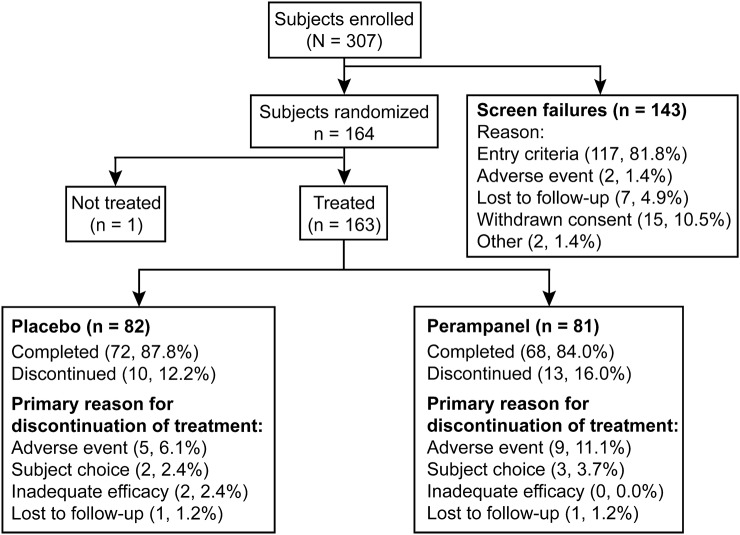
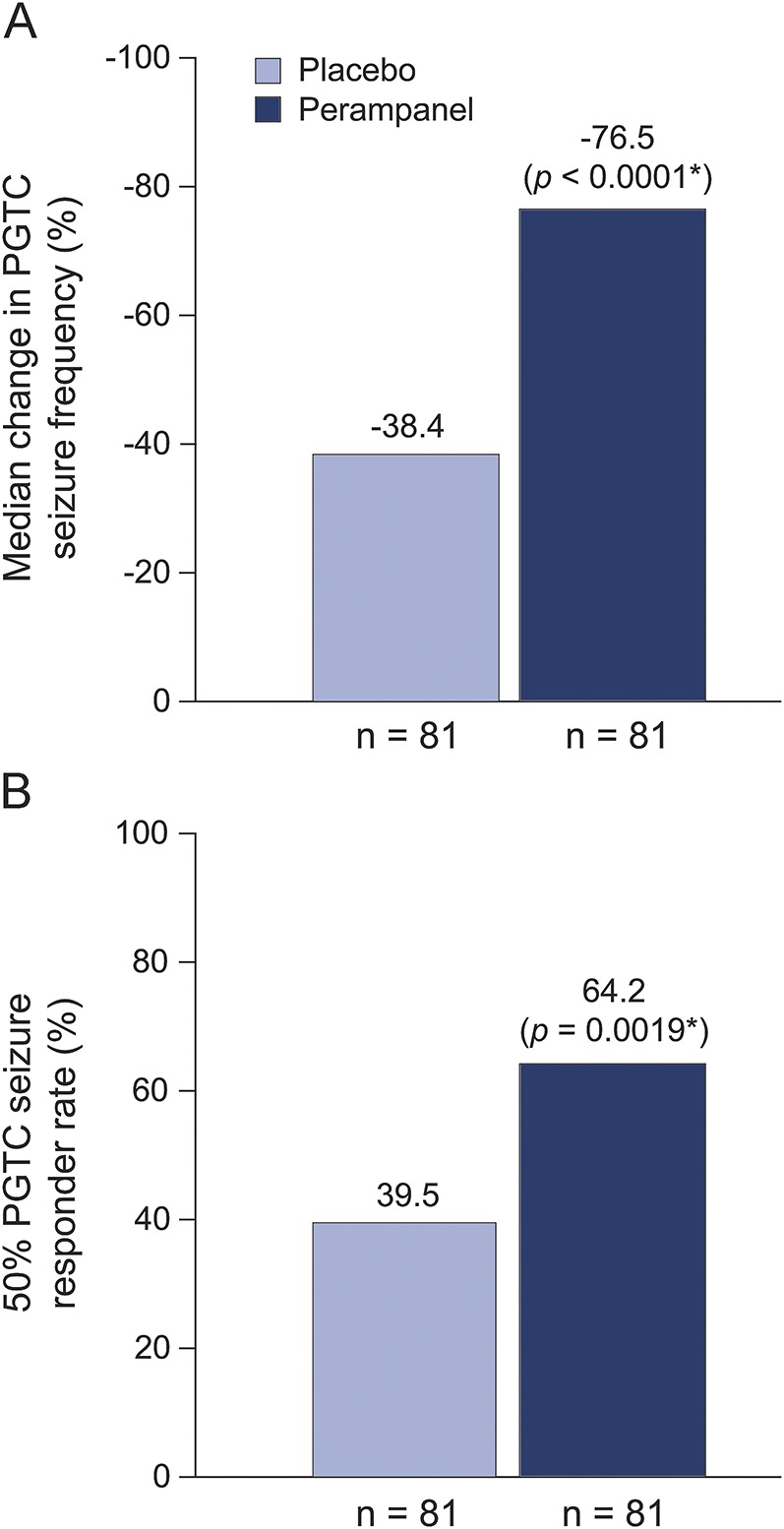
OBJECTIVE: To assess efficacy and safety of adjunctive perampanel in patients with drug-resistant, primary generalized tonic-clonic (PGTC) seizures in idiopathic generalized epilepsy (IGE). METHODS: In this multicenter, double-blind study (ClinicalTrials.gov identifier: NCT01393743; funded by Eisai Inc.), patients 12 years or older with PGTC seizures and IGE were randomized to placebo or perampanel during a 4-week titration period (perampanel up titrated from 2 to 8 mg/d, or highest tolerated dose) and 13-week maintenance period. The primary endpoint was percent change in PGTC seizure frequency per 28 days (titration plus maintenance vs baseline). The key secondary endpoint (primary endpoint for European Union registration) was 50% PGTC seizure responder rate (patients achieving $50% reduction in PGTC seizure frequency; maintenance vs baseline). Treatment-emergent adverse events were monitored. RESULTS: Of 164 randomized patients, 162 comprised the full analysis set (placebo, 81; perampanel, 81). Compared with placebo, perampanel conferred a greater median percent change in PGTC seizure frequency per 28 days (238.4%vs 276.5%; p , 0.0001) and greater 50%PGTC seizure responder rate (39.5% vs 64.2%; p 5 0.0019). During maintenance, 12.3% of placebo treated patients and 30.9%of perampanel-treated patients achieved PGTC seizure freedom. For the safety analysis (placebo, 82; perampanel, 81), the most frequent treatment-emergent adverse events with perampanel were dizziness (32.1%) and fatigue (14.8%). CONCLUSIONS: Adjunctive perampanel was well tolerated and improved control of drug-resistant PGTC seizures in patients with IGE. CLASSIFICATION OF EVIDENCE: This study provides Class I evidence that adjunctive perampanel reduces PGTC seizure frequency, compared with placebo, in patients with drug-resistant PGTC seizures in IGE.
Overview
The claims and statistics of this paper haven’t been checked yet.
Free: it reads the open-access text and checks the first 5 claims that cite a source we can check. Create a free account to check every claim.
Integrity signals
Registry
Cites
Statistics
Figures
Verification
Claims the paper makes
The claims and statistics of this paper haven’t been checked yet.
Free: it reads the open-access text and checks the first 5 claims that cite a source we can check. Create a free account to check every claim.
Claims other papers make about this one
Each is checked against this paper’s own text: does it say what the citing paper says it does?
The source backs part of the claim, not all of it — or backs it for a different population, condition or comparison.
In the citing paper
“In some studies, perampanel has been demonstrated to reduce seizure frequency by 76.5%.”
From State of the Art and Challenges in Epilepsy—A Narrative Review (2023) · cites this paper as [48]
Experimental — accuracy not yet measuredThe source backs part of the claim, not all of it — or backs it for a different population, condition or comparison.
In the citing paper
“Other antiepileptics such as Lamotrigine, Levetiracetam, and Topiramate have shown efficacy in first generalized tonic-clonic seizures not controlled by a first or additional monotherapy [48].”
From State of the Art and Challenges in Epilepsy—A Narrative Review (2023) · cites this paper as [48]
Experimental — accuracy not yet measuredThe source backs part of the claim, not all of it — or backs it for a different population, condition or comparison.
In the citing paper
“In cases with idiopathic generalized epilepsy, approximately 35% of them will require adjuvant therapy.”
From State of the Art and Challenges in Epilepsy—A Narrative Review (2023) · cites this paper as [48]
Experimental — accuracy not yet measured
Self-check
Percentages, sums and reported differences re-computed from the paper’s own numbers.
The self-check needs the paper’s full text.
Citations
Cites
Ryvlin, P., Nashef, L., Lhatoo, S. D., Bateman, L. M., Bird, J., Bleasel, A., Boon, P., Crespel, A., Dworetzky, B. A., Høgenhaven, H., et al. (2013) · The Lancet Neurology · doi:10.1016/s1474-4422(13)70214-x · Cited by 1,135
Combined analysis of risk factors for SUDEP: Combined SUDEP Analysis
Hesdorffer, D. C., Tomson, T., Benn, E., Sander, J. W., Nilsson, L., Langan, Y., Walczak, T. S., Beghi, E., Brodie, M. J., Hauser, A., et al. (2011) · Epilepsia · doi:10.1111/j.1528-1167.2010.02952.x · Cited by 501
Adjunctive perampanel for refractory partial-onset seizures: Randomized phase III study 304
French, J. A., Krauss, G. L., Biton, V., Squillacote, D., Yang, H., Laurenza, A., Kumar, D., Rogawski, M. A., Campanille, V., Floridia, J., et al. (2012) · Neurology · doi:10.1212/wnl.0b013e3182635735 · Cited by 479
Self-citationRandomized phase III study 306: Adjunctive perampanel for refractory partial-onset seizures
Krauss, G. L., Serratosa, J. M., Villanueva, V., Endziniene, M., Hong, Z., French, J., Yang, H., Squillacote, D., Edwards, H. B., Zhu, J., et al. (2012) · Neurology · doi:10.1212/wnl.0b013e318254473a · Cited by 431
Self-citationFrench, J. A., Krauss, G. L., Steinhoff, B. J., Squillacote, D., Yang, H., Kumar, D., & Laurenza, A. (2013) · Epilepsia · doi:10.1111/j.1528-1167.2012.03638.x · Cited by 423
Self-citationA randomized, placebo-controlled study of topiramate in primary generalized tonic-clonic seizures
Biton, V., Montouris, G. D., Ritter, F., Riviello, J. J., Reife, R., Lim, P., Pledger, G., & the Topiramate YTC Study Group (1999) · Neurology · doi:10.1212/wnl.52.7.1330 · Cited by 295 · cited 1×
“In a study of topiramate (n5 80), again, many patients were experiencing seizures not typically seen in IGE (tonic seizures [n5 19] or atypical absence seizures [n5 6]).(27) One important consideration for the treatment of seizures associated with IGE is the potential for improving control of PGTC seizures while exace…”
BackgroundSteinhoff, B. J., Ben‐Menachem, E., Ryvlin, P., Shorvon, S., Kramer, L., Satlin, A., Squillacote, D., Yang, H., Zhu, J., & Laurenza, A. (2013) · Epilepsia · doi:10.1111/epi.12212 · Cited by 268 · cited 1×
“in patients with drug-resistant, partial-onset seizures, across which the most frequent AEs were dizziness, fatigue, headache, irritability, and somnolence, as reported here.(9) Some AEs of special interest appeared more frequently with perampanel than placebo, including AEs relating to hostility/aggression, which is…”
ResultSelf-citationHesdorffer, D. C., Tomson, T., Benn, E., Sander, J. W., Nilsson, L., Langan, Y., Walczak, T. S., Beghi, E., Brodie, M. J., Hauser, W. A., et al. (2012) · Epilepsia · doi:10.1111/j.1528-1167.2011.03354.x · Cited by 261
Cited by
Items 301–334 of 334
Рудакова, И. Г., & Belova, Y. A. (2017) · Neurology neuropsychiatry Psychosomatics · doi:10.14412/2074-2711-2017-1s-48-53
New opportunities in the optimization of epilepsy treatment in adolescents
Guzeva, V. I., Okhrim, I. V., Гузева, О. В., Гузева, В. В., & Maksimova, N. E. (2017) · S S Korsakov Journal of Neurology and Psychiatry · doi:10.17116/jnevro20171179270-74
Fricke, U., Hein, L., & Schwabe, U. (2018) · Springer eBooks · doi:10.1007/978-3-662-57386-0_3
Is adjunctive perampanel beneficial for lafora disease?
Stevanović, G., Jović, N., & Kecmanović, M. (2020) · Vojnosanitetski pregled · doi:10.2298/vsp170416013s
Белоусова, Е. Д. (2021) · S S Korsakov Journal of Neurology and Psychiatry · doi:10.17116/jnevro2021121031116
Anticonvulsant Agents: Lacosamide and Perampanel
Tilz, C. (2021) · Springer eBooks · doi:10.1007/978-3-319-56015-1_449-1
Zelleke, T. G., Schreiber, J. M., Vu, T.-A., & Gaillard, W. D. (2020) · Springer eBooks · doi:10.1007/978-3-319-43153-6_27
Pharmakotherapie der Epilepsie
Baumgartner, C., Koren, J. P., & Pirker, S. (2022) · psychopraxis neuropraxis · doi:10.1007/s00739-022-00787-8
Perampanel success in primary generalized seizures
(2015) · Nature Reviews Neurology · doi:10.1038/nrneurol.2015.163
Bredel-Geissler, A.-E., & Tettenborn, B. (2018) · Springer Reference Medizin · doi:10.1007/978-3-662-44768-0_114-1
The Unverricht-Lundborg disease as a part of the progressive myoclonic epilepsies syndrome
Белоусова, Е. Д. (2022) · Almanac of Clinical Medicine · doi:10.18786/2072-0505-2022-50-041
Anti-convulsant Agents: Lacosamide and Perampanel
Tilz, C. (2022) · Springer eBooks · doi:10.1007/978-3-030-62059-2_449
Seifert, R., & Brandt, C. (2022) · Springer eBooks · doi:10.1007/978-3-662-66303-5_24
Self-citationUtilisation pratique du pérampanel dans les crises d’épilepsie de l’enfant et de l’adolescent
Auvin, S., Nabbout, R., Gonin, C., Garay, R. P., Bournane, R., & Arzimanoglou, A. A. (2023) · Pratique Neurologique - FMC · doi:10.1016/j.praneu.2022.12.001
Lim, S. C., Lee, W. G., Kim, D. W., Kim, K. K., Shon, Y., Park, J., Lee, Y., & Seo, D. (2023) · Epilepsy & Behavior · doi:10.1016/j.yebeh.2023.109291
“Pivotal clinical trials have demonstrated the efficacy and safety of perampanel in patients with refractory FOS [5–7] or drugresistant, primary generalized tonic-clonic seizures in idiopathic generalized epilepsy [8].”
BackgroundLee, J. H., & Lee, D. H. (2023) · Neurology Asia · doi:10.54029/2023uax
Neue Antiepileptika für Kinder mit Epilepsie
Kurlemann, G., & Polster, T. (2023) · Pädiatrie up2date · doi:10.1055/a-1339-9047
Ravat, S. H., Rohatgi, A., Kulkarni, R. V., Jabeen, S. A., Patil, B., Dash, A., & Malhotra, M. (2023) · Epilepsia Open · doi:10.1002/epi4.12885
“30,31 10,31 Observational studies build There have been no published real-world data to date on perampanel use specifically in India, a country with a high prevalence of patients with epilepsy (estimated at 4.3–5.7 per 1000 population).”
BackgroundInfluentialDie neuen anfallsunterdrückenden Medikamente für das Kindes- und Jugendalter
Kurlemann, G., Lehbrink, R., & Bosse, H. (2024) · Monatsschrift Kinderheilkunde · doi:10.1007/s00112-024-01924-w
Brandt, C., & Seifert, R. (2023) · Springer eBooks · doi:10.1007/978-3-662-68371-2_24
Self-citationEpilepsien (Anfallssuppressiva)
Brandt, C., & Seifert, R. (2025) · Springer eBooks · doi:10.1007/978-3-662-70594-0_24
Self-citationKerr, W. T., Ngo, L. Y., Zhu, L., Patten, A. R., Cheng, J. Y., Biju, L., & French, J. A. (2025) · Epilepsia · doi:10.1111/epi.18460
“25,31 To allow for rigorous comparison between trial conclusions with the simulated T-PSC design compared to the full-length trial, we evaluated the relative incidence of each category of TEAE between each dose of per-ampanel and placebo with Fisher exact tests.”
Self-citationYamamoto, T., Chez, M. G., Campos, D., Lattanzi, S., Matricardi, S., Estévez-María, J. C., D'Souza, W. J., Trinka, E., Cappucci, S., & Villanueva, V. (2025) · Epilepsy & Behavior · doi:10.1016/j.yebeh.2025.110651
Self-citationParveen, H., Alsharif, M. A., Alahmdi, M. I., Alatawi, O. M., Albalawi, M. O., Mukhtar, S., & Waheed, M. (2025) · Synthesis · doi:10.1055/a-2722-9900
Alsaadi, T. M., Penovich, P. E., Auvin, S., López-Gonzalez, J., Gennaro, G. D., Wheless, J. W., Yamamoto, T., Takahashi, S., Maehara, T., Trinka, E., et al. (2025) · Therapeutic Advances in Neurological Disorders · doi:10.1177/17562864251387912
Self-citationBonanni, P., Gambardella, A., Tinuper, P., Acone, B., Perucca, E., & Coppola, G. (2021) · Figshare · doi:10.6084/m9.figshare.16880101
Pregnancy and epilepsy: pharmacokinetic insights into antiseizure medications
Falcicchio, G., Nucera, B., Giuliano, L., Castellucci, G., Colonna, I., & Russo, E. (2026) · Expert Opinion on Drug Metabolism & Toxicology · doi:10.1080/17425255.2026.2650186 · Cited by 1
“It is approved for the treatment of focal seizures as well as for tonic-clonic seizures associated with idiopathic generalized epilepsy in both children and adults [72,73].”
Murray, V., Dukek, L., Lamine, S., Moaiyed, V., Honrath, P., Weber, Y., Habel, U., Wolking, S., & Wagels, L. (2026) · Frontiers in Behavioral Neuroscience · doi:10.3389/fnbeh.2026.1799427
“In a placebo-controlled study, adverse drug reactions related to hostility and aggression, psychosis and psychotic disorders, were more common in the Perampanel group than in the placebo group (French et al., 2015).”
Huang, L., Chen, S., Guo, H., Zhang, H., Wang, L., Wang, X., Guo, Y., Yuan, S., Luo, J., Yang, L., et al. (2026) · bioRxiv (Cold Spring Harbor Laboratory) · doi:10.64898/2026.04.21.719815
Self-citationYu, P., Zhao, T., Lin, W., Han, X., Li, F., & Hong, Z. (2026) · Acta Epileptologica · doi:10.1186/s42494-026-00253-7
Takahashi, Y., Takeuchi, M., Yoshimura, A., Daidoji, K., Matsutani, K., & Ishii, M. (2026) · Epileptic Disorders · doi:10.1002/epd2.70399
THE EFFECTIVENESS OF TREATMENT ON LENNOX GASTAUT SYNDROME: REVIEW ARTICLE
Alyoubi, R. A. (2024) · CAHIERS MAGELLANES-NS · doi:10.6084/m9.figshare.26206799
Rao, X., Wu, P., Lin, X., Zhang, J.-M., Lin, X.-J., Liu, Z.-J., Lin, R., & Chen, Y.-W. (2026) · Drug Design Development and Therapy · doi:10.2147/dddt.s648788
Metadata
- Authors
- French, J. A., Krauss, G. L., Wechsler, R. T., Wang, X.-F., DiVentura, B., Brandt, C., Trinka, E., O'Brien, T. J., Laurenza, A., Patten, A., & Bibbiani, F.
- Affiliations
- The Royal Melbourne Hospital (AU)
- From NYU Comprehensive Epilepsy Center (J.A.F.), New York, NY; Johns Hopkins Hospital (G.L.K.), Baltimore, MD; Idaho Comprehensive Epilepsy Center (R.T.W.), Boise, ID; The First Affiliated Hospital of Chongqing Medical University (X.-F.W.), China; The Epilepsy Study Consortium (B.D.), Herndon, VA; Bethel Epilepsy Center (C.B.), Bielefeld, Germany; Department of Neurology (E.T.), CDK, Paracelsus Medical University and Centre for Cognitive Neuroscience, Salzburg, Austria; Departments of Medicine and...
- Corresponding author
- French, Jacqueline A.
- ORCID
- Venue
- Neurology
- Published
- 2015-09-15
- Volume
- 85
- Issue
- 11
- Pages
- 950-957
- ISSN
- 0028-3878 (ISSN-L)
- 1526-632X
- PMC
- PMC4567458
- OpenAlex
- W1862220344
- Semantic Scholar
- 73f2df58b14c84ccb09e37a5670e4a3e9099a59c
- Cited by
- 329
- References
- 32
- Citations by year
- 2026: 10 · 2025: 26 · 2024: 20 · 2023: 26 · 2022: 39 · 2021: 39 · 2020: 43 · 2019: 23 · 2018: 25 · 2017: 34 · 2016: 37 · 2015: 6
- FWCI
- 27.57
- Type
- journal article
- Language
- en
- Open access
- hybrid
- doi.org
- Licence
- cc-by-nc-nd
- Locations
- Neurology (publishedVersion, cc-by-nc-nd)
- Europe PMC (PubMed Central) (publishedVersion, cc-by-nc-nd)
- PubMed Central (publishedVersion, cc-by-nc-nd)
- PubMed (publishedVersion)
- Minerva Access (University of Melbourne) (submittedVersion, cc-by-nc-nd)
- Funders
- American Epilepsy Society
- Pfizer
- GlaxoSmithKline
- Sanofi
- Biogen
- Sunovion
- Ultragenyx Pharmaceutical
- GW Pharmaceuticals
- Acorda Therapeutics
- Supernus Pharmaceuticals
- SK Life Science
- Upsher-Smith
- European Commission
- Austrian Science Fund
- Eisai
- Bundesministerium für Wissenschaft und Forschung
- EVER Neuro Pharma
- H. Lundbeck A/S
- Epilepsiatutkimussäätiö
- Epilepsy Society
- National Institutes of Health
- UCB Pharma
- Cilag
- Topics
- Health Sciences › Medicine › Clinical Neurology › Epilepsy research and treatment
- Health Sciences › Medicine › Pediatrics, Perinatology and Child Health › Pharmacological Effects and Toxicity Studies
- Health Sciences › Medicine › Physiology (medical) › Diet and metabolism studies
- Keywords
- perampanel, idiopathic generalized epilepsy, primary generalized tonic-clonic seizures, drug-resistant epilepsy, adjunctive antiepileptic therapy, seizure frequency, seizure freedom, adverse events, dizziness, fatigue
- MeSH terms
- Adolescent, Adult, Aged, Aged, 80 and over, Anticonvulsants, Child, Dose-Response Relationship, Drug, Double-Blind Method, Drug Therapy, Combination, Epilepsy, Generalized, Female, Humans, Male, Middle Aged, Nitriles, Pyridones, Seizures, Treatment Outcome, Young Adult
About these checks
Registry, retraction, Cites and statistics results are computed, not judged, with one exception: a printed reference that no index lists is read once by a model before it counts as a citation error. Claims are extracted by a model and kept only when their quote appears verbatim in the text; each cited source is then checked, with a model’s help, for whether it says what the claim relies on. Those verdicts can be wrong — read the claim’s quote and the cited source before relying on one.
Statistics and arithmetic are recomputed, not judged.
Confidence bands are shown only for fields calibrated on our annotated test set. None is calibrated yet, so no band is shown.
What counts as a claim ›How we measure confidence ›How we check this ›
Are you an author, or do you see a problem with this page? Request a review
Data sources
Bibliographic data: Semantic Scholar, OpenAlex, Crossref.
Contains information from the Semantic Scholar Academic Graph Datasets, made available under the ODC Attribution License (ODC-BY 1.0).
Semantic Scholar’s data is described in: Kinney, R., et al. (2023). The Semantic Scholar Open Data Platform. arXiv:2301.10140.
