

Twenty-seven-year time trends in dementia incidence in Europe and the United States: The Alzheimer Cohorts Consortium
Open accessThe DOI matches its Crossref record, with a small difference in title or year; 33 of the 33 references it cites were found in a registry or an index.
Abstract
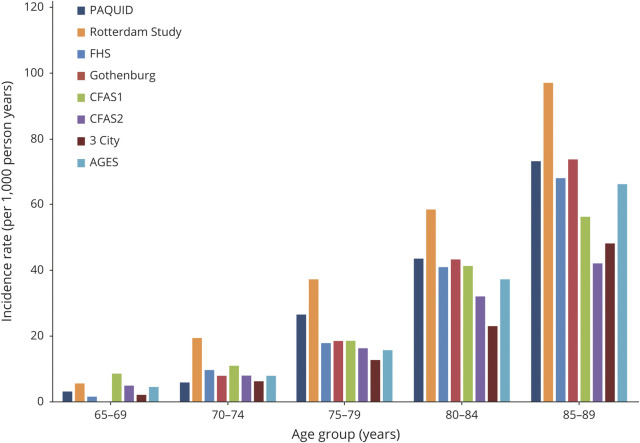
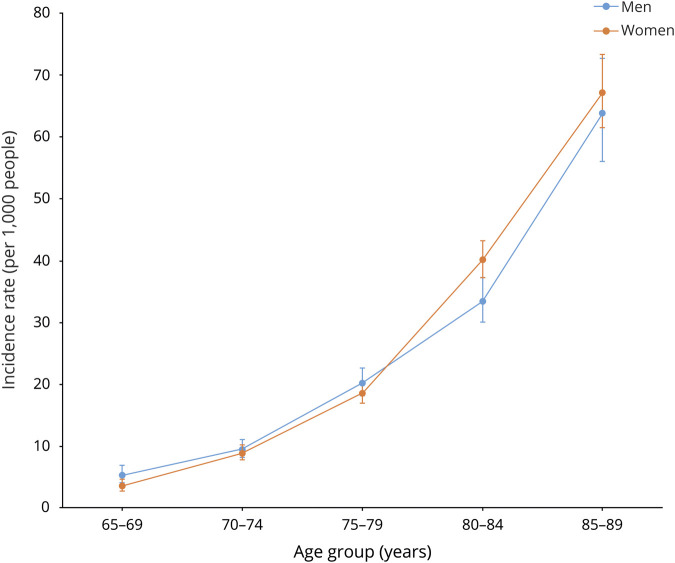
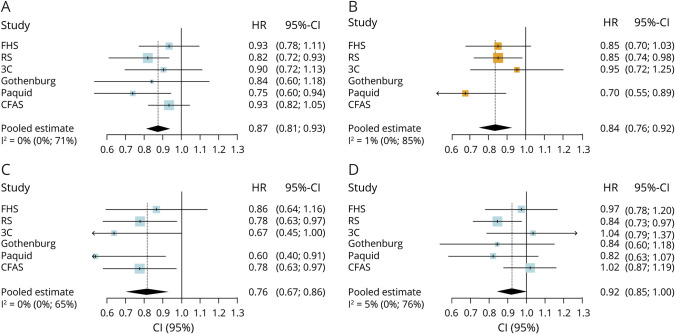
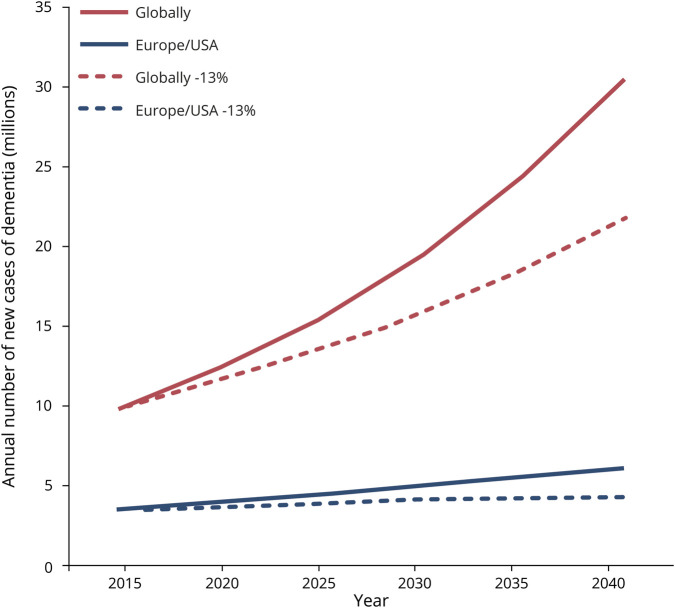
OBJECTIVE: To determine changes in the incidence of dementia between 1988 and 2015. METHODS: This analysis was performed in aggregated data from individuals >65 years of age in 7 population-based cohort studies in the United States and Europe from the Alzheimer Cohort Consortium. First, we calculated age- and sex-specific incidence rates for all-cause dementia, and then defined nonoverlapping 5-year epochs within each study to determine trends in incidence. Estimates of change per 10-year interval were pooled and results are presented combined and stratified by sex. RESULTS: Of 49,202 individuals, 4,253 (8.6%) developed dementia. The incidence rate of dementia increased with age, similarly for women and men, ranging from about 4 per 1,000 person-years in individuals aged 65-69 years to 65 per 1,000 person-years for those aged 85-89 years. The incidence rate of dementia declined by 13% per calendar decade (95% confidence interval [CI], 7%-19%), consistently across studies, and somewhat more pronouncedly in men than in women (24% [95% CI 14%-32%] vs 8% [0%-15%]). CONCLUSION: The incidence rate of dementia in Europe and North America has declined by 13% per decade over the past 25 years, consistently across studies. Incidence is similar for men and women, although declines were somewhat more profound in men. These observations call for sustained efforts to finding the causes for this decline, as well as determining their validity in geographically and ethnically diverse populations.
Overview
The claims and statistics of this paper haven’t been checked yet.
Free: it reads the open-access text and checks the first 5 claims that cite a source we can check. Create a free account to check every claim.
Integrity signals
Registry
Cites
Statistics
Figures
Verification
Claims the paper makes
The claims and statistics of this paper haven’t been checked yet.
Free: it reads the open-access text and checks the first 5 claims that cite a source we can check. Create a free account to check every claim.
Claims other papers make about this one
Each is checked against this paper’s own text: does it say what the citing paper says it does?
The source backs part of the claim, not all of it — or backs it for a different population, condition or comparison.
In the citing paper
“Where these have examined the relationship with deprivation, the decline is primarily in those in socio-economically advantaged areas.(15)”
From Dementia prevention, intervention, and care: 2024 report of the Lancet standing Commission (2024) · cites this paper as [15]
Experimental — accuracy not yet measuredThe source backs part of the claim, not all of it — or backs it for a different population, condition or comparison.
In the citing paper
“The Lancet Commission on Dementia Prevention, Intervention, and Care suggested that lifestyle modifications may already have an influence on dementia risk decades before the onset of dementia.3-8”
From Awareness of dementia risk reduction among current and future healthcare professionals: A survey study (2021) · cites this paper as [6]
Experimental — accuracy not yet measuredThe source backs part of the claim, not all of it — or backs it for a different population, condition or comparison.
In the citing paper
“Another key issue is that air pollution levels have been dropping over time in many areas of the world, and dementia incidence, as well, appears to have declined in North America and Europe in recent decades (Satizabal et al. 2016; Wolters et al. 2020).”
From Exposure to Air Pollution in Relation to Risk of Dementia and Related Outcomes: An Updated Systematic Review of the Epidemiological Literature (2021) · cites this paper as Wolters et al. 2020
Experimental — accuracy not yet measuredThe cited source says what the claim attributes to it.
In the citing paper
“Data from some HICs suggest a decline in age-specific incidence rates (15)”
From Dementia prevention, intervention, and care: 2024 report of the Lancet standing Commission (2024) · cites this paper as [15]
The cited source says what the claim attributes to it.
In the citing paper
“Evidence suggests that dementia incidence in Europe and the US has declined over the past 25 years, but declines were less in women than in men.61”
From Sex differences in cognitive decline among US adults (2021) · cites this paper as [61]
Self-check
Percentages, sums and reported differences re-computed from the paper’s own numbers.
The self-check needs the paper’s full text.
Citations
Cites
McKhann, G. M., Knopman, D. S., Chertkow, H., Hyman, B. T., Jack, C. R., Kawas, C. H., Klunk, W. E., Koroshetz, W. J., Manly, J. J., Mayeux, R., et al. (2011) · Alzheimer's & Dementia · doi:10.1016/j.jalz.2011.03.005 · Cited by 18,657
Vos, T., Abajobir, A. A., Abate, K. H., Abbafati, C., Abbas, K. M., Abd-Allah, F., Abdulkader, R. S., Abdulle, A. M., Abebo, T. A., Abera, S. F., et al. (2017) · The Lancet · doi:10.1016/s0140-6736(17)32154-2 · Cited by 13,220
Vos, T., Barber, R. M., Bell, B., Bertozzi-Villa, A., Biryukov, S., Bolliger, I., Charlson, F., Davis, A., Degenhardt, L., Dicker, D., et al. (2015) · The Lancet · doi:10.1016/s0140-6736(15)60692-4 · Cited by 6,414
Self-citationAging, natural death, and the compression of morbidity
Fries, J. F. (1980) · New England Journal of Medicine · doi:10.1056/nejm198007173030304 · Cited by 3,356
The Robust Inference for the Cox Proportional Hazards Model
Lin, D. Y., & Wei, L. J. (1989) · Journal of the American Statistical Association · doi:10.1080/01621459.1989.10478874 · Cited by 2,695
Zhou, B., Bentham, J., Di Cesare, M., Bixby, H., Danaei, G., Cowan, M. J., Paciorek, C. J., Singh, G., Hajifathalian, K., Bennett, J. E., et al. (2017) · The Lancet · doi:10.1016/s0140-6736(16)31919-5 · Cited by 2,579
Epidemiological approaches to heart disease: the Framingham study
Dawber, T. R., Meadors, G. F., & Moore, F. E. (1951) · American Journal of Public Health and the Nations Health · doi:10.2105/ajph.41.3.279 · Cited by 2,148
The Rotterdam Study: objectives and design update
Hofman, A., Breteler, M. M. B., van Duijn, C. M., Krestin, G. P., Pols, H. A., Stricker, B. H. C., Tiemeier, H., Uitterlinden, A. G., Vingerling, J. R., & Witteman, J. C. M. (2007) · European Journal of Epidemiology · doi:10.1007/s10654-007-9199-x · Cited by 1,395
Matthews, F. E., Arthur, A., Barnes, L. E., Bond, J., Jagger, C., Robinson, L., & Brayne, C. (2013) · The Lancet · doi:10.1016/s0140-6736(13)61570-6 · Cited by 1,155
Self-citation
Research works printed but not linked: 3
- 2. Alzheimer’s Disease International. Policy Brief for G8 Heads of Government: The Global Impact of Dementia 2013–2050 [online]. Available at: alz.co.uk/research/G8-policy-brief. Accessed May 20, 2019.
- 3. WHO. First WHO Ministerial Conference on Global Action Against Dementia [Internet]. Available at: hoint/mental_health/neurology/dementia/ministerial_conference_2015_report/en/(2015). Accessed February 25, 2018.
- 23. Alzheimer's Disease International. World Alzheimer Report 2015 [Internet]. Available at: alzcouk/research/world-report-2015. Accessed February 26, 2018.
Cited by
Items 301–400 of 525
Cognitive co-ageing with inequitable political ecologies: Deconditioning & urban public transport
Fletcher, J. R. (2025) · Social Science & Medicine · doi:10.1016/j.socscimed.2025.118727 · Cited by 3
The incidence of dementia in populations around the globe
Vella, A. S., Röhr, S., & Sachdev, P. S. (2025) · Current Opinion in Psychiatry · doi:10.1097/yco.0000000000001053 · Cited by 3
Incidence of dementia diagnosis in Denmark, 1986–2023: an age-period-cohort analysis
Callaway, J., Strozza, C., & Jóhannsson, Ó. D. (2026) · Social Science & Medicine · doi:10.1016/j.socscimed.2026.118951 · Cited by 3
Baumann, B., Lipka, T., Jänner, M., & Kujovic, M. (2022) · European Archives of Psychiatry and Clinical Neuroscience · doi:10.1007/s00406-022-01516-3 · Cited by 3
Gualco, C., Sette, P. D., Chiorri, C., & Maria, E. D. (2025) · Experimental Gerontology · doi:10.1016/j.exger.2025.112796 · Cited by 3
“The higher prevalence of dementia in women is linked to greater longevity, whereas most epidemiological studies did not demonstrate a difference in terms of incidence between women and men (Wolters et al., 2020).”
Exposure factors associated with dementia among older adults in Iceland: the AGES-Reykjavik study
Valsdóttir, V., Magnúsdóttir, B. B., Gylfason, H. F., Chang, M., Aspelund, T., Gudnason, V. G., Launer, L. J., & Jónsdóttir, M. K. (2023) · GeroScience · doi:10.1007/s11357-023-00804-7 · Cited by 3
“Even though there is a growing body of evidence suggesting that dementia incidence is declining in certain parts of the world [3], significant increases in the number of people affected by dementia are to be expected by 2050 due to population aging and population growth [2].”
Self-citationPerspectives on brain health and dementia prevention in Latin America: challenges and opportunities
Fox, S., León, T., Mariano, L. I., Arshad, F., Guimet, N. M., Hope, G., Tituana, K. A., & Zapata‐Restrepo, L. M. (2023) · Frontiers in Dementia · doi:10.3389/frdem.2023.1275641 · Cited by 3
Peixoto, V. G. D. M. N. P., Facci, L. A., Barbalho, T. C. D. S., Souza, R. N., Duarte, A. M., dos Santos, M. B., & de Almondes, K. M. (2024) · Frontiers in Neurology · doi:10.3389/fneur.2024.1334161 · Cited by 3
Underwood, E. C., Vera, I., Allen, D., Alvior, J., O’Driscoll, M., Silbert, S., Kim, K., & Barr, K. L. (2024) · Viruses · doi:10.3390/v16050719 · Cited by 3
Tipping the Balance Between Cognitive Reserve, Frailty, and Dementia in the Very Old?
Ottaviani, S., Tagliafico, L., Muzyka, M., Page, E. H., Ottaviani, E., Ponzano, M., Signori, A., Nencioni, A., & Monacelli, F. (2024) · Journal of Alzheimer s Disease · doi:10.3233/jad-231121 · Cited by 3
Ma’u, E., Cullum, S. J., Mukadam, N., Davis, D. H. J., Rodriguez, C. R., & Cheung, G. (2024) · The Lancet Regional Health - Western Pacific · doi:10.1016/j.lanwpc.2024.101216 · Cited by 6
Scalp Stimulation Targets for Neurological Conditions—Evidence from Large-Scale Meta-Analyses
Cao, J., Chai‐Zhang, T. C., McDonald, C. M., & Kong, J. (2022) · Journal of Integrative Neuroscience · doi:10.31083/j.jin2103083 · Cited by 3
Schott, J. M. (2022) · Practical Neurology · doi:10.1136/pn-2022-003418 · Cited by 3
Sun, K., Jin, S., Yang, Z., Li, X., Li, C., Zhang, J., Yang, G., Yang, C., Abdelrahman, Z., & Liu, Z. (2024) · Journal of Affective Disorders · doi:10.1016/j.jad.2024.01.007 · Cited by 3
Mehta, K., Morton, J. I., Salim, A., Anstey, K. J., Shaw, J. E., & Magliano, D. J. (2025) · Journal of Alzheimer s Disease · doi:10.1177/13872877251329458 · Cited by 2
Busto, G. U., Hirtz, C., Carrière, I., Bennys, K., Gutierrez, L., Kindermans, J., Helmer, C., Gabelle, A., Lehmann, S., & Berr, C. (2025) · The Journal of Prevention of Alzheimer s Disease · doi:10.1016/j.tjpad.2025.100186 · Cited by 2
“IP-MS quantifications being economically limited, a case-cohort sampling method [ 41 ] combining two selection pathways for inclusions was used: [ 1 ] a subcohort of 300 individuals randomly selected taking 1/5th of the individuals from the blood biobank thus including cases and non-cases; [ 2 ] all…”
Self-citationFujihara, S., Watanabe, R., Tsuji, T., Miyaguni, Y., & Kondo, K. (2025) · Archives of Gerontology and Geriatrics · doi:10.1016/j.archger.2025.105944 · Cited by 2
A brain health framework with application to the study of neurodegeneration
Duchesne, S., Potvin, O., Hudon, C., & Bocti, C. (2025) · Journal of Alzheimer s Disease · doi:10.1177/13872877251364867 · Cited by 2
Hickman, L. B., Pandey, B., Fish, A., Bandla, M., Husein, A., Allas, C. H., Kottakota, H., Herzog, L., Vossel, K. A., & Stern, J. M. (2025) · Epilepsia Open · doi:10.1002/epi4.70156 · Cited by 2
Alzheimer Syndrome or Age-Related Dementia—History, Therapy and Prevention
Bermejo‐Pareja, F., & del Ser, T. (2025) · Journal of Clinical Medicine · doi:10.3390/jcm14217752 · Cited by 3
“…a cascade of population-based cohort studies and registry data (e.g., in Sweden) over several decades showed a decline in dementia risk among the elderly in affluent countries across North America and Europe, but not in Asia (Japan and South Korea have not shown this trend) [16,25,145–158].”
Doblhammer, G., Erlangsen, A., Fink, A., & Canudas‐Romo, V. (2025) · Alzheimer s Research & Therapy · doi:10.1186/s13195-025-01911-7 · Cited by 2
Lifestyle shapes preclinical social and microglial deficits in an Alzheimer’s disease mouse model
Ehret, F., Doludda, B., Liu, H., Nexhipi, S., Huang, H., Rost, F., Overall, R. W., Barde, W., Rünker, A. E., Sieweke, M. H., et al. (2025) · Molecular Psychiatry · doi:10.1038/s41380-025-03368-4 · Cited by 3
Zülke, A. E., Luppa, M., Lammer, L., Röhr, S., Baber, R., Biemann, R., Wirkner, K., Zeynalova, S., Yahiaoui‐Doktor, M., Zachariae, S., et al. (2026) · Alzheimer s Research & Therapy · doi:10.1186/s13195-026-02017-4 · Cited by 4
Li, Y., Li, J., Liu, X., Wang, T., Ma, L., She, R., & Chang, Y. (2026) · Rejuvenation Research · doi:10.1177/15491684261442832 · Cited by 2
Evolving national dementia policies in the OECD: Prevention, diagnosis, and care
Kim, S., Rauet-Tejeda, J., Milstein, R., Lee, J., & Nozal, A. L. (2026) · Alzheimer s & Dementia · doi:10.1002/alz.71367 · Cited by 2
Trends in Dementia Prevalence Across Latin America and the Caribbean
Llibre‐Guerra, J. J., Wu, Y., Acosta, I., Soria, C., Sosa, A. L., Acosta, D. M., Jiménez‐Velázquez, I. Z., Guerra, M., Salas, A., Lu, R., et al. (2026) · JAMA Neurology · doi:10.1001/jamaneurol.2026.2305 · Cited by 3
Promoting Brain Health Through Public Education and Media Work
Braun, M., & Randolph, J. J. (2022) · Springer eBooks · doi:10.1007/978-3-031-11389-5_11 · Cited by 2
More Than Fiscal: The Intergenerational Report, Sustainability and Public Policy in Australia
Woods, M., Podger, A., & Hall, J. P. (2023) · ANU Press eBooks · doi:10.22459/mf.2023 · Cited by 2
Adair, T., Li, H., Temple, J., & Anstey, K. J. (2023) · Alzheimer Disease & Associated Disorders · doi:10.1097/wad.0000000000000562 · Cited by 2
Chintapalli, R., Myint, P. K., Brayne, C., Hayat, S. A., & Keevil, V. L. (2023) · European Journal of Epidemiology · doi:10.1007/s10654-023-01064-7 · Cited by 3
Self-citationPain Management in the Older Adult
Sapell, D., Hale, C., Takeshita, A., & Copenhaver, D. J. (2023) · Springer eBooks · doi:10.1007/978-3-030-01782-8_90-1 · Cited by 2
Pain Management in the Older Adult
Sapell, D., Hale, C., Takeshita, A., & Copenhaver, D. J. (2024) · Springer eBooks · doi:10.1007/978-3-030-74720-6_90 · Cited by 2
DOSE: a lifestyle philosophy for dementia prevention informed by drug development and epidemiology
Daly, T. P. (2024) · Dementia & Neuropsychologia · doi:10.1590/1980-5764-dn-2023-0112 · Cited by 2
Mora-Ortiz, M., García-Fernández, H., Pérez‐Martínez, P., & Camargo, A. (2024) · Open Research Europe · doi:10.12688/openreseurope.18568.1 · Cited by 2
What is the evidence for using antidepressants to reduce anxiety for people with dementia?
Bingley, J., Young, A., & Chong, T. W. H. (2024) · Archives of Gerontology and Geriatrics Plus · doi:10.1016/j.aggp.2024.100108 · Cited by 3
Yang, Y. J., Jiang, Y., Wen, M., & Wang, L. (2024) · International Journal of Geriatric Psychiatry · doi:10.1002/gps.70032 · Cited by 2
Ethical challenges associated with the early detection of Alzheimer's disease
Milne, R., Costa, A., & Brayne, C. (2025) · Elsevier eBooks · doi:10.1016/b978-0-12-822240-9.00019-3 · Cited by 3
Self-citationAre modifiable risk factors for dementia really modifiable?
Ma’u, E., Cullum, S. J., Röhr, S., & Brayne, C. (2025) · Current Opinion in Psychiatry · doi:10.1097/yco.0000000000001018 · Cited by 3
Self-citationAbzhandadze, T., Hoang, M. T., Raaschou, P., Norgren, J., Mo, M., Molnár, C., Xu, H., Kananen, L., Åkerman, M., Religa, D., et al. (2025) · Scientific Reports · doi:10.1038/s41598-025-03055-y · Cited by 3
“A true decline in the incidence of dementia between 2008 to 2021 may have occurred, as is supported by findings from several studies conducted in Europe and North America 26,27 .”
Technological advances enabling an enhanced understanding of early Alzheimer's disease
Au, R., Bose, N., Imam, F. B., & Kolachalama, V. B. (2025) · Alzheimer s & Dementia · doi:10.1002/alz.70883 · Cited by 2
Maladie d’Alzheimer et affections apparentées
Auriacombe, S. (2022) · Elsevier eBooks · doi:10.1016/b978-2-294-76331-1.00011-2 · Cited by 2
Alzheimer’s Disease: A Molecular Model and Implied Path to Improved Therapy
Weaver-Rosen, M., & Serwer, P. (2024) · International Journal of Molecular Sciences · doi:10.3390/ijms25063479 · Cited by 2
“These data indicate that (discussion of details in [19]), since ~1995, age-normalized AD frequency (not AD frequency without age normalization) has decreased in the United States and Western Europe but not in China and Japan [45], where anti-herpes virus vaccination has been less emphasized.”
Costa, C., Cesarini, E. N., Eusebi, P., Franchini, D., Casucci, P., Giorgi, M. D., Calvello, C., Paoletti, F. P., Romoli, M., & Parnetti, L. (2024) · Journal of Alzheimer s Disease · doi:10.3233/jad-231309 · Cited by 2
(Un)Ethical Early Interventions in the Alzheimer’s “Marketplace of Memory”
George, D. R., & Whitehouse, P. J. (2021) · AJOB Neuroscience · doi:10.1080/21507740.2021.1941402 · Cited by 2
CONCEPTUAL ADVANCEMENT: SOCIAL HEALTH AS A FACILITATOR IN THE USE OF COGNITIVE RESERVEPreprint
Vernooij-Dassen, M. J. F. J., Verspoor, E., Samtani, S., Sachdev, P. S., Ikram, M. A., Vernooij, M. W., Hubers, C., Chattat, R., Lenart‐Bugla, M., Rymaszewska, J., et al. (2022) · medRxiv · doi:10.1101/2022.06.07.22276079 · Cited by 2
Self-citationIndividuals with dementia and populations with dementia
Shaaban, C. E. (2024) · Cerebral Circulation - Cognition and Behavior · doi:10.1016/j.cccb.2024.100221 · Cited by 3
Dementia and Cognitive Impairment
Chong, Y. F. V., & Tang, S. (2024) · Elsevier eBooks · doi:10.1016/b978-0-323-99967-0.00134-4 · Cited by 2
Descriptive epidemiology of dementia in the US
Ahmadi‐Abhari, S., & Brayne, C. (2025) · BMJ · doi:10.1136/bmj.r888 · Cited by 2
Self-citationMid‐life extrapyramidal symptoms predict cognitive impairment 23 years later
Holtback, C., Welin, C., Fu, M., Thunström, E. Ö., Rosengren, A., Lappas, G., & Hansson, P. (2021) · Acta Neurologica Scandinavica · doi:10.1111/ane.13557 · Cited by 1
Preventing What’s Preventable in Dementia
Hartman-Stein, P. E., George, D. R., & McVaugh, B. K. (2021) · Springer eBooks · doi:10.1007/978-3-030-83469-2_18 · Cited by 1
Leon, T. (2022) · International Psychogeriatrics · doi:10.1017/s1041610222000059 · Cited by 2
From Reactive to Proactive – The Future Life Design to Promote Health and Extend the Human Lifespan
Yao, L., Yang, C., Graff, J. C., Wang, G., Wang, G., & Gu, W. (2024) · Advanced Biology · doi:10.1002/adbi.202400148 · Cited by 3
Geospatial Applications in Alzheimer’s Disease Research and Beyond: A Systematic Review
Zhang, Z., Wu, L., Tao, L., Hu, S. H., Long, H., Xu, Y., Li, J., Zhang, J., Zhou, Z., Liu, J., et al. (2024) · Annals of the American Association of Geographers · doi:10.1080/24694452.2024.2373808 · Cited by 2
“In contrast, rates have been rising in middle-and low-income countries (Wolters et al. 2020).”
Prosocial Intentions and Subsequent Cognitive Health: A Prospective Cohort Study
Farmer, J. G., Macchia, L., Bu, F., Gong, J., Steptoe, A., Demakakos, P., & Kubzansky, L. D. (2025) · The Journals of Gerontology Series B · doi:10.1093/geronb/gbaf004 · Cited by 2
Shi, Y., Tang, Y., Wang, Y., Fei, X., Xu, X., & Zhang, Y. (2025) · Journal of Alzheimer s Disease · doi:10.1177/13872877251344218 · Cited by 1
Islam, M. N., Musarrat, P., Konradsen, H., Tyrrell, M., Roy, A., Anik, A. I., & Kabir, Z. N. (2025) · PLoS ONE · doi:10.1371/journal.pone.0326207 · Cited by 1
Zerbini, G., Wiese, E., Muehlich, L., Hasan, A., Kunz, M., Haeckert, J., & Reicherts, P. (2025) · Journal of Applied Gerontology · doi:10.1177/07334648251372691 · Cited by 2
Zenesini, C., Cascini, S., Picariello, R., Profili, F., Belotti, L. M. B., Maniscalco, L., Acampora, A., Gnavi, R., Francesconi, P., Vignatelli, L., et al. (2025) · Journal of Clinical Medicine · doi:10.3390/jcm14186622 · Cited by 1
“In recent decades, population-based studies strengthened the role of primary prevention by reporting a decrease in the incidence of dementia, potentially attributable to reduced exposure to certain risk factors [11–14].”
Promoting risk reduction: increasing public health capacity to address dementia
Roberts, S. S., Lewis, M., Colcombe, C. W., Kline, C., Donnelly, J. M., Denno, B., Snyder, H. M., & Baumgart, M. (2025) · The Gerontologist · doi:10.1093/geront/gnaf227 · Cited by 1
Sex/gender differences in lifetime dementia risk among Asian American and White older adults
Rojas‐Saunero, L. P., Wu, Y., Zhou, Y., Hayes‐Larson, E., Gee, G. C., Brookmeyer, R., Elser, H. C., Posis, A. I. B., Kanaya, A. M., Whitmer, R. A., et al. (2025) · npj Dementia · doi:10.1038/s44400-025-00038-8 · Cited by 1
Melendo-Azuela, E. M., Lladó, A., Vela, E., Mariscal, S., Clèries, M., Piñol‐Ripoll, G., & Santaeugènia, S. (2025) · BMC Public Health · doi:10.1186/s12889-025-24341-4 · Cited by 2
de Havenon, A., Littig, L., Clocchiatti‐Tuozzo, S., Johnson, I. P., Constantinescu, S., Rivier, C. A., Huo, S., Kimberly, W. T., Gómez‐Isla, T., Kim, Y., et al. (2025) · Annals of Neurology · doi:10.1002/ana.78103 · Cited by 2
Farfel, J. M., Capuano, A. W., Nag, S., Sampaio, M. C. M., Gibbons, J., Wilson, R. S., & Bennett, D. A. (2025) · Neuroepidemiology · doi:10.1159/000547564 · Cited by 1
Validity of the Spanish version of the quick mild cognitive impairment screen (Q mci -S)
Orfila, F., Bañuelos, N. L., Vázquez‐Ibar, O., Molloy, D. W., & Ó’Caoimh, R. (2025) · Journal of Alzheimer s Disease · doi:10.1177/13872877251400791 · Cited by 1
Lutz, M., Galijašević, M., Lindtner, R. A., Ellmerer, A. E., Wippel, D., Gizewski, E. R., Mangesius, S., Krappinger, D., & Loizides, A. (2025) · Diagnostics · doi:10.3390/diagnostics15243151 · Cited by 1
The clinical phenotype of carriers of intermediate alleles in the huntingtin gene: A scoping review
van Hofslot, A., Oosterloo, M., de Jong, J. J. A., Andriessen, R. L., de Bot, S. T., & Linden, D. E. J. (2025) · Journal of Huntington s Disease · doi:10.1177/18796397251397683 · Cited by 1
Wang, M., Wang, T., Wang, X., Liu, C., Gao, F., Qiu, B., Guo, T., & Huang, Y. (2026) · Journal of Translational Medicine · doi:10.1186/s12967-026-07843-6 · Cited by 1
Scientific knowledge about dementia: From the Global South to the world
Daly, T. P., López‐Barrenechea, I., Vergara, P. U., Arshad, F., Paplikar, A., Chaudhuri, A. R., Crivelli, L., Ibáñez, A. M., Alladi, S., & Slachevsky, A. Z. (2026) · Alzheimer s & Dementia · doi:10.1002/alz.71269 · Cited by 2
Ensemble-Based Estimation of Alzheimer’s Disease Incidence from Dynamic Population Reconstructions
Bertaglia, G., Iacomini, E., & Viguerie, A. (2026) · SIAM Journal on Life Sciences · doi:10.1137/25m1782522 · Cited by 1
Beyond clinical toxicology: protecting our poisoned patients
Ferner, R. E., Aronson, J. K., & Bradberry, S. (2026) · Journal of the Royal Society of Medicine · doi:10.1177/01410768261440369 · Cited by 1
Lutski, M., Zucker, I., Rozenshmidt, M., Lin, E., Gross-Nevo, R. F., Laxer, I., Keinan-Boker, L., & Bromberg, M. (2026) · Dementia and Geriatric Cognitive Disorders · doi:10.1159/000552194 · Cited by 1
Zülke, A. E., Luppa, M., Sander, C., Baber, R., Biemann, R., Wirkner, K., Zeynalova, S., Zachariae, S., Matijević, M., Engel, C., et al. (2026) · Alzheimer s Research & Therapy · doi:10.1186/s13195-026-02087-4 · Cited by 1
Self-citationThe growing burden of dementia in Asia: Comparative insights from Japan, China, and India
Zhang, C., Chen, X., & Sun, Y. (2026) · The Journal of Prevention of Alzheimer s Disease · doi:10.1016/j.tjpad.2026.100614 · Cited by 2
“It contrasts the compressed morbidity of some other Western high-income populations, where the decline of age-specific incidence had started to stabilize the burden [40].”
How to avoid dementia — what the science really says
Pearson, H. (2026) · Nature · doi:10.1038/d41586-026-02098-z · Cited by 1
Cardiovascular Stress Physiology and Interoceptive Pathways to Brain Aging and Health
Gianaros, P. J. (2026) · Psychosomatic Medicine · doi:10.1097/psy.0000000000001510 · Cited by 1
Socioeconomic deprivation and dementia risk in New Zealand: A modelling study
Ma’u, E., Rush, N., Tamatea, J., Ofanoa, M., Walsh, S., Livingston, G., Mukadam, N., Cheung, G., & Cullum, S. J. (2026) · Australian & New Zealand Journal of Psychiatry · doi:10.1177/00048674261470616 · Cited by 1
Cardiorespiratory Fitness, Coronary Artery Calcium, and Risk of Later-Life Dementia
Gerber, Y., Leonard, D., Shuval, K., Barlow, C. E., Meernik, C., Pavlovic, A., Li, Q., Appiah, D., Gabriel, K. P., Radford, N. B., et al. (2026) · JACC Advances · doi:10.1016/j.jacadv.2026.103079 · Cited by 1
Penna, M. D. O., Maziero, B. R., Ilha, S., Blasi, T. C., & Limberger, J. B. (2021) · Research Society and Development · doi:10.33448/rsd-v10i5.14967 · Cited by 1
Vascular Brain Disease in Geriatric Neuropsychiatry
Alves, G. S., & Sudo, F. K. (2022) · IntechOpen eBooks · doi:10.5772/intechopen.101181 · Cited by 1
Incidence of Dementia Declines in High-Income Countries
(2020) · AJN American Journal of Nursing · doi:10.1097/01.naj.0000721896.29765.6e · Cited by 1
Admiral Nursing: supporting generalist nurses to work with families affected by dementia
Dening, K. H., Aldridge, Z., & Hayo, H. (2022) · Nursing Standard · doi:10.7748/ns.2022.e12006 · Cited by 1
Lutski, M., Shahar, R., Vered, S., Novick, D., Zucker, I., & Weinstein, G. (2023) · International Journal of Geriatric Psychiatry · doi:10.1002/gps.5871 · Cited by 3
“With the rapid aging of the population, the number of people living with dementia is projected to triple in the next 30 years, and the socioeconomic burden of dementia is expected to increase accordingly.(1) The proportion of persons aged 65 and older in Israel has increased from 4% in 1948% to 12% by the end of 2019.”
Dementia’s preventative futures: researcher perspectives on prospective developments in the UK
Fahey, M., Tinker, A., & Fletcher, J. R. (2023) · Working with Older People · doi:10.1108/wwop-10-2022-0049 · Cited by 2
Towards feminist health empowerment for self-testing apps : testing for dementia
Kapeller, A. (2023) · Linköping studies in arts and science · doi:10.3384/9789180751421 · Cited by 2
Health and Aged Care in the Intergenerational Report
Gibson, D. M., Goss, J. R., & Hall, J. P. (2023) · ANU Press eBooks · doi:10.22459/mf.2023.09 · Cited by 1
Melati, K. B. D. S., Herdaetha, A., & Kusuma, W. (2023) · JUXTA Jurnal Ilmiah Mahasiswa Kedokteran Universitas Airlangga · doi:10.20473/juxta.v14i22023.57-62 · Cited by 1
Sandu, I., Ștefăniu, R., Alexa‐Stratulat, T., Ilie, A. C., Albişteanu, S.-M., Turcu, A.-M., Sandu, C.-A., Alexa, A. I., Pîslaru, A. I., Grigoraș, G., et al. (2023) · Journal of Personalized Medicine · doi:10.3390/jpm13121630 · Cited by 1
“Current estimates show that the age-specific incidence of dementia is following a downward trend, possibly due to better management of both diabetes and hypertension and an increase in literacy [15], although changes in other of the afore-mentioned risk factors could also play a role.”
BackgroundInfluentialDigging Deeper: What Can We Really Learn about Dementia from History?
Ballenger, J. F., George, D. R., & Whitehouse, P. J. (2024) · Journal of Alzheimer s Disease · doi:10.3233/jad-240051 · Cited by 1
Incidence of dementia in the German Heinz Nixdorf Recall study over 20 years
Schramm, S. H., Rinck, C., Krizanovic, N., Jöckel, K., Hüsing, A., Gronewold, J., Hermann, D. M., Schmidt, B., Stang, A., & Jokisch, M. (2025) · Alzheimer s & Dementia Diagnosis Assessment & Disease Monitoring · doi:10.1002/dad2.70061 · Cited by 3
The Meanings of Alzheimer’s Disease
Daly, T. P. (2025) · Philosophy of Medicine · doi:10.5195/pom.2025.251 · Cited by 2
Wiese, E., Halms, T., Reicherts, P., Zerbini, G., Kunz, M., Hasan, A., & Haeckert, J. (2025) · The American Journal of Geriatric Psychiatry Open Science Education and Practice · doi:10.1016/j.osep.2025.06.001 · Cited by 2
The cardiometabolic "bottleneck" on cognitive function in aging
Daly, T. P. (2025) · Alzheimer s & Dementia · doi:10.1002/alz.70685 · Cited by 1
The Quest for Cure of “Alzheimer's”: Reimagining the Goal by Changing Culture
Whitehouse, P. J., George, D. R., & Riegal, C. (2025) · The Hastings Center Report · doi:10.1002/hast.4992 · Cited by 1
Sharma, S., Sharma, U., Sethiya, N. K., & Singh, L. (2026) · Current Aging Science · doi:10.2174/0118746098373086251201095903 · Cited by 1
Asociaciones entre dieta y función cognitiva en el Proyecto SUN
Muñoz, M. I. (2022) · Depósito Académico Digital Universidad de Navarra (University of Navarra) · doi:10.15581/10171/63292 · Cited by 1
Time trends in neuropathology give clues to dementia risk reduction
Merrick, R. L., & Matthews, F. E. (2023) · Nature Reviews Neurology · doi:10.1038/s41582-023-00812-3 · Cited by 2
Self-citationIs US residence a risk factor for Alzheimer's disease?
Høilund‐Carlsen, P. F., Alavi, A. A., Costa, T., Neve, R. L., Perry, G. L., Revheim, M.-E. R., & Barrio, J. R. (2025) · Journal of Alzheimer s Disease · doi:10.1177/13872877251356682 · Cited by 1
Jacquemin, C. (2023) · theses.fr (ABES) · doi:10.70675/574d02aaz56daz485fz843dz68565d474db9 · Cited by 1
Reply to comment on: “Retinal vein occlusion and the risk of dementia: a nationwide cohort study”
Nam, G. E., Han, K., Park, S. H., Cho, K. H., & Song, S. J. (2021) · American Journal of Ophthalmology · doi:10.1016/j.ajo.2021.05.005
Risk factors for dementia. Lifestyle, hormones, neurochemistry, and genetics
Najar, J. (2021) · Gothenburg University Publications Electronic Archive (Gothenburg University)
Metadata
- Authors
- Wolters, F. J., Chibnik, L. B., Waziry, R., Anderson, R., Berr, C., Beiser, A., Bis, J. C., Blacker, D., Bos, D., Brayne, C., Dartigues, J.-F., Darweesh, S. K. L., Davis-Plourde, K. L., de Wolf, F., Debette, S., Dufouil, C., Fornage, M., Goudsmit, J., Grasset, L., Gudnason, V., Hadjichrysanthou, C., Helmer, C., Ikram, M. A., Ikram, M. K., Joas, E., Kern, S., Kuller, L. H., Launer, L., Lopez, O. L., Matthews, F. E., McRae-McKee, K., Meirelles, O., Mosley, T. H., Pase, M. P., Psaty, B. M., Satizabal, C. L., Seshadri, S., Skoog, I., Stephan, B. C. M., Wetterberg, H., Wong, M. M., Zettergren, A., & Hofman, A.
- Affiliations
- Harvard University (US)
- Boston University (US)
- From the Department of Epidemiology (F.J.W., L.B.C., R.W., D. Blacker, D. Bos, J.G., A.H.), Harvard T.H. Chan School of Public Health, Boston, MA; Departments of Epidemiology (F.J.W., D. Bos, S.K.L.D., M.A.I., M.K.I., A.H.), Radiology and Nuclear Medicine (D. Bos), and Neurology (M.K.I.), Erasmus MC, Rotterdam, the Netherlands; Department of Neurology (L.B.C.), Massachusetts General Hospital, Boston; Department of Infectious Disease Epidemiology (R.A., F.d.W., C. Hadjichrysanthou, K.M.-M., M.M.W.),...
- ORCID
- Wolters, Frank J.
- Chibnik, Lori B.
- Waziry, Reem
- Anderson, Roy
- Berr, Claudine
- Beiser, Alexa
- Bis, Joshua C.
- Blacker, Deborah
- Brayne, Carol
- Dartigues, Jean-François
- Darweesh, Sirwan K.L.
- Dufouil, Carole
- Fornage, Myriam
- Grasset, Leslie
- Gudnason, Vilmundur
- Hadjichrysanthou, Christoforos
- Helmer, Catherine
- Ikram, M. Arfan
- Joas, Erik
- Kern, Silke
- Kuller, Lewis H.
- Launer, Lenore
- Matthews, Fiona E.
- Meirelles, Osorio
- Mosley, Thomas H.
- Pase, Matthew P.
- Psaty, Bruce M.
- Satizabal, Claudia L.
- Seshadri, Sudha
- Skoog, Ingmar
- Stephan, Blossom C.M.
- Wetterberg, Hanna
- Zettergren, Anna
- Hofman, Albert
- Venue
- Neurology
- Published
- 2020-08-04
- Volume
- 95
- Issue
- 5
- Pages
- e519-e531
- ISSN
- 0028-3878 (ISSN-L)
- 1526-632X
- PMC
- PMC7455342
- OpenAlex
- W3082444018
- Semantic Scholar
- be78bfa099e4c4a4dbe1129266725de4e5e7851d
- Cited by
- 489
- References
- 33
- Citations by year
- 2026: 57 · 2025: 108 · 2024: 90 · 2023: 85 · 2022: 85 · 2021: 54 · 2020: 9
- FWCI
- 42.49
- Type
- journal article
- Language
- en
- Open access
- hybrid
- doi.org
- Licence
- cc-by-nc-nd
- Locations
- Neurology (publishedVersion, cc-by-nc-nd)
- PubMed Central (publishedVersion, cc-by-nc-nd)
- PubMed (publishedVersion)
- EUR Research Repository (Erasmus University Rotterdam) (publishedVersion, other-oa)
- Repository@Nottingham (University of Nottingham) (acceptedVersion, other-oa)
- HAL (submittedVersion, cc-by-nc-nd)
- Repository@Hull (Worktribe) (University of Hull) (submittedVersion, cc-by-nc-nd)
- Repository@Nottingham (University of Nottingham) (submittedVersion, cc-by-nc-nd)
- Opin vísindi (Opin vísindi) (submittedVersion, cc-by-nc-sa)
- EUR Research Repository (Erasmus University Rotterdam) (submittedVersion, other-oa)
- RePub (Erasmus University Rotterdam) (submittedVersion, other-oa)
- Opin vísindi (Opin vísindi) (submittedVersion, other-oa)
- Oskar-Bordeaux (Universite de Bordeaux) (submittedVersion, cc-by-nc-nd)
- Spiral (Imperial College London) (submittedVersion, other-oa)
- Newcastle University ePrints (Newcastle Univesity) (cc-by-nc-nd)
- Funders
- Alzheimer's Association (IIRG-09-131338, AG033040, NS017950, AG033193, 2008-1229, ZEN‐01‐3151)
- GlaxoSmithKline
- Sanofi
- Yale University
- Västra Götalandsregionen
- Stiftelsen för Gamla Tjänarinnor
- National Institute for Health and Care Research (G9901400)
- European Commission (FP7 ICT, 601055, HORIZON2020, ICT-2011, 2007e2013, FP7/2007e2013, FP7‐ICT‐2011, 667375)
- Agence Nationale de la Recherche (06‐PNRA‐005, ANR‐06‐PNRA‐005, COGINUT ANR-06-PNRA-005, ANR-06-PNRA-0005, 2009-2012, ANR-07-LVIE-0003)
- Institut National de la Santé et de la Recherche Médicale (2009-2012)
- ZonMw
- Erasmus Universiteit Rotterdam
- Forskningsrådet för Arbetsliv och Socialvetenskap (2003-0234, 2006-0596, ZEN-01-3151, 2010-0870, 2006-0020, 2001-2646, 2008-1229, 2004-0150, 2013-2496, 2013-2300, 2008-1111, 2012-1138, 2004-0145)
- VSNU Vereniging van Universiteiten
- Fondation pour la Recherche Médicale
- Ministerie van Onderwijs, Cultuur en Wetenschap
- Nederlandse Organisatie voor Wetenschappelijk Onderzoek
- Hjärnfonden
- Vetenskapsrådet (2013–8,717, 2010-0870, 2012‐1138, 2013-2300, 2013‐2496, 2015-02830, 2015-02830, 2013-8717, 2012–5,041)
- Fondation de France
- Konung Gustaf V:s och Drottning Victorias Frimurarestiftelse
- Université de Bordeaux
- Forskningsrådet om Hälsa, Arbetsliv och Välfärd (2013-8717, 2008-1111, 2003‐0234, 2013‐2496, 2004‐0150, 2013‐2300, 2008‐1229, 2006-0596, 2006‐0020, 2004-0145, 2010-0870, 2013-1202, 2012‐1138, 2001‐2646, ZEN-01-3151)
- Mutuelle Générale de l'Education Nationale
- Hjartavernd (HHSN271201200022C, N01-AG-1-2100)
- Ipsen
- Janssen Prevention Center
- National Institutes of Health (n01ag12100-57-0-2, n01hc25195-41-0-1)
- Novartis Pharma
- Medical Research Council (G06010220, G9901400, MR/R015600/1)
- National Institute on Aging (AG-008122, AG049505, U01AG049505, N01-AG12100, AG054076, N01-HC-25195, U01AG052409, AG052409, R01AG054076, R01AG049607, AG033193, NS017950, R01AG033040, AG058589, AG 033040, AG059421, R01AG033193, RF1AG059421, R01AG008122, HHSN271201200022C, P30AG062421, P30AG066546)
- National Heart, Lung, and Blood Institute (HC25195, HL-105756, N01‐HC25195, HHSN268201500001I, HHSN268201500001C, U01HL130114, N01-HC, N01-HC-25195 and HHSN268201500001I, NS100605, AG033040, NS017950, AG033193)
- National Institute on Drug Abuse (HHSN271201200022C)
- National Eye Institute
- National Institute on Deafness and Other Communication Disorders (HHSN268201500001I)
- National Institute of Neurological Disorders and Stroke (UH2NS100605, UH3NS100605, R01NS017950)
- Janssen Pharmaceuticals
- H2020 European Research Council (678543)
- FP7 Information and Communication Technologies
- Topics
- Health Sciences › Medicine › Psychiatry and Mental health › Dementia and Cognitive Impairment Research
- Life Sciences › Neuroscience › Cellular and Molecular Neuroscience › Alzheimer's disease research and treatments
- Social Sciences › Psychology › Experimental and Cognitive Psychology › Cognitive Abilities and Testing
- Keywords
- dementia incidence, temporal trends, Alzheimer's disease, older adults, sex differences, age-specific incidence, population-based cohort, Europe, United States
- MeSH terms
- Aged, Aged, 80 and over, Dementia, Europe, Female, Humans, Male, United States, Cohort Studies, Incidence, Age Distribution, Sex Distribution
About these checks
Registry, retraction, Cites and statistics results are computed, not judged, with one exception: a printed reference that no index lists is read once by a model before it counts as a citation error. Claims are extracted by a model and kept only when their quote appears verbatim in the text; each cited source is then checked, with a model’s help, for whether it says what the claim relies on. Those verdicts can be wrong — read the claim’s quote and the cited source before relying on one.
Statistics and arithmetic are recomputed, not judged.
Confidence bands are shown only for fields calibrated on our annotated test set. None is calibrated yet, so no band is shown.
What counts as a claim ›How we measure confidence ›How we check this ›
Are you an author, or do you see a problem with this page? Request a review
Data sources
Bibliographic data: Semantic Scholar, OpenAlex, Crossref.
Contains information from the Semantic Scholar Academic Graph Datasets, made available under the ODC Attribution License (ODC-BY 1.0).
Semantic Scholar’s data is described in: Kinney, R., et al. (2023). The Semantic Scholar Open Data Platform. arXiv:2301.10140.
