

The DOI matches its Crossref record; 39 of the 39 references it cites were found in a registry or an index; 2 of the 24 sources its claims cite were checked for support.
A generalized back-door criterion
Open accessAbstract
We generalize Pearl’s back-door criterion for directed acyclic graphs (DAGs) to more general types of graphs that describe Markov equivalence classes of DAGs and/or allow for arbitrarily many hidden variables. We also give easily checkable necessary and sufficient graphical criteria for the existence of a set of variables that satisfies our generalized back-door criterion, when considering a single intervention and a single outcome variable. Moreover, if such a set exists, we provide an explicit set that fulfills the criterion. We illustrate the results in several examples. R-code is available in the R-package pcalg.
Overview
CoChat Summary
TL;DR
The paper generalizes Pearl’s back-door criterion from DAGs to CPDAGs, MAGs, and PAGs, allowing adjustment-based causal effect identification with hidden variables and/or only equivalence-class graphs. It also gives necessary and sufficient graphical conditions for when such an adjustment set exists for a single intervention and a single outcome, plus an explicit set when it does.
Key findings
- The generalized back-door criterion (Definition 3.7) is sufficient for adjustment: if a set \(W\) satisfies it relative to \((X,Y)\) and \(G\), then it satisfies the adjustment criterion (Theorem 3.1).
- For a single intervention and single outcome, there is a generalized back-door set relative to \((X,Y)\) and \(G\) iff \(Y \notin \mathrm{adj}(X, R_X)\) and \(D\text{-}\mathrm{SEP}(X,Y,R_X)\cap \mathrm{possibleDe}(X,G)=\emptyset\) (Theorem 4.1).
- When such a set exists, \(D\text{-}\mathrm{SEP}(X,Y,R_X)\) is an explicit valid choice; for DAGs this reduces to the parent set \(pa(X,D)\), and for CPDAGs and MAGs the paper gives corresponding corollaries (Corollaries 4.1–4.3).
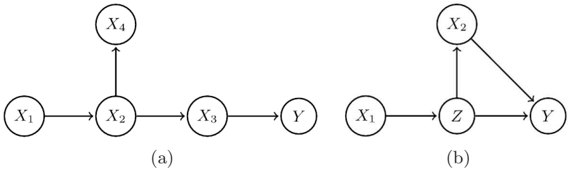
- For DAGs with multiple interventions, the generalized criterion can be weaker than Pearl’s original back-door criterion; Example 1 shows \(W=\emptyset\) works for a multi-intervention setting where Pearl’s criterion fails.
Methods
- The paper is theoretical/mathematical, developing graphical criteria for causal adjustment across DAGs, CPDAGs, MAGs, and PAGs.
- It introduces an invariance criterion, proves it implies the adjustment criterion, and then shows the generalized back-door criterion is equivalent to that invariance criterion (Theorems 7.1 and 7.3).
- The main existence result is proved using graph-theoretic constructions involving \(R^*\), \(R_X\), \(D\text{-}\mathrm{SEP}\), possible descendants, and m-separation; examples are used to illustrate DAG, CPDAG, MAG, and PAG cases. R code is available in the R-package `pcalg`.
Limitations
- The paper states that its main existence result is for a single intervention variable and a single outcome variable; extending it to sets \(X\) and \(Y\) is left for future work.
- It does not allow selection variables (“unmeasured variables that determine whether a unit is included in the sample”), only hidden/unmeasured variables.
- Evident from the text: the generalized back-door criterion identifies only a subset of all identifiable causal effects, and the explicit set it returns is not necessarily minimal.
Model-written summary. Check it against the paper before relying on it.
Integrity signals
Registry
Cites
Statistics
Figures



Verification
Claims the paper makes
2 Valid · 0 Not valid · 14 Not checked · 34 Own results and interpretations
In the paper
“If W satisfies the generalized back-door criterion relative to ( X , Y ) and G (Definition 3.7), then it satisfies the adjustment criterion relative to ( X , Y ) and G (Definition 3.6).”
What the sources say
- Not matchedcites Zhang (2008a)
Couldn’t be matched to a paper in Crossref, so it can’t be checked.
plain- Asserted: passes — The authors put it forward as true.
- Checkable: passes — It can be checked against evidence.
- Load-bearing: passes — The paper’s conclusions depend on it.
- Based: passes — The paper gives a reason why it holds.
- Rests on 2 assumptions not shown here.
- Not matched
A result the paper states — it cites no source for it, so there is none to check. The quote shows it is in the paper.
In the paper
“This shows that applying Theorem 4.1 with R ′ X instead of R X leads to incorrect results.”
boostedstates a cause- Asserted: passes — The authors put it forward as true.
- Checkable: passes — It can be checked against evidence.
- Load-bearing: passes — The paper’s conclusions depend on it.
- Based: passes — The paper gives a reason why it holds.
In the paper
“For a DAG with multiple interventions, any set that satisfies Pearl's back-door criterion also satisfies the generalized back-door criterion, but not necessarily the other way around.”
What the sources say
- Not matchedcites Pearl (1993, 2000)
Couldn’t be matched to a paper in Crossref, so it can’t be checked.
plain- Asserted: passes — The authors put it forward as true.
- Checkable: passes — It can be checked against evidence.
- Load-bearing: passes — The paper’s conclusions depend on it.
- Based: passes — The paper gives a reason why it holds.
- Not matched
None of the sources cited for this claim have been checked yet.
In the paper
“On the other hand, f ( y | do( x 1 , x 2 )) = ∫ f ( z | x 1 ) f ( y | x 2 , z ) dz for any density f compatible with D , by the g-formula.”
plainstates a cause- Asserted: passes — The authors put it forward as true.
- Checkable: passes — It can be checked against evidence.
- Load-bearing: passes — The paper’s conclusions depend on it.
- Based: passes — The paper gives a reason why it holds.
A result the paper states — it cites no source for it, so there is none to check. The quote shows it is in the paper.
In the paper
“In Section 4, we give necessary and sufficient criteria for the existence of a set that satisfies the generalized back-door criterion relative to a pair of variables ( X,Y ) and a DAG, MAG, CPDAG or PAG.”
plain- Asserted: passes — The authors put it forward as true.
- Checkable: passes — It can be checked against evidence.
- Load-bearing: passes — The paper’s conclusions depend on it.
- Based: passes — The paper gives a reason why it holds.
24 more claims
Create a free account to see all 50 claims and to verify the 3 references still open.
- Probably not a substantial claim. 9
- It may state two separate claims as one. 12
Citations
Cites
Causation, Prediction, and Search
Spirtes, P., Glymour, C., & Scheines, R. (1993) · Lecture Notes in Statistics · doi:10.1007/978-1-4612-2748-9 · Cited by 4,617
Causation, Prediction, and Search
Spirtes, P., Glymour, C., & Scheines, R. (2001) · doi:10.7551/mitpress/1754.001.0001 · Cited by 4,521
Robins, J. (1986) · Mathematical Modelling · doi:10.1016/0270-0255(86)90088-6 · Cited by 2,451 · cited 2×
“This is known as the truncated factorization formula, see, e.g., Pearl (2000); Robins (1986); Spirtes et al. (1993).”
BackgroundCausal diagrams for empirical research
PEARL, J. (1995) · Biometrika · doi:10.1093/biomet/82.4.669 · Cited by 2,355 · cited 1×
“Causal Bayesian networks are widely used for causal reasoning (e.g., Glymour et al. (1987); Koller and Friedman (2009); Pearl (1995, 2000, 2009); Spirtes et al. (1993, 2000)).”
Algorithmic graph theory and perfect graphs
Golumbic, M. C. (1980) · doi:10.1016/c2013-0-10739-8 · Cited by 2,329
Estimating high-dimensional directed acyclic graphs with the PC-algorithm
Kalisch, M., & Bühlmann, P. (2005) · arXiv (Cornell University) · doi:10.48550/arxiv.math/0510436 · Cited by 591 · cited 2×
“These algorithms have been shown to be consistent, even in certain sparse high-dimensional settings (Colombo et al., 2012; Kalisch and Bühlmann, 2007).”
MethodRichardson, T., & Spirtes, P. (2002) · The Annals of Statistics · doi:10.1214/aos/1031689015 · Cited by 545 · cited 5×
“Moreover, combining our results for CPDAGs and PAGs with fast causal structure learning algorithms such as the PC algorithm (Spirtes et al. (2000)) or the FCI algorithm (Claassen et al.”
BackgroundMethodInfluentialCausal Inference Using Graphical Models with the R Package pcalg
Kalisch, M., Mächler, M., Colombo, D., Maathuis, M. H., & Bühlmann, P. (2012) · Journal of Statistical Software · doi:10.18637/jss.v047.i11 · Cited by 520
Self-citationA New Criterion for Confounder Selection
VanderWeele, T. J., & Shpitser, I. (2011) · Biometrics · doi:10.1111/j.1541-0420.2011.01619.x · Cited by 434 · cited 2×
“variables that can be used for covariate adjustment (De Luna et al., 2011; Entner et al., 2013; VanderWeele and Shpitser, 2011)).”
BackgroundA characterization of Markov equivalence classes for acyclic digraphs
Andersson, S. A., Madigan, D., & Perlman, M. D. (1997) · The Annals of Statistics · doi:10.1214/aos/1031833662 · Cited by 425 · cited 2×
“Such a Markov equivalence class can be represented uniquely by a different type of graph, called a completed partially directed acyclic graph (CPDAG) (Andersson et al., 1997; Meek, 1995; Spirtes et al., 1993).”
Background
Research works printed but not linked: 6
- Pearl, J. (2000). Causality: Models, Reasoning, and Inference. Cambridge Univ. Press, Cambridge.
- Pearl, J. (2009). Causality: Models, Reasoning, and Inference, 2nd ed. Cambridge Univ. Press, Cambridge.
- Borboudakis, G., Triantafillou, S. and Tsamardinos, I. (2012). Tools and algorithms for causally interpreting directed edges in maximal ancestral graphs. In Proceedings of the 6 th European Workshop on Probabilistic Graphical Models (PGM 2012) 35–42. DECSAI, Univ. Granada.
- Glymour, C., Scheines, R., Spirtes, P. and Kelly, K. (1987). Discovering Causal Structure: Artificial Intelligence, Philosophy of Science, and Statistical Modeling. Academic Press, San Diego, CA.
- Koller, D. and Friedman, N. (2009). Probabilistic Graphical Models: Principles and Techniques. MIT Press, Cambridge, MA.
- Zhang, J. (2006). Causal inference and reasoning in causally insufficient systems. Ph.D. thesis, Carnegie Mellon Univ., Pittsburgh, PA.
Cited by
Causal inference for time series
Runge, J., Gerhardus, A., Varando, G., Eyring, V., & Camps-Valls, G. (2023) · Nature Reviews Earth & Environment · doi:10.1038/s43017-023-00431-y · Cited by 288
Structural Intervention Distance for Evaluating Causal Graphs
Peters, J., & Bühlmann, P. (2015) · Neural Computation · doi:10.1162/neco_a_00708 · Cited by 236
“There exists a generalized back-door criterion for MAGs and a way to construct a set satisfying the generalized back-door criterion; some identifiable effects, however, may not be identifiable via the generalized backdoor criterion (Maathuis & Colombo, 2013).”
BackgroundGraphical Criteria for Efficient Total Effect Estimation Via Adjustment in Causal Linear Models
Henckel, L., Perković, E., & Maathuis, M. H. (2022) · Journal of the Royal Statistical Society Series B (Statistical Methodology) · doi:10.1111/rssb.12451 · Cited by 138
Self-citationNandy, P., Maathuis, M. H., & Richardson, T. S. (2014) · Cited by 60
Self-citationConstructing separators and adjustment sets in ancestral graphs
van der Zander, B., Liśkiewicz, M., & Textor, J. C. (2014) · Uncertainty in Artificial Intelligence · Cited by 91
Metadata
- Authors
- Maathuis, M. H., & Colombo, D.
- ORCID
- Maathuis, Marloes H.
- Venue
- The Annals of Statistics
- Publisher
- Institute of Mathematical Statistics
- Published
- 2015-06-01
- Volume
- 43
- Issue
- 3
- Pages
- 1060-1088
- ISSN
- 0090-5364 (ISSN-L)
- OpenAlex
- W34433402
- Cited by
- 88
- References
- 31
- Citations by year
- 2026: 4 · 2025: 10 · 2024: 8 · 2023: 7 · 2022: 12 · 2021: 8 · 2020: 12 · 2019: 5 · 2018: 2 · 2017: 7 · 2016: 1 · 2015: 6
- FWCI
- 5.23
- Type
- journal article
- Language
- en
- Open access
- green
- arxiv.org
- Locations
- The Annals of Statistics (publishedVersion)
- arXiv (Cornell University) (submittedVersion)
- Project Euclid (Cornell University) (submittedVersion)
- arXiv (Cornell University)
- Topics
- Physical Sciences › Computer Science › Artificial Intelligence › Bayesian Modeling and Causal Inference
- Physical Sciences › Mathematics › Statistics and Probability › Advanced Causal Inference Techniques
- Physical Sciences › Mathematics › Statistics and Probability › Statistical Methods and Inference
- Keywords
- directed acyclic graphs, Markov equivalence classes, hidden variables, causal inference, graphical criteria, intervention, confounding
About these checks
Registry, retraction, Cites and statistics results are computed, not judged, with one exception: a printed reference that no index lists is read once by a model before it counts as a citation error. Claims are extracted by a model and kept only when their quote appears verbatim in the text; each cited source is then checked, with a model’s help, for whether it says what the claim relies on. Those verdicts can be wrong — read the claim’s quote and the cited source before relying on one.
A language model drew the claims from the paper on 2026-10-10, under version 3 of the claim definition (model deepseek-v4.1-flash, prompt extract-v3).
A second model labelled each claim on 2026-10-10 (model jev-1.13-20260917, definition revision gold-guideline-v0.2).
Statistics and arithmetic are recomputed, not judged.
Confidence bands are shown only for fields calibrated on our annotated test set. None is calibrated yet, so no band is shown.
What counts as a claim ›How we measure confidence ›How we check this ›
Are you an author, or do you see a problem with this page? Request a review
How to cite
Cite CoChat for the checks on this page, and the paper for its own findings.
- This page
- CoChat. (2026). Citation check: A generalized back-door criterion. https://app.cochat.ai/papers/10.1214/14-aos1295
- The paper
- Maathuis, M. H., & Colombo, D. (2015). A generalized back-door criterion. The Annals of Statistics. https://doi.org/10.1214/14-aos1295
Data sources
Bibliographic data: Semantic Scholar, OpenAlex, Crossref.
Contains information from the Semantic Scholar Academic Graph Datasets, made available under the ODC Attribution License (ODC-BY 1.0).
Semantic Scholar’s data is described in: Kinney, R., et al. (2023). The Semantic Scholar Open Data Platform. arXiv:2301.10140.
