

The DOI matches its Crossref record; 111 of the 114 references it cites were found in a registry or an index.
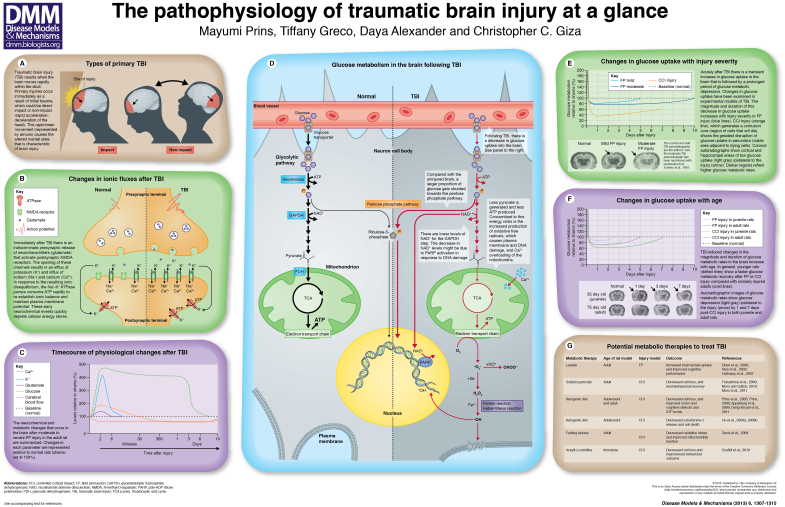
The pathophysiology of traumatic brain injury at a glance
Open accessAbstract
Summary: Traumatic brain injury (TBI) is defined as an impact, penetration or rapid movement of the brain within the skull that results in altered mental state. TBI occurs more than any other disease, including breast cancer, AIDS, Parkinson’s disease and multiple sclerosis, and affects all age groups and both genders. In the US and Europe, the magnitude of this epidemic has drawn national attention owing to the publicity received by injured athletes and military personnel. This increased public awareness has uncovered a number of unanswered questions concerning TBI, and we are increasingly aware of the lack of treatment options for a crisis that affects millions. Although each case of TBI is unique and affected individuals display different degrees of injury, different regional patterns of injury and different recovery profiles, this review and accompanying poster aim to illustrate some of the common underlying neurochemical and metabolic responses to TBI. Recognition of these recurrent features could allow elucidation of potential therapeutic targets for early intervention.
Overview
The claims and statistics of this paper haven’t been checked yet.
Run the check — free, no account needed. It reads the open-access text and checks the sources it cites.
Integrity signals
Registry
Cites
Statistics
Figures
Verification
Claims the paper makes
The claims and statistics of this paper haven’t been checked yet.
Run the check — free, no account needed. It reads the open-access text and checks the sources it cites.
Claims other papers make about this one
Each is checked against this paper’s own text: does it say what the citing paper says it does?
The check wasn’t confident either way, so it gives no verdict — never disputed.
In the citing paper
“We counted brainstem neurons in a blinded manner using the same stereological procedures as previously described.9”
From Damage to Arousal-Promoting Brainstem Neurons with Traumatic Brain Injury (2016) · cites this paper as [9]
Experimental — accuracy not yet measuredThe check wasn’t confident either way, so it gives no verdict — never disputed.
In the citing paper
“Additional factors that may protect the brainstem include lower metabolic requirements and a blood supply less likely to be damaged by direct traumatic forces.9”
From Damage to Arousal-Promoting Brainstem Neurons with Traumatic Brain Injury (2016) · cites this paper as [9]
Experimental — accuracy not yet measured
Self-check
Percentages, sums and reported differences re-computed from the paper’s own numbers.
The self-check needs the paper’s full text.
Citations
Cites
National Center for Injury Prevention and Control (U.S.). Division of Injury Response., Faul, M., Wald, M. M., Wu, L., & Coronado, V. G. (2010) · doi:10.15620/cdc.5571 · Cited by 3,494
Langlois, J., Rutland-Brown, W., & Thomas, K. (2006) · PsycEXTRA Dataset · doi:10.1037/e721222007-001 · Cited by 3,003
Chronic traumatic encephalopathy in athletes: Progressive tauopathy after repetitive head injury
McKee, A. C., Cantu, R. C., Nowinski, C. J., Hedley-Whyte, E. T., Gavett, B. E., Budson, A. E., Santini, V. E., Lee, H.-S., Kubilus, C. A., & Stern, R. A. (2009) · Journal of Neuropathology & Experimental Neurology · doi:10.1097/nen.0b013e3181a9d503 · Cited by 2,295
Brain Metabolism during Fasting*
Owen, O. E., Morgan, A. P., Kemp, H. G., Sullivan, J. M., Herrera, M. G., & Cahill, G. F. (1967) · Journal of Clinical Investigation · doi:10.1172/jci105650 · Cited by 1,662
A new model of diffuse brain injury in rats
Marmarou, A., Foda, M. A. A.-E., van den Brink, W., Campbell, J., Kita, H., & Demetriadou, K. (1994) · Journal of neurosurgery · doi:10.3171/jns.1994.80.2.0291 · Cited by 1,244
Katayama, Y., Becker, D. P., Tamura, T., & Hovda, D. A. (1990) · Journal of neurosurgery · doi:10.3171/jns.1990.73.6.0889 · Cited by 1,091
Veech, R. L. (2004) · Prostaglandins Leukotrienes and Essential Fatty Acids · doi:10.1016/j.plefa.2003.09.007 · Cited by 779
Free Radical Pathways in CNS Injury
LEWÉN, A., MATZ, P., & CHAN, P. H. (2000) · Journal of Neurotrauma · doi:10.1089/neu.2000.17.871 · Cited by 759
Bergsneider, M., Hovda, D. A., Shalmon, E., Kelly, D. F., Vespa, P. M., Martin, N. A., Phelps, M. E., McArthur, D. L., Caron, M., Kraus, J. F., et al. (1997) · Journal of neurosurgery · doi:10.3171/jns.1997.86.2.0241 · Cited by 639
Yoshino, A., Hovda, D. A., Kawamata, T., Katayama, Y., & Becker, D. P. (1991) · Brain Research · doi:10.1016/0006-8993(91)90755-k · Cited by 592
Research works printed but not linked: 1
- Hovda, 1994, Long-term changes in metabolic rates for glucose following mild, moderate and severe concussive head injuries in adult rats, J. Neurosci., 20, 845
Cited by
Sorted by citations
Recent Advances in Pathophysiology of Traumatic Brain Injury
Kaur, P., & Sharma, S. (2017) · Current Neuropharmacology · doi:10.2174/1570159x15666170613083606 · Cited by 471
“Phosphatidylserine translocation includes distinct however gradual membrane breakdown together with nuclear membranes disintegration, DNA-fragmentation, and chromatin condensation [117].”
InfluentialHenderson, T. A., & Morries, L. D. (2015) · Neuropsychiatric Disease and Treatment · doi:10.2147/ndt.s78182 · Cited by 432
“This energy crisis promotes the increased concentration of free radicals, due to increased pentose phosphate metabolism, reduced mitochondrial function, and impaired free radical scavenger mechanisms.(19) The consequences of increased free radicals can be far-reaching including propagation of additional free radicals,…”
Bidirectional Microglia–Neuron Communication in Health and Disease
Szepesi, Z., Manouchehrian, O., Bachiller, S., & Deierborg, T. (2018) · Frontiers in Cellular Neuroscience · doi:10.3389/fncel.2018.00323 · Cited by 459
“The primary injury of TBIs, caused by trauma to the head which for example might stretch, compress or tear blood vessels and axons, is not the only reason why patients die or are disabled (Prins et al., 2013).”
BackgroundThe synapse in traumatic brain injury
Jamjoom, A. A. B., Rhodes, J. K. J., Andrews, P., & Grant, S. G. N. (2020) · Brain · doi:10.1093/brain/awaa321 · Cited by 260
“The mechanical injury (primary insult) causes instantaneous tissue damage, which is followed by multiple secondary injury processes (Prins et al., 2013).”
BackgroundThe NLRP3 inflammasome in traumatic brain injury: potential as a biomarker and therapeutic target
O’Brien, W. T., Pham, L., Symons, G. F., Monif, M., Shultz, S. R., & McDonald, S. J. (2020) · Journal of Neuroinflammation · doi:10.1186/s12974-020-01778-5 · Cited by 233
Metadata
- Authors
- Prins, M., Greco, T., Alexander, D., & Giza, C. C.
- Affiliations
- University of California, Los Angeles (US)
- Corresponding author
- Prins, Mayumi
- Venue
- Disease Models & Mechanisms
- Publisher
- The Company of Biologists
- Published
- 2013-01-01
- Volume
- 6
- Issue
- 6
- Pages
- 1307-15
- ISSN
- 1754-8403 (ISSN-L)
- 1754-8411
- PMC
- PMC3820255
- OpenAlex
- W2141923055
- Cited by
- 426
- References
- 114
- Citations by year
- 2026: 7 · 2025: 29 · 2024: 37 · 2023: 40 · 2022: 41 · 2021: 55 · 2020: 55 · 2019: 40 · 2018: 46 · 2017: 27 · 2016: 14 · 2015: 24 · 2014: 8 · 2013: 3
- FWCI
- 10.37
- Type
- journal article
- Language
- en
- Open access
- gold
- doi.org
- Locations
- Disease Models & Mechanisms (publishedVersion, cc-by)
- Europe PMC (PubMed Central) (publishedVersion, other-oa)
- PubMed Central (publishedVersion, cc-by)
- PubMed (publishedVersion)
- DOAJ (DOAJ: Directory of Open Access Journals) (submittedVersion, cc-by-sa)
- Funders
- National Institute of Neurological Disorders and Stroke (NS-058489, P01NS058489)
- Topics
- Health Sciences › Medicine › Clinical Neurology › Traumatic Brain Injury and Neurovascular Disturbances
- Health Sciences › Medicine › Clinical Neurology › Traumatic Brain Injury Research
- Physical Sciences › Engineering › Biomedical Engineering › Automotive and Human Injury Biomechanics
- Keywords
- traumatic brain injury, pathophysiology, brain metabolism, altered mental status, injury patterns, recovery profiles, therapeutic target, TBI epidemiology
- MeSH terms
- Brain, Brain Injuries, Free Radicals, Glucose, Humans, Mitochondria
About these checks
Registry, retraction, Cites and statistics results are computed, not judged, with one exception: a printed reference that no index lists is read once by a model before it counts as a citation error. Claims are extracted by a model and kept only when their quote appears verbatim in the text; each cited source is then checked, with a model’s help, for whether it says what the claim relies on. Those verdicts can be wrong — read the claim’s quote and the cited source before relying on one.
Statistics and arithmetic are recomputed, not judged.
Confidence bands are shown only for fields calibrated on our annotated test set. None is calibrated yet, so no band is shown.
What counts as a claim ›How we measure confidence ›How we check this ›
Are you an author, or do you see a problem with this page? Request a review
