

Modeling the Metabolic Costs of Heavy Military Backpacking
Open accessThe DOI matches its Crossref record; 47 of the 48 references it cites were found in a registry or an index; none of the 59 sources its claims cite is checked for support yet.
Abstract
Introduction: Existing predictive equations underestimate the metabolic costs of heavy military load carriage. Metabolic costs are specific to each type of military equipment, and backpack loads often impose the most sustained burden on the dismounted warfighter. Purpose: This study aimed to develop and validate an equation for estimating metabolic rates during heavy backpacking for the US Army Load Carriage Decision Aid (LCDA), an integrated software mission planning tool. Methods: Thirty healthy, active military-age adults (3 women, 27 men; age, 25 ± 7 yr; height, 1.74 ± 0.07 m; body mass, 77 ± 15 kg) walked for 6–21 min while carrying backpacks loaded up to 66% body mass at speeds between 0.45 and 1.97 m·s −1 . A new predictive model, the LCDA backpacking equation, was developed on metabolic rate data calculated from indirect calorimetry. Model estimation performance was evaluated internally by k -fold cross-validation and externally against seven historical reference data sets. We tested if the 90% confidence interval of the mean paired difference was within equivalence limits equal to 10% of the measured metabolic rate. Estimation accuracy and level of agreement were also evaluated by the bias and concordance correlation coefficient (CCC), respectively. Results: Estimates from the LCDA backpacking equation were statistically equivalent ( P < 0.01) to metabolic rates measured in the current study (bias, −0.01 ± 0.62 W·kg −1 ; CCC, 0.965) and from the seven independent data sets (bias, −0.08 ± 0.59 W·kg −1 ; CCC, 0.926). Conclusions: The newly derived LCDA backpacking equation provides close estimates of steady-state metabolic energy expenditure during heavy load carriage. These advances enable further optimization of thermal-work strain monitoring, sports nutrition, and hydration strategies.
Overview
CoChat Summary
TL;DR
This study developed and validated the LCDA backpacking equation to estimate metabolic rate during heavy military backpacking. The equation produced estimates statistically equivalent to measured metabolic rates in the current study and in seven historical reference datasets.
Key findings
- The LCDA backpacking equation was statistically equivalent (P < 0.01) to measured metabolic rates in the current study (bias, −0.01 ± 0.62 W·kg−1; CCC, 0.965) and in seven independent datasets (bias, −0.08 ± 0.59 W·kg−1; CCC, 0.926).
- Across all current-study trials, mean measured walking M˙ was 6.12 ± 2.14 W·kg−1; k-fold cross-validation estimates were equivalent at each step (90% CI within 10% of mean walking M˙; P < 0.01).
- The final equation was M˙(W·kg−1) = M˙Rest + (0.19 + 1.78S^0.58 + 0.27S^4)(1 + 1.96LBp^1.36), where S is walking speed and LBp is backpack load divided by body mass.
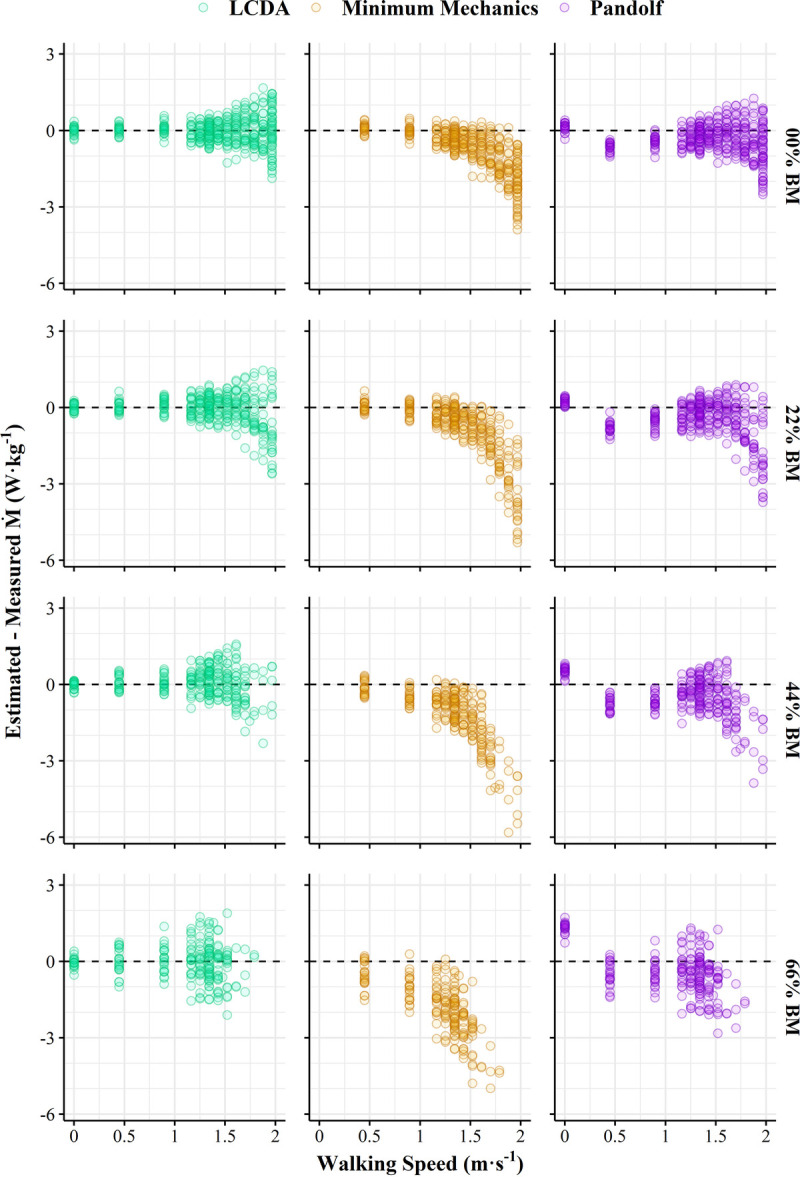
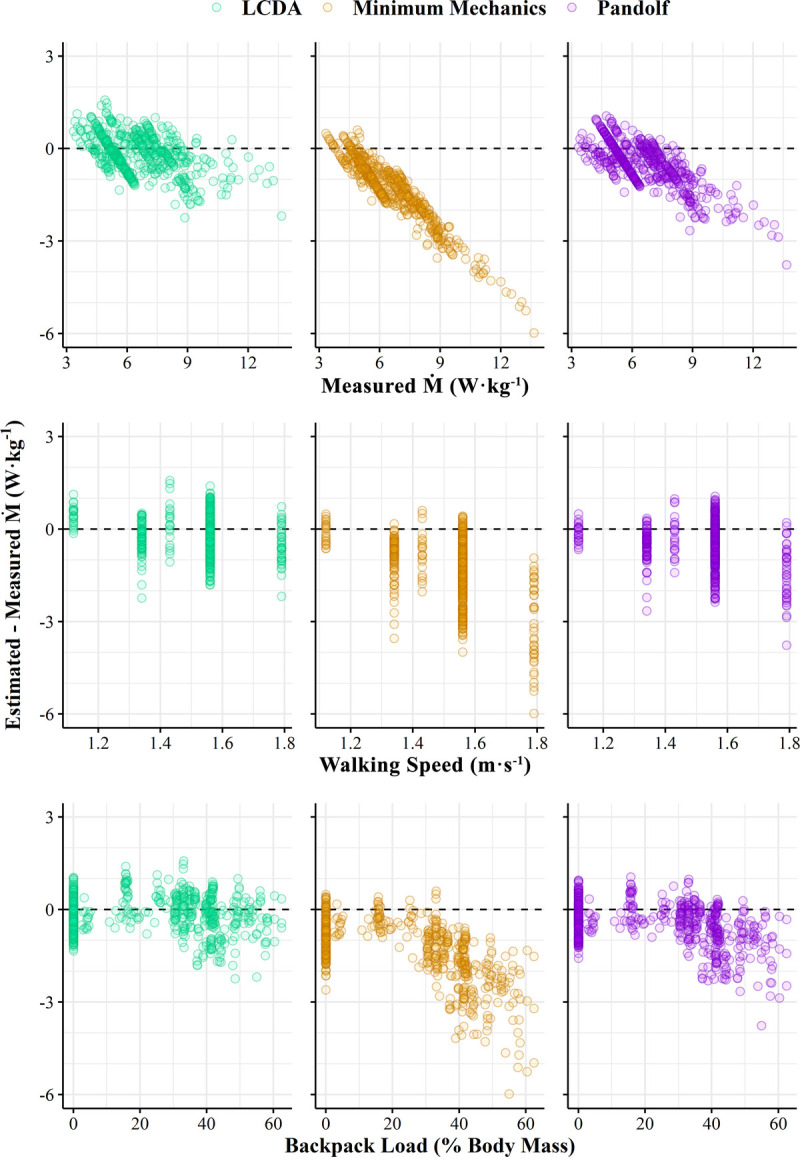
- The LCDA equation was more accurate and precise than the Minimum Mechanics model and Pandolf equation in external validation: LCDA bias −0.08 ± 0.59 W·kg−1, CCC 0.926 vs Minimum Mechanics bias −1.23 ± 1.02 W·kg−1, CCC 0.513 and Pandolf bias −0.46 ± 0.67 W·kg−1, CCC 0.863.
Methods
- Thirty healthy, active military-age adults (3 women, 27 men; age 25 ± 7 yr; height 1.74 ± 0.07 m; body mass 77 ± 15 kg) walked for 6–21 min carrying backpacks up to 66% body mass at speeds between 0.45 and 1.97 m·s−1; metabolic rate was calculated from indirect calorimetry.
- The LCDA backpacking equation was developed using nonlinear mixed-effects models, evaluated internally by k-fold cross-validation, and externally validated against seven historical reference datasets (81 healthy US Army soldiers and civilians; 17 women, 64 men; speeds 1.12–1.79 m·s−1; backpack loads up to 62% body mass).
- Estimation performance was assessed by bias, concordance correlation coefficient (CCC), and equivalence testing: whether the 90% CI of the mean paired difference was within equivalence limits equal to 10% of the measured metabolic rate.
Limitations
- The paper states the equation estimates steady-state metabolic rate and does not account for factors that may elevate costs over time, including the V̇O2 slow component, prolonged cold or heat stress, and oxygen uptake drift from substrate shifts; these would require additional inputs such as fitness/fatigue, thermophysiological modeling, and dietary intake/energy availability.
- The paper states that height was not included because a larger sample would be needed across diverse body shapes/sizes; sex differences in load-carriage metabolic costs have shown conflicting results, and the body-composition relationship needs more data. It also notes that loads >75% body mass may force gait changes and that future work should quantify other load types, surfaces, and slopes.
- Evident from the text: the development sample was predominantly men (3 women, 27 men), limiting sex-specific conclusions; the equation is specific to backpack loads and does not model other military equipment or load distributions.
Model-written summary. Check it against the paper before relying on it.
Integrity signals
Registry
Cites
Statistics
Figures
Verification
Claims the paper makes
0 Valid · 1 Not valid · 33 Not checked · 24 Own results and interpretations
A result the paper reports from its own data — it cites no other source for it, so there is none to check. The quote shows it is in the paper.
In the paper
“The final speed determined for the discontinuous trials during the load-matched incremental tests decreased with backpack load relative to body mass (0%, 1.96 ± 0.04 m·s−1; 22%, 1.86 ± 0.12 m·s−1; 44%, 1.67 ± 0.16 m·s−1; 66%, 1.48 ± 0.12 m·s−1).”
§ Modeling the Metabolic Costs of Heavy Military Backpacking > RESULTS
plainstates an association- Asserted: passes — The authors put it forward as true.
- Checkable: passes — It can be checked against evidence.
- Load-bearing: passes — The paper’s conclusions depend on it.
- Based: passes — The paper gives a reason why it holds.
A result the paper reports from its own data — it cites no other source for it, so there is none to check. The quote shows it is in the paper.
In the paper
“Overall, M˙ estimates from the LCDA backpacking equation were accurate and precise (bias, −0.01 ± 0.63 W·kg−1; 90% CI, −0.15 to 0.11 W·kg−1; CCC, 0.964).”
§ Modeling the Metabolic Costs of Heavy Military Backpacking > RESULTS
plain- Asserted: passes — The authors put it forward as true.
- Checkable: passes — It can be checked against evidence.
- Load-bearing: passes — The paper’s conclusions depend on it.
- Based: passes — The paper gives a reason why it holds.
A result the paper reports from its own data — it cites no other source for it, so there is none to check. The quote shows it is in the paper.
In the paper
“Across all trials, the mean measured walking M˙ was 6.12 ± 2.14 W·kg−1.”
§ Modeling the Metabolic Costs of Heavy Military Backpacking > RESULTS
plain- Asserted: passes — The authors put it forward as true.
- Checkable: passes — It can be checked against evidence.
- Load-bearing: passes — The paper’s conclusions depend on it.
- Based: passes — The paper gives a reason why it holds.
None of the sources cited for this claim have been checked yet.
In the paper
“Walking energy expenditure rises nonlinearly with increased load relative to body mass (11,12).”
§ Modeling the Metabolic Costs of Heavy Military Backpacking > Abstract > Conclusions
What the sources say
- Not checked yetcites [11] Looney DP Potter AW McClung HL Welles AP Santee WR. Heavy External Loads Disproportionately Increase Walking Energy Expenditure. National Strength and Conditioning Association (NSCA) 2018 National Conference. Indianapolis (IN): NSCA; 2018.
- Not checked yetcites [12] Looney DP Doughty EM Figueiredo PS,. Effects of modern military backpack loads on walking speed and cardiometabolic responses of US Army Soldiers. Appl Ergon. 2021; 94: 103395. 33652153 source
plainstates a cause- Asserted: passes — The authors put it forward as true.
- Checkable: passes — It can be checked against evidence.
- Load-bearing: passes — The paper’s conclusions depend on it.
- Based: passes — The paper gives a reason why it holds.
In the paper
“In addition, certain military equipment further increase energy costs by impairing walking biomechanics such as the effect of rifle carriage on arm swing and upper body coordination (14).”
§ Modeling the Metabolic Costs of Heavy Military Backpacking > Abstract > Conclusions
What the sources say
- Not checked yetcites [14] Seay JF Hasselquist L Bensel CK. Carrying a rifle with both hands affects upper body transverse plane kinematics and pelvis–trunk coordination. Ergonomics. 2011; 54(2): 187– 96. 21294016 source
plainstates a cause- Asserted: passes — The authors put it forward as true.
- Checkable: passes — It can be checked against evidence.
- Load-bearing: passes — The paper’s conclusions depend on it.
- Based: passes — The paper gives a reason why it holds.
17 more claims
Create a free account to see all 58 claims and to verify the 56 references still open.
- It may state two separate claims as one. 15
- Probably not a substantial claim. 27
Self-check
Percentages, sums and reported differences re-computed from the paper’s own numbers.
Each contradiction between two passages listed here was confirmed by an independent check.
Rated minor: it would not touch a result — a value no result rests on, a p-value that stays on the same side of the significance level, or a conflict that is clerical, resolved elsewhere in the paper, or outside its own findings.
In the paper
§ Modeling the Metabolic Costs of Heavy Military Backpacking > Abstract > Results
“Estimates from the LCDA backpacking equation were statistically equivalent (P < 0.01) to metabolic rates measured in the current study (bias, −0.01 ± 0.62 W·kg−1; CCC, 0.965)”
§ Modeling the Metabolic Costs of Heavy Military Backpacking > RESULTS
“Overall, M˙ estimates from the LCDA backpacking equation were accurate and precise (bias, −0.01 ± 0.63 W·kg−1; 90% CI, −0.15 to 0.11 W·kg−1; CCC, 0.964).”
Citations
Cites
Linear Mixed-Effects Models using 'Eigen' and S4
Bates, D. M., Maechler, M., Bolker, B. M., & Walker, S. C. (2015) · Cited by 5,924
Leys, C., Ley, C., Klein, O., Bernard, P., & Licata, L. (2013) · Journal of Experimental Social Psychology · doi:10.1016/j.jesp.2013.03.013 · Cited by 4,147
Model Evaluation, Model Selection, and Algorithm Selection in Machine Learning
Raschka, S. (2018) · arXiv · doi:10.48550/arxiv.1811.12808 · Cited by 735
Cunningham, J. (1991) · The American Journal of Clinical Nutrition · doi:10.1093/ajcn/54.6.963 · Cited by 607
Soldier Load Carriage: Historical, Physiological, Biomechanical, and Medical Aspects
Knapik, J. J., Reynolds, K. L., & Harman, E. (2004) · Military Medicine · doi:10.7205/milmed.169.1.45 · Cited by 598
Effects of obesity and sex on the energetic cost and preferred speed of walking
Browning, R. C., Baker, E. A., Herron, J. A., & Kram, R. (2006) · Journal of Applied Physiology · doi:10.1152/japplphysiol.00767.2005 · Cited by 488
Predicting energy expenditure with loads while standing or walking very slowly
Pandolf, K. B., Givoni, B., & Goldman, R. F. (1977) · Journal of Applied Physiology · doi:10.1152/jappl.1977.43.4.577 · Cited by 474
Slow Component of V˙O2 Kinetics: Mechanistic Bases and Practical Applications
JONES, A. M., GRASSI, B., CHRISTENSEN, P. M., KRUSTRUP, P., BANGSBO, J., & POOLE, D. C. (2011) · Medicine & Science in Sports & Exercise · doi:10.1249/mss.0b013e31821fcfc1 · Cited by 353 · cited 1×
“652 Official Journal of the American College of Sports Medicine to the development of the V̇O2 slow component (51).”
BackgroundPredicting metabolic energy cost
Givoni, B., & Goldman, R. F. (1971) · Journal of Applied Physiology · doi:10.1152/jappl.1971.30.3.429 · Cited by 269
Substrate utilization during exercise in active people
Coyle, E. (1995) · The American Journal of Clinical Nutrition · doi:10.1093/ajcn/61.4.968s · Cited by 236
The Effects of backpack weight on the biomechanics of load carriage
Harman, E., Hoon, K., Frykman, P., & Pandorf, C. (2000) · doi:10.21236/ada377886 · Cited by 177
Self-citationThe thermoneutral zone implications for metabolic studies
Kingma, B. (2012) · Frontiers in Bioscience · doi:10.2741/e518 · Cited by 170
Kenny, G. P., Notley, S. R., & Gagnon, D. (2017) · European Journal of Applied Physiology · doi:10.1007/s00421-017-3670-5 · Cited by 160
The thermoneutral zone: implications for metabolic studies
Kingma, B. (2012) · Frontiers in Bioscience · doi:10.2741/518 · Cited by 152
Kipp, S., Byrnes, W. C., & Kram, R. (2018) · Applied Physiology, Nutrition, and Metabolism · doi:10.1139/apnm-2017-0781 · Cited by 139
Men and women adopt similar walking mechanics and muscle activation patterns during load carriage
Silder, A., Delp, S. L., & Besier, T. (2013) · Journal of Biomechanics · doi:10.1016/j.jbiomech.2013.06.020 · Cited by 121
Chowdhury, E. A., Western, M. J., Nightingale, T. E., Peacock, O. J., & Thompson, D. (2017) · PLOS ONE · doi:10.1371/journal.pone.0171720 · Cited by 118
An equation for prediction of energy expenditure of walking and running.
van der Walt, W. H., & Wyndham, C. H. (1973) · Journal of Applied Physiology · doi:10.1152/jappl.1973.34.5.559 · Cited by 112
Potter, A. W., Blanchard, L., Friedl, K. E., Cadarette, B. S., & Hoyt, R. W. (2017) · Journal of Thermal Biology · doi:10.1016/j.jtherbio.2017.01.003 · Cited by 101
Self-citationHoldy, K. E. (2004) · Nutrition in Clinical Practice · doi:10.1177/0115426504019005447 · Cited by 74
Anthropometric Survey (ANSUR) II Pilot Study: Methods and Summary Statistics
Paquette, S., Gordon, C. C., & Bradtmiller, B. (2009) · Cited by 71
Estimating Energy Expenditure during Level, Uphill, and Downhill Walking
LOONEY, D. P., SANTEE, W. R., HANSEN, E. O., BONVENTRE, P. J., CHALMERS, C. R., & POTTER, A. W. (2019) · Medicine & Science in Sports & Exercise · doi:10.1249/mss.0000000000002002 · Cited by 62
Self-citationTerrain Factors for Predicting Walking and Load Carriage Energy Costs: Review and Refinement
(2015) · Journal of Sport and Human Performance · doi:10.12922/jshp.v3i3.67 · Cited by 54 · cited 1×
“The modular structure of the LCDA backpacking equation enables compatibility with previously developed terrain coefficients (η) (37,38) and the LCDA-graded walking equation (10).”
MethodSelf-citationTHE RELATIONSHIP OF BACKPACK CENTER OF MASS LOCATION TO THE METABOLIC COST OF LOAD CARRIAGE 1170
Obusek, J. P., Harman, E. A., Frykman, P., Palmer, C., & Bills, R. K. (1997) · Medicine & Science in Sports & Exercise · doi:10.1097/00005768-199705001-01168 · Cited by 53
Self-citationMetabolic rate of carrying added mass: A function of walking speed, carried mass and mass location
Schertzer, E., & Riemer, R. (2014) · Applied Ergonomics · doi:10.1016/j.apergo.2014.04.009 · Cited by 48
Walking economy is predictably determined by speed, grade, and gravitational load.
Ludlow, L. W., & Weyand, P. G. (2017) · Journal of applied physiology · doi:10.1152/japplphysiol.00504.2017 · Cited by 47 · cited 3×
“METABOLIC COSTS OF HEAVY MILITARY BACKPACKING expenditure, which is the basis of the Minimum Mechanics model (33), is not true for military load carriage.”
BackgroundMethodInfluentialDesharnais, B., Lemyre, F. C., Mireault, P., & Skinner, C. D. (2014) · Journal of Analytical Toxicology · doi:10.1093/jat/bku127 · Cited by 40
KIRK, J., & SCHNEIDER, D. A. (1992) · Ergonomics · doi:10.1080/00140139208967825 · Cited by 40
Metabolic Costs of Standing and Walking in Healthy Military-Age Adults: A Meta-regression
LOONEY, D. P., POTTER, A. W., PRYOR, J. L., BREMNER, P. E., CHALMERS, C. R., MCCLUNG, H. L., WELLES, A. P., & SANTEE, W. R. (2019) · Medicine & Science in Sports & Exercise · doi:10.1249/mss.0000000000001779 · Cited by 37
Self-citationThe Pandolf equation under-predicts the metabolic rate of contemporary military load carriage
Drain, J. R., Aisbett, B., Lewis, M., & Billing, D. C. (2017) · Journal of science and medicine in sport · doi:10.1016/j.jsams.2017.08.009 · Cited by 35
Ambulatory foot contact monitor to estimate metabolic cost of human locomotion
Hoyt, R. W., Knapik, J. J., Lanza, J. F., Jones, B. H., & Staab, J. S. (1994) · Journal of Applied Physiology · doi:10.1152/jappl.1994.76.4.1818 · Cited by 33
Metabolic Costs of Military Load Carriage over Complex Terrain
Looney, D. P., Santee, W. R., Karis, A. J., Blanchard, L. A., Rome, M. N., Carter, A. J., & Potter, A. W. (2018) · Military Medicine · doi:10.1093/milmed/usx099 · Cited by 30
Self-citationTerrain coefficients for predicting energy costs of walking over snow
Richmond, P. W., Potter, A. W., Looney, D. P., & Santee, W. R. (2019) · Applied Ergonomics · doi:10.1016/j.apergo.2018.08.017 · Cited by 29 · cited 1×
“The modular structure of the LCDA backpacking equation enables compatibility with previously developed terrain coefficients (η) (37,38) and the LCDA-graded walking equation (10).”
MethodSelf-citationObesity does not impair walking economy across a range of speeds and grades
Browning, R. C., Reynolds, M. M., Board, W. J., Walters, K. A., & Reiser, R. F. (2013) · Journal of Applied Physiology · doi:10.1152/japplphysiol.00765.2012 · Cited by 26
Load Carriage Model Development and Testing with Field Data
Santee, W. R., Blanchard, L., Speckman, K. L., González, J. A., & Wallace, R. F. (2003) · Defense Technical Information Center (DTIC) · Cited by 26
Self-citationLooney, D. P., Doughty, E. M., Figueiredo, P. S., Vangala, S. V., Pryor, J. L., Santee, W. R., McClung, H. L., & Potter, A. W. (2021) · Applied Ergonomics · doi:10.1016/j.apergo.2021.103395 · Cited by 24
Self-citationBach, A. J. E., Costello, J. T., Borg, D. N., & Stewart, I. B. (2017) · Ergonomics · doi:10.1080/00140139.2016.1173233 · Cited by 23
Load Carriage for Female Military Personnel
Orr, R. M., Pope, R., O’Shea, S. D., & Knapik, J. J. (2019) · Strength and conditioning journal · doi:10.1519/ssc.0000000000000514 · Cited by 16
Mass-normalized internal mechanical work in walking is not impaired in adults with class III obesity
Menéndez, A. F., Uva, B., Favre, L., Hans, D. B., Borrani, F., & Malatesta, D. (2020) · Journal of Applied Physiology · doi:10.1152/japplphysiol.00837.2019 · Cited by 16
No physiological or biomechanical sex-by-load interactions during treadmill-based load carriage
Vickery-Howe, D. M., Clarke, A. C., Drain, J. R., Dascombe, B. J., & Middleton, K. J. (2020) · Ergonomics · doi:10.1080/00140139.2020.1772379 · Cited by 15
Seay, J. F., Hasselquist, L., & Bensel, C. K. (2011) · Ergonomics · doi:10.1080/00140139.2010.538726 · Cited by 14
Accuracy of Metabolic Cost Predictive Equations During Military Load Carriage
Vine, C. A. J., Coakley, S. L., Blacker, S. D., Doherty, J., Hale, B. J., Walker, E. F., Rue, C. A., Lee, B. J., Flood, T. R., Knapik, J. J., et al. (2020) · The Journal of Strength and Conditioning Research · doi:10.1519/jsc.0000000000003644 · Cited by 13
Gender Differences in Energy Expenditure During Walking With Backpack and Double-Pack Loads
Li, S. S. W., Chan, O. H. T., Ng, T. Y., Kam, L. H., Ng, C. Y., Chung, W. C., & Chow, D. H. K. (2019) · Human Factors: The Journal of the Human Factors and Ergonomics Society · doi:10.1177/0018720818799190 · Cited by 12
BACKPACKING ENERGY-COST AND PHYSICAL PERFORMANCE: INTERNAL VS. EXTERNAL FRAME, BELT VS. NO-BELT 1169
Harman, E. A., Obusek, J. P., Frykman, P. N., Palmer, C. J., Bills, R. K., & Kirk, J. (1997) · Medicine & Science in Sports & Exercise · doi:10.1097/00005768-199705001-01167 · Cited by 6
Self-citation(1991) · PubMed
(2001) · PubMed
Self-citation(1953) · Defense Technical Information Center (DTIC)
Research works printed but not linked: 2
- Looney DP Potter AW McClung HL Welles AP Santee WR. Heavy External Loads Disproportionately Increase Walking Energy Expenditure. National Strength and Conditioning Association (NSCA) 2018 National Conference. Indianapolis (IN): NSCA; 2018.
- Daniels F Jr. Lyman J Vanderbie JH. A Study of the Experimental Pack T 53-8 with a Review of Methods for Studying Load-Carrying Systems. Natick (MA): Quartermaster Research and Engineering Command; 1954.
Cited by
Schafer, E. A., Chapman, C. L., Castellani, J. W., & Looney, D. P. (2024) · Journal of Applied Physiology · doi:10.1152/japplphysiol.00210.2024 · Cited by 30
Self-citationMetabolic Costs of Walking with Weighted Vests
Looney, D. P., Lavoie, E. M., Notley, S. R., HOLDEN, L. D., Arcidiacono, D. M., Potter, A. W., Silder, A., Pasiakos, S. M., Arellano, C. J., Karis, A. J., et al. (2024) · Medicine & Science in Sports & Exercise · doi:10.1249/mss.0000000000003400 · Cited by 14
Self-citationPotter, A. W., Looney, D. P., & Friedl, K. E. (2023) · International Journal of Circumpolar Health · doi:10.1080/22423982.2023.2194504 · Cited by 12
Self-citationEstimating Metabolic Energy Expenditure During Level Running in Healthy, Military-Age Women and Men
Looney, D. P., Hoogkamer, W., Kram, R., Arellano, C. J., & Spiering, B. A. (2023) · The Journal of Strength and Conditioning Research · doi:10.1519/jsc.0000000000004626 · Cited by 10
Self-citationRosbrook, P., Sweet, D. K., Qiao, J., Looney, D. P., Margolis, L. M., Hostler, D. P., Pryor, R. R., & Pryor, J. L. (2024) · Temperature · doi:10.1080/23328940.2024.2322920 · Cited by 8
Self-citation
Metadata
- Authors
- LOONEY, D. P., LAVOIE, E. M., VANGALA, S. V., HOLDEN, L. D., FIGUEIREDO, P. S., FRIEDL, K. E., FRYKMAN, P. N., HANCOCK, J. W., MONTAIN, S. J., PRYOR, J. L., SANTEE, W. R., & POTTER, A. W.
- Affiliations
- U.S. Army Research Institute of Environmental Medicine (US)
- University at Buffalo, State University of New York (US)
- Corresponding author
- LOONEY, DAVID P.
- Venue
- Medicine & Science in Sports & Exercise
- Published
- 2021-11-29
- Volume
- 54
- Issue
- 4
- Pages
- 646-654
- ISSN
- 0195-9131 (ISSN-L)
- 1530-0315
- PMC
- PMC8919998
- OpenAlex
- W3216058248
- Semantic Scholar
- 18a258bb21dbf161894b07ec0430812d7bcd02d0
- Cited by
- 39
- References
- 48
- Citations by year
- 2026: 11 · 2025: 10 · 2024: 8 · 2023: 9 · 2022: 1
- FWCI
- 3.07
- Type
- journal article
- Language
- en
- Open access
- green
- pmc.ncbi.nlm.nih.gov
- Licence
- cc-by
- Locations
- Medicine & Science in Sports & Exercise (publishedVersion)
- PubMed Central (publishedVersion, cc-by)
- PubMed (publishedVersion)
- OSTI OAI (U.S. Department of Energy Office of Scientific and Technical Information) (submittedVersion)
- Topics
- Health Sciences › Medicine › Public Health, Environmental and Occupational Health › Occupational Health and Performance
- Health Sciences › Medicine › Physiology (medical) › Cardiovascular and exercise physiology
- Health Sciences › Medicine › Physiology (medical) › Thermoregulation and physiological responses
- Keywords
- metabolic rate, metabolic cost, prediction equations, indirect calorimetry, walking, mission planning, sports nutrition, hydration
- MeSH terms
- Adolescent, Adult, Body Height, Calorimetry, Indirect, Energy Metabolism, Female, Humans, Male, Military Personnel, Walking, Young Adult
About these checks
Registry, retraction, Cites and statistics results are computed, not judged, with one exception: a printed reference that no index lists is read once by a model before it counts as a citation error. Claims are extracted by a model and kept only when their quote appears verbatim in the text; each cited source is then checked, with a model’s help, for whether it says what the claim relies on. Those verdicts can be wrong — read the claim’s quote and the cited source before relying on one.
A language model drew the claims from the paper on 2026-11-23, under version 3 of the claim definition (model deepseek-v4.1-flash, prompt extract-v3).
A second model labelled each claim on 2026-11-23 (model jev-1.13-20260917, definition revision gold-guideline-v0.2).
Statistics and arithmetic are recomputed, not judged.
Confidence bands are shown only for fields calibrated on our annotated test set. None is calibrated yet, so no band is shown.
What counts as a claim ›How we measure confidence ›How we check this ›
Are you an author, or do you see a problem with this page? Request a review
Data sources
Bibliographic data: Semantic Scholar, OpenAlex, Crossref.
Contains information from the Semantic Scholar Academic Graph Datasets, made available under the ODC Attribution License (ODC-BY 1.0).
Semantic Scholar’s data is described in: Kinney, R., et al. (2023). The Semantic Scholar Open Data Platform. arXiv:2301.10140.
