

Generation of oxygen radicals by minerals and its correlation to cytotoxicity.
Open accessThe DOI matches its Crossref record; 18 of the 18 references it cites were found in a registry or an index.
Abstract
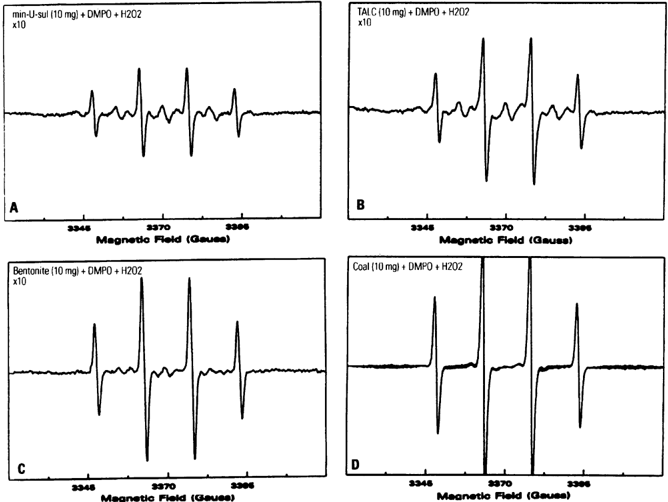
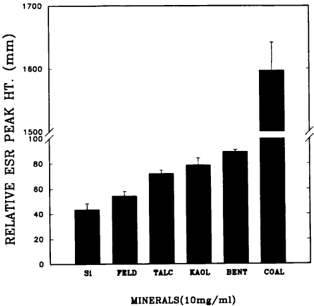
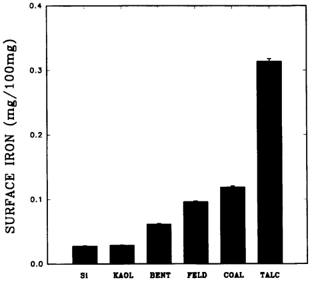
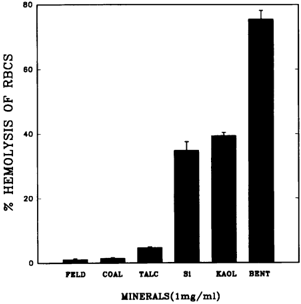
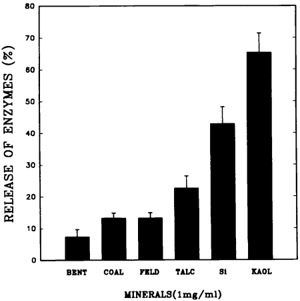
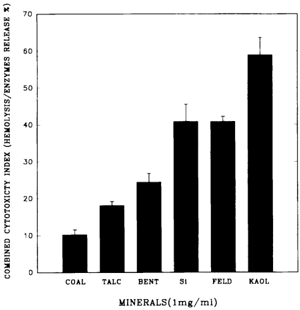
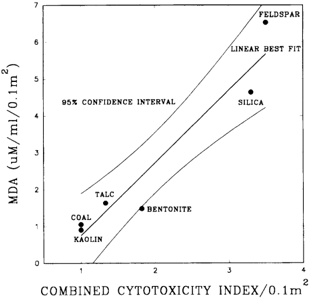
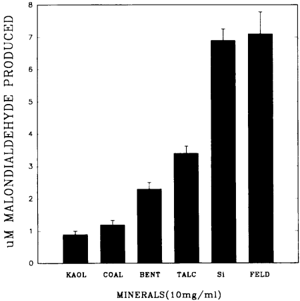
Occupational exposure to mineral dust causes pneumoconiosis and other diseases. A cytotoxicity assay to predict the potential of minerals to cause disease would be of great value as a prevention strategy. This study compares the ability of several minerals to generate the more potent oxidizing agent, hydroxyl radical (.OH), and their cytotoxicity and lipid peroxidation potentials. Crystalline silica, the most potent cytotoxic and pathogenic mineral studied, showed the least ability to generate .OH radicals while inducing the maximal lipid peroxidation. Coal mine dust, showing the maximal ability to generate .OH radicals, was the least cytotoxic in bioassays of toxicity and induction of lipid peroxidation. Based on these results, it would appear that the ability of minerals to induce lipid peroxidation provides a better correlation with known cytotoxicity and pathogenicity of minerals than does their ability to generate oxygen radicals.
Overview
The claims and statistics of this paper haven’t been checked yet.
Free: it reads the open-access text and checks the first 5 claims that cite a source we can check. Create a free account to check every claim.
Integrity signals
Registry
Cites
Statistics
Figures
Verification
Claims the paper makes
The claims and statistics of this paper haven’t been checked yet.
Free: it reads the open-access text and checks the first 5 claims that cite a source we can check. Create a free account to check every claim.
Claims other papers make about this one
Each is checked against this paper’s own text: does it say what the citing paper says it does?
The source backs part of the claim, not all of it — or backs it for a different population, condition or comparison.
In the citing paper
“In addition, iron in the Fe0 valence state (often referred to as nanophase iron) present in the particles may contribute to the formation of reactive oxygen species when in contact with human tissue, though the likelihood and severity of this possibility are unknown5–8.”
From Overview of lunar dust toxicity risk (2022) · cites this paper as [8]
Experimental — accuracy not yet measured
Self-check
Percentages, sums and reported differences re-computed from the paper’s own numbers.
The self-check needs the paper’s full text.
Citations
Cites
Adsorption of Gases in Multimolecular Layers
Brunauer, S., Emmett, P. H., & Teller, E. (1938) · Journal of the American Chemical Society · doi:10.1021/ja01269a023 · Cited by 28,156
Dye Exclusion Tests for Cell Viability
Phillips, H. J. (1973) · Tissue Culture · doi:10.1016/b978-0-12-427150-0.50101-7 · Cited by 886
Swelling and Lysis of Rat Liver Mitochondria Induced by Ferrous Ions
Hunter, F. E., Gebicki, J. M., Hoffsten, P. E., Weinstein, J., & Scott, A. (1963) · Journal of Biological Chemistry · doi:10.1016/s0021-9258(18)81341-2 · Cited by 517
Sellinger, O. Z., Beaufay, H., Jacques, P., Doyen, A., & de Duve, C. (1960) · Biochemical Journal · doi:10.1042/bj0740450 · Cited by 378
Vallyathan, V., Shi, X., Dalal, N. S., Irr, W., & Castranova, V. (1988) · American Review of Respiratory Disease · doi:10.1164/ajrccm/138.5.1213 · Cited by 327 · cited 3×
“To this end, we have devoted considerable effort during the last several years toward understanding the surface properties and chemical structure of minerals and their relation to oxygen radical generation and related cytotoxicity (5-7).”
BackgroundSelf-citationHarington, J. S., Miller, K., & Macnab, G. (1971) · Environmental Research · doi:10.1016/0013-9351(71)90038-7 · Cited by 187
Pathogenesis of silicosis: Current concepts and hypotheses
Davis, G. S. (1986) · Lung · doi:10.1007/bf02713638 · Cited by 162
Enhanced Generation of Free Radicals from Phagocytes Induced by Mineral Dusts
Vallyathan, V., Mega, J. F., Shi, X., & Dalal, N. S. (1992) · American Journal of Respiratory Cell and Molecular Biology · doi:10.1165/ajrcmb/6.4.404 · Cited by 125
Self-citationShi, X., Dalai, N. S., & Vallyathan, V. (1988) · Journal of Toxicology and Environmental Health · doi:10.1080/15287398809531205 · Cited by 79
Self-citationDalal, N. S., Shi, X., & Vallyathan, V. (1990) · Journal of Toxicology and Environmental Health · doi:10.1080/15287399009531393 · Cited by 68
Self-citationAn Improved Procedure for the Preparation of Crystalline Lactic Dehydrogenase from Hog Heart
Reeves, W. J., & Fimognari, G. M. (1963) · Journal of Biological Chemistry · doi:10.1016/s0021-9258(18)51799-3 · Cited by 63
Davis, G. S. (1986) · CHEST Journal · doi:10.1378/chest.89.3_supplement.166s · Cited by 55
(1989) · The Annals of Occupational Hygiene · doi:10.1093/annhyg/33.1.79 · Cited by 47
Self-citationSILICOTIC FIBROGENESIS: A CONCEPT OF PULMONARY FIBROSIS
Heppleston, A. G. (1982) · Elsevier eBooks · doi:10.1016/b978-0-08-026838-5.50036-2 · Cited by 39
Influence of mineral dust surface chemistry on eicosanoid production by the alveolar macrophage
Kuhn, D. C., & Demers, L. M. (1992) · Journal of Toxicology and Environmental Health · doi:10.1080/15287399209531592 · Cited by 30
Alterations in rabbit alveolar macrophages as a result of traumatic shock.
Vg, L., & Kennedy, R. E. (1976) · PubMed · Cited by 30
Castranova, V., Vallyathan, V., Dyke, K. V., & Dalal, N. S. (1989) · Springer eBooks · doi:10.1007/978-3-642-74203-3_24 · Cited by 7
Self-citation
Cited by
Silicosis and coal workers' pneumoconiosis.
Castranova, V, & Vallyathan, V (2000) · Environmental Health Perspectives · doi:10.1289/ehp.00108s4675 · Cited by 440
Self-citationProcessing Pathway Dependence of Amorphous Silica Nanoparticle Toxicity: Colloidal vs Pyrolytic
Zhang, H., Dunphy, D. R., Jiang, X., Meng, H., Sun, B., Tarn, D., Xue, M., Wang, X., Lin, S., Ji, Z., et al. (2012) · Journal of the American Chemical Society · doi:10.1021/ja304907c · Cited by 446
Hnizdo, E., & Vallyathan, V (2003) · Occupational and Environmental Medicine · doi:10.1136/oem.60.4.237 · Cited by 348
Self-citationØvrevik, J., Refsnes, M., Låg, M., Holme, J., & Schwarze, P. (2015) · Biomolecules · doi:10.3390/biom5031399 · Cited by 241
“A range of studies has also failed to find a consistent correlation between oxidative capacity of particles in cell-free systems and their ability to induce inflammatory responses or other effects in cells, animals or humans [60–82].”
BackgroundBecker, S., Soukup, J. M., & Gallagher, J. E. (2002) · Toxicology in Vitro · doi:10.1016/s0887-2333(02)00015-2 · Cited by 166
Metadata
- Authors
- Vallyathan, V
- Affiliations
- National Institute for Occupational Safety and Health (US)
- Corresponding author
- Vallyathan, V
- Venue
- Environmental Health Perspectives
- Publisher
- American Chemical Society (ACS)
- Published
- 1994-12
- Volume
- 102
- Issue
- suppl 10
- Pages
- 111-115
- ISSN
- 0091-6765 (ISSN-L)
- 1552-9924
- OpenAlex
- W2081921061
- Cited by
- 66
- References
- 18
- Citations by year
- 2024: 3 · 2023: 3 · 2022: 2 · 2021: 1 · 2020: 2 · 2019: 1 · 2017: 1 · 2016: 2 · 2015: 2 · 2014: 2 · 2013: 2 · 2012: 5
- FWCI
- 2.96
- Type
- journal article
- Language
- en
- Open access
- gold
- doi.org
- Licence
- public-domain
- Locations
- Environmental Health Perspectives (publishedVersion, public-domain)
- Europe PMC (PubMed Central) (publishedVersion)
- PubMed (publishedVersion)
- Topics
- Health Sciences › Medicine › Pulmonary and Respiratory Medicine › Occupational and environmental lung diseases
- Health Sciences › Medicine › Biochemistry (medical) › Antioxidant Activity and Oxidative Stress
- Physical Sciences › Engineering › Safety, Risk, Reliability and Quality › Industrial and Mining Safety
- Keywords
- hydroxyl radicals, oxygen free radicals, lipid peroxidation, crystalline silica, coal mine dust, mineral dust, pneumoconiosis, oxidative stress
- MeSH terms
- Animals, Dust, Erythrocytes, Hemolysis, Minerals, Sheep, Macrophages, Alveolar, Rats, Sprague-Dawley, Reactive Oxygen Species, Hydroxyl Radical, Rats
About these checks
Registry, retraction, Cites and statistics results are computed, not judged, with one exception: a printed reference that no index lists is read once by a model before it counts as a citation error. Claims are extracted by a model and kept only when their quote appears verbatim in the text; each cited source is then checked, with a model’s help, for whether it says what the claim relies on. Those verdicts can be wrong — read the claim’s quote and the cited source before relying on one.
Statistics and arithmetic are recomputed, not judged.
Confidence bands are shown only for fields calibrated on our annotated test set. None is calibrated yet, so no band is shown.
What counts as a claim ›How we measure confidence ›How we check this ›
Are you an author, or do you see a problem with this page? Request a review
Data sources
Bibliographic data: Semantic Scholar, OpenAlex, Crossref.
Contains information from the Semantic Scholar Academic Graph Datasets, made available under the ODC Attribution License (ODC-BY 1.0).
Semantic Scholar’s data is described in: Kinney, R., et al. (2023). The Semantic Scholar Open Data Platform. arXiv:2301.10140.
