

Generation of oxygen radicals by minerals and its correlation to cytotoxicity.
Open accessThe DOI matches its Crossref record; 18 of the 18 references it cites were found in a registry or an index.
Abstract
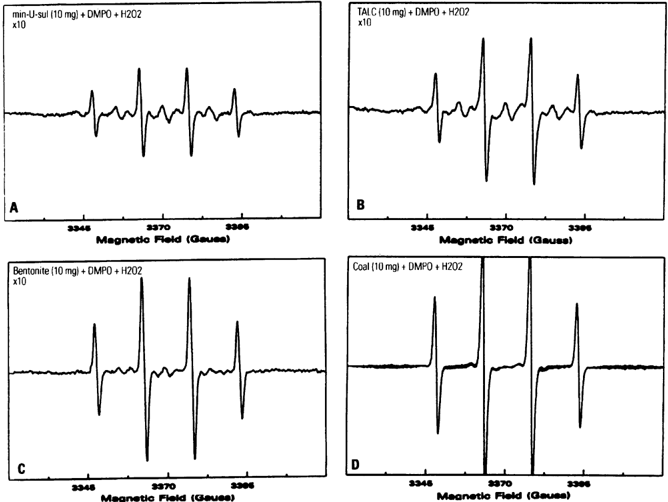
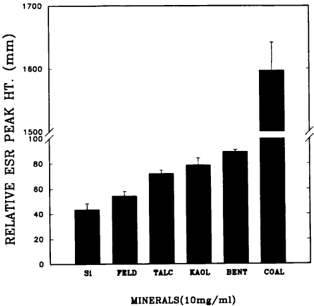
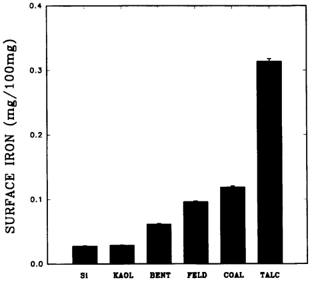
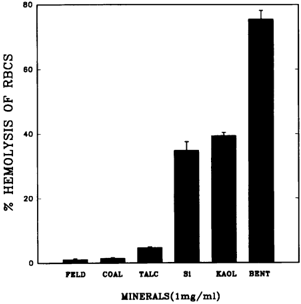
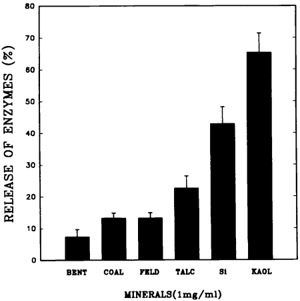
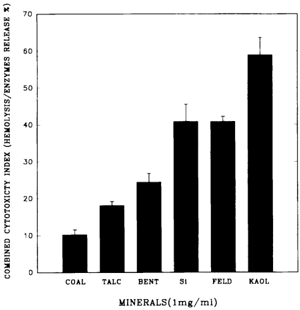
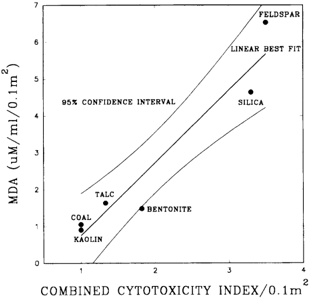
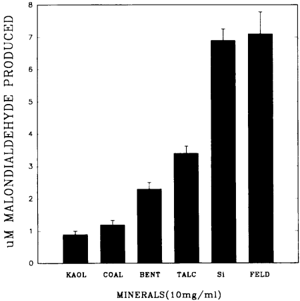
Occupational exposure to mineral dust causes pneumoconiosis and other diseases. A cytotoxicity assay to predict the potential of minerals to cause disease would be of great value as a prevention strategy. This study compares the ability of several minerals to generate the more potent oxidizing agent, hydroxyl radical (.OH), and their cytotoxicity and lipid peroxidation potentials. Crystalline silica, the most potent cytotoxic and pathogenic mineral studied, showed the least ability to generate .OH radicals while inducing the maximal lipid peroxidation. Coal mine dust, showing the maximal ability to generate .OH radicals, was the least cytotoxic in bioassays of toxicity and induction of lipid peroxidation. Based on these results, it would appear that the ability of minerals to induce lipid peroxidation provides a better correlation with known cytotoxicity and pathogenicity of minerals than does their ability to generate oxygen radicals.
Overview
The claims and statistics of this paper haven’t been checked yet.
Free: it reads the open-access text and checks the first 5 claims that cite a source we can check. Create a free account to check every claim.
Integrity signals
Registry
Cites
Statistics
Figures
Verification
Claims the paper makes
The claims and statistics of this paper haven’t been checked yet.
Free: it reads the open-access text and checks the first 5 claims that cite a source we can check. Create a free account to check every claim.
Claims other papers make about this one
Each is checked against this paper’s own text: does it say what the citing paper says it does?
The source backs part of the claim, not all of it — or backs it for a different population, condition or comparison.
In the citing paper
“In addition, iron in the Fe0 valence state (often referred to as nanophase iron) present in the particles may contribute to the formation of reactive oxygen species when in contact with human tissue, though the likelihood and severity of this possibility are unknown5–8.”
From Overview of lunar dust toxicity risk (2022) · cites this paper as [8]
Experimental — accuracy not yet measured
Self-check
Percentages, sums and reported differences re-computed from the paper’s own numbers.
The self-check needs the paper’s full text.
Citations
Cites
Adsorption of Gases in Multimolecular Layers
Brunauer, S., Emmett, P. H., & Teller, E. (1938) · Journal of the American Chemical Society · doi:10.1021/ja01269a023 · Cited by 28,156
Dye Exclusion Tests for Cell Viability
Phillips, H. J. (1973) · Tissue Culture · doi:10.1016/b978-0-12-427150-0.50101-7 · Cited by 886
Swelling and Lysis of Rat Liver Mitochondria Induced by Ferrous Ions
Hunter, F. E., Gebicki, J. M., Hoffsten, P. E., Weinstein, J., & Scott, A. (1963) · Journal of Biological Chemistry · doi:10.1016/s0021-9258(18)81341-2 · Cited by 517
Sellinger, O. Z., Beaufay, H., Jacques, P., Doyen, A., & de Duve, C. (1960) · Biochemical Journal · doi:10.1042/bj0740450 · Cited by 378
Vallyathan, V., Shi, X., Dalal, N. S., Irr, W., & Castranova, V. (1988) · American Review of Respiratory Disease · doi:10.1164/ajrccm/138.5.1213 · Cited by 327 · cited 3×
“To this end, we have devoted considerable effort during the last several years toward understanding the surface properties and chemical structure of minerals and their relation to oxygen radical generation and related cytotoxicity (5-7).”
BackgroundSelf-citationHarington, J. S., Miller, K., & Macnab, G. (1971) · Environmental Research · doi:10.1016/0013-9351(71)90038-7 · Cited by 187
Pathogenesis of silicosis: Current concepts and hypotheses
Davis, G. S. (1986) · Lung · doi:10.1007/bf02713638 · Cited by 162
Enhanced Generation of Free Radicals from Phagocytes Induced by Mineral Dusts
Vallyathan, V., Mega, J. F., Shi, X., & Dalal, N. S. (1992) · American Journal of Respiratory Cell and Molecular Biology · doi:10.1165/ajrcmb/6.4.404 · Cited by 125
Self-citationShi, X., Dalai, N. S., & Vallyathan, V. (1988) · Journal of Toxicology and Environmental Health · doi:10.1080/15287398809531205 · Cited by 79
Self-citationDalal, N. S., Shi, X., & Vallyathan, V. (1990) · Journal of Toxicology and Environmental Health · doi:10.1080/15287399009531393 · Cited by 68
Self-citation
Cited by
Silicosis and coal workers' pneumoconiosis.
Castranova, V, & Vallyathan, V (2000) · Environmental Health Perspectives · doi:10.1289/ehp.00108s4675 · Cited by 440
Self-citationProcessing Pathway Dependence of Amorphous Silica Nanoparticle Toxicity: Colloidal vs Pyrolytic
Zhang, H., Dunphy, D. R., Jiang, X., Meng, H., Sun, B., Tarn, D., Xue, M., Wang, X., Lin, S., Ji, Z., et al. (2012) · Journal of the American Chemical Society · doi:10.1021/ja304907c · Cited by 446
Hnizdo, E., & Vallyathan, V (2003) · Occupational and Environmental Medicine · doi:10.1136/oem.60.4.237 · Cited by 348
Self-citationØvrevik, J., Refsnes, M., Låg, M., Holme, J., & Schwarze, P. (2015) · Biomolecules · doi:10.3390/biom5031399 · Cited by 241
“A range of studies has also failed to find a consistent correlation between oxidative capacity of particles in cell-free systems and their ability to induce inflammatory responses or other effects in cells, animals or humans [60–82].”
BackgroundBecker, S., Soukup, J. M., & Gallagher, J. E. (2002) · Toxicology in Vitro · doi:10.1016/s0887-2333(02)00015-2 · Cited by 166
Pavan, C., Santalucia, R., Leinardi, R., Fabbiani, M., Yakoub, Y., Uwambayinema, F., Ugliengo, P., Tomatis, M., Martra, G., Turci, F., et al. (2020) · Proceedings of the National Academy of Sciences · doi:10.1073/pnas.2008006117 · Cited by 150
Clouter, A. (2001) · Toxicological Sciences · doi:10.1093/toxsci/63.1.90 · Cited by 131
“Our findings are the same as demonstrated by Vallyathan (1994).”
ResultOccupational COPD —The most under‐recognized occupational lung disease?
Murgia, N., & Gambelunghe, A. (2022) · Respirology · doi:10.1111/resp.14272 · Cited by 167
“After deposition along the airways, inorganic dust can interact with bronchial epithelial cells and macrophages,(101,102) causing cell damage, ROS production and release of cytokines, chemokines and proteases.(103,104) There is some evidence from studies in animals that welding fumes could produce oxidative stress and…”
BackgroundRole of iron in the reactivity of mineral fibers
Fubini, B., & Mollo, L. (1995) · Toxicology Letters · doi:10.1016/0378-4274(95)03531-1 · Cited by 125
Cohn, C. A., Simon, S. R., & Schoonen, M. A. A. (2008) · Particle and Fibre Toxicology · doi:10.1186/1743-8977-5-2 · Cited by 136
“In other techniques involving cells or tissues, biological products of •OHinduced oxidation which can be subsequently quantified include lipid hydroperoxides and aldehydes [19], DNA strand-breaks [3,20], products of RNA degradation [21], nucleotide base oxidation products [22-24] and multiple signaling molecules such…”
Does Vitreous Silica Contradict the Toxicity of the Crystalline Silica Paradigm?
Ghiazza, M., Polimeni, M., Fenoglio, I., Gazzano, E., Ghigo, D., & Fubini, B. (2010) · Chemical Research in Toxicology · doi:10.1021/tx900369x · Cited by 92
Breathless: Schools, Air Toxics, and Environmental Justice in California
Pastor, M., Morello‐Frosch, R., & Sadd, J. L. (2006) · Policy Studies Journal · doi:10.1111/j.1541-0072.2006.00176.x · Cited by 89
FROM COAL MINE DUST TO QUARTZ: Mechanisms of Pulmonary Pathogenicity
Castranova, V. (2000) · Inhalation Toxicology · doi:10.1080/08958370050164842 · Cited by 109
In Search of the Chemical Basis of the Hemolytic Potential of Silicas
Pavan, C., Tomatis, M., Ghiazza, M., Rabolli, V., Bolis, V., Lison, D., & Fubini, B. (2013) · Chemical Research in Toxicology · doi:10.1021/tx400105f · Cited by 87
Coal workers' pneumoconiosis: an Australian perspective
Zosky, G. R., Hoy, R. F., Silverstone, E. J., Brims, F., Miles, S., Johnson, A., Gibson, P. G., & Yates, D. H. (2016) · The Medical Journal of Australia · doi:10.5694/mja16.00357 · Cited by 95
Watts, R. J., Washington, D., Howsawkeng, J., Loge, F. J., & Teel, A. L. (2002) · Advances in Environmental Research · doi:10.1016/s1093-0191(02)00100-4 · Cited by 86
Bentonite toxicology and epidemiology – a review
Maxim, L. D., Niebo, R., & McConnell, E. E. (2016) · Inhalation Toxicology · doi:10.1080/08958378.2016.1240727 · Cited by 78
“Several studies (Baek et al., 2012; Gormley and Addison, 1983 and contained references; Guthrie, 1992; Lu et al., 2009; Vallyathan et al., 1988; Vallyathan, 1994; Van Dyke et al., 2003; Zhang et al., 2010) have demonstrated the cytotoxicity of bentonite to various degrees, but interpretation has…”
BackgroundRubio, L., Pyrgiotakis, G., Beltran‐Huarac, J., Zhang, Y., Gaurav, J., DeLoid, G. M., Spyrogianni, A., Sarosiek, K. A., Bello, D., & Demokritou, P. (2019) · Particle and Fibre Toxicology · doi:10.1186/s12989-019-0325-1 · Cited by 82
Overview of lunar dust toxicity risk
Pohlen, M., Carroll, D., Prisk, G. K., & Sawyer, A. J. (2022) · npj Microgravity · doi:10.1038/s41526-022-00244-1 · Cited by 72
Kamanzi, C., Becker, M., Jacobs, M., Konečný, P., von Holdt, J., & Broadhurst, J. L. (2023) · Environmental Geochemistry and Health · doi:10.1007/s10653-023-01583-y · Cited by 76
“To date, research defining the mechanics of iron-mediated oxidative damage has predominantly focused on the complexation of aqueous iron as the main mode of iron availability (Cohn et al., 2006a; Dalal et al., 1995; Harrington et al., 2012, 2015; Vallyathan, 1994).”
BackgroundNehls, P., Seiler, F., Rehn, B., Greferath, R., & Bruch, J. (1997) · Environmental Health Perspectives · doi:10.1289/ehp.97105s51291 · Cited by 61
Balduzzi, M., Diociaiuti, M., Berardis, B. D., Paradisi, S., & Paoletti, L. (2004) · Environmental Research · doi:10.1016/j.envres.2003.11.004 · Cited by 67
“potency of silica has been better related to lipid peroxidation than to hydroxyl radical generation and secretion (Vallyathan, 1994), we quantified the oxidative stress marker 8-isoprostanes in the culture media of silica treated cells as a lipid stable peroxidation product occurring as a result of ROS reaction at the…”
MethodNon-occupational exposure to silica dust
Bhagia, L. (2012) · Indian Journal of Occupational and Environmental Medicine · doi:10.4103/0019-5278.111744 · Cited by 59
“It has been reported that freshly fractured silica is much more cytotoxic than aged quartz.[6,36,37] Considering all these arguments, a question arises whether there should be separate silica standard for community environment (non-occupational exposure to silica dust from nonindustrial sources) and the environment in…”
BackgroundCohn, C. A., Pedigo, C. E., Hylton, S. N., Simon, S. R., & Schoonen, M. A. A. (2009) · Geochemical Transactions · doi:10.1186/1467-4866-10-8 · Cited by 58
“In the presence of cells or in tissue, the products of particleinduced radical oxidation include lipid peroxidation [28], DNA strand-breaks [29,7], RNA degradation [30], nucleobase oxidation [31,32,31,33] and upregulation of signaling molecules indicative of inflammation and apoptosis (i.”
Background(FEEDAP), E. P. O. A. A. P. O. S. U. I. A. F. (2011) · EFSA Journal · doi:10.2903/j.efsa.2011.2007 · Cited by 51
Single‐Mother Families and Air Pollution: A National Study*
Downey, L. C., & Hawkins, B. (2008) · Social Science Quarterly · doi:10.1111/j.1540-6237.2008.00545.x · Cited by 53
Surface Iron Inhibits Quartz-Induced Cytotoxic and Inflammatory Responses in Alveolar Macrophages
Ghiazza, M., Scherbart, A. M., Fenoglio, I., Grendene, F., Turci, F., Martra, G., Albrecht, C., Schins, R. P. F., & Fubini, B. (2011) · Chemical Research in Toxicology · doi:10.1021/tx1003003 · Cited by 49
Chemical disinfection with H2O2 − The proposal of a reaction kinetic model
Flores, M. J., Brandi, R. J., Cassano, A. E., & Labas, M. D. (2012) · Chemical Engineering Journal · doi:10.1016/j.cej.2012.05.107 · Cited by 49
Role of iron in asbestos-body-induced oxidant Radical generation
Mario Governa, M. A. (1999) · Journal of Toxicology and Environmental Health, Part A · doi:10.1080/009841099157241 · Cited by 39
Zhang, Y., Yang, Z., Li, R., Geng, H., & Dong, C. (2014) · Chemosphere · doi:10.1016/j.chemosphere.2014.09.009 · Cited by 37
Kanj, R. S., Kang, J., & Castranova, V. (2006) · Journal of Toxicology and Environmental Health · doi:10.1080/14736480500360504 · Cited by 36
Biomembrane Phospholipid–Oxide Surface Interactions: Crystal Chemical and Thermodynamic Basis
Sahai, N. (2002) · Journal of Colloid and Interface Science · doi:10.1006/jcis.2002.8448 · Cited by 36
Øvrevik, J., Refsnes, M., Schwarze, P. E., & Låg, M. (2008) · Toxicology Letters · doi:10.1016/j.toxlet.2008.07.001 · Cited by 33
(FEEDAP), E. P. O. A. A. P. O. S. U. I. A. F. (2012) · EFSA Journal · doi:10.2903/j.efsa.2012.2787 · Cited by 30
Particulates and the Airways: Basic Biological Mechanisms of Pulmonary Pathogenicity
Castranova, V. (1998) · Applied Occupational and Environmental Hygiene · doi:10.1080/1047322x.1998.10390122 · Cited by 34
N-acetyl l-cysteine attenuates oxidant-mediated toxicity induced by chrysotile fibers
Afaq, F., Abidi, P., & Rahman, Q. (2000) · Toxicology Letters · doi:10.1016/s0378-4274(00)00236-8 · Cited by 30
Quartz Inhibits Glucose 6-Phosphate Dehydrogenase in Murine Alveolar Macrophages
Polimeni, M., Gazzano, E., Ghiazza, M., Fenoglio, I., Bosìa, A., Fubini, B., & Ghigo, D. (2008) · Chemical Research in Toxicology · doi:10.1021/tx7003213 · Cited by 29
“A greater knowledge of such topics is particularly important in the prevention of silicaassociated pathologies, since ROS are universally acknowledged to be the main effectors of cytotoxic (16), genotoxic (17) and transforming effects (18) of silica.”
BackgroundPavan, C., Casado, G. E., Bellomo, C., Cananà, S., Tomatis, M., Leinardi, R., Mino, L., & Turci, F. (2023) · Frontiers in Chemistry · doi:10.3389/fchem.2022.1092221 · Cited by 25
“Therefore, a possible contribution of •OH radicals to the membranolytic activity of the CS samples here investigated should be ruled out, as also shown in previous studies on silica membranolysis (Vallyathan, 1994; Clouter et al., 2001; Pavan et al., 2013).”
BackgroundCytotoxic effects of wildfire ashes: In-vitro responses of skin cells
Ré, A., Rocha, A. T., Campos, I., Keizer, J. J., Gonçalves, F. J. M., Oliveira, H., Pereira, J. L., & Abrantes, N. (2021) · Environmental Pollution · doi:10.1016/j.envpol.2021.117279 · Cited by 23
Effect of Kerosene and Its Soot on the Chrysotile-Mediated Toxicity to the Rat Alveolar Macrophages
Arif, J. M., Khan, S. G., Ahmad, I., Joshi, L. D., & Rahman, Q. (1997) · Environmental Research · doi:10.1006/enrs.1996.3722 · Cited by 20
“Several studies have suggested the role of reactive oxygen species (ROS) in asbestos-mediated diseases (reviewed in Kamp et al., 1992; Vallyathan, 1994).”
BackgroundComputational Molecular Basis for Improved Silica Surface Complexation Models
Sahai, N., & Rosso, K. M. (2006) · Interface science and technology · doi:10.1016/s1573-4285(06)80057-8 · Cited by 18
Simultaneous abiotic reduction–biotic oxidation in a microbial-MnO2-catalyzed Fenton-like system
Howsawkeng, J., Teel, A. L., Hess, T. F., Crawford, R. L., & Watts, R. J. (2010) · The Science of The Total Environment · doi:10.1016/j.scitotenv.2010.10.009 · Cited by 17
Kamanzi, C., Becker, M., von Holdt, J., Hsu, N., Konečný, P., Broadhurst, J. L., & Jacobs, M. (2024) · Environmental Science & Technology · doi:10.1021/acs.est.3c08732 · Cited by 16
Gürel, A., Armutçu, F., Damatoğlu, Ş., Ünalacak, M., & Demircan, N. (2004) · Electronic Journal of General Medicine · doi:10.29333/ejgm/82220 · Cited by 16
Mossman, B. T., & Gee, J. B. L. (1997) · American Journal of Public Health · doi:10.2105/ajph.87.4.689 · Cited by 16
Governa, M., Camilucci, L., Amati, M., Visonà, I., Valentino, M., Botta, G. C., Campopiano, A., & Fanizza, C. (1998) · Toxicological Sciences · doi:10.1006/toxs.1998.2440 · Cited by 17
“…reactive oxygen species (ROS), especially hydroxyl radicals, from the surface of asbestos fibers is associated with toxicityn vitro and toxicity and/or carcinogenicityin vivo (Kamp et al., 1992; Ryrfeldt et al., 1993; Zalmaet al., 1987a; Vallyathanet al., 1992; Vallyathan, 1994; Ghioet al.,1996).”
BackgroundDoes light-stick content pose any threat to marine organisms?
Pinho, G. L. L., Ihara, P. M., & Fillmann, G. (2008) · Environmental Toxicology and Pharmacology · doi:10.1016/j.etap.2008.08.001 · Cited by 14
Dynamic Changes of Constituents in Bronchoalveolar Lavage Fluid in Experimental Silicotic Rats.
Zhang, Q., Kusaka, Y., ZHANG, Q., Linyuan, H. E., ZHANG, Z., & Sato, K. (1996) · Industrial Health · doi:10.2486/indhealth.34.379 · Cited by 13
Ahn, J., Akram, K., & Kwon, J. (2012) · Food Analytical Methods · doi:10.1007/s12161-012-9364-z · Cited by 13
“Free radicals can also be generated by oxidation of lipids (Mogens and Leif 2002; Marianne et al. 2005) and proteins (Suhur et al. 2006), influence of ash (Horwell et al. 2007) and minerals (Vallyathan 1994; Nakagawa and Sato 2005), and triboluminescence (Tetsu and Helmut 1981) during grinding.”
Background(FEEDAP), E. P. O. A. A. P. O. S. U. I. A. F. (2014) · EFSA Journal · doi:10.2903/j.efsa.2014.3904 · Cited by 11
Amphibole asbestos as an environmental trigger for systemic autoimmune diseases
Pfau, J. C., McLaurin, B. T., Buck, B. J., & Miller, F. W. (2024) · Autoimmunity Reviews · doi:10.1016/j.autrev.2024.103603 · Cited by 16
Chronic Airway Disease Due to Occupational Exposure
Hnizdo, E., Kennedy, S., Blanc, P. D., & Torén, K. (2006) · CRC Press eBooks · doi:10.3109/9780849374531-29 · Cited by 9
Governa, M., Valentino, M., Amati, M., Visonà, I., Botta, G. C., Marcer, G., & Gemignani, C. (1997) · Toxicology in Vitro · doi:10.1016/s0887-2333(97)00018-0 · Cited by 10
Development of ESR method for gamma-irradiated lactose powders
Lee, H.-M., Kwak, B., Ahn, J., & Jeong, S.-H. (2010) · Journal of Food Engineering · doi:10.1016/j.jfoodeng.2010.03.022 · Cited by 6
Haemolytic activity of soil from areas of varying podoconiosis endemicity in Ethiopia
Blond, J. S. L., Baxter, P. J., Bello, D., Raftis, J. B., Molla, Y., Cuadros, J., & Davey, G. (2017) · PLoS ONE · doi:10.1371/journal.pone.0177219 · Cited by 6
Watts, R. J., Loge, F. J., & Teel, A. L. (2006) · Defense Technical Information Center (DTIC) · Cited by 5
Impacts of Fines at Morupule Coal Mine, Botswana
Saubi, O., Suglo, R. S., & Konka, B. (2023) · Momona Ethiopian Journal of Science · doi:10.4314/mejs.v15i1.1 · Cited by 4
Menzies, D., & Kreiss, K. (2006) · CRC Press eBooks · doi:10.3109/9780849374531-31 · Cited by 4
Andraos, C., & Gulumian, M. (2020) · Inhalation Toxicology · doi:10.1080/08958378.2020.1836092 · Cited by 3
Asbestos-Related Cancer and the Amphibole Hypothesis: 5. Cullen Responds
Cullen, M. R. (1997) · American Journal of Public Health · doi:10.2105/ajph.87.4.690 · Cited by 3
Risk of Adverse Health and Performance Effects of Celestial Dust Exposure
Scully, R. R., & Meyers, V. E. (2015) · NASA STI Repository (National Aeronautics and Space Administration) · Cited by 12
Chronic obstructive airway disease due to occupational exposure
Blanc, P. D., Hnizdo, E., Kreiss, K., & Torén, K. (2013) · Informa Healthcare eBooks · doi:10.3109/9781841849256.026 · Cited by 2
Molecular and Cellular Responses to Asbestos Exposure
Atkinson, M. A. (2005) · CRC Press eBooks · doi:10.1201/9781420038149.ch4 · Cited by 4
Fines Generation and Its Impacts at Morupule Underground Coal Mine, Botswana
Saubi, O., Suglo, R. S., & Konka, B. (2024) · Advances in Science, Technology & Innovation/Advances in science, technology & innovation · doi:10.1007/978-3-031-43218-7_107 · Cited by 2
Oxygen/Nitrogen Radicals and Silica-Induced Diseases
(2004) · Lung biology in health and disease · doi:10.1201/b14147-9 · Cited by 2
Nanotechnology and health: From boundary object to bodily intervention
Perry, K.-M. E. (2010) · Summit (Simon Fraser University) · Cited by 2
Metadata
- Authors
- Vallyathan, V
- Affiliations
- National Institute for Occupational Safety and Health (US)
- Corresponding author
- Vallyathan, V
- Venue
- Environmental Health Perspectives
- Publisher
- American Chemical Society (ACS)
- Published
- 1994-12
- Volume
- 102
- Issue
- suppl 10
- Pages
- 111-115
- ISSN
- 0091-6765 (ISSN-L)
- 1552-9924
- OpenAlex
- W2081921061
- Cited by
- 66
- References
- 18
- Citations by year
- 2024: 3 · 2023: 3 · 2022: 2 · 2021: 1 · 2020: 2 · 2019: 1 · 2017: 1 · 2016: 2 · 2015: 2 · 2014: 2 · 2013: 2 · 2012: 5
- FWCI
- 2.96
- Type
- journal article
- Language
- en
- Open access
- gold
- doi.org
- Licence
- public-domain
- Locations
- Environmental Health Perspectives (publishedVersion, public-domain)
- Europe PMC (PubMed Central) (publishedVersion)
- PubMed (publishedVersion)
- Topics
- Health Sciences › Medicine › Pulmonary and Respiratory Medicine › Occupational and environmental lung diseases
- Health Sciences › Medicine › Biochemistry (medical) › Antioxidant Activity and Oxidative Stress
- Physical Sciences › Engineering › Safety, Risk, Reliability and Quality › Industrial and Mining Safety
- Keywords
- hydroxyl radicals, oxygen free radicals, lipid peroxidation, crystalline silica, coal mine dust, mineral dust, pneumoconiosis, oxidative stress
- MeSH terms
- Animals, Dust, Erythrocytes, Hemolysis, Minerals, Sheep, Macrophages, Alveolar, Rats, Sprague-Dawley, Reactive Oxygen Species, Hydroxyl Radical, Rats
About these checks
Registry, retraction, Cites and statistics results are computed, not judged, with one exception: a printed reference that no index lists is read once by a model before it counts as a citation error. Claims are extracted by a model and kept only when their quote appears verbatim in the text; each cited source is then checked, with a model’s help, for whether it says what the claim relies on. Those verdicts can be wrong — read the claim’s quote and the cited source before relying on one.
Statistics and arithmetic are recomputed, not judged.
Confidence bands are shown only for fields calibrated on our annotated test set. None is calibrated yet, so no band is shown.
What counts as a claim ›How we measure confidence ›How we check this ›
Are you an author, or do you see a problem with this page? Request a review
Data sources
Bibliographic data: Semantic Scholar, OpenAlex, Crossref.
Contains information from the Semantic Scholar Academic Graph Datasets, made available under the ODC Attribution License (ODC-BY 1.0).
Semantic Scholar’s data is described in: Kinney, R., et al. (2023). The Semantic Scholar Open Data Platform. arXiv:2301.10140.
