

Vaccine Hesitancy: Clarifying a Theoretical Framework for an Ambiguous Notion
Open accessThe DOI matches its Crossref record; 45 of the 46 references it cites were found in a registry or an index; none of the 43 sources its claims cite is checked for support yet.
Abstract
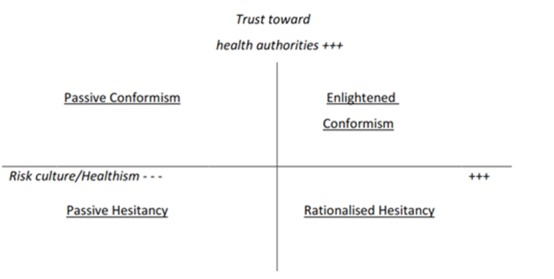
Today, according to many public health experts, public confidence in vaccines is waning. The term "vaccine hesitancy" (VH) is increasingly used to describe the spread of such vaccine reluctance. But VH is an ambiguous notion and its theoretical background appears uncertain. To clarify this concept, we first review the current definitions of VH in the public health literature and examine its most prominent characteristics. VH has been defined as a set of beliefs, attitudes, or behaviours, or some combination of them, shared by a large and heterogeneous portion of the population and including people who exhibit reluctant conformism (they may either decline a vaccine, delay it or accept it despite their doubts) and vaccine-specific behaviours. Secondly, we underline some of the ambiguities of this notion and argue that it is more a catchall category than a real concept. We also call into question the usefulness of understanding VH as an intermediate position along a continuum ranging from anti-vaccine to pro-vaccine attitudes, and we discuss its qualification as a belief, attitude or behaviour. Thirdly, we propose a theoretical framework, based on previous literature and taking into account some major structural features of contemporary societies, that considers VH as a kind of decision-making process that depends on people's level of commitment to healthism/risk culture and on their level of confidence in the health authorities and mainstream medicine.
Overview
CoChat Summary
TL;DR
This paper argues that “vaccine hesitancy” is currently too ambiguous to function as a clear concept, because existing definitions mix beliefs, attitudes, behaviors, and decision processes. The authors propose instead a two-axis framework in which vaccine hesitancy is a decision-making process shaped by commitment to healthism/risk culture and confidence in health authorities and mainstream medicine.
Key findings
- The paper states that VH has been defined in the literature as “a set of beliefs, attitudes, or behaviours, or some combination of them,” and that it includes people showing “reluctant conformism” who may decline, delay, or accept vaccines despite doubts.
- The authors argue VH is “more a catchall category than a real concept,” and that the common pro-vaccine to anti-vaccine continuum is not a good way to position it.
- They propose a framework with two axes: commitment to healthism/risk culture and confidence toward health authorities and mainstream medicine; they present example quadrants for “erratic VH” and more “rationalised” or deliberative VH.
- The paper cites survey results on trust in France: only 38% of French respondents had confidence that authorities handled the 2009 H1N1 episode for their safety, and only 34% believed the information released was true.
Methods
- Conceptual/theoretical paper: the authors review current public-health definitions of vaccine hesitancy and examine their main characteristics and ambiguities.
- They synthesize prior literature and examples from previous studies to build a proposed theoretical model, rather than reporting new empirical data.
- They use a two-dimension map to organize vaccine-hesitancy profiles and discuss how different vaccines and contexts may fall within it.
Limitations
- The paper does not present original empirical testing of the proposed framework; this is evident from the text.
- The authors explicitly note that the notion of VH lacks consistence and is used inconsistently across studies, which hampers research and interventions.
- The framework is proposed as a supplement to prior SAGE work, but the paper does not validate the model empirically; this is evident from the text.
Model-written summary. Check it against the paper before relying on it.
Integrity signals
Registry
Cites
Statistics
Figures
Verification
Claims the paper makes
0 Valid · 0 Not valid · 22 Not checked · 26 Own results and interpretations
In the paper
“Gilkey et al. 26 observed that forgoing vaccines was more common among parents more attentive to their children's health and nutrition, and others underline the weight of rational assessment and the importance of perceived control among people who were reluctant to be vaccinated against the H1N1 influenza 16 , 27.”
§ Vaccine Hesitancy: Clarifying a Theoretical Framework for an Ambiguous Notion > A theoretical model for VH
What the sources say
- Not matchedcites [26] Gilkey MB, McRee AL, Brewer NT. (2013) Forgone vaccination during childhood and adolescence: Finding of a statewide survey of parents. Prev Med 56: 202-206. PMC3582706 23295175
We don’t have this paper’s reference list.
plainstates an association- Asserted: passes — The authors put it forward as true.
- Checkable: passes — It can be checked against evidence.
- Load-bearing: passes — The paper’s conclusions depend on it.
- Based: passes — The paper gives a reason why it holds.
- Not matched
None of the sources cited for this claim could be matched to a paper, so there is nothing to check it against.
In the paper
“Moreover, some previous empirical studies have found quite contrasting profiles of attitudes among those who could be categorised as vaccine-hesitant 13 , 14.”
§ Vaccine Hesitancy: Clarifying a Theoretical Framework for an Ambiguous Notion > The ambiguities of current definitions of VH.
What the sources say
- Not matchedcites [13] Gust D, Brown C, Sheedy K, Hibbs B, Weaver D, Nowak G. (2005) Immunization attitudes and beliefs among parents: beyond a dichotomous perspective. Am J Health Behav 29(1): 81-92. 15604052
We don’t have this paper’s reference list.
- Not matchedcites [14] Velan B, Boyko V, Lerner-Geva L, Ziv A, Yagar Y, Kaplan G. (2012) Individualism, acceptance and differentiation as attitude traits in the public’s response to vaccination. Hum Vaccin Immunother 8(9): 1272-1282. PMC3579908 22894959
We don’t have this paper’s reference list.
plain- Asserted: passes — The authors put it forward as true.
- Checkable: passes — It can be checked against evidence.
- Load-bearing: passes — The paper’s conclusions depend on it.
- Based: passes — The paper gives a reason why it holds.
- Not matched
None of the sources cited for this claim could be matched to a paper, so there is nothing to check it against.
In the paper
“Definitions that try to describe VH as it is used by researchers tend to be very broad and to embrace heterogeneous people/situations and many different explanatory factors (including historic, political and socio-cultural contexts, as well as individual/social group influences 5 , 6 , 9).”
§ Vaccine Hesitancy: Clarifying a Theoretical Framework for an Ambiguous Notion > The ambiguities of current definitions of VH.
What the sources say
- Not matchedcites [5] Dubé E, Laberge C, Guay M, Bramadat P, Roy R, Bettinger J. (2013) Vaccine hesitancy: an overview. Hum Vaccin Immunother 9(8): 1763‑1773. PMC3906279 23584253
We don’t have this paper’s reference list.
- Not matchedcites [6] Gowda C, Dempsey AF. (2013) The rise (and fall?) of parental vaccine hesitancy. Hum Vaccin Immunother 9(8): 1755-1762. PMC3906278 23744504
We don’t have this paper’s reference list.
- Not matchedcites [9] Limb M. (2011) "Vaccine hesitancy" means scientists need to be more honest about risks. BMJ 15;342: d2479. 21498466
We don’t have this paper’s reference list.
plain- Asserted: passes — The authors put it forward as true.
- Checkable: passes — It can be checked against evidence.
- Load-bearing: passes — The paper’s conclusions depend on it.
- Based: passes — The paper gives a reason why it holds.
- Not matched
None of the sources cited for this claim have been checked yet.
In the paper
“The link between healthism and VH is quite obvious in several studies.”
§ Vaccine Hesitancy: Clarifying a Theoretical Framework for an Ambiguous Notion > A theoretical model for VH
boostedstates an association- Asserted: passes — The authors put it forward as true.
- Checkable: passes — It can be checked against evidence.
- Load-bearing: unclear — It is unclear whether the paper’s conclusions depend on it.
- Based: passes — The paper gives a reason why it holds.
A conclusion the paper draws from its own results — it cites no other source for it, so there is none to check. The quote shows it is in the paper.
In the paper
“Nevertheless, using this continuum to describe VH is not self-evident.”
§ Vaccine Hesitancy: Clarifying a Theoretical Framework for an Ambiguous Notion > Two issues raised by the VH definitions: what is VH, and where to position it?
plain- Asserted: passes — The authors put it forward as true.
- Checkable: unclear — It is unclear whether it could be checked against evidence.
- Load-bearing: passes — The paper’s conclusions depend on it.
- Based: passes — The paper gives a reason why it holds.
7 more claims
Create a free account to see all 48 claims and to verify the 26 references still open.
- Probably not a substantial claim. 28
- It may state two separate claims as one. 17
Citations
Cites
Risk Society, Towards a New Modernity
Leiss, W., Beck, U., Ritter, M., Lash, S., & Wynne, B. (1994) · Canadian Journal of Sociology / Cahiers canadiens de sociologie · doi:10.2307/3341155 · Cited by 12,546
Giddens, A. (2023) · Social Theory Re-Wired · doi:10.4324/9781003320609-62 · Cited by 4,813
Risk Society: Towards a New Modernity
Wallman, S., Beck, U., & Ritter, M. (1995) · The Journal of the Royal Anthropological Institute · doi:10.2307/3034709 · Cited by 3,065
Naissance de la biopolitique : cours au collège de France (1978-1979)
Foucault, M., Ewald, F., Fontana, A., & Senellart, M. (2004) · Cited by 2,556
Larson, H. J., Jarrett, C., Eckersberger, E., Smith, D. M. D., & Paterson, P. (2014) · Vaccine · doi:10.1016/j.vaccine.2014.01.081 · Cited by 2,254
Self-citationVaccine hesitancy: An overview
Dubé, E., Laberge, C., Guay, M., Bramadat, P., Roy, R., & Bettinger, J. A. (2013) · Human Vaccines & Immunotherapeutics · doi:10.4161/hv.24657 · Cited by 2,172
(2016) · Social Theory Re-Wired · doi:10.4324/9781315775357-68 · Cited by 1,815
The Imperative of Health: Public Health and the Regulated Body
Lupton, D. (1995) · SAGE Publications Ltd eBooks · doi:10.4135/9781446221976 · Cited by 1,268
Attitudes to vaccination: A critical review
Yaqub, O., Castle-Clarke, S., Sevdalis, N., & Chataway, J. (2014) · Social Science & Medicine · doi:10.1016/j.socscimed.2014.04.018 · Cited by 1,089
The imperative of health: public health and the regulated body
(1996) · Choice Reviews Online · doi:10.5860/choice.33-3358 · Cited by 1,067
Cited by
Items 201–300 of 338
Brumbaugh, K., Kaplan, L., Ma, K. P. K., et al. (2025) · The Gerontologist · doi:10.1093/geront/gnaf022 · Cited by 5
“Regardless of the level of concern or hesitancy toward the COVID-19 vaccine, some staff were “reluctant conformers,” those who may decline, delay, and reluctantly accept a vaccination due to external factors despite reluctance or doubts (Larson et al., 2014; Peretti-Watel et al., 2015).”
Proposing a New Conceptual Syndemic Framework for COVID-19 Vaccine Hesitancy: A Narrative Review
AlShurman, B. A., & Butt, Z. A. (2023) · International Journal of Environmental Research and Public Health · doi:10.3390/ijerph20021561 · Cited by 9
“Previous research has attempted to understand the complexity of interactions between different factors, vaccine dynamics, and vaccine hesitancy by using a variety of models [42].”
BackgroundGianfredi, V., Berti, A., D’Amico, M., Lorenzo, V. D., & Castaldi, S. (2023) · Women · doi:10.3390/women3010006 · Cited by 5
Psychological mechanisms and interventions directed at vaccination attitudes
Ann, S. R. R., & Baumann, O. (2023) · Frontiers in Sociology · doi:10.3389/fsoc.2023.1076015 · Cited by 8
Al‐Taie, A., & YILMAZ, Z. K. (2023) · Journal of Public Health · doi:10.1007/s10389-023-01968-4 · Cited by 5
“Vaccine hesitancy is considered a major global health problem, defined as a set of beliefs, attitudes, behaviours or a combination of them manifested as delayed acceptance or refusal of vaccines (Peretti-Watel et al. 2015; MacDonald 2015).”
Patients’ high acceptability of a future therapeutic HIV vaccine in France: a French paradox?
Dimi, S., Zucman, D., Chassany, O., Lalanne, C., Prazuck, T., Mortier, E., Majerholc, C., Aubin-Auger, I., Verger, P., & Duracinský, M. (2019) · BMC Infectious Diseases · doi:10.1186/s12879-019-4056-6 · Cited by 5
“The WHO Strategic Advisory Group of Experts (SAGE) on Immunization has recognized that reservations about vaccines (vaccine hesitancy) are a growing global problem [10, 11].”
BackgroundSelf-citationRational and irrational vaccine hesitancy
Green, M. S. (2023) · Israel Journal of Health Policy Research · doi:10.1186/s13584-023-00560-1 · Cited by 10
“Background Vaccine hesitancy remains a major threat to the uptake of effective vaccines, increasing the risks of serious vaccinepreventable diseases [1, 2].”
BackgroundAlobwede, S. M., Katoto, P. D., Cooper, S., Lumngwena, E. N., Kidzeru, E. B., Goliath, R. T., Jackson, A. M., Wiysonge, C. S., & Shey, M. S. (2022) · F1000Research · doi:10.12688/f1000research.123332.1 · Cited by 5
Determinants of COVID-19 Vaccine Acceptance in Six Lower- and Middle-Income CountriesPreprint
Kebede, A., Kanwagi, R., Dibaba, A., Kalam, M. A., Davis, T., & Larson, H. J. (2021) · Research Square · doi:10.21203/rs.3.rs-444605/v3 · Cited by 8
Self-citationSeimann, K., Siibak, A., & Napp, M. (2025) · Humanities and Social Sciences Communications · doi:10.1057/s41599-025-05799-4 · Cited by 4
“Furthermore, Peretti-Watel et al. (2015) have argued that it is crucial to differentiate between vaccine hesitancy and vaccine rejection as the”
“Freedom and Dignity Are Worth More than Life”: The Dramatic Suicide of an Anti-Vax Man
Sablone, S., Spagnolo, L., Macorano, E., Ciavarella, M. C., Pascale, N., Strisciullo, G., Introna, F., & Fazio, A. D. (2022) · Healthcare · doi:10.3390/healthcare10112141 · Cited by 4
Alhaffar, M., Douedari, Y., & Howard, N. (2023) · Human Vaccines & Immunotherapeutics · doi:10.1080/21645515.2023.2235239 · Cited by 4
Sallam, M., Abbasi, H., Obeidat, R. J., Badayneh, R., Alkhashman, F., Obeidat, A. H., Oudeh, D., Uqba, Z., & Mahafzah, A. M. (2023) · Vaccine X · doi:10.1016/j.jvacx.2023.100405 · Cited by 5
“Vaccine resistance and hesitancy defined as the rejection or reluctance to receive a vaccine despite the availability of vaccination services were reported widely during the COVID-19 pandemic [29,30,44,45].”
BackgroundEtienne‐Mesubi, M., Oni, B., Labbe-Coq, N. R., et al. (2024) · PLOS Global Public Health · doi:10.1371/journal.pgph.0002864 · Cited by 4
“MacDonald and colleagues defined vaccine hesitancy as a “delay in acceptance or refusal of vaccination despite availability of vaccination services,” often due to specific regional and cultural contexts [5], while others thought this should be defined as a “process of decision-making” [6].”
BackgroundVaccine policies in France and Europe
Fischer, A., Peretti‐Watel, P., & Ward, J. K. (2024) · Current Opinion in Immunology · doi:10.1016/j.coi.2024.102513 · Cited by 4
Self-citationWiedermann, C. J., Plagg, B., Rina, P., Piccoliori, G., & Engl, A. (2025) · International Journal of Environmental Research and Public Health · doi:10.3390/ijerph22020230 · Cited by 3
“Vaccine hesitancy, defined as reluctance or refusal to vaccinate despite the availability of vaccines, poses a significant challenge to public health worldwide [1,2].”
Kumar, M. S., Madhumathi, J., Gayathri, K., Rozario, A. G. A., Vijayaprabha, R., Balusamy, M., Sonekar, H., & Panda, S. (2022) · International Journal of Microbiology Research · doi:10.4103/ijmr.ijmr_668_22 · Cited by 5
Gaillaguet, J. (2022) · Questions vives recherches en éducation · doi:10.4000/questionsvives.6693 · Cited by 6
COVID-19 vaccination requirements for Ireland's healthcare students
Monaghan, L. F., & Begley, A. (2023) · Critical Social Policy · doi:10.1177/02610183231174846 · Cited by 4
“Peretti-Watel et al. (2015), for instance, theorise what they term ‘rationalised vaccine hesitancy’ (notably among educated middle-classes) as a consequence of these macro-social structures.”
BackgroundMedia consumption and COVID-19 vaccination hesitancy: health literacy as a response
Tollison, A. C., & LoPresti, A. (2023) · Communication Research Reports · doi:10.1080/08824096.2023.2270904 · Cited by 4
“This positions vaccine hesitancy as a fluid decision-making process that can shift as new information is made available (Peretti-Watel et al., 2015).”
BackgroundPsychosocial correlates of parents’ willingness to vaccinate their children against COVID-19
Yu, H., Bonett, S., Oyiborhoro, U., Aryal, S., Kim, A. H., Kornides, M. L., Jemmott, J. B., Glanz, K., Villarruel, A. M., & Bauermeister, J. A. (2024) · PLoS ONE · doi:10.1371/journal.pone.0305877 · Cited by 6
The Dizziness of Freedom: Understanding and Responding to Vaccine Anxieties
Benbow, D. I. (2021) · The Journal of Law Medicine & Ethics · doi:10.1017/jme.2021.81 · Cited by 4
Determinants of COVID-19 Vaccine Acceptance in Six Lower- and Middle-Income CountriesPreprint
Kebede, A., Kanwagi, R., Dibaba, A., et al. (2021) · Research Square · doi:10.21203/rs.3.rs-444605/v1 · Cited by 4
Self-citationJabar, M. A., Torneo, A. R., Razón, L. F., et al. (2021) · SSRN Electronic Journal · doi:10.2139/ssrn.3905783 · Cited by 4
Elnagar, A., Afyouni, I., Shahin, I. M. A., Nassif, A. B., & Salloum, S. A. (2021) · arXiv (Cornell University) · doi:10.48550/arxiv.2112.01293 · Cited by 15
“Therefore, vaccination hesitancy is the key issue being experienced regarding the COVID-19 vaccine uptake, which means that several hurdles will be experienced by the vaccine against COVID-19 in a post-crisis scenario [7]–[9].”
BackgroundKattumana, T., Heyerdahl, L. W., Nguyen, T., Dielen, S., Grietens, K. P., Vandamme, A., Giles‐Vernick, T., Larson, H. J., Vandaele, N. J., Vandermeulen, C., et al. (2023) · Critical Public Health · doi:10.1080/09581596.2023.2240480 · Cited by 6
“However, vaccine hesi-tancy is a contested category owing to potential confusions that follow from its ‘ambiguous’, ‘multiple, [and] varied operationalizations’ (Bussink-Voorend et al., 2022, p. 1639; Larson, 2022; Peretti-Watel et al., 2015, pp. 1, 5).”
BackgroundSelf-citationKim, S., Sarkar, R., Kumar, S., Lewis, M. G., Tozan, Y., & Albert, S. (2024) · PLOS Global Public Health · doi:10.1371/journal.pgph.0002250 · Cited by 3
“Existing studies have shown that vaccine hesitancy is associated with individuals’ socioeconomic status, which can be reflected in individuals’ health-related knowledge, attitudes, and beliefs in general [27,28].”
BackgroundParidans, M., Monseur, J. J., Gillain, N., Husson, E., Darcis, G., Saegerman, C., Gillet, L., Bureau, F., Donneau, A., Guillaume, M., et al. (2024) · PLOS Global Public Health · doi:10.1371/journal.pgph.0004066 · Cited by 3
Yappalparvi, A., Khatib, M. N., Balaraman, A. K., Rekha, M. M., Kaur, M., Sharma, G. C., Sudan, P., Naidu, K. S., Singh, R., Ramashankar, S., et al. (2025) · AIDS Research and Therapy · doi:10.1186/s12981-025-00726-8 · Cited by 4
La communication vaccinale online : analyse de corpus entre raison et émotion
Drouot, C. (2018) · Revue française des sciences de l’information et de la communication · doi:10.4000/rfsic.3864 · Cited by 3
Učakar, V., & Vrdelja, M. (2021) · Journal of Public Health · doi:10.1007/s10389-021-01584-0 · Cited by 3
“For example, some studies report that influenza vaccination is more frequent among people with a high socioeconomic status; others report the opposite or observe no relation (Lucyk et al. 2019; Peretti-Watel et al. 2015).”
BackgroundWang, Q., Xiu, S., Yang, L., Han, Y., Cui, T., Shi, N., Liu, M., Yi, Y., Liu, C., Wang, X., et al. (2022) · Human Vaccines & Immunotherapeutics · doi:10.1080/21645515.2021.2021060 · Cited by 4
Soelar, S. A., & Mustaffa, N. A. (2022) · Malaysian Journal of Medical Research · doi:10.31674/mjmr.2022.v6i03.002 · Cited by 4
Stevens, G., Johnson, L. C., Saunders, C. H., Schmidt, P. N., Sierpe, A., Thomeer, R. P., Little, N. R., Cantrell, M., Yen, R. W., Pogue, J. A., et al. (2023) · BMC Public Health · doi:10.1186/s12889-023-15266-x · Cited by 3
“The framework also distinguishes between two types of vaccine hesitant people: (1) those with poor knowledge of and/or indifference to vaccination issues, and (2) those who are interested in vaccination issues and seek more information, yet are hesitant [37].”
BackgroundIs Epistemic Trust relevant for Vaccine Hesitancy? A study during the Covid-19 pandemic
Bincoletto, A. F., Nimbi, F. M., Protopapa, G., Lingiardi, V., & Giovanardi, G. (2024) · PSICOLOGIA DELLA SALUTE · doi:10.3280/pds2024-001003 · Cited by 4
Sallam, M., Kareem, N., & Alkurtas, M. (2024) · Preventive Medicine Reports · doi:10.1016/j.pmedr.2024.102791 · Cited by 12
Zhong, J., Zhuang, Y., & Zhang, M. (2024) · Frontiers in Public Health · doi:10.3389/fpubh.2024.1329228 · Cited by 3
Howard, M. C. (2024) · British Journal of Health Psychology · doi:10.1111/bjhp.12753 · Cited by 3
Fonzi, V., Thapa, K., Luitel, K., Padilla, H. M., Harris, C. A., Khan, M. M., Nowak, G. J., & Rajbhandari‐Thapa, J. (2021) · International Journal of Environmental Research and Public Health · doi:10.3390/ijerph18157753 · Cited by 3
“This familiarity may help encourage patients who were previously vaccine-hesitant to take the COVID-19 vaccine [16].”
BackgroundSobierajski, T., Bulińska–Stangrecka, H., Wanke-Rytt, M., et al. (2022) · Vaccines · doi:10.3390/vaccines10081206 · Cited by 3
Variations and Arguments of Anti-Vaccine Movement Groups on Facebook
Widyaningrum, N., Trisnantoro, L., & Kurniawan, N. I. (2022) · KnE Social Sciences · doi:10.18502/kss.v7i5.10567 · Cited by 4
Determinants of COVID-19 Vaccine Acceptance in Six Lower- and Middle-Income CountriesPreprint
Kebede, A., Kanwagi, R., Dibaba, A., Kalam, M. A., Davis, T., & Larson, H. J. (2021) · Research Square · doi:10.21203/rs.3.rs-444605/v2 · Cited by 8
Self-citationStructural equation modeling of factors influencing childhood vaccination in Saudi Arabia
Hobani, F. O., Alharthi, A., & Alharbi, M. F. (2025) · BMC Public Health · doi:10.1186/s12889-025-23657-5 · Cited by 3
“It is shaped by individuals’ levels of commitment to healthism, perceptions of threat culture, and confidence in health authorities [69].”
Karime, S. A. (2026) · Revue Française de Sociologie · doi:10.3917/rfs.662.0255 · Cited by 2
Intention to Vaccinate against COVID-19 among Young Adults: The Role of Conspiratorial Thinking
Hromatko, I., Mikac, U., & Tadinac, M. (2023) · Vaccines · doi:10.3390/vaccines11020321 · Cited by 3
“The comparison across multiple studies is somewhat complicated by the fact that various researchers operationalize the term “vaccine hesitancy” differently [41].”
BackgroundHeritage and hesitancy: how preference for traditional Chinese medicine influences vaccine attitudes
Lan, Y., & Jin, L. (2024) · Frontiers in Public Health · doi:10.3389/fpubh.2024.1355720 · Cited by 4
Ashuza, G. S., Ndwandwe, D. E., Nyalundja, A. D., Bugeme, P. M., Ntaboba, A. B., Hatu’m, V. U., Tamuzi, J. L., Iwu, C. J., Shindano, T. A., Wiysonge, C. S., et al. (2024) · Human Vaccines & Immunotherapeutics · doi:10.1080/21645515.2024.2422686 · Cited by 2
Influenza vaccine hesitancy and its determinants among Lebanese public transportation drivers
Salam, M., & Haidar, G. H.-A. (2024) · Vaccine X · doi:10.1016/j.jvacx.2024.100606 · Cited by 2
“Certain researchers claimed that the VH definition was ambiguous and established upon uncertain theoretical backgrounds [22].”
Everest, L., Henderson, J. L., Ma, C., Prebeg, M., Relihan, J., & Hawke, L. D. (2025) · PLoS ONE · doi:10.1371/journal.pone.0313157 · Cited by 3
Vaccine hesitancy or hesitancies? A latent class analysis of pediatric patients' parents
Willis, D. E., Narcisse, M., James, L. P., Selig, J. P., Ason, M., Scott, A. J., Cornett, L. E., & McElfish, P. A. (2025) · Clinical and Translational Science · doi:10.1111/cts.70042 · Cited by 3
Engaging in Argumentation as Critical Evaluation of the Anti-vaccination Movement
Mauriz, B. P., & Ageitos, N. (2022) · Contributions from biology education research · doi:10.1007/978-3-030-89480-1_2 · Cited by 2
Universidad Peruana Los Andes, F. D. M. H. H., Dextre-Vílchez, S. A., Febres-Ramos, R. J., Universidad Peruana Los Andes, F. D. M. H. H., Dextre-Vilchez, S. R., Universidad Peruana Los Andes, F. D. M. H. H., Mercado-Rey, M. R., & Universidad Peruana Los Andes, F. D. M. H. H. (2022) · Horizonte Médico (Lima) · doi:10.24265/horizmed.2022.v22n3.05 · Cited by 2
Newspapers in Science Communication: A Content Analysis on Science and Technology News
Dönmez, İ. (2023) · İstanbul Gelişim Üniversitesi Sosyal Bilimler Dergisi · doi:10.17336/igusbd.915432 · Cited by 6
Kaljee, L., Dankerlui, D., Pach, A., Veer, S., Alhawli, A., Ayoub, R., Toma, N., Ahmed, R., Chue, S., Eggleton, C., et al. (2023) · Journal of Community Medicine & Public Health · doi:10.29011/2577-2228.100374 · Cited by 1
“Vaccine hesitancy involves decision-making processes which affect a person’s level of readiness to receive a vaccine [19].”
BackgroundAttwell, K., Hannah, A., Drislane, S., & Navin, M. C. (2024) · Journal of Health Politics Policy and Law · doi:10.1215/03616878-11377933 · Cited by 2
Walker, K. A. B. (2020) · Global Reproductive Health · doi:10.1097/grh.0000000000000042 · Cited by 3
Tauil, M. D. C. (2017) · Digital Library of Theses and Dissertations (Universidade de São Paulo) · doi:10.11606/t.6.2017.tde-25042017-140059 · Cited by 4
Conceptual Models and Coping Strategies of “Vaccine Hesitancy”: A Review Study
Zhong, Z., Zhang, J., & Peng, X. (2021) · Advances in economics, business and management research/Advances in Economics, Business and Management Research · doi:10.2991/aebmr.k.210210.068 · Cited by 2
“Vaccine hesitancy is a decision-making process that depends on people's degree of commitment to healthism/risk culture and their confidence in health authorities and mainstream medicine [8].”
BackgroundThe Drivers and Inhibitors of COVID-19 Vaccinations: A Descriptive Approach
Olaleye, S. A., Balogun, O. S., Mensah, F. A., et al. (2023) · Lecture notes in networks and systems · doi:10.1007/978-3-031-27499-2_82 · Cited by 1
Zhang, E., Wang, X., Dai, Z., Zhang, X., Shang, S., & Fang, Q. (2023) · Human Vaccines & Immunotherapeutics · doi:10.1080/21645515.2023.2288726 · Cited by 1
“24,25 Understanding vaccine hesitancy requires considering various psychological factors typically modeled by the 5C framework: confidence, complacency, constraint, calculation, and collective responsibility.”
BackgroundBehind Coronavirus Disease 2019 Vaccine Hesitancy of Filipino Nurses: A Thematic Approach
Balay‐odao, E. M., Danglipen, C. C., & Caballes, L. G. (2024) · Florence Nightingale Journal of Nursing · doi:10.5152/fnjn.2024.22281 · Cited by 1
Ghomari, S., Serrano, C., Beaugrand, A., & Gelly, M. (2024) · Health An Interdisciplinary Journal for the Social Study of Health Illness and Medicine · doi:10.1177/13634593241306574 · Cited by 1
“…of facilities, there are the socially unequal dispositions of individuals to appropriate health resources: vaccine hesitancy is unevenly distributed across society for all vaccines (Peretti-Watel et al., 2015) and more marked among the working classes for the Covid-19 vaccine (Bajos et al., 2022a).”
Anti-vaccine attitudes and COVID-19 vaccine status at the end of the U.S. public health emergency
Choi, J., Feelemyer, J. P., Choe, K., Lynch, K. A., McKnight, C. A., Yang, L. H., Jarlais, D. D., & Chang, V. W. (2025) · Vaccine · doi:10.1016/j.vaccine.2025.127003 · Cited by 2
Understanding COVID-19 vaccine hesitancy during parenthood in British Columbia
Halonen, A., Fan, H. S. L., Masina, S., Chooniedass, R., Keys, E., & Tarrant, M. (2025) · Vaccine · doi:10.1016/j.vaccine.2025.127305 · Cited by 1
Maternal vaccination decision-making in urban and rural Bengaluru, India: A mixed methods study
Sundaram, N., Kowlgi, A., Sahu, B., Murthy, G., & Tam, C. C. (2025) · Human Vaccines & Immunotherapeutics · doi:10.1080/21645515.2025.2506849 · Cited by 1
Contarino, F. M., Fiorilla, C., Bella, F., Sorrentino, M., Orsi, A., Mistretta, A., & Icardi, G. (2025) · Journal of Community Health · doi:10.1007/s10900-025-01497-z · Cited by 1
“Some studies suggest that vaccine hesitancy is more common among individuals with high SES, while others report the opposite or find no significant correlation—especially regarding educational level [ 19 ].”
Adamović, M., Nikolovski, S. S., Milojević, S., Zdravkovic, N. D., Markovic, I., Djokić, O., Tomić, S., Burazor, I., Živkov-Šaponja, D., Gačić, J., et al. (2025) · Behavioral Sciences · doi:10.3390/bs15070939 · Cited by 1
“Vaccine hesitancy is a complex, multifactorial phenomenon influenced by individual-psychological, sociodemographic, historical, socio-cultural, and political factors (Peretti-Watel et al., 2015).”
‘My baby does not even drink water yet’: risk work in vaccination consultations
Hansl, N., & Paul, K. T. (2025) · Health Risk & Society · doi:10.1080/13698575.2025.2601968 · Cited by 1
“…political ethnography (Schatz, 2009): immersion to enhance the understanding of highly context-dependent vaccination decisions (Cunliffe & Alcadipani, 2016; Peretti-Watel et al., 2015), and sensibility to acknowledge the involvement necessary to shed light on meanings attributed to social reality.”
Numerato, D., Marhánková, J. H., Cardano, M., Scavarda, A., Gariglio, L., Anderson, A., Auvinen, P., Bracke, P., Hilário, A. P., Hobson‐West, P., et al. (2026) · Journal of Health and Social Behavior · doi:10.1177/00221465251398796 · Cited by 3
Ward, J. K. (2018) · Presses universitaires du Septentrion eBooks · doi:10.4000/books.septentrion.37521 · Cited by 1
Self-citationA model for systems‐level influences on toddler immunization completion
McFadden, S. M., Sonney, J., & Bekemeier, B. (2020) · Public Health Nursing · doi:10.1111/phn.12854 · Cited by 1
Public Willingness to Receive COVID-19 Vaccines in Saudi Arabia
Alqathami, A. M., & Mohamed, N. E. (2021) · Journal of High Institute of Public Health · doi:10.21608/jhiph.2021.191776 · Cited by 2
“In addition to risk, trust of the public in the safety and effectiveness of the vaccine is vital in increasing the likelihood to get covid-19 vaccines as soon as they are available.((7-9)) In Saudi Arabia, COVID-19 epidemic became a major public health issue and was put at the top of the political agenda.”
BackgroundCompliance, procrastination and refusal: American COVID-19 vaccination trust and value orientation
Tzeng, R., Huang, F.-Y., & Lee, J. (2023) · Vaccine · doi:10.1016/j.vaccine.2023.06.060 · Cited by 1
“5 had sufficient time to receive both doses of a two-dose vaccine or single inoculations of a singledose vaccine, allowing us to investigate hesitancy as a combination of attitudes and actual behaviours rather than intention only [6].”
Science Communication and Biomedical Visualization: Two Sides of the Same Coin
Organ, J. M., & Taylor, A. M. (2023) · Advances in experimental medicine and biology · doi:10.1007/978-3-031-30379-1_1 · Cited by 1
Dougan, M., & Buckner-Capone, A. (2023) · Preventive Medicine Reports · doi:10.1016/j.pmedr.2023.102386 · Cited by 1
Ethics of COVID-19 vaccine mandates: learning from past experiences of pandemic in Tanzania
Myumbo, L. J. (2023) · International Journal of Social Science Management and Economics Research · doi:10.61421/ijssmer.2023.1202 · Cited by 1
“…health in hand (healthism) are therefore confronted with discordant sources of knowledge and are compelled to distrust “official” sciences and experts, and put their faith in “alternative” sources of information or medical practice, such as homeopathy or acupuncture (Peretti-Watel et al., 2015).”
InfluentialKovidna krajina: ranljivosti v času pandemije
Giles‐Vernick, T., Čebron, U. L., Pistotnik, S., Brunec, A., Škraban, J., Lah, T. K., Germ, V., Kuduzović, J., & Vodopivec, N. (2024) · doi:10.4312/9789612972363 · Cited by 1
Trust and Mistrust in the MMR Vaccine: Finding Divergences and Common Ground in Online Communication
Fage-Butler, A. M. (2024) · SATS · doi:10.1515/sats-2023-0014 · Cited by 7
PARENTAL VACCINE HESITANCY: WHICH CHILDHOOD VACCINES WERE REFUSED AND WHY?
Güngör, B., & Koparan, S. (2023) · Akdeniz Medical Journal · doi:10.53394/akd.1340997 · Cited by 1
Mahafzah, A. M., Sallam, M., Bakri, F. G., & Mubarak, M. S. (2024) · Advances in experimental medicine and biology · doi:10.1007/978-3-031-61939-7_17 · Cited by 3
Vaccine/Vaccination Hesitancy: Challenging Science and Society
Schaufler, S. (2024) · Open Cultural Studies · doi:10.1515/culture-2024-0500 · Cited by 2
Factors associated with COVID-19 vaccination or intent to be vaccinated across three U.S. states
Cockerill, R., Horney, J. A., Penta, S. C., Silver, A., & Clay, L. (2024) · Vaccine · doi:10.1016/j.vaccine.2024.126457 · Cited by 1
Aguilar, I. R. (2017) · Clínica/Clínica · doi:10.24197/cl.26.2017.3-10 · Cited by 7
“A lo largo de este recorrido se encuentran individuos con grados variables de duda acerca de las vacunaciones, más inclinados hacia uno u otro lado (2) .”
BackgroundZhang, Y., & Zheng, G. (2021) · Proceedings of the Association for Information Science and Technology · doi:10.1002/pra2.496 · Cited by 1
Determinants of Covid-19 Vaccine Acceptance among Students: A Web-Based Global Survey
Irfan, S. F., Ahmed, N. A., & Irfan, S. M. (2022) · European Journal of Medical and Health Sciences · doi:10.24018/ejmed.2022.4.2.1231 · Cited by 1
“The students are the prime decision makers in receiving their vaccine, and trust/ anxiety issues regarding vaccine receival is understandable as not enough evidencebased information is provided to them [6], [30].”
BackgroundTharwat, S., Saad, A. M., Nassar, M. K., et al. (2021) · Research Square · doi:10.21203/rs.3.rs-1162301/v1 · Cited by 1
Dubé, È., & MacDonald, N. E. (2017) · Oxford University Press eBooks · doi:10.1093/obo/9780199756797-0171 · Cited by 1
Niu, Q., Liu, J., Kawaguchi, A., Yoshinari, Y., Nakata, S., Aoyama, T., & Nagai‐Tanima, M. (2022) · Research Square · doi:10.21203/rs.3.rs-1710203/v2 · Cited by 1
Schmidt-Sane, M. M., Hrynick, T. A., Benninger, E., McGrath, J. W., & Ripoll, S. (2022) · OpenDocs (Institute of Development Studies) · doi:10.19088/ids.2022.072 · Cited by 1
Newman, P. A., Nyoni, T., Allan, K., Fantus, S., Dinh, D. A., Tepjan, S., Reid, L., & Guţă, A. (2023) · medRxiv · doi:10.1101/2023.02.23.23286342 · Cited by 1
Hesitancy, Awareness, and Vaccination
Mallick, D., Ray, A., Das, A., & Ghosh, S. (2023) · Wiley eBooks · doi:10.1002/9781119896715.ch8 · Cited by 1
Sallam, M., Kareem, N., & Alkurtas, M. (2023) · medRxiv · doi:10.1101/2023.12.06.23299628 · Cited by 1
The social value of a SARS-CoV-2 vaccine: Willingness to pay estimates from four western countries.
Costa‐Font, J., Rudisill, C., Harrison, S. E., & Salmasi, L. (2023) · PubMed · doi:10.1002/hec.4690 · Cited by 13
Berriche, M. (2021) · Politiques de communication · doi:10.3917/pdc.016.0115 · Cited by 22
Bocquier, A., Fressard, L., Cortaredona, S., Ward, J. K., Seror, V., Peretti‐Watel, P., & Verger, P. (2020) · médecine/sciences · doi:10.1051/medsci/2020076 · Cited by 10
“les parents les plus diplômés ? Pour apporter des éléments de réponse à ces questions et contribuer à ouvrir la « boîte noire » de l’hésitation vaccinale et de sa différenciation sociale, nous nous sommes intéressés à deux facteurs socio-cognitifs pour lesquels la sociologie du risque suggère qu’ils sont des détermina…”
Self-citationPerna, A. (2016) · uO Research (University of Ottawa) · doi:10.20381/ruor-5262 · Cited by 1
“individuals with higher educational attainment are considered to be more critical of healthrelated information and more likely to seek out alternative sources of health- and vaccinerelated information, resulting in a ‘rationalised’ form of vaccine hesitancy (Greenhalgh & Wesseley, 2004; Peretti-Watel et al., 2015).”
InfluentialOloyede, J. (2017) · Texila international journal of public health · doi:10.21522/tijph.2013.05.03.art006
Dinh, T. (2018) · Theseus (Ammattikorkeakoulujen)
Exploring vaccine decision-making to identify and address barriers to vaccine uptake in Ireland
Marshall, S. M. (2020) · Cork Open Research Archive (University College Cork, Ireland)
Edited by: Maria Renza Guelfi, M. M., Guelfi, M. R., Masoni, M., Formiconi, A. R., & Shtylla, J. (2019) · Strumenti per la didattica e la ricerca · doi:10.36253/978-88-6453-890-7 · Cited by 8
Metadata
- Authors
- Peretti-Watel, P., Ward, J. K., Schulz, W. S., Verger, P., & Larson, H. J.
- Affiliations
- INSERM, UMR912 (SESSTIM), 13006, Marseille, France; Aix Marseille University, UMR_S912, IRD, 13006, Marseille, France; ORS PACA, Southeastern Health Regional Observatory, 13006, Marseille, France
- Inserm (FR)
- London School of Hygiene & Tropical Medicine (GB)
- Venue
- PLoS Currents
- Publisher
- Public Library of Science (PLoS)
- Published
- 2015
- Volume
- 7
- Issue
- 7
- ISSN
- 2157-3999 (ISSN-L)
- PMC
- PMC4353679
- OpenAlex
- W2132007272
- Cited by
- 343
- References
- 46
- Citations by year
- 2026: 14 · 2025: 29 · 2024: 36 · 2023: 66 · 2022: 53 · 2021: 47 · 2020: 30 · 2019: 16 · 2018: 20 · 2017: 15 · 2016: 14 · 2015: 2
- FWCI
- 21.12
- Type
- journal article
- Language
- en
- Open access
- bronze
- doi.org
- Locations
- PLoS Currents (publishedVersion)
- Europe PMC (PubMed Central) (publishedVersion, cc-by)
- PubMed Central (publishedVersion, cc-by)
- PubMed (publishedVersion)
- LSHTM Research Online (London School of Hygiene and Tropical Medicine) (acceptedVersion)
- HAL (submittedVersion)
- Funders
- Agence Nationale de Sécurité du Médicament et des Produits de Santé (2013S064)
- Topics
- Social Sciences › Health › Vaccine Coverage and Hesitancy
- Social Sciences › Sociology and Political Science › Risk Perception and Management
- Social Sciences › Sociology and Political Science › Misinformation and Its Impacts
- Keywords
- vaccine hesitancy, theoretical framework, vaccine refusal, anti-vaccine attitudes, delayed vaccination, decision-making, healthism, risk culture, trust in health authorities, trust in medicine, conceptual ambiguity
About these checks
Registry, retraction, Cites and statistics results are computed, not judged, with one exception: a printed reference that no index lists is read once by a model before it counts as a citation error. Claims are extracted by a model and kept only when their quote appears verbatim in the text; each cited source is then checked, with a model’s help, for whether it says what the claim relies on. Those verdicts can be wrong — read the claim’s quote and the cited source before relying on one.
A language model drew the claims from the paper on 2026-10-10, under version 3 of the claim definition (model deepseek-v4.1-flash, prompt extract-v3).
A second model labelled each claim on 2026-10-10 (model jev-1.13-20260917, definition revision gold-guideline-v0.2).
Statistics and arithmetic are recomputed, not judged.
Confidence bands are shown only for fields calibrated on our annotated test set. None is calibrated yet, so no band is shown.
What counts as a claim ›How we measure confidence ›How we check this ›
Are you an author, or do you see a problem with this page? Request a review
Data sources
Bibliographic data: Semantic Scholar, OpenAlex, Crossref.
Contains information from the Semantic Scholar Academic Graph Datasets, made available under the ODC Attribution License (ODC-BY 1.0).
Semantic Scholar’s data is described in: Kinney, R., et al. (2023). The Semantic Scholar Open Data Platform. arXiv:2301.10140.
