

Lineage-Specific Expansions of Retroviral Insertions within the Genomes of African Great Apes but Not Humans and Orangutans
Open accessThe DOI matches its Crossref record; 48 of the 48 references it cites were found in a registry or an index.
Abstract
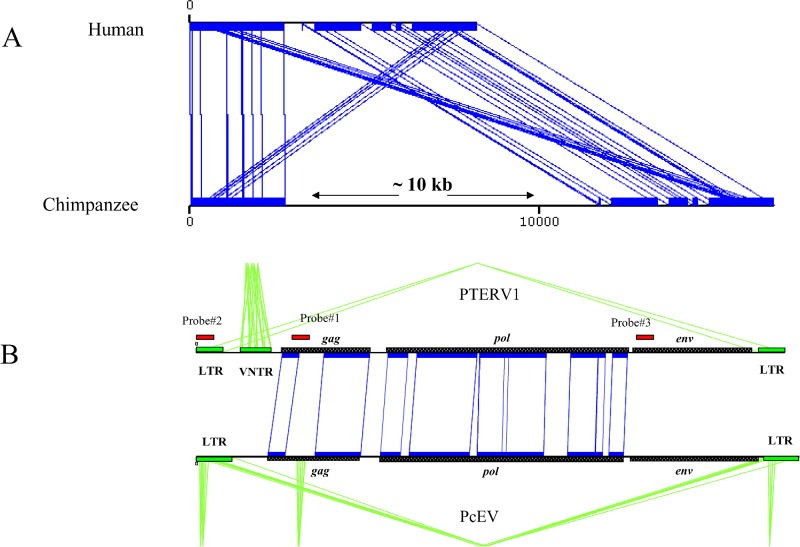
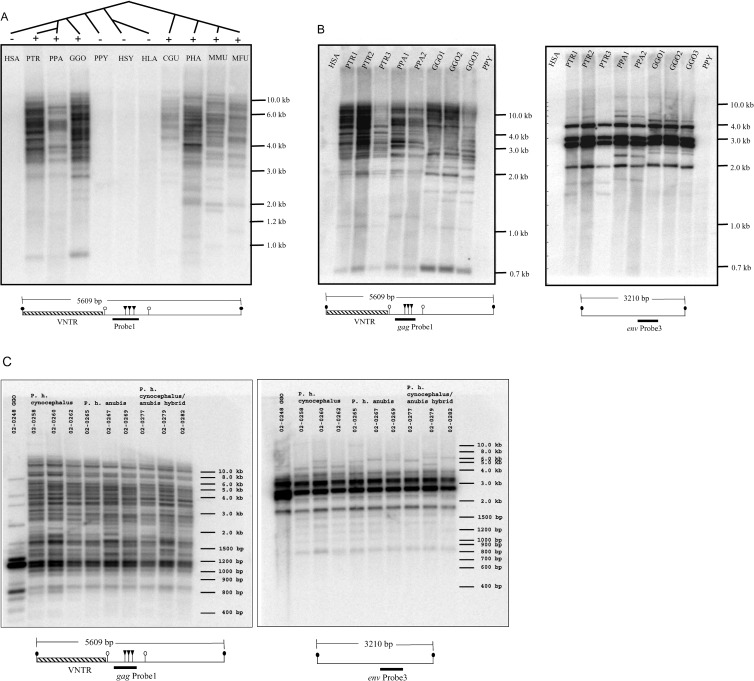
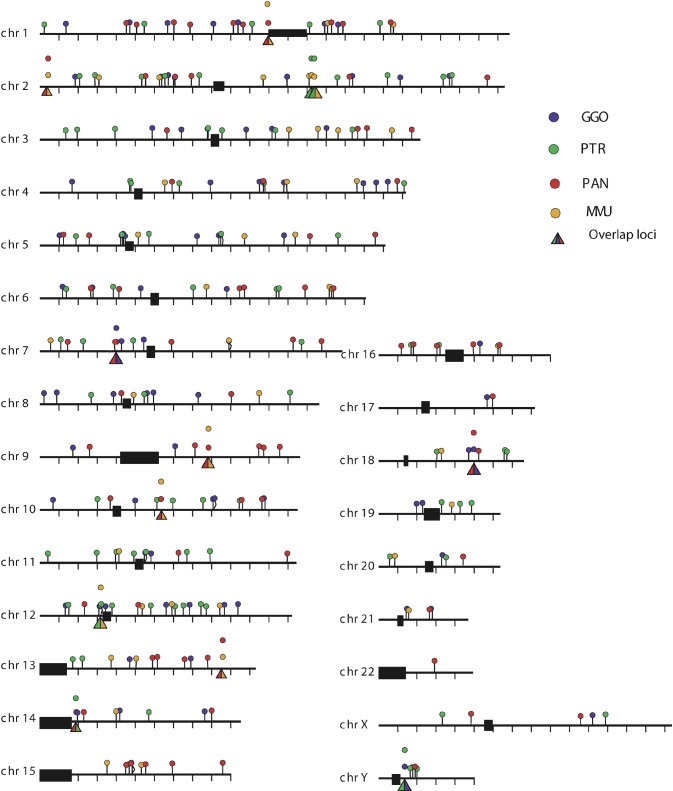
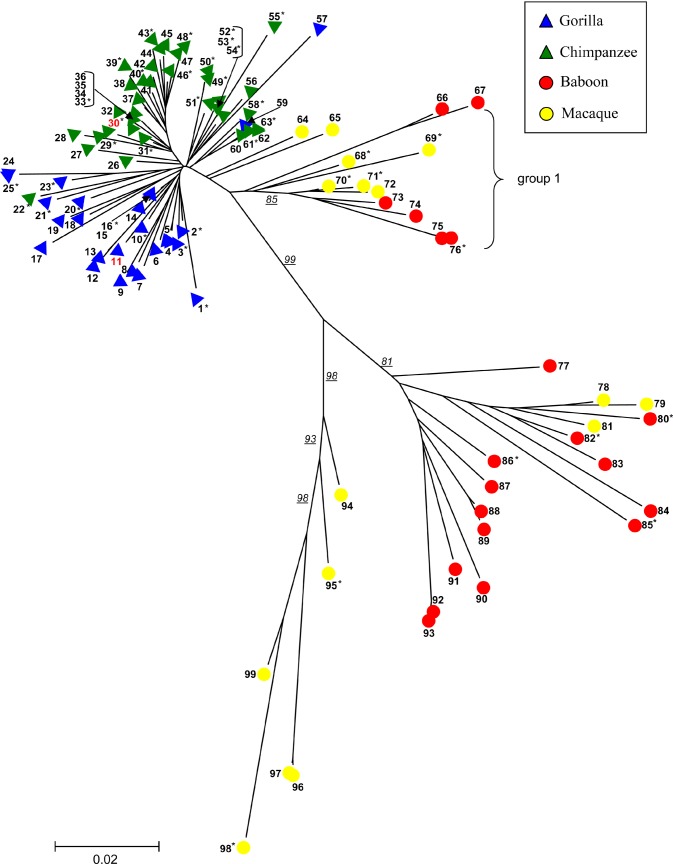
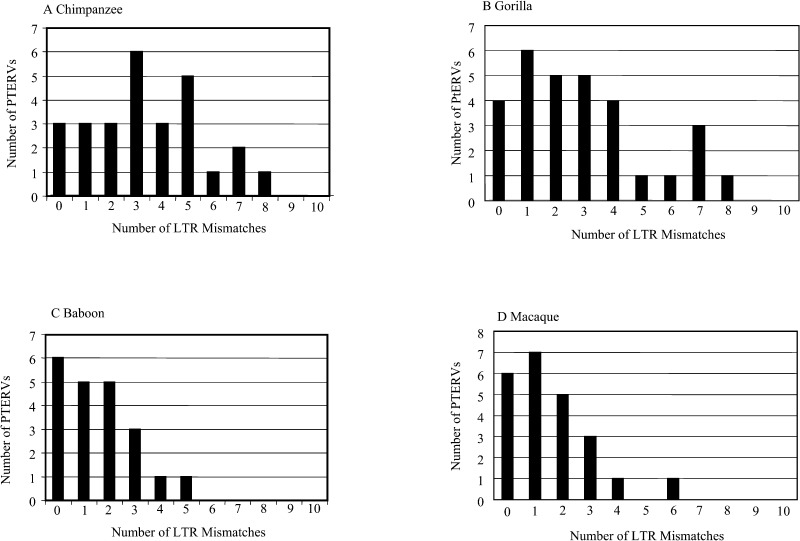
Retroviral infections of the germline have the potential to episodically alter gene function and genome structure during the course of evolution. Horizontal transmissions between species have been proposed, but little evidence exists for such events in the human/great ape lineage of evolution. Based on analysis of finished BAC chimpanzee genome sequence, we characterize a retroviral element (Pan troglodytes endogenous retrovirus 1 [PTERV1]) that has become integrated in the germline of African great ape and Old World monkey species but is absent from humans and Asian ape genomes. We unambiguously map 287 retroviral integration sites and determine that approximately 95.8% of the insertions occur at non-orthologous regions between closely related species. Phylogenetic analysis of the endogenous retrovirus reveals that the gorilla and chimpanzee elements share a monophyletic origin with a subset of the Old World monkey retroviral elements, but that the average sequence divergence exceeds neutral expectation for a strictly nuclear inherited DNA molecule. Within the chimpanzee, there is a significant integration bias against genes, with only 14 of these insertions mapping within intronic regions. Six out of ten of these genes, for which there are expression data, show significant differences in transcript expression between human and chimpanzee. Our data are consistent with a retroviral infection that bombarded the genomes of chimpanzees and gorillas independently and concurrently, 3-4 million years ago. We speculate on the potential impact of such recent events on the evolution of humans and great apes.
Overview
The claims and statistics of this paper haven’t been checked yet.
Free: it reads the open-access text and checks the first 5 claims that cite a source we can check. Create a free account to check every claim.
Integrity signals
Registry
Cites
Statistics
Figures
Verification
Claims the paper makes
The claims and statistics of this paper haven’t been checked yet.
Free: it reads the open-access text and checks the first 5 claims that cite a source we can check. Create a free account to check every claim.
Claims other papers make about this one
Each is checked against this paper’s own text: does it say what the citing paper says it does?
The source backs part of the claim, not all of it — or backs it for a different population, condition or comparison.
In the citing paper
“Consistent with our findings, the results of a previously published Southern hybridization survey indicated that sequences orthologous to CERV 1/PTERV1 elements are present in the African great apes and old world monkeys but not in Asian apes or humans [30].”
From Identification, characterization and comparative genomics of chimpanzee endogenous retroviruses (2006) · cites this paper as [30]
Experimental — accuracy not yet measuredThe cited source says what the claim attributes to it.
In the citing paper
“is identical to the above described distribution of CERV 1/PTERV1 elements [30].”
From Identification, characterization and comparative genomics of chimpanzee endogenous retroviruses (2006) · cites this paper as [30]
The check wasn’t confident either way, so it gives no verdict — never disputed.
In the citing paper
“This distribution of CERV 2 elements among primates is identical to the above described distribution of CERV 1/PTERV1 elements [30].”
From Identification, characterization and comparative genomics of chimpanzee endogenous retroviruses (2006) · cites this paper as [30]
Experimental — accuracy not yet measured
Self-check
Percentages, sums and reported differences re-computed from the paper’s own numbers.
The self-check needs the paper’s full text.
Citations
Cites
Kimura, M. (1980) · Journal of Molecular Evolution · doi:10.1007/bf01731581 · Cited by 29,778
Initial sequencing and analysis of the human genome
International Human Genome Sequencing Consortium, Whitehead Institute for Biomedical Research, C. F. G. R., Lander, E. S., Linton, L. M., Birren, B., Nusbaum, C., Zody, M. C., Baldwin, J., Devon, K., Dewar, K., et al. (2001) · Nature · doi:10.1038/35057062 · Cited by 24,216
Self-citationBase-Calling of Automated Sequencer Traces Using Phred. I. Accuracy Assessment
Ewing, B., Hillier, L., Wendl, M. C., & Green, P. (1998) · Genome Research · doi:10.1101/gr.8.3.175 · Cited by 6,967
Finishing the euchromatic sequence of the human genome
International Human Genome Sequencing Consortium (2004) · Nature · doi:10.1038/nature03001 · Cited by 4,971
Simple methods for estimating the numbers of synonymous and nonsynonymous nucleotide substitutions.
(1986) · Molecular Biology and Evolution · doi:10.1093/oxfordjournals.molbev.a040410 · Cited by 4,894
Consed: A Graphical Tool for Sequence Finishing
Gordon, D., Abajian, C., & Green, P. (1998) · Genome Research · doi:10.1101/gr.8.3.195 · Cited by 3,302
Initial sequence of the chimpanzee genome and comparison with the human genome
The Chimpanzee Sequencing and Analysis Consortium (2005) · Nature · doi:10.1038/nature04072 · Cited by 2,459
HIV-1 Integration in the Human Genome Favors Active Genes and Local Hotspots
Schröder, A. R. W., Shinn, P., Chen, H., Berry, C., Ecker, J. R., & Bushman, F. (2002) · Cell · doi:10.1016/s0092-8674(02)00864-4 · Cited by 1,832
Transcription Start Regions in the Human Genome Are Favored Targets for MLV Integration
Wu, X., Li, Y., Crise, B., & Burgess, S. M. (2003) · Science · doi:10.1126/science.1083413 · Cited by 1,305
Rannala, B., & Yang, Z. (2003) · Genetics · doi:10.1093/genetics/164.4.1645 · Cited by 1,131
Cited by
Items 101–114 of 114
Vaneechoutte, M., Mansfield, F., Munro, S., & Verhaegen, M. (2024) · Nature anthropology · doi:10.35534/natanthropol.2024.10008
A hypothesis of ape and human evolution based on comparative biology and plate tectonics
Verhaegen, M., Munro, S., Bonne, K., Mansfield, F., & Vaneechoutte, M. (2026) · Academia Biology · doi:10.20935/acadbiol8310
Zhao, S., Chi, L., & Chen, H. (2024) · Figshare · doi:10.6084/m9.figshare.24240261
Self-citationZhao, S., Chi, L., & Chen, H. (2023) · Figshare · doi:10.6084/m9.figshare.24240164
Self-citationCellular factors controlling human L1 retrotransposition
Galantonu, R. N. (2017) · theses.fr (ABES) · doi:10.70675/f24810a8z4f50z444fz84f0z11863b900b95
Teichmann, S. A., & Hagai, T. (2018) · Faculty Opinions – Post-Publication Peer Review of the Biomedical Literature · doi:10.3410/f.733031339.793546344
Zhao, K. X. (2012) · Illinois Digital Environment for Access to Learning and Scholarship (University of Illinois at Urbana-Champaign)
Viral remnant in chimpanzees silences brain gene humans still use
Pusdekar, S. (2026) · The Transmitter · doi:10.53053/xsva4247
Gabuzda, D. H. (2006) · Faculty Opinions – Post-Publication Peer Review of the Biomedical Literature · doi:10.3410/f.12432.469921
Vaneechoutte, M., Munro, S., & Verhaegen, M. (2012) · HOMO · doi:10.1016/j.jchb.2012.09.003
The role of transposable elements in primate neurodevelopment and human brain evolution
Gerdes, P., Davis-Hansson, C., & Jakobsson, J. (2026) · Trends in Genetics · doi:10.1016/j.tig.2026.10.009
Bold New Frontiers of Astrobiology
Wickramasinghe, N. C. (2015) · Journal of Astrobiology & Outreach · doi:10.4172/2332-2519.1000e115
Replication and Persistence of Primate Lentiviruses
Kirmaier, A. (2011)
Metadata
- Authors
- Yohn, C. T., Jiang, Z., McGrath, S. D., Hayden, K. E., Khaitovich, P., Johnson, M. E., Eichler, M. Y., McPherson, J. D., Zhao, S., Pääbo, S., & Eichler, E. E.
- Affiliations
- Case Western Reserve University (US)
- University of Washington (US)
- Max Planck Institute for Evolutionary Anthropology (DE)
- Baylor College of Medicine (US)
- Corresponding author
- Eichler, Evan E
- ORCID
- Venue
- PLoS Biology
- Publisher
- Public Library of Science (PLoS)
- Published
- 2005-03-01
- Volume
- 3
- Issue
- 4
- Pages
- e110
- ISSN
- 1544-9173 (ISSN-L)
- 1545-7885
- PMC
- PMC1054887
- OpenAlex
- W2060727919
- Cited by
- 104
- References
- 48
- Citations by year
- 2026: 4 · 2025: 2 · 2024: 6 · 2023: 3 · 2022: 2 · 2021: 1 · 2020: 3 · 2019: 1 · 2018: 8 · 2017: 2 · 2016: 5 · 2015: 5 · 2014: 4 · 2013: 2 · 2012: 6
- FWCI
- 13.63
- Type
- journal article
- Language
- en
- Open access
- gold
- doi.org
- Locations
- PLoS Biology (publishedVersion, cc-by)
- PubMed Central (publishedVersion, cc-by)
- Europe PMC (PubMed Central) (publishedVersion, cc-by)
- PubMed (publishedVersion)
- eScholarship (California Digital Library) (submittedVersion, cc-by)
- DOAJ (DOAJ: Directory of Open Access Journals) (submittedVersion, cc-by-sa)
- Max Planck Institute for Plasma Physics (submittedVersion)
- eScholarship (California Digital Library) (submittedVersion)
- Figshare (submittedVersion, cc-by)
- MPG.PuRe (Max Planck Society) (submittedVersion, cc-by)
- Funders
- Broad Institute
- National Institute of General Medical Sciences (R01GM058815, GM58815)
- National Center for Research Resources (P51RR013986)
- Eunice Kennedy Shriver National Institute of Child Health and Human Development (HD-07104-26, T32HD007104)
- Topics
- Life Sciences › Biochemistry, Genetics and Molecular Biology › Genetics › Chromosomal and Genetic Variations
- Life Sciences › Biochemistry, Genetics and Molecular Biology › Genetics › Genomic variations and chromosomal abnormalities
- Life Sciences › Biochemistry, Genetics and Molecular Biology › Molecular Biology › Genomics and Phylogenetic Studies
- Keywords
- endogenous retroviruses, retroviral integration, chimpanzee genome, Old World monkeys, African apes, human evolution, horizontal transmission, retroviral integration sites, gene expression divergence, retroviral evolution
- MeSH terms
- Animals, Pan troglodytes, Chromosome Mapping, Gorilla gorilla, Humans, Introns, Molecular Sequence Data, Pongo pygmaeus, Species Specificity, Transcription, Genetic, Protein Biosynthesis, Hominidae, Retroelements, Endogenous Retroviruses
About these checks
Registry, retraction, Cites and statistics results are computed, not judged, with one exception: a printed reference that no index lists is read once by a model before it counts as a citation error. Claims are extracted by a model and kept only when their quote appears verbatim in the text; each cited source is then checked, with a model’s help, for whether it says what the claim relies on. Those verdicts can be wrong — read the claim’s quote and the cited source before relying on one.
Statistics and arithmetic are recomputed, not judged.
Confidence bands are shown only for fields calibrated on our annotated test set. None is calibrated yet, so no band is shown.
What counts as a claim ›How we measure confidence ›How we check this ›
Are you an author, or do you see a problem with this page? Request a review
Data sources
Bibliographic data: Semantic Scholar, OpenAlex, Crossref.
Contains information from the Semantic Scholar Academic Graph Datasets, made available under the ODC Attribution License (ODC-BY 1.0).
Semantic Scholar’s data is described in: Kinney, R., et al. (2023). The Semantic Scholar Open Data Platform. arXiv:2301.10140.
