

Reconstructing Speech from Human Auditory Cortex
Open accessThe DOI matches its Crossref record; 61 of the 61 references it cites were found in a registry or an index.
Abstract
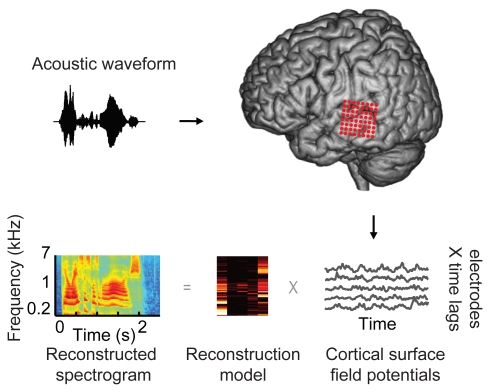
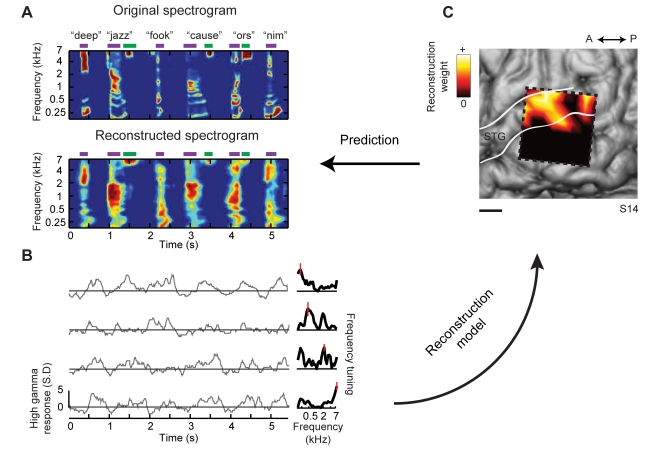
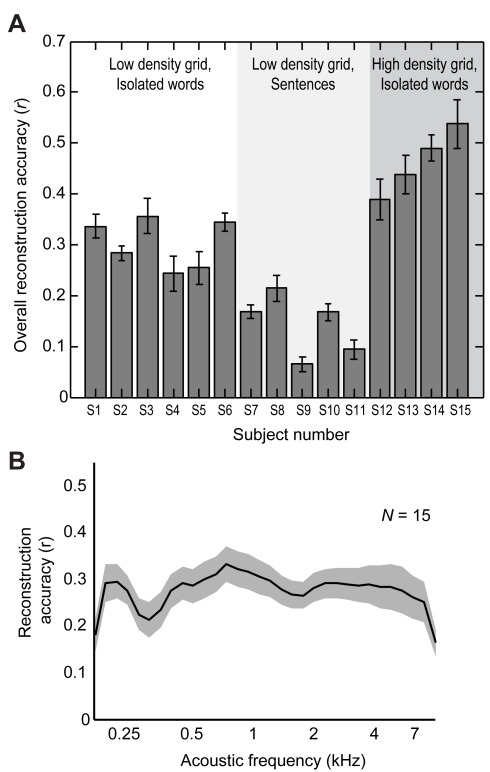
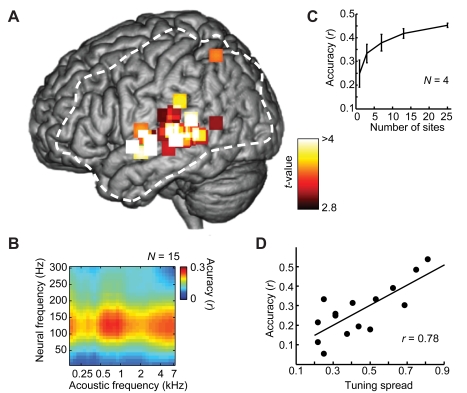
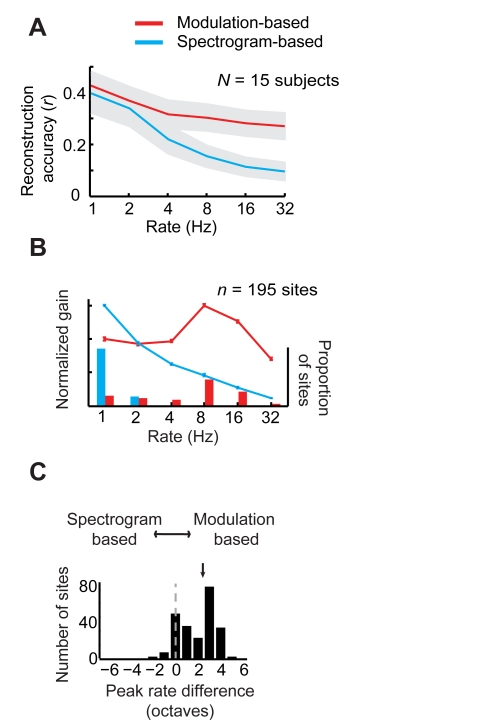
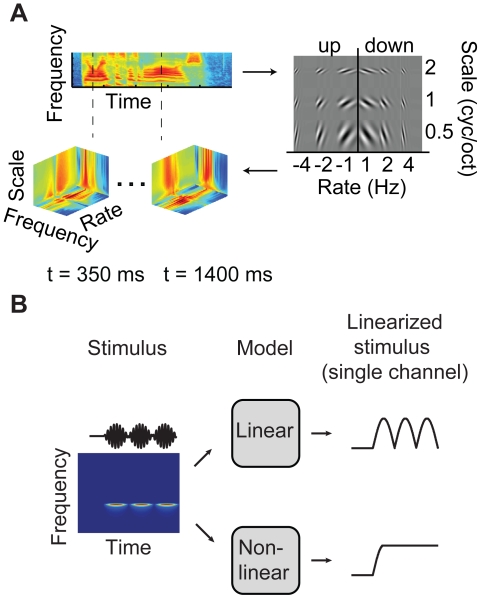
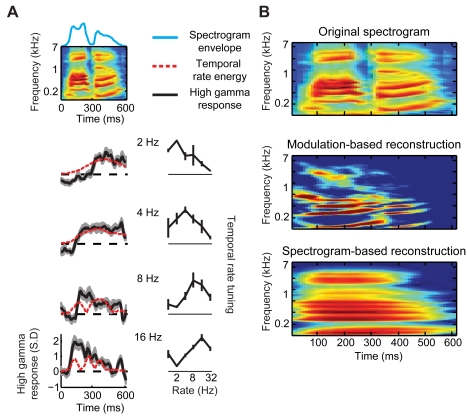
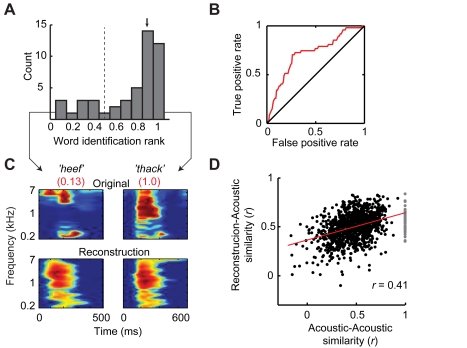
How the human auditory system extracts perceptually relevant acoustic features of speech is unknown. To address this question, we used intracranial recordings from nonprimary auditory cortex in the human superior temporal gyrus to determine what acoustic information in speech sounds can be reconstructed from population neural activity. We found that slow and intermediate temporal fluctuations, such as those corresponding to syllable rate, were accurately reconstructed using a linear model based on the auditory spectrogram. However, reconstruction of fast temporal fluctuations, such as syllable onsets and offsets, required a nonlinear sound representation based on temporal modulation energy. Reconstruction accuracy was highest within the range of spectro-temporal fluctuations that have been found to be critical for speech intelligibility. The decoded speech representations allowed readout and identification of individual words directly from brain activity during single trial sound presentations. These findings reveal neural encoding mechanisms of speech acoustic parameters in higher order human auditory cortex.
Overview
The claims and statistics of this paper haven’t been checked yet.
Free: it reads the open-access text and checks the first 5 claims that cite a source we can check. Create a free account to check every claim.
Integrity signals
Registry
Cites
Statistics
Figures
Verification
Claims the paper makes
The claims and statistics of this paper haven’t been checked yet.
Free: it reads the open-access text and checks the first 5 claims that cite a source we can check. Create a free account to check every claim.
Claims other papers make about this one
Each is checked against this paper’s own text: does it say what the citing paper says it does?
The cited source says what the claim attributes to it.
In the citing paper
“Neural activity in the STG encodes acoustic features — for example, recurring speech sound patterns in the mel-spectrogram — during speech perception53,54 and may be used to reconstruct perceived speech55,56.”
From The speech neuroprosthesis (2024) · cites this paper as [56]
Self-check
Percentages, sums and reported differences re-computed from the paper’s own numbers.
The self-check needs the paper’s full text.
Citations
Cites
The Elements of Statistical Learning
Hastie, T., Tibshirani, R., & Friedman, J. (2009) · Springer Series in Statistics · doi:10.1007/978-0-387-84858-7 · Cited by 25,970
Receptive fields, binocular interaction and functional architecture in the cat’s visual cortex
Hubel, D. H., & Wiesel, T. N. (1962) · The Journal of Physiology · doi:10.1113/jphysiol.1962.sp006837 · Cited by 13,680 · cited 1×
“The modulation model therefore represents an auditory analog to the classical energy model of complex cells in the visual system [32–36], which are invariant to the spatial phase of visual stimuli.”
MethodFundamentals of speech recognition
Rabiner, L. R., & Juang, B.-H. F. (1993) · Cited by 7,680
The cortical organization of speech processing
Hickok, G., & Poeppel, D. (2007) · Nature Reviews Neuroscience · doi:10.1038/nrn2113 · Cited by 5,495 · cited 2×
“For speech comprehension, it is hypothesized that intermediate and higher-order auditory areas extract or construct information-rich features of speech, while discarding nonessential low-level acoustic information [4,5,9, 10,43].”
BackgroundSpatiotemporal energy models for the perception of motion
Adelson, E. H., & Bergen, J. R. (1985) · Journal of the Optical Society of America A · doi:10.1364/josaa.2.000284 · Cited by 3,442 · cited 2×
“Such amplitude-based coding schemes are broadly referred to as ‘‘energy models’’ [32,33].”
BackgroundDISCONNEXION SYNDROMES IN ANIMALS AND MAN
GESCHWIND, N. (1965) · Brain · doi:10.1093/brain/88.2.237 · Cited by 3,403 · cited 5×
“To recover the acoustic waveform from the spectrogram, we used an iterative projection algorithm to estimate the phase [8].”
BackgroundMethodInfluentialTIMIT Acoustic-Phonetic Continuous Speech Corpus
Garofolo, J. S., Lamel, L. F., Fisher, W. M., Pallett, D. S., Dahlgren, N. L., Zue, V. W., & Fiscus, J. G. (2020) · Americanae (AECID Library) · doi:10.35111/17gk-bn40 · Cited by 2,508
Maps and streams in the auditory cortex: nonhuman primates illuminate human speech processing
Rauschecker, J. P., & Scott, S. K. (2009) · Nature Neuroscience · doi:10.1038/nn.2331 · Cited by 1,766 · cited 5×
“Beyond primary auditory areas, further processing in intermediate and higher-order auditory cortex likely results in additional stimulus transformations [5].”
BackgroundResultInfluentialLogothetis, N. K., & Wandell, B. A. (2004) · Annual Review of Physiology · doi:10.1146/annurev.physiol.66.082602.092845 · Cited by 1,568 · cited 1×
“This is consistent with robust speech-induced high gamma responses reported in previous intracranial studies [24–29] and with observed correlations between high gamma power and local spike rate [30].”
ResultIdentifying natural images from human brain activity
Kay, K. N., Naselaris, T., Prenger, R. J., & Gallant, J. L. (2008) · Nature · doi:10.1038/nature06713 · Cited by 1,286 · cited 2×
“An important application of this approach has also been demonstrated in the study of visual object recognition in the primate visual system [36,49,50].”
BackgroundMethod
Cited by
Items 401–500 of 694
Toward a brain-computer interface for speech restoration
Bocquelet, F. (2017) · theses.fr (ABES) · doi:10.70675/174ae573zf569z4feazb09az8ce9e84706cb · Cited by 6
Decoding speech from brain activity using linear methods
Godais, G. L. (2022) · theses.fr (ABES) · doi:10.70675/a715ba1dz66edz4e28za0faz7cd8ac99c928 · Cited by 6
3M-CPSEED, An EEG-based Dataset for Chinese Pinyin Production in Overt, Mouthed, and Imagined Speech
Ma, X., Jiang, Y., & Jiang, N. (2025) · Scientific Data · doi:10.1038/s41597-025-06346-1 · Cited by 6
Habersetzer, T., Steuer, S., Radeloff, A., & Meyer, B. T. (2025) · Scientific Data · doi:10.1038/s41597-025-06397-4 · Cited by 6
Dynamic Approaches to Phonological Processing
Hatfield, H. (2023) · Cambridge University Press eBooks · doi:10.1017/9781009258661 · Cited by 5
A low-cost configurable multichannel cortical stimulator prototype
Johnson, G. D., & Krusienski, D. J. (2013) · International IEEE/EMBS Conference on Neural Engineering · doi:10.1109/ner.2013.6696016 · Cited by 5
“org) directly decoded and used to synthesize the speech stimuli using the measured brain signals [14].”
MethodEEG object recognition: Studies for criminal investigation and neuro-applications in social care
al., C. E. (2019) · International Journal of ADVANCED AND APPLIED SCIENCES · doi:10.21833/ijaas.2020.01.008 · Cited by 5
“Pasley et al. (2012) dug deep into the possibility of speech prediction based on brainwave data collected by sensors.”
BackgroundYu, H., Zhao, Q., Li, S., Li, K., Liu, C., & Wang, J. (2022) · Frontiers in Computational Neuroscience · doi:10.3389/fncom.2022.852281 · Cited by 5
A Literature Review on the Psychological Needs of Students with Sensory Loss
Haakma, I., Janssen, M. J., & Minnaert, A. E. M. G. (2017) · The Volta Review · doi:10.17955/tvr.116.1.2.768 · Cited by 5
How Does Artificial Intelligence Contribute to iEEG Research?
Berezutskaya, J., Saive, A.-L., Jerbi, K., & van Gerven, M. A. J. (2023) · Studies in neuroscience, psychology and behavioral economics · doi:10.1007/978-3-031-20910-9_47 · Cited by 5
On the Technology Prospects and Investment Opportunities for Scalable NeurosciencePreprint
Dean, T., Ahanonu, B., Chowdhury, M., Datta, A., Esteva, A., Eth, D., Redmon, N., Rumyantsev, O., & Tarter, Y. (2013) · arXiv (Cornell University) · doi:10.48550/arxiv.1307.7302 · Cited by 5
“Advanced ECoG methods have successfully decoded speech from patterns of activity recorder over auditory cortex [160].”
MethodMartin, S., Mikutta, C., Leonard, M. K., Hungate, D., Koelsch, S., Chang, E. F., Millán, J. D. R., Knight, R. T., & Pasley, B. N. (2017) · bioRxiv (Cold Spring Harbor Laboratory) · doi:10.1101/106617 · Cited by 5
“FDR correction), consistent with previous ECoG results [33].”
MethodResultSelf-citationUnderstanding and Decoding Imagined Speech using Electrocorticographic Recordings in Humans
Martin, S. (2017) · Infoscience (Ecole Polytechnique Fédérale de Lausanne) · doi:10.5075/epfl-thesis-7740 · Cited by 5
“2013) and a spectrogram and a modulation-based representation (Pasley et al. 2012) were successfully reconstructed from high gamma signals.”
BackgroundMethodResultInfluentialDeep Boltzmann Machines as Hierarchical Generative Models of Perceptual Inference in the Cortex
Reichert, D. (2012) · ERA · Cited by 5
Stimulus Reconstruction from Cortical Responses
Mesgarani, N. (2014) · Springer eBooks · doi:10.1007/978-1-4614-7320-6_108-1 · Cited by 5
“Applications Stimulus reconstruction has been used in a variety of contexts, from decoding perceived or imagined information in the brain (Thirion et al. 2006; Naselaris et al. 2011; Pasley et al. 2012) to studying how the dynamic internal state of an organism changes the population encoding of stimulus in the cortex…”
BackgroundSelf-citationTowards decoding brain activity during passive listening of speechPreprint
Fodor, M. A., Csapó, T. G., & Arthur, F. V. (2024) · arXiv (Cornell University) · doi:10.15775/besztud.2024.1.158-184 · Cited by 5
“Both neural network-based methods and traditional regression-based approaches, like those presented by Pasley et al. (2012), have distinct advantages and disadvantages.”
MethodCortical tracking of prediction error during perception of connected speechPreprint
Webb, J. M., & Sohoglu, E. (2025) · bioRxiv (Cold Spring Harbor Laboratory) · doi:10.1101/2025.07.18.665498 · Cited by 5
“As in Sohoglu and Davis [25], we used ridge regression to measure cortical tracking of speech features [36,48,70–72].”
Nonlinear models for neurophysiological time series
la Tour, T. D. (2018) · theses.fr (ABES) · doi:10.70675/ca8e6c8czfc14z418ez92b9z6bb7bc202f94 · Cited by 5
Reliable neural interface: The first quarter century of the Neurotrophic Electrode
Kennedy, P. (2012) · 2012 Annual International Conference of the IEEE Engineering in Medicine and Biology Society · doi:10.1109/embc.2012.6346678 · Cited by 4
Akama, T., Zhang, Z., Li, P., Hongo, K., Minamikawa, S., & Polouliakh, N. (2025) · Scientific Reports · doi:10.1038/s41598-025-02790-6 · Cited by 4
Neural signals, machine learning, and the future of inner speech recognition
Chowdhury, A. T., Hassanein, A., Shibli, A. N. A., Khanafer, Y., AbuHaweeleh, M. N., Pedersen, S., & Chowdhury, M. E. H. (2025) · Frontiers in Human Neuroscience · doi:10.3389/fnhum.2025.1637174 · Cited by 4
“…corresponding stimulus properties), it has the potential to reconstruct the most probable stimulus value that elicited the observed brain activity (Pasley et al., 2012 In vector notation, the expression is characterized by vectors, encompassing stimulus feature values observed chronologically,…”
Li, J., Guo, C., Zhang, C., Chang, E. F., & Li, Y. (2026) · eLife · doi:10.7554/elife.109400.3 · Cited by 4
Self-citationA Personalized and Adaptable User Interface for a Speech and Cursor Brain-Computer Interface
Peracha, H., Iacobacci, C., Singer-Clark, T., Hochberg, L. R., Stavisky, S. D., Brandman, D. M., & Card, N. S. (2026) · CHI Conference on Human Factors in Computing Systems · doi:10.1145/3772318.3790750 · Cited by 4
Söderström, P. (2024) · Cambridge University Press eBooks · doi:10.1017/9781009161114 · Cited by 4
Neural Coding of Fundamental Frequency and Processing of Discrete Pitch Accents in Middle Age
McHaney, J. R., Guo, Z., Gnanateja, G. N., Parthasarathy, A., & Chandrasekaran, B. (2025) · European Journal of Neuroscience · doi:10.1111/ejn.70285 · Cited by 4
“As high-gamma power from intracranial EEG has been shown to correlate with the amplitude envelope of speech (Kubanek et al. 2013; Pasley et al. 2012), we conducted additional TRF analyses including envelope as a predictor to assess whether this feature may explain unique variance in our scalp-EEG…”
de Nobel, J., Briaire, J. J., Bäck, T., Kononova, A. V., & Frijns, J. H. M. (2025) · Hearing Research · doi:10.1016/j.heares.2025.109469 · Cited by 4
Cui, Z., Wang, Q., Gao, Y., Wang, J., Wang, M., Teng, P., Guan, Y., Zhou, J., Li, T., Luan, G., et al. (2017) · Frontiers in Human Neuroscience · doi:10.3389/fnhum.2017.00407 · Cited by 4
“…mechanisms underlying auditory processing with both a high spatial resolution and a high temporal resolution (Lachaux et al., 2007; Edwards et al., 2009; Sinai et al., 2009; Korzeniewska et al., 2011; Mesgarani and Chang, 2012; Pasley et al., 2012; Mesgarani et al., 2014; Nourski and Howard, 2015).”
BackgroundMethodReconstruction of Words, Syllables, and Phonemes of Internal Speech by EEG Activity
Suyuncheva, A. R., Saada, D., Gavrilenko, Y., Schevchenko, A., Vartanov, A., & Ilyushin, E. (2021) · Advances in intelligent systems and computing · doi:10.1007/978-3-030-71637-0_37 · Cited by 4
Cortical Representation of Speech Sounds: Insights from Intracranial Electrophysiology
Oganian, Y., Fox, N. P., & Chang, E. F. (2022) · Springer handbook of auditory research · doi:10.1007/978-3-030-81542-4_3 · Cited by 4
Self-citationTowards Data-Driven Cognitive Rehabilitation for Speech Disorder in Hybrid Sensor Architecture
Ghosh, A., Chatterjee, S., De, S., & Maji, A. K. (2022) · IEEE International Conference on Electronics, Computing and Communication Technologies (CONECCT) · doi:10.1109/conecct55679.2022.9865794 · Cited by 4
“Pasley et al . worked with invasive techniques [5], translating imagined speech into artificial speech.”
MethodGrimshaw, M., & Garner, T. A. (2014) · Audio Mostly Conference (AM) · doi:10.1145/2636879.2636881 · Cited by 4
“[40]) but this does not involve the extraction of the sound of the speech; statistics and predictive techniques drawn”
BackgroundGeneralizing neural signal-to-text brain-computer interfaces
Sheth, J. K., Tankus, A., Tran, M., Pouratian, N., Fried, I., & Speier, W. F. (2021) · Biomedical Physics & Engineering Express · doi:10.1088/2057-1976/abf6ab · Cited by 4
“To address these shortcomings, several studies are using invasive approaches such as electrocorticography (ECoG) for classification and reconstruction of individual phonemes and their acoustic features (Pasley et al 2012).”
MethodImaginary and Real Speech-Related EEG Patterns in the Neural Network Approach
Kiroy, V. N., Бахтин, О. М., Krivko, E., Lazurenko, D. M., Aslanyan, E. V., & Shaposhnikov, D. G. (2022) · Human Physiology · doi:10.1134/s0362119722320019 · Cited by 5
“Similar facts concerning the functional role of high-frequency EEG activity in verbal speech have been reported previously [3, 40–42], in particular the facts concerning its spectral-acoustic properties [51], features of specific phonetic discrimination of verbal material [40] and articulation characteristics [41, 52].”
BackgroundEmerging technologies with potential for objectively evaluating speech recognition skills
Rawool, V. W. (2016) · International Journal of Audiology · doi:10.3109/14992027.2015.1128570 · Cited by 4
“The stimulus reconstruction-based approach proposed in Table 1 will be possible only with further refinement (for details see Pasley et al, 2012) using neural data recorded with extracranial sensors.”
BackgroundMethodRenvall, H., Staeren, N., Barz, C. S., Ley, A., & Formisano, E. (2016) · Frontiers in Neuroscience · doi:10.3389/fnins.2016.00254 · Cited by 4
“…have recently successfully mapped different tempo-spectral characteristics of acoustic stimuli to their corresponding neural representations (Pasley et al., 2012; Mesgarani et al., 2014; Santoro et al., 2014), suggesting strong correspondences between the auditory input and cortical…”
BackgroundResultHuman Auditory Neuroscience and the Cocktail Party Problem
Simon, J. Z. (2017) · Springer handbook of auditory research · doi:10.1007/978-3-319-51662-2_7 · Cited by 4
Identifying Input Features for Development of Real-Time Translation of Neural Signals to Text
Sheth, J. K., Tankus, A., Tran, M., Comstock, L. B., Fried, I., & Speier, W. F. (2019) · Interspeech (USB) · doi:10.21437/interspeech.2019-3092 · Cited by 4
Functional MRI of the Auditory Cortex
Formisano, E., Moerel, M., & Bonte, M. L. (2015) · Biological magnetic resonance · doi:10.1007/978-1-4899-7591-1_16 · Cited by 4
Cluster-based analysis improves predictive validity of spike-triggered receptive field estimates
Bigelow, J., & Malone, B. J. (2017) · PLoS ONE · doi:10.1371/journal.pone.0183914 · Cited by 4
Buzsáki, G. (2019) · Oxford University Press eBooks · doi:10.1093/oso/9780190905385.003.0001 · Cited by 4
A Bayesian machine learning framework for true zero-training brain-computer interfaces
Kindermans, P.-J. (2014) · Ghent University Academic Bibliography (Ghent University) · Cited by 4
Bovo, A. (2014) · theses.fr (ABES) · doi:10.70675/031af5c0z3856z4ef0z8012z93c8bf45b8c5 · Cited by 4
Identification des indices acoustiques utilisés lors de la compréhension de la parole dégradée
Varnet, L. (2015) · theses.fr (ABES) · doi:10.70675/da7eb6e7z516bz4c7az9636z61d29c55fa73 · Cited by 4
“La validité neurobiologique du modèle a été récemment corroborée par la reconstruction du signal de parole écouté par un patient, à partir de l’activité neuronale enregistrée au niveau de son Gyrus Temporal Supérieur (Pasley et al., 2012).”
Zero-Shot Imagined Speech Decoding via Imagined-to-Listened MEG MappingPreprint
Maghsoudi, M., & Shamma, S. (2026) · arXiv (Cornell University) · doi:10.48550/arxiv.2605.08075 · Cited by 4
“Studies using invasive approaches such as electrocorticography (ECoG) [5, 15, 16] or stereotactic EEG (sEEG) [17] have been able to successfully reconstruct speech spectrograms and even intelligible audio.”
Self-citationTechnologies in clinical neurophysiology for brain-body interfacing: IFCN handbook chapter
Cimolato, A., Sparapani, A., & Raspopović, S. (2026) · Clinical Neurophysiology · doi:10.1016/j.clinph.2026.2111913 · Cited by 3
Brain Rhythms Provide a Framework for Neural Syntax
Buzsáki, G. (2019) · Oxford University Press eBooks · doi:10.1093/oso/9780190905385.003.0006 · Cited by 3
Neural correlation of speech envelope tracking for background noise in normal hearing
An, H., Lee, J., Suh, M., & Lim, Y. (2023) · Frontiers in Neuroscience · doi:10.3389/fnins.2023.1268591 · Cited by 3
“This frequency range has been identified in previous studies (Pasley et al., 2012; Zion Golumbic et al., 2013; Hickok and Poeppel, 2015; O’Sullivan et al., 2015) as relevant for speech envelope processing.”
BackgroundReconstructing voice identity from noninvasive auditory cortex recordings
Lamothe, C., Thoret, E., Trapeau, R., Giordano, B. L., Sein, J., Takerkart, S., Ayache, S., Artières, T., & Belin, P. (2026) · eLife · doi:10.7554/elife.98047.3 · Cited by 3
Invasive Brain-Computer Interface (BCI) for Communication
Chaudhary, U. (2025) · Springer eBooks · doi:10.1007/978-3-031-78991-5_5 · Cited by 3
Towards Speech Synthesis from Intracranial Signals
Herff, C., Diener, L., Mugler, E. M., Slutzky, M. W., Krusienski, D. J., & Schultz, T. (2020) · Springer briefs in electrical and computer engineering · doi:10.1007/978-3-030-49583-1_5 · Cited by 3
Hertrich, I., & Ackermann, H. (2012) · Wiley Interdisciplinary Reviews Cognitive Science · doi:10.1002/wcs.1211 · Cited by 3
The effect of familiarity on neural tracking of music stimuli is modulated by mind wandering
Belo, J., Clerc, M., & Schön, D. (2023) · AIMS neuroscience · doi:10.3934/neuroscience.2023025 · Cited by 3
“More precisely, this coupling takes place in the theta-delta range and also affects the amplitude of high frequency activity in the human auditory cortex [2,5–7].”
BackgroundAn ECoG-Based BCI Based on Auditory Attention to Natural Speech
Brunner, P., Dijkstra, K., Coon, W. G., Mellinger, J., Ritaccio, A. L., & Schalk, G. (2017) · Springer briefs in electrical and computer engineering · doi:10.1007/978-3-319-57132-4_2 · Cited by 3
A neural network architecture for learning word–referent associations in multiple contexts
Bassani, H. F., & Araujo, A. F. R. (2019) · Neural Networks · doi:10.1016/j.neunet.2019.05.017 · Cited by 3
“, 2005) and auditory cortex (Pasley et al., 2012).”
How Does the Brain Represent Speech?
Jones, Ō. P., & Schnupp, J. W. H. (2021) · Wiley eBooks · doi:10.1002/9781119184096.ch3 · Cited by 3
The Survey of Image Generation from EEG Signals based on Deep Learning
Yang, D., Su, D., Luo, Z., Shang, P., & Hu, Z. (2021) · International Symposium on Biomedical Engineering and Computational Biology (BECB) · doi:10.1145/3502060.3502151 · Cited by 3
“For speech reconstruction task, [29] presents a new approach to reconstruct the speech stimuli which is affected by some noisy, but the procedure is invasive which cannot be widely promoted.”
BackgroundExploring an EM-algorithm for banded regression in computational neuroscience
Fuglsang, S. A., Madsen, K. H., Puonti, O., Siebner, H. R., & Hjortkjær, J. (2024) · Imaging Neuroscience · doi:10.1162/imag_a_00155 · Cited by 3
Grootswagers, T., Dijkstra, K., ten Bosch, L., Brandmeyer, A., & Sadakata, M. (2013) · Interspeech (USB) · doi:10.21437/interspeech.2013-710 · Cited by 3
“It has been shown that phonemes can be classified using many features other than the ones used in this study (for an overview of the debate on phonetic features, see van Oostendorp et al. 2011, chapters 17,19,21,27) .”
BackgroundMethodVoice Activity Detection from Electrocorticographic Signals
Kanas, V. G., Mporas, I., Benz, H. L., Huang, N. J., Thakor, N. V., Sgarbas, K., Bezerianos, A., & Crone, N. E. (2013) · World Congress on Medical Physics and Biomedical Engineering, September 7 - 12, 2009, Munich, Germany · doi:10.1007/978-3-319-00846-2_405 · Cited by 3
Self-citationRampinini, A., & Ricciardi, E. (2017) · Studi e saggi linguistici · doi:10.4454/ssl.v55i1.181 · Cited by 3
Bigelow, J., & Malone, B. J. (2020) · Journal of Neural Engineering · doi:10.1088/1741-2552/ab7c19 · Cited by 3
Rearrangement of Timbre Space Due To Background Noise: Behavioural Evidence and Acoustic Correlates
Zacharakis, A., Terrell, M. J., Simpson, A. J. R., Pastiadis, K., & Reiss, J. D. (2017) · Acta acustica united with Acustica · doi:10.3813/aaa.919057 · Cited by 3
Semantic-hierarchical model improves classification of spoken-word evoked electrocorticography
Na, Y., Choi, I., Jang, D. P., Kang, J. K., & Woo, J. (2018) · Journal of Neuroscience Methods · doi:10.1016/j.jneumeth.2018.10.034 · Cited by 3
Low-Rank Nonlinear Decoding of μ-ECoG from the Primary Auditory Cortex
Emami, M., Sahraee-Ardakan, M., Pandit, P., Fletcher, A. K., Rangan, S., Trumpis, M., Bent, B., Chiang, C., & Viventi, J. (2018) · Conference on Cognitive Computational Neuroscience (CCN) · doi:10.32470/ccn.2018.1276-0 · Cited by 3
“Some of these methods consider both linear and non-linear mapping of the neural responses to the auditory spectrogram (Pasley et al., 2012).”
MethodThe duality of human cognition: operations and intentionality in mental life and illness
Heinrichs, R. W. (2019) · Neuroscience & Biobehavioral Reviews · doi:10.1016/j.neubiorev.2019.11.002 · Cited by 3
Brain-computer interfaces for basic neuroscience
Batista, A. P. (2020) · Handbook of clinical neurology · doi:10.1016/b978-0-444-63934-9.00017-2 · Cited by 3
Classification of Phonemes Using EEG
Priyanka, R. A., & Sadasivam, G. S. (2020) · Springer eBooks · doi:10.1007/978-3-030-24051-6_50 · Cited by 3
Fuzzy Logic Networks for Speech Recognition
Badura, S., Foltán, S., & Klimo, M. (2013) · Communications - Scientific letters of the University of Zilina · doi:10.26552/com.c.2013.2.13-18 · Cited by 3
“In early 2012 work describing the reconstruction of audio perception [12] was published.”
BackgroundRobust speech recognition with spectrogram factorisation
Hurmalainen, A. (2014) · Tampere University Institutional Repository (Tampere University) · Cited by 3
Can we build a conscious machine?Preprint
Aur, D. (2014) · arXiv (Cornell University) · doi:10.13140/2.1.2286.5608 · Cited by 3
Information Retrieval from Neurophysiological Signals
Ghaemmaghami, P. (2017) · Unitn-eprints PhD (University of Trento) · doi:10.15168/11572_369306 · Cited by 3
Hu, K., Bounni, F., & Williams, Z. M. (2017) · Neurosurgical FOCUS · doi:10.3171/2017.5.focus17244 · Cited by 3
Decoding Auditory Attention from Multivariate Neural Data using Cepstral Analysis
Mendoza, C. F., & Segar, A. (2018) · Lund University Publications Student Papers (Lund University) · Cited by 3
Toward an imagined speech-based brain computer interface using EEG signals
Alsaleh, M. (2019) · White Rose eTheses Online (University of Leeds, The University of Sheffield, University of York) · Cited by 3
Decoding Continuous Character-based Language from Non-invasive Brain RecordingsPreprint
Zhang, C., Zheng, X., Yin, R., Geng, S., Xu, J., Gao, X., Lv, C., Ling, Z., Huang, X., Cao, M., et al. (2024) · bioRxiv (Cold Spring Harbor Laboratory) · doi:10.1101/2024.03.19.585656 · Cited by 3
“Over the past decade, advancements in brain-computer interfaces have demonstrated the feasibility of decoding various forms of communication, such as speech sounds [80, 81], hand gestures [79, 82], articulatory movements [77, 78], and other signals [76] from intracranial recordings.”
BackgroundSpeech mode classification from electrocorticography: transfer between electrodes and participants
de Borman, A., Wittevrongel, B., Dyck, B. V., Rooy, K. V., Carrette, E., Meurs, A., Roost, D. V., & Hulle, M. M. V. (2025) · Journal of Neural Engineering · doi:10.1088/1741-2552/adf2de · Cited by 2
“Early work has shown that rich linguistic information is encoded in neural activity during speech production (Bouchard et al 2013, Lotte et al 2015, Chartier et al 2018) and perception (Pasley et al 2012, Mesgarani et al 2014), laying the groundwork for decoding approaches.”
Doda, D. Y., He, R., Pang, M., Sun, Y., Li, C., Anwar, F., Yasi, A., Jiang, R., Wang, W., Ming, D., et al. (2025) · Journal of intelligent medicine. · doi:10.1002/jim4.70012 · Cited by 2
Relating the Neural Representations of Vocalized, Mimed, and Imagined Speech
Maghsoudi, M., Chillale, R., & Shamma, S. (2026) · Interspeech (USB) · doi:10.21437/interspeech.2026-2836 · Cited by 2
Self-citationTechnological Innovation and Ethical Response in Neurosurgery
Menon, J., & Riskin, D. J. (2015) · The AMA Journal of Ethic · doi:10.1001/virtualmentor.2015.17.1.mhst1-1501 · Cited by 2
Falaschetti, L., Alessandrini, M., & Turchetti, C. (2024) · Intelligent systems reference library · doi:10.1007/978-3-031-65640-8_7 · Cited by 2
Audio Hashprints: Theory & Application
Tsai, T. (2016) · Cited by 2
Subcortical Processing of Speech Sounds
Chandrasekaran, B., Tessmer, R., & Gnanateja, G. N. (2022) · Springer handbook of auditory research · doi:10.1007/978-3-030-81542-4_2 · Cited by 2
Human Intracranial Cognitive Neurophysiology
Helfrich, R. F. (2022) · Neuromethods · doi:10.1007/978-1-0716-2631-3_10 · Cited by 2
Involuntary refreshing of mental representations
Velasquez, A. G., Yankulova, J. K., White, N. A., Gazzaley, A. H., & Morsella, E. (2022) · Acta Psychologica · doi:10.1016/j.actpsy.2022.103819 · Cited by 2
Rogachev, A., & Sysoeva, O. (2024) · Journal of Modern Foreign Psychology · doi:10.17759/jmfp.2024130108 · Cited by 2
Contrast Information Dynamics: A Novel Information Measure for Cognitive Modelling
Homer, S. T., Harley, N., & Wiggins, G. A. (2024) · Entropy · doi:10.3390/e26080638 · Cited by 2
“…sound is a particularly good starting point: recent research shows that perceived sound and its significant correlates are reproduced as electrical waves in the mind/brain, notwith-standing the fact that it has been deconstructed by the ear prior to its arrival in the auditory cortex [37–39].”
BackgroundSubject Disentanglement Neural Network for Speech Envelope Reconstruction from EEG
Zhang, L., Liu, J., & Xie, L. (2024) · IEEE International Conference on Bioinformatics and Biomedicine (BIBM) · doi:10.1109/bibm62325.2024.10821973 · Cited by 2
Optimal selection of electrocorticographic sensors for voice activity detection
Kanas, V. G., Mporas, I., Benz, H. L., Sgarbas, K., Crone, N. E., & Bezerianos, A. (2014) · International Conference on Control, Automation, Robotics and Vision (ICARCV) · doi:10.1109/icarcv.2014.7064274 · Cited by 2
“Brain machine interface (BMI) systems use recorded neural activity for motor control [1]-[4] or communication [5]-[8].”
Self-citationDecoding spatial attention with EEG and virtual acoustic space
Dong, Y. X., Raif, K. E., Determan, S. C., & Gai, Y. (2017) · Physiological Reports · doi:10.14814/phy2.13512 · Cited by 2
“Meanwhile, 2 to 8 Hz is the range of frequencies for which speech-envelope information is linearly related to EEG (Pasley et al. 2012; O’Sullivan et al. 2015).”
BackgroundIntergenerational Transmission in Developmental Dyslexia
Hoeft, F., & Wang, C. (2019) · Cambridge University Press eBooks · doi:10.1017/9781108553377.019 · Cited by 2
Day, C. (2012) · Computing in Science & Engineering · doi:10.1109/mcse.2012.79 · Cited by 2
Intervening in the Brain: Ethics and Neurosurgery
Amadio, J. P. (2015) · Cited by 2
Matching Pursuit Analysis of Auditory Receptive Fields' Spectro-Temporal Properties
Bach, J.-H., Kollmeier, B., & Anemüller, J. (2017) · Frontiers in Systems Neuroscience · doi:10.3389/fnsys.2017.00004 · Cited by 2
“Electro-corticography, for example, allows similar reconstruction of spectro-temporal filters (based on reverse correlation) by measuring cortical response fields (Pasley et al., 2012); they provide the additional advantage that responses can be measured in human subjects (Mesgarani and Chang, 2012).”
BackgroundIn the Spotlight: Neuroengineering
Thakor, N. V. (2012) · IEEE Reviews in Biomedical Engineering · doi:10.1109/rbme.2012.2228515 · Cited by 2
Analyzing Open EEG Data with Machine Learning: A Music Listening Experiment
Kazuma, M. O. R. I. (2024) · Japanese Journal of Physiological Psychology and Psychophysiology · doi:10.5674/jjppp.2407si · Cited by 2
Chatel-Goldman, J. (2014) · theses.fr (ABES) · doi:10.70675/329d9881z3e4ez4342za43ez34775959f9c3 · Cited by 2
Classification of speech evoked responses to English vowels
Sadeghian, A. (2012) · Carleton University's Institutional Repository (MacOdrum Library, Carleton University) · doi:10.22215/etd/2012-07382 · Cited by 2
“direct recordings from the surface of the auditory cortex) (Pasley et al., 2012).”
BackgroundTools to investigate composite receptive fields in songbird auditory region
Vahidi, N. W. (2019) · eScholarship (California Digital Library) · Cited by 2
Interpretability of statistical approaches in speech and language neurosciencePreprint
Bouton, S., Chambon, V., Golestani, N., Formisano, E., Proix, T., & Giraud, A. (2019) · PsyArXiv (OSF Preprints) · doi:10.31234/osf.io/8vwcs · Cited by 2
Metadata
- Authors
- Pasley, B. N., David, S. V., Mesgarani, N., Flinker, A., Shamma, S. A., Crone, N. E., Knight, R. T., & Chang, E. F.
- Affiliations
- University of California, Berkeley (US)
- University of Maryland, College Park (US)
- University of California, San Francisco (US)
- Johns Hopkins University (US)
- Corresponding author
- Pasley, Brian N.
- ORCID
- Venue
- PLoS Biology
- Publisher
- Public Library of Science (PLoS)
- Published
- 2012-01-31
- Volume
- 10
- Issue
- 1
- Pages
- e1001251
- ISSN
- 1544-9173 (ISSN-L)
- 1545-7885
- PMC
- PMC3269422
- OpenAlex
- W2005066437
- Cited by
- 604
- References
- 61
- Citations by year
- 2026: 21 · 2025: 30 · 2024: 28 · 2023: 35 · 2022: 36 · 2021: 32 · 2020: 51 · 2019: 66 · 2018: 42 · 2017: 53 · 2016: 43 · 2015: 51 · 2014: 42 · 2013: 50 · 2012: 24
- FWCI
- 27.32
- Type
- journal article
- Language
- en
- Open access
- gold
- doi.org
- Locations
- PLoS Biology (publishedVersion, cc-by)
- Europe PMC (PubMed Central) (publishedVersion, cc-by)
- PubMed Central (publishedVersion, cc-by)
- PubMed (publishedVersion)
- DOAJ (DOAJ: Directory of Open Access Journals) (submittedVersion)
- eScholarship (California Digital Library) (submittedVersion)
- Figshare (submittedVersion, cc-by)
- Funders
- National Institutes of Health (2r01ns021135-33, 5r00ns065120-04)
- U.S. Public Health Service (P04813)
- National Institute on Deafness and Other Communication Disorders (K99DC010439, K99DC012804, R01DC012379)
- National Institute of Neurological Disorders and Stroke (NS-40596, NS-21135, K99NS065120, R56NS021135, R37NS021135, R01NS040596, R00-NS065120, R01 NS-021135)
- Topics
- Life Sciences › Neuroscience › Cognitive Neuroscience › Neuroscience and Music Perception
- Social Sciences › Psychology › Experimental and Cognitive Psychology › Phonetics and Phonology Research
- Life Sciences › Neuroscience › Cognitive Neuroscience › Neurobiology of Language and Bilingualism
- Keywords
- speech perception, auditory cortex, superior temporal gyrus, neural decoding, speech reconstruction, acoustic features, syllable rate, word recognition, nonlinear decoding, speech intelligibility
- MeSH terms
- Algorithms, Auditory Cortex, Brain Mapping, Computer Simulation, Electrodes, Implanted, Electroencephalography, Female, Humans, Male, Models, Biological, Speech Acoustics, Linear Models
About these checks
Registry, retraction, Cites and statistics results are computed, not judged, with one exception: a printed reference that no index lists is read once by a model before it counts as a citation error. Claims are extracted by a model and kept only when their quote appears verbatim in the text; each cited source is then checked, with a model’s help, for whether it says what the claim relies on. Those verdicts can be wrong — read the claim’s quote and the cited source before relying on one.
Statistics and arithmetic are recomputed, not judged.
Confidence bands are shown only for fields calibrated on our annotated test set. None is calibrated yet, so no band is shown.
What counts as a claim ›How we measure confidence ›How we check this ›
Are you an author, or do you see a problem with this page? Request a review
Data sources
Bibliographic data: Semantic Scholar, OpenAlex, Crossref.
Contains information from the Semantic Scholar Academic Graph Datasets, made available under the ODC Attribution License (ODC-BY 1.0).
Semantic Scholar’s data is described in: Kinney, R., et al. (2023). The Semantic Scholar Open Data Platform. arXiv:2301.10140.
