

Reconstructing Speech from Human Auditory Cortex
Open accessThe DOI matches its Crossref record; 61 of the 61 references it cites were found in a registry or an index.
Abstract
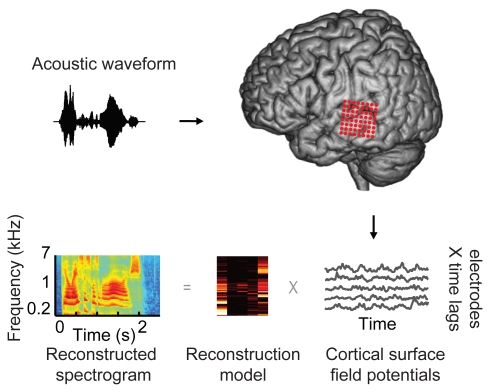
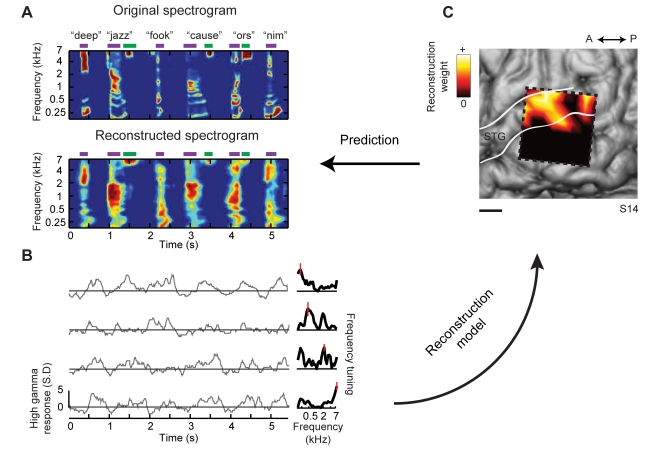
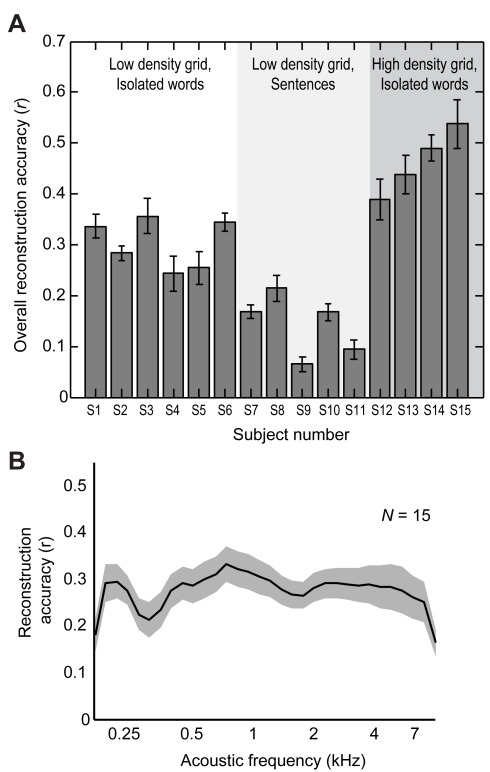
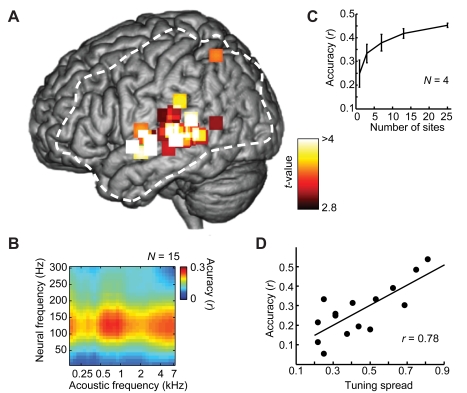
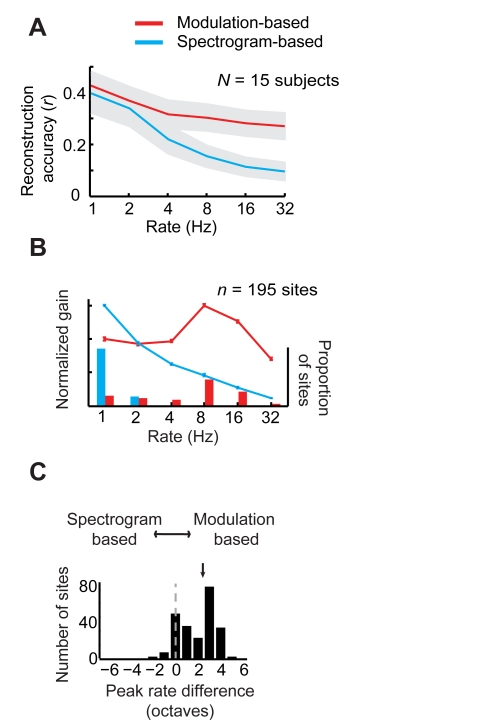
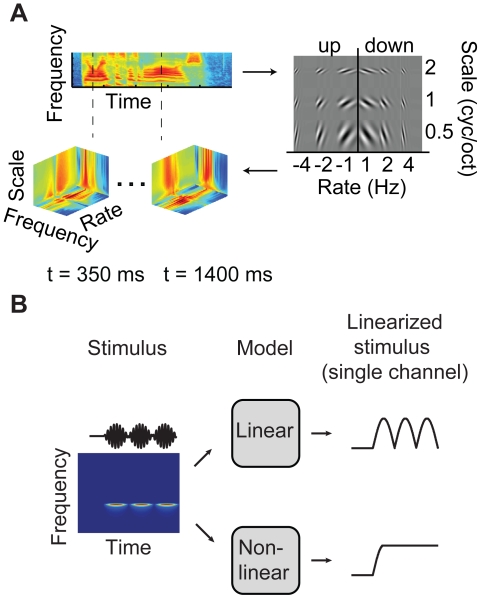
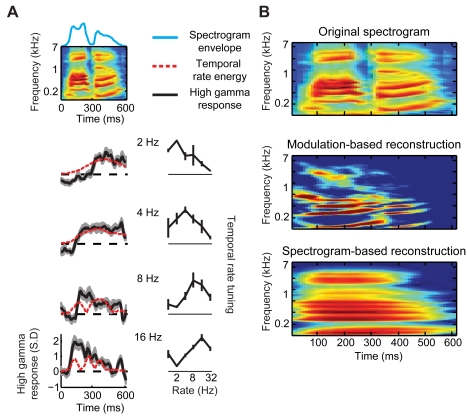
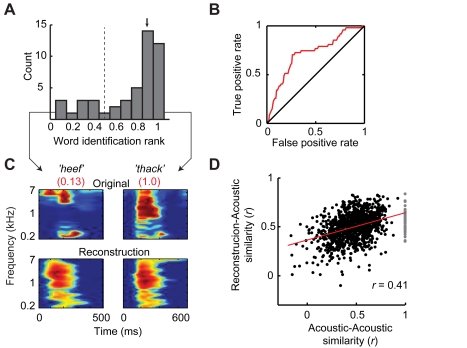
How the human auditory system extracts perceptually relevant acoustic features of speech is unknown. To address this question, we used intracranial recordings from nonprimary auditory cortex in the human superior temporal gyrus to determine what acoustic information in speech sounds can be reconstructed from population neural activity. We found that slow and intermediate temporal fluctuations, such as those corresponding to syllable rate, were accurately reconstructed using a linear model based on the auditory spectrogram. However, reconstruction of fast temporal fluctuations, such as syllable onsets and offsets, required a nonlinear sound representation based on temporal modulation energy. Reconstruction accuracy was highest within the range of spectro-temporal fluctuations that have been found to be critical for speech intelligibility. The decoded speech representations allowed readout and identification of individual words directly from brain activity during single trial sound presentations. These findings reveal neural encoding mechanisms of speech acoustic parameters in higher order human auditory cortex.
Overview
The claims and statistics of this paper haven’t been checked yet.
Free: it reads the open-access text and checks the first 5 claims that cite a source we can check. Create a free account to check every claim.
Integrity signals
Registry
Cites
Statistics
Figures
Verification
Claims the paper makes
The claims and statistics of this paper haven’t been checked yet.
Free: it reads the open-access text and checks the first 5 claims that cite a source we can check. Create a free account to check every claim.
Claims other papers make about this one
Each is checked against this paper’s own text: does it say what the citing paper says it does?
The cited source says what the claim attributes to it.
In the citing paper
“Neural activity in the STG encodes acoustic features — for example, recurring speech sound patterns in the mel-spectrogram — during speech perception53,54 and may be used to reconstruct perceived speech55,56.”
From The speech neuroprosthesis (2024) · cites this paper as [56]
Self-check
Percentages, sums and reported differences re-computed from the paper’s own numbers.
The self-check needs the paper’s full text.
Citations
Cites
The Elements of Statistical Learning
Hastie, T., Tibshirani, R., & Friedman, J. (2009) · Springer Series in Statistics · doi:10.1007/978-0-387-84858-7 · Cited by 25,970
Receptive fields, binocular interaction and functional architecture in the cat’s visual cortex
Hubel, D. H., & Wiesel, T. N. (1962) · The Journal of Physiology · doi:10.1113/jphysiol.1962.sp006837 · Cited by 13,680 · cited 1×
“The modulation model therefore represents an auditory analog to the classical energy model of complex cells in the visual system [32–36], which are invariant to the spatial phase of visual stimuli.”
MethodFundamentals of speech recognition
Rabiner, L. R., & Juang, B.-H. F. (1993) · Cited by 7,680
The cortical organization of speech processing
Hickok, G., & Poeppel, D. (2007) · Nature Reviews Neuroscience · doi:10.1038/nrn2113 · Cited by 5,495 · cited 2×
“For speech comprehension, it is hypothesized that intermediate and higher-order auditory areas extract or construct information-rich features of speech, while discarding nonessential low-level acoustic information [4,5,9, 10,43].”
BackgroundSpatiotemporal energy models for the perception of motion
Adelson, E. H., & Bergen, J. R. (1985) · Journal of the Optical Society of America A · doi:10.1364/josaa.2.000284 · Cited by 3,442 · cited 2×
“Such amplitude-based coding schemes are broadly referred to as ‘‘energy models’’ [32,33].”
BackgroundDISCONNEXION SYNDROMES IN ANIMALS AND MAN
GESCHWIND, N. (1965) · Brain · doi:10.1093/brain/88.2.237 · Cited by 3,403 · cited 5×
“To recover the acoustic waveform from the spectrogram, we used an iterative projection algorithm to estimate the phase [8].”
BackgroundMethodInfluentialTIMIT Acoustic-Phonetic Continuous Speech Corpus
Garofolo, J. S., Lamel, L. F., Fisher, W. M., Pallett, D. S., Dahlgren, N. L., Zue, V. W., & Fiscus, J. G. (2020) · Americanae (AECID Library) · doi:10.35111/17gk-bn40 · Cited by 2,508
Maps and streams in the auditory cortex: nonhuman primates illuminate human speech processing
Rauschecker, J. P., & Scott, S. K. (2009) · Nature Neuroscience · doi:10.1038/nn.2331 · Cited by 1,766 · cited 5×
“Beyond primary auditory areas, further processing in intermediate and higher-order auditory cortex likely results in additional stimulus transformations [5].”
BackgroundResultInfluentialLogothetis, N. K., & Wandell, B. A. (2004) · Annual Review of Physiology · doi:10.1146/annurev.physiol.66.082602.092845 · Cited by 1,568 · cited 1×
“This is consistent with robust speech-induced high gamma responses reported in previous intracranial studies [24–29] and with observed correlations between high gamma power and local spike rate [30].”
ResultIdentifying natural images from human brain activity
Kay, K. N., Naselaris, T., Prenger, R. J., & Gallant, J. L. (2008) · Nature · doi:10.1038/nature06713 · Cited by 1,286 · cited 2×
“An important application of this approach has also been demonstrated in the study of visual object recognition in the primate visual system [36,49,50].”
BackgroundMethod
Cited by
Items 501–600 of 694
Neural Coding of Speech Sounds
Kilgard, M. P., & Engineer, C. T. (2022) · Springer eBooks · doi:10.1007/978-1-0716-1006-0_433 · Cited by 2
Reconstructing voice identity from noninvasive auditory cortex recordingsPreprint
Lamothe, C., Thoret, E., Trapeau, R., Giordano, B. L., Sein, J., Takerkart, S., Ayache, S., Artières, T., & Belin, P. (2024) · eLife · doi:10.7554/elife.98047 · Cited by 2
A contrastive-learning approach for auditory attention detectionPreprint
Bajestan, S. A. A., Pitt, M. A., & Williamson, D. S. (2024) · arXiv (Cornell University) · doi:10.48550/arxiv.2410.18395 · Cited by 2
Decoding state specific connectivity during speech production and perceptionPreprint
Esmaeili, Y., Khalilian-Gourtani, A., Devinsky, O., Doyle, W., Dugan, P. C., Friedman, D., & Flinker, A. (2025) · bioRxiv (Cold Spring Harbor Laboratory) · doi:10.1101/2025.10.10.681678 · Cited by 2
“…majority of previous intracranial studies have focused on local high-gamma neural activity as a proxy for population firing ( Mesgarani et al., 2014 ; Pasley et al., 2012 ; Edwards et al., 2010 ; Flinker et al., 2015 ; Chang et al., 2010 ; Bouchard et al., 2013 ; Mugler et al., 2014 ; Cheung et…”
Self-citationBP-GPT: Auditory Neural Decoding Using fMRI-prompted LLMPreprint
Chen, X., Du, C., Liu, C., Wang, Y., & He, H. (2025) · arXiv (Cornell University) · doi:10.48550/arxiv.2502.15172 · Cited by 2
Audio Hashprints: Theory & Application
Tsai, T. (2016) · UC Berkeley · Cited by 2
The sleeping brain at work : perceptual processing and learning in human sleep Thomas Andrillon
Andrillon, T. (2016) · theses.fr (ABES) · doi:10.70675/db586b86zc952z428fza153z70690caa929f · Cited by 2
Huet, M.-P. (2020) · theses.fr (ABES) · doi:10.70675/1f84bb68zf46bz47ffz885cz1857093d3405 · Cited by 2
Neural Coding of Speech Sounds
Kilgard, M. P., & Engineer, C. T. (2015) · Springer eBooks · doi:10.1007/978-1-4614-7320-6_433-2 · Cited by 2
Buzsáki, G. (2019) · Oxford University Press eBooks · doi:10.1093/oso/9780190905385.003.0003 · Cited by 1
Neurocomputational Properties of Speech Sound Perception and Production
Grimaldi, M. (2023) · Neuromethods · doi:10.1007/978-1-0716-3263-5_13 · Cited by 1
Spatial richness of neural magnetic fields
Ali, Z., & Poon, A. S. Y. (2026) · PLoS Computational Biology · doi:10.1371/journal.pcbi.1014283 · Cited by 1
“On average, electrical potential templates exhibit similarity values several orders of magnitude higher than those of magnetic field templates—even for cells n = 2, 3, 4, where extensive dendritic branching reduces radial symmetry.”
Millán, J. D. R. (2013) · Elsevier eBooks · doi:10.1016/b978-0-12-398358-9.00063-x · Cited by 1
Spatio-spectral analysis of ECoG signals during voice activity
Kanas, V. G., Mporas, I., Benz, H. L., Sgarbas, K., Crone, N. E., & Bezerianos, A. (2013) · IEEE International Conference on Bioinformatics and Bioengineering (BIBE) · doi:10.1109/bibe.2013.6701531 · Cited by 1
Self-citationAmplitude modulation detection with concurrent frequency modulation
Nagaraj, N. K. (2016) · The Journal of the Acoustical Society of America · doi:10.1121/1.4962374 · Cited by 1
Combining Different Modalities in Classifying Phonological Categories
Zhao, S., & Rudzicz, F. (2016) · Lecture notes in computer science · doi:10.1007/978-3-319-45174-9_5 · Cited by 1
Through a glass darkly: Research biases that result from wearing ‘literate glasses’
Goswami, U. (2019) · L’Année psychologique · doi:10.3917/anpsy1.184.0349 · Cited by 1
Hari, R., & Puce, A. (2017) · Oxford University Press eBooks · doi:10.1093/med/9780190497774.003.0021 · Cited by 1
A high-density neural probe with novel fan-out strategy for large-scale neural recording
Cao, J., Wang, L., Tu, K., Xu, Q., Xu, M., Wang, Z., Xiao, J., Chen, H., Wang, X., Yang, B. T., et al. (2025) · Sensors and Actuators A Physical · doi:10.1016/j.sna.2025.116767 · Cited by 1
Analiza sygnałów EEG na potrzeby interfejsu mózg-komputer
Hulewicz, A., & Jukiewicz, M. (2014) · Acta Bio-Optica et Informatica Medica. Inżynieria Biomedyczna · Cited by 1
Internally Organized Cell Assembly Trajectories
Buzsáki, G. (2019) · Oxford University Press eBooks · doi:10.1093/oso/9780190905385.003.0007 · Cited by 1
Causation and Logic in Neuroscience
Buzsáki, G. (2019) · Oxford University Press eBooks · doi:10.1093/oso/9780190905385.003.0002 · Cited by 1
Neuronal Assembly: The Fundamental Unit of Communication
Buzsáki, G. (2019) · Oxford University Press eBooks · doi:10.1093/oso/9780190905385.003.0004 · Cited by 1
The Cortical Processing of Speech Sounds in the Temporal Lobe
Sjerps, M. J., & Chang, E. F. (2019) · The MIT Press eBooks · doi:10.7551/mitpress/10841.003.0033 · Cited by 1
Self-citationOBSOLETE: Entrainment in Human Auditory Cortex: Mechanism and Functions
Poeppel, D. (2020) · Elsevier eBooks · doi:10.1016/b978-0-12-809324-5.00018-3 · Cited by 1
Position Paper: Brain Signal-Based Dialogue Systems
Scharenborg, O., & Hasegawa‐Johnson, M. (2021) · Lecture notes in electrical engineering · doi:10.1007/978-981-15-9323-9_36 · Cited by 1
Les neuroprothèses pour l’humain : entre thérapeutique et augmentation
Fourneret, É., Hébert, C., & Yvert, B. (2021) · Revue des Sciences Humaines · doi:10.4000/rsh.435 · Cited by 1
Millán, J. D. R., & Perdikis, S. (2020) · Elsevier eBooks · doi:10.1016/b978-0-12-818422-6.00059-9 · Cited by 1
Buzsáki, G. (2019) · Oxford University Press eBooks · doi:10.1093/oso/9780190905385.003.0010 · Cited by 1
Reconstruction of speech spectrogram based on non-invasive EEG signal
Zhou, D., Unoki, M., Zhang, G., & Dang, J. (2022) · International Symposium on Chinese Spoken Language Processing (ISCSLP) · doi:10.1109/iscslp57327.2022.10038234 · Cited by 1
“Our results indicate a similar reconstruction accuracy to the previous ECoG study [1, 6].”
BackgroundResultWhat is the Functional Role of iEEG Oscillations in Neural Processing and Cognitive Functions?
Proix, T., Mégevand, P., & Giraud, A. (2023) · Studies in neuroscience, psychology and behavioral economics · doi:10.1007/978-3-031-20910-9_19 · Cited by 1
How Can I Identify Stimulus-Driven Neural Activity Patterns in Multi-Patient ECoG Data?
Manning, J. R. (2023) · Studies in neuroscience, psychology and behavioral economics · doi:10.1007/978-3-031-20910-9_48 · Cited by 1
Human Intracranial Recordings for Language Research
Schuerman, W. L., & Leonard, M. K. (2023) · Neuromethods · doi:10.1007/978-1-0716-3263-5_9 · Cited by 1
Neuronale Netzwerke der Sprachperzeption
Sidiropoulos, K. (2025) · Springer eBooks · doi:10.1007/978-3-662-70454-7_6 · Cited by 1
Etude sur la pensée animale: continuité neuro-cognitive de la catégorisation visuelle
Cauchoix, M. (2012) · Thèses en ligne de l'Université Toulouse III (Université Toulouse III) · Cited by 1
Stimulus Reconstruction from Cortical Responses
Mesgarani, N. (2015) · Springer eBooks · doi:10.1007/978-1-4614-7320-6_108-2 · Cited by 1
Self-citationRepresentation of music genres based on the spectro-temporal modulation responses of the human brainPreprint
Nakai, T., Koide‐Majima, N., & Nishimoto, S. (2018) · bioRxiv (Cold Spring Harbor Laboratory) · doi:10.1101/471326 · Cited by 1
Characterizing Unstructured Motor Behaviors in the Epilepsy Monitoring Unit
Gabriel, P. (2019) · eScholarship (California Digital Library) · Cited by 1
Cogan, G. B. (2020) · Nature Neuroscience · doi:10.1038/s41593-020-0616-8 · Cited by 1
Busby, C. D. (2020) · Cited by 1
Spatial and Temporal Organization of Composite Receptive Fields in the Songbird Auditory ForebrainPreprint
Vahidi, N. W. (2021) · bioRxiv (Cold Spring Harbor Laboratory) · doi:10.1101/2021.07.21.453115 · Cited by 1
When the Brain Plays a Game: Neural Responses to Visual Dynamics during Naturalistic Visual Tasks
Ki, J. J. (2021) · CUNY Academic Works (City University of New York) · Cited by 1
SSVEP based EEG Interface for Google Street View Navigation
Raza, A. (2012) · DiVA (Linkoping University) · Cited by 1
Ginzburg, J., Gotti, C., Debaque, É. C., Borderie, A., Morillon, B., Martineau, L., Bonaventure, P. L., Zatorre, R. J., & Albouy, P. (2025) · bioRxiv (Cold Spring Harbor Laboratory) · doi:10.1101/2025.06.05.657930 · Cited by 1
Neural Encoding through Hierarchical Amplitude ModulationPreprint
Ruffini, G. (2025) · bioRxiv (Cold Spring Harbor Laboratory) · doi:10.1101/2025.11.03.686310 · Cited by 1
“68,69 HAM formalizes a coarse-to-fine organization in which information can reside in the signal and in successive envelopes (envelope-of-envelope, etc.), yielding a principled multi-scale code.”
Li, J., Guo, C., Zhang, C., Chang, E. F., & Li, Y. (2025) · eLife · doi:10.7554/elife.109400.1 · Cited by 1
Self-citationAuditory cortical responses as an objective predictor of speech-in-noise performance
Deoisres, S. (2023) · ePrints Soton (University of Southampton) · Cited by 1
Towards an objective and automatic measure of speech understanding
Vanthornhout, J. (2020) · Lirias (KU Leuven) · Cited by 1
Decoding state specific connectivity during speech production and perceptionPreprint
Esmaeili, Y., Khalilian-Gourtani, A., Devinsky, O., Doyle, W., Dugan, P. C., Friedman, D. B., & Flinker, A. (2026) · eLife · doi:10.7554/elife.109566.1 · Cited by 1
Self-citationLing, S. (2023) · TSpace (University of Toronto) · Cited by 1
Neuro-steered music source separation
Cantisani, G. (2021) · theses.fr (ABES) · doi:10.70675/0fd7a113zc08fz49bbza24dz94a0834ee136 · Cited by 1
Analysis of cortical activity for the development of brain-computer interfaces for speech
Roussel, P. (2021) · theses.fr (ABES) · doi:10.70675/809449c4z0d5az4ed2zb815z6c2c02ce8521 · Cited by 1
Cortical representations of natural sounds probed with large-scale imaging in the ferret
Landemard, A. (2022) · theses.fr (ABES) · doi:10.70675/64b3a149zd9ccz4950za3ffz899741820735 · Cited by 1
Meta-learning In-Context Enables Training-Free Cross Subject Brain DecodingPreprint
Nan, M., Yu, M., Mai, W., Prince, J. S., Adeli, H., Zhang, R., Cao, J., Becker, B., Pyles, J. A., Henderson, M. M., et al. (2026) · arXiv (Cornell University) · doi:10.48550/arxiv.2604.08537 · Cited by 1
“By leveraging generative models, stimulus can be decoded from fMRI, EEG, and MEG for images [8, 15, 24, 28, 39, 58, 61, 62, 66, 68, 80, 95, 100], dynamic visual stimuli [16, 30, 36, 60, 92, 114, 117], and speech/audio/language [7, 47, 70, 78, 81, 103, 109].”
Comparing neurophysiological correlates of speech-in-noise perception across MEG, EEG and ear-EEGPreprint
Habersetzer, T., Radeloff, A., & Meyer, B. T. (2026) · bioRxiv (Cold Spring Harbor Laboratory) · doi:10.64898/2026.07.31.741889 · Cited by 1
Geirnaert, S., Bertrand, A., Francart, T., & Vanthornhout, J. (2026) · arXiv (Cornell University) · doi:10.48550/arxiv.2608.10887 · Cited by 1
“Examples include studying speech processing (Aiken and Picton, 2008; Ding and Simon, 2012; Pasley et al., 2012), music perception (Sturm et al., 2015; Di Liberto et al., 2020, 2021; Zuk et al., 2021), visual processing (Ki et al., 2020; Yao et al., 2024), attention in cocktail-party scenarios…”
Brain-Language Alignment During Naturalistic Reading and Its Disruption by Mind-WanderingPreprint
Sun, H., & Jangraw, D. C. (2026) · bioRxiv (Cold Spring Harbor Laboratory) · doi:10.64898/2026.08.14.744875 · Cited by 1
Brain-to-Language Decoding: Paradigms, Signals, Methods, Evaluation, Practical Use and BeyondPreprint
Yang, Y., Duan, Y., Liu, C., Wang, Y., Zhou, X., Lin, C.-T., & Zhang, Y. (2026) · arXiv (Cornell University) · doi:10.48550/arxiv.2609.27650 · Cited by 1
Summary and Some Future Directions
Lawson, R., & Lacey, S. (2012) · Springer eBooks · doi:10.1007/978-1-4614-5879-1_22
Chan, A. M. (2012) · Digital Access to Scholarship at Harvard (DASH) (Harvard University)
Scale-freeness and small-world phenomenon in information-flow graphs of geometrical neural networks
Piersa, J. (2013) · ReIn UW (University of Warsaw)
The Effect of Sleep on Perceptual Learning and Memory Consolidation
Irsik, V. C. (2015) · Digital Scholarship - UNLV (University of Nevada Reno) · doi:10.34917/7777311
Voicegrams transform brain activity into words
Costandi, M. (2012) · Nature · doi:10.1038/nature.2012.9945
Neural Decoding of Electrocorticographic Signals
Majima, K. (2014) · Institutional Repositories DataBase (IRDB) · doi:10.34413/dr.01185
Cognitive and affective learning processes in the digital context. An introductory study
Dominici, G., & Roblek, V. (2015) · doi:10.13140/2.1.3777.8726
Selectivity and adaptation in the human auditory system
Simpson, A. (2014)
Speech and speaker separation in human auditory cortex
Mesgarani, N., & Chang, E. F. (2012) · Interspeech (USB) · doi:10.21437/interspeech.2012-419
“A regularized linear classifier [8] was trained on neural responses of the single speakers and then used to decode both the spoken words and speaker identity of the attended speech mixture.”
MethodSelf-citationDealing with Distraction : : Learning, Attention, and the Neural Encoding of Natural Auditory Scenes
Caporello, E. (2013) · eScholarship (California Digital Library)
Towards an Auditory Attention BCI
Brunner, P., Dijkstra, K., Coon, W. G., Mellinger, J., Ritaccio, A. L., & Schalk, G. (2015) · Springer briefs in electrical and computer engineering · doi:10.1007/978-3-319-25190-5_4
Reducing the implant footprint: low-area neural recording
Muller, R., Gambini, S., & Rabaey, J. M. (2015) · Cambridge University Press eBooks · doi:10.1017/cbo9781139629539.035
Human-inspired modulation frequency features for noise-robust ASR
Ahmadi, S., Cranen, B., Boves, L., ten Bosch, L., & van den Bosch, A. P. J. (2016) · Speech Communication · doi:10.1016/j.specom.2016.09.003
Optimized Decoding for Auditory Attention Detection
Ekin, B. (2016) · ResearchWorks at the University of Washington (University of Washington)
FUZZY LOGIC NETWORKS FOR SPEECH RECOGNITION FUZZY LOGIC NETWORKS FOR SPEECH RECOGNITION
Badura, S., & Klimo, M. (2013)
Isolating neural indices of continuous speech processing from multivariate neural data
Liberto, D., & de Marco, G. (2017) · Arrow@dit (Dublin Institute of Technology)
Reconstruction of the External Stimuli from Brain SignalsPreprint
Ghaemmaghami, P. (2017) · arXiv (Cornell University) · doi:10.48550/arxiv.1711.06550
“Such scenario has been investigated by some researchers during the past years in terms of reconstruction of the naturalistic images [12,21], abstract images [16], video [22] and audio [23].”
BackgroundMcQuiggan, J. S. (2017) · TSpace (University of Toronto)
Constantino, F. C., & Simon, J. Z. (2018) · bioRxiv (Cold Spring Harbor Laboratory) · doi:10.13016/m28911s48
Electrophysiology of inhibition and auditory prediction mechanisms in human cortex
Fonken, Y. M. (2017) · eScholarship (California Digital Library)
Machine learning for neural coding of sound envelopes: slithering from sinusoids to speech
Levy, A. H. (2018) · Nottingham ePrints (University of Nottingham)
Electrocorticography on the Micron Scale: Single Units and Enhanced Neural State Estimation
Hermiz, J. (2018) · eScholarship (California Digital Library)
Predictive models of auditory perception in human electrophysiology
Holdgraf, C. (2017) · eScholarship (California Digital Library)
Characterization of Language Cortex Activity During Speech Production and Perception
Baker, H. R. (2018) · ODU Digital Commons (Old Dominion University) · doi:10.25777/yhb9-vq36
“89 median percentile rank for 47 words [28].”
BackgroundMethodInfluentialCrosse, M. J. (2016) · Arrow@dit (Dublin Institute of Technology)
Characterization and Decoding of Speech Representations From the Electrocorticogram
Chakrabarti, S. (2015) · ODU Digital Commons (Old Dominion University) · doi:10.25777/he41-jj63
Buzsáki, G. (2019) · Oxford University Press eBooks · doi:10.1093/oso/9780190905385.003.0011
Everything Is a Relationship: The Nonegalitarian, Log-Scaled Brain
Buzsáki, G. (2019) · Oxford University Press eBooks · doi:10.1093/oso/9780190905385.003.0012
Internalization of Experience: Cognition from Action
Buzsáki, G. (2019) · Oxford University Press eBooks · doi:10.1093/oso/9780190905385.003.0005
Buzsáki, G. (2019) · Oxford University Press eBooks · doi:10.1093/oso/9780190905385.003.0013
Enhancing Brain Performance by Externalizing Thought
Buzsáki, G. (2019) · Oxford University Press eBooks · doi:10.1093/oso/9780190905385.003.0009
Internally Organized Activity During Offline Brain States
Buzsáki, G. (2019) · Oxford University Press eBooks · doi:10.1093/oso/9780190905385.003.0008
Qualia, representations and the magic of philosophical rooms
Mikhailov, I. F. (2018) · Philosophy of Science and Technology · doi:10.21146/2413-9084-2018-23-2-73-88
Translating neural signals to text using a Brain-Machine InterfacePreprint
Sheth, J. K., Tankus, A., Tran, M., Pouratian, N., Fried, I., & Speier, W. F. (2019) · arXiv (Cornell University) · doi:10.48550/arxiv.1907.04265
“To address these shortcomings, several studies are using electrocorticography (ECoG) and local field potential (LFP) signals for classification and reconstruction of individual phonemes and their acoustic features [Akbari et al., 2019., Pasley et al., 2012.].”
MethodGibbings, A. (2019) · Scholarship@Western (Western University)
Phenomenological understanding of subjectivity and its significance for psychology
Rosiychuk, T. (2017) · PSIHOLOGÌÂ Ì SUSPÌLʹSTVO · doi:10.35774/pis2017.02.093
Encoding speech through brain rhythms
Fontolan, L. (2015) · Archive ouverte UNIGE (University of Geneva) · doi:10.13097/archive-ouverte/unige:124109
Cortical encoding and decoding models of speech production
Chartier, J. (2019) · eScholarship (California Digital Library)
Representations in human sciences: time for reconsideration
Mikhailov, I. F. (2019) · Vestnik of Saint Petersburg University Philosophy and Conflict Studies · doi:10.21638/spbu17.2019.206
Music rhythm reconstruction from ECoG
Herff, C., Johnson, G. D., Shih, J. J., Schultz, T., & Krusienski, D. J. (2016) · TUGraz OPEN Library (Graz University of Technology) · doi:10.3217/978-3-85125-467-9-212
Data-driven modeling of the neural dynamics underlying language processing
Berezutskaya, J. (2020) · Utrecht University Repository (Utrecht University) · doi:10.33540/103
Metadata
- Authors
- Pasley, B. N., David, S. V., Mesgarani, N., Flinker, A., Shamma, S. A., Crone, N. E., Knight, R. T., & Chang, E. F.
- Affiliations
- University of California, Berkeley (US)
- University of Maryland, College Park (US)
- University of California, San Francisco (US)
- Johns Hopkins University (US)
- Corresponding author
- Pasley, Brian N.
- ORCID
- Venue
- PLoS Biology
- Publisher
- Public Library of Science (PLoS)
- Published
- 2012-01-31
- Volume
- 10
- Issue
- 1
- Pages
- e1001251
- ISSN
- 1544-9173 (ISSN-L)
- 1545-7885
- PMC
- PMC3269422
- OpenAlex
- W2005066437
- Cited by
- 604
- References
- 61
- Citations by year
- 2026: 21 · 2025: 30 · 2024: 28 · 2023: 35 · 2022: 36 · 2021: 32 · 2020: 51 · 2019: 66 · 2018: 42 · 2017: 53 · 2016: 43 · 2015: 51 · 2014: 42 · 2013: 50 · 2012: 24
- FWCI
- 27.32
- Type
- journal article
- Language
- en
- Open access
- gold
- doi.org
- Locations
- PLoS Biology (publishedVersion, cc-by)
- Europe PMC (PubMed Central) (publishedVersion, cc-by)
- PubMed Central (publishedVersion, cc-by)
- PubMed (publishedVersion)
- DOAJ (DOAJ: Directory of Open Access Journals) (submittedVersion)
- eScholarship (California Digital Library) (submittedVersion)
- Figshare (submittedVersion, cc-by)
- Funders
- National Institutes of Health (2r01ns021135-33, 5r00ns065120-04)
- U.S. Public Health Service (P04813)
- National Institute on Deafness and Other Communication Disorders (K99DC010439, K99DC012804, R01DC012379)
- National Institute of Neurological Disorders and Stroke (NS-40596, NS-21135, K99NS065120, R56NS021135, R37NS021135, R01NS040596, R00-NS065120, R01 NS-021135)
- Topics
- Life Sciences › Neuroscience › Cognitive Neuroscience › Neuroscience and Music Perception
- Social Sciences › Psychology › Experimental and Cognitive Psychology › Phonetics and Phonology Research
- Life Sciences › Neuroscience › Cognitive Neuroscience › Neurobiology of Language and Bilingualism
- Keywords
- speech perception, auditory cortex, superior temporal gyrus, neural decoding, speech reconstruction, acoustic features, syllable rate, word recognition, nonlinear decoding, speech intelligibility
- MeSH terms
- Algorithms, Auditory Cortex, Brain Mapping, Computer Simulation, Electrodes, Implanted, Electroencephalography, Female, Humans, Male, Models, Biological, Speech Acoustics, Linear Models
About these checks
Registry, retraction, Cites and statistics results are computed, not judged, with one exception: a printed reference that no index lists is read once by a model before it counts as a citation error. Claims are extracted by a model and kept only when their quote appears verbatim in the text; each cited source is then checked, with a model’s help, for whether it says what the claim relies on. Those verdicts can be wrong — read the claim’s quote and the cited source before relying on one.
Statistics and arithmetic are recomputed, not judged.
Confidence bands are shown only for fields calibrated on our annotated test set. None is calibrated yet, so no band is shown.
What counts as a claim ›How we measure confidence ›How we check this ›
Are you an author, or do you see a problem with this page? Request a review
Data sources
Bibliographic data: Semantic Scholar, OpenAlex, Crossref.
Contains information from the Semantic Scholar Academic Graph Datasets, made available under the ODC Attribution License (ODC-BY 1.0).
Semantic Scholar’s data is described in: Kinney, R., et al. (2023). The Semantic Scholar Open Data Platform. arXiv:2301.10140.
