

Reconstructing Speech from Human Auditory Cortex
Open accessThe DOI matches its Crossref record; 61 of the 61 references it cites were found in a registry or an index.
Abstract
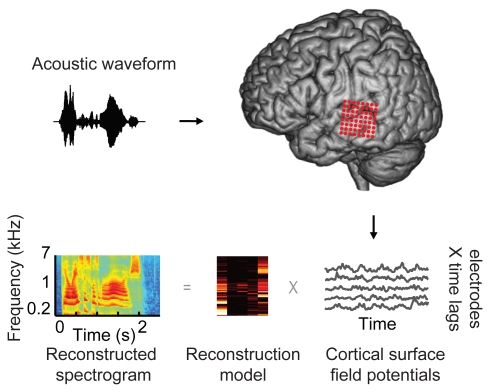
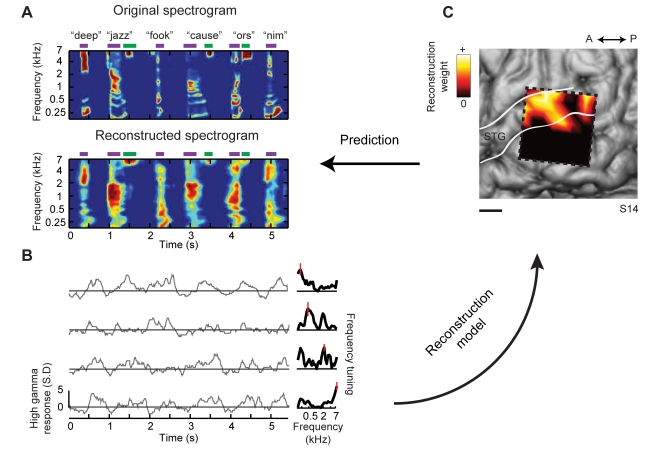
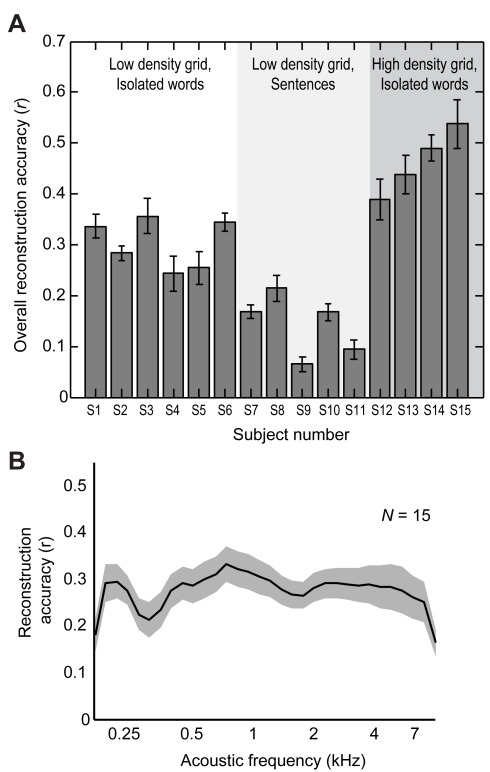
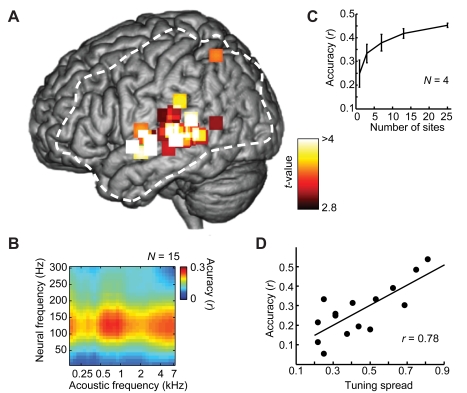
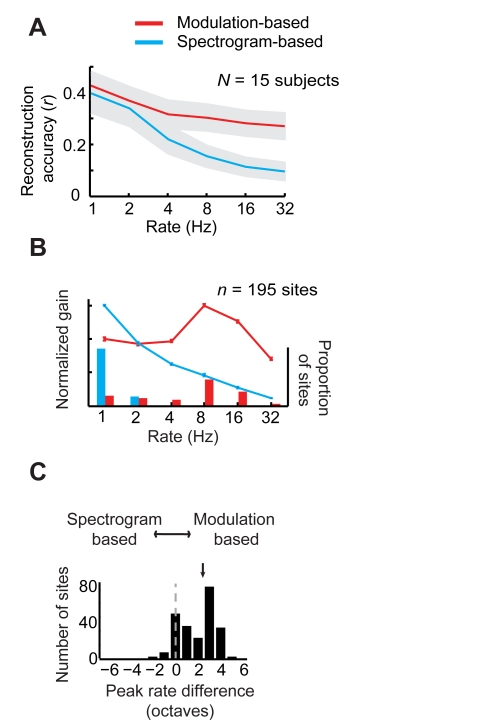
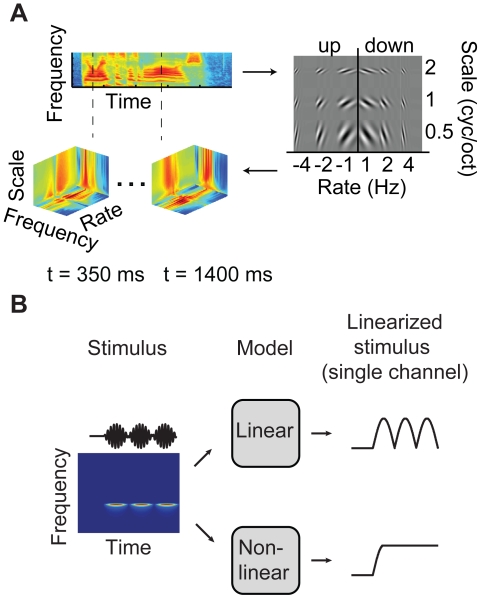
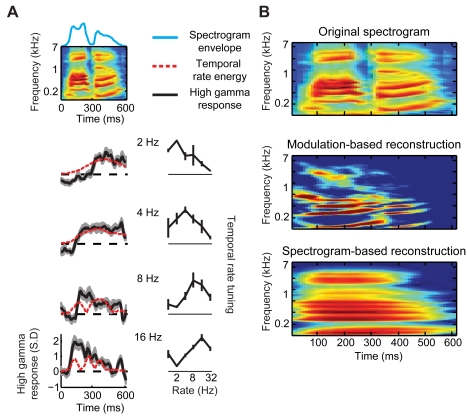
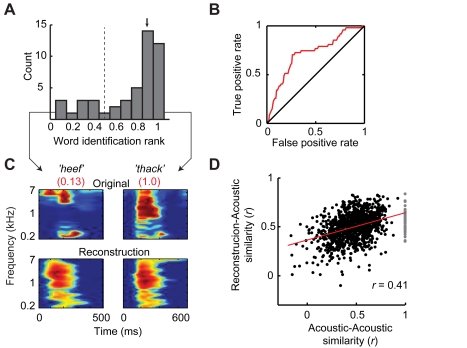
How the human auditory system extracts perceptually relevant acoustic features of speech is unknown. To address this question, we used intracranial recordings from nonprimary auditory cortex in the human superior temporal gyrus to determine what acoustic information in speech sounds can be reconstructed from population neural activity. We found that slow and intermediate temporal fluctuations, such as those corresponding to syllable rate, were accurately reconstructed using a linear model based on the auditory spectrogram. However, reconstruction of fast temporal fluctuations, such as syllable onsets and offsets, required a nonlinear sound representation based on temporal modulation energy. Reconstruction accuracy was highest within the range of spectro-temporal fluctuations that have been found to be critical for speech intelligibility. The decoded speech representations allowed readout and identification of individual words directly from brain activity during single trial sound presentations. These findings reveal neural encoding mechanisms of speech acoustic parameters in higher order human auditory cortex.
Overview
The claims and statistics of this paper haven’t been checked yet.
Free: it reads the open-access text and checks the first 5 claims that cite a source we can check. Create a free account to check every claim.
Integrity signals
Registry
Cites
Statistics
Figures
Verification
Claims the paper makes
The claims and statistics of this paper haven’t been checked yet.
Free: it reads the open-access text and checks the first 5 claims that cite a source we can check. Create a free account to check every claim.
Claims other papers make about this one
Each is checked against this paper’s own text: does it say what the citing paper says it does?
The cited source says what the claim attributes to it.
In the citing paper
“Neural activity in the STG encodes acoustic features — for example, recurring speech sound patterns in the mel-spectrogram — during speech perception53,54 and may be used to reconstruct perceived speech55,56.”
From The speech neuroprosthesis (2024) · cites this paper as [56]
Self-check
Percentages, sums and reported differences re-computed from the paper’s own numbers.
The self-check needs the paper’s full text.
Citations
Cites
The Elements of Statistical Learning
Hastie, T., Tibshirani, R., & Friedman, J. (2009) · Springer Series in Statistics · doi:10.1007/978-0-387-84858-7 · Cited by 25,970
Receptive fields, binocular interaction and functional architecture in the cat’s visual cortex
Hubel, D. H., & Wiesel, T. N. (1962) · The Journal of Physiology · doi:10.1113/jphysiol.1962.sp006837 · Cited by 13,680 · cited 1×
“The modulation model therefore represents an auditory analog to the classical energy model of complex cells in the visual system [32–36], which are invariant to the spatial phase of visual stimuli.”
MethodFundamentals of speech recognition
Rabiner, L. R., & Juang, B.-H. F. (1993) · Cited by 7,680
The cortical organization of speech processing
Hickok, G., & Poeppel, D. (2007) · Nature Reviews Neuroscience · doi:10.1038/nrn2113 · Cited by 5,495 · cited 2×
“For speech comprehension, it is hypothesized that intermediate and higher-order auditory areas extract or construct information-rich features of speech, while discarding nonessential low-level acoustic information [4,5,9, 10,43].”
BackgroundSpatiotemporal energy models for the perception of motion
Adelson, E. H., & Bergen, J. R. (1985) · Journal of the Optical Society of America A · doi:10.1364/josaa.2.000284 · Cited by 3,442 · cited 2×
“Such amplitude-based coding schemes are broadly referred to as ‘‘energy models’’ [32,33].”
BackgroundDISCONNEXION SYNDROMES IN ANIMALS AND MAN
GESCHWIND, N. (1965) · Brain · doi:10.1093/brain/88.2.237 · Cited by 3,403 · cited 5×
“To recover the acoustic waveform from the spectrogram, we used an iterative projection algorithm to estimate the phase [8].”
BackgroundMethodInfluentialTIMIT Acoustic-Phonetic Continuous Speech Corpus
Garofolo, J. S., Lamel, L. F., Fisher, W. M., Pallett, D. S., Dahlgren, N. L., Zue, V. W., & Fiscus, J. G. (2020) · Americanae (AECID Library) · doi:10.35111/17gk-bn40 · Cited by 2,508
Maps and streams in the auditory cortex: nonhuman primates illuminate human speech processing
Rauschecker, J. P., & Scott, S. K. (2009) · Nature Neuroscience · doi:10.1038/nn.2331 · Cited by 1,766 · cited 5×
“Beyond primary auditory areas, further processing in intermediate and higher-order auditory cortex likely results in additional stimulus transformations [5].”
BackgroundResultInfluentialLogothetis, N. K., & Wandell, B. A. (2004) · Annual Review of Physiology · doi:10.1146/annurev.physiol.66.082602.092845 · Cited by 1,568 · cited 1×
“This is consistent with robust speech-induced high gamma responses reported in previous intracranial studies [24–29] and with observed correlations between high gamma power and local spike rate [30].”
ResultIdentifying natural images from human brain activity
Kay, K. N., Naselaris, T., Prenger, R. J., & Gallant, J. L. (2008) · Nature · doi:10.1038/nature06713 · Cited by 1,286 · cited 2×
“An important application of this approach has also been demonstrated in the study of visual object recognition in the primate visual system [36,49,50].”
BackgroundMethod
Cited by
Items 601–694 of 694
Theta waves in speech perception, imagination and production
Jaquet, F. (2017) · IRIS
The Role of Auditory Cortex in Sound Perception and Discrimination: Insights from Optogenetics
O’Sullivan, C. (2020) · Scholars' Bank (University of Oregon)
fMRI-Guided Subdural Visual Motion BCI with Minimal Invasiveness
Zhang, D., Song, H., Xu, R., & Hong, B. (2014) · Springer briefs in electrical and computer engineering · doi:10.1007/978-3-319-09979-8_9
“2009) and the posterior superior temporal gyrus for speech reconstruction (Chang et al. 2010; Pasley et al. 2012).”
BackgroundA Method To Map EEG Signals To Spoken Speech Using Gaussian Process Modeling
Wu, H., Pan, C., Li, M., & Chen, F. (2021) · European Signal Processing Conference (EUSIPCO) · doi:10.23919/eusipco54536.2021.9615959
Somarowthu, A. (2018) · Digital Repository Service (Northeastern University) · doi:10.17760/d20323931
Zeng, F. (2020) · Faculty Opinions – Post-Publication Peer Review of the Biomedical Literature · doi:10.3410/f.737244472.793575360
Constantino, F. C., & Simon, J. Z. (2018) · bioRxiv (Cold Spring Harbor Laboratory) · doi:10.1101/251793
“…2014), an approach that has been successfully applied in auditory electrophysiology (Mesgarani et al., 2009; Ramirez et al., 2011), EEG/MEG (Ding and Simon, 2012b; O’Sullivan et al., 2015), electrocorticography (Leonard et al., 2016; Pasley et al., 2012), and fMRI (Naselaris et al., 2011).”
BackgroundMethodBuzsáki, G. (2019) · Oxford University Press eBooks · doi:10.1093/oso/9780190905385.003.0014
Stimulus Reconstruction from Cortical Responses
Mesgarani, N. (2022) · Springer eBooks · doi:10.1007/978-1-0716-1006-0_108
Self-citationNeural Coding of Speech Sounds
Kilgard, M. P. (2013) · Springer eBooks · doi:10.1007/978-1-4614-7320-6_433-1
“Stimulus reconstruction using a nonlinear modulation model and a linear spectrogram model can identify speech sounds using non-primary auditory cortex population responses (Pasley et al. 2012).”
BackgroundNeural Coding of Speech Sounds
Kilgard, M. P., & Engineer, C. T. (2015) · Springer eBooks · doi:10.1007/978-1-4614-6675-8_433
Simon, A. (2023) · VBN Forskningsportal (Aalborg Universitet) · doi:10.54337/aau548864023
Quand les neurones chantent du Pink Floyd
Tu, L. (2023) · Cerveau & Psycho · doi:10.3917/cerpsy.159.0016
Modeling of Perceived Musical Rhythms Using Electrocorticography
Dexheimer, M. G., Johnson, G. D., Shih, J. J., Herff, C., & Krusienski, D. J. (2023) · Conference proceedings/Conference proceedings - IEEE International Conference on Systems, Man, and Cybernetics · doi:10.1109/smc53992.2023.10394660
“Because a variety of complex speech and auditory signals (both perceived and imagined) have been successfully decoded using intracranial recordings [4]–[7], it is conceivable to decode perceived and imagined musical rhythms from intracranial signals for application to a brain-computer interface [8].”
BackgroundBuzsáki, G. (2019) · Oxford University Press eBooks · doi:10.1093/oso/9780190905385.002.0006
Buzsáki, G. (2019) · Oxford University Press eBooks · doi:10.1093/oso/9780190905385.002.0003
Buzsáki, G. (2019) · Oxford University Press eBooks · doi:10.1093/oso/9780190905385.002.0004
Cognition of Time and Thinking Beyond
Bi, Z. (2024) · Advances in experimental medicine and biology · doi:10.1007/978-3-031-60183-5_10
Author response: Reconstructing Voice Identity from Noninvasive Auditory Cortex Recordings
Lamothe, C., Thoret, E., Trapeau, R., Giordano, B. L., Sein, J., Takerkart, S., Ayache, S., Artières, T., & Belin, P. (2024) · eLife · doi:10.7554/elife.98047.1.sa4
eLife Assessment: Reconstructing Voice Identity from Noninvasive Auditory Cortex Recordings
Martin, A. E. (2024) · eLife · doi:10.7554/elife.98047.1.sa3
Reconstructing Voice Identity from Noninvasive Auditory Cortex RecordingsPreprint
Lamothe, C., Thoret, E., Trapeau, R., Giordano, B. L., Sein, J., Takerkart, S., Ayache, S., Artières, T., & Belin, P. (2024) · eLife · doi:10.7554/elife.98047.1
Syntax, the brain, and linguistic theory: a critical reassessment
(2024) · Frontiers research topics · doi:10.3389/978-2-8325-5181-3
Wu, Y., Li, C., Zhang, H., Chen, F., Chen, W., & Zhang, S. (2024) · International Conference on Biomedical Signal and Image Processing (ICBIP) · doi:10.1145/3691521.3691534
“…vocal-tract articulators (lips, tongue, jaw, and larynx) that produce speech sounds [19, 20], and neural activity in the STG encodes acoustic features, participates to form and plan targets for speech production to some extent, and provides auditory feedback to the language they speech [21, 22].”
Li, J., Guo, C., Chang, E. F., & Li, Y. (2024) · bioRxiv (Cold Spring Harbor Laboratory) · doi:10.1101/2024.12.16.628596
Self-citationBouton, S., Chambon, V., Golestani, N., Formisano, E., Proix, T., & Giraud, A. (2019) · PsyArXiv (OSF Preprints) · doi:10.31234/osf.io/8vwcs_v1
A Review of Multimodal Brain Language Decoding
Tang, Y. (2025) · Lecture Notes in Education Psychology and Public Media · doi:10.54254/2753-7048/2025.nd25514
Деятельность мозга и природа сознания: богословский аспект
Константинов, К. В. (2025) · Сретенское слово · doi:10.54700/w6q9qe20
“Подобные работы существуют [Brian et al. 2012; Chang, Doris 2017].”
Reconstructing Voice Identity from Noninvasive Auditory Cortex RecordingsPreprint
Lamothe, C., Thoret, E., Trapeau, R., Giordano, B. L., Sein, J., Takerkart, S., Ayache, S., Artières, T., & Belin, P. (2025) · eLife · doi:10.7554/elife.98047.2
Lee, H., Hwang, J., Kim, K., Lee, G., Chung, C. K., & Im, C. (2025) · Machine Learning with Applications · doi:10.1016/j.mlwa.2025.100805
The computational architecture of the human auditory cortex
Santoro, R. (2015) · Research Publications (Maastricht University) · doi:10.26481/dis.20150306rs
TEMPORAL CODING OF SPEECH IN HUMAN AUDITORY CORTEX
Ding, N. (2012) · University Libraries (University of Maryland)
Neuronale Reorganisation bei Presbyakusis
Waleczek, C. (2024) · Dokumentenrepositorium der RUB (Ruhr University Bochum) · doi:10.13154/294-10675
Neural and Behavioural Effects of Bilingualism on Selective Attention
Phelps, J. (2022) · Apollo (University of Cambridge) · doi:10.17863/cam.96584
The Influences of Posture and Motivation on Neural Population Activity in Motor Cortex
Marino, P. J. (2023) · D-Scholarship@Pitt (University of Pittsburgh)
Speech-related brain responses as a basis for auditory brain-computer interfaces
Souto, C. F. D. S. (2019) · Carl von Ossiezky University of Oldenburg
Morf, M. (2023) · U-PAD Unimc - Open Digital Publications (University of Macerata)
Modernism and the Making of Masud Khan.
Brown, D. J. (2015) · Queen Mary Research Online (Queen Mary University of London)
Dünnbesetzte gepulste neuronale Netze für Radarsignalverarbeitung
López-Randulfe, J., Knoll, A., & München, T. U. (2024)
EEG-gebaseerde auditieve aandachtsdetectie voor hersengestuurde hoorapparaten
Das, N. (2020) · Lirias (KU Leuven)
Fronto-parietal neural activity during multi-attribute decision-making
Nakahashi, A. (2023) · Papyrus : Institutional Repository (Université de Montréal) · doi:10.71781/26492
Improved Robustness for Brain Activity Decoding Based on Information Theoretic Learning
LI, Y., & Li, Y. (2023) · Institutional Repositories DataBase (IRDB)
Involuntary polymodal imagery involving olfaction, audition, touch, and vision
Dou, W. (2018) · California State University ScholarWorks (system-wide DSpace)
Exploring factors important for clinical application of cortical responses to continuous speech
Aljarboa, G. S. (2025) · ePrints Soton (University of Southampton)
Diepe neurale netwerken als model voor spraakperceptie
Accou, B. (2023) · Lirias
From Sound to Meaning: Representations of Speech in Human Cortex
de Heer, W. A. (2015) · eScholarship (California Digital Library)
Van de Ryck, I. (2025) · Lirias (KU Leuven)
Modelling the neural coding of natural sounds in the auditory cortex
Rahman, M. (2021) · Oxford University Research Archive (ORA) (University of Oxford) · doi:10.5287/ora-vgqknnkpx
The Influence of External Stimuli on the Generation of Voluntary Thoughts
Li, A. Y., Bui, N. C. T., Yankulova, J. K., & Morsella, E. (2025) · International Journal of Psychological Studies · doi:10.5539/ijps.v18n1p11
“One such region is the superior temporal sulcus (Pasley et al., 2012).”
Comparison of single-channel EEG decoding performance in imagined speech tasks
Ma, X., Ding, Y., Zhao, K., Zhang, P., Tang, Y., Shi, J., Chen, D., Wu, D., & Tang, Z. (2026) · Brain Hemorrhages · doi:10.1016/j.hest.2026.01.001
Bouton, S., Chambon, V., Golestani, N., Formisano, E., Proix, T., & Giraud, A. (2026) · Imaging Neuroscience · doi:10.1162/imag.a.1132
“One recent extension of this logic involves the use of dynamic temporal response functions, in which canonical response profiles are adjusted in latency and amplitude based on the predictability of each word and its context, allowing for finer-grained modeling of EEG responses to naturalistic speech…”
Neural Prostheses for Communication Restoration: Algorithmic, Systemic, and Clinical PerspectivesPreprint
Shaeri, M., Yari, A. H., Liu, J., & Shoaran, M. (2026) · doi:10.36227/techrxiv.176972150.04568340/v1
Decoding state specific connectivity during speech production and perceptionPreprint
Esmaeili, Y., Khalilian-Gourtani, A., Devinsky, O., Doyle, W., Dugan, P. C., Friedman, D. B., & Flinker, A. (2026) · eLife · doi:10.7554/elife.109566
Self-citationLi, J., Guo, C., Zhang, C., Chang, E. F., & Li, Y. (2026) · eLife · doi:10.7554/elife.109400.2
Self-citationLi, J., Guo, C., Zhang, C., Chang, E. F., & Li, Y. (2026) · eLife · doi:10.7554/elife.109400.2.sa0
Self-citationTraining a Covert Speech Brain-Computer Interface Through the Passive Perception of Speech
Moon, J. (2022) · TSpace (University of Toronto)
Human auditory cortex preferentially tracks speech over music without explicit attentionPreprint
Agravat, R. K., Desai, M., Field, A. M., Georges, S. F., Leisawitz, J. P., Foox, G., Asghar, S., Clarke, D., Tyler‐Kabara, E. C., Iqbal, M. O., et al. (2026) · bioRxiv (Cold Spring Harbor Laboratory) · doi:10.64898/2026.03.12.710296
“To estimate an upper bound of our encoding model performance, we estimated noise ceilings from electrodes with repeated stimulus presentations (de Heer et al., 2017; Desai et al., 2021; Holdgraf et al., 2017; Pasley et al., 2012).”
フジワラ, ヨ., Fujiwara, Y., & 藤原, 洋. (2023) · Institutional Repositories DataBase (IRDB)
Voluntary control of neural oscillations in the human brain
Corlier, J. (2015) · theses.fr (ABES) · doi:10.70675/7ceb116bz9921z42dfzbb8fz9f534a47bbcd
Aristia, J. (2021) · theses.fr (ABES) · doi:10.70675/fe839a0az9727z4029z8f52zeafd9413389e
Evolution of sound representations in the early auditory system and their modulation by anesthesia
Gosselin, E. (2024) · theses.fr (ABES) · doi:10.70675/f669f4b7z7620z4f6bz986dzb5301602de08
Reconstruction of overt speech from Electrocorticographic (ECoG) data using deep neural networks
Ticha, M. B. B. (2025) · theses.fr (ABES) · doi:10.70675/12c589a0z38bdz4a87zbe17zc60eac7a3e60
Pitch at the Cocktail Party: A Comparative Approach to Studying Selective Attention
Ward, J., Tarka, V., Diuba, A., & Walker, K. M. M. (2026) · Biology · doi:10.3390/biology15080618
“The spectrogram of the attended, but not ignored, voice can be reconstructed from these higher cortical responses [87].”
Puhuttujen sanamuotojen käsittely ja oppiminen aivokuoren aikasarjassa
Nora, A. (2017) · Aaltodoc (Aalto University)
Ghosh, S., Bose, S., Adhikary, A., Rajbanshi, C., & Chakraborty, S. (2026) · IGI Global eBooks · doi:10.4018/979-8-3373-6816-0.ch007
Modeling Temporal Context in EEG-to-Text Systems Using Self Attention
Shurid, S. M., Karoui, B., & Al-Radhi, M. S. (2026) · doi:10.3311/wins2026-002
Conformer-Based Neural Speech Decoding from Intracranial EEG Signals
Shende, A., & Al-Radhi, M. S. (2026) · doi:10.3311/wins2026-001
EEG based imagined speech recognition for BCI applications
Rufiner, H. L., Persia, L. E. D., Prasanna, S. R. M., Mishra, J., Agarwal, A., & Martínez, F. B. (2026) · Elsevier eBooks · doi:10.1016/b978-0-44-331426-1.00008-5
Making Machine Musicians: AI for Live Musical Performance
Palamara, J. A. (2026) · Focal Press eBooks · doi:10.4324/9781003534211
Bao, T., & Lu, R. (2026) · Array · doi:10.1016/j.array.2026.101052
Decoding and Characterizing the Intracranial Representation of Semantic InformationPreprint
Smith, C., Inchyna, S., Barrentine, B., Kana, R. K., Basilico, D., & Nelson, M. J. (2026) · bioRxiv (Cold Spring Harbor Laboratory) · doi:10.64898/2026.07.13.738249
“Much of the major advancements in motor-based language BCI systems has been done using chronically implanted micro-ECoG arrays 4,42–44 .”
Liu, C., Du, C., Chen, X., & He, H. (2026) · Pattern Recognition · doi:10.1016/j.patcog.2026.114499
Siahpoush, S. (2015) · Knowledge UdeS (Institutional Deposit of the University of Sherbrooke)
Noise processing in the auditory system with applications in speech enhancement
Telgerdi, S. M. H. (2021) · Knowledge UdeS (Institutional Deposit of the University of Sherbrooke)
Horng, A., Lin, W.-C., Benciolini, I., Dou, J., Nidiffer, A. R., & Lalor, E. C. (2026) · bioRxiv (Cold Spring Harbor Laboratory) · doi:10.64898/2026.08.11.742969
“…(Aiken and Picton 2008; Destoky et al. 2020; Di Liberto et al. 2015; Ding and Simon 2013; Etard and Reichenbach 2019; Lalor and Foxe 2010; Nourski et al. 2009; Pasley et al. 2012) and validate the use of envelope reconstruction as an index of low-level auditory encoding in the present dataset.”
Intelligible distracting speech disrupts early auditory attentionPreprint
Richardson, B. N., Adimurthy, M. G., Brown, C. A., Ihlefeld, A., Rosen, M. J., & Shinn‐Cunningham, B. G. (2026) · bioRxiv (Cold Spring Harbor Laboratory) · doi:10.64898/2026.08.19.745879
“Invasive neural recordings show that higher order human auditory cortex encodes basic acoustic features of a stimulus (Pasley et al., 2012).”
Cut, Stitch, Adapt: Data-Efficient and Low-Calibration Speech BCIs
Naskar, A., Naskar, A., & Bathula, D. (2026) · Lecture notes in computer science · doi:10.1007/978-3-032-38239-9_15
Ahmadi, A., Robotka, H., Gahr, M. L., & Theunissen, F. E. (2026) · Journal of Neuroscience · doi:10.1523/jneurosci.2108-25.2026
“The decoding of the amplitude envelope of vocal signals has been examined in more detail in human research (Pasley et al., 2012; Anumanchipalli et al., 2019) where the entrainment of cortical activity has been correlated with speech intelligibility both in normal and impaired hearing subjects…”
From Neurons to Conversation: Speech Brain-Computer InterfacesPreprint
Khajehnejad, M., Habibollahi, F., Boccato, T., Sousa, M., Olak, M., Sheiban, F. J., & Ferrante, M. (2026) · arXiv (Cornell University) · doi:10.48550/arxiv.2609.36736
“…sensitive to high-gamma activity ( 70 Hz to 150 Hz), a population-level signal associated with local firing and articulatory and phonetic representations [59, 33], and high-gamma features have supported phoneme decoding, word classification, and continuous speech reconstruction [5, 13, 7].”
InfluentialHe, X., Choudhari, V., Spratt, T. J., Raghavan, A., Lee, R. T., & Mesgarani, N. (2026) · Interspeech (USB) · doi:10.21437/interspeech.2026-3556
“This frequency band captures low-frequency neural tracking of the speech envelope widely reported in EEG and MEG literature [4, 36].”
Self-citation季荣, & 李星星 (2026) · 临床诊断与治疗杂志 · doi:10.62177/fcdt.v2i5.1774
From Predefined Auditory Stimuli to Brain-Guided Generative Auditory Neuroscience
Li, Q., & He, J. (2026) · Biology · doi:10.3390/biology15212006
A biomimetic deep encoder for auditory restoration by cortical stimulationPreprint
Lamothe, C., Verdier, A., Caris, C., Greer, R. J., Romain, D. O., Mabrouk, E., Ceballo, S., Platel, P., Butt, E., Callas, E., et al. (2026) · bioRxiv (Cold Spring Harbor Laboratory) · doi:10.64898/2026.11.05.764596
Bellier, L., Llorens, A., Marciano, D., Gunduz, A., Schalk, G., Brunner, P., & Knight, R. T. (2023) · doi:10.1371/journal.pbio.3002176.r004
Self-citationAlasfour, A., Gabriel, P., Jiang, X., Shamie, I., Melloni, L., Thesen, T., Dugan, P., Friedman, D., Doyle, W., Devinsky, O., et al. (2022) · doi:10.1371/journal.pcbi.1010401.r001
Accounting for the phonetic value of nonspeech sounds
Finley, G. (2015) · eScholarship (California Digital Library)
Trippett, D. (2013) · Cambridge University Press eBooks · doi:10.1017/cbo9781139013703.004
Metadata
- Authors
- Pasley, B. N., David, S. V., Mesgarani, N., Flinker, A., Shamma, S. A., Crone, N. E., Knight, R. T., & Chang, E. F.
- Affiliations
- University of California, Berkeley (US)
- University of Maryland, College Park (US)
- University of California, San Francisco (US)
- Johns Hopkins University (US)
- Corresponding author
- Pasley, Brian N.
- ORCID
- Venue
- PLoS Biology
- Publisher
- Public Library of Science (PLoS)
- Published
- 2012-01-31
- Volume
- 10
- Issue
- 1
- Pages
- e1001251
- ISSN
- 1544-9173 (ISSN-L)
- 1545-7885
- PMC
- PMC3269422
- OpenAlex
- W2005066437
- Cited by
- 604
- References
- 61
- Citations by year
- 2026: 21 · 2025: 30 · 2024: 28 · 2023: 35 · 2022: 36 · 2021: 32 · 2020: 51 · 2019: 66 · 2018: 42 · 2017: 53 · 2016: 43 · 2015: 51 · 2014: 42 · 2013: 50 · 2012: 24
- FWCI
- 27.32
- Type
- journal article
- Language
- en
- Open access
- gold
- doi.org
- Locations
- PLoS Biology (publishedVersion, cc-by)
- Europe PMC (PubMed Central) (publishedVersion, cc-by)
- PubMed Central (publishedVersion, cc-by)
- PubMed (publishedVersion)
- DOAJ (DOAJ: Directory of Open Access Journals) (submittedVersion)
- eScholarship (California Digital Library) (submittedVersion)
- Figshare (submittedVersion, cc-by)
- Funders
- National Institutes of Health (2r01ns021135-33, 5r00ns065120-04)
- U.S. Public Health Service (P04813)
- National Institute on Deafness and Other Communication Disorders (K99DC010439, K99DC012804, R01DC012379)
- National Institute of Neurological Disorders and Stroke (NS-40596, NS-21135, K99NS065120, R56NS021135, R37NS021135, R01NS040596, R00-NS065120, R01 NS-021135)
- Topics
- Life Sciences › Neuroscience › Cognitive Neuroscience › Neuroscience and Music Perception
- Social Sciences › Psychology › Experimental and Cognitive Psychology › Phonetics and Phonology Research
- Life Sciences › Neuroscience › Cognitive Neuroscience › Neurobiology of Language and Bilingualism
- Keywords
- speech perception, auditory cortex, superior temporal gyrus, neural decoding, speech reconstruction, acoustic features, syllable rate, word recognition, nonlinear decoding, speech intelligibility
- MeSH terms
- Algorithms, Auditory Cortex, Brain Mapping, Computer Simulation, Electrodes, Implanted, Electroencephalography, Female, Humans, Male, Models, Biological, Speech Acoustics, Linear Models
About these checks
Registry, retraction, Cites and statistics results are computed, not judged, with one exception: a printed reference that no index lists is read once by a model before it counts as a citation error. Claims are extracted by a model and kept only when their quote appears verbatim in the text; each cited source is then checked, with a model’s help, for whether it says what the claim relies on. Those verdicts can be wrong — read the claim’s quote and the cited source before relying on one.
Statistics and arithmetic are recomputed, not judged.
Confidence bands are shown only for fields calibrated on our annotated test set. None is calibrated yet, so no band is shown.
What counts as a claim ›How we measure confidence ›How we check this ›
Are you an author, or do you see a problem with this page? Request a review
Data sources
Bibliographic data: Semantic Scholar, OpenAlex, Crossref.
Contains information from the Semantic Scholar Academic Graph Datasets, made available under the ODC Attribution License (ODC-BY 1.0).
Semantic Scholar’s data is described in: Kinney, R., et al. (2023). The Semantic Scholar Open Data Platform. arXiv:2301.10140.
