

Nonindustry-Sponsored Preclinical Studies on Statins Yield Greater Efficacy Estimates Than Industry-Sponsored Studies: A Meta-Analysis
Open accessThe DOI matches its Crossref record; 54 of the 55 references it cites were found in a registry or an index, and 1 are not checked yet.
Abstract
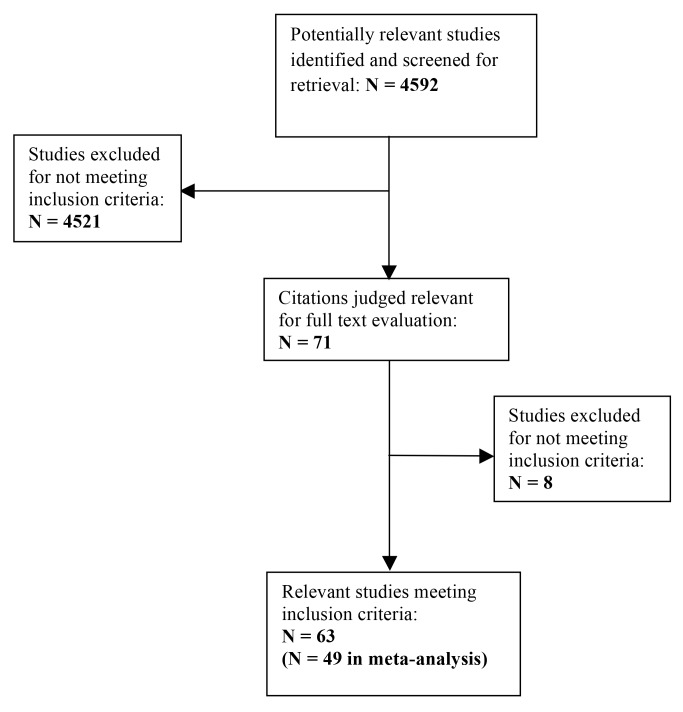
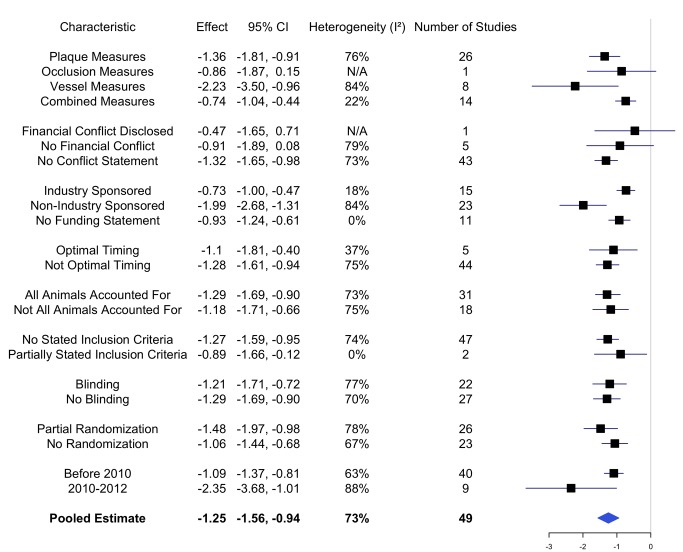
Industry-sponsored clinical drug studies are associated with publication of outcomes that favor the sponsor, even when controlling for potential bias in the methods used. However, the influence of sponsorship bias has not been examined in preclinical animal studies. We performed a meta-analysis of preclinical statin studies to determine whether industry sponsorship is associated with either increased effect sizes of efficacy outcomes and/or risks of bias in a cohort of published preclinical statin studies. We searched Medline (January 1966-April 2012) and identified 63 studies evaluating the effects of statins on atherosclerosis outcomes in animals. Two coders independently extracted study design criteria aimed at reducing bias, results for all relevant outcomes, sponsorship source, and investigator financial ties. The I(2) statistic was used to examine heterogeneity. We calculated the standardized mean difference (SMD) for each outcome and pooled data across studies to estimate the pooled average SMD using random effects models. In a priori subgroup analyses, we assessed statin efficacy by outcome measured, sponsorship source, presence or absence of financial conflict information, use of an optimal time window for outcome assessment, accounting for all animals, inclusion criteria, blinding, and randomization. The effect of statins was significantly larger for studies sponsored by nonindustry sources (-1.99; 95% CI -2.68, -1.31) versus studies sponsored by industry (-0.73; 95% CI -1.00, -0.47) (p value<0.001). Statin efficacy did not differ by disclosure of financial conflict information, use of an optimal time window for outcome assessment, accounting for all animals, inclusion criteria, blinding, and randomization. Possible reasons for the differences between nonindustry- and industry-sponsored studies, such as selective reporting of outcomes, require further study.
Overview
The claims and statistics of this paper haven’t been checked yet.
Free: it reads the open-access text and checks the first 5 claims that cite a source we can check. Create a free account to check every claim.
Integrity signals
Registry
Cites
Statistics
Figures
Verification
Claims the paper makes
The claims and statistics of this paper haven’t been checked yet.
Free: it reads the open-access text and checks the first 5 claims that cite a source we can check. Create a free account to check every claim.
Claims other papers make about this one
Each is checked against this paper’s own text: does it say what the citing paper says it does?
The source backs part of the claim, not all of it — or backs it for a different population, condition or comparison.
In the citing paper
“Our results are also in line with the consolidated evidence that industry sponsorship of various types of research is associated with favorable outcomes for the sponsor in both human [29, 31–34] and animal studies[35, 36].”
From Relationship between research outcomes and risk of bias, study sponsorship, and author financial conflicts of interest in reviews of the effects of artificially sweetened beverages on weight outcomes: a systematic review of reviews (2016) · cites this paper as [36]
Experimental — accuracy not yet measuredThe source backs part of the claim, not all of it — or backs it for a different population, condition or comparison.
In the citing paper
“Evidence for preclinical research also indicates that funding sources may influence the interpretation of study outcomes [254,260].”
From Reporting animal research: Explanation and elaboration for the ARRIVE guidelines 2.0 (2020) · cites this paper as [260]
Experimental — accuracy not yet measured
Self-check
Percentages, sums and reported differences re-computed from the paper’s own numbers.
The self-check needs the paper’s full text.
Citations
Cites
Meta-analysis in clinical trials
DerSimonian, R., & Laird, N. (1986) · Controlled Clinical Trials · doi:10.1016/0197-2456(86)90046-2 · Cited by 39,552 · cited 1×
“We pooled the data across studies and estimated summary average SMDs using random-effects models [53].”
MethodCochrane Handbook for Systematic Reviews of Interventions: Cochrane Book Series
(2008) · doi:10.1002/9780470712184 · Cited by 25,048
Pharmaceutical industry sponsorship and research outcome and quality: systematic review
Lexchin, J., Bero, L. A., Djulbegovic, B., & Clark, O. (2003) · BMJ · doi:10.1136/bmj.326.7400.1167 · Cited by 2,147 · cited 1×
“Industry sponsorship biases the written research record towards outcomes that are favorable to the sponsor, even when controlling for study design criteria [10–16].”
BackgroundSelf-citationChan, A.-W., Hróbjartsson, A., Haahr, M. T., Gøtzsche, P. C., & Altman, D. G. (2004) · JAMA · doi:10.1001/jama.291.20.2457 · Cited by 1,845
Scope and Impact of Financial Conflicts of Interest in Biomedical Research: A Systematic Review
Bekelman, J. E., Li, Y., & Gross, C. P. (2003) · JAMA · doi:10.1001/jama.289.4.454 · Cited by 1,816 · cited 1×
“Industry sponsorship biases the written research record towards outcomes that are favorable to the sponsor, even when controlling for study design criteria [10–16].”
BackgroundStimulation of Bone Formation in Vitro and in Rodents by Statins
Mundy, G., Garrett, R., Harris, S., Chan, J., Chen, D., Rossini, G., Boyce, B., Zhao, M., & Gutierrez, G. (1999) · Science · doi:10.1126/science.286.5446.1946 · Cited by 1,774
Industry sponsorship and research outcome
Lundh, A., Lexchin, J., Mintzes, B., Schroll, J. B., & Bero, L. (2017) · Cochrane Database of Systematic Reviews · doi:10.1002/14651858.mr000033.pub3 · Cited by 1,697
Self-citationBetter Reporting of Harms in Randomized Trials: An Extension of the CONSORT Statement
Ioannidis, J. P. A., Evans, S. J. W., Gøtzsche, P. C., O'Neill, R. T., Altman, D. G., Schulz, K., Moher, D., & for the CONSORT Group* (2004) · Annals of Internal Medicine · doi:10.7326/0003-4819-141-10-200411160-00009 · Cited by 1,593
Why Most Discovered True Associations Are Inflated
Ioannidis, J. P. A. (2008) · Epidemiology · doi:10.1097/ede.0b013e31818131e7 · Cited by 1,495 · cited 2×
“Among clinical studies, most discovered true associations are inflated due to methodological flaws [28].”
BackgroundResult1,026 Experimental treatments in acute stroke
O'Collins, V. E., Macleod, M. R., Donnan, G. A., Horky, L. L., van der Worp, B. H., & Howells, D. W. (2006) · Annals of Neurology · doi:10.1002/ana.20741 · Cited by 1,460
Research works printed but not linked: 1
- Lo B, Field M (2009) COI in medical research, education, and practice. Washington, DC: The National Academies Press Institute of Medicine. 20662118
Cited by
Reporting animal research: Explanation and elaboration for the ARRIVE guidelines 2.0
Percie du Sert, N., Ahluwalia, A., Alam, S., Avey, M. T., Baker, M., Browne, W. J., Clark, A., Cuthill, I. C., Dirnagl, U., Emerson, M., et al. (2020) · PLOS Biology · doi:10.1371/journal.pbio.3000411 · Cited by 2,677
Industry sponsorship and research outcome
Lundh, A., Lexchin, J., Mintzes, B., Schroll, J. B., & Bero, L. (2017) · Cochrane Database of Systematic Reviews · doi:10.1002/14651858.mr000033.pub3 · Cited by 1,697
Self-citationReporting animal research: Explanation and Elaboration for the ARRIVE guidelines 2019
Percie du Sert, N., Ahluwalia, A., Alam, S., Avey, M. T., Baker, M., Browne, W. J., Clark, A., Cuthill, I. C., Dirnagl, U., Emerson, M., et al. (2019) · bioRxiv (Cold Spring Harbor Laboratory) · doi:10.1101/703355 · Cited by 559
Risk of bias in reports of in vivo research: a focus for improvement
Macleod, M. R., Lawson McLean, A., Kyriakopoulou, A., Serghiou, S., de Wilde, A., Sherratt, N., Hirst, T., Hemblade, R., Bahor, Z., Nunes-Fonseca, C., et al. (2015) · PLOS Biology · doi:10.1371/journal.pbio.1002273 · Cited by 358
“Investigator conflict of interest might increase or decrease the risk of bias [18–20], and a statement of whether or not a conflict of interest exists may help the reader to judge whether this may have occurred.”
BackgroundLam, J., Koustas, E., Sutton, P., Johnson, P. I., Atchley, D. S., Sen, S., Robinson, K. A., Axelrad, D. A., & Woodruff, T. J. (2014) · Environmental Health Perspectives · doi:10.1289/ehp.1307923 · Cited by 214
“The Cochrane Collaboration has recognized the importance of identifying study funding source, which has been empirically shown to be associated with biases (Krauth et al. 2014; Lundh et al. 2012).”
Background
Metadata
- Authors
- Krauth, D., Anglemyer, A., Philipps, R., & Bero, L.
- Affiliations
- University of California, San Francisco (US)
- Corresponding author
- Bero, Lisa
- Venue
- PLoS Biology
- Publisher
- Public Library of Science (PLoS)
- Published
- 2014-01-21
- Volume
- 12
- Issue
- 1
- Pages
- e1001770
- ISSN
- 1544-9173 (ISSN-L)
- 1545-7885
- PMC
- PMC3897361
- OpenAlex
- W2001253472
- Cited by
- 36
- References
- 53
- Citations by year
- 2025: 1 · 2024: 1 · 2023: 1 · 2021: 2 · 2020: 4 · 2019: 2 · 2018: 1 · 2017: 3 · 2016: 4 · 2015: 10 · 2014: 7
- FWCI
- 1.43
- Type
- journal article
- Language
- en
- Open access
- gold
- doi.org
- Licence
- Locations
- PLoS Biology (publishedVersion, cc-by)
- Europe PMC (PubMed Central) (publishedVersion, cc-by)
- PubMed Central (publishedVersion, cc-by)
- PubMed (publishedVersion)
- RePEc: Research Papers in Economics (submittedVersion)
- DOAJ (DOAJ: Directory of Open Access Journals) (submittedVersion, cc-by-sa)
- eScholarship (California Digital Library) (submittedVersion)
- Figshare (submittedVersion, cc-by)
- Funders
- University of California, San Francisco
- National Institute of Environmental Health Sciences (R21ES021028)
- Topics
- Health Sciences › Nursing › Issues, ethics and legal aspects › Pharmaceutical industry and healthcare
- Health Sciences › Medicine › Cardiology and Cardiovascular Medicine › Lipoproteins and Cardiovascular Health
- Social Sciences › Decision Sciences › Statistics, Probability and Uncertainty › Meta-analysis and systematic reviews
- Keywords
- statins, industry funding, preclinical animal studies, research bias, atherosclerosis, financial conflicts of interest, selective reporting, pharmaceutical industry influence
- MeSH terms
- Animals, Cost-Benefit Analysis, Dose-Response Relationship, Drug, Drug Industry, Drug Evaluation, Preclinical, Humans, MEDLINE, Conflict of Interest, Treatment Outcome, Publication Bias, Sample Size, Hydroxymethylglutaryl-CoA Reductase Inhibitors, Atherosclerosis
About these checks
Registry, retraction, Cites and statistics results are computed, not judged, with one exception: a printed reference that no index lists is read once by a model before it counts as a citation error. Claims are extracted by a model and kept only when their quote appears verbatim in the text; each cited source is then checked, with a model’s help, for whether it says what the claim relies on. Those verdicts can be wrong — read the claim’s quote and the cited source before relying on one.
Statistics and arithmetic are recomputed, not judged.
Confidence bands are shown only for fields calibrated on our annotated test set. None is calibrated yet, so no band is shown.
What counts as a claim ›How we measure confidence ›How we check this ›
Are you an author, or do you see a problem with this page? Request a review
Data sources
Bibliographic data: Semantic Scholar, OpenAlex, Crossref.
Contains information from the Semantic Scholar Academic Graph Datasets, made available under the ODC Attribution License (ODC-BY 1.0).
Semantic Scholar’s data is described in: Kinney, R., et al. (2023). The Semantic Scholar Open Data Platform. arXiv:2301.10140.
