

Disruption of an Evolutionarily Novel Synaptic Expression Pattern in Autism
Open accessThe DOI matches its Crossref record; 77 of the 77 references it cites were found in a registry or an index.
Abstract
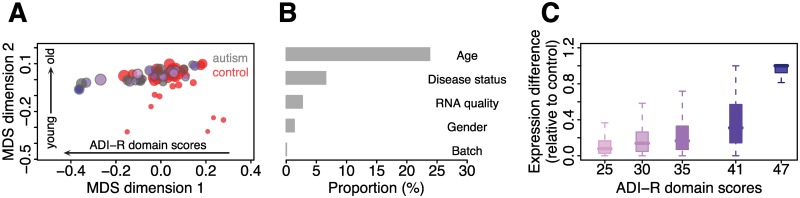
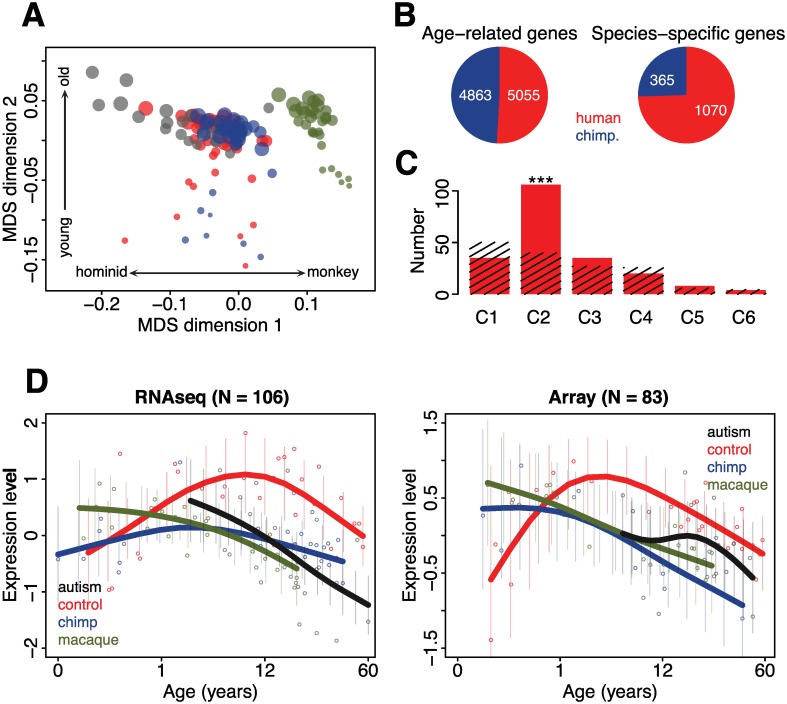
Cognitive defects in autism spectrum disorder (ASD) include socialization and communication: key behavioral capacities that separate humans from other species. Here, we analyze gene expression in the prefrontal cortex of 63 autism patients and control individuals, as well as 62 chimpanzees and macaques, from natal to adult age. We show that among all aberrant expression changes seen in ASD brains, a single aberrant expression pattern overrepresented in genes involved synaptic-related pathways is enriched in nucleotide variants linked to autism. Furthermore, only this pattern contains an excess of developmental expression features unique to humans, thus resulting in the disruption of human-specific developmental programs in autism. Several members of the early growth response (EGR) transcription factor family can be implicated in regulation of this aberrant developmental change. Our study draws a connection between the genetic risk architecture of autism and molecular features of cortical development unique to humans.
Overview
The claims and statistics of this paper haven’t been checked yet.
Free: it reads the open-access text and checks the first 5 claims that cite a source we can check. Create a free account to check every claim.
Integrity signals
Registry
Cites
Statistics
Figures


Verification
Claims the paper makes
The claims and statistics of this paper haven’t been checked yet.
Free: it reads the open-access text and checks the first 5 claims that cite a source we can check. Create a free account to check every claim.
Claims other papers make about this one
Each is checked against this paper’s own text: does it say what the citing paper says it does?
The source backs part of the claim, not all of it — or backs it for a different population, condition or comparison.
In the citing paper
“Conversely, some neurodevelopmental diseases (NDDs) that impair higher cognitive functions, such as intellectual disability (ID) and autism spectrum disorder (ASD), may involve accelerated brain development.10,11,12,13”
From Synaptic neoteny of human cortical neurons requires species-specific balancing of SRGAP2-SYNGAP1 cross-inhibition (2024) · cites this paper as [13]
Experimental — accuracy not yet measured
Self-check
Percentages, sums and reported differences re-computed from the paper’s own numbers.
The self-check needs the paper’s full text.
Citations
Cites
1 retracted
Christensen, D. L., Baio, J., Braun, K. V. N., Bilder, D., Charles, J., Constantino, J. N., Daniels, J., Durkin, M. S., Fitzgerald, R. T., Kurzius-Spencer, M., et al. (2016) · MMWR. Surveillance Summaries · doi:10.15585/mmwr.ss6503a1 · Cited by 1,964
RetractedUltrafast and memory-efficient alignment of short DNA sequences to the human genome.
Langmead, B., Trapnell, C., Pop, M., & Salzberg, S. L. (2009) · Genome Biology · doi:10.1186/gb-2009-10-3-r25 · Cited by 21,849
Shrestha, S., & Offer, S. M. (2016) · Medical Epigenetics · doi:10.1159/000444713 · Cited by 8,914
(1943) · The Nervous child · Cited by 8,870
Baio, J., Wiggins, L., Christensen, D. L., Maenner, M. J., Daniels, J., Warren, Z., Kurzius-Spencer, M., Zahorodny, W., Robinson, C., Rosenberg, et al. (2018) · MMWR. Surveillance Summaries · doi:10.15585/mmwr.ss6706a1 · Cited by 6,078
Rett syndrome is caused by mutations in X-linked MECP2, encoding methyl-CpG-binding protein 2
Amir, R. E., Van den Veyver, I. B., Wan, M., Tran, C. Q., Francke, U., & Zoghbi, H. Y. (1999) · Nature Genetics · doi:10.1038/13810 · Cited by 4,990
Understanding and sharing intentions: The origins of cultural cognition
Tomasello, M., Carpenter, M., Call, J., Behne, T., & Moll, H. (2005) · Behavioral and Brain Sciences · doi:10.1017/s0140525x05000129 · Cited by 4,882
Evolutionarily conserved elements in vertebrate, insect, worm, and yeast genomes
Siepel, A., Bejerano, G., Pedersen, J. S., Hinrichs, A. S., Hou, M., Rosenbloom, K., Clawson, H., Spieth, J., Hillier, L. W., Richards, S., et al. (2005) · Genome Research · doi:10.1101/gr.3715005 · Cited by 3,971
Autistic disturbances of affective contact.
Kanner, L. (1968) · PubMed · Cited by 3,130
Cahoy, J. D., Emery, B., Kaushal, A., Foo, L. C., Zamanian, J. L., Christopherson, K. S., Xing, Y., Lubischer, J. L., Krieg, P. A., Krupenko, S. A., et al. (2008) · The Journal of Neuroscience · doi:10.1523/jneurosci.4178-07.2008 · Cited by 3,129 · cited 2×
“These observations were generally consistent with results based on mouse neuronal marker genes reported in [40] (S12 Fig).”
BackgroundResult
Cited by
Widespread RNA editing dysregulation in brains from autistic individuals
Tran, S. S., Jun, H.-I., Bahn, J. H., Azghadi, A., Ramaswami, G., Van Nostrand, E. L., Nguyen, T. B., Hsiao, Y.-H. E., Lee, C., Pratt, G. A., et al. (2019) · Nature Neuroscience · doi:10.1038/s41593-018-0287-x · Cited by 218
Linaro, D., Vermaercke, B., Iwata, R., Ramaswamy, A., Davis, B. A., Boubakar, L., Libé-Philippot, B., Bilheu, A., Bruyne, L. D., Gall, D., et al. (2019) · doi:10.1101/626218 · Cited by 219
“Beyond evolution, human neoteny has important implications for brain diseases (Liu et al., 2016), as alterations of neuronal maturation are associated with neurodevelopmental disorders (Hutsler and Zhang, 2010; Pfeiffer et al.”
BackgroundBrain Plasticity and Human Evolution
Sherwood, C. C., & Gómez-Robles, A. (2017) · Annual Review of Anthropology · doi:10.1146/annurev-anthro-102215-100009 · Cited by 170
Self-citationPre/post-natal exposure to microplastic as a potential risk factor for autism spectrum disorder
Zaheer, J., Kim, H., Ko, I. O., Jo, E.-K., Choi, E., Lee, H., Shim, I., Woo, H., Choi, J. H., Kim, G.-H., et al. (2022) · Environment International · doi:10.1016/j.envint.2022.107121 · Cited by 151
Species-specific maturation profiles of human, chimpanzee and bonobo neural cells
Marchetto, M. C., Hrvoj-Mihic, B., Kerman, B. E., Yu, D. X., Vadodaria, K. C., Linker, S. B., Narvaiza, I., Santos, R., Denli, A. M., Mendes, A. P., et al. (2019) · eLife · doi:10.7554/elife.37527 · Cited by 132
Metadata
- Authors
- Liu, X., Han, D., Somel, M., Jiang, X., Hu, H., Guijarro, P., Zhang, N., Mitchell, A., Halene, T., Ely, J. J., Sherwood, C. C., Hof, P. R., Qiu, Z., Pääbo, S., Akbarian, S., & Khaitovich, P.
- Affiliations
- Jinan University (CN)
- Chinese Academy of Sciences (CN)
- Icahn School of Medicine at Mount Sinai (US)
- New Mexico State University Alamogordo (US)
- George Washington University (US)
- Max Planck Institute for Evolutionary Anthropology (DE)
- Skolkovo Institute of Science and Technology (RU)
- Corresponding author
- Pääbo, Svante
- Akbarian, Schahram
- Khaitovich, Philipp
- ORCID
- Venue
- PLOS Biology
- Publisher
- Public Library of Science (PLoS)
- Published
- 2016-09-29
- Volume
- 14
- Issue
- 9
- Pages
- e1002558
- ISSN
- 1544-9173 (ISSN-L)
- 1545-7885
- PMC
- PMC5042529
- OpenAlex
- W2524626331
- Cited by
- 87
- References
- 76
- Citations by year
- 2026: 5 · 2025: 8 · 2024: 10 · 2023: 10 · 2022: 10 · 2021: 11 · 2020: 5 · 2019: 8 · 2018: 11 · 2017: 8 · 2016: 1
- FWCI
- 5.94
- Type
- journal article
- Language
- en
- Open access
- gold
- doi.org
- Licence
- public-domain
- creativecommons.org/publicdomain/zero/1.0/ (vor)
- Locations
- PLoS Biology (publishedVersion, public-domain)
- PubMed Central (publishedVersion, public-domain)
- PubMed (publishedVersion)
- DOAJ (DOAJ: Directory of Open Access Journals) (submittedVersion, cc-by-sa)
- Max Planck Digital Library (submittedVersion, other-oa)
- Figshare (submittedVersion, cc-by)
- OpenMETU (Middle East Technical University) (submittedVersion, cc-by-nc-nd)
- MPG.PuRe (Max Planck Society) (submittedVersion, other-oa)
- Funders
- Chinese Academy of Sciences Leading Program (XDB13010200)
- National Natural Science Foundation of China (CN) (91331203, 31420103920, 31171232, 31501012, 31501047)
- National One Thousand Foreign Experts Plan (WQ20123100078)
- Bureau of International Cooperation, Chinese Academy of Sciences (CN) (GJHZ201313)
- Max Planck-Society
- Bundesministerium für Bildung und Forschung (DE)
- Russian Science Foundation (RU) (14-28-00234, 16-14-00220)
- Brain and Behavior Research Foundation (BBRF)
- Science and Technology Commission of Shanghai Municipality (13ZR1464200)
- SA-SIBS Scholarship program
- Youth Innovation Promotion Association of the Chinese Academy of Sciences
- China Postdoctoral Science Foundation (2015M571610)
- METU internal grant (BAP-08-11-2014-023, BAP-07-02-2015-009)
- the Young Scientist Award from Science Academy Society in Turkey
- the Simons Foundation
- Ministry of Education and Science of the Russian Federation (14.615.21.0002)
- Topics
- Life Sciences › Neuroscience › Cognitive Neuroscience › Autism Spectrum Disorder Research
- Life Sciences › Biochemistry, Genetics and Molecular Biology › Genetics › Genetics and Neurodevelopmental Disorders
- Life Sciences › Neuroscience › Developmental Neuroscience › Williams Syndrome Research
- Keywords
- autism spectrum disorder, prefrontal cortex, gene expression, synaptic pathways, nucleotide variants, chimpanzees, macaque, comparative genomics
About these checks
Registry, retraction, Cites and statistics results are computed, not judged, with one exception: a printed reference that no index lists is read once by a model before it counts as a citation error. Claims are extracted by a model and kept only when their quote appears verbatim in the text; each cited source is then checked, with a model’s help, for whether it says what the claim relies on. Those verdicts can be wrong — read the claim’s quote and the cited source before relying on one.
Statistics and arithmetic are recomputed, not judged.
Confidence bands are shown only for fields calibrated on our annotated test set. None is calibrated yet, so no band is shown.
What counts as a claim ›How we measure confidence ›How we check this ›
Are you an author, or do you see a problem with this page? Request a review
How to cite
Cite CoChat for the checks on this page, and the paper for its own findings.
- This page
- CoChat. (2026). Citation check: Disruption of an Evolutionarily Novel Synaptic Expression Pattern in Autism. https://app.cochat.ai/papers/10.1371/journal.pbio.1002558
- The paper
- Liu, X., Han, D., Somel, M., Jiang, X., Hu, H., Guijarro, P., Zhang, N., Mitchell, A., Halene, T., Ely, J. J., Sherwood, C. C., Hof, P. R., Qiu, Z., Pääbo, S., Akbarian, S., & Khaitovich, P. (2016). Disruption of an Evolutionarily Novel Synaptic Expression Pattern in Autism. PLOS Biology. https://doi.org/10.1371/journal.pbio.1002558
Data sources
Bibliographic data: Semantic Scholar, OpenAlex, Crossref.
Contains information from the Semantic Scholar Academic Graph Datasets, made available under the ODC Attribution License (ODC-BY 1.0).
Semantic Scholar’s data is described in: Kinney, R., et al. (2023). The Semantic Scholar Open Data Platform. arXiv:2301.10140.
