

The DOI matches its Crossref record; 75 of the 79 references it cites were found in a registry or an index.
The Origins of Lactase Persistence in Europe
Open accessAbstract
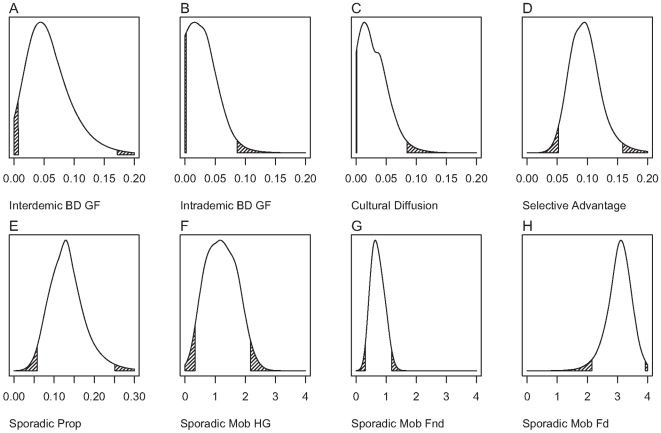
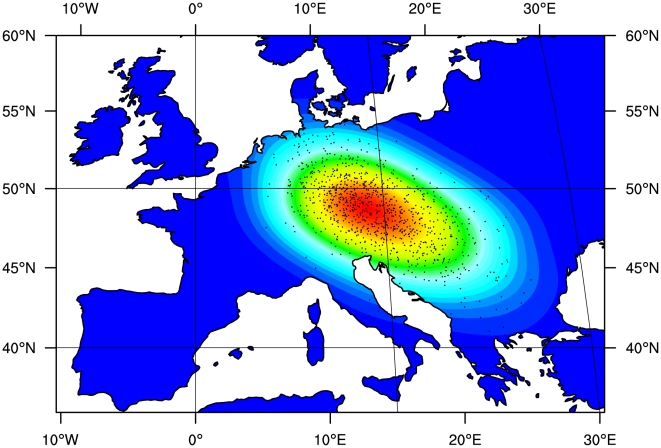
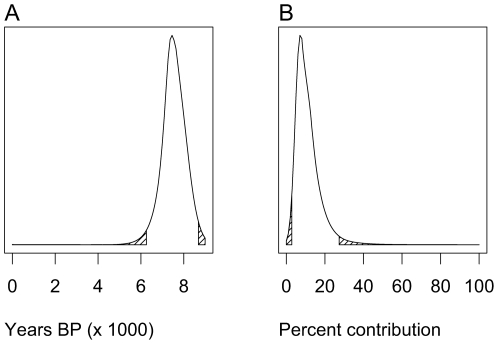
Lactase persistence (LP) is common among people of European ancestry, but with the exception of some African, Middle Eastern and southern Asian groups, is rare or absent elsewhere in the world. Lactase gene haplotype conservation around a polymorphism strongly associated with LP in Europeans (-13,910 C/T) indicates that the derived allele is recent in origin and has been subject to strong positive selection. Furthermore, ancient DNA work has shown that the--13,910*T (derived) allele was very rare or absent in early Neolithic central Europeans. It is unlikely that LP would provide a selective advantage without a supply of fresh milk, and this has lead to a gene-culture coevolutionary model where lactase persistence is only favoured in cultures practicing dairying, and dairying is more favoured in lactase persistent populations. We have developed a flexible demic computer simulation model to explore the spread of lactase persistence, dairying, other subsistence practices and unlinked genetic markers in Europe and western Asia's geographic space. Using data on--13,910*T allele frequency and farming arrival dates across Europe, and approximate Bayesian computation to estimate parameters of interest, we infer that the--13,910*T allele first underwent selection among dairying farmers around 7,500 years ago in a region between the central Balkans and central Europe, possibly in association with the dissemination of the Neolithic Linearbandkeramik culture over Central Europe. Furthermore, our results suggest that natural selection favouring a lactase persistence allele was not higher in northern latitudes through an increased requirement for dietary vitamin D. Our results provide a coherent and spatially explicit picture of the coevolution of lactase persistence and dairying in Europe.
Overview
The claims and statistics of this paper haven’t been checked yet.
Run the check — free, no account needed. It reads the open-access text and checks the sources it cites.
Integrity signals
Registry
Cites
Statistics
Figures
Verification
Claims the paper makes
The claims and statistics of this paper haven’t been checked yet.
Run the check — free, no account needed. It reads the open-access text and checks the sources it cites.
Claims other papers make about this one
Each is checked against this paper’s own text: does it say what the citing paper says it does?
In the citing paper
“although the selective sweep has been modelled as originating between Central Europe and the Balkans ~4–6,000 years BC (ref. 34).”
From Genome flux and stasis in a five millennium transect of European prehistory (2014) · cites this paper as [34]
Self-check
Percentages, sums and reported differences re-computed from the paper’s own numbers.
The self-check needs the paper’s full text.
Citations
Cites
The History and Geography of Human Genes
Cavalli-Sforza, L. L., Menozzi, P., & Piazza, A. (2018) · Princeton University Press eBooks · doi:10.2307/j.ctv301gjp · Cited by 3,175
Approximate Bayesian computation in population genetics
Beaumont, M. A., Zhang, W., & Balding, D. J. (2002) · Genetics · doi:10.1093/genetics/162.4.2025 · Cited by 2,932
Self-citationHistory and Geography of Human Genes
Piazza, A. (1994) · Advances in forensic haemogenetics · doi:10.1007/978-3-642-78782-9_1 · Cited by 1,639
Convergent adaptation of human lactase persistence in Africa and Europe
Tishkoff, S. A., Reed, F. A., Ranciaro, A., Voight, B. F., Babbitt, C. C., Silverman, J. S., Powell, K., Mortensen, H. M., Hirbo, J. B., Osman, M., et al. (2007) · Nature Genetics · doi:10.1038/ng1946 · Cited by 1,615 · cited 1×
“In Africa there are at least four known LP-associated alleles, including three that are likely to be of African origin [2,4] as well as 213,910*T, which is likely to be of European origin [3,12].”
BackgroundA Mathematical Theory of Natural and Artificial Selection, Part V: Selection and Mutation
Haldane, J. B. S. (1927) · Mathematical Proceedings of the Cambridge Philosophical Society · doi:10.1017/s0305004100015644 · Cited by 1,326 · cited 1×
“While we would expect any de novo mutation to always have an initial frequency of 1/2N, we also expect that it will have a high probability of extinction unless selection is very strong [79].”
BackgroundGenetic Signatures of Strong Recent Positive Selection at the Lactase Gene
Bersaglieri, T., Sabeti, P. C., Patterson, N. J., Vanderploeg, T. N., Schaffner, S. F., Drake, J. A., Rhodes, M. E., Reich, D., & Hirschhorn, J. N. (2004) · The American Journal of Human Genetics · doi:10.1086/421051 · Cited by 1,169 · cited 15×
“063 16 [8] 1699 7274 (69) 7112 (76) 43.”
BackgroundResultInfluentialIdentification of a variant associated with adult-type hypolactasia
Enattah, N. S., Sahi, T., Savilahti, E., Terwilliger, J. D., Peltonen, L., & Järvelä, I. E. (2002) · Nature Genetics · doi:10.1038/ng826 · Cited by 1,029 · cited 1×
“91 kb upstream from the lactase gene [5].”
BackgroundEarliest Date for Milk Use in the Near East and Southeastern Europe Linked to Cattle Herding
Evershed, R. P., Payne, S., Sherratt, A. G., Copley, M. S., Coolidge, J., Urem-Kotsu, D., Kotsakis, K., Özdoğan, M., Özdoğan, A. E., Nieuwenhuyse, O., et al. (2008) · Nature · doi:10.1038/nature07180 · Cited by 681 · cited 4×
“Recent carbon isotope ratios from lipids extracted from archaeological sherds show the presence of milk fats in present-day western Turkey and connect these findings to an increased importance of cattle herding [26,45–48].”
BackgroundInfluentialExcoffier, L. (2003) · Molecular Ecology · doi:10.1046/j.1365-294x.2003.02004.x · Cited by 663 · cited 3×
“related studies [33–36] the one we present is stochastic and more parameter-heavy.”
BackgroundMethodThe Fate of Mutations Surfing on the Wave of a Range Expansion
Klopfstein, S., Currat, M., & Excoffier, L. (2006) · Molecular Biology and Evolution · doi:10.1093/molbev/msj057 · Cited by 641 · cited 2×
“However, previous simulations have shown that the geographic centroid of allele can be offset from its location of origin, particularly when it occurs on the wave front of a demographic expansion [29,30].”
Background
Research works printed but not linked: 2
- CJ Ingram, 2008, Population and molecular genetics of lactase persistence., Journal of Human Genetics In Press
- JD Vigne, 2007, Was milk a “secondary product” in the Old World Neolithisation process? Its role in the domestication of cattle, sheep and goats., Anthropozoologica, 42, 9
Cited by
Sorted by citations
Sequencing of 50 Human Exomes Reveals Adaptation to High Altitude
Yi, X., Liang, Y., Huerta-Sanchez, E., Jin, X., Cuo, Z. X. P., Pool, J. E., Xu, X., Jiang, H., Vinckenbosch, N., Korneliussen, T. S., et al. (2010) · Science · doi:10.1126/science.1190371 · Cited by 1,611
Population genomics of Bronze Age Eurasia
Allentoft, M. E., Sikora, M., Sjögren, K.-G., Rasmussen, S., Rasmussen, M., Stenderup, J., Damgaard, P. B., Schroeder, H., Ahlström, T., Vinner, L., et al. (2015) · Nature · doi:10.1038/nature14507 · Cited by 1,550
Approximate Bayesian Computation (ABC) in practice
Csilléry, K., Blum, M. G. B., Gaggiotti, O. E., & François, O. (2010) · Trends in Ecology & Evolution · doi:10.1016/j.tree.2010.04.001 · Cited by 1,302
Ancient human genomes suggest three ancestral populations for present-day Europeans
Lazaridis, I., Patterson, N., Mittnik, A., Renaud, G., Mallick, S., Kirsanow, K., Sudmant, P. H., Schraiber, J. G., Castellano, S., Lipson, M., et al. (2014) · Nature · doi:10.1038/nature13673 · Cited by 1,357
Self-citationApproximate Bayesian Computation in Evolution and Ecology
Beaumont, M. (2010) · Annual Review of Ecology Evolution and Systematics · doi:10.1146/annurev-ecolsys-102209-144621 · Cited by 1,117
“ABC has also been used to model parameters relating to selection on lactase persistence in a spatially explicit modelling framework (Itan et al., 2009; Gerbault et al., 2009).”
MethodSelf-citation
Metadata
- Authors
- Itan, Y., Powell, A., Beaumont, M. A., Burger, J., & Thomas, M. G.
- Affiliations
- University College London (GB)
- University of Reading (GB)
- Corresponding author
- Thomas, Mark G.
- Venue
- PLoS Computational Biology
- Publisher
- Public Library of Science (PLoS)
- Published
- 2009-08-28
- Volume
- 5
- Issue
- 8
- Pages
- e1000491
- ISSN
- 1553-734X (ISSN-L)
- 1553-7358
- PMC
- PMC2722739
- OpenAlex
- W2151227169
- Cited by
- 569
- References
- 79
- Citations by year
- 2026: 16 · 2025: 52 · 2024: 18 · 2023: 17 · 2022: 20 · 2021: 31 · 2020: 39 · 2019: 43 · 2018: 26 · 2017: 44 · 2016: 29 · 2015: 46 · 2014: 46 · 2013: 39 · 2012: 41
- FWCI
- 19.89
- Type
- journal article
- Language
- en
- Open access
- gold
- doi.org
- Locations
- PLoS Computational Biology (publishedVersion, cc-by)
- PubMed Central (publishedVersion, cc-by)
- PubMed (publishedVersion)
- RePEc: Research Papers in Economics (submittedVersion)
- DOAJ (DOAJ: Directory of Open Access Journals) (submittedVersion, cc-by-sa)
- UCL Discovery (University College London) (submittedVersion)
- Figshare (submittedVersion, cc-by)
- MPG.PuRe (Max Planck Society) (submittedVersion, other-oa)
- Explore Bristol Research (submittedVersion)
- Bristol Research (University of Bristol) (submittedVersion, cc-by)
- Funders
- Arts and Humanities Research Council
- Topics
- Health Sciences › Medicine › Gastroenterology › Digestive system and related health
- Life Sciences › Biochemistry, Genetics and Molecular Biology › Genetics › Genetic and phenotypic traits in livestock
- Life Sciences › Biochemistry, Genetics and Molecular Biology › Genetics › Forensic and Genetic Research
- Keywords
- lactase persistence, lactase gene, dairy production, gene-culture coevolution, positive selection, Neolithic, demic diffusion, approximate Bayesian computation, vitamin D, European ancestry, ancient DNA, subsistence strategies, West Asia
- MeSH terms
- Alleles, Bayes Theorem, Computer Simulation, Diet, Europe, Gene Frequency, Genetic Markers, Geography, Haplotypes, Humans, Lactose, Polymorphism, Genetic, Vitamin D, Evolution, Molecular, Computational Biology, Lactase
About these checks
Registry, retraction, Cites and statistics results are computed, not judged, with one exception: a printed reference that no index lists is read once by a model before it counts as a citation error. Claims are extracted by a model and kept only when their quote appears verbatim in the text; each cited source is then checked, with a model’s help, for whether it says what the claim relies on. Those verdicts can be wrong — read the claim’s quote and the cited source before relying on one.
Statistics and arithmetic are recomputed, not judged.
Confidence bands are shown only for fields calibrated on our annotated test set. None is calibrated yet, so no band is shown.
What counts as a claim ›How we measure confidence ›How we check this ›
Are you an author, or do you see a problem with this page? Request a review
