

The DOI matches its Crossref record; 75 of the 79 references it cites were found in a registry or an index.
The Origins of Lactase Persistence in Europe
Open accessAbstract
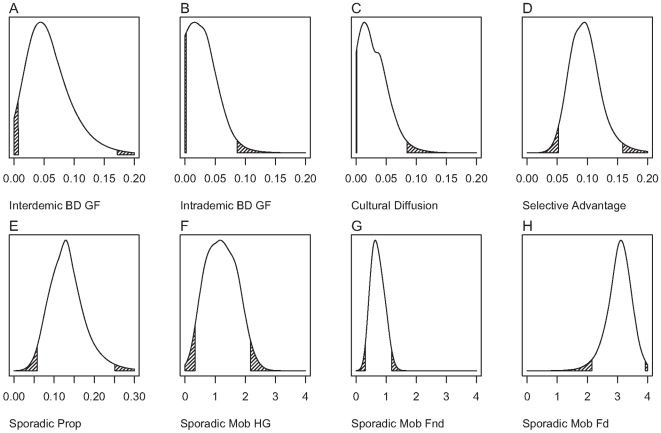
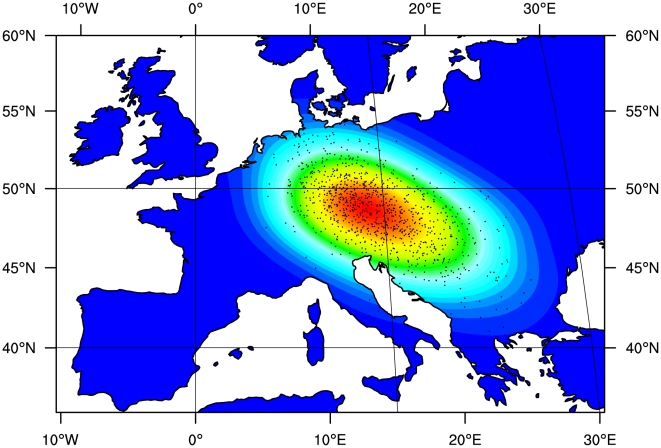
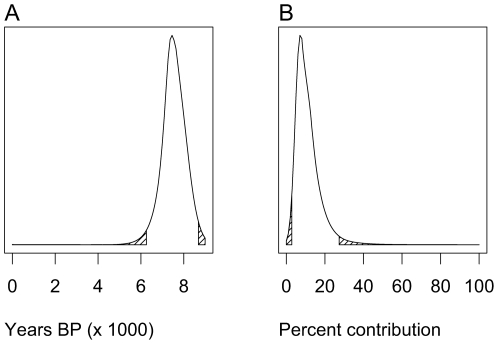
Lactase persistence (LP) is common among people of European ancestry, but with the exception of some African, Middle Eastern and southern Asian groups, is rare or absent elsewhere in the world. Lactase gene haplotype conservation around a polymorphism strongly associated with LP in Europeans (-13,910 C/T) indicates that the derived allele is recent in origin and has been subject to strong positive selection. Furthermore, ancient DNA work has shown that the--13,910*T (derived) allele was very rare or absent in early Neolithic central Europeans. It is unlikely that LP would provide a selective advantage without a supply of fresh milk, and this has lead to a gene-culture coevolutionary model where lactase persistence is only favoured in cultures practicing dairying, and dairying is more favoured in lactase persistent populations. We have developed a flexible demic computer simulation model to explore the spread of lactase persistence, dairying, other subsistence practices and unlinked genetic markers in Europe and western Asia's geographic space. Using data on--13,910*T allele frequency and farming arrival dates across Europe, and approximate Bayesian computation to estimate parameters of interest, we infer that the--13,910*T allele first underwent selection among dairying farmers around 7,500 years ago in a region between the central Balkans and central Europe, possibly in association with the dissemination of the Neolithic Linearbandkeramik culture over Central Europe. Furthermore, our results suggest that natural selection favouring a lactase persistence allele was not higher in northern latitudes through an increased requirement for dietary vitamin D. Our results provide a coherent and spatially explicit picture of the coevolution of lactase persistence and dairying in Europe.
Overview
The claims and statistics of this paper haven’t been checked yet.
Run the check — free, no account needed. It reads the open-access text and checks the sources it cites.
Integrity signals
Registry
Cites
Statistics
Figures
Verification
Claims the paper makes
The claims and statistics of this paper haven’t been checked yet.
Run the check — free, no account needed. It reads the open-access text and checks the sources it cites.
Claims other papers make about this one
Each is checked against this paper’s own text: does it say what the citing paper says it does?
In the citing paper
“although the selective sweep has been modelled as originating between Central Europe and the Balkans ~4–6,000 years BC (ref. 34).”
From Genome flux and stasis in a five millennium transect of European prehistory (2014) · cites this paper as [34]
Self-check
Percentages, sums and reported differences re-computed from the paper’s own numbers.
The self-check needs the paper’s full text.
Citations
Cites
The History and Geography of Human Genes
Cavalli-Sforza, L. L., Menozzi, P., & Piazza, A. (2018) · Princeton University Press eBooks · doi:10.2307/j.ctv301gjp · Cited by 3,175
Approximate Bayesian computation in population genetics
Beaumont, M. A., Zhang, W., & Balding, D. J. (2002) · Genetics · doi:10.1093/genetics/162.4.2025 · Cited by 2,932
Self-citationHistory and Geography of Human Genes
Piazza, A. (1994) · Advances in forensic haemogenetics · doi:10.1007/978-3-642-78782-9_1 · Cited by 1,639
Convergent adaptation of human lactase persistence in Africa and Europe
Tishkoff, S. A., Reed, F. A., Ranciaro, A., Voight, B. F., Babbitt, C. C., Silverman, J. S., Powell, K., Mortensen, H. M., Hirbo, J. B., Osman, M., et al. (2007) · Nature Genetics · doi:10.1038/ng1946 · Cited by 1,615 · cited 1×
“In Africa there are at least four known LP-associated alleles, including three that are likely to be of African origin [2,4] as well as 213,910*T, which is likely to be of European origin [3,12].”
BackgroundA Mathematical Theory of Natural and Artificial Selection, Part V: Selection and Mutation
Haldane, J. B. S. (1927) · Mathematical Proceedings of the Cambridge Philosophical Society · doi:10.1017/s0305004100015644 · Cited by 1,326 · cited 1×
“While we would expect any de novo mutation to always have an initial frequency of 1/2N, we also expect that it will have a high probability of extinction unless selection is very strong [79].”
BackgroundGenetic Signatures of Strong Recent Positive Selection at the Lactase Gene
Bersaglieri, T., Sabeti, P. C., Patterson, N. J., Vanderploeg, T. N., Schaffner, S. F., Drake, J. A., Rhodes, M. E., Reich, D., & Hirschhorn, J. N. (2004) · The American Journal of Human Genetics · doi:10.1086/421051 · Cited by 1,169 · cited 15×
“063 16 [8] 1699 7274 (69) 7112 (76) 43.”
BackgroundResultInfluentialIdentification of a variant associated with adult-type hypolactasia
Enattah, N. S., Sahi, T., Savilahti, E., Terwilliger, J. D., Peltonen, L., & Järvelä, I. E. (2002) · Nature Genetics · doi:10.1038/ng826 · Cited by 1,029 · cited 1×
“91 kb upstream from the lactase gene [5].”
BackgroundEarliest Date for Milk Use in the Near East and Southeastern Europe Linked to Cattle Herding
Evershed, R. P., Payne, S., Sherratt, A. G., Copley, M. S., Coolidge, J., Urem-Kotsu, D., Kotsakis, K., Özdoğan, M., Özdoğan, A. E., Nieuwenhuyse, O., et al. (2008) · Nature · doi:10.1038/nature07180 · Cited by 681 · cited 4×
“Recent carbon isotope ratios from lipids extracted from archaeological sherds show the presence of milk fats in present-day western Turkey and connect these findings to an increased importance of cattle herding [26,45–48].”
BackgroundInfluentialExcoffier, L. (2003) · Molecular Ecology · doi:10.1046/j.1365-294x.2003.02004.x · Cited by 663 · cited 3×
“related studies [33–36] the one we present is stochastic and more parameter-heavy.”
BackgroundMethodThe Fate of Mutations Surfing on the Wave of a Range Expansion
Klopfstein, S., Currat, M., & Excoffier, L. (2006) · Molecular Biology and Evolution · doi:10.1093/molbev/msj057 · Cited by 641 · cited 2×
“However, previous simulations have shown that the geographic centroid of allele can be offset from its location of origin, particularly when it occurs on the wave front of a demographic expansion [29,30].”
BackgroundGenetic Evidence for Near-Eastern Origins of European Cattle
Troy, C. S., MacHugh, D. E., Bailey, J. F., Magee, D. A., Loftus, R. T., Cunningham, P., Chamberlain, A. T., Sykes, B. C., & Bradley, D. G. (2001) · Nature · doi:10.1038/35074088 · Cited by 627 · cited 1×
“For example, including the movement of domestic cattle could be used to generate expectations on patterns of ancient and modern cattle genetic diversity, for which considerable data is available [69–73].”
BackgroundIntra-Deme Molecular Diversity in Spatially Expanding Populations
Ray, N., Currat, M., & Excoffier, L. (2003) · Molecular Biology and Evolution · doi:10.1093/molbev/msg009 · Cited by 605 · cited 3×
“related studies [33–36] the one we present is stochastic and more parameter-heavy.”
BackgroundMethodGenetics of Lactase Persistence and Lactose Intolerance
Swallow, D. M. (2003) · Annual Review of Genetics · doi:10.1146/annurev.genet.37.110801.143820 · Cited by 594
Bellwood, P. S., Gamble, C., LeBlanc, S. A., Pluciennik, M., Richards, M. B., & Terrell, J. E. (2007) · Cambridge Archaeological Journal · doi:10.1017/s0959774307000078 · Cited by 585 · cited 1×
“The ratios of ceiling population size for Fnd ,F d, and HG (as a proportion of the total maximum population size for the deme, Kdeme) are 50:50:1 respectively [ 37 ,39].”
MethodLactose digestion and the evolutionary genetics of lactase persistence
Ingram, C. J. E., Mulcare, C. A., Itan, Y., Thomas, M., & Swallow, D. M. (2008) · Human Genetics · doi:10.1007/s00439-008-0593-6 · Cited by 502
Self-citationPopulation History and Natural Selection Shape Patterns of Genetic Variation in 132 Genes
Akey, J. M., Eberle, M. A., Rieder, M. J., Carlson, C. S., Shriver, M. D., Nickerson, D. A., & Kruglyak, L. (2004) · PLoS Biology · doi:10.1371/journal.pbio.0020286 · Cited by 498 · cited 1×
“This frequently cited mechanism [9,41,42,44,63–65] was not included in our model and thus would seem to have negative explanatory power.”
BackgroundHassan, F. (1981) · Elsevier eBooks · doi:10.1016/b978-0-12-624180-8.50010-x · Cited by 467
Absence of the lactase-persistence-associated allele in early Neolithic Europeans
Bürger, J., Kirchner, M., Bramanti, B., Haak, W., & Thomas, M. (2007) · Proceedings of the National Academy of Sciences · doi:10.1073/pnas.0607187104 · Cited by 455 · cited 2×
“Allelic age estimates are also consistent with the results of a recent ancient DNA study [27] which showed that the 213,910*T allele was rare or absent among early farmers from Central and Eastern Europe.”
BackgroundResultSelf-citationMutations arising in the wave front of an expanding population
Edmonds, C. A., Lillie, A. S., & Cavalli-Sforza, L. L. (2004) · Proceedings of the National Academy of Sciences · doi:10.1073/pnas.0308064100 · Cited by 429 · cited 2×
“However, previous simulations have shown that the geographic centroid of allele can be offset from its location of origin, particularly when it occurs on the wave front of a demographic expansion [29,30].”
BackgroundFirst Farmers: The Origins of Agricultural Societies
Clement, C. R. (2006) · Economic Botany · doi:10.1663/0013-0001(2006)60[395:fftooa]2.0.co;2 · Cited by 414 · cited 1×
“The ratios of ceiling population size for Fnd, Fd, and HG (as a proportion of the total maximum population size for the deme, Kdeme) are 50:50:1 respectively [37,39].”
BackgroundTracing the Origin and Spread of Agriculture in Europe
Pinhasi, R., Fort, J., & Ammerman, A. J. (2005) · PLoS Biology · doi:10.1371/journal.pbio.0030410 · Cited by 409 · cited 6×
“[31] within 853 km of each sampling location, weighted using the distance from the sampling location and the standard probability density function for a Gaussian distribution of s.”
BackgroundMethodInfluentialDirect chemical evidence for widespread dairying in prehistoric Britain
Copley, M. S., Berstan, R., Dudd, S. N., Docherty, G., Mukherjee, A. J., Straker, V., Payne, S., & Evershed, R. P. (2003) · Proceedings of the National Academy of Sciences · doi:10.1073/pnas.0335955100 · Cited by 387 · cited 1×
“Furthermore, residual analyses of fats indicate dairying at the onset of the Neolithic in England, some 6,100 years BP [24,25], and after to 8,500 BP in the western parts of present day Turkey [26].”
BackgroundEnattah, N. S., Jensen, T. G. K., Nielsen, M., Lewinsky, R., Kuokkanen, M., Rasinperä, H., El‐Shanti, H., Seo, J. K., Alifrangis, M., Khalil, I. F., et al. (2008) · The American Journal of Human Genetics · doi:10.1016/j.ajhg.2007.09.012 · Cited by 339 · cited 1×
“cannot account for LP frequencies in most African [3] and Middle Eastern populations [10].”
BackgroundGene-culture coevolution between cattle milk protein genes and human lactase genes
Beja‐Pereira, A., Luikart, G., England, P. R., Bradley, D. G., Jann, O., Bertorelle, G., Chamberlain, A. T., Nunes, T. P., Metodiev, S., Ferrand, N., et al. (2003) · Nature Genetics · doi:10.1038/ng1263 · Cited by 338 · cited 1×
“It is possible that selection favouring LP has in fact been episodic and possibly spatially structured in different climate zones [20,40–44].”
BackgroundThe geographic hypothesis and lactose malabsorption
Simoons, F. J. (1978) · Digestive Diseases and Sciences · doi:10.1007/bf01263095 · Cited by 308 · cited 2×
“This frequently cited mechanism [9,41,42,44,63–65] was not included in our model and thus would seem to have negative explanatory power.”
BackgroundSimoons, F. J. (1970) · Digestive Diseases and Sciences · doi:10.1007/bf02235991 · Cited by 303 · cited 4×
“only favoured in cultures practicing dairying [13–16], and dairying”
BackgroundResultInfluentialMitochondrial Genomes of Extinct Aurochs Survive in Domestic Cattle
Achilli, A., Olivieri, A., Pellecchia, M., Uboldi, C., Colli, L., Al-Zahery, N., Accetturo, M., Pala, M., Kashani, B. H., Perego, U. A., et al. (2008) · Current Biology · doi:10.1016/j.cub.2008.01.019 · Cited by 290 · cited 1×
“For example, including the movement of domestic cattle could be used to generate expectations on patterns of ancient and modern cattle genetic diversity, for which considerable data is available [69–73].”
BackgroundIngram, C. J. E., Elamin, M. F., Mulcare, C. A., Weale, M. E., Tarekegn, A., Oljira, T., Bekele, E., Elamin, F. M., Thomas, M., Bradman, N. N., et al. (2006) · Human Genetics · doi:10.1007/s00439-006-0291-1 · Cited by 283 · cited 1×
“In Africa there are at least four known LP-associated alleles, including three that are likely to be of African origin [2,4] as well as 213,910*T, which is likely to be of European origin [3,12].”
BackgroundSelf-citationEdwards, C. J., Bollongino, R., Scheu, A., Chamberlain, A., Tresset, A., Vigne, J.-D., Baird, J. F., Larson, G., Ho, S. Y. W., Heupink, T. H., et al. (2007) · Proceedings of the Royal Society B: Biological Sciences · doi:10.1098/rspb.2007.0020 · Cited by 266 · cited 1×
“For example, including the movement of domestic cattle could be used to generate expectations on patterns of ancient and modern cattle genetic diversity, for which considerable data is available [69–73].”
BackgroundSelf-citationLactase Deficiency: An Example of Dietary Evolution
McCracken, R. D. (1971) · Current Anthropology · doi:10.1086/201234 · Cited by 228 · cited 3×
“These observations lend support to the view that 213,910*T, and thus LP, rose rapidly in frequency only after the onset of dairying, as opposed to the ‘reverse-cause’ hypothesis [14,17–19], whereby dairying developed in response to the evolution of LP.”
BackgroundResultVigne, J., & Helmer, D. (2007) · Cited by 218
The Multifaceted Origin of Taurine Cattle Reflected by the Mitochondrial Genome
Achilli, A., Bonfiglio, S., Olivieri, A., Malusà, A., Pala, M., Kashani, B. H., Perego, U. A., Ajmone-Marsan, P., Liotta, L., Semino, O., et al. (2009) · PLoS ONE · doi:10.1371/journal.pone.0005753 · Cited by 212 · cited 1×
“For example, including the movement of domestic cattle could be used to generate expectations on patterns of ancient and modern cattle genetic diversity, for which considerable data is available [69–73].”
BackgroundThe effect of the Neolithic expansion on European molecular diversity
Currat, M., & Excoffier, L. (2005) · Proceedings of the Royal Society B: Biological Sciences · doi:10.1098/rspb.2004.2999 · Cited by 210 · cited 3×
“related studies [33–36] the one we present is stochastic and more parameter-heavy.”
BackgroundMethodKretchmer, N. (1972) · Scientific American · doi:10.1038/scientificamerican1072-70 · Cited by 201 · cited 1×
“only favoured in cultures practicing dairying [13–16], and dairying”
BackgroundArchaeobotanical Evidence for the Spread of Farming in the Eastern Mediterranean
Colledge, S., Conolly, J., & Shennan, S. J. (2004) · Current Anthropology · doi:10.1086/422086 · Cited by 200 · cited 2×
“A maximum total population size is specified for each land deme taking into account its area, and assuming that lower elevation and mild Mediterranean climate results in a greater potential population size, while harsher conditions, such as high elevations and cold/desert climates, result in a smaller potential popula…”
BackgroundMethodTremblay, M., & Vézina, H. (2000) · The American Journal of Human Genetics · doi:10.1086/302770 · Cited by 195 · cited 3×
“All simulations were run for 360 generations which, assuming a generation time of 25 years [81,82], corresponds to the 9,000-year”
BackgroundMethodBalasse, M., & Tresset, A. (2002) · Journal of Archaeological Science · doi:10.1006/jasc.2001.0725 · Cited by 191 · cited 1×
“Thereby, cattle herding is in most cases connected with kill-of profiles indicative for dairying [22,50–55].”
BackgroundLactase haplotype diversity in the Old World.
Hollox, E., Poulter, M., Zvarík, M., Ferák, V., Krause, A., Jenkins, T., Saha, N., Kozlov, A., & Swallow, D. (2001) · American Journal of Human Genetics · doi:10.1086/316924 · Cited by 188 · cited 1×
“This frequently cited mechanism [9,41,42,44,63–65] was not included in our model and thus would seem to have negative explanatory power.”
BackgroundDid the first farmers of central and eastern Europe produce dairy foods?
Craig, O. E., Chapman, J., Heron, C., Willis, L. H., Bartosiewicz, L., Taylor, G., Whittle, A., & Collins, M. (2005) · Antiquity · doi:10.1017/s0003598x00115017 · Cited by 188 · cited 1×
“Slaughtering age profiles in sheep, goats and cattle suggest dairying was present in south-eastern Europe at the onset of the Neolithic [21,22], while residual milk proteins preserved in ceramic vessels provide evidence for dairying in present day Romania and Hungary 7,900–7,450 years BP [23].”
BackgroundLetter: Possible toxic water factor in coronary heart-disease.
Sharrett, A. R., & Feinleib, M. (1975) · PubMed · Cited by 186
Lewinsky, R., Jensen, T. G. K., Møller, J., Stensballe, A., Olsen, J., & Troelsen, J. T. (2005) · Human Molecular Genetics · doi:10.1093/hmg/ddi418 · Cited by 176 · cited 1×
“Furthermore, in vitro studies have indicated that the 213,910*T allele can directly affect LCT gene promoter activity [6].”
BackgroundMulcare, C., Weale, M., Jones, A. L., Connell, B., Zeitlyn, D., Tarekegn, A., Swallow, D., Bradman, N., & Thomas, M. G. (2004) · American Journal of Human Genetics · doi:10.1086/421050 · Cited by 165 · cited 7×
“However, genotype/phenotype frequency comparisons have shown that the 213,910*T allele cannot account for LP frequencies in most African [3] and Middle Eastern populations [10].”
BackgroundInfluentialSelf-citationEvidence of Still-Ongoing Convergence Evolution of the Lactase Persistence T-13910 Alleles in Humans
Enattah, N. S., Trudeau, A., Pimenoff, V. N., Maiuri, L., Auricchio, S., Greco, L., Rossi, M., Lentze, M. J., Seo, J., Rahgozar, S., et al. (2007) · The American Journal of Human Genetics · doi:10.1086/520705 · Cited by 160
Early history of European domestic cattle as revealed by ancient DNA
Bollongino, R., Edwards, C. J., Alt, K. W., Bürger, J., & Bradley, D. G. (2005) · Biology Letters · doi:10.1098/rsbl.2005.0404 · Cited by 143 · cited 1×
“For example, including the movement of domestic cattle could be used to generate expectations on patterns of ancient and modern cattle genetic diversity, for which considerable data is available [69–73].”
BackgroundDairying in antiquity. III. Evidence from absorbed lipid residues dating to the British Neolithic
Copley, M. S., Berstan, R., Mukherjee, A. J., Dudd, S. N., Straker, V., Payne, S., & Evershed, R. P. (2005) · Journal of Archaeological Science · doi:10.1016/j.jas.2004.08.006 · Cited by 143 · cited 1×
“Furthermore, residual analyses of fats indicate dairying at the onset of the Neolithic in England, some 6,100 years BP [24,25], and after to 8,500 BP in the western parts of present day Turkey [26].”
BackgroundLACTOSE NUTRITION AND NATURAL SELECTION
Flatz, G., & Rotthauwe, H.-W. (1973) · The Lancet · doi:10.1016/s0140-6736(73)93267-4 · Cited by 141 · cited 4×
“Flatz and Rotthauwe [20] proposed the calcium assimilation hypothesis, whereby”
BackgroundInfluentialFirst farmers the origins of agricultural societies
Bellwood, P. S. 1. (2005) · Cited by 133
Evidence for an apartheid-like social structure in early Anglo-Saxon England
Thomas, M., Stumpf, M. P. H., & Härke, H. (2006) · Proceedings of the Royal Society B Biological Sciences · doi:10.1098/rspb.2006.3627 · Cited by 128 · cited 3×
“All simulations were run for 360 generations which, assuming a generation time of 25 years [81,82], corresponds to the 9,000-year”
BackgroundMethodSelf-citationAoki, K. (1986) · Proceedings of the National Academy of Sciences · doi:10.1073/pnas.83.9.2929 · Cited by 121 · cited 1×
“only favoured in cultures practicing dairying [13–16], and dairying”
BackgroundMicrosatellite variation and evolution of human lactase persistence
Coelho, M., Luiselli, D., Bertorelle, G., Lopes, A. I., Seixas, S., Destro‐Bisol, G., & Rocha, J. (2005) · Human Genetics · doi:10.1007/s00439-005-1322-z · Cited by 119 · cited 2×
“closely linked microsatellites [12] as proxies for allelic age, the 213,910*T variant has been estimated to be between 2,188 and”
BackgroundNeer, W. V., & Ervynck, A. (1995) · Cited by 114
Radiocarbon dating and the expansion of farming culture from the Near East over Europe
Clark, J. G. D. (1965) · Proceedings of the Prehistoric Society · doi:10.1017/s0079497x00014717 · Cited by 111
Ewens, W. J. (1968) · Springer eBooks · doi:10.1007/978-94-010-3355-8_2 · Cited by 106
Indo‐European origins: A computer‐simulation test of five hypotheses
Barbujani, G., Sokal, R. R., & Oden, N. L. (1995) · American Journal of Physical Anthropology · doi:10.1002/ajpa.1330960202 · Cited by 104 · cited 1×
“Our simulation approach is motivated by a previous demic computer simulation study [33] and has features in common with more recent applications of this approach [34–36].”
MethodBenecke, N. (1994) · De Gruyter eBooks · doi:10.1515/9783050069456 · Cited by 95 · cited 1×
“However, a fully developed dairying-based farming economy emerges first during the late Neolithic in Southeast Europe and the Middle Neolithic Cultures following the Linearbandkeramik (LBK) in Central Europe, and is connected mainly to cattle and partly also to goat (for the Rössen culture see [50,55]).”
BackgroundLactose Intolerance and Milk Drinking Habits
Bayless, T. M., Paige, D. M., & Ferry, G. D. (1971) · Gastroenterology · doi:10.1016/s0016-5085(71)80066-5 · Cited by 85 · cited 3×
“These observations lend support to the view that 213,910*T, and thus LP, rose rapidly in frequency only after the onset of dairying, as opposed to the ‘reverse-cause’ hypothesis [14,17–19], whereby dairying developed in response to the evolution of LP.”
BackgroundResultHunters and Farmers: Then and Now
Spielmann, K. A., & Eder, J. F. (1994) · Annual Review of Anthropology · doi:10.1146/annurev.an.23.100194.001511 · Cited by 84 · cited 1×
“as an unknown but bounded parameter, and choose random values ranging from 0 to 0.2 in simulations”
BackgroundInfluentialWeale, M. E., Yepiskoposyan, L., Jager, R. F., Hovhannisyan, N., Khudoyan, A., Burbage-Hall, O., Bradman, N. N., & Thomas, M. (2001) · Human Genetics · doi:10.1007/s00439-001-0627-9 · Cited by 68 · cited 1×
“Mcurr is determined for each deme by its elevation, allowing greater mobility at lower elevations [76,77], with fixed values of 0.”
BackgroundSelf-citationDairying barriers affect the distribution of lactose malabsorption
Bloom, G., & Sherman, P. W. (2005) · Evolution and Human Behavior · doi:10.1016/j.evolhumbehav.2004.10.002 · Cited by 66 · cited 1×
“It is possible that selection favouring LP has in fact been episodic and possibly spatially structured in different climate zones [20,40–44].”
BackgroundTransitions Between Cultivation and Pastoralism in Sub-Saharan Africa [and Comments and Reply]
Mace, R. H., Anderson, D. M., Bierschenk, T., Cronk, L., Köhler‐Rollefson, I., Lancaster, W., Lancaster, F., Little, P. D., Morris, E. A., & Rossignol, J. (1993) · Current Anthropology · doi:10.1086/204183 · Cited by 56 · cited 1×
“We treat Pc as an unknown but bounded parameter, and choose random values ranging from 0 to 0.2 in simulations [74, 75 ].”
MethodInfluentialSimpson, G. G., & Dobzhansky, T. (1952) · Evolution · doi:10.2307/2405629 · Cited by 54
Bıçakçı, E., Altınbilek-Algül, Ç., Balcı, S., & Godon, M. (2007) · Cited by 48
Bánffy, E. (2004) · REAL-EOD (Library of the Hungarian Academy of Sciences and the Information Center Oriental Collection) · Cited by 41
Prummel, W. (1997) · University of Groningen research database (University of Groningen / Centre for Information Technology) · Cited by 39
Whittle, A. (2007) · Cited by 29
The logic of the herd: A computer simulation of archaeological herd structure
Cribb, R. (1987) · Journal of Anthropological Archaeology · doi:10.1016/0278-4165(87)90006-7 · Cited by 29 · cited 1×
“Milk consumption and dairying have been proposed to be as early as the Pre-Pottery Neolithic B of the Near East and may even be a reason for domestication [56,57].”
BackgroundGenetic relationship of human populations and ethnic differences in reaction to drugs and food.
Nei, M., & Saitou, N. (1986) · PubMed · Cited by 26
Thomas, M., Barnes, I., Weale, M. E., Jones, A., Forster, P., Bradman, N. N., & Pramstaller, P. P. (2007) · European Journal of Human Genetics · doi:10.1038/sj.ejhg.5201906 · Cited by 20 · cited 1×
“Mcurr is determined for each deme by its elevation, allowing greater mobility at lower elevations [76,77], with fixed values of 0.”
BackgroundSelf-citationOrigins and Implications of the Distribution of Adult Lactase Deficiency in Human Populations
McCracken, R. (1971) · Journal of Tropical Pediatrics · doi:10.1093/tropej/17.1.7 · Cited by 15 · cited 1×
“only favoured in cultures practicing dairying [13–16], and dairying”
BackgroundThe evolution of the lactase persistence phenotype
Mulcare, C. A. (2006) · OpenGrey (Institut de l'Information Scientifique et Technique) · Cited by 15
Weiss, K. M. (2004) · The Lancet · doi:10.1016/s0140-6736(04)16195-3 · Cited by 14 · cited 1×
“This frequently cited mechanism [9,41,42,44,63–65] was not included in our model and thus would seem to have negative explanatory power.”
BackgroundSimoons, F. J. (2001) · Ecology of Food and Nutrition · doi:10.1080/03670244.2001.9991661 · Cited by 12
Zur Frühentwicklung der Haustiere
Röhrs, M., & Herre, W. (1961) · Journal of Animal Breeding and Genetics · doi:10.1111/j.1439-0388.1961.tb01300.x · Cited by 11
Effects of culture: geographical and historical approaches.
Simoons, F. J. (1980) · PubMed · Cited by 2
Research works printed but not linked: 2
- CJ Ingram, 2008, Population and molecular genetics of lactase persistence., Journal of Human Genetics In Press
- JD Vigne, 2007, Was milk a “secondary product” in the Old World Neolithisation process? Its role in the domestication of cattle, sheep and goats., Anthropozoologica, 42, 9
Cited by
Sorted by citations
Sequencing of 50 Human Exomes Reveals Adaptation to High Altitude
Yi, X., Liang, Y., Huerta-Sanchez, E., Jin, X., Cuo, Z. X. P., Pool, J. E., Xu, X., Jiang, H., Vinckenbosch, N., Korneliussen, T. S., et al. (2010) · Science · doi:10.1126/science.1190371 · Cited by 1,611
Population genomics of Bronze Age Eurasia
Allentoft, M. E., Sikora, M., Sjögren, K.-G., Rasmussen, S., Rasmussen, M., Stenderup, J., Damgaard, P. B., Schroeder, H., Ahlström, T., Vinner, L., et al. (2015) · Nature · doi:10.1038/nature14507 · Cited by 1,550
Approximate Bayesian Computation (ABC) in practice
Csilléry, K., Blum, M. G. B., Gaggiotti, O. E., & François, O. (2010) · Trends in Ecology & Evolution · doi:10.1016/j.tree.2010.04.001 · Cited by 1,302
Ancient human genomes suggest three ancestral populations for present-day Europeans
Lazaridis, I., Patterson, N., Mittnik, A., Renaud, G., Mallick, S., Kirsanow, K., Sudmant, P. H., Schraiber, J. G., Castellano, S., Lipson, M., et al. (2014) · Nature · doi:10.1038/nature13673 · Cited by 1,357
Self-citationApproximate Bayesian Computation in Evolution and Ecology
Beaumont, M. (2010) · Annual Review of Ecology Evolution and Systematics · doi:10.1146/annurev-ecolsys-102209-144621 · Cited by 1,117
“ABC has also been used to model parameters relating to selection on lactase persistence in a spatially explicit modelling framework (Itan et al., 2009; Gerbault et al., 2009).”
MethodSelf-citation
Metadata
- Authors
- Itan, Y., Powell, A., Beaumont, M. A., Burger, J., & Thomas, M. G.
- Affiliations
- University College London (GB)
- University of Reading (GB)
- Corresponding author
- Thomas, Mark G.
- Venue
- PLoS Computational Biology
- Publisher
- Public Library of Science (PLoS)
- Published
- 2009-08-28
- Volume
- 5
- Issue
- 8
- Pages
- e1000491
- ISSN
- 1553-734X (ISSN-L)
- 1553-7358
- PMC
- PMC2722739
- OpenAlex
- W2151227169
- Cited by
- 569
- References
- 79
- Citations by year
- 2026: 16 · 2025: 52 · 2024: 18 · 2023: 17 · 2022: 20 · 2021: 31 · 2020: 39 · 2019: 43 · 2018: 26 · 2017: 44 · 2016: 29 · 2015: 46 · 2014: 46 · 2013: 39 · 2012: 41
- FWCI
- 19.89
- Type
- journal article
- Language
- en
- Open access
- gold
- doi.org
- Locations
- PLoS Computational Biology (publishedVersion, cc-by)
- PubMed Central (publishedVersion, cc-by)
- PubMed (publishedVersion)
- RePEc: Research Papers in Economics (submittedVersion)
- DOAJ (DOAJ: Directory of Open Access Journals) (submittedVersion, cc-by-sa)
- UCL Discovery (University College London) (submittedVersion)
- Figshare (submittedVersion, cc-by)
- MPG.PuRe (Max Planck Society) (submittedVersion, other-oa)
- Explore Bristol Research (submittedVersion)
- Bristol Research (University of Bristol) (submittedVersion, cc-by)
- Funders
- Arts and Humanities Research Council
- Topics
- Health Sciences › Medicine › Gastroenterology › Digestive system and related health
- Life Sciences › Biochemistry, Genetics and Molecular Biology › Genetics › Genetic and phenotypic traits in livestock
- Life Sciences › Biochemistry, Genetics and Molecular Biology › Genetics › Forensic and Genetic Research
- Keywords
- lactase persistence, lactase gene, dairy production, gene-culture coevolution, positive selection, Neolithic, demic diffusion, approximate Bayesian computation, vitamin D, European ancestry, ancient DNA, subsistence strategies, West Asia
- MeSH terms
- Alleles, Bayes Theorem, Computer Simulation, Diet, Europe, Gene Frequency, Genetic Markers, Geography, Haplotypes, Humans, Lactose, Polymorphism, Genetic, Vitamin D, Evolution, Molecular, Computational Biology, Lactase
About these checks
Registry, retraction, Cites and statistics results are computed, not judged, with one exception: a printed reference that no index lists is read once by a model before it counts as a citation error. Claims are extracted by a model and kept only when their quote appears verbatim in the text; each cited source is then checked, with a model’s help, for whether it says what the claim relies on. Those verdicts can be wrong — read the claim’s quote and the cited source before relying on one.
Statistics and arithmetic are recomputed, not judged.
Confidence bands are shown only for fields calibrated on our annotated test set. None is calibrated yet, so no band is shown.
What counts as a claim ›How we measure confidence ›How we check this ›
Are you an author, or do you see a problem with this page? Request a review
