

Parameter Estimation and Model Selection in Computational Biology
Open accessThe DOI matches its Crossref record; 45 of the 48 references it cites were found in a registry or an index; 1 of the 13 sources its claims cite were checked for support.
Abstract
A central challenge in computational modeling of biological systems is the determination of the model parameters. Typically, only a fraction of the parameters (such as kinetic rate constants) are experimentally measured, while the rest are often fitted. The fitting process is usually based on experimental time course measurements of observables, which are used to assign parameter values that minimize some measure of the error between these measurements and the corresponding model prediction. The measurements, which can come from immunoblotting assays, fluorescent markers, etc., tend to be very noisy and taken at a limited number of time points. In this work we present a new approach to the problem of parameter selection of biological models. We show how one can use a dynamic recursive estimator, known as extended Kalman filter, to arrive at estimates of the model parameters. The proposed method follows. First, we use a variation of the Kalman filter that is particularly well suited to biological applications to obtain a first guess for the unknown parameters. Secondly, we employ an a posteriori identifiability test to check the reliability of the estimates. Finally, we solve an optimization problem to refine the first guess in case it should not be accurate enough. The final estimates are guaranteed to be statistically consistent with the measurements. Furthermore, we show how the same tools can be used to discriminate among alternate models of the same biological process. We demonstrate these ideas by applying our methods to two examples, namely a model of the heat shock response in E. coli, and a model of a synthetic gene regulation system. The methods presented are quite general and may be applied to a wide class of biological systems where noisy measurements are used for parameter estimation or model selection.
Overview
CoChat Summary
TL;DR
The paper proposes a three-stage method for parameter estimation and model selection in biological ODE models: constrained hybrid extended Kalman filtering, an a posteriori variance/identifiability test, and moment-matching refinement. It demonstrates the approach on an E. coli heat shock model and a generalized repressilator model, where moment matching passed the statistical test while least-squares and genetic-algorithm fits failed.
Key findings
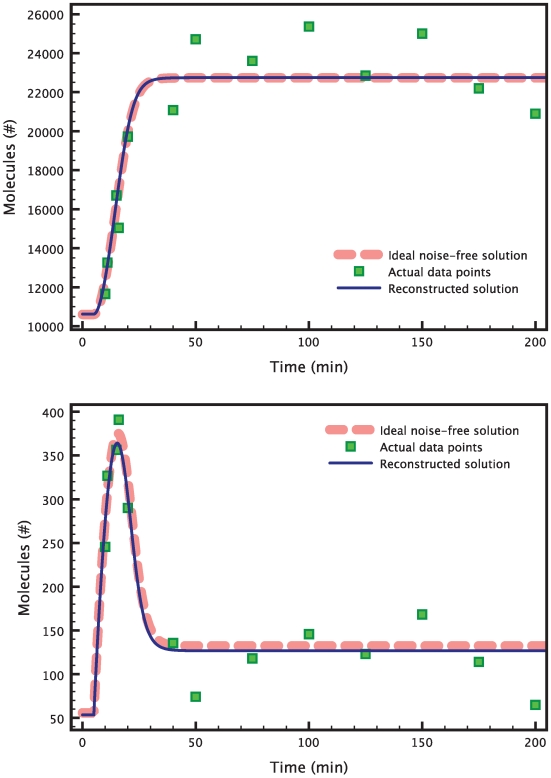
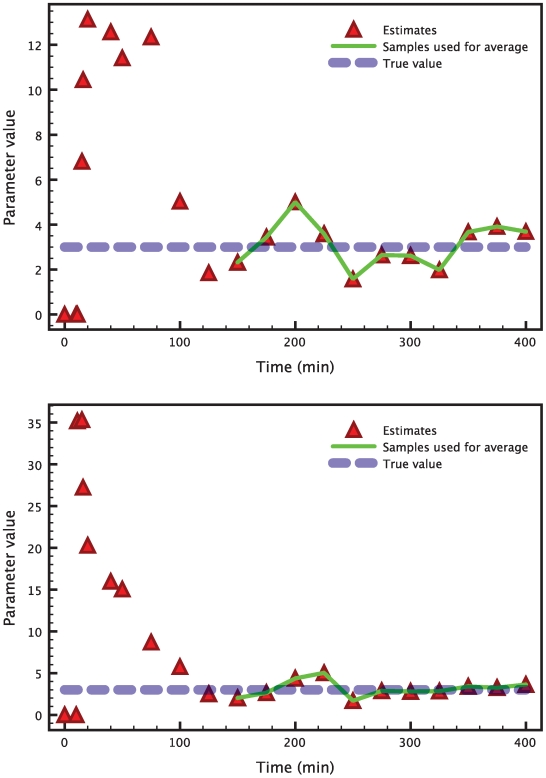
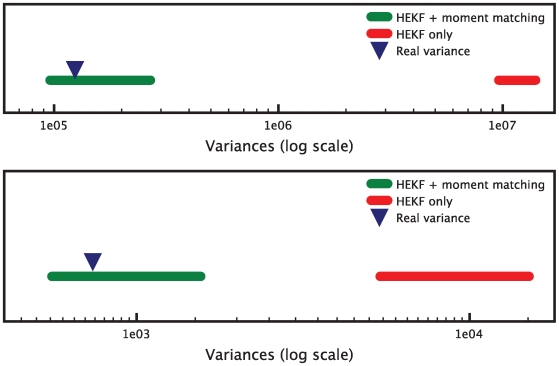
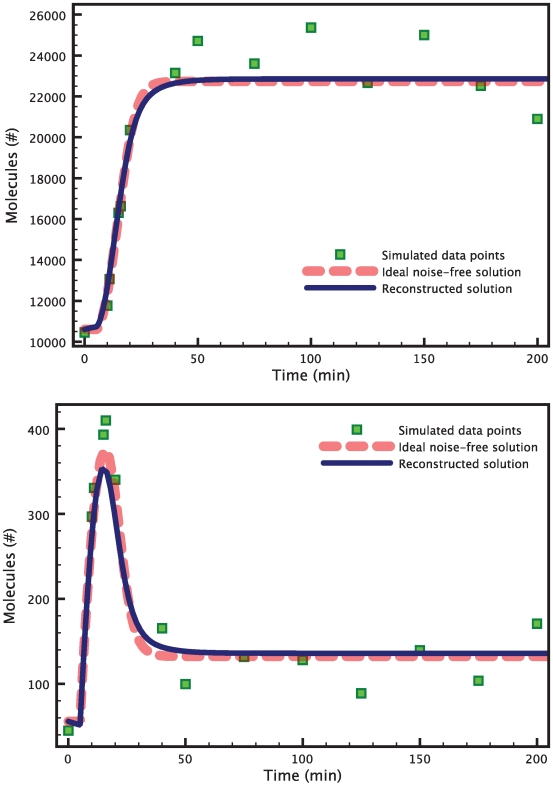
- In the small-parameter heat shock case, the HEKF estimated two parameters whose true value was 3 for both; the text reports the estimation as very accurate despite high noise, and the a posteriori identifiability test at confidence coefficient 0.95 passed for both measurement-noise components.
- For the 6-parameter heat shock case, a single HEKF run failed the identifiability test; moment-matching refinement with BFGS found a minimum after 1560 iterations with cost 0.14 in about 3 hours on a MacBook Pro with a single 2.6 GHz processor, and the refined estimates passed the test.
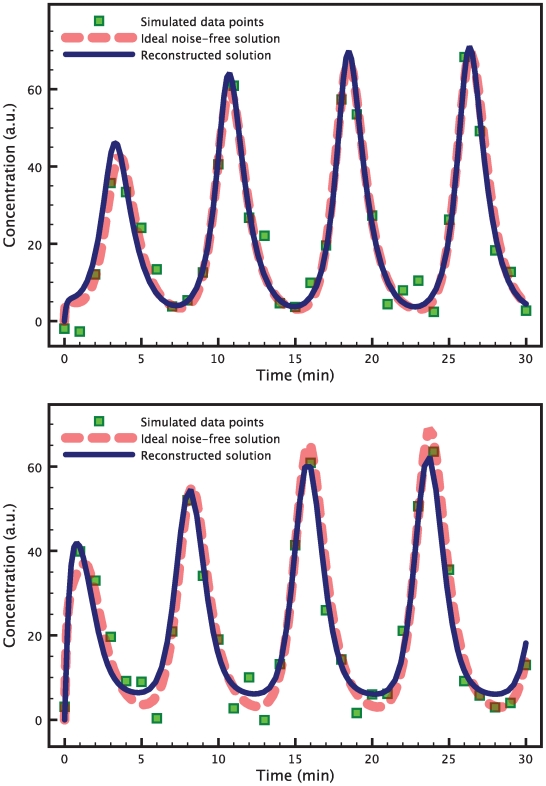
- For the 18-parameter repressilator model, a single HEKF run failed the test; moment-matching refinement with BFGS took 720 iterations (about 26 minutes) and passed all three components, whereas Levenberg-Marquardt least-squares (129 iterations, about 3 minutes) and a genetic algorithm (101 iterations, about 4 minutes) failed.
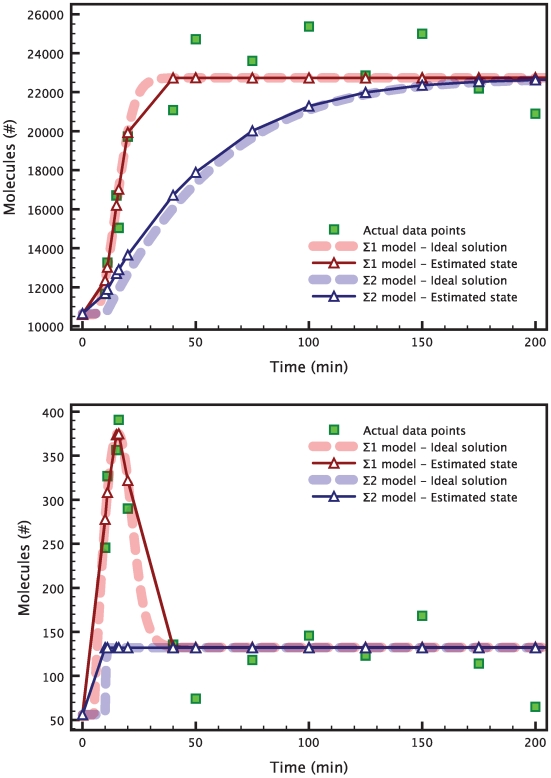
- For model selection in the heat shock example, only model \(M_1\) produced variance interval estimates containing the real measurement-noise variances; model \(M_2\), which lacks the spike in the sigma factor, was rejected as inconsistent with the measurements.
Methods
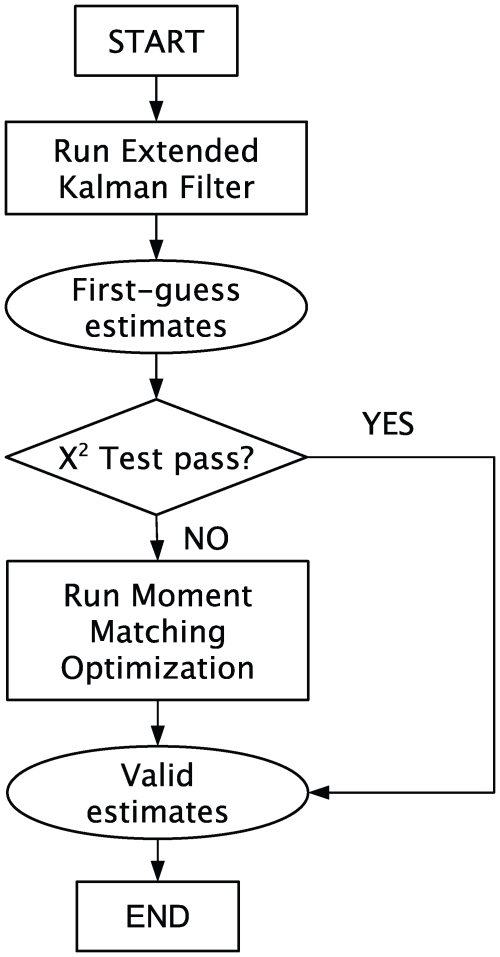
- The model is written as a continuous-time ODE state-space system; parameters are treated as constant states via state extension, and a constrained hybrid extended Kalman filter (HEKF) handles continuous-time dynamics with discrete-time measurements and equality/inequality constraints solved as quadratic programming.
- An a posteriori identifiability test estimates measurement-noise variances from residuals, forms point and interval estimates using the chi-square distribution, and rejects estimates whose intervals do not contain the known real noise variances; if the test fails, a moment-matching optimization minimizes mean and variance mismatch, typically with BFGS.
- Model selection runs the HEKF on candidate models, computes measurement-noise variance estimates for each, discards models whose interval estimates exclude the real variances, and selects the model whose variances match best; examples use simulated noisy data from an E. coli heat shock model (2 and 6 parameters; 22 data points in the small case) and a generalized repressilator model (18 parameters; 30 equally spaced mRNA data points).
Limitations
- The paper states that the extended Kalman filter is not generally optimal for nonlinear systems, may diverge or give biased estimates, can suffer from loss of observability/non-uniqueness after state extension, and is subject to numerical ill-conditioning in covariance propagation; initial estimates too far off can also cause problems.
- The paper states that the process-noise covariance is chosen by the user, the measurement-noise statistics are assumed known, the moment-matching weights are user-selected, and the refinement optimization can be computationally expensive (e.g., about 3 hours for the 6-parameter heat shock case).
- Evident from the text: the demonstrations use in silico simulated measurements rather than real experimental data, and many numerical entries in the tables and some reported percentages are missing from the provided text, limiting independent verification of the exact estimates.
Model-written summary. Check it against the paper before relying on it.
Integrity signals
Registry
Cites
Statistics
Figures
Verification
Claims the paper makes
1 Valid · 1 Not valid · 11 Not checked · 41 Own results and interpretations
Every source the paper cites for this claim was checked and supports it.
In the paper
“These and similar results indicate that the search for the exact individual values of the parameters is a hopeless task in most cases [6].”
§ Parameter Estimation and Model Selection in Computational Biology > Introduction
What the sources say
- Supportedcites [6] M Ashyraliyev, 2008, Parameter estimation and determinability analysis applied to Drosophila gap gene circuits., BMC Systems Biology source
The Background (page unavailable) says that determining all parameters accurately is usually not possible in practice. The Results and Discussion, under Parameter Determinability (page unavailable), further report that no parameter in the analyzed model could be determined individually to the chosen accuracy. Together, these support the citing sentence’s general point without implying that every parameter is indeterminable. (LLM, conf=0.90)
hedged- Asserted: passes — The authors put it forward as true.
- Checkable: passes — It can be checked against evidence.
- Load-bearing: passes — The paper’s conclusions depend on it.
- Based: passes — The paper gives a reason why it holds.
- Supported
A result the paper reports from its own data — it cites no other source for it, so there is none to check. The quote shows it is in the paper.
In the paper
“As in the large parameter space case for the heat shock model, a single run of the HEKF produces estimates that do not satisfy the identifiability test.”
§ Parameter Estimation and Model Selection in Computational Biology > Results > The repressilator
plainstates a causeSingle case- Asserted: passes — The authors put it forward as true.
- Checkable: passes — It can be checked against evidence.
- Load-bearing: passes — The paper’s conclusions depend on it.
- Based: passes — The paper gives a reason why it holds.
A result the paper reports from its own data — it cites no other source for it, so there is none to check. The quote shows it is in the paper.
In the paper
“It is clear that only produces results that are compatible with the measurements.”
§ Parameter Estimation and Model Selection in Computational Biology > Results > A model of the heat shock response in E. coli
boosted- Asserted: passes — The authors put it forward as true.
- Checkable: passes — It can be checked against evidence.
- Load-bearing: passes — The paper’s conclusions depend on it.
- Based: passes — The paper gives a reason why it holds.
A result the paper reports from its own data — it cites no other source for it, so there is none to check. The quote shows it is in the paper.
In the paper
“After a transient, the estimates keep oscillating around the true values of the parameters.”
§ Parameter Estimation and Model Selection in Computational Biology > Results > A model of the heat shock response in E. coli
plainstates an associationSingle case- Asserted: passes — The authors put it forward as true.
- Checkable: passes — It can be checked against evidence.
- Load-bearing: unclear — It is unclear whether the paper’s conclusions depend on it.
- Based: passes — The paper gives a reason why it holds.
A result the paper reports from its own data — it cites no other source for it, so there is none to check. The quote shows it is in the paper.
In the paper
“In this new example, a single run of the HEKF produces values that do not satisfy the identifiability test.”
§ Parameter Estimation and Model Selection in Computational Biology > Results > A model of the heat shock response in E. coli
plainSingle case- Asserted: passes — The authors put it forward as true.
- Checkable: passes — It can be checked against evidence.
- Load-bearing: passes — The paper’s conclusions depend on it.
- Based: passes — The paper gives a reason why it holds.
25 more claims
Create a free account to see all 54 claims and to verify the 12 references still open.
- Probably not a substantial claim. 10
- It may state two separate claims as one. 14
- The quote only partly states this claim. 3
Claims other papers make about this one
Each is checked against this paper’s own text: does it say what the citing paper says it does?
In the citing paper
“The resulting approach may be used for obtaining more accurate estimates of the parameters as well as for model selection.”
From Reverse engineering and identification in systems biology: strategies, perspectives and challenges (2014) · cites this paper as [143]
In the citing paper
“To address the issues of sparse and noisy data, Lillacci & Khammash [143] propose a combination of an extended Kalman filter (a recursive estimator well known in control engineering) with a posteriori identifiability tests and moment-matching optimization.”
From Reverse engineering and identification in systems biology: strategies, perspectives and challenges (2014) · cites this paper as [143]
Self-check
Percentages, sums and reported differences re-computed from the paper’s own numbers.
Each contradiction between two passages listed here was confirmed by an independent check.
Rated minor: it would not touch a result — a value no result rests on, a p-value that stays on the same side of the significance level, or a conflict that is clerical, resolved elsewhere in the paper, or outside its own findings.
In the paper
§ Parameter Estimation and Model Selection in Computational Biology > Results > A model of the heat shock response in E. coli
“we compute the point and interval estimates of the variances of the two components of the measurement noise according to (13) and (15) respectively.”
§ Parameter Estimation and Model Selection in Computational Biology > Methods > An a posteriori identifiability test
“Then, is in the interval(14)with a probability of .”
Citations
Cites
Optimization by Simulated Annealing
Kirkpatrick, S., Gelatt, C. D., & Vecchi, M. P. (1983) · Science · doi:10.1126/science.220.4598.671 · Cited by 45,134 · cited 1×
“Much research has been conducted on the applications to computational biology models of several optimization techniques, such as linear and nonlinear leastsquares fitting [3], simulated annealing [4], genetic algorithms [5], and evolutionary computation [6,7].”
BackgroundProbability, Random Variables, and Stochastic Processes.
Abrahams, J., & Papoulis, A. (1984) · Journal of the American Statistical Association · doi:10.2307/2288754 · Cited by 16,226
Probability, Random Variables, and Stochastic Processes
Miller, I. (1966) · Technometrics · doi:10.1080/00401706.1966.10490365 · Cited by 8,452
Practical Methods of Optimization
Fletcher, R. (2000) · Wiley eBooks · doi:10.1002/9781118723203 · Cited by 7,605
Optimal State Estimation: Kalman, H∞, and Nonlinear Approaches
Simon, D. (2006) · doi:10.1002/0470045345 · Cited by 4,875
A synthetic oscillatory network of transcriptional regulators
Elowitz, M. B., & Leibler, S. (2000) · Nature · doi:10.1038/35002125 · Cited by 4,630 · cited 1×
“The original model of Elowitz and Leibler [39] consists of six equations with four parameters, where all the three genes have the same production and degradation rates, and are affected in the same way by the corresponding repressor.”
BackgroundAnderson, B. D. O., Moore, J. B., & Eslami, M. (1982) · IEEE Transactions on Systems Man and Cybernetics · Cited by 3,195
(2007) · Springer eBooks · doi:10.1007/978-0-387-71107-2 · Cited by 2,687
Srinivas, M., & Patnaik, L. M. (1994) · Computer · doi:10.1109/2.294849 · Cited by 2,180 · cited 1×
“Much research has been conducted on the applications to computational biology models of several optimization techniques, such as linear and nonlinear leastsquares fitting [3], simulated annealing [4], genetic algorithms [5], and evolutionary computation [6,7].”
BackgroundGill, P. E., Murray, W., & Wright, M. H. (2019) · doi:10.1137/1.9781611975604 · Cited by 1,737
Cited by
Items 201–300 of 325
Bayesian Approach for Parameter Estimation in Vehicle Lateral Dynamics
Lionti, F., Gutowski, N., Aubin, S., & Martinet, P. (2024) · Lecture notes in computer science · doi:10.1007/978-3-031-62700-2_22 · Cited by 3
Hu, H., Cheng, Q., Guo, S., Wen, H., Zhang, J., Song, Y., Wang, K., Huang, D., Zhang, H., Zhang, C., et al. (2025) · Bulletin of Mathematical Biology · doi:10.1007/s11538-025-01439-9 · Cited by 3
“The measurements, which can come from PCR, immunoblotting assays, fluorescent markers, and other sources, tend to be very noisy or may be entirely undetectable due to experimental limitations (Lillacci and Khammash 2010; Taylor et al. 2022; Sule et al. 2023).”
Parameter identification for nonlinear biological phenomena modeled by S-systems
Mansouri, M. M., Avcı, O., Nounou, H. N., & Nounou, M. N. (2015) · International Multi-Conference on Systems, Signals & Devices (SSD) · doi:10.1109/ssd.2015.7348187 · Cited by 3
“[10] proposed a parameter estimation technique for biochemical models; while Lillacci and Khammash in [11] presented a new approach for parameter estimation problem of biological models using Extended Kalman Filter (EKF) on two models (a model of the heat shock response in E.”
MethodParameter Estimation in Systems Biology Models by Using Extended Kalman Filter
Capinski, M., & Polański, A. (2015) · Advances in intelligent systems and computing · doi:10.1007/978-3-319-23437-3_16 · Cited by 3
A parallel approach for accelerated parameter identification of Gene Regulatory Networks.
Saeed, T., & Ahmad, J. (2014) · IWBBIO · Cited by 3
Application of state-space model with skew-t measurement noise to blood test value prediction
Hasegawa, T., Yamaguchi, R., Kakuta, M., Ando, M., Jung, S., Tokuda, I., Murashita, K., & Imoto, S. (2021) · Applied Mathematical Modelling · doi:10.1016/j.apm.2021.08.007 · Cited by 3
MaxCal can infer models from coupled stochastic trajectories of gene expression and cell division
Torres, A., Cockerell, S., Phillips, M. W., Balázsi, G., & Ghosh, K. (2023) · Biophysical Journal · doi:10.1016/j.bpj.2023.05.017 · Cited by 3
Rigatos, G. G., Rigatou, E. G., & Djida, J. (2015) · Mathematical Biosciences & Engineering · doi:10.3934/mbe.2015.12.1017 · Cited by 3
“Moreover, through the application of nonlinear estimation (identification) methods it has become possible to obtain numerical values for the parameters of the p53 protein - mdm2 inhibitor system [6], [19], [20], [23], [27], [43], [45], [49].”
MethodA Biologically Inspired Computational Model of Time Perception
Lourenço, I., Mattila, R., Ventura, R., & Wahlberg, B. (2021) · IEEE Transactions on Cognitive and Developmental Systems · doi:10.1109/tcds.2021.3120301 · Cited by 3
“Many works have studied the question of how to infer biological parameters from the agent’s behaviour [41], [42], [43], including in reinforcement learning models, but not in a way that allows temporal information to be taken into account.”
BackgroundAn iterative parameter estimation method for biological systems and its parallel implementation
Yang, X., Guo, Y., & Guo, L. (2013) · Concurrency and Computation Practice and Experience · doi:10.1002/cpe.3071 · Cited by 3
“Having noticed the potential weakness of Kalman filters, the estimate refinement method is proposed in [19], which makes the use of the probabilistic information in the measurement noise.”
MethodInfluentialModel selection in stochastic chemical reaction networks using flow cytometry data
Lillacci, G., & Khammash, M. (2011) · IEEE Conference on Decision and Control (CDC) · doi:10.1109/cdc.2011.6161417 · Cited by 3
Self-citationModeling gene regulatory networks using Petri Nets
Bordon, J. (2012) · Cited by 4
Jang, H., Kim, K. K., Braatz, R. D., Gopaluni, R. B., & Lee, J. H. (2016) · Computers & Chemical Engineering · doi:10.1016/j.compchemeng.2016.03.018 · Cited by 3
“, 2009), the Bayesian method (Golightly and Wilkinson, 2011; Lillacci and Khammash, 2010; Boys et al., 2008), the maximum likelihood estimation (MLE) method (Neuert et al.”
MethodForlin, M., Mazza, T., & Prandi, D. (2010) · International Workshop on Parallel and Distributed Methods in Verification and International Workshop on High Performance Computational Systems Biology (PDMC-HiBi) · doi:10.1109/pdmc-hibi.2010.22 · Cited by 3
Parameter estimation of stochastic models based on limited data
Chen, M., Cao, Y., & Watson, L. T. (2018) · ACM SIGBioinformatics Record · doi:10.1145/3183624.3183627 · Cited by 3
“Various approaches have been developed to estimate parameters for stochastic biochemical systems, from Bayesian statistics [12, 14], to control theory [9, 10], and to optimization techniques [2, 12].”
BackgroundSiam, F. M., & Nasir, M. H. (2018) · MATEMATIKA · doi:10.11113/matematika.v34.n3.1147 · Cited by 3
“2 Data Fitting of the Model The goal of parameter fitting is to determine the parameter value for which model simulation best matches with the experimental data [29, 37].”
BackgroundRapid Bayesian Inference for Expensive Stochastic Models
Warne, D. J., Baker, R. E., & Simpson, M. J. (2021) · QUT ePrints (Queensland University of Technology) · doi:10.6084/m9.figshare.16934424 · Cited by 3
A Kalman Filter Approach for Biomolecular Systems with Noise Covariance Updating
Dey, A., Chakrabarti, K., Gola, K. K., & Sen, S. (2019) · Indian Control Conference · doi:10.1109/icc47138.2019.9123219 · Cited by 6
“coli and in repressilator using sampled data [17].”
Zhang, H., Chen, J., & Tian, T. (2020) · IEEE Transactions on Computational Biology and Bioinformatics · doi:10.1109/tcbb.2020.3039490 · Cited by 3
“The inference of unknown parameters in mathematical models is one of the major challenges in systems biology [9].”
BackgroundLiu, X., & Niranjan, M. (2017) · arXiv (Cornell University) · doi:10.48550/arxiv.1704.09021 · Cited by 3
“With time varying or dynamical systems, some authors have pointed out advantages of sequential estimation models, formulating the problem as state and parameter estimation in a state-space modeling framework (Quach et al., 2007; Sun et al., 2008; Lillacci and Khammash, 2010).”
BackgroundHorvath, B. N., Kratsios, A., Limmer, Y., & Yang, X. (2023) · SSRN Electronic Journal · doi:10.2139/ssrn.4615215 · Cited by 3
Marquez, G., Jafari, M., Kesapragada, M., Zhu, K., Baniya, P., Sun, Y., Hsieh, H., Hernandez, C. O., Teodorescu, M., Rolandi, M., et al. (2025) · Bioengineering · doi:10.3390/bioengineering12070678 · Cited by 2
Calcium dynamics in small spaces: Lessons learned from modeling in dendritic spines
McCabe, K. J., Mesa, M. H., & Rangamani, P. (2025) · Biophysical Journal · doi:10.1016/j.bpj.2025.09.038 · Cited by 2
“Several mathematical approaches have been proposed for quantifying the amount of uncertainty and estimate parameters considering the lack of biological experiments (42,92,93).”
Construction of a parsimonious kinetic model to capture microbial dynamics via parameter estimation
Feng, X., Tang, Y., & Dolan, K. D. (2013) · Inverse Problems in Science and Engineering · doi:10.1080/17415977.2013.782542 · Cited by 2
“[3] In this study, we applied parameter estimation techniques [4,5] in reconstructing the Monod model to decipher growth kinetics of Shewanella oneidensis MR-1.”
MethodAn approach to the conditional robustness problem for biochemical networks
Bianconi, F., Baldelli, E., & Valigi, P. (2014) · Proceedings of the ... American Control Conference/Proceedings of the American Control Conference · doi:10.1109/acc.2014.6859085 · Cited by 3
“Parameter identification and model selection is also a relevant issue (see [19], [20] and the references therein), and the related problem, studied in [21], of core prediction.”
BackgroundStructural identification of biochemical reaction networks from population snapshot data
Eugenio Cinquemani, B. (2017) · IFAC-PapersOnLine · doi:10.1016/j.ifacol.2017.08.2227 · Cited by 2
“…best of our knowledge, however, this concept has not been used systematically to address reconstruction of networks with unknown structure, except for a few efforts in model discrimination and selection (Neuert et al., 2013; Ocone et al., 2015; Lillacci and Khammash, 2010; Cinquemani et al., 2009).”
MethodBakshi, A., Sengupta, S., De, R. K., & Dasgupta, A. (2024) · Expert Systems with Applications · doi:10.1016/j.eswa.2024.125339 · Cited by 2
A NEW HYBRID BEE EVOLUTION ALGORITHM FOR PARAMETER ESTIMATION IN BIOLOGICAL MODEL
Abdullah, A., Deris, S., & Mohamad, M. S. (2013) · ICIC express letters. Part B, Applications · Cited by 2
Hybrid Evolutionary Clonal Selection for Parameter Estimation of Biological Model
Abdullah, A., Deris, S., & Anwar, S. (2012) · Cited by 2
Parameter Estimation Using Divide-and-Conquer Methods for Differential Equation Models
Kim, S. (2016) · Journal of Biometrics & Biostatistics · doi:10.4172/2155-6180.1000305 · Cited by 2
“The models are often constructed with time derivative expressions, such as ordinary differential equations (ODEs), to describe the change of certain quantities of interest over time [1,2].”
BackgroundGlobal dynamics and parameter identifiability in a predator-prey interaction model
Tripathi, J. P., Meghwani, S. S., Tyagi, S., & Abbas, S. (2018) · Nonautonomous Dynamical Systems · doi:10.1515/msds-2018-0009 · Cited by 2
“This parameter estimation [25, 26] problemcanbe formulated as constrainednonlinear optimization problem.”
MethodDerivative-Free Optimization of Rate Parameters of Capsid Assembly Models from Bulk in Vitro Data
Xie, L., Smith, G. R., & Schwartz, R. S. (2016) · IEEE Transactions on Computational Biology and Bioinformatics · doi:10.1109/tcbb.2016.2563421 · Cited by 2
“Simulation-based model fitting has proven effective for a variety of simpler network models in biology [17], [20] and has previously been combined with rule-based modeling for systems that face similar problems of combinatorial blowup in pathway space to capsid systems [21], [22], [23], [24], [25], [26], [27].”
BackgroundMethodSparse Covariance Estimation from Quadratic Measurements: A Precise Analysis
Abbasi, E., Salehi, F., & Hassibi, B. (2019) · IEEE International Symposium on Information Theory (ISIT) · doi:10.1109/isit.2019.8849405 · Cited by 2
“The problem of covariance estimation arises in many areas of modern statistics and information processing systems such as finance [1], biology [2] and wireless communications [3].”
BackgroundAvramidis, E., Lalik, M., & Akman, O. E. (2020) · ACM Transactions on Mathematical Software · doi:10.1145/3385076 · Cited by 2
“…in constructing a given model can then be rigorously assessed, and insights obtained into how the model could be modified so as to improve the accuracy of its predictions [Ashyraliyev et al. 2009; Avramidis and Akman 2017; Cedersund and Roll 2009; Lillacci and Khammash 2010; Slezak et al. 2010].”
BackgroundAnalysis of the effectiveness of the treatment of solid tumors in two cases of drug administration
Parajdi, L. G., Precup, R., Şerban, M.-A., & Haplea, I. Ş. (2021) · Mathematical Biosciences & Engineering · doi:10.3934/mbe.2021096 · Cited by 2
Alvarez-Buylla, E. R., Martínez‐García, J. C., Dávila-Velderrain, J., Domínguez‐Hüttinger, E., & Martínez-Sánchez, M. E. (2018) · Advances in experimental medicine and biology · doi:10.1007/978-3-319-89354-9_2 · Cited by 2
Modelling speciation: Problems and implications
Bard, J. (2022) · In Silico Biology · doi:10.3233/isb-220253 · Cited by 2
“Considerable effort is now being invested in analysing these networks [42–44].”
BackgroundGene Regulation Network Modeling and Mechanism Analysis Based on MicroRNA-Disease Related Data
Liu, H., & Yan, F. (2019) · Elsevier eBooks · doi:10.1016/b978-0-12-801238-3.11339-x · Cited by 2
Functional redundancy in the NF-κB signalling pathwayPreprint
Włodarczyk, M., Lipniacki, T., & Komorowski, M. (2013) · arXiv (Cornell University) · doi:10.48550/arxiv.1303.3109 · Cited by 2
“[5] Gabriele Lillacci and Mustafa Khammash.”
Bianconi, F., Antonini, C., Tomassoni, L., & Valigi, P. (2017) · bioRxiv (Cold Spring Harbor Laboratory) · doi:10.1101/197400 · Cited by 2
Automatic Control in Systems Biology
Balakrishnan, N., & Bagheri, N. (2023) · Springer handbooks · doi:10.1007/978-3-030-96729-1_55 · Cited by 1
Takagi, T., Tanaka, Y., Sasano, E., Kanda, K., & Sakai, Y. (2025) · Scientific Reports · doi:10.1038/s41598-025-29171-3 · Cited by 1
Regularization Methods for Scatterometry Image Reconstruction
Peres, G. G. I., Granados, A., & Escorihuela, M. (2025) · IEEE Transactions on Geoscience and Remote Sensing · doi:10.1109/tgrs.2025.3614547 · Cited by 1
“MAP image deblurring is encountered in a variety of applications, such as astronomical observations [17], computerized tomography [18], or mathematical biology [19].”
Threonine Biosynthesis Pathway Simulation Using IBMDE with Parameter Estimation
Chong, C. K., Mohamad, M. S., Deris, S., Shamsir, M. S., Choon, Y. W., & Chai, L. E. (2013) · Lecture notes in computer science · doi:10.1007/978-3-642-40319-4_17 · Cited by 1
Grand Challenges in Computational Physiology and Medicine
Winslow, R. L. (2011) · Frontiers in Physiology · doi:10.3389/fphys.2011.00079 · Cited by 2
“Techniques such as sensitivity analysis (Marino et al., 2008) or use of minimization algorithms to estimate model parameters that yield a best fit to large constraining data sets (Lillacci and Khammash, 2010) can sometimes help.”
An iterative parameter estimation method for biological systems
Yang, X., Guo, Y., & Bradley, J. T. (2012) · doi:10.1145/2483954.2483965 · Cited by 1
“1 Model of a biological system In this paper, we infer the parameters of a standard repressilator model [16], which is often used as an example of numerical algorithms [3, 11, 12].”
MethodInfluentialChong, C. K., Mohamad, M. S., Deris, S., Shamsir, M. S., Chai, L. E., & Choon, Y. W. (2014) · Journal of Biological Systems · doi:10.1142/s0218339014500065 · Cited by 1
Yeoh, J. X., Chong, C. K., Mohamad, M. S., Choon, Y. W., Chai, L. E., Deris, S., & Ibrahim, Z. (2014) · Jurnal Teknologi · doi:10.11113/jt.v72.1778 · Cited by 1
Computational Modeling of Biochemical Processes and Cell Differentiation
Flöttmann, M., Scharp, T., & Klipp, E. (2011) · WORLD SCIENTIFIC eBooks · doi:10.1142/9789814317931_0001 · Cited by 1
Bordon, J., Moškon, M., & Mraz, M. (2014) · Cited by 3
Parameter estimation for gene regulatory networks: A two-stage MCMC Bayesian approach
Xue, N., Pan, W., & Guo, Y. (2016) · Annual International Conference of the IEEE Engineering in Medicine and Biology Society (EMBC) · doi:10.1109/embc.2016.7590988 · Cited by 1
“Convoluted algorithms do not scale well, certainly not suited for online identification [5].”
BackgroundBayesian Computation Methods for Inferring Regulatory Network Models Using Biomedical Data
Tian, T. (2016) · Advances in experimental medicine and biology · doi:10.1007/978-981-10-1503-8_12 · Cited by 8
Parameter estimation for dynamical systems
Stanhope, S. R. (2016) · D-Scholarship@Pitt (University of Pittsburgh) · Cited by 1
Zhang, M., Zhao, A., Guo, C., & Guo, L. (2021) · Journal of Theoretical Biology · doi:10.1016/j.jtbi.2021.110877 · Cited by 5
Current Approaches of Building Mechanistic Pharmacodynamic Drug–Target Binding Models
Liang, J., Tran, V. N.-N., Hemez, C. F., & Wiesch, P. A. Z. (2021) · Methods in molecular biology · doi:10.1007/978-1-0716-1767-0_1 · Cited by 1
System Biology Approach to Study Cancer Related Pathways
Guo, Y., & Yang, X. (2012) · Springer eBooks · doi:10.1007/978-94-007-4819-4_2 · Cited by 2
He, W., Xia, P., Zhang, X., & Tian, T. (2022) · Mathematics · doi:10.3390/math10244748 · Cited by 1
Haase, N., Holtkamp, W., Christ, S., Heinemann, D., Rodnina, M. V., & Rudorf, S. (2024) · PLoS Computational Biology · doi:10.1371/journal.pcbi.1011918 · Cited by 1
Baranon, M. D., Weke, P. G. O., Alladatin, J., & Ale, B. M. (2024) · Computational and Mathematical Biophysics · doi:10.1515/cmb-2024-0005 · Cited by 1
Gamboa, D., Galicia, T. C., & Campos-Hernández, P. J. (2025) · Mathematical and Computational Applications · doi:10.3390/mca30020043 · Cited by 1
“However, subsequent research by Gabriele un-derscored the importance of parameter estimation in systems biology, highlighting its crucial role in generating meaningful predictions from computational models designed to represent biological systems accurately [30].”
Chong, C. K., Mohamad, M. S., Deris, S., Shamsir, M. S., Abdullah, A., Choon, Y. W., Chai, L. E., & Omatu, S. (2012) · Advances in intelligent and soft computing · doi:10.1007/978-3-642-28765-7_85 · Cited by 1
“The use of KF can improve DE’s performance as it updates the population with Kalman gain value which handles noisy data [1].”
BackgroundMulti-objective identification of synthetic circuits stochastic models using flow flcytometry data
Boada, Y., Vignoni, A., & Picó, J. (2017) · Mediterranean Conference on Control and Automation (MED) · doi:10.1109/med.2017.7984261 · Cited by 1
“Thus, the problem of parameter identification falls on indirect determination of the unknown parameters from measurements of other quantities, and it is a key issue in synthetic biology [2].”
BackgroundЖелткова, В. В., Zheltkov, D. A., Bocharov, G. A., & Tyrtyshnikov, E. E. (2020) · Lecture notes in computer science · doi:10.1007/978-3-030-41032-2_23 · Cited by 1
Nasir, M. H., & Siam, F. M. (2019) · Journal of Advances in Technology and Engineering Research · doi:10.20474/jater-5.3.5 · Cited by 1
Hosseini, Z. S., & Golpayegani, S. M. R. H. (2020) · Medical & Biological Engineering & Computing · doi:10.1007/s11517-020-02151-7 · Cited by 1
Thermal Model and Disturbance Co-identification using Optimization and Filtering Techniques
Shamachurn, H., & Hassen, S. Z. S. (2020) · IEEE PES/IAS PowerAfrica Conference (PowerAfrica) · doi:10.1109/powerafrica49420.2020.9219952 · Cited by 1
“More details about imposing constraints are provided in [16].”
BackgroundCritical Comparison of MaxCal and Other Stochastic Modeling Approaches in Analysis of Gene Networks
Firman, T., Huihui, J., Clark, A. R., & Ghosh, K. (2021) · Entropy · doi:10.3390/e23030357 · Cited by 1
Errors of Indices in Household Surveys of Punjab Urban through Principal Components
Imran, M., & Zaidi, F. (2021) · Pakistan Journal of Humanities and Social Sciences · doi:10.52131/pjhss.2021.0901.0112 · Cited by 1
Estimating milk yield for individual cows using measurements of total milk flow
Shorten, P. R. (2021) · Computers and Electronics in Agriculture · doi:10.1016/j.compag.2021.106473 · Cited by 1
A Bayesian framework for inferring heterogeneity of cellular processes using single-cell data
He, W., Xia, P., Zhang, X., & Tian, T. (2021) · IEEE International Conference on Bioinformatics and Biomedicine (BIBM) · doi:10.1109/bibm52615.2021.9669689 · Cited by 1
Duan, X., Rubin, J. E., & Swigon, D. (2023) · Inverse Problems · doi:10.1088/1361-6420/acd414 · Cited by 5
“update the probability distribution, or the parameter estimate together with estimates of uncertainty, as new measurements are obtained [39].”
Backgroundde Lomana, A. L. G. (2010) · Repositori digital de la UPF (Universitat Pompeu Fabra) · Cited by 1
Liao, S., Vejchodský, T., & Erban, R. (2014) · arXiv (Cornell University) · doi:10.48550/arxiv.1406.7825 · Cited by 2
“The distance function (2) is then formulated as [36] where ˆ µ i are the i -th order empirical moments, µ i (cid:126)k are the i -th order moments of p (cid:126)x | (cid:126)k and L is a finite index set.”
BackgroundThe dynamics of the XlnR regulon of Aspergillus niger: a systems biology approach
Omony, J. (2012) · doi:10.18174/239288 · Cited by 1
“One of the most popular formalisms for modeling the time responses in biological networks is the use of differential equations (see [33, 51, 52, 53, 152, 153, 154, 155] for example applications).”
BackgroundLinearly convergent nonlinear conjugate gradient methods for a parameter identification problemsPreprint
Riahi, M. K., & Qattan, I. A. (2018) · arXiv (Cornell University) · doi:10.48550/arxiv.1806.10197 · Cited by 2
“…technique have been successfully used in a large spectrum of dynamical models, ranging from macro-scale modeling such as fluid-mechanics [10, 27, 33], aerospace and kinematics, to a micro-scale modeling such as neuron science [2], biological [22], semiconductors [21, 35] and chemical applications.”
MethodComputational inference in mathematical biology: Methodological developments and applications
Warne, D. J. (2020) · Queensland University of Technology · doi:10.5204/thesis.eprints.202835 · Cited by 1
A systems engineering approach to model, tune and test synthetic gene circuits
Acosta, Y. F. B. (2018) · RiuNet (Universitat Politècnica de València) · doi:10.4995/thesis/10251/112725 · Cited by 1
“The problem of parameter identification, that is, the indirect determination of the unknown parameters from measurements of other quantities, is a key issue in computational and systems and synthetic biology (Lillacci and Khammash, 2010).”
BackgroundCRFIEKF: An Efficient Parameter Estimation Method for Biochemical Pathway ModelingPreprint
Bakshi, A., Dasgupta, A., Chakrabarti, A., & De, R. K. (2022) · SSRN Electronic Journal · doi:10.2139/ssrn.4071343 · Cited by 1
Shi, Z. (2018) · Carleton University's Institutional Repository (MacOdrum Library, Carleton University) · doi:10.22215/etd/2018-13348 · Cited by 3
“To keep the parameters within a stable range, inequality constraints and optimization can be applied [138][139].”
Forecasting drug overdose mortality by age in the United States at the national and county levelsPreprint
Böttcher, L., Chou, T., & D'Orsogna, M. R. (2023) · doi:10.31235/osf.io/yfdj5 · Cited by 1
Design principles underlying nearly-homeostatic biological networksPreprint
Tang, Z. F., & McMillen, D. R. (2025) · bioRxiv (Cold Spring Harbor Laboratory) · doi:10.1101/2025.10.23.683559 · Cited by 1
Chong, C. K., Mohamad, M. S., Deris, S., Choon, Y. W., & Chai, L. E. (2012) · Communications in computer and information science · doi:10.1007/978-3-642-32826-8_37
“Regrettably, it has encountered a few problems such as increasing number unknown parameters and equations in the model which contributes to high complexity of the model [1] and low accuracy due to the existence of noise data [2].”
BackgroundIntegration of Reaction Kinetics Theory and Gene Expression Programming to Infer Reaction Mechanism
White, J., & Srivastava, R. (2017) · Lecture notes in computer science · doi:10.1007/978-3-319-55849-3_4
Parameter distribution estimation in first order ODE
Yang, T., Nguyen, N., Jin, Y.-F., & Lindsey, M. L. (2013) · IEEE International Workshop on Genomic Signal Processing and Statistics · doi:10.1109/gensips.2013.6735932
“Lillacci et al has applied a new method based on the combination of Kalman filtering, statistical tests, and optimization techniques to show how the statistics of the measurement noise can be exploited and incorporated into the design of the estimation algorithm, and to validate the computed estimates [7].”
MethodChong, C. K., Mohamad, M. S., Deris, S., Shamsir, M. S., & Abdullah, A. (2014) · International Journal of Data Mining and Bioinformatics · doi:10.1504/ijdmb.2014.064893
Fellow, I., Jang, H., Kim, K. K., Lee, J. H., & Braatz, R. D. (2014) · IFAC Proceedings Volumes · doi:10.3182/20140824-6-za-1003.01125
Yeoh, J. X., Chong, C. K., Choon, Y. W., Chai, L. E., Deris, S., Illias, R. M., & Mohamad, M. S. (2013) · Lecture notes in computer science · doi:10.1007/978-3-642-40319-4_16
“Basically biological processes are modeled using Ordinary Differential Equations (ODEs) to describe the evolution over time of certain quantities of interest(Lillacci and Khammash, 2010).”
MethodA modelling framework for Synthetic Biology
Boysen, J. J., & Laursen, S. M. (2014)
Karimi, H. (2013) · QSpace (Queen's University Library) · Cited by 2
strategies, perspectives and challenges Reverse engineering and identification in systems biology:
Villaverde, A. F., & Banga, J. R. (2014)
A 2-Level Granular Network Model for Biological Data Mining Analysis
Gadish, M. A. (2014) · The Atrium (University of Guelph)
Sepúlveda-Gálvez, A., Badillo-Corona, J. A., & Chaírez, I. (2016) · Network Modeling Analysis in Health Informatics and Bioinformatics · doi:10.1007/s13721-016-0128-3
“In parameter characterization of the metabolic network model, one of the major problems is that distinctly different set of parameter values may fit to the experimental data (Ko et al. 2009; Meskin et al. 2013; Lillacci and Khammash 2010).”
BackgroundModeling and Monitoring of Chemical System
Mansouri, M. M., Nounou, H. N., & Nounou, M. N. (2016) · Advances in computational intelligence and robotics book series · doi:10.4018/978-1-4666-9644-0.ch032
“These techniques include the extended Kalman filter (EKF) (Lillacci & Khammash, 2010), the unscented Kalman filter (UKF) (Gustafsson & Hendeby, 2012), the particle filter (PF) (Arulampalam et al., 2005), and more recently the variational Bayesian filter (VBF) (Mansouri et al., 2014).”
MethodInfluentialInference of Gaussian graphical models and ordinary differential equations
Vujačić, I. (2014) · University of Groningen research database (University of Groningen / Centre for Information Technology)
Adaptation in biological networks
Grave, I., & Tang, Y. (2014) · IEEE International Conference on Control Science and Systems Engineering (ICCSSE) · doi:10.1109/ccsse.2014.7224538
“Several solutions to the problem of parameter identification in biological systems have been proposed in the literature, see [13] for a brief review.”
BackgroundTackling complex models in systems biology
Apri, M. (2013) · doi:10.18174/247957
The Best Linear Approximation of Biomolecular Systems
Relan, R., Dey, A., & Sen, S. (2019) · Indian Control Conference · doi:10.1109/indiancc.2019.8715638
“dk Various techniques such as linear and nonlinear least squares fitting [6], Bayesian methods [7], Kalman filter and its variants [8]–[10] for the identification of biomolecular systems are reported in the literature.”
MethodParameter estimation and stability analysis of gene-regulation network of bacteriophage
(2019) · Communications in Mathematical Biology and Neuroscience · doi:10.28919/cmbn/4080
“In addition to measuring technical deficiencies, computing protein concentration is difficult and more expensive, it also takes more time to distinguish between different translations of the same protein in some biological experiments[8].”
BackgroundAvramidis, E., Lalik, M., & Akman, O. E. (2019) · arXiv (Cornell University) · doi:10.48550/arxiv.1908.03869
“…this parameter optimisation step in a robust, automated fashion is a critical step in the construction and analysis of biological models [12, 13, 14, 15, 16, 17], because determining the optimal parameter values enables alternative models to be systematically ranked and experimentally testable…”
BackgroundEnsemble smoothers for inference of hidden states and parameters in combinatorial regulatory model
Hasegawa, T., Yamaguchi, R., Niida, A., Miyano, S., & Imoto, S. (2019) · Journal of the Franklin Institute · doi:10.1016/j.jfranklin.2019.10.015
Metadata
- Authors
- Lillacci, G., & Khammash, M.
- Affiliations
- University of California, Santa Barbara (US)
- Corresponding author
- Khammash, Mustafa
- Venue
- PLoS Computational Biology
- Publisher
- Public Library of Science (PLoS)
- Published
- 2010-03-05
- Volume
- 6
- Issue
- 3
- Pages
- e1000696
- ISSN
- 1553-734X (ISSN-L)
- 1553-7358
- PMC
- PMC2832681
- OpenAlex
- W2044278781
- Semantic Scholar
- 9a362ed58bcf80e6191bf963bfb5cc5a48f26719
- Cited by
- 325
- References
- 48
- Citations by year
- 2026: 4 · 2025: 13 · 2024: 18 · 2023: 11 · 2022: 16 · 2021: 24 · 2020: 21 · 2019: 29 · 2018: 27 · 2017: 21 · 2016: 19 · 2015: 28 · 2014: 29 · 2013: 34 · 2012: 14
- FWCI
- 8.46
- Type
- journal article
- Language
- en
- Open access
- gold
- doi.org
- Locations
- PLoS Computational Biology (publishedVersion, cc-by)
- PubMed Central (publishedVersion, cc-by)
- PubMed (publishedVersion)
- RePEc: Research Papers in Economics (submittedVersion)
- DOAJ (DOAJ: Directory of Open Access Journals) (submittedVersion, cc-by-sa)
- Figshare (submittedVersion, cc-by)
- Funders
- National Science Foundation (0802008, DAAD19-03-D-0004, 0835847)
- Deutscher Akademischer Austauschdienst
- National Institutes of Health
- National Institute of General Medical Sciences (R01GM049831)
- Division of Electrical, Communications and Cyber Systems (0835847, ECCS-0802008)
- Army Research Office (DAAD 19-03-D-0004, ECCS-0835847)
- Institute for Collaborative Biotechnologies (ECCS-0835847, DAAD19-03-D-0004)
- Topics
- Life Sciences › Biochemistry, Genetics and Molecular Biology › Molecular Biology › Gene Regulatory Network Analysis
- Physical Sciences › Engineering › Control and Systems Engineering › Control Systems and Identification
- Life Sciences › Biochemistry, Genetics and Molecular Biology › Molecular Biology › Microbial Metabolic Engineering and Bioproduction
- Keywords
- parameter estimation, model selection, extended Kalman filter, recursive parameter estimation, identifiability, heat shock response, Escherichia coli, synthetic gene regulation, rate constants, mathematical biology
- MeSH terms
- Algorithms, Animals, Computer Simulation, Gene Expression Regulation, Humans, Models, Biological, Signal Transduction, Proteome, Systems Biology
About these checks
Registry, retraction, Cites and statistics results are computed, not judged, with one exception: a printed reference that no index lists is read once by a model before it counts as a citation error. Claims are extracted by a model and kept only when their quote appears verbatim in the text; each cited source is then checked, with a model’s help, for whether it says what the claim relies on. Those verdicts can be wrong — read the claim’s quote and the cited source before relying on one.
A language model drew the claims from the paper on 2026-10-05, under version 3 of the claim definition (model deepseek-v4.1-flash, prompt extract-v3).
A second model labelled each claim on 2026-10-05 (model jev-1.13-20260917, definition revision gold-guideline-v0.2).
Cited sources are checked with a language model’s help (gpt-6-sol).
Statistics and arithmetic are recomputed, not judged.
Confidence bands are shown only for fields calibrated on our annotated test set. None is calibrated yet, so no band is shown.
What counts as a claim ›How we measure confidence ›How we check this ›
Are you an author, or do you see a problem with this page? Request a review
Data sources
Bibliographic data: Semantic Scholar, OpenAlex, Crossref.
Contains information from the Semantic Scholar Academic Graph Datasets, made available under the ODC Attribution License (ODC-BY 1.0).
Semantic Scholar’s data is described in: Kinney, R., et al. (2023). The Semantic Scholar Open Data Platform. arXiv:2301.10140.
