

Parameter Estimation and Model Selection in Computational Biology
Open accessThe DOI matches its Crossref record; 45 of the 48 references it cites were found in a registry or an index; 1 of the 13 sources its claims cite were checked for support.
Abstract
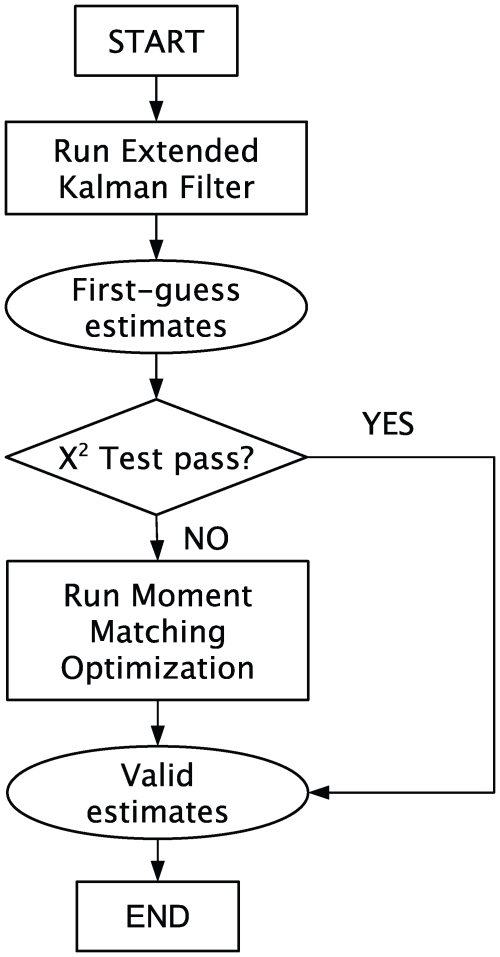
A central challenge in computational modeling of biological systems is the determination of the model parameters. Typically, only a fraction of the parameters (such as kinetic rate constants) are experimentally measured, while the rest are often fitted. The fitting process is usually based on experimental time course measurements of observables, which are used to assign parameter values that minimize some measure of the error between these measurements and the corresponding model prediction. The measurements, which can come from immunoblotting assays, fluorescent markers, etc., tend to be very noisy and taken at a limited number of time points. In this work we present a new approach to the problem of parameter selection of biological models. We show how one can use a dynamic recursive estimator, known as extended Kalman filter, to arrive at estimates of the model parameters. The proposed method follows. First, we use a variation of the Kalman filter that is particularly well suited to biological applications to obtain a first guess for the unknown parameters. Secondly, we employ an a posteriori identifiability test to check the reliability of the estimates. Finally, we solve an optimization problem to refine the first guess in case it should not be accurate enough. The final estimates are guaranteed to be statistically consistent with the measurements. Furthermore, we show how the same tools can be used to discriminate among alternate models of the same biological process. We demonstrate these ideas by applying our methods to two examples, namely a model of the heat shock response in E. coli, and a model of a synthetic gene regulation system. The methods presented are quite general and may be applied to a wide class of biological systems where noisy measurements are used for parameter estimation or model selection.
Overview
CoChat Summary
TL;DR
The paper proposes a three-stage method for parameter estimation and model selection in biological ODE models: constrained hybrid extended Kalman filtering, an a posteriori variance/identifiability test, and moment-matching refinement. It demonstrates the approach on an E. coli heat shock model and a generalized repressilator model, where moment matching passed the statistical test while least-squares and genetic-algorithm fits failed.
Key findings
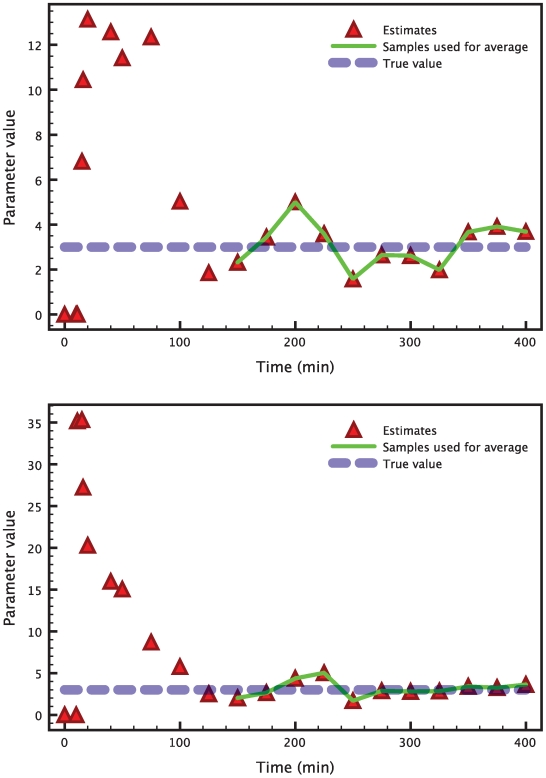
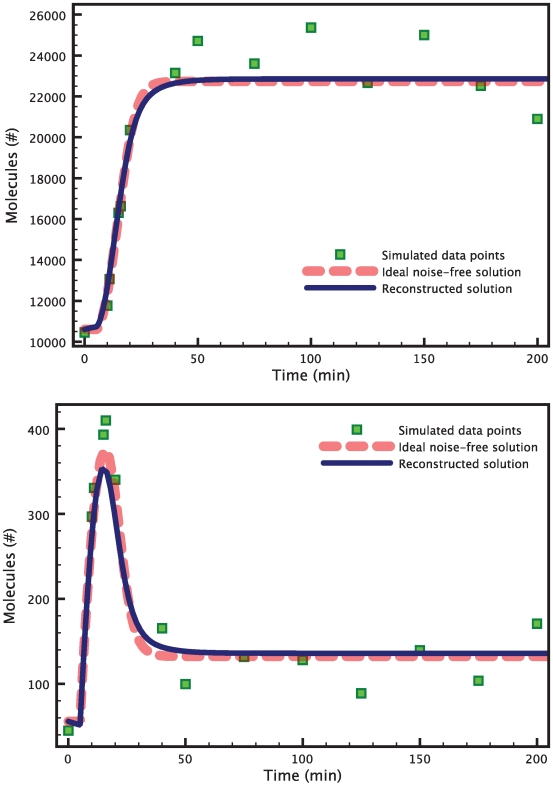
- In the small-parameter heat shock case, the HEKF estimated two parameters whose true value was 3 for both; the text reports the estimation as very accurate despite high noise, and the a posteriori identifiability test at confidence coefficient 0.95 passed for both measurement-noise components.
- For the 6-parameter heat shock case, a single HEKF run failed the identifiability test; moment-matching refinement with BFGS found a minimum after 1560 iterations with cost 0.14 in about 3 hours on a MacBook Pro with a single 2.6 GHz processor, and the refined estimates passed the test.
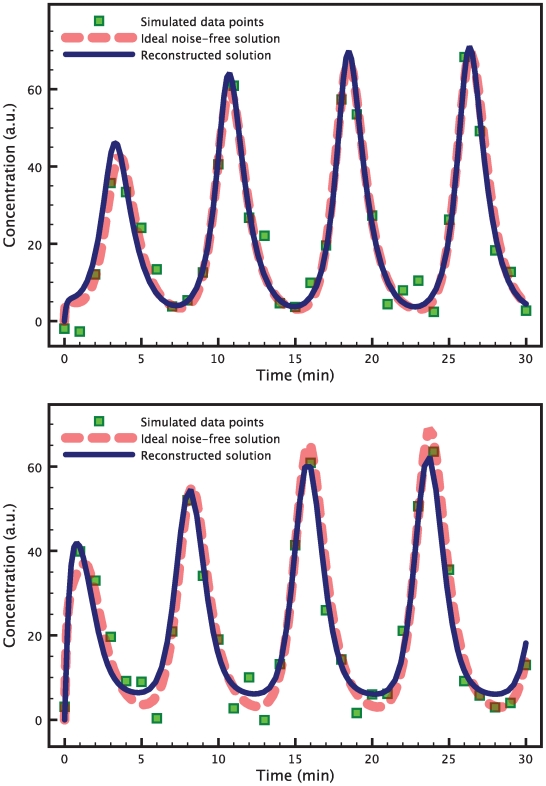
- For the 18-parameter repressilator model, a single HEKF run failed the test; moment-matching refinement with BFGS took 720 iterations (about 26 minutes) and passed all three components, whereas Levenberg-Marquardt least-squares (129 iterations, about 3 minutes) and a genetic algorithm (101 iterations, about 4 minutes) failed.
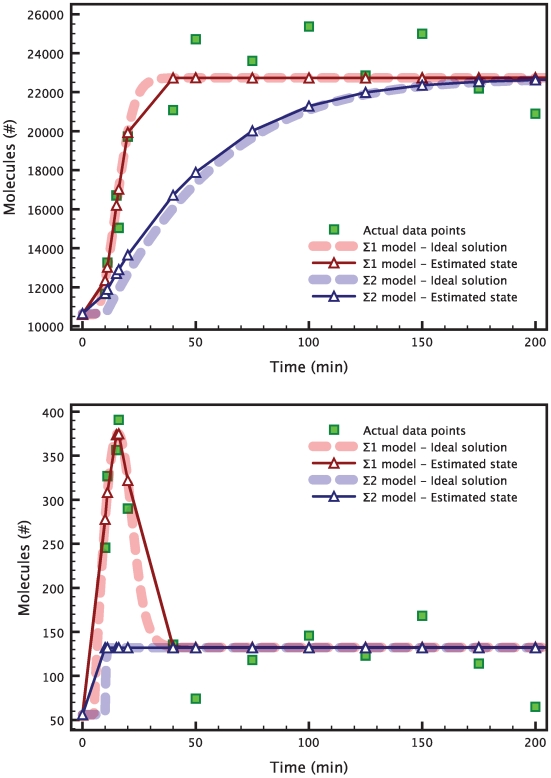
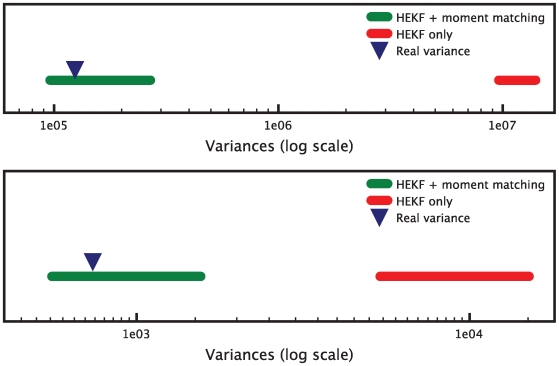
- For model selection in the heat shock example, only model \(M_1\) produced variance interval estimates containing the real measurement-noise variances; model \(M_2\), which lacks the spike in the sigma factor, was rejected as inconsistent with the measurements.
Methods
- The model is written as a continuous-time ODE state-space system; parameters are treated as constant states via state extension, and a constrained hybrid extended Kalman filter (HEKF) handles continuous-time dynamics with discrete-time measurements and equality/inequality constraints solved as quadratic programming.
- An a posteriori identifiability test estimates measurement-noise variances from residuals, forms point and interval estimates using the chi-square distribution, and rejects estimates whose intervals do not contain the known real noise variances; if the test fails, a moment-matching optimization minimizes mean and variance mismatch, typically with BFGS.
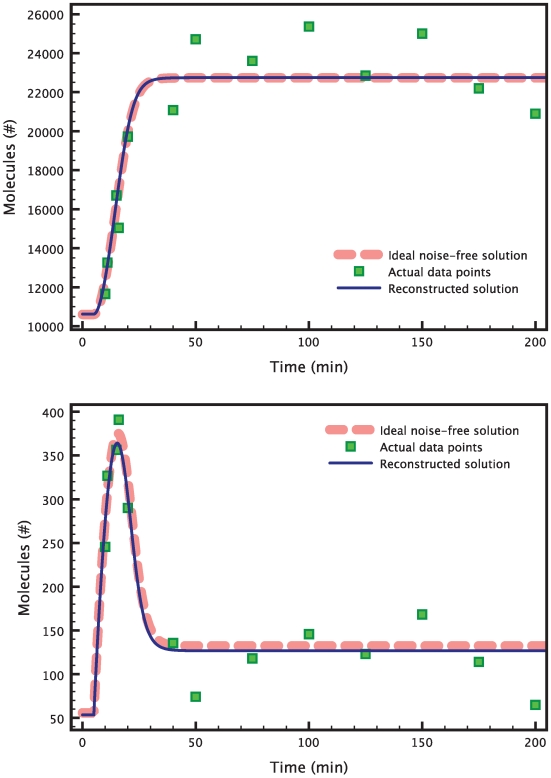
- Model selection runs the HEKF on candidate models, computes measurement-noise variance estimates for each, discards models whose interval estimates exclude the real variances, and selects the model whose variances match best; examples use simulated noisy data from an E. coli heat shock model (2 and 6 parameters; 22 data points in the small case) and a generalized repressilator model (18 parameters; 30 equally spaced mRNA data points).
Limitations
- The paper states that the extended Kalman filter is not generally optimal for nonlinear systems, may diverge or give biased estimates, can suffer from loss of observability/non-uniqueness after state extension, and is subject to numerical ill-conditioning in covariance propagation; initial estimates too far off can also cause problems.
- The paper states that the process-noise covariance is chosen by the user, the measurement-noise statistics are assumed known, the moment-matching weights are user-selected, and the refinement optimization can be computationally expensive (e.g., about 3 hours for the 6-parameter heat shock case).
- Evident from the text: the demonstrations use in silico simulated measurements rather than real experimental data, and many numerical entries in the tables and some reported percentages are missing from the provided text, limiting independent verification of the exact estimates.
Model-written summary. Check it against the paper before relying on it.
Integrity signals
Registry
Cites
Statistics
Figures
Verification
Claims the paper makes
1 Valid · 1 Not valid · 11 Not checked · 41 Own results and interpretations
Every source the paper cites for this claim was checked and supports it.
In the paper
“These and similar results indicate that the search for the exact individual values of the parameters is a hopeless task in most cases [6].”
§ Parameter Estimation and Model Selection in Computational Biology > Introduction
What the sources say
- Supportedcites [6] M Ashyraliyev, 2008, Parameter estimation and determinability analysis applied to Drosophila gap gene circuits., BMC Systems Biology source
The Background (page unavailable) says that determining all parameters accurately is usually not possible in practice. The Results and Discussion, under Parameter Determinability (page unavailable), further report that no parameter in the analyzed model could be determined individually to the chosen accuracy. Together, these support the citing sentence’s general point without implying that every parameter is indeterminable. (LLM, conf=0.90)
hedged- Asserted: passes — The authors put it forward as true.
- Checkable: passes — It can be checked against evidence.
- Load-bearing: passes — The paper’s conclusions depend on it.
- Based: passes — The paper gives a reason why it holds.
- Supported
A result the paper reports from its own data — it cites no other source for it, so there is none to check. The quote shows it is in the paper.
In the paper
“As in the large parameter space case for the heat shock model, a single run of the HEKF produces estimates that do not satisfy the identifiability test.”
§ Parameter Estimation and Model Selection in Computational Biology > Results > The repressilator
plainstates a causeSingle case- Asserted: passes — The authors put it forward as true.
- Checkable: passes — It can be checked against evidence.
- Load-bearing: passes — The paper’s conclusions depend on it.
- Based: passes — The paper gives a reason why it holds.
A result the paper reports from its own data — it cites no other source for it, so there is none to check. The quote shows it is in the paper.
In the paper
“It is clear that only produces results that are compatible with the measurements.”
§ Parameter Estimation and Model Selection in Computational Biology > Results > A model of the heat shock response in E. coli
boosted- Asserted: passes — The authors put it forward as true.
- Checkable: passes — It can be checked against evidence.
- Load-bearing: passes — The paper’s conclusions depend on it.
- Based: passes — The paper gives a reason why it holds.
A result the paper reports from its own data — it cites no other source for it, so there is none to check. The quote shows it is in the paper.
In the paper
“After a transient, the estimates keep oscillating around the true values of the parameters.”
§ Parameter Estimation and Model Selection in Computational Biology > Results > A model of the heat shock response in E. coli
plainstates an associationSingle case- Asserted: passes — The authors put it forward as true.
- Checkable: passes — It can be checked against evidence.
- Load-bearing: unclear — It is unclear whether the paper’s conclusions depend on it.
- Based: passes — The paper gives a reason why it holds.
A result the paper reports from its own data — it cites no other source for it, so there is none to check. The quote shows it is in the paper.
In the paper
“In this new example, a single run of the HEKF produces values that do not satisfy the identifiability test.”
§ Parameter Estimation and Model Selection in Computational Biology > Results > A model of the heat shock response in E. coli
plainSingle case- Asserted: passes — The authors put it forward as true.
- Checkable: passes — It can be checked against evidence.
- Load-bearing: passes — The paper’s conclusions depend on it.
- Based: passes — The paper gives a reason why it holds.
25 more claims
Create a free account to see all 54 claims and to verify the 12 references still open.
- Probably not a substantial claim. 10
- It may state two separate claims as one. 14
- The quote only partly states this claim. 3
Claims other papers make about this one
Each is checked against this paper’s own text: does it say what the citing paper says it does?
In the citing paper
“The resulting approach may be used for obtaining more accurate estimates of the parameters as well as for model selection.”
From Reverse engineering and identification in systems biology: strategies, perspectives and challenges (2014) · cites this paper as [143]
In the citing paper
“To address the issues of sparse and noisy data, Lillacci & Khammash [143] propose a combination of an extended Kalman filter (a recursive estimator well known in control engineering) with a posteriori identifiability tests and moment-matching optimization.”
From Reverse engineering and identification in systems biology: strategies, perspectives and challenges (2014) · cites this paper as [143]
Self-check
Percentages, sums and reported differences re-computed from the paper’s own numbers.
Each contradiction between two passages listed here was confirmed by an independent check.
Rated minor: it would not touch a result — a value no result rests on, a p-value that stays on the same side of the significance level, or a conflict that is clerical, resolved elsewhere in the paper, or outside its own findings.
In the paper
§ Parameter Estimation and Model Selection in Computational Biology > Results > A model of the heat shock response in E. coli
“we compute the point and interval estimates of the variances of the two components of the measurement noise according to (13) and (15) respectively.”
§ Parameter Estimation and Model Selection in Computational Biology > Methods > An a posteriori identifiability test
“Then, is in the interval(14)with a probability of .”
Citations
Cites
Optimization by Simulated Annealing
Kirkpatrick, S., Gelatt, C. D., & Vecchi, M. P. (1983) · Science · doi:10.1126/science.220.4598.671 · Cited by 45,134 · cited 1×
“Much research has been conducted on the applications to computational biology models of several optimization techniques, such as linear and nonlinear leastsquares fitting [3], simulated annealing [4], genetic algorithms [5], and evolutionary computation [6,7].”
BackgroundProbability, Random Variables, and Stochastic Processes.
Abrahams, J., & Papoulis, A. (1984) · Journal of the American Statistical Association · doi:10.2307/2288754 · Cited by 16,226
Probability, Random Variables, and Stochastic Processes
Miller, I. (1966) · Technometrics · doi:10.1080/00401706.1966.10490365 · Cited by 8,452
Practical Methods of Optimization
Fletcher, R. (2000) · Wiley eBooks · doi:10.1002/9781118723203 · Cited by 7,605
Optimal State Estimation: Kalman, H∞, and Nonlinear Approaches
Simon, D. (2006) · doi:10.1002/0470045345 · Cited by 4,875
A synthetic oscillatory network of transcriptional regulators
Elowitz, M. B., & Leibler, S. (2000) · Nature · doi:10.1038/35002125 · Cited by 4,630 · cited 1×
“The original model of Elowitz and Leibler [39] consists of six equations with four parameters, where all the three genes have the same production and degradation rates, and are affected in the same way by the corresponding repressor.”
BackgroundAnderson, B. D. O., Moore, J. B., & Eslami, M. (1982) · IEEE Transactions on Systems Man and Cybernetics · Cited by 3,195
(2007) · Springer eBooks · doi:10.1007/978-0-387-71107-2 · Cited by 2,687
Srinivas, M., & Patnaik, L. M. (1994) · Computer · doi:10.1109/2.294849 · Cited by 2,180 · cited 1×
“Much research has been conducted on the applications to computational biology models of several optimization techniques, such as linear and nonlinear leastsquares fitting [3], simulated annealing [4], genetic algorithms [5], and evolutionary computation [6,7].”
BackgroundGill, P. E., Murray, W., & Wright, M. H. (2019) · doi:10.1137/1.9781611975604 · Cited by 1,737
Cited by
Items 101–200 of 325
Tang, W.-H., Ho, W., & Chen, Y. J. (2018) · BioMedical Engineering OnLine · doi:10.1186/s12938-018-0574-5 · Cited by 17
Wang, M., Risuleo, R. S., Jacobsen, E. W., Chotteau, V., & Hjalmarsson, H. (2019) · Computers & Chemical Engineering · doi:10.1016/j.compchemeng.2019.106671 · Cited by 19
Rapid Bayesian Inference for Expensive Stochastic Models
Warne, D. J., Baker, R. E., & Simpson, M. J. (2021) · Journal of Computational and Graphical Statistics · doi:10.1080/10618600.2021.2000419 · Cited by 21
“For P ∈ N, the function E(·, ·, P) is the P-th order empirical moment-matching distance function (Lillacci and Khammash 2010; Zechner et al. 2012; Liao, Vejchodský, and Erban 2015), given by E(X, Y, P) = P∑ m=0 ∑ b∈Sm 1 |Sm|m ( μ̂(X)b − μ̂(Y)b μ̂(X)b )2 , for two sample sets X = {x1, x2, . . . ,…”
BackgroundQuantitative modeling of gene networks of biological systems using fuzzy Petri nets and fuzzy sets
Hamed, R. I. (2017) · Journal of King Saud University - Science · doi:10.1016/j.jksus.2017.01.005 · Cited by 16
Mathematical modeling of the cGAS pathway reveals robustness of DNA sensing to TREX1 feedback
Gregg, R. W., Sarkar, S. N., & Shoemaker, J. E. (2018) · Journal of Theoretical Biology · doi:10.1016/j.jtbi.2018.11.001 · Cited by 15
Model Extension and Model Selection
Sunnåker, M., & Stelling, J. (2015) · Studies in mechanobiology, tissue engineering and biomaterials · doi:10.1007/978-3-319-21296-8_9 · Cited by 16
“[36] used an extended Kalmanfilter to estimate statisticalmoments of states and parameters simultaneously, and used the overlap betweenmodel predictions and data aswell as aχ2 test as criteria for model selection.”
MethodIsmail, A. M., Mohamad, M. S., Majid, H. A., Abas, K. H., Deris, S., Zaki, N., Hashim, S. Z. M., Ibrahim, Z., & Remli, M. A. (2017) · Biosystems · doi:10.1016/j.biosystems.2017.09.013 · Cited by 14
Differential methods for assessing sensitivity in biological models
Mester, R., Landeros, A., Rackauckas, C., & Lange, K. L. (2022) · PLoS Computational Biology · doi:10.1371/journal.pcbi.1009598 · Cited by 23
“= imag(sol) / d # compute partial for k = 1:lx # record partial for each species @views solution[k][:,j + 1] = sol[k,:] end end return solution end function ODE(dx, x, p, t) # CARRGO model dx[1] = p[4] � x[1] � (1—x[1] / p[5])—p[1] � x[1] � x[2] dx[2] = p[2] x[1] � x[2]—p[3] � x[2] end Fig 1.”
BackgroundMethodForecasting drug-overdose mortality by age in the United States at the national and county levels
Böttcher, L., Chou, T., & D'Orsogna, M. R. (2024) · PNAS Nexus · doi:10.1093/pnasnexus/pgae050 · Cited by 15
“In addition to applications in climate dynamics, data assimilation has been used to estimate parameters in systems biology (35), to provide risk-dependent individual contact interventions during outbreaks (36), to identify patients with antibiotic-resistant bacteria in hospital wards (37), and to…”
MethodBronstein, L., Zechner, C., & Koeppl, H. (2015) · Methods · doi:10.1016/j.ymeth.2015.05.012 · Cited by 17
Tøndel, K., Indahl, U. G., Gjuvsland, A. B., Omholt, S. W., & Martens, H. A. (2012) · BMC Systems Biology · doi:10.1186/1752-0509-6-88 · Cited by 17
“and typically focus on one output variable at a time [1,2], a generic methodology for analysis of model behaviour that is able to handle the entire range of model complexities and give a comprehensive overview of the relationships between the input parameters and all model outputs, is sorely needed.”
BackgroundDray, K. E., Muldoon, J. J., Mangan, N. M., Bagheri, N., & Leonard, J. N. (2022) · ACS Synthetic Biology · doi:10.1021/acssynbio.1c00528 · Cited by 14
Automated parameter estimation for biological models using Bayesian statistical model checking
Hussain, F., LANGMEAD, C. J., Mi, Q., Dutta‐Moscato, J., Yoram Vodovotz, B., & Jha, S. K. (2015) · BMC Bioinformatics · doi:10.1186/1471-2105-16-s17-s8 · Cited by 18
Modeling of nonlinear biological phenomena modeled by S-systems
Mansouri, M. M., Nounou, H. N., Nounou, M. N., & Datta, A. A. (2014) · Mathematical Biosciences · doi:10.1016/j.mbs.2014.01.011 · Cited by 14
Baker, S. M., Poskar, C. H., & Junker, B. H. (2011) · EURASIP Journal on Bioinformatics and Systems Biology · doi:10.1186/1687-4153-2011-7 · Cited by 18
“In the Kalman filter method, identifiability is addressed with the view of observability [2].”
BackgroundMethodMechanistic modeling of viral particle production
Canova, C. T., Inguva, P., & Braatz, R. D. (2022) · Biotechnology and Bioengineering · doi:10.1002/bit.28296 · Cited by 17
Fan, M., Kuwahara, H., Wang, X., Wang, S., & Gao, X. (2015) · Briefings in Bioinformatics · doi:10.1093/bib/bbv015 · Cited by 14
Bianconi, F., Baldelli, E., Luovini, V., Petricoin, E. F., Crinò, L., & Valigi, P. (2015) · BMC Systems Biology · doi:10.1186/s12918-015-0216-5 · Cited by 15
“The generated model will depend on several parameters, and the corresponding identification and model selection problems are relevant issues (see [18, 19] and the references therein).”
BackgroundBaker, S. M., Poskar, C. H., Schreiber, F., & Junker, B. H. (2013) · Bioinformatics · doi:10.1093/bioinformatics/btt097 · Cited by 14
“While it might be possible to experimentally measure some of these parameters, for most of them, conducting biological experiments to determine their values are difficult, expensive, time-consuming or not currently possible (Lillacci and Khammash, 2010).”
BackgroundInfluentialDelay models for the early embryonic cell cycle oscillator
Rombouts, J., Vandervelde, A., & Gelens, L. (2018) · PLoS ONE · doi:10.1371/journal.pone.0194769 · Cited by 13
“The literature on this subject is vast, and the fitting of parameters and an accurate quantification of the uncertainty is not obvious, especially when models become large [58–60].”
Low-dimensional models of single neurons: a review
Chialva, U., Boscá, V. G., & Rotstein, H. G. (2023) · Biological Cybernetics · doi:10.1007/s00422-023-00960-1 · Cited by 13
“…and Schaefer 2015; Brunton et al. 2016;Chamption et al. 2019;Deb2001;Deb andBeyer 2001; Deb et al. 2002a, b; Evensen 2009; Goncalves et al. 2020; Lillacci and Khammash 2010; Moye and Diekman 2018; Mensi et al. 2012; Papamarkou et al. 2019; Pozzorini et al. 2015; Rossi 2018; Shahriari et al.…”
BackgroundDahlquist, K. D., Fitzpatrick, B. G., Camacho, E. T., Entzminger, S. D., & Wanner, N. C. (2015) · Bulletin of Mathematical Biology · doi:10.1007/s11538-015-0092-6 · Cited by 13
“Biologically,computationally, and mathematically, parameter estimation remains a significant challenge for the modeling of gene regulatory dynamics, even for medium-scale networks of just 5–10 interacting genes, (Cao and Zhao 2008; Lillacci and Khammash 2010; Kuwahara et al. 2013; Fan et al. 2015).”
BackgroundMethodZheltkova, V. V., Zheltkov, D. A., Grossman, Z., Bocharov, G. A., & Tyrtyshnikov, E. E. (2017) · Journal of Inverse and Ill-Posed Problems · doi:10.1515/jiip-2016-0083 · Cited by 13
“An extensive review of the existing methods, including their classifications and properties can be found in [1, 26].”
BackgroundMethodHybrid Dynamic Optimization Methods for Systems Biology with Efficient Sensitivities
Lewis, N. R., Hedengren, J. D., & Haseltine, E. L. (2015) · Processes · doi:10.3390/pr3030701 · Cited by 12
“Lillacci and Khammash [48] proposes a method based on an extended Kalman filter (also known as a dynamic recursive estimator) to find valid estimates of model parameters and discriminate among alternative models of the same biological process.”
Jones, E. W., & Carlson, J. M. (2018) · PLoS Computational Biology · doi:10.1371/journal.pcbi.1006001 · Cited by 15
Kimura, A., Celani, A., Nagao, H., Stasevich, T. J., & Nakamura, K. (2015) · Frontiers in Physiology · doi:10.3389/fphys.2015.00060 · Cited by 11
“Lillacci and Khammash applied an extended Kalman filter for parameter estimation in non-linear biological systems, including the heat shock response in E. coli (Lillacci and Khammash, 2010).”
MethodA framework for scalable parameter estimation of gene circuit models using structural information
Kuwahara, H., Fan, M., Wang, S., & Gao, X. (2013) · Bioinformatics · doi:10.1093/bioinformatics/btt232 · Cited by 11
“This is due to the fact that the moment-matching algorithm used an unconstrained local optimization technique (Lillacci and Khammash, 2010).”
InfluentialA Parts Database with Consensus Parameter Estimation for Synthetic Circuit Design
Huynh, L. N., & Tagkopoulos, I. (2016) · ACS Synthetic Biology · doi:10.1021/acssynbio.5b00205 · Cited by 11
Wadi, A., Abdel–Hafez, M. F., Husseini, G. A., & Paul, V. (2019) · IEEE Transactions on NanoBioscience · doi:10.1109/tnb.2019.2950344 · Cited by 12
“of state and parameter estimation into one and/or apply constrained optimization on the parameter set to ensure finding physically meaningful parameters have been proposed [20], [21].”
BackgroundKarimi, H., & McAuley, K. B. (2013) · Industrial & Engineering Chemistry Research · doi:10.1021/ie4023989 · Cited by 11
Parameter Estimation in the Age of Degeneracy and Unidentifiability
Lederman, D., Patel, R., Itani, O., & Rotstein, H. G. (2022) · Mathematics · doi:10.3390/math10020170 · Cited by 13
A Homotopy Method for Parameter Estimation of Nonlinear Differential Equations with Multiple Optima
Hao, W. (2017) · Journal of Scientific Computing · doi:10.1007/s10915-017-0518-4 · Cited by 10
Large-Scale Kinetic Parameters Estimation of Metabolic Model of Escherichia Coli
Mohammed Adam Kunna Azrag, T. A. A. K., Azrag, M. A. K., Kadir, T. A. A., Kabir, M. N., & Jaber, A. S. (2019) · International Journal of Machine Learning and Computing · doi:10.18178/ijmlc.2019.9.2.781 · Cited by 10
Systems Biology: The Role of Engineering in the Reverse Engineering of Biological Signaling
Iglesias, P. A. (2013) · Cells · doi:10.3390/cells2020393 · Cited by 13
“, [66–68]), and the use of computational tools to guide synthetic biology (e.”
BackgroundMaximum Caliber Can Characterize Genetic Switches with Multiple Hidden Species
Firman, T., Wedekind, S., McMorrow, T. J., & Ghosh, K. (2018) · The Journal of Physical Chemistry B · doi:10.1021/acs.jpcb.7b12251 · Cited by 12
Identifying Optimal Models to Represent Biochemical Systems
Apri, M., de Gee, M., van Mourik, S., & Molenaar, J. (2014) · PLoS ONE · doi:10.1371/journal.pone.0083664 · Cited by 11
“For this aspect a vast body of separate literature exists, e.g., [11–16].”
BackgroundA differentiable reformulation for E-optimal design of experiments in nonlinear dynamic biosystems
Telen, D., Riet, N. V., Logist, F., & van Impe, J. F. M. (2015) · Mathematical Biosciences · doi:10.1016/j.mbs.2015.02.006 · Cited by 12
“An overview of the state of the art can be found in [11, 12, 13].”
BackgroundAvramidis, E., & Akman, O. E. (2017) · BMC Systems Biology · doi:10.1186/s12918-017-0416-2 · Cited by 10
“It is a critical step in the construction and analysis of biological models [24], because determining the optimal parameter values enables alternative models to be systematically ranked and experimentally testable predictions to be formulated [24–30].”
BackgroundComputational Modelling of Liver Metabolism and its Applications in Research and the Clinics
Tomaš, T. C., Moškon, M., Mraz, M., & Rozman, D. (2018) · Acta chimica slovenica · doi:10.17344/acsi.2018.4461 · Cited by 10
Inferring kinetic parameters of oscillatory gene regulation from single cell time-series data
Burton, J., Manning, C. S., Rattray, M., Papalopulu, N., & Kursawe, J. (2021) · Journal of The Royal Society Interface · doi:10.1098/rsif.2021.0393 · Cited by 9
“It is a powerful method to calculate posterior probabilities if delays are not present in the model [45], and can be extended to estimate the gradient of the likelihood function, making gradient-based sampling of the posterior distribution possible [46].”
MethodRiahi, M. K., & Qattan, I. A. (2021) · Mathematical Methods in the Applied Sciences · doi:10.1002/mma.8009 · Cited by 11
“from which we can see that a necessary condition for the well-posedness of the adjoint equation (5)3 is that the derivative δF should be at least Lipschitz continuous operator.”
BackgroundWang, H., & Wang, X. (2013) · Journal of Theoretical Biology · doi:10.1016/j.jtbi.2013.09.020 · Cited by 8
Rapid Discrimination Among Putative Mechanistic Models of Biochemical Systems
Lomnitz, J. G., & Savageau, M. A. (2016) · Scientific Reports · doi:10.1038/srep32375 · Cited by 7
“The LacI-primary circuit is defined by the system of Eqs (7) to (10) following the substitution of PL from Eq.”
BackgroundMethodBianconi, F., Antonini, C., Tomassoni, L., & Valigi, P. (2018) · IEEE Transactions on Control Systems Technology · doi:10.1109/tcst.2018.2844362 · Cited by 14
“Since biological models are often highly nonlinear, estimation techniques must be robust in order to determine reliable estimates and also assess parameter uncertainty [4], [15], [16].”
BackgroundMethodEstimation of neuron parameters from imperfect observations
Taylor, J. D., Winnall, S., & Nogaret, A. (2020) · PLoS Computational Biology · doi:10.1371/journal.pcbi.1008053 · Cited by 10
A New Bayesian Methodology for Nonlinear Model Calibration in Computational Systems Biology
Bianconi, F., Tomassoni, L., Antonini, C., & Valigi, P. (2020) · Frontiers in Applied Mathematics and Statistics · doi:10.3389/fams.2020.00025 · Cited by 7
“Moreover, models represent an excellent tool to predict the value of biological parameters that may not be directly accessible through biological experiments because they would be time consuming, expensive or not feasible [5].”
MethodInfluentialParameter Estimation in a PDE Model for the Spatial Spread of Cocoa Black Pod Disease
Fomba, C. G. N., Hoopen, G. M. T., Soubeyrand, S., Roques, L., Ambang, Z., & Soh, P. T. (2021) · Bulletin of Mathematical Biology · doi:10.1007/s11538-021-00934-z · Cited by 8
Madi, M. K., & Karameh, F. N. (2017) · PLoS ONE · doi:10.1371/journal.pone.0181513 · Cited by 8
Methods of Nonlinear Time Series Analysis and Applications: A Review
Ambika, G., & Harikrishnan, K. P. (2019) · Energy, environment, and sustainability · doi:10.1007/978-981-15-0536-2_2 · Cited by 12
Parameter estimation and model selection for stochastic differential equations for biological growth
Baltazar‐Larios, F., Delgado-Vences, F. J., & Ornelas, A. (2025) · Environmental and Ecological Statistics · doi:10.1007/s10651-025-00643-z · Cited by 7
“Fitting differential equations is a classic example of inverse problems and has been treated by many authors with several approaches (see for instance Hasanoglu and Romanov (2017), Isakov (2006), or Lillacci and Khammash (2010)); in particular, fitting ODEs has been deeply studied.”
Mechanism-based and data-driven modeling in cell-free synthetic biology
Yurchenko, A., Özkul, G., van Riel, N. A. W., van Hest, J. C. M., & de Greef, T. F. A. (2024) · Chemical Communications · doi:10.1039/d4cc01289e · Cited by 8
Burrage, K., Burrage, P., Leier, A., & Marquez‐Lago, T. T. (2017) · Springer eBooks · doi:10.1007/978-3-319-62627-7_11 · Cited by 8
Inferring causality in biological oscillators
Tyler, J., Forger, D. B., & Kim, J. K. (2021) · Bioinformatics · doi:10.1093/bioinformatics/btab623 · Cited by 8
“Although testing reproducibility requires computationally-expensive model simulations and fittings (Mhaskar et al., 2002; Balsa-Canto et al., 2008; Radde and Kaderali, 2009; Toni et al., 2009; Geva-Zatorsky et al., 2010; Lillacci and Khammash, 2010; Wang and Enright, 2013; Stražar et al., 2014; Trejo Banos et al., 201…”
Modeling and forecasting age-specific drug overdose mortality in the United States
Böttcher, L., Chou, T., & D'Orsogna, M. R. (2023) · The European Physical Journal Special Topics · doi:10.1140/epjs/s11734-023-00801-z · Cited by 7
Adaptive Models for Gene Networks
Shin, Y.-J., Sayed, A. H., & Shen, X. (2012) · PLoS ONE · doi:10.1371/journal.pone.0031657 · Cited by 7
“To achieve a better ‘‘fit’’ between models and measurements, researchers often resort to increasing the order or complexity of their models [5,6] while assuming constant model parameters [7–9].”
BackgroundRevisiting a synthetic intracellular regulatory network that exhibits oscillations
Tyler, J., Shiu, A., & Walton, J. R. (2019) · Journal of Mathematical Biology · doi:10.1007/s00285-019-01346-3 · Cited by 7
“Specifically, we aim to build off the work of Khammash and Lillacci in [15] to compare parameter estimates of previous repressilator models with our generalized model.”
MethodResultImage‐BasedIn silicoModels of Organogenesis
Gómez, H. F., Georgieva, L., Michos, O., & Iber, D. (2017) · Systems Biology · doi:10.1002/9783527696130.ch12 · Cited by 7
An information field theory approach to Bayesian state and parameter estimation in dynamical systems
Hao, K., & Bilionis, I. (2024) · Journal of Computational Physics · doi:10.1016/j.jcp.2024.113139 · Cited by 8
Chong, C. K., Mohamad, M. S., Deris, S., Shamsir, M. S., Chai, L., & Choon, Y. W. (2013) · Current Bioinformatics · doi:10.2174/15748936113080990007 · Cited by 6
“According to Lillacci and Khammash [22], to assure that the final simulated results are statistically consistent with the experimental results, a statistical test, chi-square test (X2 test) must be used.”
MethodResultInfluentialModular Parameter Identification of Biomolecular Networks
Lang, M., & Stelling, J. (2016) · SIAM Journal on Scientific Computing · doi:10.1137/15m103306x · Cited by 8
Stražar, M., Mraz, M., Zimic, N., & Moškon, M. (2013) · Natural Computing · doi:10.1007/s11047-013-9383-8 · Cited by 6
“A fundamental problem in modeling synthetic GRNs is the uncertainty in the values of the model parameters (Lillacci and Khammash 2010, 2012) and the level of modeling complexity for a specific network.”
BackgroundModeling environmental disturbances with the chemical master equation
Yeung, E., Beck, J. L., & Murray, R. M. (2013) · IEEE Conference on Decision and Control (CDC) · doi:10.1109/cdc.2013.6760076 · Cited by 7
“We plan on developing novel system identification procedures, as well as levering existing techniques [23] to build a library of models that characterize the manner in which environmental disturbances impact both synthetic and natural biological processes.”
MethodAnalytical Solution of Multicompartment Solute Kinetics for Hemodialysis
Korohoda, P., & Schneditz, D. (2013) · Computational and Mathematical Methods in Medicine · doi:10.1155/2013/654726 · Cited by 6
Rigatos, G. G. (2016) · IET Systems Biology · doi:10.1049/iet-syb.2015.0058 · Cited by 6
Reconstruction of promoter activity statistics from reporter protein population snapshot data
Eugenio Cinquemani, B. (2015) · IEEE Conference on Decision and Control (CDC) · doi:10.1109/cdc.2015.7402418 · Cited by 7
“We provide a solution in the form of Bayesian smoothing, along with simulation results showing the potential of the approach and the performance gain relative to causal, online filtering strategies [26], [15].”
MethodQuantitative Kinetic Models from Intravital Microscopy: A Case Study Using Hepatic Transport
Tavakoli, M., Tsekouras, K., Day, R. N., Dunn, K. W., & Pressé, S. (2019) · The Journal of Physical Chemistry B · doi:10.1021/acs.jpcb.9b04729 · Cited by 9
A control theoretic three timescale model for analyzing energy management in mammalian cancer cells
Dasgupta, A., Bakshi, A., Chowdhury, N., & De, R. K. (2020) · Computational and Structural Biotechnology Journal · doi:10.1016/j.csbj.2020.12.019 · Cited by 7
“3 depicts that the parameter values in (0, 1) considered in this article are quite similar with those estimated by hybrid extended Kalman filtering based method [70].”
MethodAbrevaya, G., Dumas, G., Aravkin, A. Y., Zheng, P., Gagnon-Audet, J.-C., Kozloski, J., Polosecki, P. I., Lajoie, G., Cox, D., Dawson, S. P., et al. (2021) · Neural Computation · doi:10.1162/neco_a_01401 · Cited by 9
“…differential equations (ODEs) from data is a problem of significant interest in various research communities, ranging from physics and biology to control theory, machine learning and optimization (Lillacci & Khammash, 2010; Rackauckas et al., 2020; Sabatier, 2000; van Leeuwen & Herrmann, 2015).”
BackgroundChong, C. K., Mohamad, M. S., Deris, S., Shamsir, M. S., Choon, Y. W., & Chai, L. (2014) · Current Bioinformatics · doi:10.2174/157489360905141014154242 · Cited by 6
Online Machine Learning Based Predictor for Biological Systems
Marquez, G., Johnson, B. J., Jafari, M., & Gomez, M. M. (2019) · IEEE Symposium Series on Computational Intelligence (SSCI) · doi:10.1109/ssci44817.2019.9002945 · Cited by 7
“They all are considered to be challenging tasks due to the complex nonlinear nature of biological systems [4].”
BackgroundBirgin, E. G., Correa, M. R., González-López, V. A., Martínez, J. M., & Rodrigues, D. S. (2024) · Journal of Hydraulic Engineering · doi:10.1061/jhend8.hyeng-13748 · Cited by 7
Generating synthetic signaling networks for in silico modeling studies
Xu, J. H., Wiley, H. S., & Sauro, H. M. (2020) · Journal of Theoretical Biology · doi:10.1016/j.jtbi.2024.111901 · Cited by 5
Modeling preferential attraction to infected hosts in vector-borne diseases
Thapa, I., & Ghersi, D. (2023) · Frontiers in Public Health · doi:10.3389/fpubh.2023.1276029 · Cited by 5
“In both types of approaches, choosing a correct set of parameters is key to successfully model the phenomenon of interest (14), (15), (16), (17).”
BackgroundWells, S. A., Taylor, J. D., Morris, P. G., & Nogaret, A. (2024) · PRX Life · doi:10.1103/prxlife.2.023007 · Cited by 7
“The challenge, however, is that the state equations of neurons are generally unknown and modelling neurons with empirical models such as the Hodgkin-Huxley model [9, 10, 14–19] introduces model error which biasses parameter estimates away from true values [20–28].”
BackgroundKessels, B. M., Fey, R. H. B., & van de Wouw, N. (2024) · Multibody System Dynamics · doi:10.1007/s11044-024-10015-3 · Cited by 5
“5 × 10 -4 , batch size 5 = 50, and number of epochs = 350.”
Dynamic Modeling of Metabolic and Gene Regulatory Systems toward Developing Virtual Microbes
Kurata, H., Maeda, K., & Matsuoka, Y. (2013) · JOURNAL OF CHEMICAL ENGINEERING OF JAPAN · doi:10.1252/jcej.13we152 · Cited by 5
Parameter identification of biological networks using extended Kalman filtering and χ2 criteria
Lillacci, G., & Khammash, M. (2010) · IEEE Conference on Decision and Control (CDC) · doi:10.1109/cdc.2010.5717460 · Cited by 6
Self-citationHasegawa, T., Yamaguchi, R., Kakuta, M., Sawada, K., Kawatani, K., Murashita, K., Nakaji, S., & Imoto, S. (2020) · PLoS ONE · doi:10.1371/journal.pone.0230172 · Cited by 5
“For this purpose, we apply a statistical approach using the SSM, which has successful applications in a wide range of fields [10–14].”
A New Competitive Implementation of the Electromagnetism-Like Algorithm for Global Optimization
Rocha, A. M. A. C., Silva, A., & Rocha, J. G. (2015) · Lecture notes in computer science · doi:10.1007/978-3-319-21407-8_36 · Cited by 5
“In the context of bioprocess engineering optimization, the parameter estimation problem goal is to find the set of parameters of a mathematical model to obtain the best possible fit to the existing experimental data [17,26,30].”
BackgroundOmony, J., Mach-Aigner, A. R., Straten, G. V., & van Boxtel, A. J. B. (2015) · BMC Systems Biology · doi:10.1186/s12918-016-0257-4 · Cited by 5
“Ordinary differential equations (ODEs) are a popular formalism for modeling time responses in regulatory networks [18 – 23].”
BackgroundSamarasinghe, S., & Ling, H. (2017) · Biosystems · doi:10.1016/j.biosystems.2017.01.001 · Cited by 6
“…can provide a comprehensive quantitative view of temporal dynamic of the system in fine detail but simulating a large network with ODEs is complex due to the large number of ODEs with many unknown parameters (Ashyraliyev et al., 2009; Lillacci & Khammash, 2010; Sun et al., 2008; Xie et al., 2010).”
BackgroundDavidović, A., Chait, R., Batt, G., & Ruess, J. (2022) · PLoS Computational Biology · doi:10.1371/journal.pcbi.1009950 · Cited by 5
On the impact of discreteness and abstractions on modelling noise in gene regulatory networks
Bodei, C., Bortolussi, L., Chiarugi, D., Guerriero, M. L., Policriti, A., & Romanel, A. (2015) · Computational Biology and Chemistry · doi:10.1016/j.compbiolchem.2015.04.004 · Cited by 4
“Each step represents a possible control point, where several biochemical mechanisms play a role (see [11] for a comprehensive review and [12] for an application to model selection).”
BackgroundQualitative, semi-quantitative, and quantitative simulation of the osmoregulation system in yeast
Pang, W., & Coghill, G. M. (2015) · Biosystems · doi:10.1016/j.biosystems.2015.04.003 · Cited by 5
“For the second issue, many parameter estimation techniques have been developed, for instance, the recent work of Lillacci and Khammash (2010) and Tashkova et al.”
MethodGlobal Sensitivity Analysis Procedure Accounting for Effect of Available Experimental Data
Chu, Y., Huang, Z. J., & Hahn, J. (2010) · Industrial & Engineering Chemistry Research · doi:10.1021/ie101283g · Cited by 5
Heidary, Z., Javanmard, S. H., Izadi, I., Zare, N., & Ghaisari, J. (2022) · Scientific Reports · doi:10.1038/s41598-022-20634-5 · Cited by 6
Crouch, S. A. W., Krause, J., Dandekar, T., & Breitenbach, T. (2024) · Computational and Structural Biotechnology Journal · doi:10.1016/j.csbj.2024.04.010 · Cited by 4
“There are already some mathematical frameworks developed for fitting parameters of a model to the data [16,17,21,27,46,47,51,54].”
Assaf, G., Liu, F., Monika Heiner, A., & Herajy, M. (2025) · Computers in Biology and Medicine · doi:10.1016/j.compbiomed.2024.109624 · Cited by 4
Boada, Y., Vignoni, A., Reynoso-Meza, G., & Picó, J. (2016) · IFAC-PapersOnLine · doi:10.1016/j.ifacol.2016.12.106 · Cited by 6
“Accurate parameter identification is crucial whenever one wants to obtain quantitative, or even qualitative information from the models (Lillacci and Khammash, 2010). to obtain quantitative, or even qualitative information from the models (Lillacci and Khammash, 2010).”
InfluentialApproximate Bayesian Computational Methods for the Inference of Unknown Parameters
Ke, Y., & Tian, T. (2019) · MATRIX book series · doi:10.1007/978-3-030-04161-8_45 · Cited by 7
Approaches to Parameter Estimation from Model Neurons and Biological Neurons
Nogaret, A. (2022) · Algorithms · doi:10.3390/a15050168 · Cited by 6
Hasegawa, T., Mori, T., Yamaguchi, R., Imoto, S., Miyano, S., & Akutsu, T. (2014) · Journal of Computational Biology · doi:10.1089/cmb.2014.0171 · Cited by 4
“In order to assimilate a simulation model and observational data, we apply a nonlinear state space model (Asif and Sanguinetti, 2011; Hirose et al., 2008; Kojima et al., 2010; Lillacci and Khammash, 2010; Quach et al., 2007).”
Methodvon Haeseler, F., Rudolph, N., Findeisen, R., & Huber, H. J. (2018) · IFAC-PapersOnLine · doi:10.1016/j.ifacol.2018.09.298 · Cited by 4
“These general methods comprise approaches based on Generalized Mass Action, S-system based methods (Savageau, 1969a,b; Torres and Voit, 2002), and such from control theory (Geffen et al., 2008; Farina et al., 2006; Lillacci and Khammash, 2010; Otter, 1986).”
MethodParameter estimation methods for biological systems
Mu, L. (2010) · University Library - University of Saskatchewan (University of Saskatchewan) · Cited by 4
Shi, Y., & Watada, J. (2015) · ICIC Express Letters · Cited by 4
Improving Parameter Estimation of Epidemic Models: Likelihood Functions and Kalman FilteringPreprint
Li, T., Rahmandad, H., & Sterman, J. D. (2022) · SSRN Electronic Journal · doi:10.2139/ssrn.4165188 · Cited by 5
Data reconstruction from machine learning models via inverse estimation and Bayesian inference
Hartoyo, A., Ciupek, D., Malawski, M., & Crimi, A. (2025) · Scientific Reports · doi:10.1038/s41598-025-96215-z · Cited by 3
Bridging the multiscale gap: Identifying cellular parameters from multicellular data
Baker, Q. B., Podgorski, G. J., Johnson, C. D., Vargis, E., & Flann, N. S. (2015) · IEEE Conference on Computational Intelligence in Bioinformatics and Computational Biology (CIBCB) · doi:10.1109/cibcb.2015.7300323 · Cited by 5
“This scenario can be ameliorated by fitting the model to experimental in vitro / in vivo data [1] [14].”
MethodParameter Estimation of Three Cell Interaction Using Lotka Volterra Differential Equations
Meça, A., Uka, A., & Ali, M. (2021) · International Conference on Computing, Networking, Telecommunications & Engineering Sciences Applications (CoNTESA) · doi:10.1109/contesa52813.2021.9657116 · Cited by 3
Metadata
- Authors
- Lillacci, G., & Khammash, M.
- Affiliations
- University of California, Santa Barbara (US)
- Corresponding author
- Khammash, Mustafa
- Venue
- PLoS Computational Biology
- Publisher
- Public Library of Science (PLoS)
- Published
- 2010-03-05
- Volume
- 6
- Issue
- 3
- Pages
- e1000696
- ISSN
- 1553-734X (ISSN-L)
- 1553-7358
- PMC
- PMC2832681
- OpenAlex
- W2044278781
- Semantic Scholar
- 9a362ed58bcf80e6191bf963bfb5cc5a48f26719
- Cited by
- 325
- References
- 48
- Citations by year
- 2026: 4 · 2025: 13 · 2024: 18 · 2023: 11 · 2022: 16 · 2021: 24 · 2020: 21 · 2019: 29 · 2018: 27 · 2017: 21 · 2016: 19 · 2015: 28 · 2014: 29 · 2013: 34 · 2012: 14
- FWCI
- 8.46
- Type
- journal article
- Language
- en
- Open access
- gold
- doi.org
- Locations
- PLoS Computational Biology (publishedVersion, cc-by)
- PubMed Central (publishedVersion, cc-by)
- PubMed (publishedVersion)
- RePEc: Research Papers in Economics (submittedVersion)
- DOAJ (DOAJ: Directory of Open Access Journals) (submittedVersion, cc-by-sa)
- Figshare (submittedVersion, cc-by)
- Funders
- National Science Foundation (0802008, DAAD19-03-D-0004, 0835847)
- Deutscher Akademischer Austauschdienst
- National Institutes of Health
- National Institute of General Medical Sciences (R01GM049831)
- Division of Electrical, Communications and Cyber Systems (0835847, ECCS-0802008)
- Army Research Office (DAAD 19-03-D-0004, ECCS-0835847)
- Institute for Collaborative Biotechnologies (ECCS-0835847, DAAD19-03-D-0004)
- Topics
- Life Sciences › Biochemistry, Genetics and Molecular Biology › Molecular Biology › Gene Regulatory Network Analysis
- Physical Sciences › Engineering › Control and Systems Engineering › Control Systems and Identification
- Life Sciences › Biochemistry, Genetics and Molecular Biology › Molecular Biology › Microbial Metabolic Engineering and Bioproduction
- Keywords
- parameter estimation, model selection, extended Kalman filter, recursive parameter estimation, identifiability, heat shock response, Escherichia coli, synthetic gene regulation, rate constants, mathematical biology
- MeSH terms
- Algorithms, Animals, Computer Simulation, Gene Expression Regulation, Humans, Models, Biological, Signal Transduction, Proteome, Systems Biology
About these checks
Registry, retraction, Cites and statistics results are computed, not judged, with one exception: a printed reference that no index lists is read once by a model before it counts as a citation error. Claims are extracted by a model and kept only when their quote appears verbatim in the text; each cited source is then checked, with a model’s help, for whether it says what the claim relies on. Those verdicts can be wrong — read the claim’s quote and the cited source before relying on one.
A language model drew the claims from the paper on 2026-10-05, under version 3 of the claim definition (model deepseek-v4.1-flash, prompt extract-v3).
A second model labelled each claim on 2026-10-05 (model jev-1.13-20260917, definition revision gold-guideline-v0.2).
Cited sources are checked with a language model’s help (gpt-6-sol).
Statistics and arithmetic are recomputed, not judged.
Confidence bands are shown only for fields calibrated on our annotated test set. None is calibrated yet, so no band is shown.
What counts as a claim ›How we measure confidence ›How we check this ›
Are you an author, or do you see a problem with this page? Request a review
Data sources
Bibliographic data: Semantic Scholar, OpenAlex, Crossref.
Contains information from the Semantic Scholar Academic Graph Datasets, made available under the ODC Attribution License (ODC-BY 1.0).
Semantic Scholar’s data is described in: Kinney, R., et al. (2023). The Semantic Scholar Open Data Platform. arXiv:2301.10140.
