

The DOI matches its Crossref record; 56 of the 56 references it cites were found in a registry or an index.
DOGS: Reaction-Driven de novo Design of Bioactive Compounds
Open accessAbstract
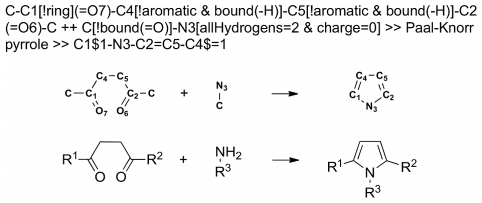
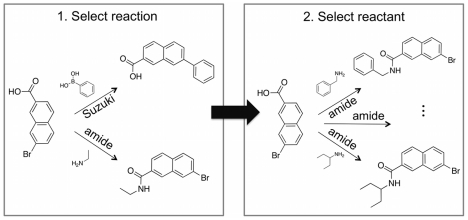
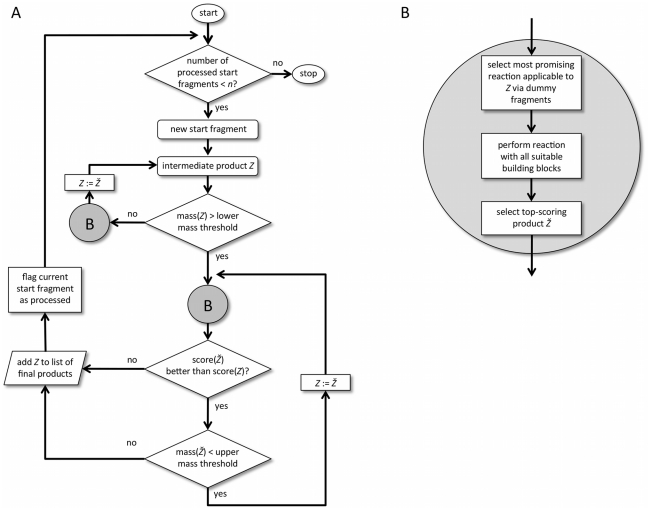
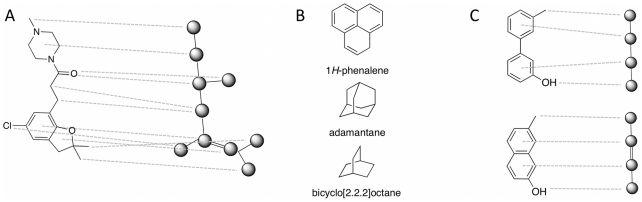
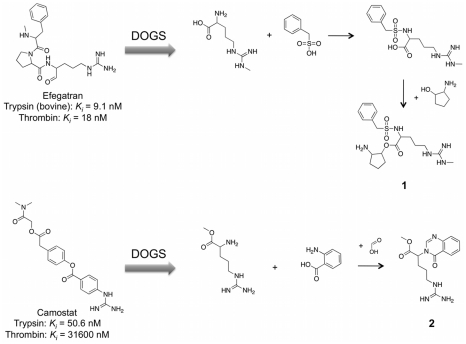
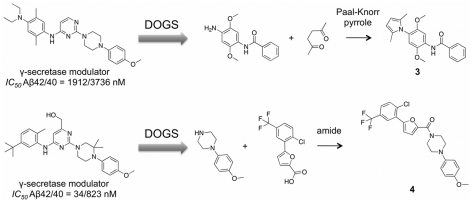
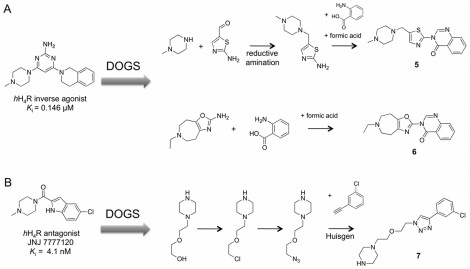
We present a computational method for the reaction-based de novo design of drug-like molecules. The software DOGS (Design of Genuine Structures) features a ligand-based strategy for automated 'in silico' assembly of potentially novel bioactive compounds. The quality of the designed compounds is assessed by a graph kernel method measuring their similarity to known bioactive reference ligands in terms of structural and pharmacophoric features. We implemented a deterministic compound construction procedure that explicitly considers compound synthesizability, based on a compilation of 25'144 readily available synthetic building blocks and 58 established reaction principles. This enables the software to suggest a synthesis route for each designed compound. Two prospective case studies are presented together with details on the algorithm and its implementation. De novo designed ligand candidates for the human histamine H₄ receptor and γ-secretase were synthesized as suggested by the software. The computational approach proved to be suitable for scaffold-hopping from known ligands to novel chemotypes, and for generating bioactive molecules with drug-like properties.
Overview
The claims and statistics of this paper haven’t been checked yet.
Run the check — free, no account needed. It reads the open-access text and checks the sources it cites.
Integrity signals
Registry
Cites
Statistics
Figures
Verification
Claims the paper makes
The claims and statistics of this paper haven’t been checked yet.
Run the check — free, no account needed. It reads the open-access text and checks the sources it cites.
Claims other papers make about this one
Each is checked against this paper’s own text: does it say what the citing paper says it does?
In the citing paper
“This algorithm applies 58 well-established chemical transformation rules to a set of 25144 readily available synthetic blocks from the Sigma-Aldrich catalog.”
From QSAR without borders (2020) · cites this paper as [154]
Self-check
Percentages, sums and reported differences re-computed from the paper’s own numbers.
The self-check needs the paper’s full text.
Citations
Cites
Lipinski, C. A., Lombardo, F., Dominy, B. W., & Feeney, P. J. (2001) · Advanced Drug Delivery Reviews · doi:10.1016/s0169-409x(00)00129-0 · Cited by 18,139
Lipinski, C. A., Lombardo, F., Dominy, B. W., & Feeney, P. J. (1997) · Advanced Drug Delivery Reviews · doi:10.1016/s0169-409x(96)00423-1 · Cited by 11,484
Partition coefficients and their uses
Leo, A., Hansch, C., & Elkins, D. R. (1971) · Chemical Reviews · doi:10.1021/cr60274a001 · Cited by 4,253 · cited 1×
“A common parameter closely related to lipophilicity is the octanol-water partition coefficient (logP(o/w)) [28].”
BackgroundZINC − A Free Database of Commercially Available Compounds for Virtual Screening
Irwin, J. J., & Shoichet, B. K. (2005) · Journal of Chemical Information and Modeling · doi:10.1021/ci049714+ · Cited by 4,058 · cited 1×
“Louis, MO 63103, USA) catalog containing 56,878 chemical building blocks was downloaded from the ZINC database [16,17].”
MethodLipinski, C. A., Lombardo, F., Dominy, B. W., & Feeney, P. J. (2012) · Advanced Drug Delivery Reviews · doi:10.1016/j.addr.2012.09.019 · Cited by 3,720 · cited 1×
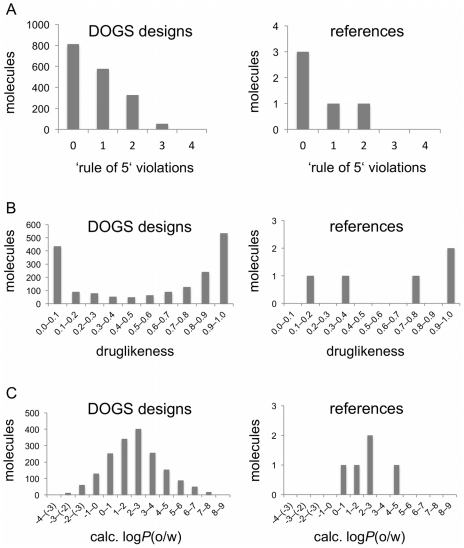
“of Lipinski’s ‘rule of 5’ [25] were recorded for the 1’767 molecules using a descriptor implemented in the software MOE.”
MethodA subset of NSAIDs lower amyloidogenic Aβ42 independently of cyclooxygenase activity
Weggen, S., Eriksen, J. L., Das, P., Sagi, S. A., Wang, R., Pietrzik, C. U., Findlay, K. A., Smith, T. E., Murphy, M. P., Bulter, T., et al. (2001) · Nature · doi:10.1038/35102591 · Cited by 1,388 · cited 1×
“c-Secretase modulators shift the product ratio of APP processing from the highly amyloidogenic Ab42 peptides towards shorter Ab fragments with a lower propensity to aggregate like Ab38 [31,33].”
BackgroundSelf-citationTrypsin Cleaves Exclusively C-terminal to Arginine and Lysine Residues
Olsen, J. V., Ong, S., & Mann, M. (2004) · Molecular & Cellular Proteomics · doi:10.1074/mcp.t400003-mcp200 · Cited by 1,309 · cited 3×
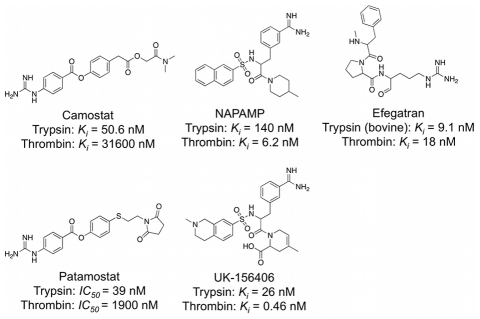
“S1 pocket during peptide bond cleavage [30].”
BackgroundInfluentialThe Chemistry Development Kit (CDK): An Open-Source Java Library for Chemo- and Bioinformatics
Steinbeck, C., Han, Y., Kühn, S., Horlacher, O., Luttmann, E., & Willighagen, E. (2003) · Journal of Chemical Information and Computer Sciences · doi:10.1021/ci025584y · Cited by 1,111 · cited 1×
“2) [23,24].”
Alzheimer's disease: strategies for disease modification
Citron, M. (2010) · Nature Reviews Drug Discovery · doi:10.1038/nrd2896 · Cited by 1,075
Computer-based de novo design of drug-like molecules
Schneider, G., & Fechner, U. (2005) · Nature Reviews Drug Discovery · doi:10.1038/nrd1799 · Cited by 956
Self-citation
Cited by
Sorted by citations
Items 201–257 of 257
Rodrigues, T., & Schneider, G. (2015) · Elsevier eBooks · doi:10.1016/b978-0-12-417205-0.00006-7 · Cited by 5
Self-citationReaction‐Driven De Novo Design: a Keystone for Automated Design of Target Family‐Oriented Libraries
Hartenfeller, M., Renner, S., & Jacoby, E. (2013) · doi:10.1002/9783527677016.ch10 · Cited by 4
Self-citationEnumerable Libraries and Accessible Chemical Space in Drug Discovery
Knehans, T., Boyles, N. A., & Bos, P. H. (2024) · Wiley eBooks · doi:10.1002/9783527840748.ch14 · Cited by 4
Molecule auto-correction to facilitate molecular design
Kerstjens, A., & Winter, H. L. D. (2024) · Journal of Computer-Aided Molecular Design · doi:10.1007/s10822-024-00549-1 · Cited by 4
“A historically popular approach has been to construct chemicals as combinations of smaller molecular fragments, either systematically extracted from reference molecules [14–18] or sourced from commercial reagent libraries [19, 20].”
Piyushbhai, M. K., Sharma, P., Ramalingam, R., Binesh, A., & Venkatachalam, K. (2024) · Current Bioactive Compounds · doi:10.2174/0115734072327345241121185704 · Cited by 5
Kerstjens, A., & Winter, H. L. D. (2023) · Journal of Cheminformatics · doi:10.1186/s13321-023-00761-5 · Cited by 3
Visualization, Exploration, and Screening of Chemical Space in Drug Discovery
Naveja, J. J., Saldívar‐González, F. I., Prado‐Romero, D. L., Ruiz-Moreno, A. J., Velasco-Velázquez, M. A., Miranda‐Quintana, R. A., & Medina‐Franco, J. L. (2024) · Wiley eBooks · doi:10.1002/9783527840748.ch16 · Cited by 4
Huang, C.-H., & Lin, S. (2023) · Journal of Chemical Information and Modeling · doi:10.1021/acs.jcim.3c01745 · Cited by 3
Computational Multi-target Drug Design
Guruprasad, L., Saxena, S., Banerjee, A., & Boggarapu, G. (2025) · Springer handbooks · doi:10.1007/978-3-031-81728-1_28 · Cited by 2
Cheminformatic Analysis of Natural Product Fragments
Reker, D. (2019) · Fortschritte der Chemie Organischer Naturstoffe/Fortschritte der Chemie organischer Naturstoffe/Progress in the chemistry of organic natural products · doi:10.1007/978-3-030-14632-0_5 · Cited by 2
Jocys, Z., Zhu, Z., Willems, H. M. G., & Farrahi, K. (2025) · Artificial Intelligence in the Life Sciences · doi:10.1016/j.ailsci.2025.100148 · Cited by 9
“Reaction Templates We use the publicly available reaction template set (Hartenfeller et al., 2012).”
Pharmacophore Alignment Search Tool (PhAST): Significance Assessment of Chemical Similarity
Hähnke, V. D., Rupp, M., Hartmann, A. K., & Schneider, G. (2013) · Molecular Informatics · doi:10.1002/minf.201300021 · Cited by 2
Self-citation3-D loaded scaffolds obtained by supercritical CO2assisted process
Cardea, S., & Reverchon, E. (2014) · IOP Conference Series Materials Science and Engineering · doi:10.1088/1757-899x/62/1/012004 · Cited by 2
A Deep Molecular Generative Model Based on Multi-Resolution Graph Variational AutoencodersPreprint
Gao, Z., Wang, X., Gaines, B. B., Bi, J., & Song, M. (2021) · ChemRxiv · doi:10.26434/chemrxiv.14692551 · Cited by 3
ViSAS for Entering Chemical Space: Virtual Screening of Analog Series and Related AdvancesPreprint
Naveja-Romero, J. J., Saldívar-González, F. I., Prado-Romero, D. L., Ruiz-Moreno, A. J., Velasco-Velázquez, M. A., Miranda-Quintana, R. A., & Medina‐Franco, J. L. (2022) · ChemRxiv · doi:10.26434/chemrxiv-2022-9t2rj · Cited by 2
PURE: policy-guided unbiased REpresentations for structure-constrained molecular generation
Gupta, A., Lenin, B., Current, S. F., Batra, R., Ravindran, B., Raman, K., & Parthasarathy, S. (2025) · Journal of Cheminformatics · doi:10.1186/s13321-025-01090-5 · Cited by 1
“Several other works exist in the literature, including sampling-based methods [17], search-based methods [18–20], auto encoders and VAEs [21–24], flow models [24–28], GANs [29], transformers [30], diffusion ([31] and genetic algorithms [32].”
In silico-driven protocol for hit-to-lead optimization: a case study on PDE9A inhibitors
Ogawa, H., Ohta, M., & Ikeguchi, M. (2025) · Journal of Computer-Aided Molecular Design · doi:10.1007/s10822-025-00729-7 · Cited by 3
“Molecular generation strategies encompass rule-based methods—R-group enumeration [43–46], reaction-based design [47–49], and matched molecular pair transformations [50–54]—as well as deep generative models [55–58].”
Coping with Complexity in Ligand-Based De Novo Design
Schneider, G., & Schneider, P. (2016) · ACS symposium series · doi:10.1021/bk-2016-1222.ch008 · Cited by 1
Self-citationExploring Virtual Scaffold Spaces
Pitt, W. R., & Kroeplien, B. (2013) · Methods and principles in medicinal chemistry · doi:10.1002/9783527665143.ch05 · Cited by 2
Masquelin, T., Kaerner, A., Bernhardt, R. J., Wang, J., & Nicolaou, C. A. (2021) · Wiley eBooks · doi:10.1002/0471266949.bmc261 · Cited by 1
Construction of Drug‐Like Compounds by Markov Chains
Kutchukian, P. S., Virtanen, S. I., Lounkine, E., Glick, M., & Shakhnovich, E. I. (2013) · Wiley eBooks · doi:10.1002/9783527677016.ch13 · Cited by 1
Is Computer-Assisted Rescaffolding the Future in Lead Generation?
Heßler, G., & Baringhaus, K. H. (2013) · Future Medicinal Chemistry · doi:10.4155/fmc.13.3
In Silico-Guided Design of Novel-Scaffold Therapeutics Targeting the Dopamine D3 Receptor
Hailemicael, D. G. (2014)
Structure generation and de novo design using reaction networks
Wallace, J. E. A. (2016) · White Rose eTheses Online (University of Leeds, The University of Sheffield, University of York)
OBSOLETE: Topical Chemical Space in Relation to Biological Space
Massarotti, A. (2019) · Elsevier eBooks · doi:10.1016/b978-0-12-409547-2.12796-9
Modern Trends in Chemical Reactions Modeling
Varnek, A. A., & Baskin, I. I. (2020) · Elsevier eBooks · doi:10.1016/b978-0-12-801238-3.11543-0
Virtual Screening for Chemists
Saha, I., & Harran, P. G. (2021) · ACS in focus · doi:10.1021/acsinfocus.7e5001
REVIEW OF METHODS FOR AUTOMATIC GENERATION OF MOLECULAR STRUCTURES
Москалев, В. Б. (2021) · doi:10.37539/may191.2021.95.21.002
De novo design and synthesis of biomolecules
Paul, S. S., Dhali, D., Yaseen, Y., Basu, U., Pal, S., Mohammed, N. Y., & Trabelsi, H. (2022) · Elsevier eBooks · doi:10.1016/b978-0-12-824469-2.00020-8
Paratexts and Documentary Practices
Weber, N., & Thomer, A. K. (2019) · IGI Global eBooks · doi:10.4018/978-1-5225-8903-7.ch024 · Cited by 1
SynthI: a new open-source tool for synthon-based library designPreprint
Varnek, A. A., Zabolotna, Y., Volochnyuk, D. M., Ryabukhin, S. V., Gavrylenko, K., Horvath, D., Klimchuk, O., Oksiuta, O., & Marcou, G. (2021) · ChemRxiv · doi:10.26434/chemrxiv-2021-v53hl
Abdelalim, M. (2022) · ChemRxiv · doi:10.26434/chemrxiv-2022-090pf
Elaleem, M. A. (2022) · ChemRxiv · doi:10.26434/chemrxiv-2022-090pf-v2
Chemical Annotation Score – A novel distance metric with application in de novo designPreprint
Canault, B., Pogány, P., & Pickett, S. D. (2022) · Research Square · doi:10.21203/rs.3.rs-2213551/v1
Protein structure-based organic chemistry-driven ligand design from ultra-large chemical spacesPreprint
Rognan, D., Sindt, F., Seyller, A., & Eguida, M. (2024) · Research Square · doi:10.21203/rs.3.rs-3687338/v1
Critical Assessment of Generative Models for de Novo Molecular Structure Generation
Miyao, T. (2023) · Journal of Computer Aided Chemistry · doi:10.2751/jcac.23.1
Chemical Similarity and Substructure Searches
Kriege, N. M., Seidel, T., Humbeck, L., & Lessel, U. F. (2024) · Elsevier eBooks · doi:10.1016/b978-0-323-95502-7.00048-8
Design of bisamide inhibitors of the TASK-1 potassium channel in silico
Liu, L., Liu, J., Chen, L., Na, R., Yang, L., Liu, X., & Zhao, X. (2024) · Physical Chemistry Chemical Physics · doi:10.1039/d4cp03521f
Symmetry-constrained generation of diverse low-bandgap molecules with Monte Carlo tree search
Subramanian, A., Damewood, J., Nam, J., Greenman, K. P., Singhal, A. P., & Gómez‐Bombarelli, R. (2025) · Chemical Science · doi:10.1039/d4sc08675a
Ensemble Guided Fine-Tuning Pre-Trained Models for Kinase Inhibitor Design
Chen, T. S., Chu, J., & Yang, J. M. (2025) · Annual International Conference of the IEEE Engineering in Medicine and Biology Society (EMBC) · doi:10.1109/embc58623.2025.11253376
Additional file 1 of CReM: chemically reasonable mutations framework for structure generation
Полищук, П. Г. (2020) · Figshare · doi:10.6084/m9.figshare.12178002
Kerstjens, A., & Winter, H. L. D. (2024) · Figshare · doi:10.6084/m9.figshare.26619985
Additional file 1 of LEADD: Lamarckian evolutionary algorithm for de novo drug design
Kerstjens, A., & Winter, H. L. D. (2022) · Figshare · doi:10.6084/m9.figshare.18482568
Additional file 1 of ReMODE: a deep learning-based web server for target-specific drug design
Wang, M., Wang, J., Weng, G., Kang, Y., Pan, P., Li, D., Deng, Y., Li, H., HSIEH, C., & Hou, T. (2024) · Figshare · doi:10.6084/m9.figshare.26553248
Additional file 1 of Global reactivity models are impactful in industrial synthesis applications
Neves, P., McClure, K. J., Verhoeven, J., Dyubankova, N., Ирекович, Н. Р., Gedich, A., Menon, S., Shi, Z., & Wegner, J. K. (2024) · Figshare · doi:10.6084/m9.figshare.26567995
Cherti, M. (2018) · theses.fr (ABES) · doi:10.70675/d040b5b4zd926z4f6ez9870z7af586f801ab
Conception d'un logiciel pour la recherche de nouvelles molécules bioactives
Bournez, C. (2019) · theses.fr (ABES) · doi:10.70675/1a4f06f0zdfa4z41efza87az70239c45c50c
A Transformer for Reaction-Aware Compound Explorations with GFlowNet in QSAR-Guided Molecular Design
Nakamura, S., Yasuo, N., & Sekijima, M. (2026) · Journal of Chemical Information and Modeling · doi:10.1021/acs.jcim.6c00181
Zhao, W., Pan, X., Yang, W., LIU, Z., Wei, X., Lin, A., Tang, B., Zhang, L., Xiao, M., Zeng, Q., et al. (2026) · Probiotics and Antimicrobial Proteins · doi:10.1007/s12602-026-11131-6
BindingDB Entry 50047605: Novel approaches to map small molecule-target interactions.
BindingDB (2017) · UC San Diego · doi:10.7270/q2gf0wdk
BindingDB Entry 50047582: De Novo Design at the Edge of Chaos.
BindingDB (2017) · UC San Diego · doi:10.7270/q2fn184p
BindingDB (2017) · UC San Diego · doi:10.7270/q26t0pkn
BindingDB Entry 50019731: Design of Nurr1 Agonists
BindingDB (2024) · UC San Diego · doi:10.7270/q22r3x21
BindingDB (2021) · UC San Diego · doi:10.7270/q25t3pv2
Metadata
- Authors
- Hartenfeller, M., Zettl, H., Walter, M., Rupp, M., Reisen, F., Proschak, E., Weggen, S., Stark, H., & Schneider, G.
- Affiliations
- ETH Zurich (CH)
- Goethe University Frankfurt (DE)
- Heinrich Heine University Düsseldorf (DE)
- Corresponding author
- Schneider, Gisbert
- Venue
- PLoS Computational Biology
- Publisher
- Public Library of Science (PLoS)
- Published
- 2012-02-16
- Volume
- 8
- Issue
- 2
- Pages
- e1002380
- ISSN
- 1553-734X (ISSN-L)
- 1553-7358
- PMC
- PMC3280956
- OpenAlex
- W2052933929
- Cited by
- 251
- References
- 56
- Citations by year
- 2026: 3 · 2025: 13 · 2024: 27 · 2023: 16 · 2022: 25 · 2021: 31 · 2020: 25 · 2019: 23 · 2018: 17 · 2017: 9 · 2016: 15 · 2015: 11 · 2014: 12 · 2013: 17 · 2012: 6
- FWCI
- 15.80
- Type
- journal article
- Language
- en
- Open access
- gold
- doi.org
- Locations
- PLoS Computational Biology (publishedVersion, cc-by)
- PubMed Central (publishedVersion, cc-by)
- PubMed (publishedVersion)
- Repository for Publications and Research Data (ETH Zurich) (publishedVersion, cc-by)
- KOPS (University of Konstanz) (submittedVersion, cc-by)
- DOAJ (DOAJ: Directory of Open Access Journals) (submittedVersion)
- Figshare (submittedVersion, cc-by)
- Publication Server of Goethe University Frankfurt am Main (Goethe University Frankfurt) (submittedVersion, cc-by)
- ETH Zürich Research Collection (cc-by)
- Funders
- Deutsche Forschungsgemeinschaft (BM0806)
- Ministry of Education, India
- Topics
- Life Sciences › Pharmacology, Toxicology and Pharmaceutics › Drug Discovery › Computational Drug Discovery Methods
- Physical Sciences › Chemistry › Organic Chemistry › Synthesis and Characterization of Heterocyclic Compounds
- Physical Sciences › Chemistry › Organic Chemistry › Chemical Synthesis and Analysis
- Keywords
- de novo drug design, ligand-based drug design, synthetic building blocks, scaffold hopping, histamine H4 receptor, gamma-secretase, bioactive compounds, drug-likeness
- MeSH terms
- Receptors, Histamine H4, Algorithms, Automation, Computers, Humans, Ligands, Models, Chemical, Receptors, Histamine, Software, Technology, Pharmaceutical, Drug Design, Models, Statistical, Molecular Structure, Computational Biology, Receptors, G-Protein-Coupled, Amyloid Precursor Protein Secretases
About these checks
Registry, retraction, Cites and statistics results are computed, not judged, with one exception: a printed reference that no index lists is read once by a model before it counts as a citation error. Claims are extracted by a model and kept only when their quote appears verbatim in the text; each cited source is then checked, with a model’s help, for whether it says what the claim relies on. Those verdicts can be wrong — read the claim’s quote and the cited source before relying on one.
Statistics and arithmetic are recomputed, not judged.
Confidence bands are shown only for fields calibrated on our annotated test set. None is calibrated yet, so no band is shown.
What counts as a claim ›How we measure confidence ›How we check this ›
Are you an author, or do you see a problem with this page? Request a review
