

The DOI matches its Crossref record; 57 of the 58 references it cites were found in a registry or an index.
miRTex: A Text Mining System for miRNA-Gene Relation Extraction
Open accessAbstract
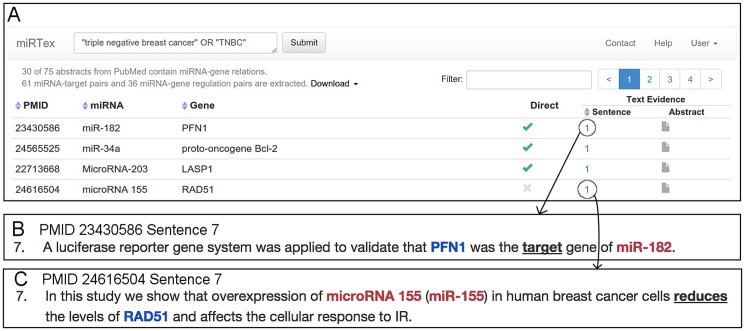
MicroRNAs (miRNAs) regulate a wide range of cellular and developmental processes through gene expression suppression or mRNA degradation. Experimentally validated miRNA gene targets are often reported in the literature. In this paper, we describe miRTex, a text mining system that extracts miRNA-target relations, as well as miRNA-gene and gene-miRNA regulation relations. The system achieves good precision and recall when evaluated on a literature corpus of 150 abstracts with F-scores close to 0.90 on the three different types of relations. We conducted full-scale text mining using miRTex to process all the Medline abstracts and all the full-length articles in the PubMed Central Open Access Subset. The results for all the Medline abstracts are stored in a database for interactive query and file download via the website at http://proteininformationresource.org/mirtex. Using miRTex, we identified genes potentially regulated by miRNAs in Triple Negative Breast Cancer, as well as miRNA-gene relations that, in conjunction with kinase-substrate relations, regulate the response to abiotic stress in Arabidopsis thaliana. These two use cases demonstrate the usefulness of miRTex text mining in the analysis of miRNA-regulated biological processes.
Overview
The claims and statistics of this paper haven’t been checked yet.
Free: it reads the open-access text and checks the first 5 claims that cite a source we can check. Create a free account to check every claim.
Integrity signals
Registry
Cites
Statistics
Figures




Verification
Claims the paper makes
The claims and statistics of this paper haven’t been checked yet.
Free: it reads the open-access text and checks the first 5 claims that cite a source we can check. Create a free account to check every claim.
Claims other papers make about this one
Each is checked against this paper’s own text: does it say what the citing paper says it does?
The check wasn’t confident either way, so it gives no verdict — never disputed.
In the citing paper
“our results demonstrate that problematic articles are already indexed within gene knowledge bases (32, 33, 34, 35, 36).”
From Identification of human gene research articles with wrongly identified nucleotide sequences (2022) · cites this paper as [32]
Experimental — accuracy not yet measured
Self-check
Percentages, sums and reported differences re-computed from the paper’s own numbers.
The self-check needs the paper’s full text.
Citations
Cites
LIBSVM: A library for support vector machines
Chang, C.-C., & Lin, C.-J. (2011) · ACM Transactions on Intelligent Systems and Technology · doi:10.1145/1961189.1961199 · Cited by 40,918
An Introduction to Support Vector Machines and Other Kernel-based Learning Methods
Cristianini, N., & Shawe-Taylor, J. (2000) · doi:10.1017/cbo9780511801389 · Cited by 13,855
The C. elegans heterochronic gene lin-4 encodes small RNAs with antisense complementarity to lin-14
Lee, R. C., Feinbaum, R. L., & Ambros, V. (1993) · Cell · doi:10.1016/0092-8674(93)90529-y · Cited by 12,948
The Stanford CoreNLP Natural Language Processing Toolkit
Manning, C., Surdeanu, M., Bauer, J., Finkel, J., Bethard, S., & McClosky, D. (2014) · Proceedings of 52nd Annual Meeting of the Association for Computational Linguistics: System Demonstrations · doi:10.3115/v1/p14-5010 · Cited by 7,037
Cytoscape 2.8: new features for data integration and network visualization
Smoot, M. E., Ono, K., Ruscheinski, J., Wang, P.-L., & Ideker, T. (2011) · Bioinformatics · doi:10.1093/bioinformatics/btq675 · Cited by 4,830
STRING v9.1: protein-protein interaction networks, with increased coverage and integration
Franceschini, A., Szklarczyk, D., Frankild, S., Kuhn, M., Simonovic, M., Roth, A., Lin, J., Minguez, P., Bork, P., von Mering, C., et al. (2012) · Nucleic Acids Research · doi:10.1093/nar/gks1094 · Cited by 4,398
Regulation of mRNA Translation and Stability by microRNAs
Fabian, M. R., Sonenberg, N., & Filipowicz, W. (2010) · Annual Review of Biochemistry · doi:10.1146/annurev-biochem-060308-103103 · Cited by 3,214 · cited 1×
“miRNAs have been found to regulate a wide range of cellular and development processes through gene expression suppression or mRNA degradation [2].”
BackgroundGriffiths-Jones, S. (2004) · Nucleic Acids Research · doi:10.1093/nar/gkh023 · Cited by 2,220
Activities at the Universal Protein Resource (UniProt)
(2014) · Nucleic Acids Research · doi:10.1093/nar/gkt1140 · Cited by 1,735
A uniform system for microRNA annotation
AMBROS, V., BARTEL, B., BARTEL, D. P., BURGE, C. B., CARRINGTON, J. C., CHEN, X., DREYFUSS, G., EDDY, S. R., GRIFFITHS-JONES, S., MARSHALL, M., et al. (2003) · RNA · doi:10.1261/rna.2183803 · Cited by 1,553
Research works printed but not linked: 1
- C-C Chang, 2011, ACM Trans Intell Syst Technol, 2, 27:1
Cited by
Deep learning with word embeddings improves biomedical named entity recognition
Habibi, M., Weber, L., Neves, M., Wiegandt, D. L., & Leser, U. (2017) · Bioinformatics · doi:10.1093/bioinformatics/btx228 · Cited by 542
Constructing knowledge graphs and their biomedical applications
Nicholson, D. N., & Greene, C. S. (2020) · Computational and Structural Biotechnology Journal · doi:10.1016/j.csbj.2020.05.017 · Cited by 299
Information retrieval and text mining technologies for chemistry
Krallinger, M., Rabal, O., Lourenço, A., Oyarzabal, J., & Valencia, A. (2017) · Chemical Reviews · doi:10.1021/acs.chemrev.6b00851 · Cited by 281
Cross-type biomedical named entity recognition with deep multi-task learning
Wang, X., Zhang, Y., Ren, X., Zhang, Y., Zitnik, M., Shang, J., Langlotz, C., & Han, J. (2019) · Bioinformatics · doi:10.1093/bioinformatics/bty869 · Cited by 273
Transfer learning for biomedical named entity recognition with neural networks
Giorgi, J. M., & Bader, G. D. (2018) · Bioinformatics · doi:10.1093/bioinformatics/bty449 · Cited by 188
Metadata
- Authors
- Li, G., Ross, K. E., Arighi, C. N., Peng, Y., Wu, C. H., & Vijay-Shanker, K.
- Affiliations
- University of Delaware (US)
- Georgetown University Medical Center (US)
- Corresponding author
- Li, Gang
- Venue
- PLOS Computational Biology
- Publisher
- Public Library of Science (PLoS)
- Published
- 2015-09-25
- Volume
- 11
- Issue
- 9
- Pages
- e1004391
- ISSN
- 1553-734X (ISSN-L)
- 1553-7358
- PMC
- PMC4583433
- OpenAlex
- W1941318214
- Cited by
- 61
- References
- 58
- Citations by year
- 2026: 3 · 2025: 1 · 2024: 6 · 2023: 2 · 2022: 4 · 2021: 6 · 2020: 5 · 2019: 7 · 2018: 10 · 2017: 10 · 2016: 7
- FWCI
- 3.91
- Type
- journal article
- Language
- en
- Open access
- gold
- doi.org
- Licence
- Locations
- PLoS Computational Biology (publishedVersion, cc-by)
- Europe PMC (PubMed Central) (publishedVersion, cc-by)
- PubMed Central (publishedVersion, cc-by)
- PubMed (publishedVersion)
- RePEc: Research Papers in Economics (submittedVersion)
- DOAJ (DOAJ: Directory of Open Access Journals) (submittedVersion, cc-by-sa)
- Figshare (submittedVersion, cc-by)
- Funders
- National Science Foundation (P20 GM103446, 1062520)
- Delaware IDeA Network of Biomedical Research Excellence (P20‐GM103446)
- National Institutes of Health (GM103446)
- National Institute of General Medical Sciences (P20GM103446)
- Topics
- Health Sciences › Medicine › Health Informatics › Biomedical Text Mining and Ontologies
- Life Sciences › Biochemistry, Genetics and Molecular Biology › Cancer Research › MicroRNA in disease regulation
- Life Sciences › Biochemistry, Genetics and Molecular Biology › Molecular Biology › Bioinformatics and Genomic Networks
- Keywords
- microRNA, gene expression regulation, text mining, literature mining, MEDLINE abstracts, PubMed Central, triple-negative breast cancer, abiotic stress response, Arabidopsis thaliana
- MeSH terms
- Genes, Humans, Models, Genetic, Periodicals as Topic, Computational Biology, Databases, Genetic, MicroRNAs, Data Mining
About these checks
Registry, retraction, Cites and statistics results are computed, not judged, with one exception: a printed reference that no index lists is read once by a model before it counts as a citation error. Claims are extracted by a model and kept only when their quote appears verbatim in the text; each cited source is then checked, with a model’s help, for whether it says what the claim relies on. Those verdicts can be wrong — read the claim’s quote and the cited source before relying on one.
Statistics and arithmetic are recomputed, not judged.
Confidence bands are shown only for fields calibrated on our annotated test set. None is calibrated yet, so no band is shown.
What counts as a claim ›How we measure confidence ›How we check this ›
Are you an author, or do you see a problem with this page? Request a review
How to cite
Cite CoChat for the checks on this page, and the paper for its own findings.
- This page
- CoChat. (2026). Citation check: miRTex: A Text Mining System for miRNA-Gene Relation Extraction. https://app.cochat.ai/papers/10.1371/journal.pcbi.1004391
- The paper
- Li, G., Ross, K. E., Arighi, C. N., Peng, Y., Wu, C. H., & Vijay-Shanker, K. (2015). miRTex: A Text Mining System for miRNA-Gene Relation Extraction. PLOS Computational Biology. https://doi.org/10.1371/journal.pcbi.1004391
Data sources
Bibliographic data: Semantic Scholar, OpenAlex, Crossref.
Contains information from the Semantic Scholar Academic Graph Datasets, made available under the ODC Attribution License (ODC-BY 1.0).
Semantic Scholar’s data is described in: Kinney, R., et al. (2023). The Semantic Scholar Open Data Platform. arXiv:2301.10140.
