

The Multilayer Connectome of Caenorhabditis elegans
Open accessThe DOI matches its Crossref record; 137 of the 137 references it cites were found in a registry or an index.
Abstract
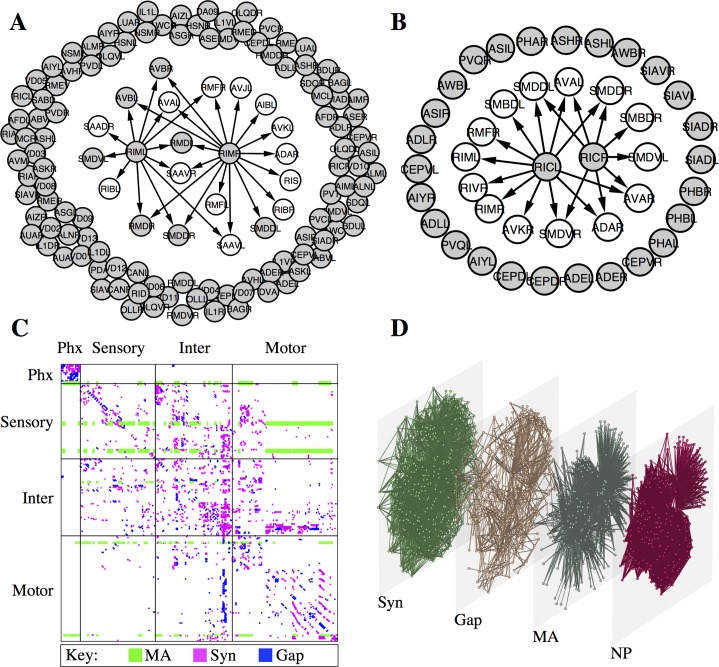
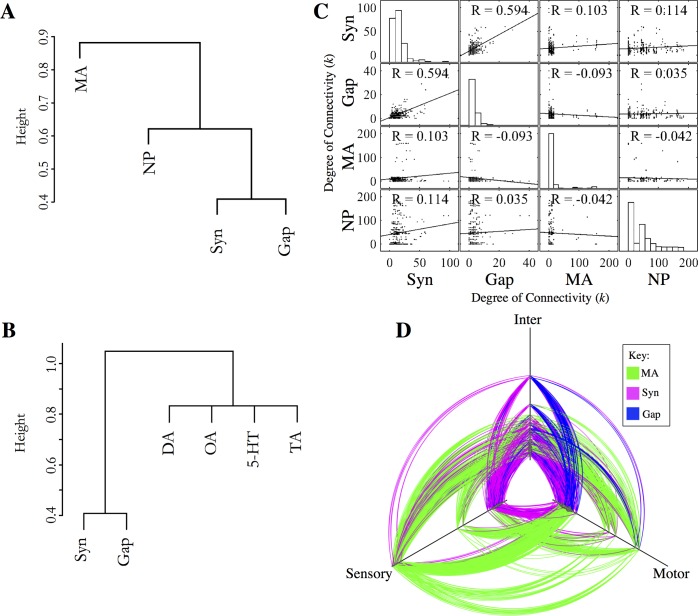
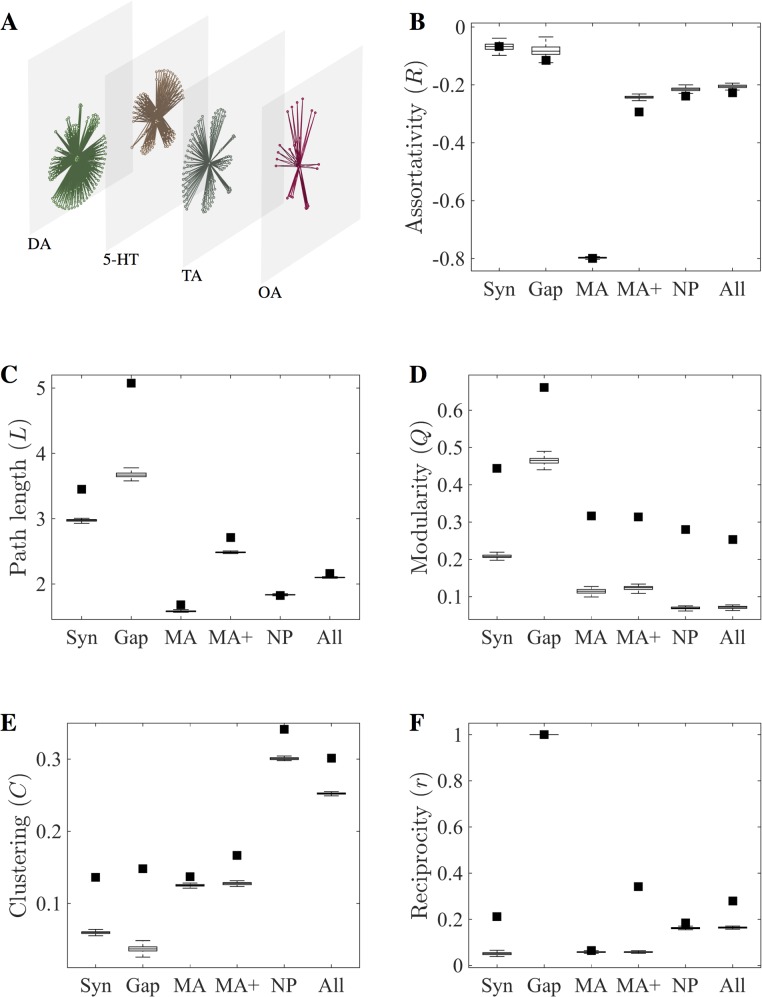
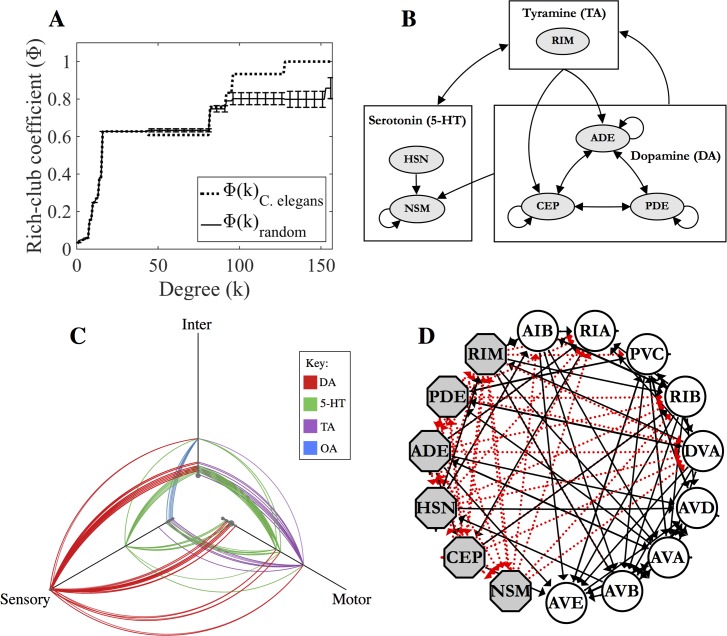
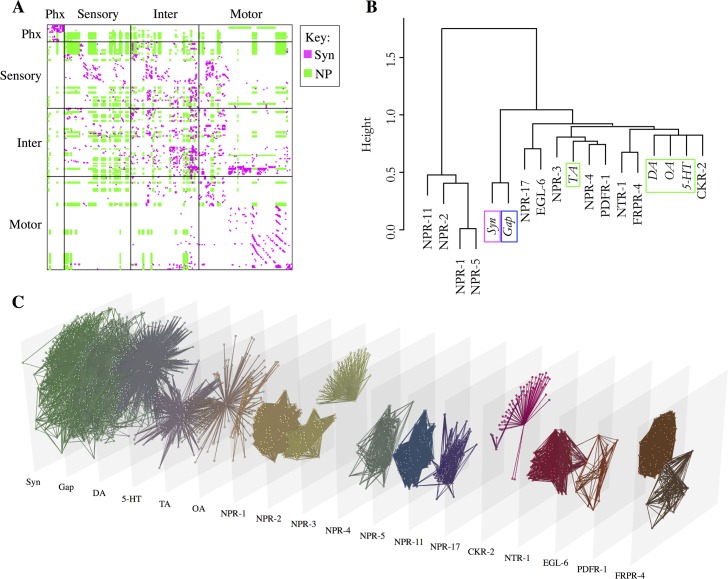
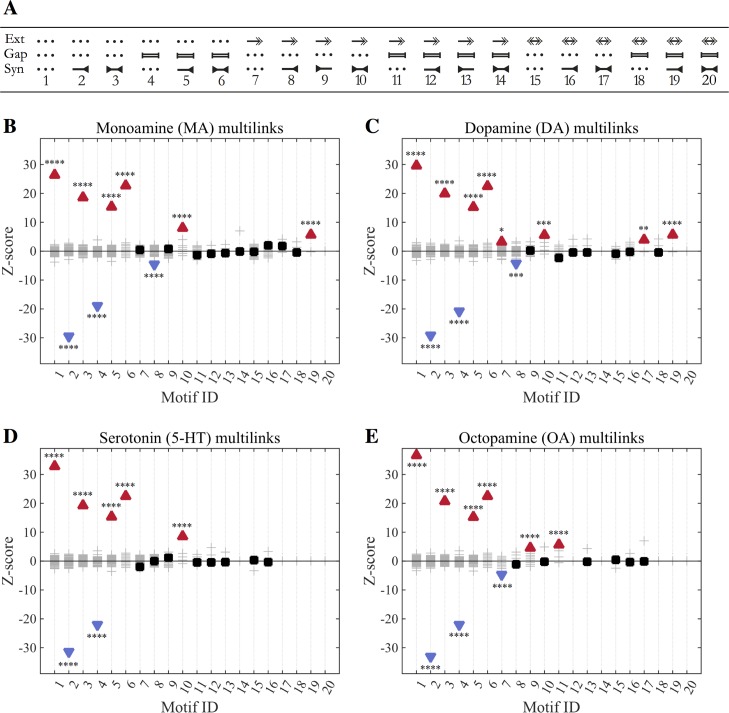
Connectomics has focused primarily on the mapping of synaptic links in the brain; yet it is well established that extrasynaptic volume transmission, especially via monoamines and neuropeptides, is also critical to brain function and occurs primarily outside the synaptic connectome. We have mapped the putative monoamine connections, as well as a subset of neuropeptide connections, in C. elegans based on new and published gene expression data. The monoamine and neuropeptide networks exhibit distinct topological properties, with the monoamine network displaying a highly disassortative star-like structure with a rich-club of interconnected broadcasting hubs, and the neuropeptide network showing a more recurrent, highly clustered topology. Despite the low degree of overlap between the extrasynaptic (or wireless) and synaptic (or wired) connectomes, we find highly significant multilink motifs of interaction, pinpointing locations in the network where aminergic and neuropeptide signalling modulate synaptic activity. Thus, the C. elegans connectome can be mapped as a multiplex network with synaptic, gap junction, and neuromodulator layers representing alternative modes of interaction between neurons. This provides a new topological plan for understanding how aminergic and peptidergic modulation of behaviour is achieved by specific motifs and loci of integration between hard-wired synaptic or junctional circuits and extrasynaptic signals wirelessly broadcast from a small number of modulatory neurons.
Overview
The claims and statistics of this paper haven’t been checked yet.
Free: it reads the open-access text and checks the first 5 claims that cite a source we can check. Create a free account to check every claim.
Integrity signals
Registry
Cites
Statistics
Figures
Verification
Claims the paper makes
The claims and statistics of this paper haven’t been checked yet.
Free: it reads the open-access text and checks the first 5 claims that cite a source we can check. Create a free account to check every claim.
Claims other papers make about this one
Each is checked against this paper’s own text: does it say what the citing paper says it does?
The cited source says what the claim attributes to it.
In the citing paper
“Here, the analysis of reducibility revealed that the monoamine networks have a unique structure, with information complementary to that provided by neuropeptide networks 90 .”
From Complex networks from classical to quantum (2019) · cites this paper as [90]
The cited source says what the claim attributes to it.
In the citing paper
“the connectome of the nematode Caenorhabditis elegans -one of the most studied in the fi eld because of its small size, with ~300 neuronal cells -has been mapped to a multiplex network where layers encode synaptic, gap junction, and neuromodulator interactions.”
From Complex networks from classical to quantum (2019) · cites this paper as [90]
Self-check
Percentages, sums and reported differences re-computed from the paper’s own numbers.
The self-check needs the paper’s full text.
Citations
Cites
Cytoscape: A software Environment for integrated models of biomolecular interaction networks
Shannon, P., Markiel, A., Ozier, O., Baliga, N. S., Wang, J. T., Ramage, D., Amin, N., Schwikowski, B., & Ideker, T. (2003) · Genome Research · doi:10.1101/gr.1239303 · Cited by 51,888
Collective dynamics of ‘small-world’ networks
Watts, D. J., & Strogatz, S. H. (1998) · Nature · doi:10.1038/30918 · Cited by 43,060 · cited 2×
“Here we present a draft monoamine connectome, along with a partial neuropeptide connectome, for the nematode C. elegans, based on new and published expression PLOS Computational Biology | DOI:10.1371/journal.pcbi.1005283 December 16, 2016 1 / 31 OPENACCESS Citation: Bentley B, Branicky R, Barnes…”
BackgroundMethodInfluentialEmergence of Scaling in Random Networks
Barabási, A.-L., & Albert, R. (1999) · Science · doi:10.1126/science.286.5439.509 · Cited by 36,135
Hierarchical Grouping to Optimize an Objective Function
Ward, J. H. (1963) · Journal of the American Statistical Association · doi:10.1080/01621459.1963.10500845 · Cited by 20,598
The Structure and Function of Complex Networks
Newman, M. E. J. (2003) · SIAM Review · doi:10.1137/s003614450342480 · Cited by 18,719
Social Network Analysis: Methods and Applications
Wasserman, S. S., & Faust, K. (1994) · Cited by 17,989
Modularity and community structure in networks
Newman, M. E. J. (2006) · Proceedings of the National Academy of Sciences · doi:10.1073/pnas.0601602103 · Cited by 12,256 · cited 1×
“(DOCX)”
Complex brain networks: graph theoretical analysis of structural and functional systems
Bullmore, E., & Sporns, O. (2009) · Nature Reviews Neuroscience · doi:10.1038/nrn2575 · Cited by 11,820
Self-citationComplex network measures of brain connectivity: Uses and interpretations
Rubinov, M., & Sporns, O. (2010) · NeuroImage · doi:10.1016/j.neuroimage.2009.10.003 · Cited by 11,522
The structure of the nervous system of the nematode Caenorhabditis elegans
White, J. G., Southgate, E., Thomson, J. N., & Brenner, S. (1986) · Philosophical Transactions of the Royal Society of London. B, Biological Sciences · doi:10.1098/rstb.1986.0056 · Cited by 5,589 · cited 1×
“The monoamine and neuropeptide networks exhibit distinct topological properties, with the monoamine network displaying a highly disassortative star-like structure with a rich- club of interconnected broadcasting hubs, and the neuropeptide network showing a more recurrent, highly clustered topology.”
Background
Cited by
Bassett, D. S., & Sporns, O. (2017) · Nature Neuroscience · doi:10.1038/nn.4502 · Cited by 2,398
“Building on the as yet unparalleled achievement of mapping the neuronal wiring of the nematode C. elegans 10 , the reconstruction of synaptic connectivity among neurons at the ultrastructural level has evolved rapidly, as has measurement of extra-synaptic connectivity 11 .”
BackgroundGeneration of circadian rhythms in the suprachiasmatic nucleus
Hastings, M. H., Maywood, E. S., & Brancaccio, M. (2018) · Nature Reviews Neuroscience · doi:10.1038/s41583-018-0026-z · Cited by 1,065
Network science of biological systems at different scales: A review
Gosak, M., Markovič, R., Dolenšek, J., Slak Rupnik, M., Marhl, M., Stožer, A., & Perc, M. (2018) · Physics of Life Reviews · doi:10.1016/j.plrev.2017.11.003 · Cited by 419
“…signals propagating through synapses and neuronal dendrites, or with diffusion of ions through gap junctions [131,185] Later, Bentley et al. [186] expanded this representation by additionally integrating monoamine neuromodulator layers It has been argued that the multilayer approach…”
BackgroundThe physics of brain network structure, function and control
Lynn, C. W., & Bassett, D. S. (2019) · Nature Reviews Physics · doi:10.1038/s42254-019-0040-8 · Cited by 400
Hulse, B. K., Haberkern, H., Franconville, R., Turner-Evans, D., Takemura, S.-Y., Wolff, T., Noorman, M., Dreher, M., Dan, C., Parekh, R., et al. (2021) · eLife · doi:10.7554/elife.66039 · Cited by 392
Metadata
- Authors
- Bentley, B., Branicky, R., Barnes, C. L., Chew, Y. L., Yemini, E., Bullmore, E. T., Vértes, P. E., & Schafer, W. R.
- Affiliations
- MRC Laboratory of Molecular Biology (GB)
- Howard Hughes Medical Institute (US)
- Columbia University (US)
- GlaxoSmithKline (United Kingdom) (GB)
- University of Cambridge (GB)
- Corresponding author
- Schafer, William R.
- ORCID
- Venue
- PLOS Computational Biology
- Publisher
- Public Library of Science (PLoS)
- Published
- 2016-12-16
- Volume
- 12
- Issue
- 12
- Pages
- e1005283
- ISSN
- 1553-734X (ISSN-L)
- 1553-7358
- PMC
- PMC5215746
- OpenAlex
- W2514803758
- Cited by
- 269
- References
- 136
- Citations by year
- 2026: 6 · 2025: 21 · 2024: 22 · 2023: 24 · 2022: 33 · 2021: 34 · 2020: 27 · 2019: 27 · 2018: 53 · 2017: 21 · 2016: 1
- FWCI
- 19.07
- Type
- journal article
- Language
- en
- Update notices
- new_version (2017-01-04)
- Open access
- gold
- doi.org
- Licence
- Locations
- PLoS Computational Biology (publishedVersion, cc-by)
- Europe PMC (PubMed Central) (publishedVersion, cc-by)
- PubMed Central (publishedVersion, cc-by)
- PubMed (publishedVersion)
- arXiv (Cornell University) (submittedVersion)
- Apollo (University of Cambridge) (submittedVersion, cc-by)
- DOAJ (DOAJ: Directory of Open Access Journals) (submittedVersion, cc-by-sa)
- Figshare (submittedVersion, cc-by)
- Queen Mary Research Online (Queen Mary University of London) (submittedVersion, cc-by)
- arXiv (Cornell University)
- Apollo (cc-by)
- Columbia Academic Commons (Columbia University)
- Funders
- Wellcome Trust (WT103784MA)
- Medical Research Council (MC-A022-5PB91, MR/K020706/1)
- National Institutes of Health (5T32DK007328-37)
- Topics
- Life Sciences › Neuroscience › Cellular and Molecular Neuroscience › Neurobiology and Insect Physiology Research
- Life Sciences › Neuroscience › Cellular and Molecular Neuroscience › Neuroscience and Neuropharmacology Research
- Life Sciences › Neuroscience › Cognitive Neuroscience › Neural dynamics and brain function
- Keywords
- Caenorhabditis elegans, connectome, monoamine signaling, neuropeptide signaling, gap junctions, neuromodulation, multiplex networks, network motifs, network topology, synaptic connectivity, modulatory neurons, gene expression
- MeSH terms
- Animals, Biogenic Monoamines, Signal Transduction, Caenorhabditis elegans, Computational Biology, Connectome
About these checks
Registry, retraction, Cites and statistics results are computed, not judged, with one exception: a printed reference that no index lists is read once by a model before it counts as a citation error. Claims are extracted by a model and kept only when their quote appears verbatim in the text; each cited source is then checked, with a model’s help, for whether it says what the claim relies on. Those verdicts can be wrong — read the claim’s quote and the cited source before relying on one.
Statistics and arithmetic are recomputed, not judged.
Confidence bands are shown only for fields calibrated on our annotated test set. None is calibrated yet, so no band is shown.
What counts as a claim ›How we measure confidence ›How we check this ›
Are you an author, or do you see a problem with this page? Request a review
Data sources
Bibliographic data: Semantic Scholar, OpenAlex, Crossref.
Contains information from the Semantic Scholar Academic Graph Datasets, made available under the ODC Attribution License (ODC-BY 1.0).
Semantic Scholar’s data is described in: Kinney, R., et al. (2023). The Semantic Scholar Open Data Platform. arXiv:2301.10140.
