

A HIF1α Regulatory Loop Links Hypoxia and Mitochondrial Signals in Pheochromocytomas
Open accessThe DOI matches its Crossref record; 44 of the 46 references it cites were found in a registry or an index; 4 of the 31 sources its claims cite were checked for support.
Abstract
Pheochromocytomas are neural crest-derived tumors that arise from inherited or sporadic mutations in at least six independent genes. The proteins encoded by these multiple genes regulate distinct functions. We show here a functional link between tumors with VHL mutations and those with disruption of the genes encoding for succinate dehydrogenase (SDH) subunits B (SDHB) and D (SDHD). A transcription profile of reduced oxidoreductase is detected in all three of these tumor types, together with an angiogenesis/hypoxia profile typical of VHL dysfunction. The oxidoreductase defect, not previously detected in VHL-null tumors, is explained by suppression of the SDHB protein, a component of mitochondrial complex II. The decrease in SDHB is also noted in tumors with SDHD mutations. Gain-of-function and loss-of-function analyses show that the link between hypoxia signals (via VHL) and mitochondrial signals (via SDH) is mediated by HIF1alpha. These findings explain the shared features of pheochromocytomas with VHL and SDH mutations and suggest an additional mechanism for increased HIF1alpha activity in tumors.
Overview
CoChat Summary
TL;DR
This study links pheochromocytomas with VHL mutations to those with SDHB or SDHD mutations through a shared hypoxia/angiogenesis and reduced oxidoreductase expression signature. It proposes a HIF1α–SDHB regulatory loop in which HIF1α suppresses SDHB, impairing mitochondrial complex II and further stabilizing HIF1α.
Key findings
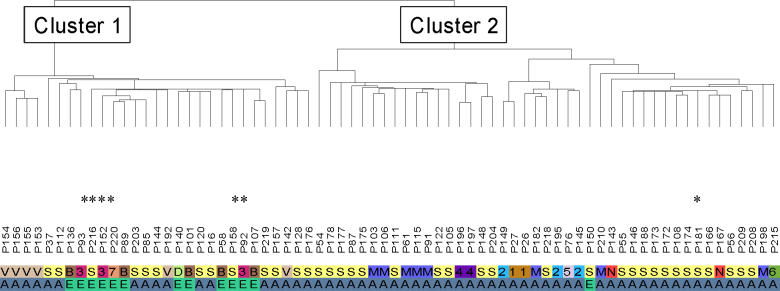
- Unsupervised clustering of 76 primary pheochromocytomas/paragangliomas identified two dominant clusters: Cluster 1 contained all VHL and SDH tumors, while Cluster 2 contained all MEN2 and NF1 tumors; Cluster 1 included 12 of 13 extra-adrenal tumors, though more than half of Cluster 1 tumors were adrenal.
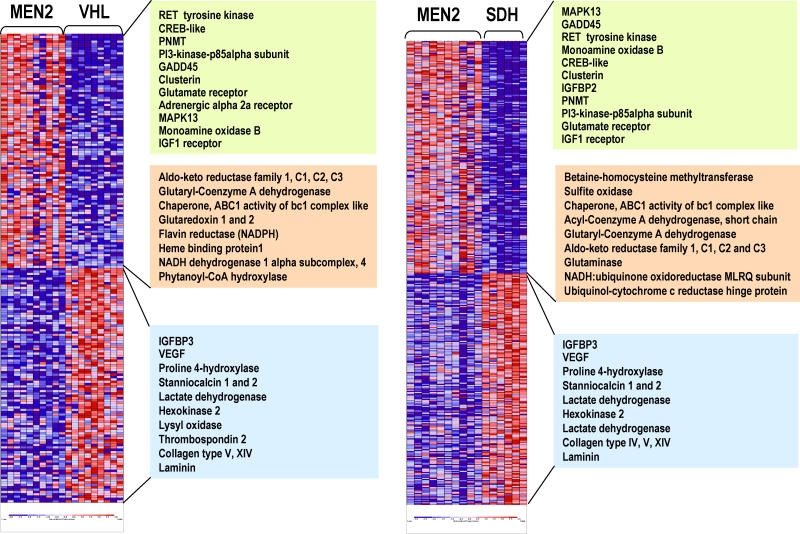
- Cluster 1 tumors showed a hypoxia/angiogenesis signature plus coordinated suppression of oxidoreductase enzymes; supervised predictors distinguished MEN2 from VHL and MEN2 from SDH tumors with extensive gene overlap, and over 92% of the cohort was correctly assigned to one of the two classes.
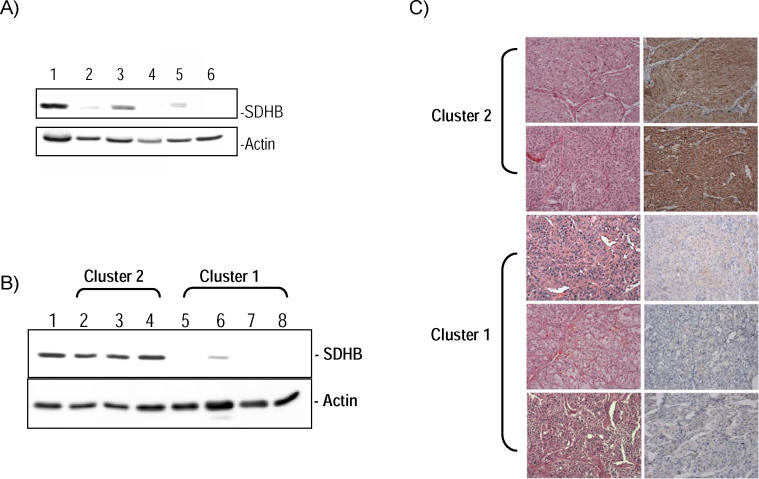
- SDHB protein was reduced in all tumors with SDH mutations and also suppressed in the majority of VHL-mutant and sporadic Cluster 1 tumors tested by immunoblot; SDHB immunostaining was highly concordant with immunoblot findings.
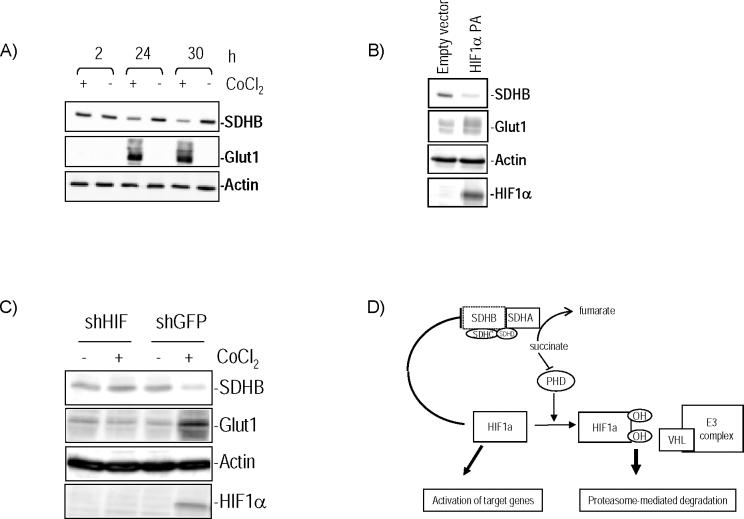
- In cell models, cobalt chloride reduced SDHB protein, expression of nondegradable HIF1αP402A/P564A downregulated SDHB, and HIF1α shRNA prevented cobalt chloride–induced SDHB reduction, supporting HIF1α-dependent SDHB regulation.
Methods
- Tumor specimens: 76 catecholamine-secreting pheochromocytomas or paragangliomas, including hereditary, familial undetermined, and sporadic tumors; 13 were extra-adrenal; no head/neck paragangliomas or SDHC-mutant tumors were included.
- Expression profiling: 84 tumor samples including six replicates were hybridized to Affymetrix U133A arrays; after excluding four poor-quality scans, 76 unique tumors were analyzed using dChip normalization, unsupervised hierarchical clustering, supervised k-nearest neighbor and weighted-voting models, and GSEA.
- Validation: DNA sequencing of RET, VHL, SDHD, SDHB, and SDHC in familial samples and 20 sporadic tumors; quantitative real-time PCR, Western blotting, immunohistochemistry, and cell-line experiments in HEK293, MPC 9/3L, and A2058 cells with cobalt chloride, HIF1α mutant, or HIF1α shRNA.
Limitations
- The paper states that limited tumor material prevented quantitation of HIF1α and HIF2α protein levels in primary samples.
- The paper states that HIF1α effects were less marked than those of hypoxia-mimetic agents, suggesting additional factors besides HIF1α may be involved in SDHB suppression, and that the precise mechanisms linking HIF1α and SDHB remain to be identified.
- The paper notes that long-term follow-up was not available to precisely define one VHL family as VHL type 2C; evident from the text, the series excluded head/neck paragangliomas and SDHC-mutant tumors, and only 20 sporadic tumors were sequenced.
Model-written summary. Check it against the paper before relying on it.
Integrity signals
Registry
Cites
Statistics
Figures
Verification
Claims the paper makes
2 Valid · 1 Not valid · 19 Not checked · 72 Own results and interpretations
Some cited sources support this claim and some don’t — read each source’s verdict below.
In the paper
“The two prototype genes of Cluster 2 (RET and NF1) are linked by their common ability to activate the RAS/RAF/MAP kinase signaling cascade [16,17].”
§ A HIF1α Regulatory Loop Links Hypoxia and Mitochondrial Signals in Pheochromocytomas > Results > Suppressed SDHB Expression Is a Common Feature of VHL and SDH Tumors
What the sources say
- Disputedcites [16] Ballester R Marchuk D Boguski M Saulino A Letcher R 1990 The NF1 locus encodes a protein functionally related to mammalian GAP and yeast IRA proteins Cell 63 851 859 2121371 sourceExperimental — accuracy not yet measured
The Abstract (page not supplied) reports that an NF1 segment inhibits both wild-type and activated H-ras in yeast, contrary to the claim that NF1 activates the signaling cascade. The paper establishes a functional link between NF1 and RAS, but it does not report that NF1 and RET share an ability to activate a RAS/RAF/MAP kinase cascade. (LLM, conf=0.88)
Checked by a reasoning model — may be wrong.
- Partly supportedcites [17] Califano D Rizzo C D'Alessio A Colucci-D'Amato GL Cali G 2000 Signaling through Ras is essential for ret oncogene-induced cell differentiation in PC12 cells J Biol Chem 275 19297 19305 10748077 sourceExperimental — accuracy not yet measured
The paper reports that active RET mutants trigger Ras signaling in PC12 cells, and its discussion links RET to the Ras/MAP kinase pathway (Discussion; page not provided). It does not address NF1, so it cannot establish the claimed common ability of RET and NF1 to activate the cascade. (LLM, conf=0.86)
plainstates an association- Asserted: passes — The authors put it forward as true.
- Checkable: passes — It can be checked against evidence.
- Load-bearing: passes — The paper’s conclusions depend on it.
- Based: passes — The paper gives a reason why it holds.
- Disputed
The cited sources support only part of this claim — read each source’s verdict below.
In the paper
“Mitochondrial complex II is a component of the electron transport chain, and mutations of SDHB or SDHD genes that abrogate the oxidoreductase function of complex II can cause pheochromocytomas [9,14,15].”
§ A HIF1α Regulatory Loop Links Hypoxia and Mitochondrial Signals in Pheochromocytomas > Results > Suppressed SDHB Expression Is a Common Feature of VHL and SDH Tumors
What the sources say
- Partly supportedcites [9] Gimenez-Roqueplo AP Favier J Rustin P Mourad JJ Plouin PF 2001 The R22X mutation of the SDHD gene in hereditary paraganglioma abolishes the enzymatic activity of complex II in the mitochondrial respiratory chain and activates the hypoxia pathway Am J Hum Genet 69 1186 1197 11605159 PMC1235531 sourceExperimental — accuracy not yet measured
Our copy squarely supports the SDHD branch: the Results (Enzyme-Function Studies) and Abstract report that the R22X SDHD mutation with maternal LOH gave 'a complete and selective loss of complex II enzymatic activity in the inherited pheochromocytoma', and the Discussion links that defect to angiogenic-factor overproduction and tumour growth (though hedged: 'probably involved … possibly in tumor development', 'unclear whether the activation of hypoxia pathways is or is not sufficient to induce tumorigenesis by itself'). The SDHB branch is not this paper's finding: the Introduction only credits 'inactivating SDHB gene mutations … detected in two kindreds' to Astuti et al. 2001b, without measuring complex II activity or specifying pheochromocytoma for SDHB. So only half of the disjunctive claim, plus its causal strength, is carried by this source. (LLM, conf=0.70)
- Not checked yetcites [14] Gimenez-Roqueplo AP Favier J Rustin P Rieubland C Kerlan V 2002 Functional consequences of a SDHB gene mutation in an apparently sporadic pheochromocytoma J Clin Endocrinol Metab 87 4771 4774 12364472 source
- Not checked yetcites [15] Yankovskaya V Horsefield R Tornroth S Luna-Chavez C Miyoshi H 2003 Architecture of succinate dehydrogenase and reactive oxygen species generation Science 299 700 704 12560550 source
plainstates a cause- Asserted: passes — The authors put it forward as true.
- Checkable: passes — It can be checked against evidence.
- Load-bearing: passes — The paper’s conclusions depend on it.
- Based: passes — The paper gives a reason why it holds.
- Partly supported
The cited sources support only part of this claim — read each source’s verdict below.
In the paper
“These clinical observations and the finding of increased expression of HIF targets in tumors with SDH mutations [9,10] have suggested the possibility that the VHL and SDH syndromes intersect at the molecular level.”
§ A HIF1α Regulatory Loop Links Hypoxia and Mitochondrial Signals in Pheochromocytomas > Introduction
What the sources say
- Partly supportedcites [9] Gimenez-Roqueplo AP Favier J Rustin P Mourad JJ Plouin PF 2001 The R22X mutation of the SDHD gene in hereditary paraganglioma abolishes the enzymatic activity of complex II in the mitochondrial respiratory chain and activates the hypoxia pathway Am J Hum Genet 69 1186 1197 11605159 PMC1235531 sourceExperimental — accuracy not yet measured
Our copy fully supports the HIF-target half of the sentence: the Abstract reports VEGF and EPAS1/HIF2α mRNA three- and sixfold higher in the SDHD-mutant (R22X) pheochromocytoma than in sporadic controls, the Results (fig. 7) give the Mann-Whitney statistics for that increase, and the Discussion describes 'strong expression of hypoxia-inducible transcription factors (EPAS1/HIF2α and HIF1α) and genes encoding some of the targets of these factors' in the paragangliomas, alongside the family's clinical observations. What the source does not contain is the convergence with VHL: searches for 'VHL', 'von Hippel-Lindau' and oxygen-sensing comparisons returned no passage in which this paper links SDH to the VHL syndrome or pathway — its stated conclusion is only that complex II loss is 'associated with a high expression of angiogenic factors' and that it remains 'unclear whether the activation of hypoxia pathways is or is not sufficient to induce tumorigenesis'. The assertion that the VHL and SDH syndromes intersect at the molecular level is therefore the citing authors' inference, not a point this paper makes. (LLM, conf=0.68)
- Not checked yetcites [10] Gimenez-Roqueplo AP Favier J Rustin P Rieubland C Crespin M 2003 Mutations in the SDHB gene are associated with extra-adrenal and/or malignant phaeochromocytomas Cancer Res 63 5615 5621 14500403
hedgedstates an association- Asserted: passes — The authors put it forward as true.
- Checkable: passes — It can be checked against evidence.
- Load-bearing: passes — The paper’s conclusions depend on it.
- Based: passes — The paper gives a reason why it holds.
- Partly supported
A result the paper reports from its own data — it cites no other source for it, so there is none to check. The quote shows it is in the paper.
In the paper
“We found that the expression of SDHB is reduced in all tumors with SDH (both SDHB and SDHD) mutations in this cohort (Figure 3A)”
§ A HIF1α Regulatory Loop Links Hypoxia and Mitochondrial Signals in Pheochromocytomas > Results > Suppressed SDHB Expression Is a Common Feature of VHL and SDH Tumors
plainstates an association- Asserted: passes — The authors put it forward as true.
- Checkable: passes — It can be checked against evidence.
- Load-bearing: passes — The paper’s conclusions depend on it.
- Based: passes — The paper gives a reason why it holds.
A result the paper reports from its own data — it cites no other source for it, so there is none to check. The quote shows it is in the paper.
In the paper
“In two cell line models, HEK293 and mouse pheochromocytoma cell line (MPC) 9/3L, exposure to the hypoxia-mimetic agent cobalt chloride reduced SDHB protein expression (Figure 4A).”
§ A HIF1α Regulatory Loop Links Hypoxia and Mitochondrial Signals in Pheochromocytomas > Results > HIF1α Contributes to SDHB Regulation
plainstates a causen = 2- Asserted: passes — The authors put it forward as true.
- Checkable: passes — It can be checked against evidence.
- Load-bearing: passes — The paper’s conclusions depend on it.
- Based: passes — The paper gives a reason why it holds.
50 more claims
Create a free account to see all 94 claims and to verify the 27 references still open.
- It may state two separate claims as one. 19
- Probably not a substantial claim. 29
Claims other papers make about this one
Each is checked against this paper’s own text: does it say what the citing paper says it does?
The source backs part of the claim, not all of it — or backs it for a different population, condition or comparison.
In the citing paper
“For example, the HIF1α transcription factor accumulates in SDH and FH mutant tumors, presumably due to inhibition of the EglN prolyl hydroxylases (Dahia et al., 2005; Isaacs et al., 2005; Pollard et al., 2005, 2007; Selak et al., 2005).”
From Influence of Metabolism on Epigenetics and Disease (2013) · cites this paper as Dahia et al., 2005
Experimental — accuracy not yet measuredThe cited source says what the claim attributes to it.
In the citing paper
“In addition, patients harbouring mutations in SDH have increased HIF-1α activity23,24 and circulating succinate25.”
From Succinate is an inflammatory signal that induces IL-1β through HIF-1α (2013) · cites this paper as [24]
Self-check
Percentages, sums and reported differences re-computed from the paper’s own numbers.
Each contradiction between two passages listed here was confirmed by an independent check.
Rated minor: it would not touch a result — a value no result rests on, a p-value that stays on the same side of the significance level, or a conflict that is clerical, resolved elsewhere in the paper, or outside its own findings.
In the paper
§ A HIF1α Regulatory Loop Links Hypoxia and Mitochondrial Signals in Pheochromocytomas > Results > Suppressed SDHB Expression Is a Common Feature of VHL and SDH Tumors
“lanes 5–7”
§ A HIF1α Regulatory Loop Links Hypoxia and Mitochondrial Signals in Pheochromocytomas > Results > Suppressed SDHB Expression Is a Common Feature of VHL and SDH Tumors
“tumors 16, 85, 101, and 152, respectively”
Citations
Cites
Cluster analysis and display of genome-wide expression patterns
Eisen, M. B., Spellman, P. T., Brown, P. O., & Botstein, D. (1998) · Proceedings of the National Academy of Sciences · doi:10.1073/pnas.95.25.14863 · Cited by 16,184 · cited 1×
“Gene filtering and hierarchical clustering analysis were also performed in dChip [29].”
Golub, T. R., Slonim, D. K., Tamayo, P., Huard, C., Gaasenbeek, M., Mesirov, J. P., Coller, H., Loh, M. L., Downing, J. R., Caligiuri, M. A., et al. (1999) · Science · doi:10.1126/science.286.5439.531 · Cited by 11,516
Mootha, V. K., Lindgren, C. M., Eriksson, K.-F., Subramanian, A., Sihag, S., Lehar, J., Puigserver, P., Carlsson, E., Ridderstråle, M., Laurila, E., et al. (2003) · Nature Genetics · doi:10.1038/ng1180 · Cited by 10,197 · cited 1×
“To gather insights into the function of genes associated with the clusters defined by the comparisons described above, we used a statistical method designed to test for the enrichment of groups of genes in data generated from expression studies, GSEA [”
MethodJaakkola, P., Mole, D. R., Tian, Y.-M., Wilson, M. I., Gielbert, J., Gaskell, S. J., Kriegsheim, A. V., Hebestreit, H. F., Mukherji, M., Schofield, C. J., et al. (2001) · Science · doi:10.1126/science.1059796 · Cited by 5,535
HIFα Targeted for VHL-Mediated Destruction by Proline Hydroxylation: Implications for O 2 Sensing
Ivan, M., Kondo, K., Yang, H., Kim, W., Valiando, J., Ohh, M., Salic, A., Asara, J. M., Lane, W. S., & Kaelin Jr., W. G. (2001) · Science · doi:10.1126/science.1059817 · Cited by 4,735
Model-based analysis of oligonucleotide arrays: Expression index computation and outlier detection.
Li, C., & Wong, W. H. (2001) · Proceedings of the National Academy of Sciences · doi:10.1073/pnas.98.1.31 · Cited by 3,133 · cited 1×
“The reliability of the clusters was verified by a resampling method based on the standard errors for expression values [30].”
Self-citationSuccinate links TCA cycle dysfunction to oncogenesis by inhibiting HIF-α prolyl hydroxylase
Selak, M. A., Armour, S. M., MacKenzie, E. D., Boulahbel, H., Watson, D. G., Mansfield, K. D., Pan, Y., Simon, M. C., Thompson, C. B., & Gottlieb, E. (2005) · Cancer Cell · doi:10.1016/j.ccr.2004.11.022 · Cited by 2,108 · cited 1×
“(D) Proposed model of HIF1α and SDHB interregulation. HIF1α downregulates SDHB, which leads to complex II dysfunction. High succinate levels resulting from loss of complex II, in turn, inhibit prolyl hydroxylase (PHD) activity [”
BackgroundMLL translocations specify a distinct gene expression profile that distinguishes a unique leukemia
Armstrong, S. A., Staunton, J. E., Silverman, L. B., Pieters, R., den Boer, M. L., Minden, M. D., Sallan, S. E., Lander, E. S., Golub, T. R., & Korsmeyer, S. J. (2002) · Nature Genetics · doi:10.1038/ng765 · Cited by 1,723
Mutations in SDHD , a Mitochondrial Complex II Gene, in Hereditary Paraganglioma
Baysal, B. E., Ferrell, R. E., Willett-Brozick, J. E., Lawrence, E. C., Myssiorek, D., Bosch, A., Mey, A. V. D., Taschner, P. E. M., Rubinstein, W. S., Myers, E. N., et al. (2000) · Science · doi:10.1126/science.287.5454.848 · Cited by 1,638 · cited 1×
“encode subunits of SDH, the enzyme that composes mitochondrial complex II [”
Kanellopoulou, C., Muljo, S. A., Kung, A. L., Ganesan, S., Drapkin, R., Jenuwein, T., Livingston, D. M., & Rajewsky, K. (2005) · Genes & Development · doi:10.1101/gad.1248505 · Cited by 1,254
Self-citation
Cited by
Items 301–400 of 442
Functional significance of germline EPAS1 variants
Dwight, T., Kim, E., Bastard, K., Benn, D. E., Eisenhofer, G., Richter, S., Mannelli, M., Rapizzi, E., Prejbisz, A., Pęczkowska, M., et al. (2020) · Endocrine Related Cancer · doi:10.1530/erc-20-0280 · Cited by 15
Self-citationPast, Present and Future of Human Chromaffin Cells: Role in Physiology and Therapeutics
Pérez‐Alvarez, A., Hernández‐Vivanco, A., & Albillos, A. (2010) · Cellular and Molecular Neurobiology · doi:10.1007/s10571-010-9582-0 · Cited by 19
“HIF1a is the functional link between tumors related to VHL mutations and those related to disruption of the genes encoding for succinate dehydrogenase (SDH) subunits B (SDHB) and D (SDHD) (Dahia et al. 2005).”
BackgroundA Phenotypic Perspective on Mammalian Oxygen Sensor Candidates
Baysal, B. E. (2006) · Annals of the New York Academy of Sciences · doi:10.1196/annals.1353.024 · Cited by 20
Fumarate Metabolic Signature for the Detection of Reed Syndrome in Humans
Casey, R. T., McLean, M. A., Challis, B., McVeigh, T. P., Warren, A. Y., Mendil, L., Houghton, R., de Sanctis, S., Kosmoliaptsis, V., Sandford, R. N., et al. (2019) · Clinical Cancer Research · doi:10.1158/1078-0432.ccr-19-1729 · Cited by 16
Novel Hereditary Forms of Pheochromocytomas and Paragangliomas
Dahia, P. L. M. (2013) · Frontiers of hormone research · doi:10.1159/000345671 · Cited by 18
Self-citationDiagnosis of silent pheochromocytoma and paraganglioma
Clifton-Bligh, R. J. (2013) · Expert Review of Endocrinology & Metabolism · doi:10.1586/eem.12.76 · Cited by 18
Mitochondrial complex II regulates a distinct oxygen sensing mechanism in monocytes
Sharma, S., Wang, J., Gomez, E. C., Taggart, R. T., & Baysal, B. E. (2017) · Human Molecular Genetics · doi:10.1093/hmg/ddx041 · Cited by 16
Pellegata, N. S., Quintanilla‐Martinez, L., Keller, G., Liyanarachchi, S., Höfler, H., Atkinson, M. J., & Fend, F. (2007) · Archiv für Pathologische Anatomie und Physiologie und für Klinische Medicin · doi:10.1007/s00428-007-0431-6 · Cited by 16
“Recently, genome-wide approaches have been used to identify molecular pathways involved in sporadic and hereditary pheochromocytomas and paragangliomas development [15, 16, 18].”
BackgroundPheochromocytomas in Multiple Endocrine Neoplasia Type 2
Tsang, V., Tacon, L. J., Learoyd, D., & Robinson, B. G. (2015) · Recent results in cancer research/Recent Results in Cancer Research · doi:10.1007/978-3-319-22542-5_7 · Cited by 15
Self-citationLee, S. E., Oh, E., Lee, B., Kim, Y. J., Oh, D., Jung, K., Choi, J., Kim, J., Kim, S. J., Yang, J. W., et al. (2016) · Oncotarget · doi:10.18632/oncotarget.8234 · Cited by 15
Urinary Bladder Paraganglioma in Childhood: A Case Report and Review of the Literature
Bohn, O. L., Pardo-Castillo, E., Fuertes-Camilo, M., Ríos-Luna, N. P., Martinez, A., & Sánchez-Sosa, S. (2011) · Pediatric and Developmental Pathology · doi:10.2350/10-10-0926-cr.1 · Cited by 15
“Interestingly, high levels of hypoxia-inducible factor 1 subunit alpha can suppress SDHB, indicating a hypoxic pattern in SDHB-mutant tumors [18].”
BackgroundInfluentialHensen, E. F., Goeman, J. J., Oosting, J., van der Meij, A. G. L., Hogendoorn, P. C. W., Cremers, C. W. R. J., Devilee, P., & Cornelisse, C. J. (2009) · BMC Medical Genomics · doi:10.1186/1755-8794-2-25 · Cited by 17
Clinical and molecular markers guide the genetics of pheochromocytoma and paraganglioma
Cascón, A., & Robledo, M. (2024) · Biochimica et Biophysica Acta (BBA) - Reviews on Cancer · doi:10.1016/j.bbcan.2024.189141 · Cited by 20
Current Diagnostic Status of Pheochromocytomaand Future Perspective: A Mini Review
Khatami, F., & Tavangar, S. M. (2017) · Iranian journal of pathology · doi:10.30699/ijp.2017.26267 · Cited by 13
“Regarding PCCs transcription profiles, two different groups of hereditary PCCs were identified including first cluster which has VHL and SDHx mutant tumors and the second cluster with RET and NF1 mutations (88, 89).”
Roh, T. H., Yim, H., Roh, J., Lee, K. B., Park, S. H., Jeong, S., Kim, S.-H., & Kim, J.-H. (2019) · Scientific Reports · doi:10.1038/s41598-019-42338-z · Cited by 16
Identification of Novel Mutations and Expressions of EPAS1 in Phaeochromocytomas and Paragangliomas
Islam, F., Pillai, S., Gopalan, V., & Lam, A. K.-Y. (2020) · Genes · doi:10.3390/genes11111254 · Cited by 14
“Genes associated with the pathogenesis of phaeochromocytomas/paragangliomas are divided into two major clusters depending on their gene expression profile [6,8].”
Background15 YEARS OF PARAGANGLIOMA: Metabolism and pheochromocytoma/paraganglioma
Mannelli, M., Rapizzi, E., Fucci, R., Canu, L., Ercolino, T., Luconi, M., & Young, W. F. (2015) · Endocrine Related Cancer · doi:10.1530/erc-15-0215 · Cited by 15
Recent progress in molecular classification of phaeochromocytoma and paraganglioma
Boehm, E., Gill, A. J., Clifton-Bligh, R. J., & Tothill, R. W. (2024) · Best Practice & Research Clinical Endocrinology & Metabolism · doi:10.1016/j.beem.2024.101939 · Cited by 15
Genetics of pheochromocytoma and paraganglioma: New developments
Pigny, P., & Cardot-Bauters, C. (2009) · Annales d Endocrinologie · doi:10.1016/j.ando.2009.11.004 · Cited by 14
Self-citationThe sympathetic nervous system: malignancy, disease, and novel functions
Huber, K., Janoueix‐Lerosey, I., Kummer, W., Rohrer, H., & Tischler, A. S. (2018) · Cell and Tissue Research · doi:10.1007/s00441-018-2831-0 · Cited by 13
Self-citationIgaz, P., Wiener, Z., Szabó, P. M., Falus, A., Gaillard, R. C., Horányi, J., Rácz, K., & Tulassay, Z. (2006) · The Journal of Steroid Biochemistry and Molecular Biology · doi:10.1016/j.jsbmb.2006.06.011 · Cited by 13
Byun, J., Lee, S. H., Moon, E. J., Park, M.-H., Jang, H., Weitzel, D. H., Kim, H.-H., Basnet, N., Kwon, D.-Y., Lee, C.-T., et al. (2023) · British Journal of Cancer · doi:10.1038/s41416-023-02148-7 · Cited by 18
Schovánek, J., Bullova, P., Tayem, Y. I., Giubellino, A., WESLEY, R. A., Lendvai, N. K., Nölting, S., Kopáček, J., Fryšák, Z., Pommier, Y. G., et al. (2015) · Endocrinology · doi:10.1210/en.2015-1476 · Cited by 13
New cancer targets emerging from studies of the Von Hippel‐Lindau tumor suppressor protein
Kaelin, W. G. (2010) · Annals of the New York Academy of Sciences · doi:10.1111/j.1749-6632.2010.05781.x · Cited by 12
Hypoxia Signaling and Circadian Disruption in and by Pheochromocytoma
Tabebi, M., Söderkvist, P., & Jensen, L. D. (2018) · Frontiers in Endocrinology · doi:10.3389/fendo.2018.00612 · Cited by 12
NDUFA4 promotes the progression of head and neck paraganglioma by inhibiting ferroptosis
Wang, Z., Tao, E., Chen, Y., Wang, Q., Liu, M., Wei, L., Xu, S., Chen, W., & Zhong, C. (2023) · Biochemistry and Cell Biology · doi:10.1139/bcb-2023-0018 · Cited by 11
Eisenhofer, G., Vocke, C. D., ELKAHLOUN, A. G., Huynh, T.-T., Prodanov, T., Lenders, J., Timmers, H. J. L. M., Benhammou, J. N., Linehan, W. M., & Pacák, K. (2012) · Hormone and Metabolic Research · doi:10.1055/s-0032-1304662 · Cited by 11
Target therapy in metastatic pheochromocytoma: current perspectives and controversies
Mohammed, A. A., Elshentenawy, A., Sherisher, M. A., & EL-Khatib, H. M. (2014) · Oncology Reviews · doi:10.4081/oncol.2014.249 · Cited by 11
Pheochromocytoma/Paraganglioma: A Poster Child for Cancer Metabolism
Tevosian, S. G., & Ghayee, H. K. (2018) · The Journal of Clinical Endocrinology & Metabolism · doi:10.1210/jc.2017-01991 · Cited by 12
Germline DLST Variants Promote Epigenetic Modifications in Pheochromocytoma-Paraganglioma
Buffet, A., Zhang, J., Rebel, H. G., Corssmit, E. P. M., Jansen, J. C., Hensen, E. F., Bovée, J. V. M. G., Morini, A., Gimenez‐Roqueplo, A., Hes, F. J., et al. (2020) · The Journal of Clinical Endocrinology & Metabolism · doi:10.1210/clinem/dgaa819 · Cited by 13
Wiedemann, T., Peitzsch, M., Qin, N., Neff, F., Ehrhart‐Bornstein, M., Eisenhofer, G., & Pellegata, N. S. (2016) · Endocrinology · doi:10.1210/en.2016-1108 · Cited by 11
Management of Pheochromocytomas and Paragangliomas
Passman, J. E., & Wachtel, H. (2024) · Surgical Clinics of North America · doi:10.1016/j.suc.2024.02.014 · Cited by 16
Mottie, L., Meulemans, J., & Poorten, V. V. (2023) · Current Opinion in Otolaryngology & Head & Neck Surgery · doi:10.1097/moo.0000000000000876 · Cited by 14
Hypoxic Signaling Pathways in Carotid Body Tumors
Cao, K., Yuan, W., Hou, C., Wang, Z., Yu, J., & Wang, T. (2024) · Cancers · doi:10.3390/cancers16030584 · Cited by 13
Jochmanová, I., & Lazúrová, I. (2014) · Biomedical Papers · doi:10.5507/bp.2014.021 · Cited by 10
Recognizing hypoxia in phaeochromocytomas and paragangliomas
Dahia, P. L. M., & Toledo, R. A. (2020) · Nature Reviews Endocrinology · doi:10.1038/s41574-020-0324-1 · Cited by 11
Self-citationCelada, L., Cubiella, T., San‐Juan‐Guardado, J., Martínez, A. S. J., Valdés, N., Jiménez‐Fonseca, P., Díaz, I., Enguita, J. M., Astudillo, A., Álvarez-González, E., et al. (2022) · Cancers · doi:10.3390/cancers14122986 · Cited by 12
Rowbotham, D. A., Enfield, K. S. S., Martínez, V. D., Thu, K. L., Vucic, E. A., Stewart, G. L., Bennewith, K. L., & Lam, W. L. (2014) · International Journal of Endocrinology · doi:10.1155/2014/546347 · Cited by 12
“It has been well documented that loss of function alterations to VHL, components of the succinate dehydrogenase (SDH) complex, and HIF2A, as well as pseudohypoxia characterize cluster 1 PCC tumors and correlate with increased HIF1 signaling [25, 26, 55, 56].”
BackgroundCytoplasmic HIF-2α as tissue biomarker to identify metastatic sympathetic paraganglioma
Karakaya, S., Gunnesson, L., Elias, E., Salvo, P. M., Robledo, M., Nilsson, O., Wängberg, B., Abel, F., Påhlman, S., Muth, A., et al. (2023) · Scientific Reports · doi:10.1038/s41598-023-38606-8 · Cited by 8
Guan, X., Li, M., Pang, Y., He, Y., Wang, J., Xu, X., Cheng, K. M., Li, Z., & Liu, L. (2024) · Best Practice & Research Clinical Endocrinology & Metabolism · doi:10.1016/j.beem.2024.101956 · Cited by 10
Hypoxia-associated genetic signature in ovarian steroid cell tumor NOS
Chao, A., Huang, H.-J., Lin, C., Lee, C., Lin, C., Chao, A., Lai, C., Chang, T., Wu, K., & Wu, R. (2023) · Endocrine Related Cancer · doi:10.1530/erc-23-0179 · Cited by 8
Targeting Cyclooxygenase-2 in Pheochromocytoma and Paraganglioma: Focus on Genetic Background
Ullrich, M., Richter, S., Seifert, V., Hauser, S., Calsina, B., Martínez‐Montes, Á. M., ter Laak, M., Ziegler, C. G., Timmers, H. J. L. M., Eisenhofer, G., et al. (2019) · Cancers · doi:10.3390/cancers11060743 · Cited by 8
Choi, H. R., Koo, J. S., Lee, C.-R., Lee, J., Kang, S., Jo, Y. S., & Chung, W.-Y. (2021) · Biology · doi:10.3390/biology10070677 · Cited by 10
HIF2 and endocrine neoplasia: an evolving story
Maher, E. R. (2013) · Endocrine Related Cancer · doi:10.1530/erc-13-0146 · Cited by 9
“…pathways is seen in von Hippel–Lindau (VHL) disease and succinate dehydrogenase (SDH) subunit-associated tumours but not in pheochromocytomas and paragangliomas associated with NF1, RET, TMEM127 and MAX mutations (Eisenhofer et al. 2004, Dahia et al. 2005, Pollard et al. 2006, Favier et al. 2009).”
BackgroundSeppet, E. K., Gizatullina, Z. Z., Trumbeckaitė, S., Zierz, S., Striggow, F., & Gellerich, F. N. (2007) · Wiley eBooks · doi:10.1002/9783527621095.ch15 · Cited by 10
Filippi, L., Innocenti, F., Pascarella, F., Scaramuzzo, R. T., Morganti, R., Bagnoli, P., Cammalleri, M., Monte, M. D., Calvani, M., & Pini, A. (2024) · Medicinal Research Reviews · doi:10.1002/med.22092 · Cited by 8
Gaussian Logic for Predictive Classification
Kuželka, O., Szabóová, A., Holec, M., & Železný, F. (2011) · Lecture notes in computer science · doi:10.1007/978-3-642-23783-6_18 · Cited by 7
“1 Pheochromocytoma [5] 64.”
A Case of Malignant Pheochromocytoma with Holt-Oram Syndrome
Yoshihara, A., Tanabe, A., Saito, H., Hizuka, N., Ishizawa, A., Horikawa, R., & Takano, K. (2008) · Endocrine Journal · doi:10.1507/endocrj.k07e-011 · Cited by 7
Milione, M., Pusceddu, S., Gasparini, P., Melotti, F., Maisonneuve, P., Mazzaferro, V., de Braud, F., & Pelosi, G. (2012) · Cancers · doi:10.3390/cancers4030808 · Cited by 7
“is a highly conserved heterotetrameric protein, with SDHA and SDHB functioning as catalytic subunits, which protrudes into the mitochondrial matrix and is anchored to the inner membrane by means of SDHC and SDHD subunits, the latter also providing the binding site for ubiquinone [15–40].”
BackgroundParaganglioma as a risk factor for bone metastasis
Yokomoto‐Umakoshi, M., Umakoshi, H., Tsuiki, M., Ogasawara, T., 佳歩, 廣., Tanabe, A., Tagami, T., Shimatsu, A., & Naruse, M. (2017) · Endocrine Journal · doi:10.1507/endocrj.ej17-0368 · Cited by 7
“PPGL cells have been demonstrated to intensely express CXCR4 which is closely associated with forma‐ tion of bone metastasis in patients with breast or prostate cancer [8, 21].”
BackgroundMetastatic pheochromocytoma and paraganglioma: Integrating tumor biology in clinical practice
Varghese, J. M., Skefos, C. M., & Jiménez, C. (2024) · Molecular and Cellular Endocrinology · doi:10.1016/j.mce.2024.112344 · Cited by 6
Placental and Fetal Metabolic Reprogramming in Pregnancies with Intrauterine Growth Restriction
Innocenti, F., Scaramuzzo, R. T., Lunardi, F., Tosto, S., Pascarella, F., Calvani, M., Pini, A., & Filippi, L. (2024) · Reproductive Sciences · doi:10.1007/s43032-024-01764-9 · Cited by 8
Genetic diagnosis in acromegaly and gigantism: From research to clinical practice
Ramírez‐Rentería, C., & Hernández-Ramírez, L. C. (2024) · Best Practice & Research Clinical Endocrinology & Metabolism · doi:10.1016/j.beem.2024.101892 · Cited by 8
An Update on the Genetic Drivers of Corticotroph Tumorigenesis
Hernández-Ramírez, L. C., Perez‐Rivas, L. G., Theodoropoulou, M., & Korbonits, M. (2024) · Experimental and Clinical Endocrinology & Diabetes · doi:10.1055/a-2337-2265 · Cited by 7
Self-citationActivation of RAS Signalling is Associated with Altered Cell Adhesion in Phaeochromocytoma
Rossitti, H. M., Dutta, R. K., Larsson, C., Ghayee, H. K., Söderkvist, P., & Gimm, O. (2020) · International Journal of Molecular Sciences · doi:10.3390/ijms21218072 · Cited by 6
Sanceau, J., Westbrook, R., & Favier, J. (2025) · Annales d Endocrinologie · doi:10.1016/j.ando.2025.101772 · Cited by 6
The Role of Mitochondria in Obstructive Sleep Apnea: Implications for the Upper Airway Muscles
Carlos, K., do Prado, G. F., & Tengan, C. H. (2025) · International Journal of Molecular Sciences · doi:10.3390/ijms262110562 · Cited by 6
Sarkadi, B., & Patócs, A. (2019) · Experientia supplementum · doi:10.1007/978-3-030-25905-1_8 · Cited by 6
Molecular pathology of endocrine gland tumors: genetic alterations and clinicopathologic relevance
Leo, A. D., Ruscelli, M., Maloberti, T., Coluccelli, S., Repaci, A., de Biase, D., & Tallini, G. (2023) · Archiv für Pathologische Anatomie und Physiologie und für Klinische Medicin · doi:10.1007/s00428-023-03713-4 · Cited by 8
Molecular genetics of pheochromocytoma/paraganglioma
Wachtel, H., & Nathanson, K. L. (2024) · Current Opinion in Endocrine and Metabolic Research · doi:10.1016/j.coemr.2024.100527 · Cited by 11
A Catecholamine Crisis on Mount Kilimanjaro: A Hypoxia Effect?
Ayala‐Ramirez, M., Habra, M. A., Busaidy, N. L., Cote, G. J., Rich, T. A., Waguespack, S. G., & Jiménez, C. (2010) · Journal of Travel Medicine · doi:10.1111/j.1708-8305.2010.00463.x · Cited by 5
Germline SDHB‐inactivating mutation in gastric spindle cell sarcoma
Heilig, C. E., Horak, P., Lipka, D. B., Möck, A., Uhrig, S., Kreutzfeldt, S., Richter, S., Gieldon, L., Fröhlich, M., Hutter, B., et al. (2020) · Genes Chromosomes and Cancer · doi:10.1002/gcc.22876 · Cited by 7
Fast Construction of Relational Features for Machine Learning
Kuželka, O. (2013) · Czech Technical University Digital Library (Czech Technical University in Prague) · Cited by 6
Glover, M. J., Waguespack, S. G., Campbell, M. T., Varghese, J. M., Ng, C. S., Lu, Y., & Jiménez, C. (2026) · The Journal of Clinical Endocrinology & Metabolism · doi:10.1210/clinem/dgag182 · Cited by 5
Pseudohypoxia, Mitochondrial Mutations, the Warburg Effect, and Cancer.
Sanders, E. (2012) · Cited by 5
ARHI is a novel epigenetic silenced tumor suppressor in sporadic pheochromocytoma
Wang, D., Li, S., Wang, L., Zhao, L., Xiang, B., Li, Y., Shan, B., & Liu, J. (2017) · Oncotarget · doi:10.18632/oncotarget.21149 · Cited by 4
Catecholamine-Secreting Tumors in Pediatric Patients With Cyanotic Congenital Heart Disease
Agarwal, S., Jindal, I., Balazs, A. E., & Paul, D. (2019) · Journal of the Endocrine Society · doi:10.1210/js.2019-00226 · Cited by 5
Epigenetics and disease progression in neuroendocrine neoplasms
Lobato, E. C., Lafranchi, A., Freitas-Castro, F., Fagundes, G. F. C., Sadiković, B., Lines, K. E., & Almeida, M. Q. (2026) · Endocrine Reviews · doi:10.1210/endrev/bnag005 · Cited by 3
Chinopoulos, C. (2026) · Redox Biology · doi:10.1016/j.redox.2026.104224 · Cited by 3
“Under hypoxia, reverse SDH flux (fumarate reduction to succinate) acts as an electron sink, generating succinate; succinate accumulation inhibits prolyl hydroxylases that hydroxylate HIF-α to promote degradation, thereby favoring HIF stabilization leading to “ pseudohypoxia ” [90], [91].”
The Role of Inositols in Endocrine and Neuroendocrine Tumors
Mormando, M., Puliani, G., Bianchini, M., Lauretta, R., & Appetecchia, M. (2024) · Biomolecules · doi:10.3390/biom14081004 · Cited by 3
Sadow, P. M., Hartford, N. M., & Nosé, V. (2014) · Surgical pathology clinics · doi:10.1016/j.path.2014.08.008 · Cited by 3
Self-citationHereditary syndromes associated with neuroendocrine tumors
Oleinikov, K., & Grozinsky‐Glasberg, S. (2021) · Current Opinion in Endocrine and Metabolic Research · doi:10.1016/j.coemr.2021.03.018 · Cited by 3
Hereditary Syndromes Involving Pheochromocytoma and Paraganglioma
Geurts, J. L., Rich, T. A., Evans, D. B., & Wang, T. S. (2015) · Elsevier eBooks · doi:10.1016/b978-0-12-800892-8.00016-6 · Cited by 3
Genetic markers for the diagnosis and prognosis of pheochromocytoma
Thouënnon, E., Pierre, A., Guillemot, J., Yon, L., Eisenhofer, G., & Anouar, Y. (2009) · Expert Review of Endocrinology & Metabolism · doi:10.1586/17446651.4.1.45 · Cited by 3
15. Management of Paraganglioma
Neumann, H. P. H., & Eng, C. (2010) · The Endocrine Society eBooks · doi:10.1210/caem1.9781936704606.ch15 · Cited by 4
ACN9 Regulates the Inflammatory Responses in Human Bronchial Epithelial Cells
Jeong, J. H., Kim, J., Kim, J., Heo, H.-R., Jeong, J. S., Ryu, Y.-J., Hong, Y., Han, S., Hong, S., Lee, S., et al. (2017) · Tuberculosis & respiratory diseases · doi:10.4046/trd.2017.80.3.247 · Cited by 4
Clinical decision making in small non-functioning VHL-related incidentalomas
Därr, R., Kater, J., Sekula, P., Bausch, B., Krauß, T., Bode, C., Walz, G., Neumann, H. P. H., & Zschiedrich, S. (2020) · Endocrine Connections · doi:10.1530/ec-20-0208 · Cited by 4
Congenital Cyanotic Heart Disease and the Association with Pheochromocytomas and Paragangliomas
Jones, R. B., & Cohen, D. L. (2023) · Current Cardiology Reports · doi:10.1007/s11886-023-01974-8 · Cited by 4
Tabebi, M., Söderkvist, P., & Gimm, O. (2022) · Endocrine Related Cancer · doi:10.1530/erc-22-0217 · Cited by 2
Extraadrenal pheochromocytoma associated to SDHD gene mutation
Lendvai, N., Szabó, I., Butz, H., Bekő, G., Horányi, J., Tarjányi, M., Alföldi, S., Szabó, I., Rácz, K., & Patócs, A. (2009) · Orvosi Hetilap · doi:10.1556/oh.2009.28587 · Cited by 3
Chiron, S., Wei, Z., Chen, Y., Zhang, K., Wen, G., Fischer, W. H., Mahata, S. K., & O’Connor, D. T. (2011) · Circulation Cardiovascular Genetics · doi:10.1161/circgenetics.110.957886 · Cited by 2
Tena, I., Ponce, J. L., Tajahuerce, M., Vercher-Conejero, J. L., Cifrián, M., Wolf, K. I., Miret, M., Olmo-García, M. I. D., Reboll, R., Conde-Moreno, A. J., et al. (2017) · Journal of Clinical and Translational Endocrinology Case Reports · doi:10.1016/j.jecr.2017.12.001 · Cited by 2
Paraganglioma and Pheochromocytoma
Iacobone, M., & Torresan, F. (2021) · Springer eBooks · doi:10.1007/978-3-030-62241-1_15 · Cited by 2
Pathology of Pheochromocytoma and Paraganglioma
Turchini, J., Gill, A. J., & Tischler, A. S. (2018) · Contemporary Endocrinology · doi:10.1007/978-3-319-77048-2_2 · Cited by 2
“In a study of a small number of cases in 2005, Dahia et al. were first to show by immunohistochemistry and immunoblots that SDHB protein expression is lost in hereditary paraganglioma with SDHB or SDHD mutations (Dahia et al. 2005).”
BackgroundSelf-citationMolecular Biology of Pheochromocytomas and Paragangliomas
King, E. E., & Dahia, P. L. M. (2009) · Springer eBooks · doi:10.1007/978-1-4419-1069-1_13 · Cited by 2
“As seen in VHL disease, mutations in the genes encoding this complex lead to stabilization of the HIF protein [30, 32, 33 ].”
BackgroundInfluentialSelf-citationMitochondrial-to-Nuclear Communications in Cancer
Dakubo, G. D. (2010) · Springer eBooks · doi:10.1007/978-3-642-11416-8_4 · Cited by 2
Genetic Alterations in Pheochromocytoma and Paraganglioma
Welander, J. (2015) · Linköping University medical dissertations · doi:10.3384/diss.diva-114806 · Cited by 2
Tumors of the Adrenal Medulla and Extra-adrenal Paraganglia
Tischler, A. S., & de Krijger, R. R. (2009) · Humana Press eBooks · doi:10.1007/978-1-60327-396-1_9 · Cited by 2
“known association of the most common VHL subtypes with hypoxic signaling pathways that influence vasculogenesis [34], but it is an inconsistent finding.”
BackgroundSelf-citationThe Role Of Fumarase (FH) In Tumorigenesis
Lehtonen, R. (2006) · Helda - University of Helsinki Institutional Repository · Cited by 2
Mitochondrial changes in clear cell renal cell carcinoma: mechanisms and potential targets
Yang, J., Pan, X., Luo, X., Zheng, X., & Wang, J. (2026) · Biochemical and Biophysical Research Communications · doi:10.1016/j.bbrc.2026.153354 · Cited by 1
Estrada-Zúñiga, C. M., Liang, R., Landry, B. N., Alvarez, A., Gonzalez‐Cantu, H., Conceicao, V. N. D., Trevino, R., Gius, D. R., Asa, S. L., Powers, J. F., et al. (2026) · The Journal of Clinical Endocrinology & Metabolism · doi:10.1210/clinem/dgag288 · Cited by 1
Self-citationBalog, B., Tõke, J., Róna, K., Szücs, N., Igaz, P., Pusztai, P., Sármán, B., Gláz, E., Kiss, R., Patócs, A., et al. (2015) · Orvosi Hetilap · doi:10.1556/oh.2015.30127 · Cited by 2
Phaeochromocytoma and Other Diseases of the Sympathetic Nervous System
Srirangalingam, U., & Chew, S. L. (2008) · Humana Press eBooks · doi:10.1007/978-1-60327-177-6_5 · Cited by 1
Gupta, S., & Erickson, L. A. (2023) · Clinics in Laboratory Medicine · doi:10.1016/j.cll.2026.06.010 · Cited by 2
Mitochondrial Tumor Suppressors
Baysal, B. E. (2008) · Springer eBooks · doi:10.1007/978-0-387-84835-8_9 · Cited by 1
“Thus, extant data raise the possibility that certain mtDNA mutations observed in common tumors might not be causally related to tumor pathogenesis, and they might become prominent because of genetic drift thought to occur during the chaotic proliferation of cancer cells ( Coller et al. 2001 ).”
BackgroundGenetics of Pheochromocytoma and Paraganglioma
Babic, B., & Nilubol, N. (2016) · Springer eBooks · doi:10.1007/978-3-319-44136-8_5 · Cited by 1
A novel ensemble method for high-dimensional genomic data classification
Espichán-Linares, A., & Villanueva, E. (2018) · IEEE International Conference on Bioinformatics and Biomedicine (BIBM) · doi:10.1109/bibm.2018.8621386 · Cited by 3
“adrenal dahia [16] 76 16000 bladder blaveri [17] 40 10368 breast desmedt [18] 198 22283 breast glaab [19] 128 47293 breast gruvberger [20] 58 3389 breast kreike [21] 59 7770 breast ma 2 [22] 60 5475 breast minn [23] 68 22238 breast sharma [24] 60 1368 breast veer [25] 97 25000 breast wang [26] 286 22000 breast west [2…”
Paragangliomas and Pheochromocytomas
Mete, Ö., Tischler, A. S., & Asa, S. L. (2020) · Springer eBooks · doi:10.1007/978-3-030-54391-4_12 · Cited by 3
Self-citationMolecular pathways linking the pheochromocytoma susceptibility genes
Leow, M. K. (2007) · Pediatric Blood & Cancer · doi:10.1002/pbc.21138 · Cited by 1
The Pathogenesis of Pheochromocytomas: Of Mice and Men
Korpershoek, E. (2011) · EUR Research Repository (Erasmus University Rotterdam) · Cited by 1
Metadata
- Authors
- Dahia, P. L. M., Ross, K. N., Wright, M. E., Hayashida, C. Y., Santagata, S., Barontini, M., Kung, A. L., Sanso, G., Powers, J. F., Tischler, A. S., Hodin, R., Heitritter, S., Moore, F., Dluhy, R., Sosa, J. A., Ocal, I. T., Benn, D. E., Marsh, D. J., Robinson, B. G., Schneider, K., Garber, J., Arum, S. M., Korbonits, M., Grossman, A., Pigny, P., Toledo, S. P. A., Nosé, V., Li, C., & Stiles, C. D.
- Affiliations
- Harvard University (US)
- Broad Institute (US)
- Universidade de São Paulo (BR)
- Brigham and Women's Hospital (US)
- Hospital General de Niños Ricardo Gutierrez (AR)
- Tufts University (US)
- Yale University (US)
- The University of Sydney (AU)
- Boston University (US)
- St Bartholomew's Hospital (GB)
- Université de Lille (FR)
- Corresponding author
- Dahia, Patricia L. M
- ORCID
- Venue
- PLoS Genetics
- Publisher
- Public Library of Science (PLoS)
- Published
- 2005-07-25
- Volume
- 1
- Issue
- 1
- Pages
- e8
- ISSN
- 1553-7390 (ISSN-L)
- 1553-7404
- PMC
- PMC1183527
- OpenAlex
- W2093711185
- Semantic Scholar
- 95012d4d3ac3f080e7e5247a25cf9caa2d5312a5
- Cited by
- 443
- References
- 46
- Citations by year
- 2026: 10 · 2025: 7 · 2024: 14 · 2023: 15 · 2022: 17 · 2021: 11 · 2020: 24 · 2019: 19 · 2018: 20 · 2017: 30 · 2016: 18 · 2015: 34 · 2014: 34 · 2013: 36 · 2012: 26
- FWCI
- 17.50
- Type
- journal article
- Language
- en
- Open access
- gold
- doi.org
- Locations
- PLoS Genetics (publishedVersion, cc-by)
- Europe PMC (PubMed Central) (publishedVersion, cc-by)
- PubMed Central (publishedVersion, cc-by)
- PubMed (publishedVersion)
- Figshare (submittedVersion, cc-by)
- DOAJ (DOAJ: Directory of Open Access Journals) (submittedVersion, cc-by-sa)
- eScholarship (California Digital Library) (submittedVersion)
- eScholarship (California Digital Library) (submittedVersion, cc-by)
- UTS ePRESS (University of Technology Sydney) (submittedVersion, other-oa)
- Queen Mary Research Online (Queen Mary University of London) (submittedVersion, cc-by)
- Funders
- Dana Foundation
- Massachusetts General Hospital
- National Institutes of Health (CA48017, HD 24926)
- National Cancer Institute (R01CA048017)
- National Institute of Neurological Disorders and Stroke (R01NS037685)
- Topics
- Health Sciences › Medicine › Surgery › Adrenal and Paraganglionic Tumors
- Life Sciences › Biochemistry, Genetics and Molecular Biology › Cancer Research › Cancer, Hypoxia, and Metabolism
- Health Sciences › Medicine › Oncology › Ear and Head Tumors
- Keywords
- pheochromocytoma, HIF-1α, hypoxia, mitochondrial signaling, succinate dehydrogenase, SDHB, SDHD, VHL mutation, tumor angiogenesis, neural crest-derived tumors, transcriptional regulation
About these checks
Registry, retraction, Cites and statistics results are computed, not judged, with one exception: a printed reference that no index lists is read once by a model before it counts as a citation error. Claims are extracted by a model and kept only when their quote appears verbatim in the text; each cited source is then checked, with a model’s help, for whether it says what the claim relies on. Those verdicts can be wrong — read the claim’s quote and the cited source before relying on one.
The claim verdicts this report counts are experimental: their accuracy is not yet measured.
A language model drew the claims from the paper on 2026-10-06, under version 3 of the claim definition (model deepseek-v4.1-flash, prompt extract-v3).
A second model labelled each claim on 2026-10-06 (model jev-1.13-20260917, definition revision gold-guideline-v0.2).
Cited sources are checked with a language model’s help (gpt-6-sol and qwen3.8-omni-flash).
Statistics and arithmetic are recomputed, not judged.
Confidence bands are shown only for fields calibrated on our annotated test set. None is calibrated yet, so no band is shown.
What counts as a claim ›How we measure confidence ›How we check this ›
Are you an author, or do you see a problem with this page? Request a review
Data sources
Bibliographic data: Semantic Scholar, OpenAlex, Crossref.
Contains information from the Semantic Scholar Academic Graph Datasets, made available under the ODC Attribution License (ODC-BY 1.0).
Semantic Scholar’s data is described in: Kinney, R., et al. (2023). The Semantic Scholar Open Data Platform. arXiv:2301.10140.
