

Reduced Neutrophil Count in People of African Descent Is Due To a Regulatory Variant in the Duffy Antigen Receptor for Chemokines Gene
Open accessThe DOI matches its Crossref record; 53 of the 53 references it cites were found in a registry or an index.
Abstract
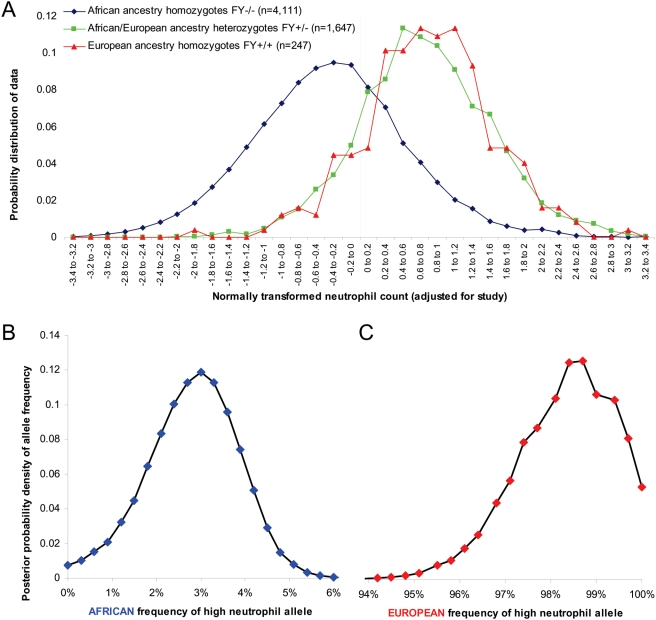
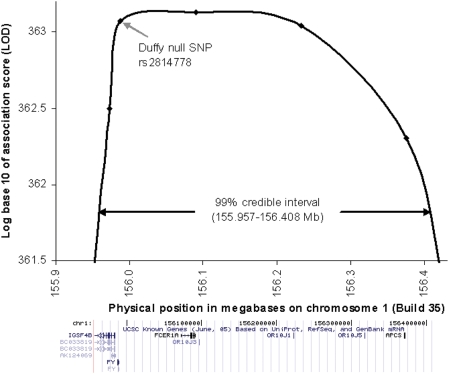
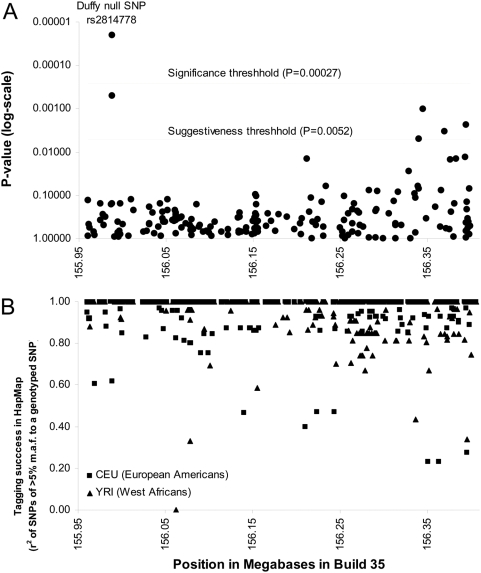
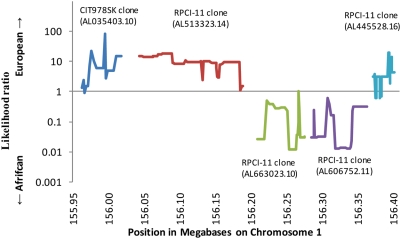
Persistently low white blood cell count (WBC) and neutrophil count is a well-described phenomenon in persons of African ancestry, whose etiology remains unknown. We recently used admixture mapping to identify an approximately 1-megabase region on chromosome 1, where ancestry status (African or European) almost entirely accounted for the difference in WBC between African Americans and European Americans. To identify the specific genetic change responsible for this association, we analyzed genotype and phenotype data from 6,005 African Americans from the Jackson Heart Study (JHS), the Health, Aging and Body Composition (Health ABC) Study, and the Atherosclerosis Risk in Communities (ARIC) Study. We demonstrate that the causal variant must be at least 91% different in frequency between West Africans and European Americans. An excellent candidate is the Duffy Null polymorphism (SNP rs2814778 at chromosome 1q23.2), which is the only polymorphism in the region known to be so differentiated in frequency and is already known to protect against Plasmodium vivax malaria. We confirm that rs2814778 is predictive of WBC and neutrophil count in African Americans above beyond the previously described admixture association (P = 3.8 x 10(-5)), establishing a novel phenotype for this genetic variant.
Overview
The claims and statistics of this paper haven’t been checked yet.
Free: it reads the open-access text and checks the first 5 claims that cite a source we can check. Create a free account to check every claim.
Integrity signals
Registry
Cites
Statistics
Figures
Verification
Claims the paper makes
The claims and statistics of this paper haven’t been checked yet.
Free: it reads the open-access text and checks the first 5 claims that cite a source we can check. Create a free account to check every claim.
Claims other papers make about this one
Each is checked against this paper’s own text: does it say what the citing paper says it does?
The check wasn’t confident either way, so it gives no verdict — never disputed.
In the citing paper
“Direct medical costs associated with TRD are estimated to be 2-6 times higher compared with other patients with MDD, 42, 43 with costs increasing with chronicity and severity of TRD. 44”
From Treatment resistance in psychiatry: state of the art and new directions (2022) · cites this paper as [44]
Experimental — accuracy not yet measured
Self-check
Percentages, sums and reported differences re-computed from the paper’s own numbers.
The self-check needs the paper’s full text.
Citations
Cites
Initial sequencing and analysis of the human genome
International Human Genome Sequencing Consortium, Whitehead Institute for Biomedical Research, C. F. G. R., Lander, E. S., Linton, L. M., Birren, B., Nusbaum, C., Zody, M. C., Baldwin, J., Devon, K., Dewar, K., et al. (2001) · Nature · doi:10.1038/35057062 · Cited by 24,216 · cited 1×
“Because RPCI-11 is the source for most (,74%) of the human genome reference sequence [14], we conclude that much of the public human genome reference sequence is that of an African American, and includes a substantial amount of sequence of African ancestral origin.”
Self-citationThe sequence of the human genome
Venter, J. C., Adams, M. D., Myers, E. W., Li, P. W., Mural, R. J., Sutton, G. G., Smith, H. O., Yandell, M., Evans, C. A., Holt, R. A., et al. (2001) · Science · doi:10.1126/science.1058040 · Cited by 13,909
A haplotype map of the human genome
The International HapMap Consortium (2005) · Nature · doi:10.1038/nature04226 · Cited by 5,858 · cited 1×
“These sequences include 4 West Africans and 2 Europeans examined as part of a fosmid end-sequencing project [45], 2 European Americans sequenced as part of the Celera Genomics human genome sequencing project [46,47], 1 European American sequenced for the purpose of SNP discovery [48,49], and 2 African Americans also s…”
MethodA second generation human haplotype map of over 3.1 million SNPs
The International HapMap Consortium (2007) · Nature · doi:10.1038/nature06258 · Cited by 4,438 · cited 5×
“54 million autosomal SNPs in the November 2006 Phase2 HapMap data set [10], there were only 115 SNPs with a frequency differentiation at least this extreme, and only one in the region of admixture association: the SNP rs2814778 (at position 155.”
BackgroundMethodInfluential(1989) · PubMed · Cited by 3,139
A map of human genome sequence variation containing 1.42 million single nucleotide polymorphisms
The International SNP Map Working Group, Laboratories:, C. S. H., Sachidanandam, R., Weissman, D., Schmidt, S. C., Kakol, J. M., Stein, L. D., National Center for Biotechnology Information:, Marth, G., Sherry, S., et al. (2001) · Nature · doi:10.1038/35057149 · Cited by 2,977 · cited 1×
“These sequences include 4 West Africans and 2 Europeans examined as part of a fosmid end-sequencing project [45], 2 European Americans sequenced as part of the Celera Genomics human genome sequencing project [46,47], 1 European American sequenced for the purpose of SNP discovery [48,49], and 2 African Americans also s…”
MethodSelf-citationTHE ATHEROSCLEROSIS RISK IN COMMUNIT (ARIC) STUDY: DESIGN AND OBJECTIVES
THE ARIC INVESTIGATORS (1989) · American Journal of Epidemiology · doi:10.1093/oxfordjournals.aje.a115184 · Cited by 2,924
Prescribing Personalized Nutrition for Cardiovascular Health: Are We Ready?
Juma, S., Imrhan, V., Vijayagopal, P., & Prasad, C. (2014) · Lifestyle Genomics · doi:10.1159/000370213 · Cited by 1,891
The Diploid Genome Sequence of an Individual Human
Levy, S., Sutton, G., Ng, P. C., Feuk, L., Halpern, A. L., Walenz, B. P., Axelrod, N., Huang, J., Kirkness, E. F., Denisov, G., et al. (2007) · PLoS Biology · doi:10.1371/journal.pbio.0050254 · Cited by 1,778 · cited 1×
“These sequences include 4 West Africans and 2 Europeans examined as part of a fosmid end-sequencing project [45], 2 European Americans sequenced as part of the Celera Genomics human genome sequencing project [46,47], 1 European American sequenced for the purpose of SNP discovery [48,49], and 2 African Americans also s…”
MethodThe Sequence of the Human Genome
Venter, J. C., Smith, H. O., & Adams, M. D. (2015) · Clinical Chemistry · doi:10.1373/clinchem.2014.237016 · Cited by 1,648 · cited 1×
“These sequences include 4 West Africans and 2 Europeans examined as partof a fosmidend-sequencingproject[45], 2 EuropeanAmericans sequenced as part of the Celera Genomics human genome sequencing project [ 46 ,47], 1 European American sequenced for the purpose of SNP discovery [48,49], and 2 African Americans also sequ…”
Background
Cited by
A draft sequence of the Neandertal genome
Green, R. E., Krause, J., Briggs, A. W., Maricic, T., Stenzel, U., Kircher, M., Patterson, N., Li, H., Zhai, W., Fritz, M. H.-Y., et al. (2010) · Science · doi:10.1126/science.1188021 · Cited by 4,318
“To obtain haploid human sequences, we took advantage of the fact that the human genome reference sequence is composed of a tiling path of bacterial artificial chromosomes (BACs), which each represent single human haplotypes over scales of 50 to 150 kb, and we focused on BACs from RPCI11, the individual that contribute…”
Self-citationGenetic history of an archaic hominin group from Denisova Cave in Siberia
Reich, D., Green, R. E., Kircher, M., Krause, J., Patterson, N., Durand, E. Y., Viola, B., Briggs, A. W., Stenzel, U., Johnson, P. L. F., et al. (2010) · Nature · doi:10.1038/nature09710 · Cited by 1,991
Self-citationA guide to chemokines and their receptors
Hughes, C. E., & Nibbs, R. J. B. (2018) · The FEBS Journal · doi:10.1111/febs.14466 · Cited by 1,412
Chen, M.-H., Raffield, L. M., Mousas, A., Sakaue, S., Huffman, J. E., Moscati, A., Trivedi, B., Jiang, T., Akbari, P., Vuckovic, D., et al. (2020) · Cell · doi:10.1016/j.cell.2020.06.045 · Cited by 661
Blood Groups in Infection and Host Susceptibility
Cooling, L. (2015) · Clinical Microbiology Reviews · doi:10.1128/cmr.00109-14 · Cited by 632
“The Fy(a b ) phenotype is linked to benign ethnic neutropenia, characterized by a mild decrease in the number of neutrophils (517).”
Background
Metadata
- Authors
- Reich, D., Nalls, M. A., Kao, W. H. L., Akylbekova, E. L., Tandon, A., Patterson, N., Mullikin, J., Hsueh, W.-C., Cheng, C.-Y., Coresh, J., Boerwinkle, E., Li, M., Waliszewska, A., Neubauer, J., Li, R., Leak, T. S., Ekunwe, L., Files, J. C., Hardy, C. L., Zmuda, J. M., Taylor, H. A., Ziv, E., Harris, T. B., & Wilson, J. G.
- Affiliations
- Broad Institute (US)
- Johns Hopkins University (US)
- Jackson State University (US)
- National Human Genome Research Institute (US)
- University of California, San Francisco (US)
- The University of Texas Health Science Center at Houston (US)
- University of Tennessee Health Science Center (US)
- University of Pittsburgh (US)
- University of Mississippi Medical Center (US)
- Tougaloo College (US)
- National Institutes of Health (US)
- Corresponding author
- Reich, David
- Wilson, James G.
- ORCID
- Venue
- PLoS Genetics
- Publisher
- Public Library of Science (PLoS)
- Published
- 2009-01-30
- Volume
- 5
- Issue
- 1
- Pages
- e1000360
- ISSN
- 1553-7390 (ISSN-L)
- 1553-7404
- PMC
- PMC2628742
- OpenAlex
- W2144990191
- Cited by
- 423
- References
- 53
- Citations by year
- 2026: 26 · 2025: 30 · 2024: 29 · 2023: 28 · 2022: 24 · 2021: 36 · 2020: 22 · 2019: 21 · 2018: 24 · 2017: 19 · 2016: 23 · 2015: 20 · 2014: 16 · 2013: 18 · 2012: 22
- FWCI
- 16.77
- Type
- journal article
- Language
- en
- Open access
- gold
- doi.org
- Licence
- Locations
- PLoS Genetics (publishedVersion, public-domain)
- PubMed Central (publishedVersion, public-domain)
- PubMed (publishedVersion)
- D-Scholarship@Pitt (University of Pittsburgh) (acceptedVersion)
- eScholarship (California Digital Library) (submittedVersion)
- Digital Access to Scholarship at Harvard (DASH) (Harvard University) (submittedVersion, cc-by)
- Digital Commons-TMC (Texas Medical Center) (submittedVersion)
- National University of Singapore (submittedVersion)
- DOAJ (DOAJ: Directory of Open Access Journals) (submittedVersion, cc-by-sa)
- eScholarship (California Digital Library) (submittedVersion, public-domain)
- Funders
- Broad Institute
- National Institutes of Health (n01hc95170-30-0-1, n01hc55021-47-0-1, n01hc55020-39-0-0, n01hc55016-37-0-0, n01hc055022-024, n01hc95171-31-0-1, n01hc55019-35-0-1, n01hc55018-38-0-1, 6u54rr020278-06, 5r01hl084107-04, n01hc95172-31-0-1, n01hc55015-48-0-1)
- National Institute on Aging (N01‐AG‐6–2101, N01-HC-55021, N01-AG-6-2101, N01-AG-6-2103, and N01-AG-6-2106, N01-HC-55018, N01AG62106, N01-HC-55015, N01-HC-55019, N01-HC-55020, N01-HC-55016, N01-AG-62103, N01-HC-55022)
- National Heart, Lung, and Blood Institute (N01-HC55022, HC-55016, N01 HC055016, N01-HC-55018, N01 HC 55020, HC-55021, HC-55018, N01-HC-55015, N01-HC-55016, N01-HC-55018, N01-HC-55019, N01-HC-55020, N01-HC-55021, and N01-HC-55022, N01 HC 55019, N01 HC095171, HC-55022, N01 HC055020, N01 HC095172, HC-55019, N01-HC, N01AG62101, N01 HC055018, R01-HL-084107, HC-55015, N01HC95172, HC-55020, N01-HC55016, N01 HC095170, N01AG62106, N01 HC 95170, N01 HC055022, N01 HC055019, N01AG62103, N01‐HC‐55015, N01-HC55021, N01 HC055021, N01 HC-95171, N01 HC055015)
- National Human Genome Research Institute (U01HG004168)
- National Institute of Diabetes and Digestive and Kidney Diseases (K01DK067207, R21DK073482)
- National Center on Minority Health and Health Disparities
- National Center for Research Resources (U54-RR020278, RR020278)
- National Institute on Minority Health and Health Disparities
- Topics
- Life Sciences › Biochemistry, Genetics and Molecular Biology › Genetics › Genetic Associations and Epidemiology
- Social Sciences › Anthropology › Race, Genetics, and Society
- Life Sciences › Biochemistry, Genetics and Molecular Biology › Genetics › Forensic and Genetic Research
- Keywords
- DARC, neutrophil count, white blood cell count, African Americans, admixture mapping, vivax malaria, West Africans, European Americans
- MeSH terms
- Adult, Aged, Aged, 80 and over, Black or African American, Chromosomes, Human, Pair 1, Duffy Blood-Group System, Female, Genotype, Humans, Leukocyte Count, Male, Middle Aged, Neutrophils, Phenotype, Receptors, Cell Surface, Cohort Studies, Case-Control Studies, Polymorphism, Single Nucleotide, Black People, White People
About these checks
Registry, retraction, Cites and statistics results are computed, not judged, with one exception: a printed reference that no index lists is read once by a model before it counts as a citation error. Claims are extracted by a model and kept only when their quote appears verbatim in the text; each cited source is then checked, with a model’s help, for whether it says what the claim relies on. Those verdicts can be wrong — read the claim’s quote and the cited source before relying on one.
Statistics and arithmetic are recomputed, not judged.
Confidence bands are shown only for fields calibrated on our annotated test set. None is calibrated yet, so no band is shown.
What counts as a claim ›How we measure confidence ›How we check this ›
Are you an author, or do you see a problem with this page? Request a review
Data sources
Bibliographic data: Semantic Scholar, OpenAlex, Crossref.
Contains information from the Semantic Scholar Academic Graph Datasets, made available under the ODC Attribution License (ODC-BY 1.0).
Semantic Scholar’s data is described in: Kinney, R., et al. (2023). The Semantic Scholar Open Data Platform. arXiv:2301.10140.
