

The DOI matches its Crossref record; 80 of the 80 references it cites were found in a registry or an index.
Widespread Genomic Signatures of Natural Selection in Hominid Evolution
Open accessAbstract
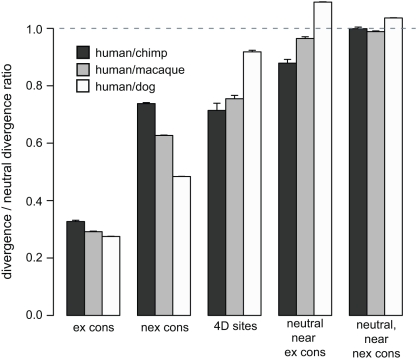
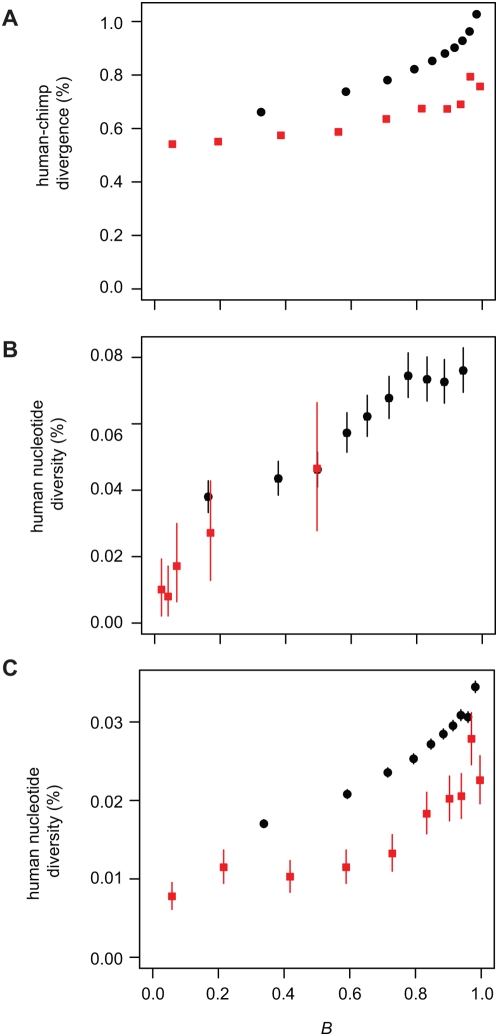
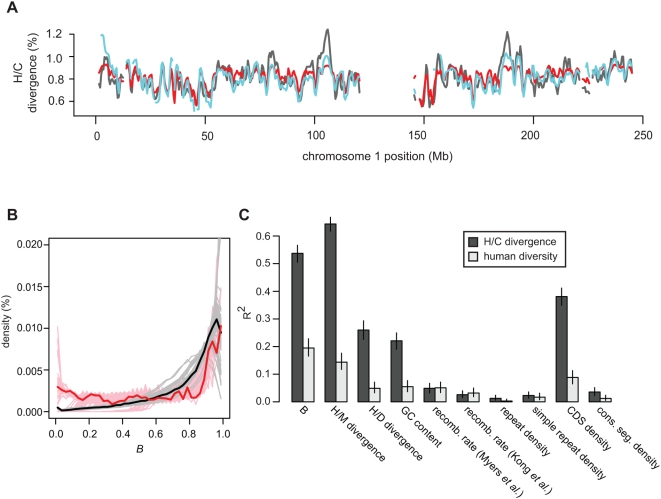
Selection acting on genomic functional elements can be detected by its indirect effects on population diversity at linked neutral sites. To illuminate the selective forces that shaped hominid evolution, we analyzed the genomic distributions of human polymorphisms and sequence differences among five primate species relative to the locations of conserved sequence features. Neutral sequence diversity in human and ancestral hominid populations is substantially reduced near such features, resulting in a surprisingly large genome average diversity reduction due to selection of 19-26% on the autosomes and 12-40% on the X chromosome. The overall trends are broadly consistent with "background selection" or hitchhiking in ancestral populations acting to remove deleterious variants. Average selection is much stronger on exonic (both protein-coding and untranslated) conserved features than non-exonic features. Long term selection, rather than complex speciation scenarios, explains the large intragenomic variation in human/chimpanzee divergence. Our analyses reveal a dominant role for selection in shaping genomic diversity and divergence patterns, clarify hominid evolution, and provide a baseline for investigating specific selective events.
Overview
The claims and statistics of this paper haven’t been checked yet.
Run the check — free, no account needed. It reads the open-access text and checks the sources it cites.
Integrity signals
Registry
Cites
Statistics
Figures
Verification
Claims the paper makes
The claims and statistics of this paper haven’t been checked yet.
Run the check — free, no account needed. It reads the open-access text and checks the sources it cites.
Claims other papers make about this one
Each is checked against this paper’s own text: does it say what the citing paper says it does?
The source backs part of the claim, not all of it — or backs it for a different population, condition or comparison.
In the citing paper
“In particular, background selection (i.e., the selective removal of deleterious alleles across the genome) appears to play a primary role in shaping the highly polygenic architecture of human traits and diseases [1, 7–9].”
From Denisovan and Neanderthal archaic introgression differentially impacted the genetics of complex traits in modern populations (2022) · cites this paper as [1]
Experimental — accuracy not yet measuredThe cited source says what the claim attributes to it.
In the citing paper
“To ensure the observed differences between aSNPs and naSNPs were not caused by different levels of background selection we downloaded from https://github.com/gmcvicker/bkgd the bed file containing the list of pre-computed values for the B-statistic in hg19 coordinates [32].”
From Denisovan introgression has shaped the immune system of present-day Papuans (2022) · cites this paper as [32]
The check wasn’t confident either way, so it gives no verdict — never disputed.
In the citing paper
“Genomic features related to natural selection are enriched for loci associated with complex traits [1, 7–9].”
From Denisovan and Neanderthal archaic introgression differentially impacted the genetics of complex traits in modern populations (2022) · cites this paper as [1]
Experimental — accuracy not yet measured
Self-check
Percentages, sums and reported differences re-computed from the paper’s own numbers.
The self-check needs the paper’s full text.
Citations
Cites
Kimura, M. (1980) · Journal of Molecular Evolution · doi:10.1007/bf01731581 · Cited by 29,778
Initial sequencing and analysis of the human genome
International Human Genome Sequencing Consortium, Whitehead Institute for Biomedical Research, C. F. G. R., Lander, E. S., Linton, L. M., Birren, B., Nusbaum, C., Zody, M. C., Baldwin, J., Devon, K., Dewar, K., et al. (2001) · Nature · doi:10.1038/35057062 · Cited by 24,216
Evolutionary trees from DNA sequences: A maximum likelihood approach.
Felsenstein, J. (1981) · Journal of Molecular Evolution · doi:10.1007/bf01734359 · Cited by 14,571
The Human Genome Browser at UCSC
Kent, W. J., Sugnet, C. W., Furey, T. S., Roskin, K. M., Pringle, T. H., Zahler, A. M., & Haussler, A. D. (2002) · Genome Research · doi:10.1101/gr.229102 · Cited by 10,400
Tandem repeats finder: a program to analyze DNA sequences
Benson, G. (1999) · Nucleic Acids Research · doi:10.1093/nar/27.2.573 · Cited by 9,374
Practical Methods of Optimization
Fletcher, R. (2000) · Wiley eBooks · doi:10.1002/9781118723203 · Cited by 7,649
Base-Calling of Automated Sequencer Traces Using Phred. I. Accuracy AssessmentPreprint
Ewing, B., Hillier, L., Wendl, M. C., & Green, P. (1998) · Genome Research · doi:10.1101/gr.8.3.175 · Cited by 6,993
Self-citationBase-Calling of Automated Sequencer Traces Using Phred. II. Error Probabilities
Ewing, B., & Green, P. (1998) · Genome Research · doi:10.1101/gr.8.3.186 · Cited by 5,439
Self-citationA second generation human haplotype map of over 3.1 million SNPs
The International HapMap Consortium (2007) · Nature · doi:10.1038/nature06258 · Cited by 4,438
Evolutionarily conserved elements in vertebrate, insect, worm, and yeast genomes
Siepel, A., Bejerano, G., Pedersen, J. S., Hinrichs, A. S., Hou, M., Rosenbloom, K., Clawson, H., Spieth, J., Hillier, L. W., Richards, S., et al. (2005) · Genome Research · doi:10.1101/gr.3715005 · Cited by 3,971 · cited 5×
“Gcons extends the two-state phylogenetic Hidden Markov Model (phyloHMM) approach used by phastCons [23] by incorporating alignment gap information.”
BackgroundMethodInfluential
Research works printed but not linked: 1
- M Galassi, 2006, GNU Scientific Library Reference Manual (2nd Ed.).
Cited by
Sorted by citations
Items 401–458 of 458
Hitchhiking and Selective Sweeps
Walsh, B., & Lynch, M. (2018) · Oxford University Press eBooks · doi:10.1093/oso/9780198830870.003.0008
Understanding variation in nucleotide diversity across the mouse genome
Booker, T. R. (2018) · ERA
Zhang, W., Wang, Y., Yang, M., Wu, X., Zhang, X., Ding, Y., & Yin, Z. (2019) · bioRxiv (Cold Spring Harbor Laboratory) · doi:10.1101/596387
Natural selection reduced diversity on human Y chromosomesPreprint
Sayres, M. A. W., Lohmueller, K. E., & Nielsen, R. (2013) · arXiv (Cornell University) · doi:10.48550/arxiv.1303.5012
Gu, X. (2020) · bioRxiv (Cold Spring Harbor Laboratory) · doi:10.1101/2020.01.11.901066
Natural Selection, Genetic Variation, and Human Diversity
Emery, L. S., & Akey, J. M. (2021) · Springer eBooks · doi:10.1007/978-3-030-61646-5_9
Pettersson, U. (2020) · Faculty Opinions – Post-Publication Peer Review of the Biomedical Literature · doi:10.3410/f.737361910.793571755
Wu, J., Yonezawa, T., & Kishino, H. (2022) · Genes · doi:10.3390/genes13040708 · Cited by 1
Nürnberger, J. I. (2019) · Faculty Opinions – Post-Publication Peer Review of the Biomedical Literature · doi:10.3410/f.732754977.793562989
Stankiewicz, P. (2020) · Faculty Opinions – Post-Publication Peer Review of the Biomedical Literature · doi:10.3410/f.737361910.793574278
Keightley, P. D. (2015) · Faculty Opinions – Post-Publication Peer Review of the Biomedical Literature · doi:10.3410/f.725429967.793506454
Faculty Opinions recommendation of The effect of strong purifying selection on genetic diversity.
Kumar, S. (2018) · Faculty Opinions – Post-Publication Peer Review of the Biomedical Literature · doi:10.3410/f.733321780.793549383
Wang, T., Zhou, M. R., Guo, J., Guo, Y., Ding, K., Wang, P., & Wang, Z. (2021) · Research Square · doi:10.21203/rs.3.rs-200078/v1
Wang, F., & Tekle, Y. I. (2022) · Frontiers in Ecology and Evolution · doi:10.3389/fevo.2022.851816
d ΧΥ to infer local adaptive evolutionPreprint
Nam, K. (2023) · doi:10.22541/au.167403980.04943108/v1
Lauterbur, M. E., Cavassim, M. I. A., Gladstein, A. L., Gower, G., Pope, N. S., Tsambos, G., Adrion, J. R., Belsare, S., Biddanda, A., Caudill, V. R., et al. (2023) · eLife · doi:10.7554/elife.84874.1.sa0
The impact of stability considerations on genetic fine-mapping
Aw, A. J., Jin, L. C., Ioannidis, N. M., & Song, Y. S. (2026) · eLife · doi:10.7554/elife.88039.3
The impact of stability considerations on genetic fine-mappingPreprint
Aw, A. J., Jin, L. C., Ioannidis, N. M., & Song, Y. S. (2023) · eLife · doi:10.7554/elife.88039
The Impact of Stability Considerations on Genetic Fine-MappingPreprint
Aw, A. J., Jin, L. C., Ioannidis, N. M., & Song, Y. S. (2023) · eLife · doi:10.7554/elife.88039.1
Assessing the Presence of Recent Adaptation in the Human Genome With Mixture Density Regression
Salazar‐Tortosa, D. F., Huang, Y.-F., & Enard, D. (2023) · Genome Biology and Evolution · doi:10.1093/gbe/evad170 · Cited by 1
Quantifying Adaptive Evolution of the Human Immune Cell LandscapePreprint
Salvador‐Martínez, I., Murga-Moreno, J., Nieto, J. C., Alsinet, C., Enard, D., & Heyn, H. (2023) · bioRxiv (Cold Spring Harbor Laboratory) · doi:10.1101/2023.10.06.559946
Song, W., Shi, Y., & Lin, G. N. (2023) · eLife · doi:10.7554/elife.92574.1
Song, W., Shi, Y., & Lin, G. N. (2024) · eLife · doi:10.7554/elife.92574
F ST and genetic diversity in an island model with background selectionPreprint
Hasan, A., & Whitlock, M. C. (2024) · bioRxiv (Cold Spring Harbor Laboratory) · doi:10.1101/2024.03.15.585154
Song, W., Shi, Y., & Lin, G. N. (2024) · doi:10.7554/elife.92574.2
Wang, T., Zhou, M. R., Guo, J., Guo, Y., Ding, K., Wang, P., & Wang, Z. (2021) · Figshare · doi:10.6084/m9.figshare.14708048
Liu, X., Li, C., Mou, C., Dong, Y., & Tu, Y.-C. (2020) · Figshare · doi:10.6084/m9.figshare.13316921
Lin, Y.-J., Menon, A. S., Hu, Z., & Brenner, S. E. (2024) · bioRxiv (Cold Spring Harbor Laboratory) · doi:10.1101/2024.06.25.600283
The evolutionary fate of Neanderthal DNA in 30,780 admixed genomes with recent African-like ancestryPreprint
Pfennig, A., & Lachance, J. (2024) · bioRxiv (Cold Spring Harbor Laboratory) · doi:10.1101/2024.07.25.605203
Purifying Selection Influences the Comparison of Heterozygosities between Populations
Subramanian, S. (2024) · Biology · doi:10.3390/biology13100810
Negative selection on baboon admixture is strongest on chromosome XPreprint
Sørensen, E. F., Hellenthal, G., & Munch, K. (2024) · bioRxiv (Cold Spring Harbor Laboratory) · doi:10.1101/2024.12.18.629079
Wang, L., Ye, C., Cheng, N., & Xia, J. (2025) · Journal of Chemical Information and Modeling · doi:10.1021/acs.jcim.5c00855
Fan, X., Huang, D., Wu, Z., Dong, X., Wang, J., Zhang, S., Dong, X., Gu, X., Li, M., Sham, P. C., et al. (2025) · Genome biology · doi:10.1186/s13059-025-03843-9 · Cited by 1
Sarachakov, A., Yudina, A., Svekolkin, V., Parfenenkova, A., Spektor, M., Oshchepkova, P., Pak, M. A., Antysheva, Z., Balabanian, L., Brown, J. H., et al. (2025) · Human Genetics · doi:10.1007/s00439-025-02775-5
Meyerson, W., Leisman, J., Navarro, F. C. P., & Gerstein, M. (2020) · Figshare · doi:10.6084/m9.figshare.12432275
Liu, X., Li, C., Mou, C., Dong, Y., & Tu, Y. (2020) · Figshare · doi:10.6084/m9.figshare.13316924
Liu, X., Li, C., Mou, C., Dong, Y., & Tu, Y. (2020) · Figshare · doi:10.6084/m9.figshare.13316918
Zhou, A., Zhang, W., Ge, X., Liu, Q., Luo, F., Xu, S., Hu, W., & Lu, Y. (2024) · Figshare · doi:10.6084/m9.figshare.25779352
Meyerson, W., Leisman, J., Navarro, F. C. P., & Gerstein, M. (2020) · Figshare · doi:10.6084/m9.figshare.12432284
Liu, X., Li, C., Mou, C., Dong, Y., & Tu, Y. (2020) · Figshare · doi:10.6084/m9.figshare.13316927
Meyerson, W., Leisman, J., Navarro, F. C. P., & Gerstein, M. (2020) · Figshare · doi:10.6084/m9.figshare.12432269
Zhou, A., Zhang, W., Ge, X., Liu, Q., Luo, F., Xu, S., Hu, W., & Lu, Y. (2024) · Figshare · doi:10.6084/m9.figshare.25779506
Meyerson, W., Leisman, J., Navarro, F. C. P., & Gerstein, M. (2020) · Figshare · doi:10.6084/m9.figshare.12432260
Radjasandirane, R., Cretin, G., Diharce, J., de Brevern, A. G., & Gelly, J. (2025) · medRxiv · doi:10.64898/2025.12.22.25342839
The Impact of Stability Considerations on Genetic Fine-mappingPreprint
Aw, A. J., Jin, L. C., Ioannidis, N. M., & Song, Y. S. (2026) · eLife · doi:10.7554/elife.88039.2
Gabrielli, M., Leroy, T., Roux, C., Milá, B., Thébaud, C., & Nabholz, B. (2026) · bioRxiv (Cold Spring Harbor Laboratory) · doi:10.64898/2026.02.25.707877
Identifying Adaptive Footprints in the Presence of Demographic Uncertainty
Arnab, S. P., Khan, M., dos Santos, A. L. C., Fumagalli, M., & DeGiorgio, M. (2026) · Genome Biology and Evolution · doi:10.1093/gbe/evag075 · Cited by 1
Origines et conséquences des variants régulateurs chez l'humain
Silvert, M. (2019) · theses.fr (ABES) · doi:10.70675/1b639ff7z70fdz4801zb57cz0f5f7a477b9d
Annotation et hiérarchisation de variants non-codants dans le contexte de maladies humaines
Moyon, L. (2019) · theses.fr (ABES) · doi:10.70675/208b20dcz3942z4342z8908z65691180bec0
Evolutionary history and speciation in Mascarene white-eyes (Zosteropidae)
Gabrielli, M. (2020) · theses.fr (ABES) · doi:10.70675/41039f5cz83d6z4bf6z9633zd89df4acd267
Limited Selection on Neanderthal DNA in 30,780 Recently Admixed Genomes with African-like Ancestry
Pfennig, A., & Lachance, J. (2026) · Molecular Biology and Evolution · doi:10.1093/molbev/msag136
Pervasive cryptic selection in the human noncoding genomePreprint
Ramesh, S., Di, C., & Lohmueller, K. E. (2026) · bioRxiv (Cold Spring Harbor Laboratory) · doi:10.64898/2026.06.09.731256
The Genome-Wide Effect of Drift and Selection over a Single GenerationPreprint
Sgarlata, G. M., & Coop, G. (2026) · bioRxiv (Cold Spring Harbor Laboratory) · doi:10.64898/2026.08.04.742829
Genomic insights into natural selection in recent human history
Skoglund, P., & Mathieson, I. (2026) · Nature Reviews Genetics · doi:10.1038/s41576-026-01010-9
Metadata
- Authors
- McVicker, G., Gordon, D., Davis, C., & Green, P.
- Affiliations
- University of Washington (US)
- Howard Hughes Medical Institute (US)
- Corresponding author
- McVicker, Graham
- Green, Phil
- Venue
- PLoS Genetics
- Publisher
- Public Library of Science (PLoS)
- Published
- 2009-05-08
- Volume
- 5
- Issue
- 5
- Pages
- e1000471
- ISSN
- 1553-7390 (ISSN-L)
- 1553-7404
- PMC
- PMC2669884
- OpenAlex
- W2032311106
- Cited by
- 456
- References
- 80
- Citations by year
- 2026: 24 · 2025: 25 · 2024: 37 · 2023: 34 · 2022: 23 · 2021: 29 · 2020: 38 · 2019: 33 · 2018: 33 · 2017: 23 · 2016: 25 · 2015: 25 · 2014: 30 · 2013: 16 · 2012: 25
- FWCI
- 11.83
- Type
- journal article
- Language
- en
- Open access
- gold
- doi.org
- Locations
- PLoS Genetics (publishedVersion, cc-by)
- PubMed Central (publishedVersion, cc-by)
- PubMed (publishedVersion)
- DOAJ (DOAJ: Directory of Open Access Journals) (submittedVersion, cc-by-sa)
- Figshare (submittedVersion, cc-by)
- Funders
- Howard Hughes Medical Institute
- Natural Sciences and Engineering Research Council of Canada
- Topics
- Life Sciences › Biochemistry, Genetics and Molecular Biology › Genetics › Evolution and Genetic Dynamics
- Life Sciences › Biochemistry, Genetics and Molecular Biology › Genetics › Forensic and Genetic Research
- Life Sciences › Biochemistry, Genetics and Molecular Biology › Genetics › Genetic diversity and population structure
- Keywords
- natural selection, hominid evolution, human polymorphism, background selection, hitchhiking, X chromosome, human-chimpanzee divergence
- MeSH terms
- Animals, Pan troglodytes, Humans, Markov Chains, Models, Genetic, Primates, Recombination, Genetic, Selection, Genetic, X Chromosome, Hominidae, Genome, Human, Confidence Intervals, Likelihood Functions, Conserved Sequence, Evolution, Molecular, Polymorphism, Single Nucleotide, Chromosomes, Human, X
About these checks
Registry, retraction, Cites and statistics results are computed, not judged, with one exception: a printed reference that no index lists is read once by a model before it counts as a citation error. Claims are extracted by a model and kept only when their quote appears verbatim in the text; each cited source is then checked, with a model’s help, for whether it says what the claim relies on. Those verdicts can be wrong — read the claim’s quote and the cited source before relying on one.
Statistics and arithmetic are recomputed, not judged.
Confidence bands are shown only for fields calibrated on our annotated test set. None is calibrated yet, so no band is shown.
What counts as a claim ›How we measure confidence ›How we check this ›
Are you an author, or do you see a problem with this page? Request a review
