

The DOI matches its Crossref record; 80 of the 80 references it cites were found in a registry or an index.
Widespread Genomic Signatures of Natural Selection in Hominid Evolution
Open accessAbstract
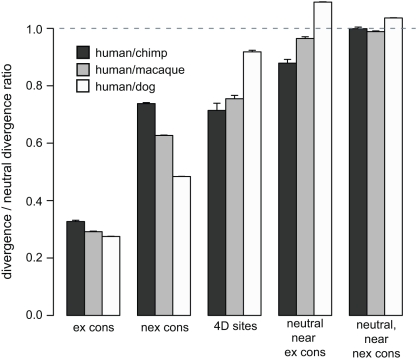
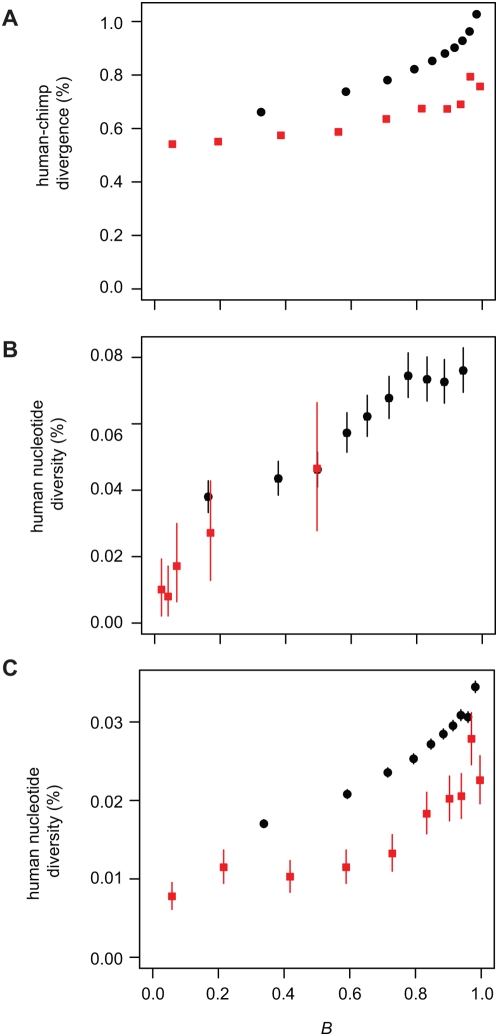
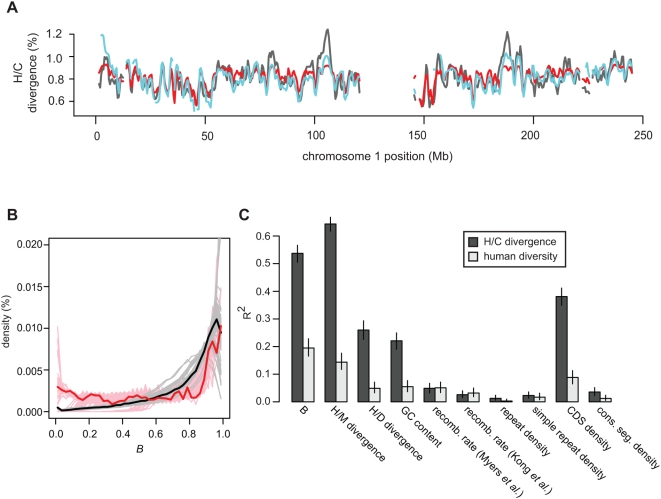
Selection acting on genomic functional elements can be detected by its indirect effects on population diversity at linked neutral sites. To illuminate the selective forces that shaped hominid evolution, we analyzed the genomic distributions of human polymorphisms and sequence differences among five primate species relative to the locations of conserved sequence features. Neutral sequence diversity in human and ancestral hominid populations is substantially reduced near such features, resulting in a surprisingly large genome average diversity reduction due to selection of 19-26% on the autosomes and 12-40% on the X chromosome. The overall trends are broadly consistent with "background selection" or hitchhiking in ancestral populations acting to remove deleterious variants. Average selection is much stronger on exonic (both protein-coding and untranslated) conserved features than non-exonic features. Long term selection, rather than complex speciation scenarios, explains the large intragenomic variation in human/chimpanzee divergence. Our analyses reveal a dominant role for selection in shaping genomic diversity and divergence patterns, clarify hominid evolution, and provide a baseline for investigating specific selective events.
Overview
The claims and statistics of this paper haven’t been checked yet.
Run the check — free, no account needed. It reads the open-access text and checks the sources it cites.
Integrity signals
Registry
Cites
Statistics
Figures
Verification
Claims the paper makes
The claims and statistics of this paper haven’t been checked yet.
Run the check — free, no account needed. It reads the open-access text and checks the sources it cites.
Claims other papers make about this one
Each is checked against this paper’s own text: does it say what the citing paper says it does?
The source backs part of the claim, not all of it — or backs it for a different population, condition or comparison.
In the citing paper
“In particular, background selection (i.e., the selective removal of deleterious alleles across the genome) appears to play a primary role in shaping the highly polygenic architecture of human traits and diseases [1, 7–9].”
From Denisovan and Neanderthal archaic introgression differentially impacted the genetics of complex traits in modern populations (2022) · cites this paper as [1]
Experimental — accuracy not yet measuredThe cited source says what the claim attributes to it.
In the citing paper
“To ensure the observed differences between aSNPs and naSNPs were not caused by different levels of background selection we downloaded from https://github.com/gmcvicker/bkgd the bed file containing the list of pre-computed values for the B-statistic in hg19 coordinates [32].”
From Denisovan introgression has shaped the immune system of present-day Papuans (2022) · cites this paper as [32]
The check wasn’t confident either way, so it gives no verdict — never disputed.
In the citing paper
“Genomic features related to natural selection are enriched for loci associated with complex traits [1, 7–9].”
From Denisovan and Neanderthal archaic introgression differentially impacted the genetics of complex traits in modern populations (2022) · cites this paper as [1]
Experimental — accuracy not yet measured
Self-check
Percentages, sums and reported differences re-computed from the paper’s own numbers.
The self-check needs the paper’s full text.
Citations
Cites
Kimura, M. (1980) · Journal of Molecular Evolution · doi:10.1007/bf01731581 · Cited by 29,778
Initial sequencing and analysis of the human genome
International Human Genome Sequencing Consortium, Whitehead Institute for Biomedical Research, C. F. G. R., Lander, E. S., Linton, L. M., Birren, B., Nusbaum, C., Zody, M. C., Baldwin, J., Devon, K., Dewar, K., et al. (2001) · Nature · doi:10.1038/35057062 · Cited by 24,216
Evolutionary trees from DNA sequences: A maximum likelihood approach.
Felsenstein, J. (1981) · Journal of Molecular Evolution · doi:10.1007/bf01734359 · Cited by 14,571
The Human Genome Browser at UCSC
Kent, W. J., Sugnet, C. W., Furey, T. S., Roskin, K. M., Pringle, T. H., Zahler, A. M., & Haussler, A. D. (2002) · Genome Research · doi:10.1101/gr.229102 · Cited by 10,400
Tandem repeats finder: a program to analyze DNA sequences
Benson, G. (1999) · Nucleic Acids Research · doi:10.1093/nar/27.2.573 · Cited by 9,374
Practical Methods of Optimization
Fletcher, R. (2000) · Wiley eBooks · doi:10.1002/9781118723203 · Cited by 7,649
Base-Calling of Automated Sequencer Traces Using Phred. I. Accuracy AssessmentPreprint
Ewing, B., Hillier, L., Wendl, M. C., & Green, P. (1998) · Genome Research · doi:10.1101/gr.8.3.175 · Cited by 6,993
Self-citationBase-Calling of Automated Sequencer Traces Using Phred. II. Error Probabilities
Ewing, B., & Green, P. (1998) · Genome Research · doi:10.1101/gr.8.3.186 · Cited by 5,439
Self-citationA second generation human haplotype map of over 3.1 million SNPs
The International HapMap Consortium (2007) · Nature · doi:10.1038/nature06258 · Cited by 4,438
Evolutionarily conserved elements in vertebrate, insect, worm, and yeast genomes
Siepel, A., Bejerano, G., Pedersen, J. S., Hinrichs, A. S., Hou, M., Rosenbloom, K., Clawson, H., Spieth, J., Hillier, L. W., Richards, S., et al. (2005) · Genome Research · doi:10.1101/gr.3715005 · Cited by 3,971 · cited 5×
“Gcons extends the two-state phylogenetic Hidden Markov Model (phyloHMM) approach used by phastCons [23] by incorporating alignment gap information.”
BackgroundMethodInfluential
Research works printed but not linked: 1
- M Galassi, 2006, GNU Scientific Library Reference Manual (2nd Ed.).
Cited by
Sorted by citations
A general framework for estimating the relative pathogenicity of human genetic variants
Kircher, M., Witten, D. M., Jain, P., O'Roak, B. J., Cooper, G. M., & Shendure, J. (2014) · Nature Genetics · doi:10.1038/ng.2892 · Cited by 6,183
LD Score regression distinguishes confounding from polygenicity in genome-wide association studies
Schizophrenia Working Group of the Psychiatric Genomics Consortium, Bulik-Sullivan, B. K., Loh, P.-R., Finucane, H. K., Ripke, S., Yang, J., Patterson, N., Daly, M. J., Price, A. L., & Neale, B. M. (2015) · Nature Genetics · doi:10.1038/ng.3211 · Cited by 5,559
A draft sequence of the Neandertal genome
Green, R. E., Krause, J., Briggs, A. W., Maricic, T., Stenzel, U., Kircher, M., Patterson, N., Li, H., Zhai, W., Fritz, M. H.-Y., et al. (2010) · Science · doi:10.1126/science.1188021 · Cited by 4,318
An integrated map of structural variation in 2,504 human genomes
Sudmant, P. H., Rausch, T., Gardner, E. J., Handsaker, R. E., Abyzov, A., Huddleston, J., Zhang, Y., Ye, K., Jun, G., Hsi-Yang Fritz, M., et al. (2015) · Nature · doi:10.1038/nature15394 · Cited by 2,354
Sequencing of 53,831 diverse genomes from the NHLBI TOPMed Program
Taliun, D., Harris, D. N., Kessler, M. D., Carlson, J., Szpiech, Z. A., Torres, R., Taliun, S. A. G., Corvelo, A., Gogarten, S. M., Kang, H. M., et al. (2021) · Nature · doi:10.1038/s41586-021-03205-y · Cited by 2,213
A high-coverage genome sequence from an archaic denisovan individual
Meyer, M., Kircher, M., Gansauge, M.-T., Li, H., Racimo, F., Mallick, S., Schraiber, J. G., Jay, F., Prüfer, K., de Filippo, C., et al. (2012) · Science · doi:10.1126/science.1224344 · Cited by 1,967
GERAD1 Consortium, Pardiñas, A. F., CRESTAR Consortium, Holmans, P., Pocklington, A. J., Escott-Price, V., Ripke, S., Carrera, N., Legge, S. E., Bishop, S., et al. (2018) · Nature Genetics · doi:10.1038/s41588-018-0059-2 · Cited by 1,552
The genomic landscape of Neanderthal ancestry in present-day humans
Sankararaman, S., Mallick, S., Dannemann, M., Prüfer, K., Kelso, J., Pääbo, S., Patterson, N., & Reich, D. (2014) · Nature · doi:10.1038/nature12961 · Cited by 1,107
The genetics of human adaptation: hard sweeps, soft sweeps, and polygenic adaptation
Pritchard, J. K., Pickrell, J. K., & Coop, G. (2010) · Current Biology · doi:10.1016/j.cub.2009.11.055 · Cited by 932
“Taken together, these observations are most easily explained by either widespread positive selection, or possibly by background selection against mildly deleterious alleles [29,32].”
InfluentialInsights into hominid evolution from the gorilla genome sequence
Scally, A., Dutheil, J. Y., Hillier, L. W., Jordan, G. E., Goodhead, I., Herrero, J., Hobolth, A., Lappalainen, T., Mailund, T., Marquès‐Bonet, T., et al. (2012) · Nature · doi:10.1038/nature10842 · Cited by 776
Estimating and interpreting F ST : The impact of rare variants
Bhatia, G., Patterson, N., Sankararaman, S., & Price, A. L. (2013) · Genome Research · doi:10.1101/gr.154831.113 · Cited by 612
Liu, X., Li, C., Mou, C., Dong, Y., & Tu, Y.-C. (2020) · Genome Medicine · doi:10.1186/s13073-020-00803-9 · Cited by 652
Comparative genetic architectures of schizophrenia in East Asian and European populations
Schizophrenia Working Group of the Psychiatric Genomics Consortium, Lam, M., Indonesia Schizophrenia Consortium, Genetic REsearch on schizophreniA neTwork-China and the Netherlands (GREAT-CN), Chen, C.-Y., Li, Z., Martin, A. R., Bryois, J., Ma, X., Gaspar, H., et al. (2019) · Nature Genetics · doi:10.1038/s41588-019-0512-x · Cited by 655
Resurrecting Surviving Neandertal Lineages from Modern Human Genomes
Vernot, B., & Akey, J. M. (2014) · Science · doi:10.1126/science.1245938 · Cited by 562
Bayesian inference of ancient human demography from individual genome sequences
Gronau, I., Hubisz, M. J., Gulko, B., Danko, C. G., & Siepel, A. C. (2011) · Nature Genetics · doi:10.1038/ng.937 · Cited by 590
The bonobo genome compared with the chimpanzee and human genomes
Prüfer, K., Munch, K., Hellmann, I., Akagi, K., Miller, J. R., Walenz, B., Koren, S., Sutton, G., Kodira, C., Winer, R., et al. (2012) · Nature · doi:10.1038/nature11128 · Cited by 579
Ancient gene flow from early modern humans into Eastern Neanderthals
Kuhlwilm, M., Gronau, I., Hubisz, M. J., de Filippo, C., Prado-Martinez, J., Kircher, M., Fu, Q., Burbano, H. A., Lalueza-Fox, C., de la Rasilla, M., et al. (2016) · Nature · doi:10.1038/nature16544 · Cited by 577
Schizophrenia Working Group of the Psychiatric Genomics Consortium, Loh, P.-R., Bhatia, G., Gusev, A., Finucane, H. K., Bulik-Sullivan, B. K., Pollack, S. J., de Candia, T. R., Lee, S. H., Wray, N. R., et al. (2015) · Nature Genetics · doi:10.1038/ng.3431 · Cited by 449
The Combined Landscape of Denisovan and Neanderthal Ancestry in Present-Day Humans
Sankararaman, S., Mallick, S., Patterson, N., & Reich, D. (2016) · Current Biology · doi:10.1016/j.cub.2016.03.037 · Cited by 465
Gazal, S., Finucane, H. K., Furlotte, N. A., Loh, P.-R., Palamara, P. F., Liu, X., Schoech, A., Bulik-Sullivan, B., Neale, B. M., Gusev, A., et al. (2017) · Nature Genetics · doi:10.1038/ng.3954 · Cited by 525
Excavating Neandertal and Denisovan DNA from the genomes of Melanesian individuals
Vernot, B., Tucci, S., Kelso, J., Schraiber, J. G., Wolf, A. B., Gittelman, R. M., Dannemann, M., Grote, S., McCoy, R. C., Norton, H., et al. (2016) · Science · doi:10.1126/science.aad9416 · Cited by 459
Variation in the mutation rate across mammalian genomes
Hodgkinson, A., & Eyre-Walker, A. (2011) · Nature Reviews Genetics · doi:10.1038/nrg3098 · Cited by 487
Natural selection interacts with recombination to shape the evolution of hybrid genomes
Schumer, M., Xu, C., Powell, D. L., Durvasula, A., Skov, L., Holland, C., Blazier, J. C., Sankararaman, S., Andolfatto, P., Rosenthal, G. G., et al. (2018) · Science · doi:10.1126/science.aar3684 · Cited by 412
A population genetic signal of polygenic adaptation
Berg, J. J., & Coop, G. (2014) · PLoS Genetics · doi:10.1371/journal.pgen.1004412 · Cited by 487
The Genetic Cost of Neanderthal Introgression
Harris, K., & Nielsen, R. (2016) · Genetics · doi:10.1534/genetics.116.186890 · Cited by 419
Genomic signatures of selection at linked sites: unifying the disparity among species
Cutter, A. D., & Payseur, B. A. (2013) · Nature Reviews Genetics · doi:10.1038/nrg3425 · Cited by 467
The Date of Interbreeding between Neandertals and Modern Humans
Sankararaman, S., Patterson, N., Li, H., Pääbo, S., & Reich, D. (2012) · PLoS Genetics · doi:10.1371/journal.pgen.1002947 · Cited by 460
Adaptation–not by sweeps alone
Pritchard, J. K., & Di Rienzo, A. (2010) · Nature Reviews Genetics · doi:10.1038/nrg2880 · Cited by 445
Genetic evidence for two founding populations of the Americas
Skoglund, P., Mallick, S., Bortolini, M. C., Chennagiri, N., Hünemeier, T., Petzl-Erler, M. L., Salzano, F. M., Patterson, N., & Reich, D. (2015) · Nature · doi:10.1038/nature14895 · Cited by 365
Classic Selective Sweeps Were Rare in Recent Human Evolution
Hernandez, R. D., Kelley, J. L., Elyashiv, E., Melton, S., Auton, A., McVean, G., 1000 Genomes Project, Sella, G., & Przeworski, M. (2011) · Science · doi:10.1126/science.1198878 · Cited by 441
Detection of human adaptation during the past 2000 years
Field, Y., Boyle, E. A., Telis, N., Gao, Z., Gaulton, K. J., Golan, D., Yengo, L., Rocheleau, G., Froguel, P., McCarthy, M. I., et al. (2016) · Science · doi:10.1126/science.aag0776 · Cited by 383
Signatures of negative selection in the genetic architecture of human complex traits
Zeng, J., de Vlaming, R., Wu, Y., Robinson, M. R., Lloyd-Jones, L. R., Yengo, L., Yap, C. X., Xue, A., Sidorenko, J., McRae, A. F., et al. (2018) · Nature Genetics · doi:10.1038/s41588-018-0101-4 · Cited by 391
Genome-wide patterns and properties of de novo mutations in humans
Francioli, L. C., Polak, P. P., Koren, A., Menelaou, A., Chun, S., Renkens, I., van Duijn, C. M., Swertz, M. A., Wijmenga, C., van Ommen, G. B., et al. (2015) · Nature Genetics · doi:10.1038/ng.3292 · Cited by 383
McCormack, J. E., Faircloth, B. C., Crawford, N. G., Gowaty, P. A., Brumfield, R. T., & Glenn, T. C. (2011) · Genome Research · doi:10.1101/gr.125864.111 · Cited by 380
Marsden, C. D., Ortega-Del Vecchyo, D., O’Brien, D. P., Taylor, J. F., Ramirez, O., Vilà, C., Marques-Bonet, T., Schnabel, R. D., Wayne, R. K., & Lohmueller, K. E. (2016) · Proceedings of the National Academy of Sciences · doi:10.1073/pnas.1512501113 · Cited by 333
Genome-Wide Inference of Ancestral Recombination Graphs
Rasmussen, M. D., Hubisz, M. J., Gronau, I., & Siepel, A. (2014) · PLoS Genetics · doi:10.1371/journal.pgen.1004342 · Cited by 371
Reduced signal for polygenic adaptation of height in UK Biobank
Berg, J. J., Harpak, A., Sinnott-Armstrong, N., Joergensen, A. M., Mostafavi, H., Field, Y., Boyle, E. A., Zhang, X., Racimo, F., Pritchard, J. K., et al. (2019) · eLife · doi:10.7554/elife.39725 · Cited by 339
Multiple Deeply Divergent Denisovan Ancestries in Papuans
Jacobs, G. S., Hudjashov, G., Saag, L., Kusuma, P., Darusallam, C. C., Lawson, D. J., Mondal, M., Pagani, L., Ricaut, F.-X., Stoneking, M., et al. (2019) · Cell · doi:10.1016/j.cell.2019.02.035 · Cited by 346
Lachance, J., Vernot, B., Elbers, C. C., Ferwerda, B., Froment, A., Bodo, J.-M., Lema, G., Fu, W., Nyambo, T., Rebbeck, T. R., et al. (2012) · Cell · doi:10.1016/j.cell.2012.07.009 · Cited by 343
A direct characterization of human mutation based on microsatellites
Sun, J. X., Helgason, A., Másson, G., Ebenesersdóttir, S. S., Li, H., Mallick, S., Gnerre, S., Patterson, N. J., Kong, A., Reich, D., et al. (2012) · Nature Genetics · doi:10.1038/ng.2398 · Cited by 348
Natural Selection Constrains Neutral Diversity across A Wide Range of Species
Corbett-Detig, R. B., Hartl, D. L., & Sackton, T. B. (2015) · PLoS Biology · doi:10.1371/journal.pbio.1002112 · Cited by 334
The genomic consequences of hybridization
Moran, B. M., Payne, C. Y., Langdon, Q. K., Powell, D. L., Brandvain, Y. J., & Schumer, M. E. (2021) · eLife · doi:10.7554/elife.69016 · Cited by 342
S weep F inder 2: increased sensitivity, robustness and flexibility
DeGiorgio, M., Huber, C. D., Hubisz, M. J., Hellmann, I., & Nielsen, R. (2016) · Bioinformatics · doi:10.1093/bioinformatics/btw051 · Cited by 329
Chimpanzee genomic diversity reveals ancient admixture with bonobos
de Manuel, M., Kuhlwilm, M., Frandsen, P., Sousa, V. C., Desai, T., Prado-Martinez, J., Hernández-Rodríguez, J., Dupanloup, I., Lao, Ó., Hallast, P., et al. (2016) · Science · doi:10.1126/science.aag2602 · Cited by 307
The Strength of Selection against Neanderthal Introgression
Juric, I., Aeschbacher, S., & Coop, G. (2016) · PLOS Genetics · doi:10.1371/journal.pgen.1006340 · Cited by 309
The Effects of Deleterious Mutations on Evolution at Linked Sites
Charlesworth, B. (2012) · Genetics · doi:10.1534/genetics.111.134288 · Cited by 304
Determinants of Mutation Rate Variation in the Human Germline
Ségurel, L., Wyman, M. J., & Przeworski, M. (2014) · Annual Review of Genomics and Human Genetics · doi:10.1146/annurev-genom-031714-125740 · Cited by 289
Springer, M. S., & Gatesy, J. (2015) · Molecular Phylogenetics and Evolution · doi:10.1016/j.ympev.2015.07.018 · Cited by 281
The deleterious mutation load is insensitive to recent population history.
Simons, Y. B., Turchin, M. C., Pritchard, J. K., & Sella, G. (2014) · Nature Genetics · doi:10.1038/ng.2896 · Cited by 279
Patterns of coding variation in the complete exomes of three Neandertals
Castellano, S., Parra, G., Sánchez-Quinto, F. A., Racimo, F., Kuhlwilm, M., Kircher, M., Sawyer, S., Fu, Q., Heinze, A., Nickel, B., et al. (2014) · Proceedings of the National Academy of Sciences · doi:10.1073/pnas.1405138111 · Cited by 247
Uganda Genome Resource Enables Insights into Population History and Genomic Discovery in Africa
Gurdasani, D., Carstensen, T., Fatumo, S., Chen, G., Franklin, C. S., Prado-Martinez, J., Bouman, H. J., Abascal, F., Haber, M., Tachmazidou, I., et al. (2019) · Cell · doi:10.1016/j.cell.2019.10.004 · Cited by 255
The Effect of Strong Purifying Selection on Genetic Diversity
Cvijović, I., Good, B. H., & Desai, M. M. (2018) · Genetics · doi:10.1534/genetics.118.301058 · Cited by 246
Evidence of Abundant Purifying Selection in Humans for Recently Acquired Regulatory Functions
Ward, L. D., & Kellis, M. (2012) · Science · doi:10.1126/science.1225057 · Cited by 209
Inferring Demographic History from a Spectrum of Shared Haplotype Lengths
Harris, K., & Nielsen, R. (2013) · PLoS Genetics · doi:10.1371/journal.pgen.1003521 · Cited by 230
Limits of long-term selection against Neandertal introgression
Petr, M., Pääbo, S., Kelso, J., & Vernot, B. (2019) · Proceedings of the National Academy of Sciences · doi:10.1073/pnas.1814338116 · Cited by 211
Moorjani, P., Sankararaman, S., Fu, Q., Przeworski, M., Patterson, N., & Reich, D. (2016) · Proceedings of the National Academy of Sciences · doi:10.1073/pnas.1514696113 · Cited by 174
Hobolth, A., Dutheil, J. Y., Hawks, J. D., Schierup, M. H., & Mailund, T. (2011) · Genome Research · doi:10.1101/gr.114751.110 · Cited by 213
Archaic Hominin Admixture Facilitated Adaptation to Out-of-Africa Environments
Gittelman, R. M., Schraiber, J. G., Vernot, B., Mikacenic, C., Wurfel, M. M., & Akey, J. M. (2016) · Current Biology · doi:10.1016/j.cub.2016.10.041 · Cited by 181
Evidence that RNA Viruses Drove Adaptive Introgression between Neanderthals and Modern Humans
Enard, D., & Petrov, D. A. (2018) · Cell · doi:10.1016/j.cell.2018.08.034 · Cited by 208
Kim, B. Y., Huber, C. D., & Lohmueller, K. E. (2017) · Genetics · doi:10.1534/genetics.116.197145 · Cited by 200
Spence, J. P., & Song, Y. S. (2019) · Science Advances · doi:10.1126/sciadv.aaw9206 · Cited by 184
Methods and models for unravelling human evolutionary history
Schraiber, J. G., & Akey, J. M. (2015) · Nature Reviews Genetics · doi:10.1038/nrg4005 · Cited by 171
Genome-wide signals of positive selection in human evolutionPreprint
Enard, D., Messer, P. W., & Petrov, D. A. (2014) · Genome Research · doi:10.1101/gr.164822.113 · Cited by 176
Interpreting differentiation landscapes in the light of long-term linked selection
Burri, R. (2017) · Evolution Letters · doi:10.1002/evl3.14 · Cited by 162
Recovering signals of ghost archaic introgression in African populations
Durvasula, A., & Sankararaman, S. (2020) · Science Advances · doi:10.1126/sciadv.aax5097 · Cited by 160
A Genomic Map of the Effects of Linked Selection in Drosophila
Elyashiv, E., Sattath, S., Hu, T. T., Strutsovsky, A., McVicker, G., Andolfatto, P., Coop, G., & Sella, G. (2016) · PLoS Genetics · doi:10.1371/journal.pgen.1006130 · Cited by 167
Self-citationLohmueller, K. E., Albrechtsen, A., Li, Y., Kim, S. Y., Korneliussen, T. S., Vinckenbosch, N., Tian, G., Huerta‐Sánchez, E., Feder, A. F., Grarup, N., et al. (2011) · PLoS Genetics · doi:10.1371/journal.pgen.1002326 · Cited by 155
Pouyet, F., Aeschbacher, S., Thiéry, A., & Excoffier, L. (2018) · eLife · doi:10.7554/elife.36317 · Cited by 153
Background Selection as Baseline for Nucleotide Variation across the Drosophila Genome
Comeron, J. M. (2014) · PLoS Genetics · doi:10.1371/journal.pgen.1004434 · Cited by 147
Detecting positive selection in the genome
Booker, T. R., Jackson, B., & Keightley, P. D. (2017) · BMC Biology · doi:10.1186/s12915-017-0434-y · Cited by 151
Complex History of Admixture between Modern Humans and Neandertals
Vernot, B., & Akey, J. M. (2015) · The American Journal of Human Genetics · doi:10.1016/j.ajhg.2015.01.006 · Cited by 149
Effects of Selection at Linked Sites on Patterns of Genetic Variability
Charlesworth, B., & Jensen, J. D. (2021) · Annual Review of Ecology Evolution and Systematics · doi:10.1146/annurev-ecolsys-010621-044528 · Cited by 152
Evolutionary perspectives on health and medicine
Stearns, S. C., Nesse, R. M., Govindaraju, D. R., & Ellison, P. T. (2010) · Proceedings of the National Academy of Sciences · doi:10.1073/pnas.0914475107 · Cited by 144
Buffalo, V. (2021) · eLife · doi:10.7554/elife.67509 · Cited by 146
Determining the factors driving selective effects of new nonsynonymous mutations
Huber, C. D., Kim, B. Y., Marsden, C. D., & Lohmueller, K. E. (2017) · Proceedings of the National Academy of Sciences · doi:10.1073/pnas.1619508114 · Cited by 144
Evidence for Pervasive Adaptive Protein Evolution in Wild Mice
Halligan, D. L., Oliver, F., Eyre‐Walker, A., Harr, B., & Keightley, P. D. (2010) · PLoS Genetics · doi:10.1371/journal.pgen.1000825 · Cited by 142
Towards the identification of the loci of adaptive evolution
Pardo‐Díaz, C., Salazar, C. A., & Jiggins, C. D. (2014) · Methods in Ecology and Evolution · doi:10.1111/2041-210x.12324 · Cited by 141
Detecting recent selective sweeps while controlling for mutation rate and background selection
Huber, C. D., DeGiorgio, M., Hellmann, I., & Nielsen, R. (2015) · Molecular Ecology · doi:10.1111/mec.13351 · Cited by 126
Selection and Adaptation in the Human Genome
Fu, W., & Akey, J. M. (2013) · Annual Review of Genomics and Human Genetics · doi:10.1146/annurev-genom-091212-153509 · Cited by 129
Shi, H., Gazal, S., Kanai, M., Koch, E. M., Schoech, A. P., Siewert, K. M., Kim, S. S., Luo, Y., Amariuta, T., Huang, H., et al. (2021) · Nature Communications · doi:10.1038/s41467-021-21286-1 · Cited by 119
A DNA language model based on multispecies alignment predicts the effects of genome-wide variants
Benegas, G., Albors, C., Aw, A. J., Ye, C., & Song, Y. S. (2025) · Nature Biotechnology · doi:10.1038/s41587-024-02511-w · Cited by 145
Estimating the genome-wide contribution of selection to temporal allele frequency change
Buffalo, V., & Coop, G. (2020) · Proceedings of the National Academy of Sciences · doi:10.1073/pnas.1919039117 · Cited by 116
Natural Selection Reduced Diversity on Human Y Chromosomes
Sayres, M. A. W., Lohmueller, K. E., & Nielsen, R. (2014) · PLoS Genetics · doi:10.1371/journal.pgen.1004064 · Cited by 120
Direct and indirect consequences of meiotic recombination: implications for genome evolution
Webster, M. T., & Hurst, L. D. (2011) · Trends in Genetics · doi:10.1016/j.tig.2011.11.002 · Cited by 120
Genomic history of the Sardinian population
Chiang, C. W. K., Marcus, J. H., Sidore, C., Biddanda, A., Al-Asadi, H., Żołędziewska, M., Pitzalis, M., Busonero, F., Maschio, A., Pistis, G., et al. (2018) · Nature Genetics · doi:10.1038/s41588-018-0215-8 · Cited by 108
Ancestral Population Genomics: The Coalescent Hidden Markov Model Approach
Dutheil, J. Y., Ganapathy, G., Hobolth, A., Mailund, T., Uyenoyama, M. K., & Schierup, M. H. (2009) · Genetics · doi:10.1534/genetics.109.103010 · Cited by 109
Mailund, T., Dutheil, J. Y., Hobolth, A., Lunter, G. A., & Schierup, M. H. (2011) · PLoS Genetics · doi:10.1371/journal.pgen.1001319 · Cited by 107
Halligan, D. L., Kousathanas, A., Ness, R. W., Harr, B., Eöry, L., Keane, T., Adams, D. J., & Keightley, P. D. (2013) · PLoS Genetics · doi:10.1371/journal.pgen.1003995 · Cited by 106
Pease, J. B., & Hahn, M. W. (2013) · Evolution · doi:10.1111/evo.12118 · Cited by 104
Personal and population genomics of human regulatory variationPreprint
Vernot, B., Stergachis, A. B., Maurano, M. T., Vierstra, J. D., Neph, S. J., Thurman, R. E., Stamatoyannopoulos, J. A., & Akey, J. M. (2012) · Genome Research · doi:10.1101/gr.134890.111 · Cited by 110
Height-reducing variants and selection for short stature in Sardinia
Żołędziewska, M., The Understanding Society Scientific Group, Sidore, C., Chiang, C. W. K., Sanna, S., Mulas, A., Steri, M., Busonero, F., Marcus, J. H., Marongiu, M., et al. (2015) · Nature Genetics · doi:10.1038/ng.3403 · Cited by 100
Quantifying the Variation in the Effective Population Size Within a Genome
Gossmann, T. I., Woolfit, M., & Eyre‐Walker, A. (2011) · Genetics · doi:10.1534/genetics.111.132654 · Cited by 99
Detecting signatures of positive selection in non-model species using genomic data
Weigand, H., & Leese, F. (2018) · Zoological Journal of the Linnean Society · doi:10.1093/zoolinnean/zly007 · Cited by 110
Kidd, J. M., Gravel, S., Byrnes, J., Moreno-Estrada, A., Musharoff, S., Bryc, K., Degenhardt, J. D., Brisbin, A., Sheth, V., Chen, R., et al. (2012) · The American Journal of Human Genetics · doi:10.1016/j.ajhg.2012.08.025 · Cited by 95
Genetic Diversity in the Interference Selection Limit
Good, B. H., Walczak, A. M., Neher, R. A., & Desai, M. M. (2014) · PLoS Genetics · doi:10.1371/journal.pgen.1004222 · Cited by 98
Natural Selection and Genetic Diversity in the Butterfly Heliconius melpomene
Martin, S. H., Möst, M., Palmer, W. J., Salazar, C. A., McMillan, W. O., Jiggins, F. M., & Jiggins, C. D. (2016) · Genetics · doi:10.1534/genetics.115.183285 · Cited by 95
Recombination in the Human Pseudoautosomal Region PAR1
Hinch, A. G., Altemose, N., Noor, N., Donnelly, P., & Myers, S. (2014) · PLoS Genetics · doi:10.1371/journal.pgen.1004503 · Cited by 99
Human Population Differentiation Is Strongly Correlated with Local Recombination Rate
Keinan, A., & Reich, D. (2010) · PLoS Genetics · doi:10.1371/journal.pgen.1000886 · Cited by 95
Detecting ancient positive selection in humans using extended lineage sorting
Peyrégne, S., Boyle, M. J., Dannemann, M., & Prüfer, K. (2017) · Genome Research · doi:10.1101/gr.219493.116 · Cited by 93
Trans genomic capture and sequencing of primate exomes reveals new targets of positive selectionPreprint
George, R. D., McVicker, G., Diederich, R., Ng, S. B. H., MacKenzie, A. P., Swanson, W. J., Shendure, J., & Thomas, J. H. (2011) · Genome Research · doi:10.1101/gr.121327.111 · Cited by 89
Self-citation
Metadata
- Authors
- McVicker, G., Gordon, D., Davis, C., & Green, P.
- Affiliations
- University of Washington (US)
- Howard Hughes Medical Institute (US)
- Corresponding author
- McVicker, Graham
- Green, Phil
- Venue
- PLoS Genetics
- Publisher
- Public Library of Science (PLoS)
- Published
- 2009-05-08
- Volume
- 5
- Issue
- 5
- Pages
- e1000471
- ISSN
- 1553-7390 (ISSN-L)
- 1553-7404
- PMC
- PMC2669884
- OpenAlex
- W2032311106
- Cited by
- 456
- References
- 80
- Citations by year
- 2026: 24 · 2025: 25 · 2024: 37 · 2023: 34 · 2022: 23 · 2021: 29 · 2020: 38 · 2019: 33 · 2018: 33 · 2017: 23 · 2016: 25 · 2015: 25 · 2014: 30 · 2013: 16 · 2012: 25
- FWCI
- 11.83
- Type
- journal article
- Language
- en
- Open access
- gold
- doi.org
- Locations
- PLoS Genetics (publishedVersion, cc-by)
- PubMed Central (publishedVersion, cc-by)
- PubMed (publishedVersion)
- DOAJ (DOAJ: Directory of Open Access Journals) (submittedVersion, cc-by-sa)
- Figshare (submittedVersion, cc-by)
- Funders
- Howard Hughes Medical Institute
- Natural Sciences and Engineering Research Council of Canada
- Topics
- Life Sciences › Biochemistry, Genetics and Molecular Biology › Genetics › Evolution and Genetic Dynamics
- Life Sciences › Biochemistry, Genetics and Molecular Biology › Genetics › Forensic and Genetic Research
- Life Sciences › Biochemistry, Genetics and Molecular Biology › Genetics › Genetic diversity and population structure
- Keywords
- natural selection, hominid evolution, human polymorphism, background selection, hitchhiking, X chromosome, human-chimpanzee divergence
- MeSH terms
- Animals, Pan troglodytes, Humans, Markov Chains, Models, Genetic, Primates, Recombination, Genetic, Selection, Genetic, X Chromosome, Hominidae, Genome, Human, Confidence Intervals, Likelihood Functions, Conserved Sequence, Evolution, Molecular, Polymorphism, Single Nucleotide, Chromosomes, Human, X
About these checks
Registry, retraction, Cites and statistics results are computed, not judged, with one exception: a printed reference that no index lists is read once by a model before it counts as a citation error. Claims are extracted by a model and kept only when their quote appears verbatim in the text; each cited source is then checked, with a model’s help, for whether it says what the claim relies on. Those verdicts can be wrong — read the claim’s quote and the cited source before relying on one.
Statistics and arithmetic are recomputed, not judged.
Confidence bands are shown only for fields calibrated on our annotated test set. None is calibrated yet, so no band is shown.
What counts as a claim ›How we measure confidence ›How we check this ›
Are you an author, or do you see a problem with this page? Request a review
