

The DOI matches its Crossref record; 61 of the 61 references it cites were found in a registry or an index.
Genome-Wide Copy Number Variation in Epilepsy: Novel Susceptibility Loci in Idiopathic Generalized and Focal Epilepsies
Open accessAbstract
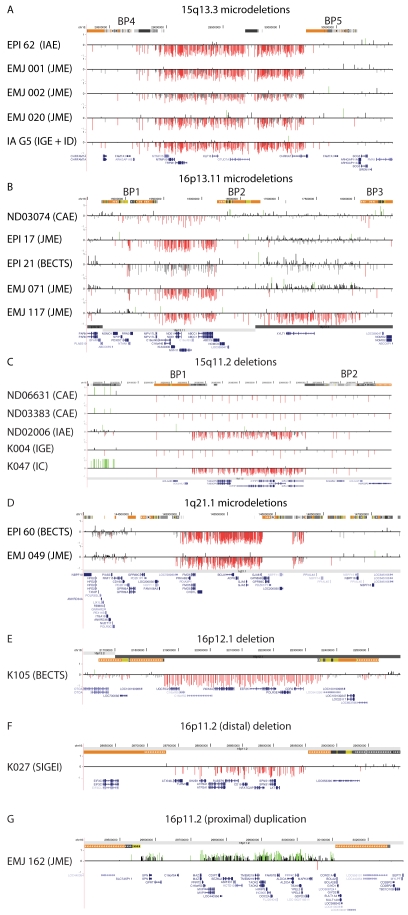
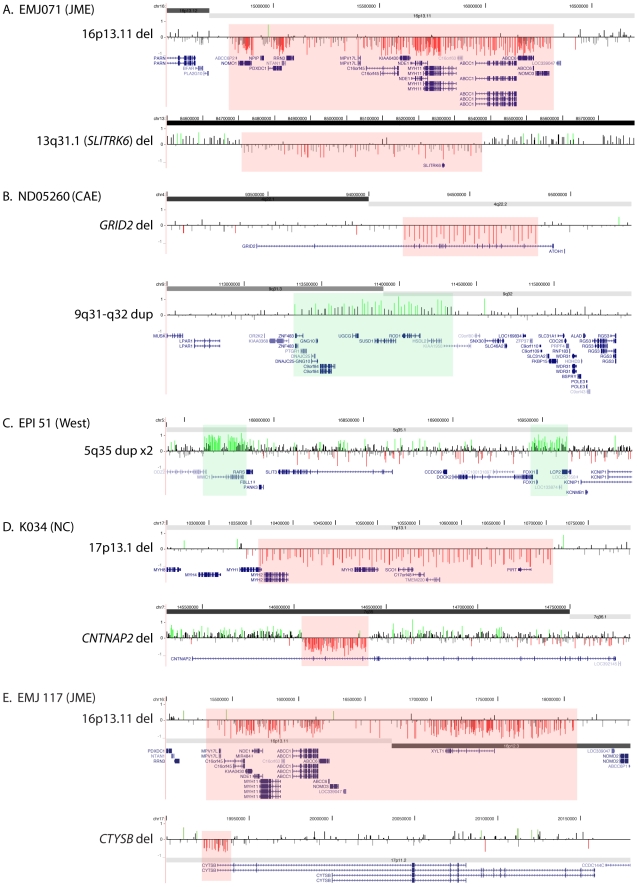
Epilepsy is one of the most common neurological disorders in humans with a prevalence of 1% and a lifetime incidence of 3%. Several genes have been identified in rare autosomal dominant and severe sporadic forms of epilepsy, but the genetic cause is unknown in the vast majority of cases. Copy number variants (CNVs) are known to play an important role in the genetic etiology of many neurodevelopmental disorders, including intellectual disability (ID), autism, and schizophrenia. Genome-wide studies of copy number variation in epilepsy have not been performed. We have applied whole-genome oligonucleotide array comparative genomic hybridization to a cohort of 517 individuals with various idiopathic, non-lesional epilepsies. We detected one or more rare genic CNVs in 8.9% of affected individuals that are not present in 2,493 controls; five individuals had two rare CNVs. We identified CNVs in genes previously implicated in other neurodevelopmental disorders, including two deletions in AUTS2 and one deletion in CNTNAP2. Therefore, our findings indicate that rare CNVs are likely to contribute to a broad range of generalized and focal epilepsies. In addition, we find that 2.9% of patients carry deletions at 15q11.2, 15q13.3, or 16p13.11, genomic hotspots previously associated with ID, autism, or schizophrenia. In summary, our findings suggest common etiological factors for seemingly diverse diseases such as ID, autism, schizophrenia, and epilepsy.
Overview
The claims and statistics of this paper haven’t been checked yet.
Run the check — free, no account needed. It reads the open-access text and checks the sources it cites.
Integrity signals
Registry
Cites
Statistics
Figures
Verification
Claims the paper makes
The claims and statistics of this paper haven’t been checked yet.
Run the check — free, no account needed. It reads the open-access text and checks the sources it cites.
Claims other papers make about this one
Each is checked against this paper’s own text: does it say what the citing paper says it does?
In the citing paper
“More directly, rare variation in CNTNAP2, including CNVs, other structural disruptions and deleterious sequence variation, has been identified in subjects with autism, epilepsy, intellectual disability, Pitt-Hopkins-like syndrome, schizophrenia and Tourette syndrome (42–48), albeit with differing degrees of evidence for effect on these traits.”
From Individual common variants exert weak effects on the risk for autism spectrum disorders (2012) · cites this paper as [45]
Self-check
Percentages, sums and reported differences re-computed from the paper’s own numbers.
The self-check needs the paper’s full text.
Citations
Cites
Global variation in copy number in the human genome
Redon, R., Ishikawa, S., Fitch, K. R., Feuk, L., Perry, G. H., Andrews, T. D., Fiegler, H., Shapero, M. H., Carson, A. R., Chen, W., et al. (2006) · Nature · doi:10.1038/nature05329 · Cited by 4,377
Strong association of de novo copy number mutations with autism
Sebat, J., Lakshmi, B., Malhotra, D., Troge, J., Lese-Martin, C., Walsh, T., Yamrom, B., Yoon, S., Krasnitz, A., Kendall, J., et al. (2007) · Science · doi:10.1126/science.1138659 · Cited by 2,795
Structural Variation of Chromosomes in Autism Spectrum Disorder
Marshall, C. R., Noor, A., Vincent, J. B., Lionel, A. C., Feuk, L., Skaug, J., Shago, M., Moessner, R., Pinto, D., Ren, Y., et al. (2008) · The American Journal of Human Genetics · doi:10.1016/j.ajhg.2007.12.009 · Cited by 1,815 · cited 2×
“2 Mb), which has been associated with autism, developmental delay and schizophrenia [10–12,14,27,35,37].”
BackgroundSelf-citationRare Structural Variants Disrupt Multiple Genes in Neurodevelopmental Pathways in Schizophrenia
Walsh, T., McClellan, J. M., McCarthy, S. E., Addington, A. M., Pierce, S. B., Cooper, G. M., Nord, A. S., Kusenda, M., Malhotra, D., Bhandari, A., et al. (2008) · Science · doi:10.1126/science.1155174 · Cited by 1,800
Self-citationLarge recurrent microdeletions associated with schizophrenia.
GROUP, Stefansson, H., Rujescu, D., Cichon, S., Pietiläinen, O. P. H., Ingason, A., Steinberg, S., Fossdal, R., Sigurdsson, E., Sigmundsson, T., et al. (2008) · Nature · doi:10.1038/nature07229 · Cited by 1,745
Association between Microdeletion and Microduplication at 16p11.2 and Autism
Weiss, L. A., Shen, Y., Korn, J. M., Arking, D. E., Miller, D. T., Fossdal, R., Saemundsen, E., Stefansson, H., Ferreira, M. A. R., Green, T., et al. (2008) · New England Journal of Medicine · doi:10.1056/nejmoa075974 · Cited by 1,666
Rare chromosomal deletions and duplications increase risk of schizophrenia
The International Schizophrenia Consortium (2008) · Nature · doi:10.1038/nature07239 · Cited by 1,475
Mapping autism risk loci using genetic linkage and chromosomal rearrangements
The Autism Genome Project Consortium (2007) · Nature Genetics · doi:10.1038/ng1985 · Cited by 1,402
Recent Segmental Duplications in the Human Genome
Bailey, J. A., Gu, Z., Clark, R. A., Reinert, K., Samonte, R. V., Schwartz, S., Adams, M. D., Myers, E. W., Li, P. W., & Eichler, E. E. (2002) · Science · doi:10.1126/science.1072047 · Cited by 1,355
Self-citation
Research works printed but not linked: 1
- I Helbig, 2009, 15q13.3 microdeletions increase risk of idiopathic generalized epilepsy., Nat Genet, 41, 160, 10.1038/ng.292 · DOI · Paper page
Cited by
Sorted by citations
Genetic architectures of psychiatric disorders: the emerging picture and its implications
Sullivan, P. F., Daly, M. J., & O'Donovan, M. (2012) · Nature Reviews Genetics · doi:10.1038/nrg3240 · Cited by 1,177
Schizophrenia: an integrated sociodevelopmental-cognitive model
Howes, O. D., & Murray, R. M. (2014) · The Lancet · doi:10.1016/s0140-6736(13)62036-x · Cited by 864
Rare de novo and transmitted copy-number variation in autistic spectrum disorders
Levy, D., Ronemus, M., Yamrom, B., Lee, Y.-H., Leotta, A., Kendall, J., Marks, S., Lakshmi, B., Pai, D., Ye, K., et al. (2011) · Neuron · doi:10.1016/j.neuron.2011.05.015 · Cited by 712
Genetics of autism spectrum disorders
Geschwind, D. H. (2011) · Trends in Cognitive Sciences · doi:10.1016/j.tics.2011.07.003 · Cited by 696
Targeted resequencing in epileptic encephalopathies identifies de novo mutations in CHD2 and SYNGAP1
Carvill, G. L., Heavin, S. B., Yendle, S. C., McMahon, J. M., O'Roak, B. J., Cook, J., Khan, A., Dorschner, M. O., Weaver, M., Calvert, S., et al. (2013) · Nature Genetics · doi:10.1038/ng.2646 · Cited by 687
Self-citation
Metadata
- Authors
- Mefford, H. C., Muhle, H., Ostertag, P., von Spiczak, S., Buysse, K., Baker, C., Franke, A., Malafosse, A., Genton, P., Thomas, P., Gurnett, C. A., Schreiber, S., Bassuk, A. G., Guipponi, M., Stephani, U., Helbig, I., & Eichler, E. E.
- Affiliations
- University of Washington (US)
- Christian-Albrechts-Universität zu Kiel (DE)
- Ghent University Hospital (BE)
- University of Geneva (CH)
- Henri Gastaut Hospital (FR)
- Hôpital Pasteur (FR)
- Washington University in St. Louis (US)
- University of Iowa (US)
- Howard Hughes Medical Institute (US)
- Corresponding author
- Mefford, Heather C.
- ORCID
- Venue
- PLoS Genetics
- Publisher
- Public Library of Science (PLoS)
- Published
- 2010-05-20
- Volume
- 6
- Issue
- 5
- Pages
- e1000962
- ISSN
- 1553-7390 (ISSN-L)
- 1553-7404
- PMC
- PMC2873910
- OpenAlex
- W2003479128
- Cited by
- 474
- References
- 61
- Citations by year
- 2026: 8 · 2025: 6 · 2024: 17 · 2023: 7 · 2022: 20 · 2021: 33 · 2020: 21 · 2019: 21 · 2018: 16 · 2017: 28 · 2016: 22 · 2015: 48 · 2014: 45 · 2013: 61 · 2012: 51
- FWCI
- 32.35
- Type
- journal article
- Language
- en
- Open access
- gold
- doi.org
- Locations
- PLoS Genetics (publishedVersion, cc-by)
- Europe PMC (PubMed Central) (publishedVersion, cc-by)
- PubMed Central (publishedVersion, cc-by)
- PubMed (publishedVersion)
- Archive ouverte UNIGE (University of Geneva) (acceptedVersion, other-oa)
- Radboud Repository (Radboud University) (submittedVersion, other-oa)
- DOAJ (DOAJ: Directory of Open Access Journals) (submittedVersion, cc-by-sa)
- Radboud Repository (Radboud University) (submittedVersion)
- Archive ouverte UNIGE (University of Geneva) (submittedVersion, cc-by)
- Funders
- Howard Hughes Medical Institute
- Burroughs Wellcome Fund
- National Institutes of Health
- National Institute of Neurological Disorders and Stroke (R01NS064159, NS064159)
- Eunice Kennedy Shriver National Institute of Child Health and Human Development (HD043376, HD043569, K12HD043376, R01HD043569)
- Topics
- Life Sciences › Biochemistry, Genetics and Molecular Biology › Genetics › Genomic variations and chromosomal abnormalities
- Health Sciences › Medicine › Clinical Neurology › Epilepsy research and treatment
- Life Sciences › Biochemistry, Genetics and Molecular Biology › Genetics › Genetics and Neurodevelopmental Disorders
- Keywords
- copy number variation, epilepsy, idiopathic generalized epilepsy, focal epilepsy, AUTS2, CNTNAP2, 15q11.2, 15q13.3, neurodevelopmental disorders, intellectual disability, autism spectrum disorder, schizophrenia
- MeSH terms
- Epilepsy, Humans, Genetic Variation, Genome, Gene Dosage, Genetic Predisposition to Disease
About these checks
Registry, retraction, Cites and statistics results are computed, not judged, with one exception: a printed reference that no index lists is read once by a model before it counts as a citation error. Claims are extracted by a model and kept only when their quote appears verbatim in the text; each cited source is then checked, with a model’s help, for whether it says what the claim relies on. Those verdicts can be wrong — read the claim’s quote and the cited source before relying on one.
Statistics and arithmetic are recomputed, not judged.
Confidence bands are shown only for fields calibrated on our annotated test set. None is calibrated yet, so no band is shown.
What counts as a claim ›How we measure confidence ›How we check this ›
Are you an author, or do you see a problem with this page? Request a review
