

The DOI matches its Crossref record; 35 of the 36 references it cites were found in a registry or an index.
Genetic Determinants of Serum Testosterone Concentrations in Men
Open accessAbstract
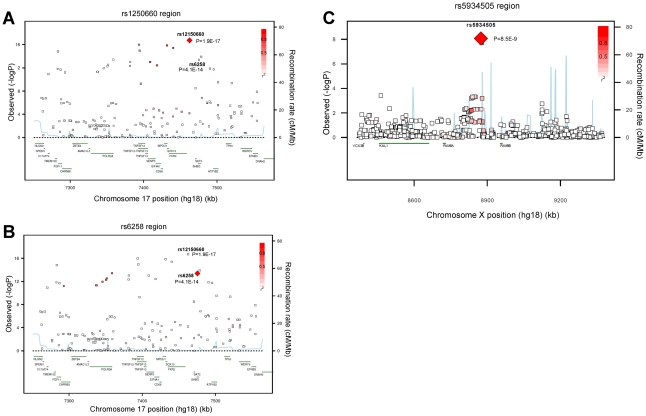
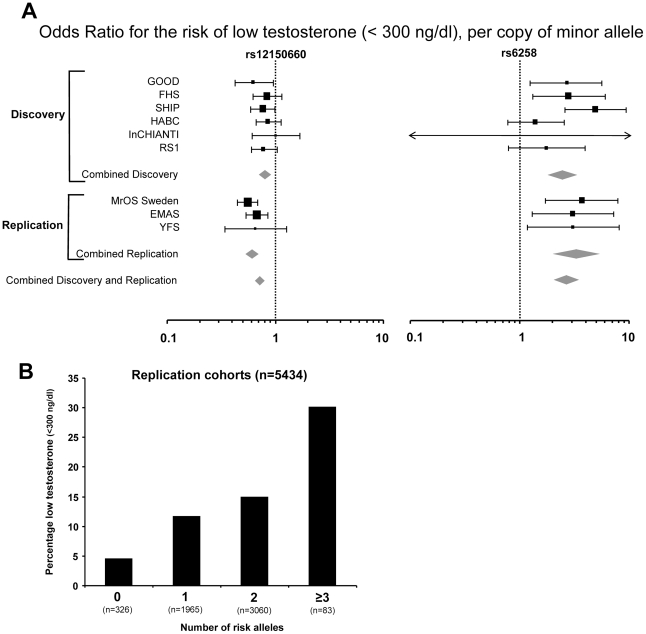
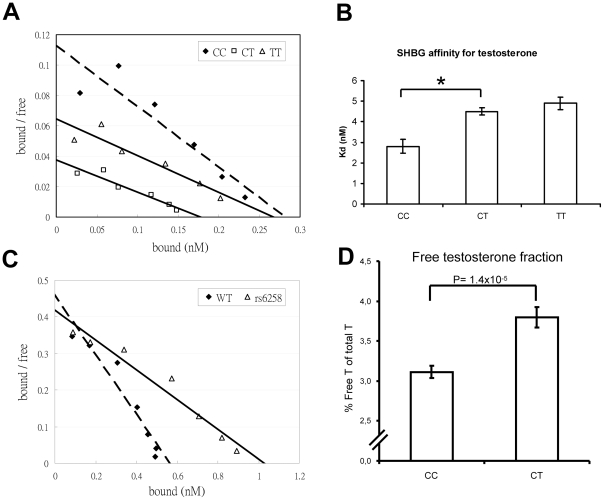
Testosterone concentrations in men are associated with cardiovascular morbidity, osteoporosis, and mortality and are affected by age, smoking, and obesity. Because of serum testosterone's high heritability, we performed a meta-analysis of genome-wide association data in 8,938 men from seven cohorts and followed up the genome-wide significant findings in one in silico (n = 871) and two de novo replication cohorts (n = 4,620) to identify genetic loci significantly associated with serum testosterone concentration in men. All these loci were also associated with low serum testosterone concentration defined as <300 ng/dl. Two single-nucleotide polymorphisms at the sex hormone-binding globulin (SHBG) locus (17p13-p12) were identified as independently associated with serum testosterone concentration (rs12150660, p = 1.2×10(-41) and rs6258, p = 2.3×10(-22)). Subjects with ≥ 3 risk alleles of these variants had 6.5-fold higher risk of having low serum testosterone than subjects with no risk allele. The rs5934505 polymorphism near FAM9B on the X chromosome was also associated with testosterone concentrations (p = 5.6×10(-16)). The rs6258 polymorphism in exon 4 of SHBG affected SHBG's affinity for binding testosterone and the measured free testosterone fraction (p<0.01). Genetic variants in the SHBG locus and on the X chromosome are associated with a substantial variation in testosterone concentrations and increased risk of low testosterone. rs6258 is the first reported SHBG polymorphism, which affects testosterone binding to SHBG and the free testosterone fraction and could therefore influence the calculation of free testosterone using law-of-mass-action equation.
Overview
The claims and statistics of this paper haven’t been checked yet.
Run the check — free, no account needed. It reads the open-access text and checks the sources it cites.
Integrity signals
Registry
Cites
Statistics
Figures
Verification
Claims the paper makes
The claims and statistics of this paper haven’t been checked yet.
Run the check — free, no account needed. It reads the open-access text and checks the sources it cites.
Claims other papers make about this one
Each is checked against this paper’s own text: does it say what the citing paper says it does?
The cited source says what the claim attributes to it.
In the citing paper
“Mean serum T concentrations are found to be highest in men with the TT genotype, lowest for the GG genotype and situated in between for the GT genotype of this SNP.”
From Role of sex hormone-binding globulin in the free hormone hypothesis and the relevance of free testosterone in androgen physiology (2022) · cites this paper as [65]
The cited source says what the claim attributes to it.
In the citing paper
“Rs12150660, located 11.5 kb upstream of the major transcription start site of SHBG, represented the SNP with the strongest genotype-dependent difference in T.”
From Role of sex hormone-binding globulin in the free hormone hypothesis and the relevance of free testosterone in androgen physiology (2022) · cites this paper as [65]
The cited source says what the claim attributes to it.
In the citing paper
“In fact, because of lower binding affinity of SHBG, the percentage free T was 22% higher in individuals with the CT vs the CC genotype [65].”
From Role of sex hormone-binding globulin in the free hormone hypothesis and the relevance of free testosterone in androgen physiology (2022) · cites this paper as [65]
The cited source says what the claim attributes to it.
In the citing paper
“Differences in serum T concentrations for both SNPs, however, were still significant after adjusting for these altered SHBG concentrations [65].”
From Role of sex hormone-binding globulin in the free hormone hypothesis and the relevance of free testosterone in androgen physiology (2022) · cites this paper as [65]
The cited source says what the claim attributes to it.
In the citing paper
“Furthermore, the CT genotype for the rs6258 polymorphism results in reduced binding affinity of SHBG for testosterone.”
From Role of sex hormone-binding globulin in the free hormone hypothesis and the relevance of free testosterone in androgen physiology (2022) · cites this paper as [65]
The cited source says what the claim attributes to it.
In the citing paper
“For the second SNP, rs6258, a rare missense polymorphism located in exon 4 of SHBG, lower concentrations of T were observed for the CT vs CC genotype.”
From Role of sex hormone-binding globulin in the free hormone hypothesis and the relevance of free testosterone in androgen physiology (2022) · cites this paper as [65]
The cited source says what the claim attributes to it.
In the citing paper
“Analysis of genome-wide association data of more than 8000 men identified that two SNPs within the SHBG locus are independently associated with serum T concentrations.”
From Role of sex hormone-binding globulin in the free hormone hypothesis and the relevance of free testosterone in androgen physiology (2022) · cites this paper as [65]
The cited source says what the claim attributes to it.
In the citing paper
“In men presenting with a T versus C allele of rs5934505, a decrease in total and calculated free T, but not in SHBG concentrations was observed [65, 77].”
From Role of sex hormone-binding globulin in the free hormone hypothesis and the relevance of free testosterone in androgen physiology (2022) · cites this paper as [65]
The cited source says what the claim attributes to it.
In the citing paper
“Additionally, as rs12150660 and rs6258 are located within the SHBG locus, a relevant association with SHBG concentration was demonstrated for both SNPs [65–67].”
From Role of sex hormone-binding globulin in the free hormone hypothesis and the relevance of free testosterone in androgen physiology (2022) · cites this paper as [65]
In the citing paper
“while the largest GWAS on serum T identified three independent genetic variants associated with serum T in men [17, 18].”
From Causal relationship between obesity and serum testosterone status in men: A bi-directional mendelian randomization analysis (2017) · cites this paper as [18]
In the citing paper
“Two of the three SNPs constituting the genetic risk score for BMI reside in the SHBG locus and have previously been reported to associate with SHBG (18).”
From Causal relationship between obesity and serum testosterone status in men: A bi-directional mendelian randomization analysis (2017) · cites this paper as [18]
Self-check
Percentages, sums and reported differences re-computed from the paper’s own numbers.
The self-check needs the paper’s full text.
Citations
Cites
Measuring inconsistency in meta-analyses
Higgins, J. P. T., Thompson, S. G., Deeks, J. J., & Altman, D. G. (2003) · BMJ · doi:10.1136/bmj.327.7414.557 · Cited by 63,139
Bhasin, S., Cunningham, G. R., Hayes, F. J., Matsumoto, A. M., Snyder, P. J., Swerdloff, R. S., & Montori, V. M. (2010) · The Journal of Clinical Endocrinology & Metabolism · doi:10.1210/jc.2009-2354 · Cited by 1,954
Self-citationIdentification of late-onset hypogonadism in middle-aged and elderly men
Wu, F. C. W., Tajar, A., Beynon, J. M., Pye, S. R., Silman, A. J., Finn, J. D., O'Neill, T. W., Bartfai, G., Casanueva, F. F., Forti, G., et al. (2010) · New England Journal of Medicine · doi:10.1056/nejmoa0911101 · Cited by 1,544
Self-citationAdverse Events Associated with Testosterone Administration
Basaria, S., Coviello, A. D., Travison, T. G., Storer, T. W., Farwell, W. R., Jette, A. M., Eder, R., Tennstedt, S., Ulloor, J., Zhang, A., et al. (2010) · New England Journal of Medicine · doi:10.1056/nejmoa1000485 · Cited by 1,494
Self-citationThe Decline of Androgen Levels in Elderly Men and Its Clinical and Therapeutic Implications
Kaufman, J. M., & Vermeulen, A. (2005) · Endocrine Reviews · doi:10.1210/er.2004-0013 · Cited by 1,079
Wu, F. C. W., Tajar, A., Pye, S. R., Silman, A. J., Finn, J. D., O'Neill, T. W., Bartfai, G., Casanueva, F., Forti, G., Giwercman, A., et al. (2008) · The Journal of Clinical Endocrinology & Metabolism · doi:10.1210/jc.2007-1972 · Cited by 939
Self-citationLow Serum Testosterone and Mortality in Older Men
Laughlin, G. A., Barrett-Connor, E., & Bergstrom, J. (2008) · The Journal of Clinical Endocrinology & Metabolism · doi:10.1210/jc.2007-1792 · Cited by 798
Pe'er, I., Yelensky, R., Altshuler, D., & Daly, M. J. (2008) · Genetic Epidemiology · doi:10.1002/gepi.20303 · Cited by 783
Kupelian, V., Page, S. T., Araujo, A. B., Travison, T. G., Bremner, W. J., & McKinlay, J. B. (2006) · The Journal of Clinical Endocrinology & Metabolism · doi:10.1210/jc.2005-1326 · Cited by 561
Travison, T. G., Araujo, A. B., Kupelian, V., O’Donnell, A. B., & McKinlay, J. B. (2007) · The Journal of Clinical Endocrinology & Metabolism · doi:10.1210/jc.2006-1859 · Cited by 410
Cited by
Sorted by citations
Testosterone Therapy in Men With Hypogonadism: An Endocrine Society Clinical Practice Guideline.
Bhasin, S., Brito, J. P., Cunningham, G. R., Hayes, F. J., Hodis, H. N., Matsumoto, A. M., Snyder, P. J., Swerdloff, R. S., Wu, F. C., & Yialamas, M. A. (2018) · The Journal of Clinical Endocrinology & Metabolism · doi:10.1210/jc.2018-00229 · Cited by 1,736
Self-citationEstrada, K., Styrkársdóttir, U., Εvangelou, Ε., Hsu, Y., Duncan, E. L., Ntzani, E., Oei, L., Albagha, O., Amin, N., Kemp, J. P., et al. (2012) · Nature Genetics · doi:10.1038/ng.2249 · Cited by 1,184
Self-citationAn atlas of genetic influences on osteoporosis in humans and mice
23andMe Research Team, Morris, J. A., Kemp, J. P., Youlten, S. E., Laurent, L., Logan, J. G., Chai, R. C., Vulpescu, N. A., Forgetta, V., Kleinman, A., et al. (2019) · Nature Genetics · doi:10.1038/s41588-018-0302-x · Cited by 773
Self-citationUsing human genetics to understand the disease impacts of testosterone in men and women
The Endometrial Cancer Association Consortium, Ruth, K. S., Day, F. R., Tyrrell, J., Thompson, D. J., Wood, A. R., Mahajan, A., Beaumont, R. N., Wittemans, L., Martin, S., et al. (2020) · Nature Medicine · doi:10.1038/s41591-020-0751-5 · Cited by 720
Self-citationHayes, M. G., Urbanek, M., Ehrmann, D. A., Armstrong, L. L., Lee, J. Y., Sisk, R., Karaderi, T., Barber, T. M., McCarthy, M. I., Franks, S., et al. (2015) · Nature Communications · doi:10.1038/ncomms8502 · Cited by 478
Metadata
- Authors
- Ohlsson, C., Wallaschofski, H., Lunetta, K. L., Stolk, L., Perry, J. R. B., Koster, A., Petersen, A.-K., Eriksson, J., Lehtimäki, T., Huhtaniemi, I. T., Hammond, G. L., Maggio, M., Coviello, A. D., EMAS Study Group, Ferrucci, L., Heier, M., Hofman, A., Holliday, K. L., Jansson, J.-O., Kähönen, M., Karasik, D., Karlsson, M. K., Kiel, D. P., Liu, Y., Ljunggren, Ö., Lorentzon, M., Lyytikäinen, L.-P., Meitinger, T., Mellström, D., Melzer, D., Miljkovic, I., Nauck, M., Nilsson, M., Penninx, B., Pye, S. R., Vasan, R. S., Reincke, M., Rivadeneira, F., Tajar, A., Teumer, A., Uitterlinden, A. G., Ulloor, J., Viikari, J., Völker, U., Völzke, H., Wichmann, H. E., Wu, T.-S., Zhuang, W. V., Ziv, E., Wu, F. C. W., Raitakari, O., Eriksson, A., Bidlingmaier, M., Harris, T. B., Murray, A., de Jong, F. H., Murabito, J. M., Bhasin, S., Vandenput, L., & Haring, R.
- Affiliations
- University of Gothenburg (SE)
- Universitätsmedizin Greifswald (DE)
- Boston University (US)
- Erasmus MC (NL)
- Centre for Human Genetics (GB)
- National Institutes of Health (US)
- Helmholtz Munich (DE)
- Tampere University Hospital (FI)
- Imperial College London (GB)
- University of British Columbia (CA)
- University of Parma (IT)
- Manchester Academic Health Science Centre (GB)
- Harvard University (US)
- Uppsala University (SE)
- University of Exeter (GB)
- University of Pittsburgh (US)
- Amsterdam Public Health (NL)
- University of Turku (FI)
- University of California, San Francisco (US)
- Ludwig-Maximilians-Universität München (DE)
- Corresponding author
- Ohlsson, Claes
- ORCID
- Ohlsson, Claes
- Lunetta, Kathryn L.
- Perry, John R. B.
- Koster, Annemarie
- Lehtimäki, Terho
- Huhtaniemi, Ilpo T.
- Hammond, Geoffrey L.
- Maggio, Marcello
- Coviello, Andrea D.
- Ferrucci, Luigi
- Heier, Margit
- Jansson, John-Olov
- Kähönen, Mika
- Karasik, David
- Karlsson, Magnus K.
- Kiel, Douglas P.
- Ljunggren, Östen
- Lorentzon, Mattias
- Lyytikäinen, Leo-Pekka
- Meitinger, Thomas
- Mellström, Dan
- Melzer, David
- Miljkovic, Iva
- Nauck, Matthias
- Nilsson, Maria
- Penninx, Brenda
- Pye, Stephen R.
- Vasan, Ramachandran S.
- Rivadeneira, Fernando
- Teumer, Alexander
- Uitterlinden, André G.
- Viikari, Jorma
- Völker, Uwe
- Völzke, Henry
- Wichmann, H. Erich
- Zhuang, Wei Vivian
- Ziv, Elad
- Wu, Frederick C. W.
- Raitakari, Olli
- Eriksson, Anna
- Bidlingmaier, Martin
- Harris, Tamara B.
- Murray, Anna
- Murabito, Joanne M.
- Bhasin, Shalender
- Vandenput, Liesbeth
- Haring, Robin
- Venue
- PLoS Genetics
- Publisher
- Public Library of Science (PLoS)
- Published
- 2011-10-06
- Volume
- 7
- Issue
- 10
- Pages
- e1002313
- ISSN
- 1553-7390 (ISSN-L)
- 1553-7404
- PMC
- PMC3188559
- OpenAlex
- W2108434880
- Cited by
- 224
- References
- 36
- Citations by year
- 2026: 5 · 2025: 14 · 2024: 11 · 2023: 7 · 2022: 17 · 2021: 14 · 2020: 12 · 2019: 18 · 2018: 19 · 2017: 19 · 2016: 12 · 2015: 16 · 2014: 24 · 2013: 16 · 2012: 18
- FWCI
- 2.59
- Type
- journal article
- Language
- en
- Open access
- gold
- doi.org
- Licence
- Locations
- PLoS Genetics (publishedVersion, public-domain)
- Europe PMC (PubMed Central) (publishedVersion, public-domain)
- PubMed Central (publishedVersion, public-domain)
- PubMed (publishedVersion)
- EUR Research Repository (Erasmus University Rotterdam) (publishedVersion, other-oa)
- Tampere University Institutional Repository (Tampere University) (publishedVersion)
- D-Scholarship@Pitt (University of Pittsburgh) (acceptedVersion)
- eScholarship (California Digital Library) (submittedVersion, public-domain)
- Figshare (submittedVersion, cc-by)
- Amsterdam UMC (VU Amsterdam) - Institutional Repository (submittedVersion, other-oa)
- VU Research Portal (submittedVersion, other-oa)
- Tampere University Institutional Repository (Tampere University) (submittedVersion)
- Digital Access to Scholarship at Harvard (DASH) (Harvard University) (submittedVersion, cc-by)
- Research Bank (Australian Catholic University) (submittedVersion)
- EUR Research Repository (Erasmus University Rotterdam) (submittedVersion, other-oa)
- RePub (Erasmus University Rotterdam) (submittedVersion, other-oa)
- RePEc: Research Papers in Economics (submittedVersion)
- Digital Academic REpository of VU University Amsterdam (Vrije Universiteit Amsterdam) (submittedVersion)
- DOAJ (DOAJ: Directory of Open Access Journals) (submittedVersion, cc-by-sa)
- Open access LMU (Ludwid Maxmilian's Universitat Munchen) (submittedVersion, other-oa)
- eScholarship (California Digital Library) (submittedVersion)
- Figshare (submittedVersion)
- Lund University Publications (Lund University) (submittedVersion, other-oa)
- mediaTUM (Technical University of Munich) (submittedVersion)
- Site cant be reached (submittedVersion)
- Open Research Exeter (University of Exeter) (submittedVersion)
- Pure Amsterdam UMC (submittedVersion, other-oa)
- Research Explorer (The University of Manchester) (submittedVersion)
- Data Archiving and Networked Services (DANS) (submittedVersion, other-oa)
- Funders
- Wake Forest University
- School of Medicine, Boston University (N01-HC25195)
- Johns Hopkins University (HHSN268200782096C)
- European Commission (01ZZ0103, 201865, 01ZZ0403, 03ZIK012, 01ZZ9603, 014-93-015)
- Stiftelsen för Strategisk Forskning
- ZonMw (050-060-810)
- Erasmus Universiteit Rotterdam
- Bundesministerium für Bildung und Forschung (01ZZ9603, 01ZZ0103, and 01ZZ0403, 03IS2061A, 01GS0823, NGFN-2, 03ZIK012, 01ZZ0403, and 01ZZ0403, 01ZZ0103, 01ZZ9603)
- Erasmus Medisch Centrum (050-060-810, 014-93-015)
- Nederlandse Organisatie voor Wetenschappelijk Onderzoek (050.060.810, 014-93-015, 911-03-012, 01ZZ9603, 01ZZ0403, 175.010.2005.011, 01ZZ0103)
- Novo Nordisk
- Vetenskapsrådet (2006‐3832)
- Siemens
- Göteborgs Universitet
- Bayerische Akademie der Wissenschaften
- Novo Nordisk Fonden
- Universität Greifswald
- Ministry of Cultural Affairs
- National Institutes of Health (N01-AG-6-2103, 5r01ag032098-05, R01 AR/AG 41398, 35627, N01‐AG‐6‐2106, N01-AG-6-2101, n01hc025195-11-0-0, HHSN268200782096C, N01-HC 25195, 5P30AG031679, 5p30ag031679-15)
- Canadian Institutes of Health Research (N01-HC-25195, MOP 15261)
- Leibniz-Gemeinschaft
- Münchner Zentrum für Gesundheitswissenschaften
- Leibniz-Rechenzentrum
- National Institute on Aging (N01‐AG‐6–2101, N.1‐AG‐1‐2111, N01-AG-6-2101, N01-AG-6-2103, and N01-AG-6-2106, R01AG031206, R01AG032098, N.1-AG-1-1, 5 P30 AG031679, R01AR/AG 41398, AR/AG 41398, N02-HL-6-4278, N01-HC-25195, AG-6-2106, AG-6-2103, and N01-AG, P30-AG031679, 1R01-AG-31206, AG-6-2101, R21AG032598, and N01-AG-6–2106, N01AG62106, 1R01AG032098, AG41398, 1R01AG032098‐01A1, N01-AG-62103, N01 AG-5-0002)
- National Heart, Lung, and Blood Institute (HC25195, N01‐HC25195, N01-HC, N02- HL-64278, N01AG62101, N01-HC-025195, N01AG62106, HHSN268200782096C, N01AG62103)
- National Human Genome Research Institute (HHSN268200782096C)
- National Institute of Arthritis and Musculoskeletal and Skin Diseases (R01AR041398)
- National Institute on Minority Health and Health Disparities (263MD9164, 263MD 821336, R01MD009164)
- Topics
- Health Sciences › Medicine › Endocrinology, Diabetes and Metabolism › Hormonal and reproductive studies
- Life Sciences › Biochemistry, Genetics and Molecular Biology › Genetics › Genetic Associations and Epidemiology
- Health Sciences › Medicine › Reproductive Medicine › Sperm and Testicular Function
- Keywords
- serum testosterone, androgen deficiency, sex hormone-binding globulin, X chromosome, free testosterone, genetic factors, heritability
- MeSH terms
- Adult, Aged, 80 and over, Alleles, Humans, Male, Middle Aged, Nuclear Proteins, Sex Hormone-Binding Globulin, Testosterone, Body Mass Index, Polymorphism, Single Nucleotide, Chromosomes, Human, X, Genome-Wide Association Study
About these checks
Registry, retraction, Cites and statistics results are computed, not judged, with one exception: a printed reference that no index lists is read once by a model before it counts as a citation error. Claims are extracted by a model and kept only when their quote appears verbatim in the text; each cited source is then checked, with a model’s help, for whether it says what the claim relies on. Those verdicts can be wrong — read the claim’s quote and the cited source before relying on one.
Statistics and arithmetic are recomputed, not judged.
Confidence bands are shown only for fields calibrated on our annotated test set. None is calibrated yet, so no band is shown.
What counts as a claim ›How we measure confidence ›How we check this ›
Are you an author, or do you see a problem with this page? Request a review
