

Mapping the Hsp90 Genetic Interaction Network in Candida albicans Reveals Environmental Contingency and Rewired Circuitry
Open accessThe DOI matches its Crossref record; 53 of the 53 references it cites were found in a registry or an index.
Abstract
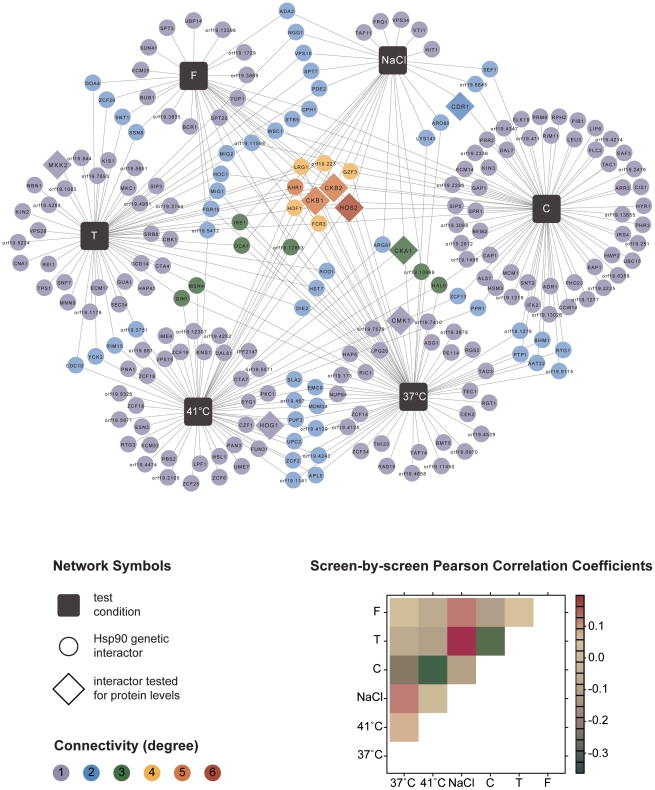
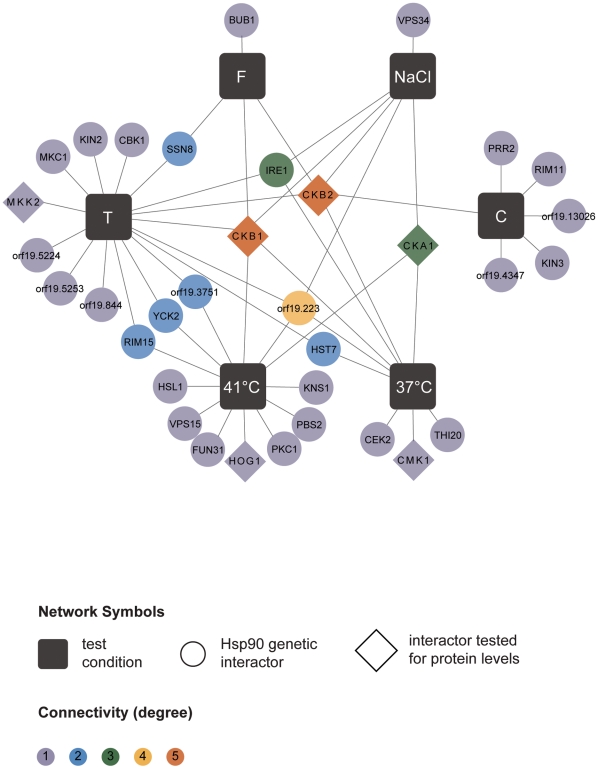
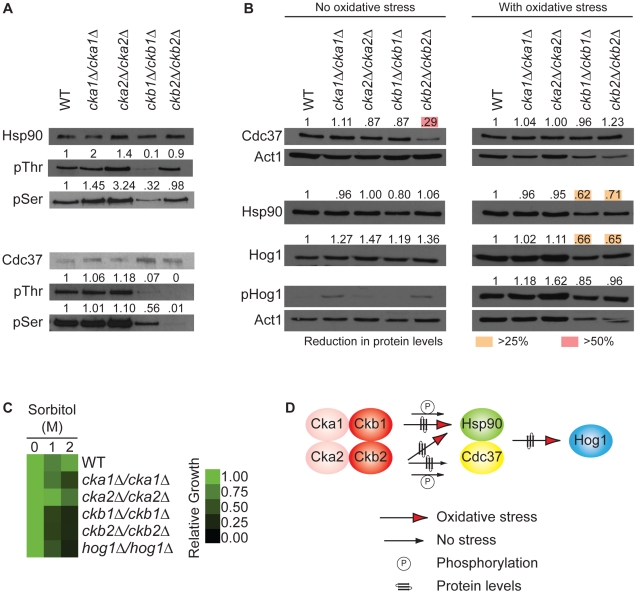
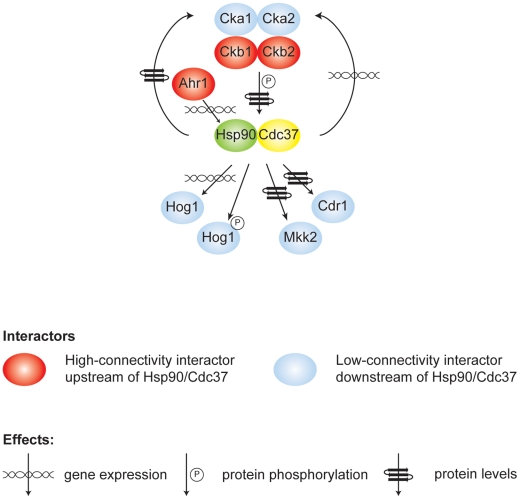
The molecular chaperone Hsp90 regulates the folding of diverse signal transducers in all eukaryotes, profoundly affecting cellular circuitry. In fungi, Hsp90 influences development, drug resistance, and evolution. Hsp90 interacts with -10% of the proteome in the model yeast Saccharomyces cerevisiae, while only two interactions have been identified in Candida albicans, the leading fungal pathogen of humans. Utilizing a chemical genomic approach, we mapped the C. albicans Hsp90 interaction network under diverse stress conditions. The chaperone network is environmentally contingent, and most of the 226 genetic interactors are important for growth only under specific conditions, suggesting that they operate downstream of Hsp90, as with the MAPK Hog1. Few interactors are important for growth in many environments, and these are poised to operate upstream of Hsp90, as with the protein kinase CK2 and the transcription factor Ahr1. We establish environmental contingency in the first chaperone network of a fungal pathogen, novel effectors upstream and downstream of Hsp90, and network rewiring over evolutionary time.
Overview
The claims and statistics of this paper haven’t been checked yet.
Free: it reads the open-access text and checks the first 5 claims that cite a source we can check. Create a free account to check every claim.
Integrity signals
Registry
Cites
Statistics
Figures
Verification
Claims the paper makes
The claims and statistics of this paper haven’t been checked yet.
Free: it reads the open-access text and checks the first 5 claims that cite a source we can check. Create a free account to check every claim.
Claims other papers make about this one
Each is checked against this paper’s own text: does it say what the citing paper says it does?
The source backs part of the claim, not all of it — or backs it for a different population, condition or comparison.
In the citing paper
“our analysis suggests all components of the Pkc1-MAPK pathway in C. albicans require Hsp90 for stability, including Pkc1, Bck1, Mkk2, and Mkc1”
From Functional Genomic Screening Reveals Core Modulators of Echinocandin Stress Responses in Candida albicans (2018) · cites this paper as Diezmann et al., 2012
Experimental — accuracy not yet measuredThe source backs part of the claim, not all of it — or backs it for a different population, condition or comparison.
In the citing paper
“The fungal Hsp90 interactome, which includes numerous client proteins such as receptors, protein kinases and transcription factors, displays a surprisingly high degree of plasticity that depends on environmental conditions.”
From Fungal Hsp90: a biological transistor that tunes cellular outputs to thermal inputs (2012) · cites this paper as [67]
Experimental — accuracy not yet measuredThe source backs part of the claim, not all of it — or backs it for a different population, condition or comparison.
In the citing paper
“Also, many features of the Hsp90 interactome are highly conserved from yeast to humans despite substantial network rewiring over evolutionary time.”
From Fungal Hsp90: a biological transistor that tunes cellular outputs to thermal inputs (2012) · cites this paper as [67]
Experimental — accuracy not yet measuredThe source backs part of the claim, not all of it — or backs it for a different population, condition or comparison.
In the citing paper
“These conserved features include a preponderance of protein kinases and transcription factors as client proteins67,78,91-93.”
From Fungal Hsp90: a biological transistor that tunes cellular outputs to thermal inputs (2012) · cites this paper as [67]
Experimental — accuracy not yet measuredThe source backs part of the claim, not all of it — or backs it for a different population, condition or comparison.
In the citing paper
“Kinases like Hog1, Mkc1 and Cek1, which are crucial for cell wall integrity [50], are also well- established clients of Hsp90 [12,51].”
From Heat shock protein 90 localizes to the surface and augments virulence factors of Cryptococcus neoformans (2017) · cites this paper as [51]
Experimental — accuracy not yet measured
3 more claims about this paper
Create a free account to see every claim other papers make about this one.
Self-check
Percentages, sums and reported differences re-computed from the paper’s own numbers.
The self-check needs the paper’s full text.
Citations
Cites
Cytoscape: A software Environment for integrated models of biomolecular interaction networks
Shannon, P., Markiel, A., Ozier, O., Baliga, N. S., Wang, J. T., Ramage, D., Amin, N., Schwikowski, B., & Ideker, T. (2003) · Genome Research · doi:10.1101/gr.1239303 · Cited by 51,888 · cited 2×
“Network analyses and GO category enrichment Networks of 226 global interactions and 34 kinase interactions were visualized with Cytoscape [50] and the layout manually improved for readability and clarity.”
MethodEpidemiology of Invasive Candidiasis: a Persistent Public Health Problem
Pfaller, M. A., & Diekema, D. J. (2007) · Clinical Microbiology Reviews · doi:10.1128/cmr.00029-06 · Cited by 4,174 · cited 1×
“albicans is the leading fungal pathogen of humans worldwide with mortality rates approaching 50%, and is the fourth most common cause of hospital-acquired infections [16,21,22].”
BackgroundJava Treeview—extensible visualization of microarray data
Saldanha, A. J. (2004) · Bioinformatics · doi:10.1093/bioinformatics/bth349 · Cited by 2,991
A generic protein purification method for protein complex characterization and proteome exploration
Rigaut, G., Shevchenko, A., Rutz, B., Wilm, M., Mann, M., & Séraphin, B. (1999) · Nature Biotechnology · doi:10.1038/13732 · Cited by 2,707 · cited 1×
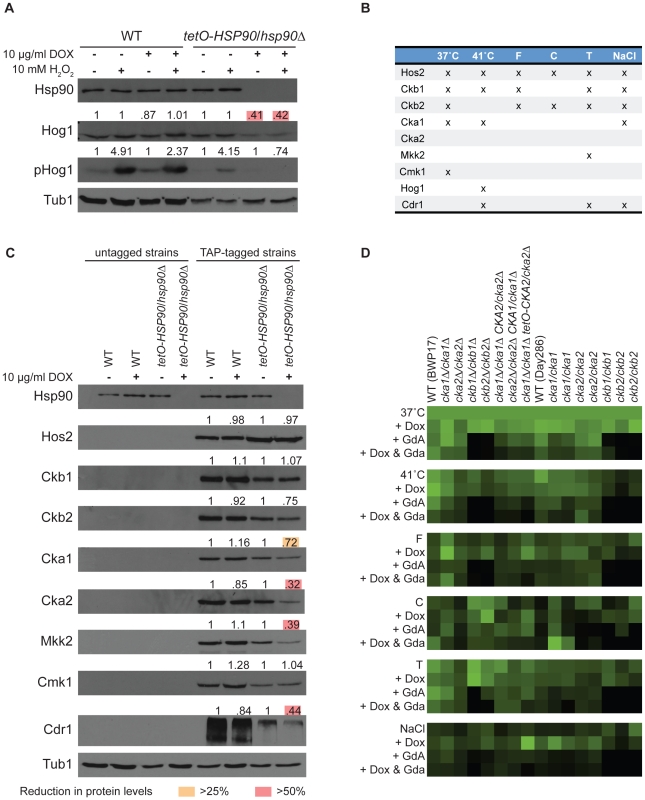
“Genes of candidate interactors were tagged with the tandem affinity purification (TAP) tag [52] in the wild-type strain SN95 and its derivative CaLC1411 using a PCR-based strategy [53].”
MethodHsp90 as a capacitor for morphological evolution
Rutherford, S. L., & Lindquist, S. (1998) · Nature · doi:10.1038/24550 · Cited by 2,270 · cited 1×
“phenotypic effects of genetic variation in an environmentally responsive manner [6,7,8,9], influencing ,20% of observed”
BackgroundHSP90 at the hub of protein homeostasis: emerging mechanistic insights
Taipale, M., Jarosz, D. F., & Lindquist, S. (2010) · Nature Reviews Molecular Cell Biology · doi:10.1038/nrm2918 · Cited by 1,818 · cited 1×
“in all eukaryotes that specializes in folding metastable client proteins, many of which are signal transducers [1,2].”
BackgroundTargeting the dynamic HSP90 complex in cancer
Trepel, J., Mollapour, M., Giaccone, G., & Neckers, L. (2010) · Nature Reviews Cancer · doi:10.1038/nrc2887 · Cited by 1,514 · cited 1×
“Hsp90 function is subject to complex regulation by post-translational modification, including phosphorylation and acetylation, and depends upon an ATP binding and hydrolysis cycle [3,4].”
BackgroundWhitesell, L., Mimnaugh, E. G., De Costa, B., Myers, C. E., & Neckers, L. M. (1994) · Proceedings of the National Academy of Sciences · doi:10.1073/pnas.91.18.8324 · Cited by 1,444 · cited 1×
“To identify Hsp90 genetic interactors, the library was screened for mutants hypersensitive to pharmacological inhibition of Hsp90 with geldanamycin, which binds with high affinity to Hsp90’s unusual ATP binding pocket and thereby blocks ATP-dependent chaperone function [27].”
BackgroundHsp90 as a capacitor of phenotypic variation
Queitsch, C., Sangster, T. A., & Lindquist, S. (2002) · Nature · doi:10.1038/nature749 · Cited by 1,372
Structure and mechanism of the Hsp90 molecular chaperone machinery
Pearl, L. H., & Prodromou, C. (2006) · Annual Review of Biochemistry · doi:10.1146/annurev.biochem.75.103004.142738 · Cited by 1,103 · cited 1×
“Hsp90 function is subject to complex regulation by post-translational modification, including phosphorylation and acetylation, and depends upon an ATP binding and hydrolysis cycle [3,4].”
Background
Cited by
Items 101–113 of 113
Expressão, regulação e funcionalidade de genes HSPs no dermatófito Trichophyton rubrum
Jacob, T. R. (2016) · Digital Library of Theses and Dissertations (Universidade de São Paulo) · doi:10.11606/t.17.2016.tde-15052014-105536
Chaperone protein Hsp90 a possible key in treating in fungal infections caused by Candida albicans
Pace, K. (2012) · Microreviews in Cell and Molecular Biology
Khalili, V., Shokri, H., Akim, A. M., & Khosravi, A. (2016) · Europe PMC (PubMed Central) · Cited by 3
Sun, N. (2013) · DigitalGeorgetown (Georgetown University Library)
Regulation of Fungal Drug Resistance and Morphogenesis by Lysine Deacetylases
Li, X. (2015) · TSpace (University of Toronto)
Shekhar‐Guturja, T. (2016) · TSpace (University of Toronto)
Hill, J. A. (2014) · TSpace (University of Toronto)
Germination of a Field: Women in Candida albicans Research
Anderson, F. M., Polvi, E. J., Veri, A. O., & O’Meara, T. R. (2021) · Current Clinical Microbiology Reports · doi:10.1007/s40588-021-00169-5
Environmental adaptation of Candida albicans : the examples of persistence and chlamydosporulation
Denega, I. (2020) · theses.fr (ABES) · doi:10.70675/748584ddzf6f4z4124z9237z56d0535d3352
Hao, Y., Wang, R., Liao, H., Wang, M., Ye, Z., Liu, Y., Lv, Q., Zhang, D., Yan, L., & Xie, F. (2026) · European Journal of Medicinal Chemistry · doi:10.1016/j.ejmech.2026.118991
In Silico Druggability Analysis of Cdc37 in Candidiasis
Dey, S., Das, S., Mondal, A., Chattopadhyay, D., Mondal, P. S., Mondal, T., Roy, M., & Saha, T. (2026) · International journal of research and scientific innovation · doi:10.51244/ijrsi.2026.1307000341
Lee, S., Fu, C., Giamberardino, C. D., Averette, A. F., LeBlanc, E., Kilgore, J. A., Williams, N. S., Heitman, J., Perfect, J. R., Robbins, N., et al. (2026) · npj Antimicrobials and Resistance · doi:10.1038/s44259-026-00272-x
Self-citation
Metadata
- Authors
- Diezmann, S., Michaut, M., Shapiro, R. S., Bader, G. D., & Cowen, L. E.
- Affiliations
- University of Toronto (CA)
- Corresponding author
- Cowen, Leah E.
- Venue
- PLoS Genetics
- Publisher
- Public Library of Science (PLoS)
- Published
- 2012-03-15
- Volume
- 8
- Issue
- 3
- Pages
- e1002562
- ISSN
- 1553-7390 (ISSN-L)
- 1553-7404
- PMC
- PMC3305360
- OpenAlex
- W2031431271
- Cited by
- 112
- References
- 53
- Citations by year
- 2026: 2 · 2025: 4 · 2024: 4 · 2023: 3 · 2022: 8 · 2021: 8 · 2020: 8 · 2019: 4 · 2018: 10 · 2017: 14 · 2016: 15 · 2015: 6 · 2014: 11 · 2013: 7 · 2012: 8
- FWCI
- 4.12
- Type
- journal article
- Language
- en
- Open access
- gold
- doi.org
- Locations
- PLoS Genetics (publishedVersion, cc-by)
- PubMed Central (publishedVersion, cc-by)
- PubMed (publishedVersion)
- Explore Bristol Research (publishedVersion)
- The University of Bath Online Publications Store (The University of Bath) (submittedVersion, cc-by)
- DOAJ (DOAJ: Directory of Open Access Journals) (submittedVersion, cc-by-sa)
- Figshare (submittedVersion, cc-by)
- Pure (University of Bath) (submittedVersion, cc-by)
- Funders
- Burroughs Wellcome Fund
- Canadian Institutes of Health Research (MOP-86452)
- National Institute of General Medical Sciences (P41GM103504)
- Topics
- Life Sciences › Biochemistry, Genetics and Molecular Biology › Molecular Biology › Heat shock proteins research
- Life Sciences › Biochemistry, Genetics and Molecular Biology › Molecular Biology › Fungal and yeast genetics research
- Life Sciences › Biochemistry, Genetics and Molecular Biology › Genetics › Bacterial Genetics and Biotechnology
- Keywords
- HSP90, Candida albicans, genetic interaction networks, molecular chaperones, protein folding, environmental contingencies, network rewiring, Hog1 MAPK, casein kinase 2, chemical genomics, fungal pathogens, stress conditions
- MeSH terms
- Adenosine Triphosphate, Candida albicans, Culture Media, Environmental Microbiology, Phosphotransferases, Saccharomyces cerevisiae, Stress, Physiological, Signal Transduction, Gene Expression Regulation, Bacterial, Benzoquinones, HSP90 Heat-Shock Proteins, Lactams, Macrocyclic, Gene Regulatory Networks, Protein Interaction Maps
About these checks
Registry, retraction, Cites and statistics results are computed, not judged, with one exception: a printed reference that no index lists is read once by a model before it counts as a citation error. Claims are extracted by a model and kept only when their quote appears verbatim in the text; each cited source is then checked, with a model’s help, for whether it says what the claim relies on. Those verdicts can be wrong — read the claim’s quote and the cited source before relying on one.
Statistics and arithmetic are recomputed, not judged.
Confidence bands are shown only for fields calibrated on our annotated test set. None is calibrated yet, so no band is shown.
What counts as a claim ›How we measure confidence ›How we check this ›
Are you an author, or do you see a problem with this page? Request a review
Data sources
Bibliographic data: Semantic Scholar, OpenAlex, Crossref.
Contains information from the Semantic Scholar Academic Graph Datasets, made available under the ODC Attribution License (ODC-BY 1.0).
Semantic Scholar’s data is described in: Kinney, R., et al. (2023). The Semantic Scholar Open Data Platform. arXiv:2301.10140.
