

Speciation and Introgression between Mimulus nasutus and Mimulus guttatus
Open accessPublished version of a preprint
The DOI matches its Crossref record; 108 of the 108 references it cites were found in a registry or an index.
Abstract
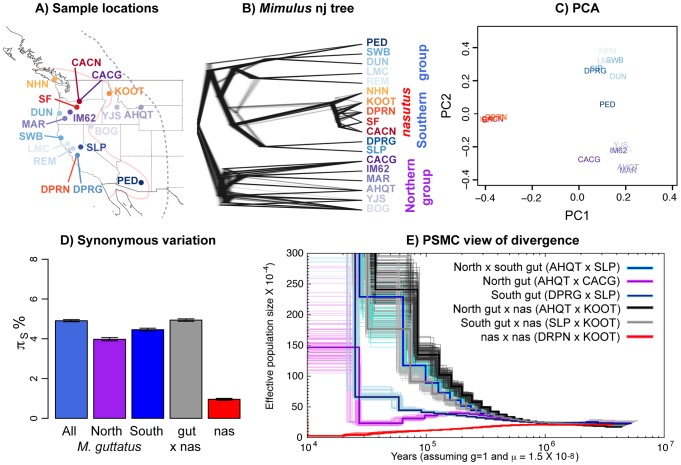
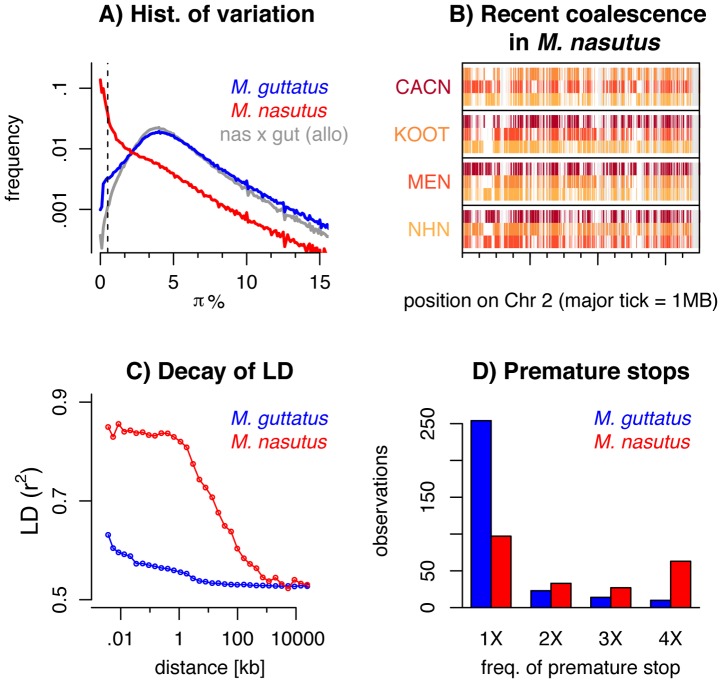
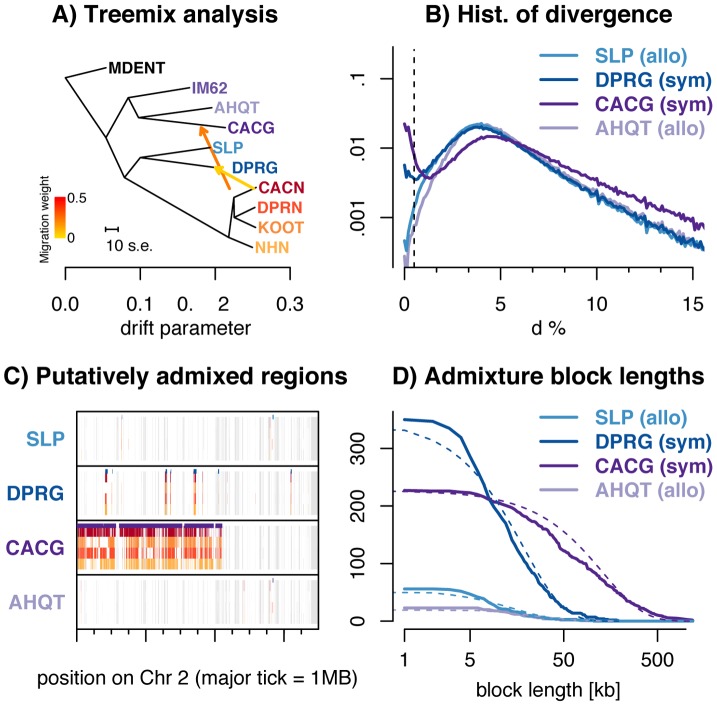
Mimulus guttatus and M. nasutus are an evolutionary and ecological model sister species pair differentiated by ecology, mating system, and partial reproductive isolation. Despite extensive research on this system, the history of divergence and differentiation in this sister pair is unclear. We present and analyze a population genomic data set which shows that M. nasutus budded from a central Californian M. guttatus population within the last 200 to 500 thousand years. In this time, the M. nasutus genome has accrued genomic signatures of the transition to predominant selfing, including an elevated proportion of nonsynonymous variants, an accumulation of premature stop codons, and extended levels of linkage disequilibrium. Despite clear biological differentiation, we document genomic signatures of ongoing, bidirectional introgression. We observe a negative relationship between the recombination rate and divergence between M. nasutus and sympatric M. guttatus samples, suggesting that selection acts against M. nasutus ancestry in M. guttatus.
Overview
The claims and statistics of this paper haven’t been checked yet.
Free: it reads the open-access text and checks the first 5 claims that cite a source we can check. Create a free account to check every claim.
Integrity signals
Registry
Cites
Statistics
Figures
Verification
Claims the paper makes
The claims and statistics of this paper haven’t been checked yet.
Free: it reads the open-access text and checks the first 5 claims that cite a source we can check. Create a free account to check every claim.
Claims other papers make about this one
Each is checked against this paper’s own text: does it say what the citing paper says it does?
The cited source says what the claim attributes to it.
In the citing paper
“As predicted from hybrid zone theory (Barton and Hewitt 1985), rates of introgression are positively correlated with recombination rates (Brandvain et al., 2014; Owens et al., 2021; Owens et al., 2023).”
From Genomics of plant speciation (2023) · cites this paper as Brandvain et al., 2014
Self-check
Percentages, sums and reported differences re-computed from the paper’s own numbers.
The self-check needs the paper’s full text.
Citations
Cites
R: A Language and Environment for Statistical Computing
R Core Team (2025) · doi:10.32614/r.manuals · Cited by 352,181
The Sequence Alignment/Map format and SAMtools
Li, H., Handsaker, B., Wysoker, A., Fennell, T., Ruan, J., Homer, N., Marth, G., Abecasis, G., Durbin, R., & 1000 Genome Project Data Processing Subgroup (2009) · Bioinformatics · doi:10.1093/bioinformatics/btp352 · Cited by 62,041 · cited 2×
“0 reference genome (69) using Burrows-Wheeler Aligner (bwa (70)) with a minimum alignment quality threshold of Q29 (filtering done using SAMtools (71)).”
Fast and accurate short read alignment with Burrows-Wheeler transform
Li, H., & Durbin, R. (2009) · Bioinformatics · doi:10.1093/bioinformatics/btp324 · Cited by 58,607
The Genome Analysis Toolkit: A MapReduce framework for analyzing next-generation DNA sequencing data
McKenna, A., Hanna, M., Banks, E., Sivachenko, A., Cibulskis, K., Kernytsky, A., Garimella, K., Altshuler, D., Gabriel, S., Daly, M., et al. (2010) · Genome Research · doi:10.1101/gr.107524.110 · Cited by 27,895 · cited 2×
“Genotyper, with a site quality threshold of Q40 [89,90].”
A framework for variation discovery and genotyping using next-generation DNA sequencing data
DePristo, M. A., Banks, E., Poplin, R., Garimella, K. V., Maguire, J. R., Hartl, C., Philippakis, A. A., del Angel, G., Rivas, M. A., Hanna, M., et al. (2011) · Nature Genetics · doi:10.1038/ng.806 · Cited by 11,456 · cited 2×
“Genotyper, with a site quality threshold of Q40 [89,90].”
BackgroundAPE: analyses of phylogenetics and evolution in R language
Paradis, E., Claude, J., & Strimmer, K. (2004) · Bioinformatics · doi:10.1093/bioinformatics/btg412 · Cited by 11,335 · cited 1×
“We construct the nj tree with the nj function in the R [91] package ape [92], and root it by the outgroup, M.”
MethodA draft sequence of the Neandertal genome
Green, R. E., Krause, J., Briggs, A. W., Maricic, T., Stenzel, U., Kircher, M., Patterson, N., Li, H., Zhai, W., Fritz, M. H.-Y., et al. (2010) · Science · doi:10.1126/science.1188021 · Cited by 4,318
Biological sequence analysis probabilistic models of proteins and nucleic acids
Durbin, R. M., Eddy, S. R., Krogh, A., & Mitchison, G. (1998) · Cited by 3,565
Biological Sequence Analysis: Probabilistic Models of Proteins and Nucleic Acids
Durbin, R., Eddy, S. R., Krogh, A., & Mitchison, G. (1998) · Cambridge University Press eBooks · doi:10.1017/cbo9780511790492 · Cited by 3,246 · cited 1×
“[101] in a customized R script controlling for underflow (available upon request) to calculate posterior probabilities of M.”
BackgroundAncient Admixture in Human History
Patterson, N., Moorjani, P., Luo, Y., Mallick, S., Rohland, N., Zhan, Y., Genschoreck, T., Webster, T., & Reich, D. (2012) · Genetics · doi:10.1534/genetics.112.145037 · Cited by 2,848 · cited 2×
“We evaluate significance with a block jackknife, dropping one chromosome in each run [100].”
Method
Research works printed but not linked: 2
- 7. Grant V (1971) Plant Speciation. New York: Columbia University Press.
- 26. Diaz A, MacNair MR (1999) Pollen tube competition as a mechanism of prezygotic reproductive isolation between Mimulus nasutus. American Journal of Botany 144: 471-478.
Cited by
Items 101–200 of 261
Izuno, A., Hatakeyama, M., Nishiyama, T., Tamaki, I., Shimizu‐Inatsugi, R., Sasaki, R., Shimizu, K. K., & Isagi, Y. (2016) · Journal of Plant Research · doi:10.1007/s10265-016-0822-3 · Cited by 24
“Population genomics with genome-wide variants, even if the variants are detected within individual genome sequences, can estimate the genomic divergence within a species in time and space as well as the required time scale and environmental factors for the ecological divergence (Brandvain et al. 2014; Fitak et al. 201…”
BackgroundEndosperm-based incompatibilities in hybrid monkeyflowers
Kinser, T. J., Smith, R. D., Lawrence, A. H., Cooley, A. M., Vallejo‐Marín, M., Smith, G. D., & Puzey, J. R. (2021) · The Plant Cell · doi:10.1093/plcell/koab117 · Cited by 25
Kumar, J., Heikrujam, M., Sharma, K. R., & Agrawal, V. (2019) · Industrial Crops and Products · doi:10.1016/j.indcrop.2019.03.006 · Cited by 21
Recombination-aware phylogenomics
Burbrink, F. T., DeBaun, D., Foley, N. M., & Murphy, W. J. (2025) · Trends in Ecology & Evolution · doi:10.1016/j.tree.2025.06.011 · Cited by 27
Suetsugu, K., Fukushima, K., Makino, T., Ikematsu, S., Sakamoto, T., & Kimura, S. (2022) · New Phytologist · doi:10.1111/nph.18495 · Cited by 23
The Boechera model system for evolutionary ecology
Rushworth, C. A., Wagner, M. R., Mitchell‐Olds, T., & Anderson, J. T. (2022) · American Journal of Botany · doi:10.1002/ajb2.16090 · Cited by 19
Ancient hybridization leads to the repeated evolution of red flowers across a monkeyflower radiation
Short, A. W., & Streisfeld, M. A. (2023) · Evolution Letters · doi:10.1093/evlett/qrad024 · Cited by 17
“By contrast, introgressed deleterious and neutral variants will remain in linkage disequilibrium in regions of low recombination, which will make it easier for selection to purge introgressed variation from the population (Aeschbacher et al., 2017; Brandvain et al., 2014; Schumer et al., 2018).”
Pantoja, P. O., Simón‐Porcar, V. I., Puzey, J. R., & Vallejo‐Marín, M. (2017) · Plant Ecology & Diversity · doi:10.1080/17550874.2017.1287785 · Cited by 22
“Previous studies that used thousands of SNP markers (Brandvain et al. 2014; Puzey and Vallejo-Marín 2014; Twyford and Friedman 2015) have detected some geographic structure in the native range.”
BackgroundLovell, J. T., Walstead, R., Lawrence, A., Stark-Dykema, E. R., Farnitano, M. C., Harder, A. M., Brůna, T., Barry, K., Goodstein, D., Jenkins, J., et al. (2025) · Molecular Ecology Resources · doi:10.1111/1755-0998.70012 · Cited by 24
“…(1) IM767, an inbred line from the same Iron Mountain population as IM62 but genomically unrelated (Veltsos and Kelly 2024); (2) SF, an accession of self-fertilising M. nasutus (Brandvain et al. 2014); and (3) LVR, a M. tilingii accession from a distinct clade (Sandstedt et al. 2021; Figure 1).”
InfluentialSelf-citationSianta, S. A., Peischl, S., Moeller, D. A., & Brandvain, Y. J. (2022) · Evolution · doi:10.1093/evolut/qpac013 · Cited by 22
Self-citationThe role of hybrid seed inviability in angiosperm speciation
Coughlan, J. M. (2023) · American Journal of Botany · doi:10.1002/ajb2.16135 · Cited by 19
Jiang, Z., Zang, W., Ericson, P. G. P., Song, G., Wu, S., Feng, S., Drovetski, S. V., Liu, G., Zhang, D., Saitoh, T., et al. (2024) · BMC Biology · doi:10.1186/s12915-024-01848-7 · Cited by 19
“…to persist within high-recombination regions than within low-recombination regions, because neutral or positively selected variants may be effectively unlinked from deleterious alleles in high-recombination regions, and hence less likely to be removed as a result of background selection [34, 35].”
BackgroundSianta, S. A., Moeller, D. A., & Brandvain, Y. J. (2024) · Proceedings of the National Academy of Sciences · doi:10.1073/pnas.2316008121 · Cited by 18
“Other studies have found similar asymmetric introgression between selfers and outcrossers (23, 24, 26, 27, 62–64), suggesting that these phenotypic and ecological factors associated with mating system shifts have consistent consequences on hybridization and introgression.”
BackgroundResultInfluentialSelf-citationLaFountain, A. M., Frank, H. A., & Yuan, Y. (2015) · Archives of Biochemistry and Biophysics · doi:10.1016/j.abb.2015.03.006 · Cited by 23
Flores‐Vergara, M. A., Oneal, E., Costa, M. L., Villarino, G., Roberts, C., Balaguer, M. A. D. L., Coimbra, S., Willis, J. H., & Franks, R. G. (2020) · Frontiers in Plant Science · doi:10.3389/fpls.2020.00132 · Cited by 19
Two new hybrid populations expand the swordtail hybridization model system
Powell, D. L., Moran, B. M., Kim, B. Y., Banerjee, S. M., Aguillon, S. M., Fascinetto‐Zago, P., Langdon, Q. K., & Schumer, M. E. (2021) · Evolution · doi:10.1111/evo.14337 · Cited by 16
O’Donnell, S., Fitz‐Gibbon, S. T., & Sork, V. L. (2021) · Journal of Heredity · doi:10.1093/jhered/esab053 · Cited by 20
Li, J., Schumer, M. E., & Bank, C. (2022) · PLoS Genetics · doi:10.1371/journal.pgen.1010120 · Cited by 23
Ivey, C. T., Habecker, N., Bergmann, J.-P., Ewald, J., Frayer, M. E., & Coughlan, J. M. (2023) · Evolution · doi:10.1093/evolut/qpad044 · Cited by 18
Dagilis, A. J., & Matute, D. R. (2023) · PLoS Biology · doi:10.1371/journal.pbio.3002185 · Cited by 25
Payne, B. L., & Alvarez‐Ponce, D. (2018) · Genome Biology and Evolution · doi:10.1093/gbe/evy053 · Cited by 20
“Speciation and introgression between Mimulus nasutus and Mimulus guttatus.”
BackgroundRapid evolution of post-zygotic reproductive isolation is widespread in Arctic plant lineages
Gustafsson, A. L. S., Gussarova, G. L., Borgen, L., Ikeda, H., Antonelli, A., Marie‐Orleach, L., Rieseberg, L. H., & Brochmann, C. (2021) · Annals of Botany · doi:10.1093/aob/mcab128 · Cited by 17
Blom, M. P. K., Peona, V., Prost, S., Christidis, L., Benz, B. W., Jønsson, K. A., Suh, A., & Irestedt, M. (2024) · iScience · doi:10.1016/j.isci.2024.110300 · Cited by 21
“31 However,theoretical models 32 and empirical work 33–35 have both highlighted that the magnitude and spatial distribution of introgression is non-random across the genome and that it often scales with local recombination rate.”
Herrig, D. K., Ridenbaugh, R. D., Vertacnik, K. L., Everson, K. M., Sim, S. B., Geib, S. M., Weisrock, D. W., & Linnen, C. R. (2024) · Systematic Biology · doi:10.1093/sysbio/syae036 · Cited by 21
Divergence in drought‐response traits between sympatric species of Mimulus
Mantel, S. J., & Sweigart, A. L. (2019) · Ecology and Evolution · doi:10.1002/ece3.5549 · Cited by 15
“Consistent with the idea that differentially adapted loci contribute to reproductive isolation between species, we find evidence of selection against M. nasutus ancestry across the M. guttatus genome at CAC (Brandvain et al., 2014; Kenney & Sweigart, 2016).”
BackgroundMethodInfluentialSelf-citationSmith, C. C. R., & Flaxman, S. M. (2019) · Molecular Ecology Resources · doi:10.1111/1755-0998.13092 · Cited by 18
“…(Haenel, Laurentino, Roesti, & Berner, 2018), along each chromosome (Berner & Roesti, 2017; Roesti, Hendry, Salzburger, & Berner, 2012), between gene dense or sparse regions (Brandvain, Kenney, Flagel, Coop, & Sweigart, 2014), and, of course, with inversions (Kirkpatrick & Barton, 2006).”
Genomic inference of complex domestication histories in three Solanaceae species
Arnoux, S., Fraïssé, C., & Sauvage, C. (2020) · Journal of Evolutionary Biology · doi:10.1111/jeb.13723 · Cited by 16
“The human-mediated selfing of crop plants to retain phenotype of interest in gardens could enhance their isolation and also explain this asymmetric gene flow (e.g. Brandvain et al., 2014).”
BackgroundCahenzli, F., Bonetti, C., & Erhardt, A. (2018) · Evolution · doi:10.1111/evo.13556 · Cited by 19
“…that despite hybridization between M. guttatus and M. nasutus, divergence in phenology and mating system and selection against interspecific alleles can lead to hybrid dysfunction and may maintain these species in sympatry (Brandvain et al. 2014; Sweigart and Flagel 2015; Kenney and Sweigart 2016).”
BackgroundThom, G., Moreira, L. R., Batista, R., Gehara, M., Aleixo, A. L. P., & Smith, B. T. (2024) · Genome Biology and Evolution · doi:10.1093/gbe/evae002 · Cited by 16
Predicting evolutionary change at the DNA level in a natural Mimulus population
Monnahan, P. J., Colicchio, J. M., Fishman, L., Macdonald, S. J., & Kelly, J. K. (2021) · PLoS Genetics · doi:10.1371/journal.pgen.1008945 · Cited by 19
“guttatus) contribute alleles to the IM population [54,71] may provide a source of selectively relevant variation.”
BackgroundJensen, E. L., Gaughran, S. J., Garrick, R. C., Russello, M. A., & Caccone, A. (2021) · Molecular Ecology · doi:10.1111/mec.16176 · Cited by 16
“However, increases in inverse co-alescent rate may not always correspond to increases in N e , and can be caused instead by historical population subdivision or admixture events (Brandvain et al., 2014; Nadachowska-Brzyska et al., 2016).”
BackgroundKolis, K. M., Berg, C. S., Nelson, T. C., & Fishman, L. (2022) · Evolution · doi:10.1111/evo.14469 · Cited by 16
“Other close selfer-outcrosser pairs show similar habitat/phenology associations (e.g., Pettengill and Moeller 2012; Briscoe Runquist et al. 2014).”
BackgroundSupergene potential of a selfish centromere
Finseth, F. R., Brown, K. E., Demaree, A., & Fishman, L. (2022) · Philosophical Transactions of the Royal Society B Biological Sciences · doi:10.1098/rstb.2021.0208 · Cited by 15
Habitat Predicts Levels of Genetic Admixture in Saccharomyces cerevisiae
Tilakaratna, V., & Bensasson, D. (2017) · G3 Genes Genomes Genetics · doi:10.1534/g3.117.041806 · Cited by 14
“Indeed, genetic admixture also complicates the population genomic analysis of model plants (Hufford et al. 2013; Brandvain et al. 2014) and animals (Pool et al. 2012), including humans (Sankararaman et al. 2014; Harris and Nielsen 2016).”
InfluentialHibbins, M. S., & Hahn, M. W. (2021) · PLoS Genetics · doi:10.1371/journal.pgen.1009892 · Cited by 20
Kerwin, R. E., & Sweigart, A. L. (2020) · Molecular Biology and Evolution · doi:10.1093/molbev/msaa071 · Cited by 15
“nasutus, two closely related species that diverged roughly 200,000 years ago (Brandvain et al. 2014).”
BackgroundSelf-citation15 years of introgression studies: quantifying gene flow across Eukaryotes
Dagilis, A. J., Peede, D., Coughlan, J. M., Jofre, G. I., D’Agostino, E. R. R., Mavengere, H., Tate, A. D., & Matute, D. R. (2021) · doi:10.1101/2021.06.15.448399 · Cited by 14
Kerwin, R. E., & Sweigart, A. L. (2017) · G3 Genes|Genomes|Genetics · doi:10.1534/g3.117.300148 · Cited by 13
“Despite these barriers to interspeci fi c gene fl ow, sympatric populations display evidence of genome-wide introgression (Sweigart and Willis 2003; Brandvain et al. 2014; Kenney and Sweigart 2016).”
Self-citationDiversification, spread, and admixture of octoploid strawberry in the Western Hemisphere
Bird, K. A., Hardigan, M. A., Ragsdale, A. P., Knapp, S. J., VanBuren, R., & Edger, P. P. (2021) · American Journal of Botany · doi:10.1002/ajb2.1776 · Cited by 13
“Second, we applied the D-statistic in a similar fashion to Brandvain et al. (2014) and set up a series of calculations where Y is the F. chiloensis subsp. textitpacifica populations which are largely sympatric with F. virginiana populations, Z is the F. chiloensis subsp. lucida, which is more…”
MethodTouzet, P., Villain, S., Buret, L., Martin, H., Holl, A.-C., Poux, C., & Cuguen, J. (2018) · Ecology and Evolution · doi:10.1002/ece3.3774 · Cited by 12
Responses to climate change – insights and limitations from herbaceous plant model species
Kooyers, N. J., Anderson, J. T., Angert, A. L., Avolio, M. L., Campbell, D. R., Expósito‐Alonso, M., Juenger, T., Moeller, D. A., Napier, J. D., & Sheth, S. N. (2025) · New Phytologist · doi:10.1111/nph.70468 · Cited by 19
“…been considered a model species for climate change, but it is an important model for speciation (Vickery, 1964, 1978; Fishman & Willis, 2001; Brandvain et al ., 2014; Ferris et al ., 2014; Oneal et al ., 2016), hybridization (Sweigart et al ., 2006; Coughlan et al ., 2020; Ivey et al .,…”
InfluentialThe tip of the iceberg: Genome wide marker analysis reveals hidden hybridization during invasion
Rosinger, H. S., Geraldes, A., Nurkowski, K. A., Battlay, P., Cousens, R. D., Rieseberg, L. H., & Hodgins, K. A. (2021) · Molecular Ecology · doi:10.1111/mec.15768 · Cited by 13
“In line with the expectation of selection against selfing ancestry in outcrossers, in Mimulus gutattus (outcrossing) genomic regions with high recombination rates have reduced levels of ancestry from the selfing species Mimulus nasutus (Brandvain et al., 2014).”
BackgroundPostzygotic barriers persist despite ongoing introgression in hybridizing Mimulus species
Mantel, S. J., & Sweigart, A. L. (2024) · Molecular Ecology · doi:10.1111/mec.17261 · Cited by 10
“…genomic variation at Catherine Creek have revealed clear signatures of historical and contemporary hybridization (Kenney & Sweigart, 2016), resulting in largely unidirectional introgression from M. nasutus into M. guttatus (Brandvain et al., 2014; Kenney & Sweigart, 2016; Sweigart & Willis, 2003).”
BackgroundInfluentialSelf-citationArchaic introgression and the distribution of shared variation under stabilizing selection
Ragsdale, A. P. (2025) · PLoS Genetics · doi:10.1371/journal.pgen.1011623 · Cited by 13
“Genomic surveys of natural systems show that historical admixture among diverged popula-Competing interests: The authors have declared that no competing interests exist. tions and closely related taxa commonly occurs [1–3] and is widespread in primate [4,5] and hominin [6,7] evolution.”
Gao, L., & Rieseberg, L. H. (2020) · National Science Review · doi:10.1093/nsr/nwaa108 · Cited by 13
Against the Odds: Hybrid Zones between Mangrove Killifish Species with Different Mating Systems
Berbel‐Filho, W. M., Tatarenkov, A., Pacheco, G., Espírito‐Santo, H. M. V., Lira, M. G. S., de Leániz, C. G., Avise, J. C., Lima, S. M. Q., Lopez, C. M. R., & Consuegra, S. (2021) · Genes · doi:10.3390/genes12101486 · Cited by 12
“The influence of mating system differences vs selection and/or other reproductive barriers on hybridization zones are hard to disentangle in natural populations [6,69].”
BackgroundPopulation-genomic inference of the strength and timing of selection against gene flowPreprint
Aeschbacher, S., Selby, J. P., Willis, J. H., & Coop, G. (2016) · bioRxiv (Cold Spring Harbor Laboratory) · doi:10.1101/072736 · Cited by 13
Self-citationSpeciation and domestication in Suiformes: a genomic perspective
Frantz, L. (2015) · doi:10.18174/329687 · Cited by 11
Dittberner, H., Tellier, A., & de Meaux, J. (2022) · Molecular Biology and Evolution · doi:10.1093/molbev/msac015 · Cited by 15
“…barriers are established progressively, depending on the size and degree of reproductive isolation of the species, with genetic variation being shared over periods of time that are longer than previously thought (Brandvain et al. 2014; Novikova et al. 2016; Edelman et al. 2019; Small et al. 2020).”
BackgroundInfluence of a climatic gradient on genetic exchange between two oak species
Bürge, D. O., Parker, V. T., Mulligan, M. R., & Sork, V. L. (2019) · American Journal of Botany · doi:10.1002/ajb2.1315 · Cited by 10
Beirinckx, L., Vanschoenwinkel, B., & Triest, L. (2020) · Frontiers in Plant Science · doi:10.3389/fpls.2020.00830 · Cited by 14
Farnitano, M. C., Karoly, K., & Sweigart, A. L. (2025) · PLoS Genetics · doi:10.1371/journal.pgen.1011624 · Cited by 10
“…bp distance between adjacent sites multiplied by the global recombination rate estimate of 3.9e-8 Morgans/bp, calculated using a total genetic map length of 14.7 Morgans [89] across a genome size of 375 Mb, approximately the mean genome size between M. guttatus (~430 Mb) and M. nasutus (~320 Mb).”
InfluentialSelf-citationWang, Z., Guo, Z., Zhong, C., Lyu, H., Li, X., Duke, N. C., & Shi, S. (2020) · Journal of Systematics and Evolution · doi:10.1111/jse.12709 · Cited by 10
“Gene flow during speciation has been reported in many taxa, especially at the early stages (Harr, 2006; Brandvain et al., 2014; Clarkson et al., 2014; Poelstra et al., 2014; Wang et al., 2020).”
BackgroundReproductive Ecology of Flowering Plants: An Introduction
Tandon, R., Koul, M., & Shivanna, K. R. (2020) · Springer eBooks · doi:10.1007/978-981-15-4210-7_1 · Cited by 14
Recent selection for self-compatibility in a population ofLeavenworthia alabamica
Herman, A., & Schoen, D. J. (2016) · Evolution · doi:10.1111/evo.12937 · Cited by 10
Genome evolution is surprisingly predictable after initial hybridizationPreprint
Langdon, Q. K., Groh, J. S., Aguillon, S. M., Powell, D. L., Gunn, T. R., Payne, C. Y., Baczenas, J. J., Donny, A. E., Dodge, T. O., Du, K., et al. (2023) · bioRxiv (Cold Spring Harbor Laboratory) · doi:10.1101/2023.12.21.572897 · Cited by 9
Hybrid Mimulus flowers attract a new pollinator
Peng, F., Sun, X., van Vloten, C., Correll, J., Langdon, M., Ngochanthra, W., Johnson, K. A., & Kane, S. A. (2024) · New Phytologist · doi:10.1111/nph.19668 · Cited by 10
Owens, G. L., Caseys, C., Mitchell, N., Hübner, S., Whitney, K. D., & Rieseberg, L. H. (2025) · Molecular Biology and Evolution · doi:10.1093/molbev/msaf014 · Cited by 11
Mapping restricted introgression across the genomes of admixed indigenous African cattle breeds
Friedrich, J., Bailey, R. I., Talenti, A., Chaudhry, U. N., Ali, Q., Obishakin, E., Ezeasor, C., Powell, J., Hanotte, O., Tijjani, A., et al. (2023) · Genetics Selection Evolution · doi:10.1186/s12711-023-00861-8 · Cited by 9
“Similar patterns have also been documented in other taxa, e.g. monkeyflowers [74], swordtail fish [75], and maize [76].”
ResultHawkins, A. K., Garza, E. R., Dietz, V. A., Hernandez, O. J., Hawkins, W. D., Burrell, A. M., & Pepper, A. E. (2017) · Genome Biology and Evolution · doi:10.1093/gbe/evx259 · Cited by 17
“Here, introgression is supported by a distinct peak of alleles that diverged long after the initial point of divergence (Twyford and Ennos 2012; Brandvain et al. 2014).”
BackgroundInfluentialPopulation Genomics of Speciation and Admixture
Nadeau, N. J., & Kawakami, T. (2018) · Population genomics · doi:10.1007/13836_2018_24 · Cited by 12
Inferring the landscape of recombination using recurrent neural networksPreprint
Adrion, J. R., Galloway, J., & Kern, A. D. (2019) · bioRxiv (Cold Spring Harbor Laboratory) · doi:10.1101/662247 · Cited by 8
“…diverse phenomena ranging from the impacts of natural selection ( Elyashiv et al., 2016 ), to patterns of admixture and introgression ( Price et al., 2009 ; Brandvain et al., 2014 ; Schumer et al., 2018 ), to polygenic associations in genome-wide association studies ( Bulik-Sullivan et al., 2015 ).”
BackgroundTripp, E. A., Dexter, K. G., & Stone, H. B. (2021) · Ecology and Evolution · doi:10.1002/ece3.7371 · Cited by 6
“Our and other studies (e.g., Brandvain et al., 2014; Moyle et al., 2004; Scopece et al., 2007) confirm a growing generality of this pattern in plants.”
ResultMao, X., Tsagkogeorga, G., Bailey, S., & Rossiter, S. J. (2017) · Biological Journal of the Linnean Society · doi:10.1093/biolinnean/blx017 · Cited by 7
“…in 50 driving functional novelty and adaptive introgression (see Seehausen, 2004; Song et al., 2011; Clarkson et al., 2014; Norrisa et al., 2015), as well as in speciation (see Mallet, 2008; Mavárez & Linares, 2008; Nolte & Tautz, 2010; Brandvain et al., 2014; reviewed in Abbott et al., 2013;).”
BackgroundEvolution of seed mass associated with mating systems in multiple plant families
Tateyama, H., Chimura, K., & Tsuchimatsu, T. (2021) · Journal of Evolutionary Biology · doi:10.1111/jeb.13949 · Cited by 7
“…size, the extent of linkage disequilibrium, geographical distribution, gamete numbers and morphology of reproductive traits (Barrett, 2002; Brandvain et al., 2014; Cruden, 2000; Grossenbacher et al., 2017; Shimizu & Tsuchimatsu, 2015; Sicard & Lenhard, 2011) In particular, a set of…”
BackgroundPredictors of genomic differentiation within a hybrid taxon
Cuevas, A., Eroukhmanoff, F., Ravinet, M., Sætre, G., & Runemark, A. (2022) · PLoS Genetics · doi:10.1371/journal.pgen.1010027 · Cited by 8
Strong postmating reproductive isolation in Mimulus section Eunanus
Farnitano, M. C., & Sweigart, A. L. (2023) · Journal of Evolutionary Biology · doi:10.1111/jeb.14219 · Cited by 6
Self-citationWhitener, M. R., Mangelson, H., & Sweigart, A. L. (2024) · Evolution · doi:10.1093/evolut/qpae079 · Cited by 4
Self-citationFluctuating selection in a monkeyflower hybrid zone
Tataru, D., Leon, M. D., Dutton, S., Perez, F. M., Rendahl, A., & Ferris, K. G. (2024) · Evolution Letters · doi:10.1093/evlett/qrae050 · Cited by 6
Recent Advances in the Inference of Gene Flow from Population Genomic Data
Adams, R. H. J., Schield, D. R., & Castoe, T. A. (2019) · Current Molecular Biology Reports · doi:10.1007/s40610-019-00120-0 · Cited by 8
Orsucci, M., & Sicard, A. (2021) · Journal of Experimental Botany · doi:10.1093/jxb/eraa549 · Cited by 7
Effects of the neo‐X chromosome on genomic signatures of hybridization inRumex hastatulus
Beaudry, F. E. G., Rifkin, J. L., Peake, A. L., Kim, D., Jarvis‐Cross, M., Barrett, S. C. H., & Wright, S. (2022) · Molecular Ecology · doi:10.1111/mec.16496 · Cited by 7
“However, allele frequency clines are often heterogeneous across the genome of hybrid individuals (Aeschbacher et al., 2017; Brandvain et al., 2014; Gibson and Moyle, 2019; Rieseberg et al., 1995; Rifkin et al., 2019).”
BackgroundHibbins, M. S., Rifkin, J. L., Choudhury, B. I., Voznesenska, O., Sacchi, B. M., Yuan, M., Gong, Y., Barrett, S. C. H., & Wright, S. (2024) · Evolution Letters · doi:10.1093/evlett/qrae060 · Cited by 9
“In addition, reduced recombination on the sex chromosomes may result in stronger linked selection against introgressed haplotypes containing deleterious variants (Brandvain et al., 2014; Geraldes et al., 2011; Martin et al., 2019).”
Preston, J. C., Zhong, J., McKeown, M., den Bakker, M., & Friedman, J. (2016) · G3 Genes Genomes Genetics · doi:10.1534/g3.115.026468 · Cited by 10
Recombination-aware phylogenomics unravels the complex divergence of hybridizing species.Preprint
Li, G., Figueiró, H. V., Eduardo Eizirik, C., & Murphy, W. J. (2018) · bioRxiv (Cold Spring Harbor Laboratory) · doi:10.1101/485904 · Cited by 6
“This rate strongly influences how genealogical histories are distributed across chromosomes, as non-species trees are more likely to persist within regions with high recombination rates because deleterious alleles become effectively unlinked from neutral or positively selected variants (Brandvain et al. 2014; Schumer…”
BackgroundSelection and gene flow define polygenic barriers between incipient butterfly speciesPreprint
Belleghem, S. M. V., Cole, J. M., Montejo‐Kovacevich, G., Bacquet, C. N., McMillan, W. O., Papa, R., & Counterman, B. A. (2020) · bioRxiv (Cold Spring Harbor Laboratory) · doi:10.1101/2020.04.09.034470 · Cited by 6
“As demonstrated by other studies, in a scenario of “isolation with migration” (IM) with long periods of 213 migration and divergent selection, our simulations predict a strong negative correlation between 214 recombination rate and FST [20,21,33] and a strong positive correlation between recombination rate and 215 fd…”
BackgroundLong, Z., Zhang, X., Yu, Y., Owens, G. L., Rennison, D. J., Palma‐Silva, C., Ortíz-Barrientos, D., & Rieseberg, L. H. (2026) · Plants People Planet · doi:10.1002/ppp3.70144 · Cited by 11
“This pattern is consistent in plants and animals and has been observed in empirical studies of sunflowers (Owens et al., 2021; Owens et al., 2025), monkeyflowers (Brandvain et al., 2014; Kenney & Sweigart, 2016), oaks (Fu et al., 2022), and strawberries (Feng et al., 2023).”
Sexual selection drives the speciation of lineages with contrasting mating systems
Orsucci, M., Sartori, K., Lombardi, A. V., Vanikiotis, T., Ouvrard, P., Wärdig, C., Messer, M., Köhler, C., & Sicard, A. (2025) · Current Biology · doi:10.1016/j.cub.2025.03.046 · Cited by 6
Suetsugu, K., Hirota, S. K., Makino, T. T., Suyama, Y., Kaneko, S., & Fukushima, K. (2025) · Proceedings of the Royal Society B Biological Sciences · doi:10.1098/rspb.2025.0574 · Cited by 5
“These database-derived samples included model lineages for studying genomic selfing syndrome, such as Capsella [10,11,17,72,73].”
Comparative Population Genomics of Relictual Caribbean Island Gossypium hirsutum
Ning, W., Hu, G., Yuan, D., Arick, M. A., Hsu, C., Magbanua, Z. V., Pechanova, O., Peterson, D. G., Dong, Y., Udall, J. A., et al. (2026) · Molecular Ecology · doi:10.1111/mec.70239 · Cited by 6
“Although some genomic regions maintained pre-bottleneck dated polymorphisms from recent ancestry (e.g., Brandvain et al. 2014), a large proportion of genomic regions have markedly reduced genetic variation.”
A carnivorous plant genetic map: pitcher/insect-capture QTL on a genetic linkage map ofSarracenia
Malmberg, R. L., Rogers, W. L., & Alabady, M. (2018) · Life Science Alliance · doi:10.26508/lsa.201800146 · Cited by 5
“…a larger number of minor effect loci for traits contributing to the evolution or domestication of these species (as examples [Doebley, John, 1992; Wills & Burke, 2007; Brandvain et al, 2014; Fishman et al, 2014; Wang et al, 2015; Garner et al, 2016; Kenney & Sweigart, 2016; Badouin et al, 2017]).”
BackgroundFlorez‐Rueda, A. M., Scharmann, M., Roth, M., & Städler, T. (2021) · Frontiers in Plant Science · doi:10.3389/fpls.2021.624442 · Cited by 6
Short, A. W., & Streisfeld, M. A. (2025) · Molecular Ecology · doi:10.1111/mec.17778 · Cited by 5
“Specifically, selection will be highly efficient at removing blocks of introgressed ancestry when they occur in regions of low recombination, as deleterious alleles are less likely to be separated from neutral or beneficial variation (Aeschbacher et al. 2017; Brandvain et al. 2014).”
Jansamut, P., Gale, G. A., Sukmak, M., Wajjwalku, W., Punkong, C., Kaolim, N., Soda, N., & Klinsawat, W. (2024) · Global Ecology and Conservation · doi:10.1016/j.gecco.2024.e02932 · Cited by 5
Tisinai, S. L., & Busch, J. W. (2024) · Proceedings of the Royal Society B Biological Sciences · doi:10.1098/rspb.2024.0586 · Cited by 4
“Individuals of M. nasutus were included given evidence of introgression with M. guttatus [53].”
BackgroundResultInfluentialAbsence of postmating barriers between a selfing vs. outcrossing Chilean Mimulus species pair
Stanton, K. A., Valentin, C. M., Wijnen, M. E., Stutstman, S., Palacios, J. J., & Cooley, A. M. (2016) · American Journal of Botany · doi:10.3732/ajb.1600079 · Cited by 4
“Th e divergence time between M. luteus and M. cupreus is thought to be greater than that between M. guttatus and M. nasutus ( Beardsley et al., 2004 ; Brandvain et al., 2014 ), allowing more time for intrinsic incompatibilities to evolve and potentially contribute to reproductive isolation.”
BackgroundIntrogression and parental conflict shape repeated occurrences of postzygotic isolation in Mimulus
Frayer, M. E., Soliman, H. K., Schwarz, P., & Coughlan, J. M. (2026) · Current Biology · doi:10.1016/j.cub.2026.02.022 · Cited by 7
Giesen, A., Blanckenhorn, W. U., Schäfer, M. A., Shimizu, K. K., Shimizu‐Inatsugi, R., Misof, B. Y., Podsiadłowski, L., Niehuis, O., Lischer, H. E. L., Aeschbacher, S., et al. (2023) · Evolutionary Biology · doi:10.1007/s11692-023-09612-5 · Cited by 4
The recombination landscape of introgression in yeast
Schwarzkopf, E. J., Brandt, N., & Heil, C. S. (2025) · PLoS Genetics · doi:10.1371/journal.pgen.1011585 · Cited by 3
“This theory is supported empirically through enrichment of introgressed segments in regions of higher recombination in a number of organisms including Mimulus, maize, butterflies, swordtail fish, stickleback, and humans [43,45–49].”
Xia, H., Cheng, T., & Ma, X. (2022) · Caryologia · doi:10.36253/caryologia-1444 · Cited by 3
“Genetic diversity when analysed by neutral markers does not correspond to the adaptive ability of plant populations, but these types of markers are very useful for the interpretation of the past landscapes, refugia and gene flow (Brandvain et al., 2014).”
BackgroundLópez‐Villalobos, A., & Eckert, C. G. (2019) · American Journal of Botany · doi:10.1002/ajb2.1396 · Cited by 3
Fite, T., Tefera, T. M., Goftishu, M., & Damte, T. (2022) · Ecology and Evolution · doi:10.1002/ece3.8907 · Cited by 3
“Wide geographical distributions, the availability of many alternative host plants (Brandvain et al., 2014; Peter & Slatkin, 2013) and climate change (Bonin et al., 2007; Willi et al., 2006) all contribute to the genetic variation in organisms.”
BackgroundScot molecular markers and population differentiation in Hedera helix L.
Li, H., Wang, Y., & Iqbal, R. (2021) · Genetika · doi:10.2298/gensr2102739l · Cited by 3
“The analysis of the distribution of the genetic variability patterns specific for landscape and ecological parameters is valuable for identification of the taxa most vulnerable to the anthropogenic impacts (BRANDVAIN et al., 2014).”
BackgroundRetractedPuzey, J. R., Willis, J. H., & Kelly, J. K. (2015) · bioRxiv (Cold Spring Harbor Laboratory) · doi:10.1101/031575 · Cited by 3
Mechanisms driving endosperm-based hybrid incompatibilities: insights from hybrid monkeyflowersPreprint
Kinser, T. J., Smith, R. D., Lawrence, A. H., Cooley, A. M., Vallejo‐Marín, M., Smith, G. D., & Puzey, J. R. (2018) · bioRxiv (Cold Spring Harbor Laboratory) · doi:10.1101/461939 · Cited by 3
Evolution of multiple postzygotic barriers between species of the Mimulus tilingii complexPreprint
Sandstedt, G. D., Wu, C. A., & Sweigart, A. L. (2020) · bioRxiv (Cold Spring Harbor Laboratory) · doi:10.1101/2020.08.07.241489 · Cited by 2
Self-citationGenetic load may increase or decrease with selfing depending upon the recombination environmentPreprint
Sianta, S. A., Peischl, S., Moeller, D. A., & Brandvain, Y. J. (2021) · bioRxiv (Cold Spring Harbor Laboratory) · doi:10.1101/2021.05.20.445016 · Cited by 3
“Non-equilibrial demography, which can affect all populations regardless of mating system, can have complex effects on selection efficacy and the architecture of genetic load, confounding inference of selection efficacy from molecular variation (Brandvain and Wright 2016).”
BackgroundSelf-citationGenomic architecture drives population structuring in Amazonian birdsPreprint
Thom, G., Moreira, L. R., Batista, R., Gehara, M., Aleixo, A. L. P., & Smith, B. T. (2021) · bioRxiv (Cold Spring Harbor Laboratory) · doi:10.1101/2021.12.01.470789 · Cited by 3
“In these regions, linkage is maintained between introgressed variants and large genomic blocks may be removed from a population if deleterious alleles are present (Mořkovský et al. 2018; Brandvain et al. 2014; Schumer et al. 2017).”
BackgroundFishman, L., McIntosh, M., Nelson, T. C., Baesen, K., Finseth, F. R., & Stark-Dykema, E. R. (2024) · bioRxiv (Cold Spring Harbor Laboratory) · doi:10.1101/2024.01.25.577247 · Cited by 3
“We used inbred lines of M. nasutus (SF5, Sherars Falls, Oregon) (Fishman et al. 2001, 2002; Brandvain et al. 2014) and annual highly outcrossing M. guttatus (IM767, Iron Mountain, Oregon) (Willis 1999; Puzey et al. 2017; Troth et al. 2018) as the parents.”
MethodSuetsugu, K., Hirota, S. K., Ishibashi, M., Ishida, K., Hayakawa, H., & Suyama, Y. (2024) · Evolution Letters · doi:10.1093/evlett/qrae034 · Cited by 3
Metadata
- Authors
- Brandvain, Y., Kenney, A. M., Flagel, L., Coop, G., & Sweigart, A. L.
- Affiliations
- University of Minnesota (US)
- University of Georgia (US)
- Monsanto (United States) (US)
- University of California, Davis (US)
- Corresponding author
- Brandvain, Yaniv
- Venue
- PLoS Genetics
- Publisher
- Public Library of Science (PLoS)
- Published
- 2014-06-26
- Volume
- 10
- Issue
- 6
- Pages
- e1004410
- ISSN
- 1553-7390 (ISSN-L)
- 1553-7404
- PMC
- PMC4072524
- OpenAlex
- W2247624088
- Semantic Scholar
- bee07af1a29ff4d238dc50408a8327370a0d671f
- Cited by
- 259
- References
- 107
- Citations by year
- 2026: 11 · 2025: 20 · 2024: 30 · 2023: 16 · 2022: 24 · 2021: 26 · 2020: 27 · 2019: 27 · 2018: 29 · 2017: 12 · 2016: 21 · 2015: 10 · 2014: 5
- FWCI
- 10.51
- Type
- journal article
- Language
- en
- Open access
- gold
- doi.org
- Locations
- PLoS Genetics (publishedVersion, cc-by)
- bioRxiv (Cold Spring Harbor Laboratory) (acceptedVersion, cc-by)
- PubMed Central (publishedVersion, cc-by)
- PubMed (publishedVersion)
- arXiv (Cornell University) (submittedVersion)
- eScholarship (California Digital Library) (submittedVersion, cc-by)
- OSTI OAI (U.S. Department of Energy Office of Scientific and Technical Information) (submittedVersion)
- DOAJ (DOAJ: Directory of Open Access Journals) (submittedVersion, cc-by-sa)
- Figshare (submittedVersion, cc-by)
- arXiv (Cornell University) (cc-by)
- Funders
- National Science Foundation (DEAC02-05CH11231, 1262645, 1002942)
- U.S. Department of Energy (-AC02-05CH11231, Contract No. DE-AC02-05-CH11231, 05CH11231, No. DE-AC02-05-CH11231, DE AC02 05CH11231, DE-AC02-)
- Alfred P. Sloan Foundation (DE-AC02-05CH11231)
- University of Georgia
- Joint Genome Institute (AC02-05CH11231, DE–AC02–05CH11231)
- National Institutes of Health (DE-AC02–05CH11231, RO1GM107374)
- Office of Science (No. DE-AC02- 05-CH11231, DEAC02–05CH11231, AC02-05CH11231, DE-AC02, 05CH11231, Contract No. DE-AC02-05CH11231)
- University of Georgia Research Foundation
- Georgia Advanced Computing Resource Center, University of Georgia
- National Institute of General Medical Sciences (R01GM083098, RO1GM83098, R01GM108779, RO1GM107374, DE-AC02-05CH11231, NIH RO1GM83098, R01GM107374)
- Topics
- Life Sciences › Biochemistry, Genetics and Molecular Biology › Genetics › Genetic diversity and population structure
- Life Sciences › Biochemistry, Genetics and Molecular Biology › Genetics › Chromosomal and Genetic Variations
- Life Sciences › Biochemistry, Genetics and Molecular Biology › Genetics › Evolution and Genetic Dynamics
- Keywords
- Mimulus guttatus, speciation, introgression, sister species, self-pollination, recombination rate, linkage disequilibrium, non-synonymous mutations, premature stop codon, reproductive isolation, population divergence
- MeSH terms
- Genetics, Population, Phenotype, Species Specificity, Genetic Variation, Linkage Disequilibrium, Genome, Plant, Mimulus, Genetic Speciation, Gene Flow, Reproductive Isolation
About these checks
Registry, retraction, Cites and statistics results are computed, not judged, with one exception: a printed reference that no index lists is read once by a model before it counts as a citation error. Claims are extracted by a model and kept only when their quote appears verbatim in the text; each cited source is then checked, with a model’s help, for whether it says what the claim relies on. Those verdicts can be wrong — read the claim’s quote and the cited source before relying on one.
Statistics and arithmetic are recomputed, not judged.
Confidence bands are shown only for fields calibrated on our annotated test set. None is calibrated yet, so no band is shown.
What counts as a claim ›How we measure confidence ›How we check this ›
Are you an author, or do you see a problem with this page? Request a review
Data sources
Bibliographic data: Semantic Scholar, OpenAlex, Crossref.
Contains information from the Semantic Scholar Academic Graph Datasets, made available under the ODC Attribution License (ODC-BY 1.0).
Semantic Scholar’s data is described in: Kinney, R., et al. (2023). The Semantic Scholar Open Data Platform. arXiv:2301.10140.
