

Speciation and Introgression between Mimulus nasutus and Mimulus guttatus
Open accessPublished version of a preprint
The DOI matches its Crossref record; 108 of the 108 references it cites were found in a registry or an index.
Abstract
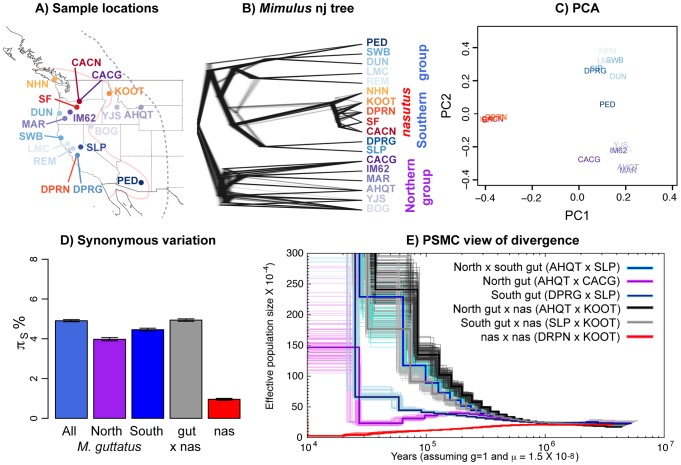
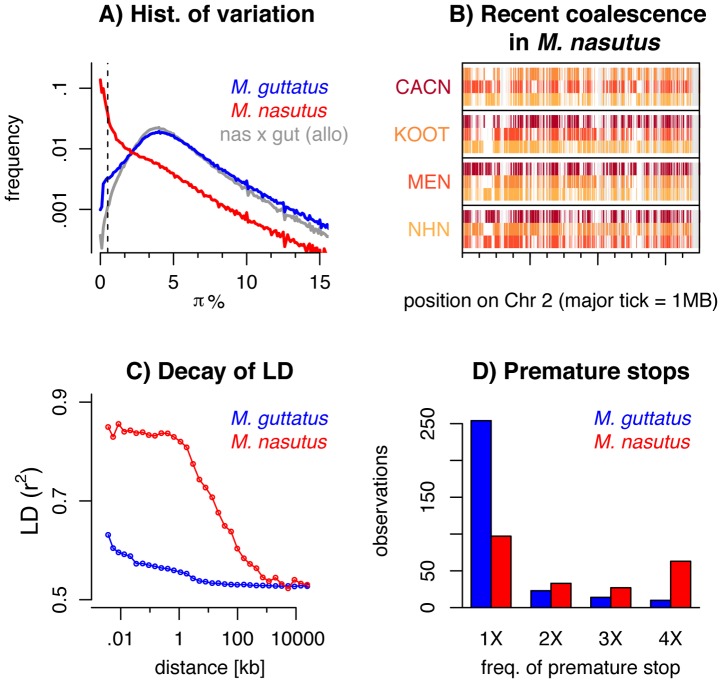
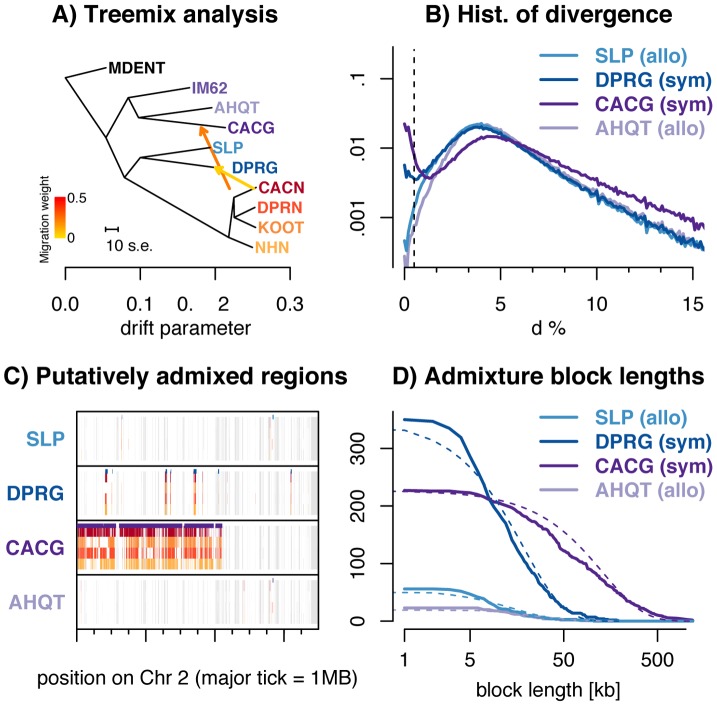
Mimulus guttatus and M. nasutus are an evolutionary and ecological model sister species pair differentiated by ecology, mating system, and partial reproductive isolation. Despite extensive research on this system, the history of divergence and differentiation in this sister pair is unclear. We present and analyze a population genomic data set which shows that M. nasutus budded from a central Californian M. guttatus population within the last 200 to 500 thousand years. In this time, the M. nasutus genome has accrued genomic signatures of the transition to predominant selfing, including an elevated proportion of nonsynonymous variants, an accumulation of premature stop codons, and extended levels of linkage disequilibrium. Despite clear biological differentiation, we document genomic signatures of ongoing, bidirectional introgression. We observe a negative relationship between the recombination rate and divergence between M. nasutus and sympatric M. guttatus samples, suggesting that selection acts against M. nasutus ancestry in M. guttatus.
Overview
The claims and statistics of this paper haven’t been checked yet.
Free: it reads the open-access text and checks the first 5 claims that cite a source we can check. Create a free account to check every claim.
Integrity signals
Registry
Cites
Statistics
Figures
Verification
Claims the paper makes
The claims and statistics of this paper haven’t been checked yet.
Free: it reads the open-access text and checks the first 5 claims that cite a source we can check. Create a free account to check every claim.
Claims other papers make about this one
Each is checked against this paper’s own text: does it say what the citing paper says it does?
The cited source says what the claim attributes to it.
In the citing paper
“As predicted from hybrid zone theory (Barton and Hewitt 1985), rates of introgression are positively correlated with recombination rates (Brandvain et al., 2014; Owens et al., 2021; Owens et al., 2023).”
From Genomics of plant speciation (2023) · cites this paper as Brandvain et al., 2014
Self-check
Percentages, sums and reported differences re-computed from the paper’s own numbers.
The self-check needs the paper’s full text.
Citations
Cites
R: A Language and Environment for Statistical Computing
R Core Team (2025) · doi:10.32614/r.manuals · Cited by 352,181
The Sequence Alignment/Map format and SAMtools
Li, H., Handsaker, B., Wysoker, A., Fennell, T., Ruan, J., Homer, N., Marth, G., Abecasis, G., Durbin, R., & 1000 Genome Project Data Processing Subgroup (2009) · Bioinformatics · doi:10.1093/bioinformatics/btp352 · Cited by 62,041 · cited 2×
“0 reference genome (69) using Burrows-Wheeler Aligner (bwa (70)) with a minimum alignment quality threshold of Q29 (filtering done using SAMtools (71)).”
Fast and accurate short read alignment with Burrows-Wheeler transform
Li, H., & Durbin, R. (2009) · Bioinformatics · doi:10.1093/bioinformatics/btp324 · Cited by 58,607
The Genome Analysis Toolkit: A MapReduce framework for analyzing next-generation DNA sequencing data
McKenna, A., Hanna, M., Banks, E., Sivachenko, A., Cibulskis, K., Kernytsky, A., Garimella, K., Altshuler, D., Gabriel, S., Daly, M., et al. (2010) · Genome Research · doi:10.1101/gr.107524.110 · Cited by 27,895 · cited 2×
“Genotyper, with a site quality threshold of Q40 [89,90].”
A framework for variation discovery and genotyping using next-generation DNA sequencing data
DePristo, M. A., Banks, E., Poplin, R., Garimella, K. V., Maguire, J. R., Hartl, C., Philippakis, A. A., del Angel, G., Rivas, M. A., Hanna, M., et al. (2011) · Nature Genetics · doi:10.1038/ng.806 · Cited by 11,456 · cited 2×
“Genotyper, with a site quality threshold of Q40 [89,90].”
BackgroundAPE: analyses of phylogenetics and evolution in R language
Paradis, E., Claude, J., & Strimmer, K. (2004) · Bioinformatics · doi:10.1093/bioinformatics/btg412 · Cited by 11,335 · cited 1×
“We construct the nj tree with the nj function in the R [91] package ape [92], and root it by the outgroup, M.”
MethodA draft sequence of the Neandertal genome
Green, R. E., Krause, J., Briggs, A. W., Maricic, T., Stenzel, U., Kircher, M., Patterson, N., Li, H., Zhai, W., Fritz, M. H.-Y., et al. (2010) · Science · doi:10.1126/science.1188021 · Cited by 4,318
Biological sequence analysis probabilistic models of proteins and nucleic acids
Durbin, R. M., Eddy, S. R., Krogh, A., & Mitchison, G. (1998) · Cited by 3,565
Biological Sequence Analysis: Probabilistic Models of Proteins and Nucleic Acids
Durbin, R., Eddy, S. R., Krogh, A., & Mitchison, G. (1998) · Cambridge University Press eBooks · doi:10.1017/cbo9780511790492 · Cited by 3,246 · cited 1×
“[101] in a customized R script controlling for underflow (available upon request) to calculate posterior probabilities of M.”
BackgroundAncient Admixture in Human History
Patterson, N., Moorjani, P., Luo, Y., Mallick, S., Rohland, N., Zhan, Y., Genschoreck, T., Webster, T., & Reich, D. (2012) · Genetics · doi:10.1534/genetics.112.145037 · Cited by 2,848 · cited 2×
“We evaluate significance with a block jackknife, dropping one chromosome in each run [100].”
Method
Research works printed but not linked: 2
- 7. Grant V (1971) Plant Speciation. New York: Columbia University Press.
- 26. Diaz A, MacNair MR (1999) Pollen tube competition as a mechanism of prezygotic reproductive isolation between Mimulus nasutus. American Journal of Botany 144: 471-478.
Cited by
Finding the genomic basis of local adaptation: pitfalls, practical solutions, and future directions
Hoban, S., Kelley, J. L., Lotterhos, K. E., Antolin, M. F., Bradburd, G., Lowry, D. B., Poss, M. L., Reed, L. K., Storfer, A., & Whitlock, M. C. (2016) · The American Naturalist · doi:10.1086/688018 · Cited by 876
“…individual loci is hybridization and introgression from related taxa (e.g., Geraldes et al. 2014; Fraïsse et al. 2016),whichcouldconfoundgenetic-environment associations and differentiation outlier methods focusedononespecies(Kaneetal.2009;NachmanandPayseur 2012;Brandvainetal.2014;Braggetal.2015).”
Genomic architecture and introgression shape a butterfly radiation
Edelman, N. B., Frandsen, P. B., Miyagi, M., Clavijo, B., Davey, J., Dikow, R. B., García-Accinelli, G., Van Belleghem, S. M., Patterson, N., Neafsey, D. E., et al. (2019) · Science · doi:10.1126/science.aaw2090 · Cited by 602
Mallet, J., Besansky, N., & Hahn, M. W. (2016) · BioEssays · doi:10.1002/bies.201500149 · Cited by 586
A genomic perspective on hybridization and speciation
Payseur, B. A., & Rieseberg, L. H. (2016) · Molecular Ecology · doi:10.1111/mec.13557 · Cited by 552
“Selection to remove long genomic blocks from one species in hybrids was postulated to explain a negative correlation between absolute divergence and recombination rate in monkey flowers (Brandvain et al. 2014).”
BackgroundVariation in recombination frequency and distribution across eukaryotes: patterns and processes
Stapley, J., Feulner, P. G. D., Johnston, S. E., Santure, A. W., & Smadja, C. M. (2017) · Philosophical Transactions of the Royal Society B: Biological Sciences · doi:10.1098/rstb.2016.0455 · Cited by 507
“nasutus/guttatus) negative relationship between recombination rate and absolute divergence X [203] Flycatchers (Ficedula albicollis, F.”
Natural selection interacts with recombination to shape the evolution of hybrid genomes
Schumer, M., Xu, C., Powell, D. L., Durvasula, A., Skov, L., Holland, C., Blazier, J. C., Sankararaman, S., Andolfatto, P., Rosenthal, G. G., et al. (2018) · Science · doi:10.1126/science.aar3684 · Cited by 412
Recombination rate variation shapes barriers to introgression across butterfly genomes
Martin, S. H., Davey, J. W., Salazar, C., & Jiggins, C. D. (2019) · PLOS Biology · doi:10.1371/journal.pbio.2006288 · Cited by 320
The genomic consequences of hybridization
Moran, B. M., Payne, C., Langdon, Q., Powell, D. L., Brandvain, Y., & Schumer, M. (2021) · eLife · doi:10.7554/elife.69016 · Cited by 311
Self-citationLocal PCA Shows How the Effect of Population Structure Differs Along the Genome
Li, H., & Ralph, P. (2019) · Genetics · doi:10.1534/genetics.118.301747 · Cited by 221
Phylogenomic approaches to detecting and characterizing introgression
Hibbins, M. S., & Hahn, M. W. (2022) · Genetics · doi:10.1093/genetics/iyab173 · Cited by 216
“This logic has been informally applied to test for introgression (Brandvain et al. 2014) and has recently been formalized in several test statistics including D 3 (Hahn and Hibbins 2019) and the branch-length test (Suvorov et al. 2021).”
Herman, A., Brandvain, Y., Weagley, J., Jeffery, W. R., Keene, A. C., Kono, T. J. Y., Bilandžija, H., Borowsky, R., Espinasa, L., O'Quin, K., et al. (2018) · Molecular Ecology · doi:10.1111/mec.14877 · Cited by 198
Self-citationThe Unreasonable Effectiveness of Convolutional Neural Networks in Population Genetic Inference
Flagel, L., Brandvain, Y., & Schrider, D. R. (2019) · Molecular Biology and Evolution · doi:10.1093/molbev/msy224 · Cited by 193
“CNN’s can accurately detect introgressed loci Recent studies indicate that closely related species often exchange genes (Kulathinal et al. 2009; Martin et al. 2013; Brandvain et al. 2014; Fontaine et al. 2015).”
BackgroundSelf-citationAfrican genomes illuminate the early history and transition to selfing in Arabidopsis thaliana
Durvasula, A., Fulgione, A., Gutaker, R. M., Alacakaptan, S. I., Flood, P. J., Neto, C., Tsuchimatsu, T., Burbano, H. A., Picó, F. X., Alonso-Blanco, C., et al. (2017) · Proceedings of the National Academy of Sciences · doi:10.1073/pnas.1616736114 · Cited by 186
“lyrata-like ancestral population [similar to that observed in Mimulus nasutus (44) and Capsella rubella (45–47)], followed by an expansion in Ne as the selfing population began to spread.”
MethodTwyford, A. D., & Friedman, J. (2015) · Evolution · doi:10.1111/evo.12663 · Cited by 180
Hybridization and hybrid speciation under global change
Vallejo‐Marín, M., & Hiscock, S. J. (2016) · New Phytologist · doi:10.1111/nph.14004 · Cited by 179
Li, G., Figueiró, H. V., Eizirik, E., & Murphy, W. J. (2019) · Molecular Biology and Evolution · doi:10.1093/molbev/msz139 · Cited by 159
“Second, alternative trees resulting from hybridization will tend to be enriched within regions displaying high-recombination rates, because introgressed deleterious alleles are more efficiently unlinked from neutral or positively selected variants (Brandvain et al. 2014; Schumer et al. 2018).”
BackgroundMartin, C. H., Cutler, J. S., Friel, J. P., Dening Touokong, C., Coop, G., & Wainwright, P. C. (2015) · Evolution · doi:10.1111/evo.12674 · Cited by 155
“Specific introgression events were also variable in similar studies estimating complex population histories (Brandvain et al. 2014).”
Self-citationPredicting the Landscape of Recombination Using Deep Learning
Adrion, J. R., Galloway, J. G., & Kern, A. D. (2020) · Molecular Biology and Evolution · doi:10.1093/molbev/msaa038 · Cited by 150
Davey, J. W., Chouteau, M., Barker, S. L., Maroja, L. S., Baxter, S. W., Simpson, F., Merrill, R. M., Joron, M., Mallet, J., Dasmahapatra, K. K., et al. (2016) · G3 Genes Genomes Genetics · doi:10.1534/g3.115.023655 · Cited by 156
Evolution of Selfing: Recurrent Patterns in Molecular Adaptation
Shimizu, K. K., & Tsuchimatsu, T. (2015) · Annual Review of Ecology Evolution and Systematics · doi:10.1146/annurev-ecolsys-112414-054249 · Cited by 159
Corbett-Detig, R., & Nielsen, R. (2017) · PLOS Genetics · doi:10.1371/journal.pgen.1006529 · Cited by 146
“Admixture has been reported in a variety of natural populations of 70 animals [1,2], plants [3-5] and humans [6,7], and theoretical and empirical evidence 71 suggests that admixture may affect a diverse suit of evolutionary processes.”
BackgroundWidespread selection and gene flow shape the genomic landscape during a radiation of monkeyflowers
Stankowski, S., Chase, M. A., Fuiten, A. M., Rodrigues, M. F., Ralph, P. L., & Streisfeld, M. A. (2019) · PLOS Biology · doi:10.1371/journal.pbio.3000391 · Cited by 134
Runemark, A., Vallejo‐Marín, M., & Meier, J. I. (2019) · PLoS Genetics · doi:10.1371/journal.pgen.1008404 · Cited by 157
“This pattern has been detected in monkeyflowers Mimulus[81], in Mus domesticus house mice[82], in Heliconius butterflies[80] and in Xiphophorus swordtail fish[43].”
BackgroundLoter: A Software Package to Infer Local Ancestry for a Wide Range of Species
Alves, T. D., Mairal, J., & Blum, M. G. B. (2018) · Molecular Biology and Evolution · doi:10.1093/molbev/msy126 · Cited by 133
“…et al. 2013; Suarez-Gonzalez et al. 2016; Medugorac et al. 2017), to map genes involved in reproductive isolation (Corbett-Detig and Nielsen 2017) and phenotypic variation (Lindtke et al. 2013; vonHoldt et al. 2016), and to decipher past admixture processes (Brandvain et al. 2014; Liu et al. 2014).”
BackgroundNatural hybridization reveals incompatible alleles that cause melanoma in swordtail fish
Powell, D. L., García-Olazábal, M., Keegan, M., Reilly, P., Du, K., Díaz-Loyo, A. P., Banerjee, S., Blakkan, D., Reich, D., Andolfatto, P., et al. (2020) · Science · doi:10.1126/science.aba5216 · Cited by 124
Deleterious variation shapes the genomic landscape of introgression
Kim, B. Y., Huber, C. D., & Lohmueller, K. E. (2018) · PLOS Genetics · doi:10.1371/journal.pgen.1007741 · Cited by 117
Population-genomic inference of the strength and timing of selection against gene flow
Aeschbacher, S., Selby, J. P., Willis, J. H., & Coop, G. (2017) · Proceedings of the National Academy of Sciences · doi:10.1073/pnas.1616755114 · Cited by 114
“guttatus, pericentromeric regions are gene-poor and characterized by low recombination rates, which results in a genome-wide positive correlation between gene density and recombination rate (14) (SI Appendix, Fig.”
BackgroundInfluentialSelf-citationThe genomic impact of historical hybridization with massive mitochondrial DNA introgression
Seixas, F., Boursot, P., & Melo‐Ferreira, J. (2018) · Genome biology · doi:10.1186/s13059-018-1471-8 · Cited by 116
New approaches for genome assembly and scaffolding
Rice, E. S., & Green, R. E. (2019) · Annual Review of Animal Biosciences · doi:10.1146/annurev-animal-020518-115344 · Cited by 110
“Genome assemblies are used as alignment references for sequences from different populations (resequencing projects) or related species, allowing discoveries such as the history, timing, and location of admixture events, including those between brown and polar bears (15), humans and Neanderthals (16–18), multiple speci…”
BackgroundThe Limits of Natural Selection in a Nonequilibrium World
Brandvain, Y. J., & Wright, S. (2016) · Trends in Genetics · doi:10.1016/j.tig.2016.01.004 · Cited by 111
“Similarly, an excess of putatively deleterious mutations in predominantly self-fertilizing plants suggests that purifying selection is limited in these taxa [27–30].”
BackgroundSelf-citationGene flow analysis method, the D-statistic, is robust in a wide parameter space
Zheng, Y., & Janke, A. (2018) · BMC Bioinformatics · doi:10.1186/s12859-017-2002-4 · Cited by 112
“To date the maximal sequence divergence on which the D- and f-statistics have been applied is 4 to 5%, in mosquitoes of the genus Anopheles [26] and plants of the genus Mimulus [27].”
BackgroundSchrider, D. R., Ayroles, J., Matute, D. R., & Kern, A. D. (2018) · PLOS Genetics · doi:10.1371/journal.pgen.1007341 · Cited by 104
Selective sorting of ancestral introgression in maize and teosinte along an elevational cline
Calfee, E., Gates, D. J., Lorant, A., Perkins, M. T., Coop, G., & Ross‐Ibarra, J. (2021) · PLoS Genetics · doi:10.1371/journal.pgen.1009810 · Cited by 115
Self-citationPopulation-level genetic variation and climate change in a biodiversity hotspot
Schierenbeck, K. A. (2016) · Annals of Botany · doi:10.1093/aob/mcw214 · Cited by 111
Nelson, T. C., Stathos, A. M., Vanderpool, D. D., Finseth, F. R., Yuan, Y.-W., & Fishman, L. (2021) · PLOS Genetics · doi:10.1371/journal.pgen.1009095 · Cited by 101
Full-genome evolutionary histories of selfing, splitting, and selection in Caenorhabditis
Thomas, C. G., Wang, W., Jovelin, R., Ghosh, R., Lomasko, T., Trinh, Q. M., Kruglyak, L., Stein, L. D., & Cutter, A. D. (2015) · Genome Research · doi:10.1101/gr.187237.114 · Cited by 106
“…Ross et al. 2011), and genomic analysis of populations of individuals provides a powerful means to further characterize evolution on contemporary timescales to understand the origins of novelty and constraint (Langley et al. 2012; The 1000 Genomes Project Consortium 2012; Brandvain et al. 2014).”
BackgroundChristie, K., Fraser, L., & Lowry, D. B. (2022) · Evolution · doi:10.1111/evo.14565 · Cited by 91
“Asymmetric postzygotic RI is common in plants (Tiffin et al. 2001) and typically results from cytoplasmic-nuclear interactions or other uniparentally inherited genetic factors (Turelli and Moyle 2007; Brandvain et al. 2014b; Barnard-Kubow and Galloway 2017; Coughlan et al. 2020).”
BackgroundPer-Nucleus Crossover Covariation and Implications for Evolution
Wang, S., Veller, C., Sun, F., Ruiz‐Herrera, A., Shang, Y., Liu, H., Zickler, D., Chen, Z., Kleckner, N. E., & Zhang, L. (2019) · Cell · doi:10.1016/j.cell.2019.02.021 · Cited by 87
“Higher recombination thus causes finer ‘‘trimming,’’ allowing greater retention of introgressed DNA that is neutral or beneficial (Brandvain et al., 2014; Schumer et al., 2018; Edelman et al., 2018; Martin et al., 2019).”
Bock, D. G., Cai, Z., Elphinstone, C., González-Segovia, E., Hirabayashi, K., Huang, K., Keais, G. L., Kim, A., Owens, G. L., & Rieseberg, L. H. (2023) · Plant Communications · doi:10.1016/j.xplc.2023.100599 · Cited by 84
“For example, in the budding speciation of Mimulus nasutus from M. guttatus (Brandvain et al., 2014) or of C. rubella from C. grandiflora (Foxe et al., 2009), reduced Ne in the descendant species has been attributed to the transition to selfing, which then contributed to speciation.”
Ferris, K. G., Barnett, L. L., Blackman, B. K., & Willis, J. H. (2016) · Molecular Ecology · doi:10.1111/mec.13763 · Cited by 83
“introgression has been documented between several taxa (Sweigart & Willis 2003; Brandvain et al. 2014).”
BackgroundGene duplicates cause hybrid lethality between sympatric species of Mimulus
Zuellig, M. P., & Sweigart, A. L. (2018) · PLOS Genetics · doi:10.1371/journal.pgen.1007130 · Cited by 82
Self-citationThe evolution of genomic islands by increased establishment probability of linked alleles
Yeaman, S., Aeschbacher, S., & Bürger, R. (2016) · Molecular Ecology · doi:10.1111/mec.13611 · Cited by 91
“In such cases, however, there may still be a genome-wide aggregate signal in the form of a negative correlation between divergence and local recombination rates (Nachman & Payseur 2012; Brandvain et al. 2014).”
BackgroundPlant speciation in the Quaternary
Kadereit, J. W., & Abbott, R. J. (2021) · Plant Ecology & Diversity · doi:10.1080/17550874.2021.2012849 · Cited by 82
Reproductive isolation and introgression between sympatric Mimulus species
Kenney, A. M., & Sweigart, A. L. (2016) · Molecular Ecology · doi:10.1111/mec.13630 · Cited by 76
Self-citationPowerful methods for detecting introgressed regions from population genomic data
Rosenzweig, B. K., Pease, J. B., Besansky, N. J., & Hahn, M. W. (2016) · Molecular Ecology · doi:10.1111/mec.13610 · Cited by 90
“patterns of divergence between closely related lineages (e.g. Kulathinal et al. 2009; Renaut et al. 2012; Cui et al. 2013; Martin et al. 2013; Brandvain et al. 2014; Brawand et al. 2014; Carneiro et al. 2014; J onsson et al. 2014; Lamichhaney et al. 2015).”
BackgroundModel‐based detection and analysis of introgressed Neanderthal ancestry in modern humans
Steinrücken, M., Spence, J. P., Kamm, J. A., Wieczorek, E., & Song, Y. S. (2018) · Molecular Ecology · doi:10.1111/mec.14565 · Cited by 73
“…between D. simulans and D. melanogaster (Li, Satta, & Takahata, 1999); 200 to 500 thousand generations between M. guttatis and M. nasutus (Brandvain, Kenney, Flagel, Coop, & Sweigart, 2014); and 750 thousand to 5 million generations between A. californiense and A. tigrinum mavortium…”
Selection against admixture and gene regulatory divergence in a long-term primate field study
Vilgalys, T. P., Fogel, A. S., Mututua, R. S., Warutere, J. K., Siodi, L. I., Anderson, J. A., Kim, S. Y., Voyles, T., Robinson, J. A., Wall, J. D., et al. (2022) · Science · doi:10.1126/science.abm4917 · Cited by 74
Coughlan, J. M., Brown, M. W., & Willis, J. H. (2019) · Current Biology · doi:10.1016/j.cub.2019.11.023 · Cited by 73
Genes and speciation: is it time to abandon the biological species concept?
Wang, X., He, Z., Shi, S., & Wu, C. (2019) · National Science Review · doi:10.1093/nsr/nwz220 · Cited by 75
“4) Plants often show patterns of speciation that are different fromanimals, in particular, in their tendencies to hybridize [37,46].”
BackgroundPopulation structure and local selection yield high genomic variation in Mimulus guttatus
Puzey, J. R., Willis, J. H., & Kelly, J. K. (2016) · Molecular Ecology · doi:10.1111/mec.13922 · Cited by 77
“Populations within the complex are often inter-fertile to varying degrees and gene flow occurs between populations, including those named as distinct species (Brandvain et al. 2014).”
InfluentialA Three-Sample Test for Introgression
Hahn, M. W., & Hibbins, M. S. (2019) · Molecular Biology and Evolution · doi:10.1093/molbev/msz178 · Cited by 75
Mating system variation in hybrid zones: facilitation, barriers and asymmetries to gene flow
Pickup, M., Brandvain, Y. J., Fraïssé, C., Yakimowski, S. B., Barton, N., Dixit, T., Lexer, C., Cereghetti, E., & Field, D. L. (2019) · New Phytologist · doi:10.1111/nph.16180 · Cited by 76
“…we predict genome-wide selection against the mildly deleterious variants residing on selfing-derived ancestry, a prediction consistent with the negative correlation between recombination rate and Mimulus nasutus (selfing) ancestry in the outcrossing SC species, M. guttatus (Brandvain et al., 2014).”
ResultSelf-citationAssessing biological factors affecting postspeciation introgression
Hamlin, J. A. P., Hibbins, M. S., & Moyle, L. C. (2020) · Evolution Letters · doi:10.1002/evl3.159 · Cited by 76
“This specific direction of introgression is also supported by observations from detailed case studies in other plant groups (e.g., Mimulus; Brandvain et al. 2014).”
BackgroundResultInfluentialCoughlan, J. M., & Willis, J. H. (2019) · Molecular Ecology · doi:10.1111/mec.14804 · Cited by 67
“The divergence between M. decorus and M. guttatus is similar to the divergence between the recent diverged M. nasutus and M. guttatus, which are believed to have diverged roughly 200kya, and for which π across all sites is ~3%–4% (Brandvain et al., 2014).”
ResultOneal, E., Lowry, D. B., Wright, K. M., Zhu, Z., & Willis, J. H. (2014) · Molecular Ecology · doi:10.1111/mec.12778 · Cited by 70
“However, published gene trees show M. guttatus to be a polytomy of annuals and perennials (Sweigart & Willis 2003; Modliszewski & Willis 2012, Brandvain et al. 2013).”
BackgroundHejase, H. A., Salman‐Minkov, A., Campagna, L., Hubisz, M. J., Lovette, I. J., Gronau, I., & Siepel, A. C. (2020) · Proceedings of the National Academy of Sciences · doi:10.1073/pnas.2015987117 · Cited by 65
Puzey, J. R., & Vallejo‐Marín, M. (2014) · Molecular Ecology · doi:10.1111/mec.12875 · Cited by 68
“2) and may represent a secondary dispersal or reflect an introgression event between these two groups (Brandvain et al. 2014).”
BackgroundGould, B. A., Chen, Y., & Lowry, D. B. (2016) · Molecular Ecology · doi:10.1111/mec.13881 · Cited by 64
“Prior values for theta and divergence were both set to 0.05 according to estimates generated by Brandvain et al. (2014).”
BackgroundMethodResultInfluentialThe case for the continued use of the genus name Mimulus for all monkeyflowers
Lowry, D. B., Sobel, J. M., Angert, A. L., Ashman, T., Baker, R. L., Blackman, B. K., Brandvain, Y. J., Byers, K. J. R. P., Cooley, A. M., Coughlan, J. M., et al. (2019) · Taxon · doi:10.1002/tax.12122 · Cited by 66
“…Sheth & Angert, 2014), circadian rhythms (Greenham & al., 2017), genetic recombination (Hellsten & al., 2013), mating systems (Fenster & Ritland, 1994; Dudash & Carr, 1998; Brandvain & al., 2014) and developmental biology (Moody & al., 1999; Baker & Diggle, 2011; Baker & al., 2012; Yuan, 2019).”
Self-citationGene regulatory divergence between locally adapted ecotypes in their native habitats
Gould, B. A., Chen, Y., & Lowry, D. B. (2018) · Molecular Ecology · doi:10.1111/mec.14852 · Cited by 66
Garner, A. G., Kenney, A. M., Fishman, L., & Sweigart, A. L. (2016) · New Phytologist · doi:10.1111/nph.13897 · Cited by 60
Self-citationChristmas, M. J., Jones, J. C., Olsson, A., Wallerman, O., Bunikis, I., Kierczak, M., Peona, V., Whitley, K. M., Larva, T., Suh, A., et al. (2021) · Molecular Biology and Evolution · doi:10.1093/molbev/msab086 · Cited by 62
“2019), Mimulus monkeyflowers (Brandvain et al. 2014), house mice (Janou sek et al.”
BackgroundEvolutionary Models for the Diversification of Placental Mammals Across the KPg Boundary
Springer, M. S., Foley, N. M., Brady, P. L., Gatesy, J., & Murphy, W. J. (2019) · Frontiers in Genetics · doi:10.3389/fgene.2019.01241 · Cited by 59
Recombination and selection against introgressed DNA
Veller, C., Edelman, N. B., Muralidhar, P., & Nowak, M. A. (2023) · Evolution · doi:10.1093/evolut/qpad021 · Cited by 71
Inference of recombination maps from a single pair of genomes and its application to ancient samples
Barroso, G. V., Puzović, N., & Dutheil, J. Y. (2019) · PLoS Genetics · doi:10.1371/journal.pgen.1008449 · Cited by 64
Selfish chromosomal drive shapes recent centromeric histone evolution in monkeyflowers
Finseth, F. R., Nelson, T. C., & Fishman, L. (2021) · PLoS Genetics · doi:10.1371/journal.pgen.1009418 · Cited by 53
“5 x 10, following [20], this accumulation of variation corresponds to 200–1497 years (M.”
BackgroundMethodInfluentialThe Timing and Direction of Introgression Under the Multispecies Network Coalescent
Hibbins, M. S., & Hahn, M. W. (2019) · Genetics · doi:10.1534/genetics.118.301831 · Cited by 61
“…between selection and introgression: in a number of systems introgression appears to occur more frequently in regions of the genome with higher recombination, which are less affected by linked selection (Geraldes et al. 2011; Brandvain et al. 2014; Aeschbacher et al. 2017; Schumer et al. 2018b).”
BackgroundZuellig, M. P., & Sweigart, A. L. (2018) · Evolution · doi:10.1111/evo.13596 · Cited by 48
Self-citationRecent hybrids recapitulate ancient hybrid outcomes
Chaturvedi, S., Lucas, L. K., Buerkle, C. A., Fordyce, J. A., Forister, M. L., Nice, C. C., & Gompert, Z. (2020) · Nature Communications · doi:10.1038/s41467-020-15641-x · Cited by 55
“Recombination interacts with selection to shape 33 hybrid genomes [23, 24, 16, 25].”
Twyford, A. D., Wong, E. L. Y., & Friedman, J. (2020) · Heredity · doi:10.1038/s41437-020-0335-7 · Cited by 62
Hendrick, M. F., Finseth, F. R., Mathiasson, M. E., Palmer, K., Broder, E. M., Breigenzer, P., & Fishman, L. (2016) · Molecular Ecology · doi:10.1111/mec.13753 · Cited by 49
“The primarily outcrossing M. guttatus is the central member of a species complex of interfertile but ecologically and evolutionarily distinct taxa (Brandvain et al. 2014), and is also highly diverse within (Mojica et al. 2012; Flagel et al. 2014) and among (Oneal et al. 2014; Kooyers et al. 2015;…”
BackgroundRifkin, J. L., Castillo, A. S., Liao, I. T., & Rausher, M. D. (2019) · Molecular Ecology · doi:10.1111/mec.14945 · Cited by 42
“As has been found in other closely related species pairs involving a highly selfing species and a more outcrossing species (Brandvain et al., 2014; Kenney & Sweigart, 2016; Palma‐Silva et al., 2011; Ruhsam, Hollingsworth, & Ennos, 2011; Sweigart & Willis, 2003), we observed asymmetric gene flow,…”
BackgroundSchumer, M. E., Powell, D. L., & Corbett-Detig, R. B. (2020) · Molecular Ecology Resources · doi:10.1111/1755-0998.13175 · Cited by 40
A genomic map of clinal variation across the European rabbit hybrid zone
Rafati, N., Blanco, J., Rubin, C., Sayyab, S., Sabatino, S. J., Afonso, S., Feng, C., Alves, P. C., Villafuerte, R., Ferrand, N., et al. (2018) · Molecular Ecology · doi:10.1111/mec.14494 · Cited by 39
Untangling the Evolution of American Wild Grapes: Admixed Species and How to Find Them
Zecca, G., Labra, M., & Grassi, F. (2020) · Frontiers in Plant Science · doi:10.3389/fpls.2019.01814 · Cited by 49
Re-evaluating Homoploid Reticulate Evolution in Helianthus Sunflowers
Owens, G. L., Huang, K., Todesco, M., & Rieseberg, L. H. (2023) · Molecular Biology and Evolution · doi:10.1093/molbev/msad013 · Cited by 39
“For example, introgressed loci are more likely to persist in regions of high recombination because they more quickly unlink from deleterious neighboring loci, such as genetic incompatibilities (Brandvain et al. 2014; Schumer et al. 2018).”
BackgroundPredictability and parallelism in the contemporary evolution of hybrid genomes
Langdon, Q. K., Powell, D. L., Kim, B. Y., Banerjee, S. M., Payne, C. Y., Dodge, T. O., Moran, B. M., Fascinetto‐Zago, P., & Schumer, M. E. (2022) · PLoS Genetics · doi:10.1371/journal.pgen.1009914 · Cited by 38
“This purging can be explained by several mechanisms of selection on hybrids, including selection against hybrid incompatibilities [19, 25, 28, 29, 34], and tends to be stronger in regions of the genome with many linked coding or conserved basepairs [8, 12, 34].”
BackgroundFast and robust detection of ancestral selective sweeps
Cheng, X., Xu, C., & DeGiorgio, M. (2017) · Molecular Ecology · doi:10.1111/mec.14416 · Cited by 41
Evidence for widespread selection in shaping the genomic landscape during speciation of Populus
Wang, J., Street, N. R., Park, E., Liu, J., & Ingvarsson, P. K. (2020) · Molecular Ecology · doi:10.1111/mec.15388 · Cited by 40
Evolution of multiple postzygotic barriers between species of the Mimulus tilingii complex*
Sandstedt, G. D., Wu, C. A., & Sweigart, A. L. (2020) · Evolution · doi:10.1111/evo.14105 · Cited by 39
Self-citationThe genetics of speciation: are complex incompatibilities easier to evolve?
Fraïssé, C., Elderfield, J., & Welch, J. J. (2014) · Journal of Evolutionary Biology · doi:10.1111/jeb.12339 · Cited by 44
Becher, H., Powell, R. F., Brown, M. R., Metherell, C., Pellicer, J., Leitch, I. J., & Twyford, A. D. (2021) · Annals of Botany · doi:10.1093/aob/mcab102 · Cited by 43
Hibbins, M. S., Gibson, M. J. S., & Hahn, M. W. (2020) · eLife · doi:10.7554/elife.63753 · Cited by 43
Genomic studies on the nature of species: adaptation and speciation in Mimulus
Twyford, A. D., Streisfeld, M. A., Lowry, D. B., & Friedman, J. (2015) · Molecular Ecology · doi:10.1111/mec.13190 · Cited by 38
“Brandvain et al. (2014) used population genomic sequencing to reveal that the more geographically restricted and selfing M. nasutus budded off from the geographically more widespread, outcrossing M. guttatus.”
BackgroundMethodInfluentialEvidence of Natural Selection Acting on a Polymorphic Hybrid Incompatibility Locus in Mimulus
Sweigart, A. L., & Flagel, L. E. (2015) · Genetics · doi:10.1534/genetics.114.171819 · Cited by 35
“Despite their phenotypic differences, these species are closely related, having diverged 200,000 years ago (Brandvain et al. 2014).”
BackgroundMethodInfluentialSelf-citationRapid and predictable genome evolution across three hybrid ant populations
Nouhaud, P., Martin, S. H., Portinha, B., Sousa, V. C., & Kulmuni, J. (2022) · PLoS Biology · doi:10.1371/journal.pbio.3001914 · Cited by 34
“Variation in local ancestry patterns along hybrid genomes has been found across many taxa, including sunflowers [5], monkeyflowers [6], humans [7], swordtail fish [8,9], sparrows [10], butterflies [11,12], and maize [13].”
Nelson, T. C., Monnahan, P. J., McIntosh, M., Finseth, F. R., Anderson, K., MacArthur‐Waltz, E., Kelly, J. K., & Fishman, L. (2018) · Molecular Ecology · doi:10.1111/mec.14904 · Cited by 34
Ravinet, M., Kume, M., Ishikawa, A., & Kitano, J. (2020) · Journal of Evolutionary Biology · doi:10.1111/jeb.13664 · Cited by 33
“…between recombination rates and introgression has been reported in both theoretical (Butlin, 2005; Nachman & Payseur, 2012; Noor & Bennett, 2009) and empirical studies (Brandvain et al., 2014; Janoušek et al., 2015; Juric et al., 2016; Martin et al., 2019; Samuk et al., 2017; Schumer et al., 2018).”
BackgroundThe genomic secrets of invasive plants
Hodgins, K. A., Battlay, P., & Bock, D. G. (2025) · New Phytologist · doi:10.1111/nph.20368 · Cited by 43
Jordan, C. Y., Lohse, K., Turner, F. S., Thomson, M. L., Gharbi, K., & Ennos, R. A. (2017) · Molecular Ecology · doi:10.1111/mec.14426 · Cited by 29
Plant adaptation and speciation studied by population genomic approaches
Bamba, M., Kawaguchi, Y. W., & Tsuchimatsu, T. (2018) · Development Growth & Differentiation · doi:10.1111/dgd.12578 · Cited by 37
Pollinator‐mediated assemblage processes in California wildflowers
Runquist, R. D. B., Grossenbacher, D. L., Porter, S. S., Kay, K. M., & Smith, J. (2016) · Journal of Evolutionary Biology · doi:10.1111/jeb.12845 · Cited by 33
A snapshot of progenitor–derivative speciation in Iberodes (Boraginaceae)
Otero, A., Vargas, P., Fernández‐Mazuecos, M., Jiménez‐Mejías, P., Valcárcel, V., Villa‐Machío, I., & Hipp, A. L. (2022) · Molecular Ecology · doi:10.1111/mec.16459 · Cited by 36
“…by pollinator shift Stankowski et al. (2015) Mimulus nasutus/M. guttatus Phrymaceae Ecological divergence mediated by mating system differentiation Brandvain et al. (2014) Miscanthus Poaceae Ecological divergence mediated by bioclimatic niche Huang et al. (2014) Oryza Poaceae Ecological…”
BackgroundDeMarche, M. L., Miller, T. J., & Kay, K. M. (2015) · American Journal of Botany · doi:10.3732/ajb.1400415 · Cited by 33
Whole‐genome analyses disentangle reticulate evolution of primroses in a biodiversity hotspot
Stubbs, R. L., Theodoridis, S., Mora‐Carrera, E., Keller, B., Yousefi, N., Potente, G., Léveillé‐Bourret, É., Celep, F., Kochjarová, J., Tedoradze, G., et al. (2022) · New Phytologist · doi:10.1111/nph.18525 · Cited by 28
“…be due to S-locus introgression or to the nuclear genome including high-recombination regions that are enriched for signals of gene flow, as documented in studies with both empirical (Brandvain et al., 2014; Li et al., 2019) and simulated (Schierup & Hein, 2000, p. 200; Leach e et al., 2014) data.”
BackgroundBelleghem, S. M. V., Cole, J. M., Montejo‐Kovacevich, G., Bacquet, C. N., McMillan, W. O., Papa, R., & Counterman, B. A. (2021) · Evolution · doi:10.1111/evo.14272 · Cited by 29
“Hence, we expect a negative association between recombination rate and divergence across the genome (Keinan and Reich 2010; Brandvain et al. 2014; Aeschbacher et al. 2017; Stankowski et al. 2019).”
BackgroundGOOGA: A platform to synthesize mapping experiments and identify genomic structural diversity
Flagel, L., Blackman, B. K., Fishman, L., Monnahan, P. J., Sweigart, A. L., & Kelly, J. K. (2019) · PLoS Computational Biology · doi:10.1371/journal.pcbi.1006949 · Cited by 27
Self-citationLangdon, Q. K., Groh, J. S., Aguillon, S. M., Powell, D. L., Gunn, T. R., Payne, C. Y., Baczenas, J. J., Donny, A. E., Dodge, T. O., Du, K., et al. (2024) · PLoS Biology · doi:10.1371/journal.pbio.3002742 · Cited by 33
Recombination and selection against introgressed DNAPreprint
Veller, C., Edelman, N. B., Muralidhar, P., & Nowak, M. A. (2019) · bioRxiv (Cold Spring Harbor Laboratory) · doi:10.1101/846147 · Cited by 29
“Recombination can influence the retention of introgressed DNA because it allows neutral (and beneficial) introgressed alleles to recombine away from deleterious introgressed alleles before the deleterious alleles are eliminated (Brandvain et al. 2014; Schumer et al. 2018).”
BackgroundWidespread selection and gene flow shape the genomic landscape during a radiation of monkeyflowersPreprint
Stankowski, S., Chase, M. A., Fuiten, A. M., Rodrigues, M. F., Ralph, P. L., & Streisfeld, M. A. (2018) · bioRxiv (Cold Spring Harbor Laboratory) · doi:10.1101/342352 · Cited by 23
Metadata
- Authors
- Brandvain, Y., Kenney, A. M., Flagel, L., Coop, G., & Sweigart, A. L.
- Affiliations
- University of Minnesota (US)
- University of Georgia (US)
- Monsanto (United States) (US)
- University of California, Davis (US)
- Corresponding author
- Brandvain, Yaniv
- Venue
- PLoS Genetics
- Publisher
- Public Library of Science (PLoS)
- Published
- 2014-06-26
- Volume
- 10
- Issue
- 6
- Pages
- e1004410
- ISSN
- 1553-7390 (ISSN-L)
- 1553-7404
- PMC
- PMC4072524
- OpenAlex
- W2247624088
- Semantic Scholar
- bee07af1a29ff4d238dc50408a8327370a0d671f
- Cited by
- 259
- References
- 107
- Citations by year
- 2026: 11 · 2025: 20 · 2024: 30 · 2023: 16 · 2022: 24 · 2021: 26 · 2020: 27 · 2019: 27 · 2018: 29 · 2017: 12 · 2016: 21 · 2015: 10 · 2014: 5
- FWCI
- 10.51
- Type
- journal article
- Language
- en
- Open access
- gold
- doi.org
- Locations
- PLoS Genetics (publishedVersion, cc-by)
- bioRxiv (Cold Spring Harbor Laboratory) (acceptedVersion, cc-by)
- PubMed Central (publishedVersion, cc-by)
- PubMed (publishedVersion)
- arXiv (Cornell University) (submittedVersion)
- eScholarship (California Digital Library) (submittedVersion, cc-by)
- OSTI OAI (U.S. Department of Energy Office of Scientific and Technical Information) (submittedVersion)
- DOAJ (DOAJ: Directory of Open Access Journals) (submittedVersion, cc-by-sa)
- Figshare (submittedVersion, cc-by)
- arXiv (Cornell University) (cc-by)
- Funders
- National Science Foundation (DEAC02-05CH11231, 1262645, 1002942)
- U.S. Department of Energy (-AC02-05CH11231, Contract No. DE-AC02-05-CH11231, 05CH11231, No. DE-AC02-05-CH11231, DE AC02 05CH11231, DE-AC02-)
- Alfred P. Sloan Foundation (DE-AC02-05CH11231)
- University of Georgia
- Joint Genome Institute (AC02-05CH11231, DE–AC02–05CH11231)
- National Institutes of Health (DE-AC02–05CH11231, RO1GM107374)
- Office of Science (No. DE-AC02- 05-CH11231, DEAC02–05CH11231, AC02-05CH11231, DE-AC02, 05CH11231, Contract No. DE-AC02-05CH11231)
- University of Georgia Research Foundation
- Georgia Advanced Computing Resource Center, University of Georgia
- National Institute of General Medical Sciences (R01GM083098, RO1GM83098, R01GM108779, RO1GM107374, DE-AC02-05CH11231, NIH RO1GM83098, R01GM107374)
- Topics
- Life Sciences › Biochemistry, Genetics and Molecular Biology › Genetics › Genetic diversity and population structure
- Life Sciences › Biochemistry, Genetics and Molecular Biology › Genetics › Chromosomal and Genetic Variations
- Life Sciences › Biochemistry, Genetics and Molecular Biology › Genetics › Evolution and Genetic Dynamics
- Keywords
- Mimulus guttatus, speciation, introgression, sister species, self-pollination, recombination rate, linkage disequilibrium, non-synonymous mutations, premature stop codon, reproductive isolation, population divergence
- MeSH terms
- Genetics, Population, Phenotype, Species Specificity, Genetic Variation, Linkage Disequilibrium, Genome, Plant, Mimulus, Genetic Speciation, Gene Flow, Reproductive Isolation
About these checks
Registry, retraction, Cites and statistics results are computed, not judged, with one exception: a printed reference that no index lists is read once by a model before it counts as a citation error. Claims are extracted by a model and kept only when their quote appears verbatim in the text; each cited source is then checked, with a model’s help, for whether it says what the claim relies on. Those verdicts can be wrong — read the claim’s quote and the cited source before relying on one.
Statistics and arithmetic are recomputed, not judged.
Confidence bands are shown only for fields calibrated on our annotated test set. None is calibrated yet, so no band is shown.
What counts as a claim ›How we measure confidence ›How we check this ›
Are you an author, or do you see a problem with this page? Request a review
Data sources
Bibliographic data: Semantic Scholar, OpenAlex, Crossref.
Contains information from the Semantic Scholar Academic Graph Datasets, made available under the ODC Attribution License (ODC-BY 1.0).
Semantic Scholar’s data is described in: Kinney, R., et al. (2023). The Semantic Scholar Open Data Platform. arXiv:2301.10140.
