

Speciation and Introgression between Mimulus nasutus and Mimulus guttatus
Open accessPublished version of a preprint
The DOI matches its Crossref record; 108 of the 108 references it cites were found in a registry or an index.
Abstract
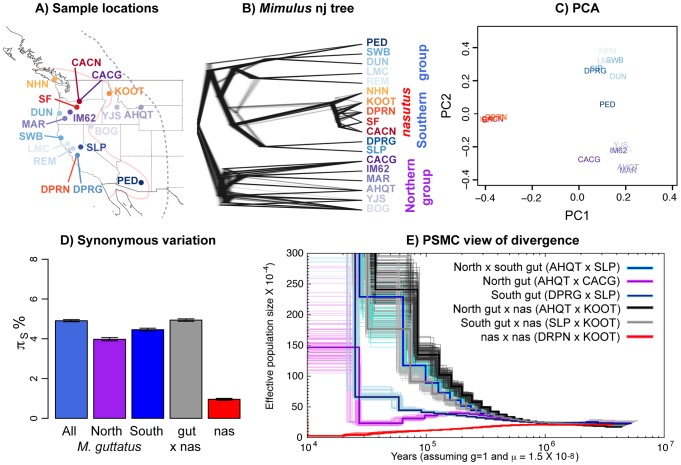
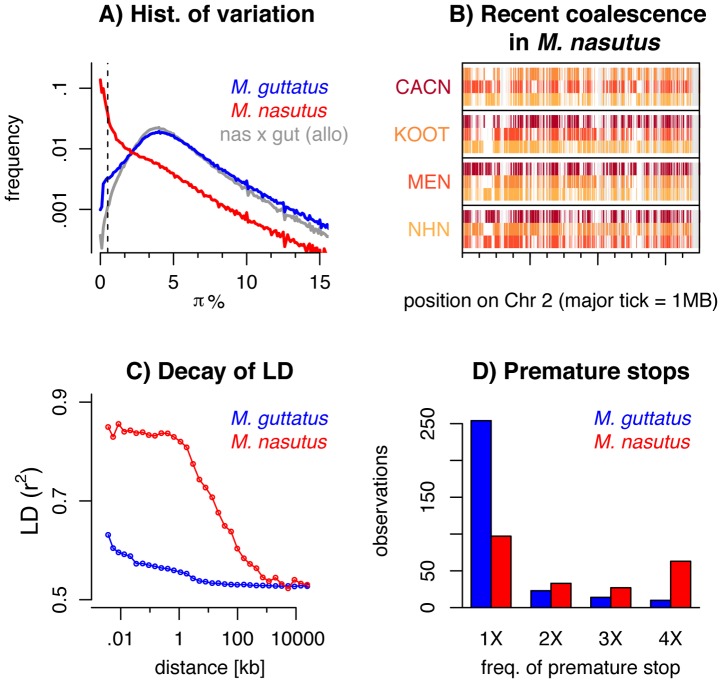
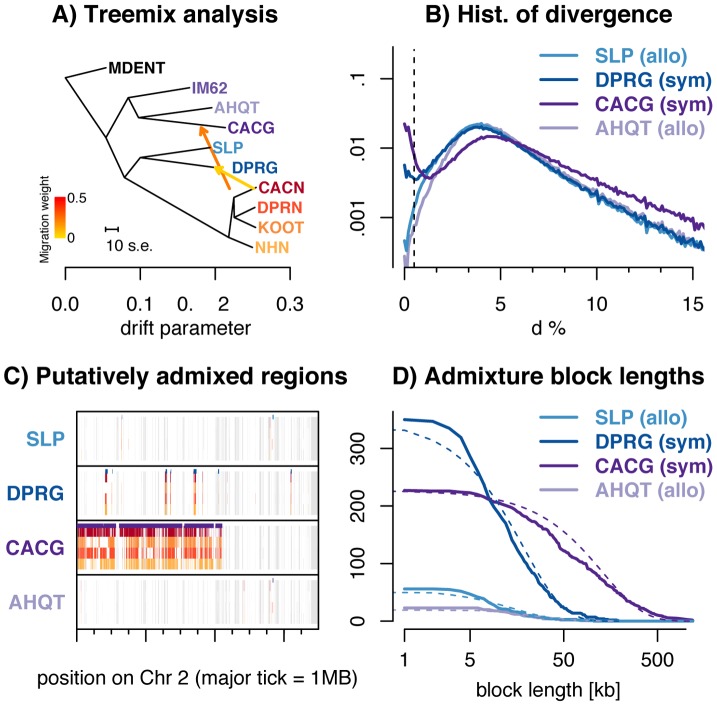
Mimulus guttatus and M. nasutus are an evolutionary and ecological model sister species pair differentiated by ecology, mating system, and partial reproductive isolation. Despite extensive research on this system, the history of divergence and differentiation in this sister pair is unclear. We present and analyze a population genomic data set which shows that M. nasutus budded from a central Californian M. guttatus population within the last 200 to 500 thousand years. In this time, the M. nasutus genome has accrued genomic signatures of the transition to predominant selfing, including an elevated proportion of nonsynonymous variants, an accumulation of premature stop codons, and extended levels of linkage disequilibrium. Despite clear biological differentiation, we document genomic signatures of ongoing, bidirectional introgression. We observe a negative relationship between the recombination rate and divergence between M. nasutus and sympatric M. guttatus samples, suggesting that selection acts against M. nasutus ancestry in M. guttatus.
Overview
The claims and statistics of this paper haven’t been checked yet.
Free: it reads the open-access text and checks the first 5 claims that cite a source we can check. Create a free account to check every claim.
Integrity signals
Registry
Cites
Statistics
Figures
Verification
Claims the paper makes
The claims and statistics of this paper haven’t been checked yet.
Free: it reads the open-access text and checks the first 5 claims that cite a source we can check. Create a free account to check every claim.
Claims other papers make about this one
Each is checked against this paper’s own text: does it say what the citing paper says it does?
The cited source says what the claim attributes to it.
In the citing paper
“As predicted from hybrid zone theory (Barton and Hewitt 1985), rates of introgression are positively correlated with recombination rates (Brandvain et al., 2014; Owens et al., 2021; Owens et al., 2023).”
From Genomics of plant speciation (2023) · cites this paper as Brandvain et al., 2014
Self-check
Percentages, sums and reported differences re-computed from the paper’s own numbers.
The self-check needs the paper’s full text.
Citations
Cites
R: A Language and Environment for Statistical Computing
R Core Team (2025) · doi:10.32614/r.manuals · Cited by 352,181
The Sequence Alignment/Map format and SAMtools
Li, H., Handsaker, B., Wysoker, A., Fennell, T., Ruan, J., Homer, N., Marth, G., Abecasis, G., Durbin, R., & 1000 Genome Project Data Processing Subgroup (2009) · Bioinformatics · doi:10.1093/bioinformatics/btp352 · Cited by 62,041 · cited 2×
“0 reference genome (69) using Burrows-Wheeler Aligner (bwa (70)) with a minimum alignment quality threshold of Q29 (filtering done using SAMtools (71)).”
Fast and accurate short read alignment with Burrows-Wheeler transform
Li, H., & Durbin, R. (2009) · Bioinformatics · doi:10.1093/bioinformatics/btp324 · Cited by 58,607
The Genome Analysis Toolkit: A MapReduce framework for analyzing next-generation DNA sequencing data
McKenna, A., Hanna, M., Banks, E., Sivachenko, A., Cibulskis, K., Kernytsky, A., Garimella, K., Altshuler, D., Gabriel, S., Daly, M., et al. (2010) · Genome Research · doi:10.1101/gr.107524.110 · Cited by 27,895 · cited 2×
“Genotyper, with a site quality threshold of Q40 [89,90].”
A framework for variation discovery and genotyping using next-generation DNA sequencing data
DePristo, M. A., Banks, E., Poplin, R., Garimella, K. V., Maguire, J. R., Hartl, C., Philippakis, A. A., del Angel, G., Rivas, M. A., Hanna, M., et al. (2011) · Nature Genetics · doi:10.1038/ng.806 · Cited by 11,456 · cited 2×
“Genotyper, with a site quality threshold of Q40 [89,90].”
BackgroundAPE: analyses of phylogenetics and evolution in R language
Paradis, E., Claude, J., & Strimmer, K. (2004) · Bioinformatics · doi:10.1093/bioinformatics/btg412 · Cited by 11,335 · cited 1×
“We construct the nj tree with the nj function in the R [91] package ape [92], and root it by the outgroup, M.”
MethodA draft sequence of the Neandertal genome
Green, R. E., Krause, J., Briggs, A. W., Maricic, T., Stenzel, U., Kircher, M., Patterson, N., Li, H., Zhai, W., Fritz, M. H.-Y., et al. (2010) · Science · doi:10.1126/science.1188021 · Cited by 4,318
Biological sequence analysis probabilistic models of proteins and nucleic acids
Durbin, R. M., Eddy, S. R., Krogh, A., & Mitchison, G. (1998) · Cited by 3,565
Biological Sequence Analysis: Probabilistic Models of Proteins and Nucleic Acids
Durbin, R., Eddy, S. R., Krogh, A., & Mitchison, G. (1998) · Cambridge University Press eBooks · doi:10.1017/cbo9780511790492 · Cited by 3,246 · cited 1×
“[101] in a customized R script controlling for underflow (available upon request) to calculate posterior probabilities of M.”
BackgroundAncient Admixture in Human History
Patterson, N., Moorjani, P., Luo, Y., Mallick, S., Rohland, N., Zhan, Y., Genschoreck, T., Webster, T., & Reich, D. (2012) · Genetics · doi:10.1534/genetics.112.145037 · Cited by 2,848 · cited 2×
“We evaluate significance with a block jackknife, dropping one chromosome in each run [100].”
Method
Research works printed but not linked: 2
- 7. Grant V (1971) Plant Speciation. New York: Columbia University Press.
- 26. Diaz A, MacNair MR (1999) Pollen tube competition as a mechanism of prezygotic reproductive isolation between Mimulus nasutus. American Journal of Botany 144: 471-478.
Cited by
Items 201–261 of 261
Floral colour variation across life history and geography in Mimulus ringens (Phrymaceae)
White, S. V., & Royer, A. M. (2024) · Botanical Journal of the Linnean Society · doi:10.1093/botlinnean/boad065 · Cited by 2
Glasenapp, M. R., & Pogson, G. H. (2024) · Genome Biology and Evolution · doi:10.1093/gbe/evae124 · Cited by 3
“Numerous empirical studies have demonstrated a positive correlation between introgression and the local recombination rate (Brandvain et al. 2014; Schumer et al. 2016; Ravinet et al. 2018, 2021; Martin et al. 2019; Calfee et al. 2021).”
BackgroundYang, Z., Liang, L., Xiang, W., Wu, Q., Wang, L., & Ma, Q. (2025) · Molecular Phylogenetics and Evolution · doi:10.1016/j.ympev.2025.108293 · Cited by 2
Will Benchtop Sequencers Resolve the Sequencing Trade-off in Plant Genetics?
Twyford, A. D. (2016) · Frontiers in Plant Science · doi:10.3389/fpls.2016.00433 · Cited by 2
“NGS is well-suited to studies requiring large amounts of sequence data for few individuals, such as de novo genome assembly, or large-scale genome resequencing projects (e.g., Brandvain et al., 2014).”
When genes move, genomes collide
Brandvain, Y. J., & Matute, D. R. (2018) · PLoS Genetics · doi:10.1371/journal.pgen.1007286 · Cited by 2
Self-citationFyon, F., & Berbel‐Filho, W. M. (2023) · Ecology and Evolution · doi:10.1002/ece3.10538 · Cited by 1
Habitat-related specifity of iPBS fingerprint in European populations of Hedera helix L.
Žiarovská, J., Ražná, K., Fernández-Cusimamani, E., Bošeľová, D., & Kyseľ, M. (2019) · Folia oecologica · doi:10.2478/foecol-2019-0005 · Cited by 2
“The analysis of the distribution of the genetic variability patterns specific for landscape nad ecological parameters is valuable for identification of the taxa most vulnerable to the anthropogenic impacts (Brandvain et al., 2014).”
BackgroundGiesen, A., Blanckenhorn, W. U., Schäfer, M. A., Shimizu, K. K., Shimizu‐Inatsugi, R., Misof, B. Y., Niehuis, O., Podsiadłowski, L., Lischer, H. E. L., Aeschbacher, S., et al. (2020) · bioRxiv (Cold Spring Harbor Laboratory) · doi:10.1101/2020.03.11.985903 · Cited by 2
“…there is evidence for divergent selection against gene flow in sympatry (in terms of a negative correlation between nucleotide divergence and recombination rate) even though average levels of introgression are higher in sympatry than allopatry (Brandvain et al. 2014; Aeschbacher et al. 2017).”
BackgroundGenomic Architecture of the Clownfish Hybrid Amphiprion leucokranos
Schmid, S., Hartasánchez, D. A., Huang, W.-T., Gainsford, A., Jones, G. P., & Salamin, N. (2025) · Genome Biology and Evolution · doi:10.1093/gbe/evaf031 · Cited by 3
“…hybrid genome would consist of a few potentially adaptive tracts of A. chry-sopterus embedded in an A. sandaracinos background (Runemark et al. 2019), similar to the stabilized hybrid genomes of the Anopheles mosquito (Hanemaaijer et al. 2018) or the monkeyflowers (Brandvain et al. 2014).”
Mendes, S. L., Bernardo, C., Perea, S., Moreno, J. M., Doadrio, I., Feulner, P. G. D., Sousa‐Santos, C., & Sousa, V. C. (2025) · Molecular Ecology · doi:10.1111/mec.70009 · Cited by 2
“…this depends on many factors, such as the effect, number and location of deleterious mutations, recombination rate and how the minor parental segments impact gene expression, for example (Brandvain et al. 2014; Calfee et al. 2021; Cuevas et al. 2022; Runemark et al. 2018; Schumer et al. 2018).”
Martínez‐Gómez, J., Escalona, M., Colicchio, J. M., Hamm, L. N., Marimuthu, M. P. A., Nguyen, O., Chumchim, N., Seligmann, W., Meyer, R. S., Sexton, J. P., et al. (2025) · Journal of Heredity · doi:10.1093/jhered/esaf059 · Cited by 1
Novel major loci shape habitat‐associated flowering time variation in Yellowstone monkeyflowers
Berg, C. S., Cherne-Hendrick, M., Kolis, K. M., Stebbins, K., Finseth, F. R., & Fishman, L. (2025) · New Phytologist · doi:10.1111/nph.70810 · Cited by 3
“To define parental genotypes, we used whole-genome sequences from the parents: for the AHQT parent, we used an existing whole-genome sequence (Brandvain et al ., 2014); the whole-genome sequence from the AHQN parent was prepped using an NEBNext Illumina prep kit and sequenced by HudsonAlpha on a…”
Sianta, S. A., Kern, B. R., Suri, A., Brandvain, Y. J., & Moeller, D. A. (2026) · New Phytologist · doi:10.1111/nph.71113 · Cited by 1
“Asymmetric introgression from outcrossers to selfers has been noted in multiple systems while evidence of the reverse is limited (Sweigart & Willis, 2003; Ruhsam et al ., 2011; Pettengill & Moeller, 2012b; Brandvain et al ., 2014; Rifkin et al ., 2019; Sianta et al ., 2024).”
Self-citationHow competition can drive allochronic divergence: A case study in the Marine Midge, Clunio marinus
Jacobsen, A. G. G., Kaiser, T. S., & Gokhale, C. S. (2026) · PLoS Computational Biology · doi:10.1371/journal.pcbi.1014235 · Cited by 1
Evolution of genome-wide barriers to gene flow during complex speciation in rattlesnakes
Farleigh, K., Highland, D. K., Alderman, M. G., Francioli, Y. Z., Hirst, S. R., Faber, E. M., Perry, B. W., Holding, M. L., Gaytán, G. C., Borja, M., et al. (2026) · Proceedings of the National Academy of Sciences · doi:10.1073/pnas.2609058123 · Cited by 2
Plant Communities in Changing Environment
Hegedüšová, K., Bartha, S., Biurrun, I., Šibík, J., & Valachovič, M. (2024) · Biologia · doi:10.1007/s11756-024-01661-1 · Cited by 3
“To identify the taxa most sensitive to anthropogenic changes, an understanding of the distribution of genetic variation in the landscape and the life history or ecologi - cal parameters that influence this variation is important (Brandvain et al. 2014 ).”
Millar, A., & Chapman, H. (2024) · Journal of Ecology · doi:10.1111/1365-2745.14455 · Cited by 1
“Erythranthe guttata (also referred to as Mimulus guttatus ), an evolutionary model species (Brandvain et al., 2014 ), offers an ideal study system for exploring these dynamics during its inva - sion of New Zealand's Canterbury Region.”
Yu, H., Li, Z., & Jian-Cheng, L. (2022) · Genetika · doi:10.2298/gensr2202553h · Cited by 1
Spatial proximity determines post-speciation introgression in SolanumPreprint
Hamlin, J. A. P., & Moyle, L. C. (2019) · bioRxiv (Cold Spring Harbor Laboratory) · doi:10.1101/529115 · Cited by 1
“Regardless, because there are clear predictions about associations between mating system, genetic load, the efficacy of selection, and the propensity and direction of introgression (Busch, 2005; Charlesworth et al., 1990; Harris and Nielsen, 2016; Juric et al., 2016; Lande and Schemske, 1985)—some of which appear to b…”
BackgroundWang, Z., Guo, Z., Zhong, C., Lyu, H., Li, X., Duke, N. C., & SHI, S. (2020) · doi:10.22541/au.160133400.04358024
Re-evaluating homoploid reticulate evolution in the annual sunflowersPreprint
Owens, G. L., Huang, K., Todesco, M., & Rieseberg, L. H. (2022) · bioRxiv (Cold Spring Harbor Laboratory) · doi:10.1101/2022.10.14.512273 · Cited by 1
Sianta, S. A., Moeller, D. A., & Brandvain, Y. J. (2023) · bioRxiv (Cold Spring Harbor Laboratory) · doi:10.1101/2023.08.30.555593 · Cited by 1
Self-citationPham, K., & Soltis, P. S. (2023) · Elsevier eBooks · doi:10.1016/b978-0-12-822562-2.00056-6 · Cited by 1
Ongoing hybridisation among clownfishes: the genomic architecture of the Kimbe Bay hybrid zonePreprint
Schmid, S., Hartasánchez, D. A., Gainsford, A., Jones, G. P., & Salamin, N. (2024) · bioRxiv (Cold Spring Harbor Laboratory) · doi:10.1101/2024.03.10.584293 · Cited by 1
Chen, H., Joseph, P. V., & Coughlan, J. M. (2025) · bioRxiv (Cold Spring Harbor Laboratory) · doi:10.1101/2025.08.12.669946 · Cited by 4
Gompert, Z., Lucas, L. K., Donley, A., Foriser, M. L., Fordyce, J. A., & Nice, C. C. (2025) · bioRxiv (Cold Spring Harbor Laboratory) · doi:10.1101/2025.11.28.691233 · Cited by 1
Digest: Hybrid incompatibilities and introgression in wild monkeyflowers*
Stitzer, M. C., & Brand, P. (2018) · Evolution · doi:10.1111/evo.13616
Breaking down barriers in morning glories
Field, D. L., & Fraïssé, C. (2019) · Molecular Ecology · doi:10.1111/mec.15048
Evolutionary Effects of Hybridization
Edelman, N. B. (2020) · Digital Access to Scholarship at Harvard (DASH) (Harvard University)
Wang, X., Guo, Z., Xu, S., Shao, S., Li, S., Yang, M. Y., Chen, Q., Zhong, C., Duke, N. C., He, Z., et al. (2020) · Research Square · doi:10.21203/rs.3.rs-71265/v1
Li, J., Schumer, M. E., & Bank, C. (2021) · bioRxiv (Cold Spring Harbor Laboratory) · doi:10.1101/2021.08.04.454891
Infecção pneumocócica invasiva no adulto em Portugal em 2008 e 2009
Horácio, A. N. (2011) · Portuguese National Funding Agency for Science, Research and Technology (RCAAP Project by FCT)
Genomic signatures of hybridization on the neo-X chromosome of Rumex hastatulusPreprint
Beaudry, F. E. G., Rifkin, J. L., Peake, A. L., Kim, D., Jarvis‐Cross, M., Barrett, S. C. H., & Wright, S. (2022) · bioRxiv (Cold Spring Harbor Laboratory) · doi:10.1101/2022.02.10.479988
“However, allele frequency clines are often heterogeneous across the genome of hybrid individuals (Aeschbacher et al. 2017; Brandvain et al. 2014; Gibson and Moyle 2019; Rieseberg et al 1995; Rifkin et al. 2019).”
BackgroundIvey, C. T., Habecker, N., Bergmann, J.-P., Ewald, J., & Coughlan, J. M. (2022) · bioRxiv (Cold Spring Harbor Laboratory) · doi:10.1101/2022.09.08.507212
Strong postmating reproductive isolation in Mimulus section EunanusPreprint
Farnitano, M. C., & Sweigart, A. L. (2022) · bioRxiv (Cold Spring Harbor Laboratory) · doi:10.1101/2022.12.21.521469
Self-citationVariation of harvest index of wheat and triticale in monocrops and intercrops system of cultivation
Grčak, M., Grčak, D., Jevtić, R., Lalošević, M., Župunski, V., Orbović, B., & Knežević, D. (2022) · Genetika · doi:10.2298/gensr2203235g
The evolutionary fate of divergent genomes in hybrid zones between selfing and outcrossing speciesPreprint
Fyon, F., & Berbel‐Filho, W. M. (2023) · Research Square · doi:10.21203/rs.3.rs-2623781/v1
Effects of selfing on speciation through the accumulation of Dobzhansky-Muller incompatibilitiesPreprint
Xu, K. (2023) · bioRxiv (Cold Spring Harbor Laboratory) · doi:10.1101/2023.03.13.532387 · Cited by 1
“Indeed, asymmetric introgression from selfing Mimulus nasutus populations to outcrossing Mimulus guttatus populations has been found in the previous study (Brandvain et al. 2014).”
BackgroundResultAdaptive Differentiation in the General-Purpose Genotype Invasive Plant Erythranthe guttataPreprint
Millar, A., & Chapman, H. (2024) · bioRxiv (Cold Spring Harbor Laboratory) · doi:10.1101/2024.04.30.591966
The genomic outcomes of hybridization vary over time within a monkeyflower radiationPreprint
Short, A. W., & Streisfeld, M. A. (2024) · bioRxiv (Cold Spring Harbor Laboratory) · doi:10.1101/2024.08.26.609732
Farnitano, M. C., Karoly, K. M., & Sweigart, A. L. (2024) · bioRxiv (Cold Spring Harbor Laboratory) · doi:10.1101/2024.09.18.613726
Self-citationMating Systems in Plants, Genome Evolution and
Arenas‐Castro, H., & Cochran, C. (2024) · Elsevier eBooks · doi:10.1016/b978-0-443-15750-9.00040-9
Introgression and Parental Conflict Underlie Repeated Occurrences of Postzygotic IsolationPreprint
Frayer, M. E., Soliman, H. K., Schwarz, P., & Coughlan, J. M. (2025) · bioRxiv (Cold Spring Harbor Laboratory) · doi:10.1101/2025.08.12.669975
“Given that the entire complex exhibits significant allele sharing some of which is caused by introgression (Brandvain et al. 2014; Twyford and Friedman 2015; Ivey et al. 2023; Mantel and Sweigart 2024), distinguishing patterns of incomplete lineage sorting from introgression within M. guttatus is…”
Pangenomics in the Mimulus guttatus Species Complex
James, M. E. (2025) · Molecular Ecology Resources · doi:10.1111/1755-0998.70087
“…it has been used extensively to explore the role of chromosomal inversions in local adaptation (Lowry and Willis 2010), the interplay between natural selection and introgression during speciation (Brandvain et al. 2014), and the mechanisms generating reproductive isolation (Coughlan et al. 2020).”
Friedrich, J., Bailey, R. I., Talenti, A., Chaudhry, U., Ali, Q., Obishakin, E. F., Ezeasor, C., Powell, J., Hanotte, O., Tijjani, A., et al. (2024) · Figshare · doi:10.6084/m9.figshare.26654056
Friedrich, J., Bailey, R. I., Talenti, A., Chaudhry, U., Ali, Q., Obishakin, E. F., Ezeasor, C., Powell, J., Hanotte, O., Tijjani, A., et al. (2024) · Figshare · doi:10.6084/m9.figshare.26654053
Friedrich, J., Bailey, R. I., Talenti, A., Chaudhry, U., Ali, Q., Obishakin, E. F., Ezeasor, C., Powell, J., Hanotte, O., Tijjani, A., et al. (2024) · Figshare · doi:10.6084/m9.figshare.26654065
Friedrich, J., Bailey, R. I., Talenti, A., Chaudhry, U., Ali, Q., Obishakin, E. F., Ezeasor, C., Powell, J., Hanotte, O., Tijjani, A., et al. (2024) · Figshare · doi:10.6084/m9.figshare.26654062
Friedrich, J., Bailey, R. I., Talenti, A., Chaudhry, U., Ali, Q., Obishakin, E. F., Ezeasor, C., Powell, J., Hanotte, O., Tijjani, A., et al. (2024) · Figshare · doi:10.6084/m9.figshare.26654059
Friedrich, J., Bailey, R. I., Talenti, A., Chaudhry, U., Ali, Q., Obishakin, E. F., Ezeasor, C., Powell, J., Hanotte, O., Tijjani, A., et al. (2024) · Figshare · doi:10.6084/m9.figshare.26654047
Jiang, Z., Zang, W., Ericson, P. G. P., Song, G., Wu, S., Feng, S., Drovetski, S. V., Liu, G., Zhang, D., Saitoh, T., et al. (2024) · Figshare · doi:10.6084/m9.figshare.25302933
Friedrich, J., Bailey, R. I., Talenti, A., Chaudhry, U., Ali, Q., Obishakin, E. F., Ezeasor, C., Powell, J., Hanotte, O., Tijjani, A., et al. (2024) · Figshare · doi:10.6084/m9.figshare.26654050
Love, J. M., Mahesh, A., & Ferris, K. G. (2026) · bioRxiv (Cold Spring Harbor Laboratory) · doi:10.64898/2026.01.14.699501
“Per-site allele frequencies were estimated from the .sync file and then aggregated into non-overlapping 1000bp windows, based on prior Mimulus work showing that linkage disequilibrium decays to background levels within ~1 kb (Brandvain et al., 2014).”
Rolón, B. A., Ferris, K. G., & Bael, S. A. V. (2026) · bioRxiv (Cold Spring Harbor Laboratory) · doi:10.64898/2026.01.18.700187
“It is interesting to note that the most dissimilar FEF communities due to geographical distance are in the two species that have self-fertilizing mating systems, M. laciniatus (Ferris et al., 2014) and M. nasutus (Brandvain et al., 2014).”
Phenotypically Wild Barley Shows Evidence of Introgression From Domesticated Barley
Liu, C., Li, L., Shao, M., Franckowiak, J. D., Pacheco, J. B., Scott, J. C., Gavin, R., Roy, J. K., Sallam, A. H., Steffenson, B. J., et al. (2026) · Molecular Ecology · doi:10.1111/mec.70244 · Cited by 3
“The rate of introgression tends to be lowest in low recombination portions of the genome (Brandvain et al. 2014; Schumer et al. 2018), owing to linked selection, and species with fewer chromosomes should show less evidence of historic introgression (Veller et al. 2023).”
Localised admixture triggers parallel adaptation in a coral species trio on the Great Barrier ReefPreprint
Popovic, I., Prata, K. E., Naugle, M. S., Byrne, I., Howitt, S. M., Meziere, Z., Bridge, T. C. L., Mocellin, V. J. L., Howells, E. J., Bay, L. K., et al. (2026) · bioRxiv (Cold Spring Harbor Laboratory) · doi:10.64898/2026.02.07.704610 · Cited by 1
Seixas, F. (2017) · theses.fr (ABES) · doi:10.70675/979b8521z416ez4ee9z84f5z361713d7ff2f · Cited by 5
Fraïssé, C. (2014) · theses.fr (ABES) · doi:10.70675/36bf0a28z47d6z42e4z8855z4e20221465b4 · Cited by 1
Arnoux, S. (2019) · theses.fr (ABES) · doi:10.70675/e882858bz2af0z4aafzbc50zadcbeaf56913 · Cited by 3
Farnitano, M. C., Sotola, V. A., & Sweigart, A. L. (2026) · Molecular Ecology · doi:10.1111/mec.70522
“Second, incomplete lineage sorting, which is common due to the nested nature of M. guttatus — M. nasutus divergence (Brandvain et al. 2014; Lovell et al. 2025), might cause certain variants, which are in fact seg-regating within M. guttatus prior to introgression, to be used as evidence for M.…”
InfluentialSelf-citationUsing genomic tools to understand species differentiation and admixture in hares and mice
Marques, J. P. (2022) · theses.fr (ABES) · doi:10.70675/4a9cb331z69c9z4867z8dbezfa019b800e6b · Cited by 1
Metadata
- Authors
- Brandvain, Y., Kenney, A. M., Flagel, L., Coop, G., & Sweigart, A. L.
- Affiliations
- University of Minnesota (US)
- University of Georgia (US)
- Monsanto (United States) (US)
- University of California, Davis (US)
- Corresponding author
- Brandvain, Yaniv
- Venue
- PLoS Genetics
- Publisher
- Public Library of Science (PLoS)
- Published
- 2014-06-26
- Volume
- 10
- Issue
- 6
- Pages
- e1004410
- ISSN
- 1553-7390 (ISSN-L)
- 1553-7404
- PMC
- PMC4072524
- OpenAlex
- W2247624088
- Semantic Scholar
- bee07af1a29ff4d238dc50408a8327370a0d671f
- Cited by
- 259
- References
- 107
- Citations by year
- 2026: 11 · 2025: 20 · 2024: 30 · 2023: 16 · 2022: 24 · 2021: 26 · 2020: 27 · 2019: 27 · 2018: 29 · 2017: 12 · 2016: 21 · 2015: 10 · 2014: 5
- FWCI
- 10.51
- Type
- journal article
- Language
- en
- Open access
- gold
- doi.org
- Locations
- PLoS Genetics (publishedVersion, cc-by)
- bioRxiv (Cold Spring Harbor Laboratory) (acceptedVersion, cc-by)
- PubMed Central (publishedVersion, cc-by)
- PubMed (publishedVersion)
- arXiv (Cornell University) (submittedVersion)
- eScholarship (California Digital Library) (submittedVersion, cc-by)
- OSTI OAI (U.S. Department of Energy Office of Scientific and Technical Information) (submittedVersion)
- DOAJ (DOAJ: Directory of Open Access Journals) (submittedVersion, cc-by-sa)
- Figshare (submittedVersion, cc-by)
- arXiv (Cornell University) (cc-by)
- Funders
- National Science Foundation (DEAC02-05CH11231, 1262645, 1002942)
- U.S. Department of Energy (-AC02-05CH11231, Contract No. DE-AC02-05-CH11231, 05CH11231, No. DE-AC02-05-CH11231, DE AC02 05CH11231, DE-AC02-)
- Alfred P. Sloan Foundation (DE-AC02-05CH11231)
- University of Georgia
- Joint Genome Institute (AC02-05CH11231, DE–AC02–05CH11231)
- National Institutes of Health (DE-AC02–05CH11231, RO1GM107374)
- Office of Science (No. DE-AC02- 05-CH11231, DEAC02–05CH11231, AC02-05CH11231, DE-AC02, 05CH11231, Contract No. DE-AC02-05CH11231)
- University of Georgia Research Foundation
- Georgia Advanced Computing Resource Center, University of Georgia
- National Institute of General Medical Sciences (R01GM083098, RO1GM83098, R01GM108779, RO1GM107374, DE-AC02-05CH11231, NIH RO1GM83098, R01GM107374)
- Topics
- Life Sciences › Biochemistry, Genetics and Molecular Biology › Genetics › Genetic diversity and population structure
- Life Sciences › Biochemistry, Genetics and Molecular Biology › Genetics › Chromosomal and Genetic Variations
- Life Sciences › Biochemistry, Genetics and Molecular Biology › Genetics › Evolution and Genetic Dynamics
- Keywords
- Mimulus guttatus, speciation, introgression, sister species, self-pollination, recombination rate, linkage disequilibrium, non-synonymous mutations, premature stop codon, reproductive isolation, population divergence
- MeSH terms
- Genetics, Population, Phenotype, Species Specificity, Genetic Variation, Linkage Disequilibrium, Genome, Plant, Mimulus, Genetic Speciation, Gene Flow, Reproductive Isolation
About these checks
Registry, retraction, Cites and statistics results are computed, not judged, with one exception: a printed reference that no index lists is read once by a model before it counts as a citation error. Claims are extracted by a model and kept only when their quote appears verbatim in the text; each cited source is then checked, with a model’s help, for whether it says what the claim relies on. Those verdicts can be wrong — read the claim’s quote and the cited source before relying on one.
Statistics and arithmetic are recomputed, not judged.
Confidence bands are shown only for fields calibrated on our annotated test set. None is calibrated yet, so no band is shown.
What counts as a claim ›How we measure confidence ›How we check this ›
Are you an author, or do you see a problem with this page? Request a review
Data sources
Bibliographic data: Semantic Scholar, OpenAlex, Crossref.
Contains information from the Semantic Scholar Academic Graph Datasets, made available under the ODC Attribution License (ODC-BY 1.0).
Semantic Scholar’s data is described in: Kinney, R., et al. (2023). The Semantic Scholar Open Data Platform. arXiv:2301.10140.
