

Evaluating eHealth: How to Make Evaluation More Methodologically Robust
Open accessThe DOI matches its Crossref record; 32 of the 32 references it cites were found in a registry or an index; none of the 12 sources its claims cite is checked for support yet.
Abstract
In the third in a series of articles on evaluating eHealth, Richard Lilford and colleagues consider the evaluation of health IT systems as they are rolled out following preimplementation testing.
Overview
CoChat Summary
TL;DR
This essay argues that eHealth evaluations should be methodologically pluralistic, using both quantitative and qualitative methods, and should usually assess systems at organizational/workgroup level rather than only at the individual patient level. It also argues that external summative evaluation should be kept distinct from internal formative feedback, because mixing them can reduce the generalisability of findings.
Key findings
- The authors state that evaluation of IT systems often requires a mixed-methods approach and that there is “no” consensus yet comparable to randomized trials for drugs.
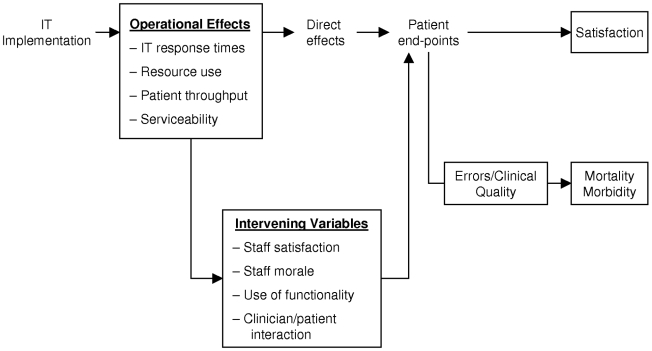
- They argue that the primary unit of analysis for many IT systems is likely the organizational/workgroup level (e.g., wards, hospitals, practices), because systems may not be restrictable to individuals and “contamination” can dilute effects.
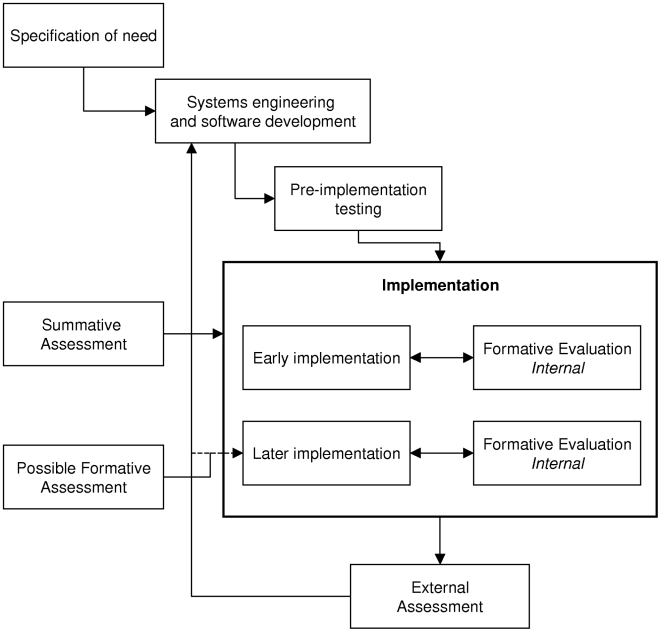
- They distinguish formative assessment as timely feedback to implementers and summative assessment as generalisable knowledge for decision makers beyond the life cycle of a particular application.
- They recommend external assessments because they can be independent, use masked assessment of endpoints, include contemporaneous controls, and use before-and-after controlled designs to reduce bias.
Methods
- Not stated in the paper.
- The paper is a narrative essay/review drawing on the authors’ experience with National Programme for Information Technology (NPFIT) evaluation in England and on cited literature.
- The main “analysis” is conceptual and argumentative: it synthesizes methodological principles for evaluating eHealth, including mixed methods, organizational-level observation, and separation of formative versus summative evaluation.
Limitations
- The paper notes a tension between formative and summative evaluation: feedback used to improve implementation can alter summative results and reduce generalisability.
- It states that distinctions between formative and summative assessment are “not watertight,” so these categories overlap in practice.
- Evident from the text: this is a position essay rather than an empirical study, so it does not present original outcome data or a systematic test of the proposed methods.
Model-written summary. Check it against the paper before relying on it.
Integrity signals
Registry
Cites
Statistics
Figures
Verification
Claims the paper makes
0 Valid · 0 Not valid · 12 Not checked · 27 Own results and interpretations
In the paper
“little evidence is available on the effect of multifunctional commercially developed systems”
§ Evaluating eHealth: How to Make Evaluation More Methodologically Robust > eHealth in the UK
What the sources say
- Not checked yetcites [3] Chaudhry B Wang J Wu S Maglione M Mojica W 2006 Systematic review: impact of health information technology on quality, efficiency, and costs of medical care. Ann Intern Med 144 742 752 16702590 source
plain- Asserted: passes — The authors put it forward as true.
- Checkable: passes — It can be checked against evidence.
- Load-bearing: passes — The paper’s conclusions depend on it.
- Based: passes — The paper gives a reason why it holds.
In the paper
“they often need to be studied at the organisational level [17].”
§ Evaluating eHealth: How to Make Evaluation More Methodologically Robust > Observations at Patient and System Level
What the sources say
- Not checked yetcites [17] Hippisley-Cox J Pringle M Cater R Wynn A Hammersley V 2003 The electronic patient record in primary care–regression or progression? A cross sectional study. BMJ 326 1439 1443 12829558 PMC162256 source
plain- Asserted: passes — The authors put it forward as true.
- Checkable: passes — It can be checked against evidence.
- Load-bearing: passes — The paper’s conclusions depend on it.
- Based: passes — The paper gives a reason why it holds.
A conclusion the paper draws from its own results — it cites no other source for it, so there is none to check. The quote shows it is in the paper.
In the paper
“External assessment can provide expertise in the measurement of endpoints (for example, error rates/quality) where special expertise is needed.”
§ Evaluating eHealth: How to Make Evaluation More Methodologically Robust > External and Internal Assessments
plainstates a cause- Asserted: passes — The authors put it forward as true.
- Checkable: unclear — It is unclear whether it could be checked against evidence.
- Load-bearing: passes — The paper’s conclusions depend on it.
- Based: passes — The paper gives a reason why it holds.
A conclusion the paper draws from its own results — it cites no other source for it, so there is none to check. The quote shows it is in the paper.
In the paper
“The primary unit of analysis in evaluation of IT systems is therefore likely to be at the organisational/workgroup level (e.g., wards, hospitals, practices).”
§ Evaluating eHealth: How to Make Evaluation More Methodologically Robust > Observations at Patient and System Level
hedged- Asserted: passes — The authors put it forward as true.
- Checkable: passes — It can be checked against evidence.
- Load-bearing: passes — The paper’s conclusions depend on it.
- Based: passes — The paper gives a reason why it holds.
A conclusion the paper draws from its own results — it cites no other source for it, so there is none to check. The quote shows it is in the paper.
In the paper
“if the results of formative research are fed back into implementations, this may influence summative results.”
§ Evaluating eHealth: How to Make Evaluation More Methodologically Robust > Formative and Summative Assessment
hedgedstates a possible cause- Asserted: passes — The authors put it forward as true.
- Checkable: passes — It can be checked against evidence.
- Load-bearing: passes — The paper’s conclusions depend on it.
- Based: passes — The paper gives a reason why it holds.
10 more claims
Create a free account to see all 39 claims and to verify the 12 references still open.
- Probably not a substantial claim. 19
- It may state two separate claims as one. 8
Claims other papers make about this one
Each is checked against this paper’s own text: does it say what the citing paper says it does?
The cited source says what the claim attributes to it.
In the citing paper
“Finally, our formative work might have had an impact on the findings from our summative research, and this could therefore be seen by some as a limitation. We, however, view this as a strength as it provided an opportunity to share with hospitals any early lessons learnt.98”
The cited source says what the claim attributes to it.
In the citing paper
“Several authors [1,2,4,6,62,76-87] note that a broader view is needed to assess the overall impact on health care.”
From A Holistic Framework to Improve the Uptake and Impact of eHealth Technologies (2011) · cites this paper as [62]
In the citing paper
“This is unsurprising given that only limited national-scale implementations of EHR systems have taken place to date, and there is as a consequence little published evidence to inform larger scale evaluations [28].”
In the citing paper
“In our view, the conditions for implementation must be taken into account right from the start (contextual inquiry and value specification; see Figure 1) [62].”
From A Holistic Framework to Improve the Uptake and Impact of eHealth Technologies (2011) · cites this paper as [62]
Citations
Cites
Chaudhry, B., Wang, J., Wu, S., Maglione, M., Mojica, W., Roth, E., Morton, S. C., & Shekelle, P. G. (2006) · Annals of Internal Medicine · doi:10.7326/0003-4819-144-10-200605160-00125 · Cited by 3,159 · cited 1×
“Such evaluations fulfil a real need, since a recent systematic review showed that ‘‘most of the high quality literature regarding multifunctional health information technology systems comes from 4 benchmark research institutions’’ and that ‘‘little evidence is available on the effect of multifunctional commercially de…”
BackgroundInformation Technology and Organizational Change: Causal Structure in Theory and Research
Markus, M. L., & Robey, D. (1988) · Management Science · doi:10.1287/mnsc.34.5.583 · Cited by 2,108
Developing and Evaluating Complex Interventions: New Guidance
Craig, P., Dieppe, P. A., MacIntyre, S., Michie, S., Nazareth, I., & Petticrew, M. P. (2006) · UCL Discovery (University College London) · Cited by 1,979
Poissant, L. (2005) · Journal of the American Medical Informatics Association · doi:10.1197/jamia.m1700 · Cited by 901
Lilford, R., Mohammed, M. A., Spiegelhalter, D., & Thomson, R. (2004) · The Lancet · doi:10.1016/s0140-6736(04)15901-1 · Cited by 448 · cited 2×
“In quality measurement many methodological traps lie in wait for nonexperts [6,28,29].”
BackgroundMethodSelf-citationKaplan, B. (2001) · International Journal of Medical Informatics · doi:10.1016/s1386-5056(01)00184-8 · Cited by 380 · cited 1×
“ical pluralism’’ [4–8].”
Evaluating eHealth Interventions: The Need for Continuous Systemic Evaluation
Catwell, L., & Sheikh, A. (2009) · PLoS Medicine · doi:10.1371/journal.pmed.1000126 · Cited by 307 · cited 1×
“However, as Catwell and Sheikh described in the first article in this series [1], IT systems can introduce harms as well as benefits.”
BackgroundA controlled trial of smart infusion pumps to improve medication safety in critically ill patients*
Rothschild, J. M., Keohane, C. A., Cook, E. F., Orav, E. J., Burdick, E., Thompson, S., Hayes, J., & Bates, D. W. (2005) · Critical Care Medicine · doi:10.1097/01.ccm.0000155912.73313.cd · Cited by 301 · cited 1×
“, computerised decision support) [14–16], they often need to be studied at the organisational level [17].”
BackgroundThe Use of Electronic Medical Records: Communication Patterns in Outpatient Encounters
Makoul, G., Curry, R. H., & Tang, P. C. (2001) · Journal of the American Medical Informatics Association · doi:10.1136/jamia.2001.0080610 · Cited by 240
STARE-HI—Statement on reporting of evaluation studies in Health Informatics
TALMON, J., AMMENWERTH, E., BRENDER, J., DEKEIZER, N., NYKANEN, P., & RIGBY, M. (2009) · International Journal of Medical Informatics · doi:10.1016/j.ijmedinf.2008.09.002 · Cited by 234
Research works printed but not linked: 1
- Benko LB 2003 Back to the drawing board. Mod Healthc 33 12
Cited by
A Holistic Framework to Improve the Uptake and Impact of eHealth Technologies
van Gemert-Pijnen, J. E., Nijland, N., van Limburg, M., Ossebaard, H. C., Kelders, S. M., Eysenbach, G., & Seydel, E. R. (2011) · Journal of Medical Internet Research · doi:10.2196/jmir.1672 · Cited by 1,126
“Several authors [1,2,4,6,62,76-87] note that a broader view is needed to assess the overall impact on health care.”
Sheikh, A., Cornford, T., Barber, N., Avery, A., Takian, A., Lichtner, V., Petrakaki, D., Crowe, S., Marsden, K., Robertson, A., et al. (2011) · BMJ · doi:10.1136/bmj.d6054 · Cited by 314
Greenhalgh, T., Stramer, K., Bratan, T., Byrne, E., Russell, J., & Potts, H. W. W. (2010) · BMJ · doi:10.1136/bmj.c3111 · Cited by 275
“However, this standard is not accepted by some healthcare information systems researchers, who define robustness in terms of experimental or quasi-experimental studies of the “deployment” of a technology and its “impact” on predefined outcomes.”
BackgroundWhy Do Evaluations of eHealth Programs Fail? An Alternative Set of Guiding Principles
Greenhalgh, T., & Russell, J. (2010) · PLoS Medicine · doi:10.1371/journal.pmed.1000360 · Cited by 273
“has published three papers offering a “robust” and “scientific” approach to eHealth evaluation”
BackgroundWestbrook, J. I., Reckmann, M., Li, L., Runciman, W. B., Burke, R., Lo, C., Baysari, M. T., Braithwaite, J., & Day, R. O. (2012) · PLoS Medicine · doi:10.1371/journal.pmed.1001164 · Cited by 216
“The complexity of undertaking ‘‘real-world’’ studies should not be underestimated [43–45].”
Bossen, C., Jensen, L. G., & Udsen, F. W. (2013) · International Journal of Medical Informatics · doi:10.1016/j.ijmedinf.2013.05.010 · Cited by 183
“[30] R.”
BackgroundStudying technology use as social practice: the untapped potential of ethnography
Greenhalgh, T., & Swinglehurst, D. (2011) · BMC Medicine · doi:10.1186/1741-7015-9-45 · Cited by 163
“…and quasi-experimental studies oriented to determining the relationship between predefined variables such as completeness, accuracy, IT response times and morbidity (what Kaplan calls the variance approach) are commonly depicted as synonymous with robust health informatics research [8].”
BackgroundGreenhalgh, T., Maylor, H., Shaw, S., Wherton, J., Papoutsi, C., Betton, V., Nelissen, N., Gremyr, A., Rushforth, A., Koshkouei, M., et al. (2020) · JMIR Research Protocols · doi:10.2196/16861 · Cited by 152
“However, the introduction of new health care and social care technologies in real-world settings (with concomitant changes in organizational roles and routines) is more typically a social and political process in which power is unevenly distributed and success is defined differently by different stakeholders [15].”
BackgroundEvidence-Based Evaluation of eHealth Interventions: Systematic Literature Review
Enam, A., Torres-Bonilla, J., & Eriksson, H. (2018) · Journal of Medical Internet Research · doi:10.2196/10971 · Cited by 151
“Conduct the evaluation by external evaluators to provide expertise where it is needed and minimize the bias of in-house evaluators [12] External evaluation”
BackgroundMethodInfluentialGREENHALGH, T., RUSSELL, J., ASHCROFT, R. E., & PARSONS, W. (2011) · Milbank Quarterly · doi:10.1111/j.1468-0009.2011.00642.x · Cited by 119
Gates, P., Hardie, R., Raban, M. Z., Li, L., & Westbrook, J. I. (2020) · Journal of the American Medical Informatics Association · doi:10.1093/jamia/ocaa230 · Cited by 123
“We adapted these tools to best reflect the complexity of conducting these “realworld” intervention studies and removed the criterion requiring control groups as—while highly desirable—opportunities for obtaining control groups may be very limited for real-world studies of this type of organization-wide IT intervention…”
MethodNew approaches to evaluating complex health and care systems
Lamont, T., Barber, N., Pury, J. D., Fulop, N., Garfield-Birkbeck, S., Lilford, R., Mear, L., Raine, R., & Fitzpatrick, R. (2016) · BMJ · doi:10.1136/bmj.i154 · Cited by 87
Self-citationA Patient-Centered Framework for Evaluating Digital Maturity of Health Services: A Systematic Review
Flott, K., Callahan, R., Darzi, A., & Mayer, E. (2016) · Journal of Medical Internet Research · doi:10.2196/jmir.5047 · Cited by 86
“Although a framework should aim to be as objective as possible, considerable evidence suggests that mixed methods add invaluable richness to the data and improve its ability to drive improvement policy [11,16].”
BackgroundSalway, T. J., Farrell, J., Bondyra, M., Haag, D., Shoveller, J., & Gilbert, M. (2012) · Journal of Medical Internet Research · doi:10.2196/jmir.1948 · Cited by 85
Greenhalgh, T., Stramer, K., Bratan, T., Byrne, E., Russell, J., Hinder, S., & POTTS, H. W. W. (2010) · UCL Discovery (University College London) · Cited by 103
Morrison, Z., Robertson, A., Cresswell, K., Crowe, S., & Sheikh, A. (2011) · Journal of Healthcare Engineering · doi:10.1260/2040-2295.2.1.25 · Cited by 81
“There is also a clear need for work that focuses on building an evidence base for the benefits of national EHR implementations [58, 59].”
BackgroundSalisbury, C., Thomas, C., O'Cathain, A., Rogers, A., Pope, C., Yardley, L., Hollinghurst, S., Fahey, T., Lewis, G., Large, S., et al. (2015) · BMJ Open · doi:10.1136/bmjopen-2014-006448 · Cited by 80
Greenhalgh, T. (2012) · Journal of Primary Health Care · doi:10.1071/hc12092 · Cited by 91
Gilbert, M., Haag, D., Salway, T. J., Bondyra, M., Elliot, E., Chabot, C., Farrell, J., Bonnell, A., Kopp, S., Andruschak, J., et al. (2016) · JMIR Research Protocols · doi:10.2196/resprot.6293 · Cited by 64
“As recommended for the evaluation of eHealth interventions, we will use mixed-methods to evaluate the impact of GCO at individual, population, and health service delivery levels [53,54] (Table 4).”
Aicken, C. R. H., Fuller, S., Sutcliffe, L. J., Estcourt, C. S., Gkatzidou, V., Oakeshott, P., HONE, K. S., Sadiq, S. T., Sonnenberg, P., & Shahmanesh, M. (2016) · BMC Public Health · doi:10.1186/s12889-016-3648-y · Cited by 64
“an understanding of user-behaviour [29], particularly relevant for our intervention, which will be used remotely with minimal supervision.”
BackgroundSchaller, S., Marinova-Schmidt, V., Setzer, M., Kondylakis, H., Griebel, L., Sedlmayr, M., Graessel, E., Maler, J. M., Kirn, S., & Kolominsky-Rabas, P. L. (2016) · JMIR Research Protocols · doi:10.2196/resprot.4354 · Cited by 53
“This approach has been recommended in previous reviews and studies on eHealth interventions [21,39,40].”
Takian, A., Petrakaki, D., Cornford, T., Sheikh, A., & Barber, N. (2012) · BMC Health Services Research · doi:10.1186/1472-6963-12-105 · Cited by 51
“The initial design of the NHS CRS evaluation study The successful implementation of the NHS CRS was seen as a critical factor for the success of the NPfIT [38].”
BackgroundMethodInfluential“Real-World” Practical Evaluation Strategies: A Review of Telehealth Evaluation
Agboola, S., Hale, T. M., Masters, C., Kvedar, J., & Jethwani, K. (2014) · JMIR Research Protocols · doi:10.2196/resprot.3459 · Cited by 49
“To generate more robust conclusions of causality, the use of multiple methods, using both qualitative and quantitative research methods [25], and frameworks to “triangulate” the effects of telehealth programs have been suggested as a useful strategy [16].”
Jongsma, K. R., van den Heuvel, J. F. M., Rake, J., Bredenoord, A. L., & Bekker, M. N. (2020) · JMIR mhealth and uhealth · doi:10.2196/17271 · Cited by 56
“A mixed methods study, alongside a prospective blended care study (SAFE@home study) [16,17], was performed to explore the understanding of patients’experiences with mHealth [18,19].”
Nijland, N. (2010) · doi:10.3990/1.9789036531337 · Cited by 44
Evolution of a capacitive electromyography contactless biosensor: Design and modelling techniques
Ng, C. L., & Reaz, M. B. I. (2019) · Measurement · doi:10.1016/j.measurement.2019.05.031 · Cited by 44
Web-Based Tools for Text-Based Patient-Provider Communication in Chronic Conditions: Scoping Review
Voruganti, T., Grunfeld, E., Makuwaza, T., & Bender, J. L. (2017) · Journal of Medical Internet Research · doi:10.2196/jmir.7987 · Cited by 38
“However, such reviews often limited their inclusion to randomized controlled trials (RCTs; which may be inappropriate for eHealth evaluation [30]) and synthesized the effects across several chronic diseases, which may be misleading because such measures are often too heterogeneous to be objectively compared.”
BackgroundLiu, F., Jiang, Y., Xu, G., & Ding, Z. (2020) · Telemedicine Journal and e-Health · doi:10.1089/tmj.2019.0215 · Cited by 34
Kip, H., Oberschmidt, K., & Bierbooms, J. J. P. A. (2021) · International Journal of Forensic Mental Health · doi:10.1080/14999013.2020.1808914 · Cited by 38
“…et al., 2018); realist evaluations to determine what works, how, in which conditions and for whom (Pawson et al., 2005); or mixed-methods approaches in which quantitative data is integrated with qualitative findings to provide more insight into reasons for effectiveness (Lilford et al., 2009).”
Faujdar, D. S., Singh, T., Kaur, M., Sahay, S., & Kumar, R. (2021) · Healthcare Informatics Research · doi:10.4258/hir.2021.27.4.315 · Cited by 29
“However, there is no clear consensus on the most appropriate method to evaluate eHealth systems, which are considered to be highly complex [15].”
BackgroundInfluentialEvaluating health information technologies: A systematic review of framework recommendations
Neame, M. T., Sefton, G., Roberts, M., Harkness, D., Sinha, I. P., & Hawcutt, D. B. (2020) · International Journal of Medical Informatics · doi:10.1016/j.ijmedinf.2020.104247 · Cited by 27
Rahimi, K., Velardo, C., Triantafyllidis, A. K., Conrad, N., Shah, S. A., Chantler, T., Mohseni, H., Stoppani, E., Moore, F., Paton, C., et al. (2015) · European Heart Journal - Quality of Care and Clinical Outcomes · doi:10.1093/ehjqcco/qcv013 · Cited by 24
Tang, T., Heidebrecht, C., Coburn, A., Mansfield, E. D., Roberto, E., Lucez, E., Lim, M. E., Reid, R. J., & Quan, S. D. (2019) · International Journal of Medical Informatics · doi:10.1016/j.ijmedinf.2019.04.010 · Cited by 27
Implementation science at the crossroads
Lilford, R. J. (2017) · BMJ Quality & Safety · doi:10.1136/bmjqs-2017-007502 · Cited by 23
Self-citationCresswell, K. M., Ali, M., Avery, A. J., Barber, N., Cornford, T., Crowe, S., Fernando, B., Jacklin, A., Jani, Y. H., Klecuń, E., et al. (2011) · Figshare · Cited by 29
Aicken, C. R. H., Sutcliffe, L. J., Gibbs, J., Tickle, L. J., HONE, K. S., Harding-Esch, E. M., Mercer, C. H., Sonnenberg, P., Sadiq, S. T., Estcourt, C. S., et al. (2017) · Sexually Transmitted Infections · doi:10.1136/sextrans-2017-053227 · Cited by 19
Unkels, R., Manzi, F., Kapologwe, N., Baker, U., Ahmad, A., Nabiev, R., Berndtsson, M., Baraka, J., Hanson, C., & Hirose, A. (2023) · PLOS Global Public Health · doi:10.1371/journal.pgph.0000972 · Cited by 18
“Reasons for the reported data discrepancy may be found in i) the health system’s organizational culture regarding health data [9, 10, 45, 57], ii) the environment of data collection [47] and iii) duplicate data entry [18].”
Hestmark, L., Romøren, M., Heiervang, K. S., Hansson, K. M., Ruud, T., Benth, J. Š., Norheim, I., Weimand, B. M., & Pedersen, R. (2023) · Administration and Policy in Mental Health and Mental Health Services Research · doi:10.1007/s10488-023-01255-0 · Cited by 17
“By providing continuous feedback on the results (formative assessment), the external validity of the findings is limited to interventions that employ a similar implementation strategy (Lilford et al., 2009).”
BackgroundKernebeck, S., Holle, D., Pogscheba, P., Jordan, F., Mertl, F., Huldtgren, A., Bader, S., Kirste, T., Teipel, S. J., Holle, B., et al. (2019) · JMIR Research Protocols · doi:10.2196/11630 · Cited by 15
Ng, N., Eriksson, M., Guerrero, E., Gustafsson, C., Kinsman, J., Lindberg, J., Lindgren, H., Lindvall, K., Lundgren, A. S., Lönnberg, G., et al. (2021) · Frontiers in Public Health · doi:10.3389/fpubh.2021.593453 · Cited by 14
“Here a mixed-method approach helps provide a robustmethodological framework for both design and evaluation (55).”
MethodeHealth: advantages, disadvantages and guiding principles for the future. (Preprint)Preprint
Soriano, B. J. N., Duarte, S. G., Fernández‐Alonso, A. M., Perales, A. B., & Carreño, T. P. (2019) · doi:10.2196/preprints.15366 · Cited by 13
When all else fails: The (mis)use of qualitative research in the evaluation of complex interventions
Rotteau, L., Albert, M., Bhattacharyya, O. K., Berta, W. B., & Webster, F. (2020) · Journal of Evaluation in Clinical Practice · doi:10.1111/jep.13396 · Cited by 11
Smith, M. Y., Frise, S., Feron, J., & Marshall, R. (2022) · Drug Safety · doi:10.1007/s40264-022-01165-4 · Cited by 12
“, summative evaluations) to assess the intervention’s initial and sustained impact over time [45].”
BackgroundTechnical evaluation of an e-health platform.
Lo, O., Lü, F., Buchanan, W. J., & Thüemmler, C. (2012) · Edinburgh Napier Research Repository (Edinburgh Napier University) · Cited by 12
Salisbury, C., O’Cathain, A., Thomas, C., Edwards, L., Montgomery, A. A., Hollinghurst, S. P., Large, S., Nicholl, J. P., Pope, C. J., Rogers, A. E., et al. (2017) · Programme Grants for Applied Research · doi:10.3310/pgfar05010 · Cited by 9
“This is a paradox for the evaluation of all health service innovations, but particularly in relation to telehealth, and a number of authors have discussed alternative approaches to timely evaluation.(254,255,280)”
BackgroundIMPROV-ED trial: eHealth programme for faster recovery and reduced healthcare utilisation after CABG
van Steenbergen, G. J., van Veghel, D., Woorst, J. T., van Lieshout, D., & Dekker, L. (2020) · Netherlands Heart Journal · doi:10.1007/s12471-020-01508-9 · Cited by 12
The impact of paediatric dose range checking software
Neame, M. T., Moss, J., Dominguez, J. S., Gill, A. M., Barnes, N., Sinha, I. P., & Hawcutt, D. B. (2020) · European Journal of Hospital Pharmacy · doi:10.1136/ejhpharm-2020-002244 · Cited by 9
Validity and Reliability of the eHealth Analysis and Steering Instrument
Henkemans, O. B., Dusseldorp, E., Keijsers, J. F. E. M., Kessens, J. M., Neerincx, M. A., & Otten, W. (2013) · Medicine 2 0 · doi:10.2196/med20.2571 · Cited by 7
“Although the RCT is sometimes criticized as too limited to assess the effectiveness of eHealth services [4,5], we consider the RCT as a suitable and conservative approach to examine the effects of stand-alone eHealth services to support individual users in their self-management.”
BackgroundRahimi, S. A., Archambault, P. M., Ravitsky, V., Lemoine, M., Langlois, S., Forest, J., Giguere, A. M. C., Rousseau, F., Dolan, J. G., & Légaré, F. (2019) · JMIR Research Protocols · doi:10.2196/13321 · Cited by 8
“Informed by recommendations about how to evaluate eHealth tools [32], and a study on needs assessments for mobile technology [33], we developed an interview guide to conduct semistructured interviews with couples or single participants to assess (1) their attitudes toward mHealth apps in general and for prenatal scree…”
MethodThe need for independent evaluations of government-led health information technology initiatives
Sheikh, A., Atun, R. A., & Bates, D. W. (2014) · BMJ Quality & Safety · doi:10.1136/bmjqs-2014-003273 · Cited by 10
Greenhalgh, T., Stramer, K., Bratan, T., Byrne, E., Hinder, S., & POTTS, H. W. W. (2010) · Cited by 8
Al-Khudairy, L., Akram, Y., Watson, S., Kudrna, L., Hofman, J., Nightingale, M., Alidu, L., Rudge, A., Rawdin, C., Ghosh, I., et al. (2023) · PLOS Global Public Health · doi:10.1371/journal.pgph.0001381 · Cited by 7
“which the incentive was calculated was independent of the evaluation described here in line with principles of independent intra-mural and extra-mural evaluations [21].”
MethodSelf-citationA Flexible Toolkit for Evaluating Person-Centred Digital Health and Wellness at Scale
Lennon, M., Bouamrane, M.-M., Grieve, E., O’Donnell, C. A., O’Connor, S., Agbakoba, R., Devlin, A. M., Barry, S., Bikker, A., Finch, T. L., et al. (2016) · Advances in intelligent systems and computing · doi:10.1007/978-3-319-41652-6_11 · Cited by 9
Pickering, B., Bartholomew, R., Janian, M. N., López-Moreno, B., & Surridge, M. (2020) · Lecture notes in computer science · doi:10.1007/978-3-030-49059-1_9 · Cited by 10
Adherence factors to paperless primary healthcare: a focus group study
Iljaž, R. J., Meglič, M., Petek, D., Kolšek, M., & Susič, T. P. (2013) · Slovenian Journal of Public Health · doi:10.2478/sjph-2014-0006 · Cited by 6
“This evaluation of attitudes by the key user subgroups regarding the use of ICT and paperless records in primary healthcare included the qualitative method, which is becoming increasingly popular in health informatics research (1, 4, 8, 13, 31, 45-50).”
MethodWalzer, S., Armbruster, C., Kunze, C., & Farin‐Glattacker, E. (2023) · Springer eBooks · doi:10.1007/978-3-658-39302-1_2 · Cited by 4
Jones, E. B., Swain, M. J., Patel, V., & Furukawa, M. F. (2014) · Healthcare · doi:10.1016/j.hjdsi.2013.12.015 · Cited by 6
Aicken, C. R. H., Gabb, J., Martino, S. D., Witney, T., & Lucassen, M. F. G. (2025) · JMIR mhealth and uhealth · doi:10.2196/55433 · Cited by 6
“The integration of qualitative and quantitative approaches can aid an understanding of user behavior and issues affecting intervention success [56] and strengthens the conclusions that can be drawn [57].”
Magnée, M. J. C. M., Cox, I. M., & Teunisse, J. (2015) · Stem- Spraak- en Taalpathologie · Cited by 3
Conducting Performance Evaluation of an e-Health Platform
Lo, O., Fan, L., Buchanan, W. J., & Thüemmler, C. (2013) · Advances in business information systems and analytics book series · doi:10.4018/978-1-4666-4062-7.ch016 · Cited by 5
“…noted that “few blueprint for effect evaluation methodologies" (Dansky et al,. 2006, p. 397) exist whilst the same backing can be provided in the work of Lilford et al. (2009) in which they state that no general consensus can be found in techniques used to evaluate e-Health implementations.”
BackgroundAn Overview of Clinical Informatics
Cresswell, K. M., Bates, D. W., Wright, A. T., & Sheikh, A. (2017) · Elsevier eBooks · doi:10.1016/b978-0-12-809523-2.00001-7 · Cited by 7
Jurkeviciute, M. (2019) · BMC Medical Informatics and Decision Making · doi:10.1186/s12911-019-0975-9 · Cited by 3
Unkels, R., Manzi, F., Kapologwe, N., Baker, U., Ahmad, A., Nabiev, R., Berndtsson, M., Baraka, J., Hanson, C., & Hirose, A. (2022) · medRxiv · doi:10.1101/2022.02.07.22270225 · Cited by 3
“Technology that is not adapted to the context may increase time spent on data generation, negatively affecting service provision and consequently patient safety [18, 19].”
BackgroundDeveloping and Measuring the Business Case for Health Information Technology
Unwin, D. W., Sanzogni, L., & Sandhu, K. (2017) · Advances in human services and public health (AHSPH) book series · doi:10.4018/978-1-5225-2262-1.ch015 · Cited by 2
Developments and challenges of e-health strategies for people with inflammatory bowel disease
Avery, P. (2020) · British Journal of Healthcare Management · doi:10.12968/bjhc.2020.0010 · Cited by 2
Crossing Boundaries : Transferring eHealth services across the Northern Periphery
Pesola, U.-M. (2013) · DiVA at Umeå University (Umeå University) · Cited by 4
The Emerging Area of E‐health Communication Research
Kreps, G. L. (2020) · Wiley eBooks · doi:10.1002/9781119399926.ch53 · Cited by 2
Unkels, R., Ahmad, A., Manzi, F., Kasembe, A., Kapologwe, N., Nabiev, R., Berndtsson, M., Hirose, A., & Hanson, C. (2023) · medRxiv · doi:10.1101/2023.04.12.23288456 · Cited by 2
“Data from the previous year were included to mitigate effects of interdependency between SPT and DHIS2 during the reference year due to duplicated data entry (20).”
BackgroundMethodReview: Nurse acceptance of electronic health record technology: a literature review
Cooper, A. (2015) · Journal of research in nursing · doi:10.1177/1744987115616236 · Cited by 1
“Other commentators have identified the need for multi-perspective evaluations that integrate qualitative and quantitative methods and take a more longitudinal approach (Catwell and Sheikh, 2009; Lilford et al., 2009).”
BackgroundSalisbury, C., Rogers, A. E., Yardley, L., Fahey, T. P., Lewis, G., Edwards, L., Brownsell, S., & Montgomery, A. A. (2014)
Børøsund, E. (2015) · NVA (Nasjonalt vitenarkiv)
Cumming, G., Luciano, J., MacRury, S. M., McKendrick, D., Stephen, K., & Chitty, A. (2014) · CRC Press eBooks · doi:10.1201/b17724-44
Team-based electronic communication in the care of patients with complex conditions
Voruganti, R. T. (2017) · TSpace (University of Toronto)
CeHRes roadmap utilization in development of eHealth technology solutions : a Scoping review
Palokangas, M. (2017) · Cited by 3
Digital health in obstetric care
van den Heuvel, J. F. M. (2021) · Utrecht University Repository (Utrecht University) · doi:10.33540/605 · Cited by 3
Developing and Measuring the Business Case for Health Information Technology
Unwin, D. W., Sanzogni, L., & Sandhu, K. (2018) · IGI Global eBooks · doi:10.4018/978-1-5225-5201-7.ch076
Developing and Measuring the Business Case for Health Information Technology
Unwin, D. W., Sanzogni, L., & Sandhu, K. (2018) · IGI Global eBooks · doi:10.4018/978-1-5225-6915-2.ch018
Ahouehome, C., Bureau, A., Rahimi, S. A., Gadio, S., Julien, Y., Assan, O. Q., Guay-Bélanger, S., Rousseau, F., Forest, J., Langlois, S., et al. (2026) · Patient Education and Counseling · doi:10.1016/j.pec.2026.109548
Metadata
- Authors
- Lilford, R. J., Foster, J., & Pringle, M.
- Affiliations
- University of Birmingham (GB)
- University of Nottingham (GB)
- Corresponding author
- Lilford, Richard James
- Venue
- PLoS Medicine
- Publisher
- Public Library of Science (PLoS)
- Published
- 2009-11-24
- Volume
- 6
- Issue
- 11
- Pages
- e1000186
- ISSN
- 1549-1277 (ISSN-L)
- 1549-1676
- PMC
- PMC2777393
- OpenAlex
- W2023814934
- Cited by
- 79
- References
- 32
- Citations by year
- 2026: 1 · 2025: 1 · 2023: 5 · 2022: 2 · 2021: 3 · 2020: 11 · 2019: 6 · 2018: 4 · 2017: 8 · 2016: 6 · 2015: 5 · 2014: 5 · 2013: 6 · 2012: 5
- FWCI
- 11.28
- Type
- journal article
- Language
- en
- Open access
- gold
- doi.org
- Locations
- PLoS Medicine (publishedVersion, cc-by)
- PubMed Central (publishedVersion, cc-by)
- PubMed (publishedVersion)
- RePEc: Research Papers in Economics (submittedVersion)
- DOAJ (DOAJ: Directory of Open Access Journals) (submittedVersion, cc-by-sa)
- University of Birmingham Research Portal (University of Birmingham) (submittedVersion, other-oa)
- Topics
- Health Sciences › Health Professions › Health Information Management › Electronic Health Records Systems
- Social Sciences › Public Administration › Evaluation and Performance Assessment
- Health Sciences › Health Professions › General Health Professions › Mobile Health and mHealth Applications
- Keywords
- eHealth evaluation, implementation evaluation, method robustness, health information technology
- MeSH terms
- Evaluation Studies as Topic, United Kingdom, Humans, Medical Informatics
About these checks
Registry, retraction, Cites and statistics results are computed, not judged, with one exception: a printed reference that no index lists is read once by a model before it counts as a citation error. Claims are extracted by a model and kept only when their quote appears verbatim in the text; each cited source is then checked, with a model’s help, for whether it says what the claim relies on. Those verdicts can be wrong — read the claim’s quote and the cited source before relying on one.
A language model drew the claims from the paper on 2026-10-11, under version 3 of the claim definition (model deepseek-v4.1-flash, prompt extract-v3).
A second model labelled each claim on 2026-10-11 (model jev-1.13-20260917, definition revision gold-guideline-v0.2).
Statistics and arithmetic are recomputed, not judged.
Confidence bands are shown only for fields calibrated on our annotated test set. None is calibrated yet, so no band is shown.
What counts as a claim ›How we measure confidence ›How we check this ›
Are you an author, or do you see a problem with this page? Request a review
Data sources
Bibliographic data: Semantic Scholar, OpenAlex, Crossref.
Contains information from the Semantic Scholar Academic Graph Datasets, made available under the ODC Attribution License (ODC-BY 1.0).
Semantic Scholar’s data is described in: Kinney, R., et al. (2023). The Semantic Scholar Open Data Platform. arXiv:2301.10140.
