

Estimating the Global Clinical Burden of Plasmodium falciparum Malaria in 2007
Open accessThe DOI matches its Crossref record; 109 of the 110 references it cites were found in a registry or an index.
Abstract
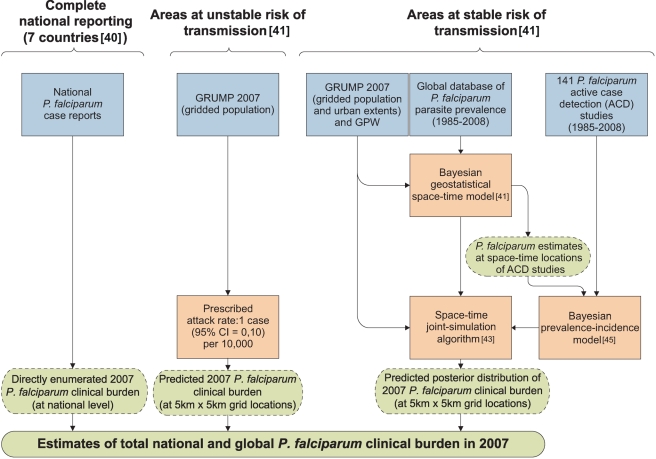
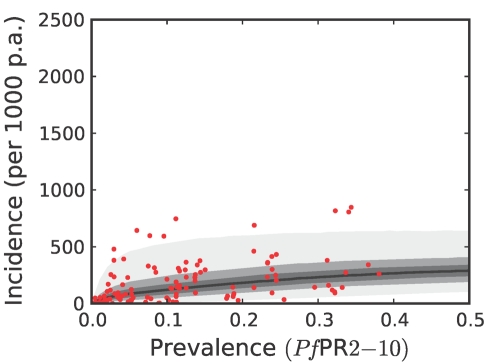
BACKGROUND: The epidemiology of malaria makes surveillance-based methods of estimating its disease burden problematic. Cartographic approaches have provided alternative malaria burden estimates, but there remains widespread misunderstanding about their derivation and fidelity. The aims of this study are to present a new cartographic technique and its application for deriving global clinical burden estimates of Plasmodium falciparum malaria for 2007, and to compare these estimates and their likely precision with those derived under existing surveillance-based approaches. METHODS AND FINDINGS: In seven of the 87 countries endemic for P. falciparum malaria, the health reporting infrastructure was deemed sufficiently rigorous for case reports to be used verbatim. In the remaining countries, the mapped extent of unstable and stable P. falciparum malaria transmission was first determined. Estimates of the plausible incidence range of clinical cases were then calculated within the spatial limits of unstable transmission. A modelled relationship between clinical incidence and prevalence was used, together with new maps of P. falciparum malaria endemicity, to estimate incidence in areas of stable transmission, and geostatistical joint simulation was used to quantify uncertainty in these estimates at national, regional, and global scales. Combining these estimates for all areas of transmission risk resulted in 451 million (95% credible interval 349-552 million) clinical cases of P. falciparum malaria in 2007. Almost all of this burden of morbidity occurred in areas of stable transmission. More than half of all estimated P. falciparum clinical cases and associated uncertainty occurred in India, Nigeria, the Democratic Republic of the Congo (DRC), and Myanmar (Burma), where 1.405 billion people are at risk. Recent surveillance-based methods of burden estimation were then reviewed and discrepancies in national estimates explored. When these cartographically derived national estimates were ranked according to their relative uncertainty and replaced by surveillance-based estimates in the least certain half, 98% of the global clinical burden continued to be estimated by cartographic techniques. CONCLUSIONS AND SIGNIFICANCE: Cartographic approaches to burden estimation provide a globally consistent measure of malaria morbidity of known fidelity, and they represent the only plausible method in those malaria-endemic countries with nonfunctional national surveillance. Unacceptable uncertainty in the clinical burden of malaria in only four countries confounds our ability to evaluate needs and monitor progress toward international targets for malaria control at the global scale. National prevalence surveys in each nation would reduce this uncertainty profoundly. Opportunities for further reducing uncertainty in clinical burden estimates by hybridizing alternative burden estimation procedures are also evaluated.
Overview
The claims and statistics of this paper haven’t been checked yet.
Free: it reads the open-access text and checks the first 5 claims that cite a source we can check. Create a free account to check every claim.
Integrity signals
Registry
Cites
Statistics
Figures
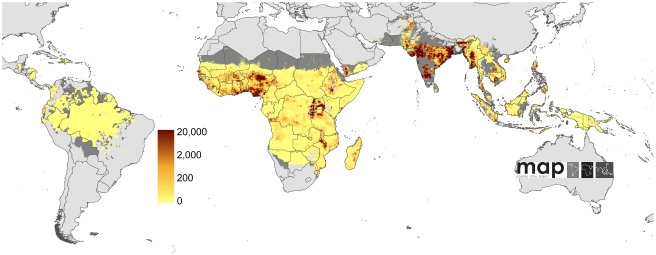
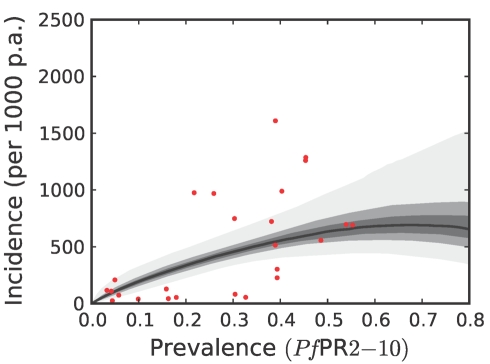
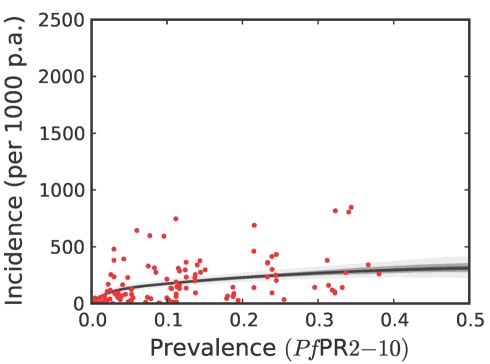
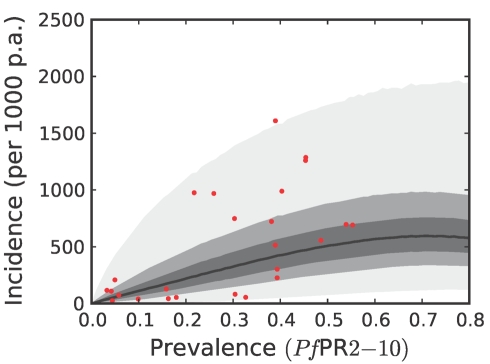
Verification
Claims the paper makes
The claims and statistics of this paper haven’t been checked yet.
Free: it reads the open-access text and checks the first 5 claims that cite a source we can check. Create a free account to check every claim.
Claims other papers make about this one
Each is checked against this paper’s own text: does it say what the citing paper says it does?
The check wasn’t confident either way, so it gives no verdict — never disputed.
In the citing paper
“The available articles indicate that pregnant women infected with P.falciparum and P.vivax have higher plasma concentrations of pro-inflammatory cytokines than their uninfected counterparts [117, 118].”
From Current update on malaria in pregnancy: a systematic review (2025) · cites this paper as [118]
Experimental — accuracy not yet measured
Self-check
Percentages, sums and reported differences re-computed from the paper’s own numbers.
The self-check needs the paper’s full text.
Citations
Cites
Mortality by cause for eight regions of the world: Global Burden of Disease Study
Murray, C. J., & Lopez, A. D. (1997) · The Lancet · doi:10.1016/s0140-6736(96)07493-4 · Cited by 4,043 · cited 1×
“The clinical consequences of Plasmodium falciparum infection have several features that confound traditional approaches to disease burden and disability measurement [10,11].”
BackgroundThe global distribution of clinical episodes of Plasmodium falciparum malaria
Snow, R. W., Guerra, C. A., Noor, A. M., Myint, H. Y., & Hay, S. I. (2005) · Nature · doi:10.1038/nature03342 · Cited by 2,741 · cited 5×
“Africa [1,3,4,6,7] and once before globally [5].”
BackgroundMethodResultInfluentialSelf-citationA new world malaria map: Plasmodium falciparum endemicity in 2010
Gething, P. W., Patil, A. P., Smith, D. L., Guerra, C. A., Elyazar, I. R., Johnston, G. L., Tatem, A. J., & Hay, S. I. (2011) · Malaria Journal · doi:10.1186/1475-2875-10-378 · Cited by 1,146
Self-citationThe neglected burden of Plasmodium vivax malaria
Mendis, K., Sina, B., Marchesini, P., & Carter, R. (2001) · The American Journal of Tropical Medicine and Hygiene · doi:10.4269/ajtmh.2001.64.97 · Cited by 970 · cited 1×
“vivax malaria [109–112], but new, innovative approaches based on an understanding of the clinical epidemiology and better cartography are required to improve upon current efforts to define the burden due to P.”
BackgroundWHO Regional Office for Europe
Tsechkovski, M. (1993) · The Lancet · doi:10.1016/0140-6736(93)91122-3 · Cited by 871
A Climate-based Distribution Model of Malaria Transmission in Sub-Saharan Africa
Craig, M. H., Snow, R. W., & le Sueur, D. (1999) · Parasitology Today · doi:10.1016/s0169-4758(99)01396-4 · Cited by 854 · cited 1×
“In our previous global estimates [5], we adapted a historical, categorical description of malaria endemicity, whilst in Africa we [1,3,4] and others [6,7] have previously used a climate suitability model of the likelihood of stable transmission as an index of differences in transmission intensity [102,103].”
MethodSelf-citationVivax Malaria: Neglected and Not Benign
Price, R. N., Tjitra, E., Guerra, C. A., Yeung, S., White, N. J., & Anstey, N. M. (2007) · The American Journal of Tropical Medicine and Hygiene · doi:10.4269/ajtmh.2007.77.79 · Cited by 838 · cited 1×
“vivax malaria [109–112], but new, innovative approaches based on an understanding of the clinical epidemiology and better cartography are required to improve upon current efforts to define the burden due to P.”
BackgroundSelf-citationSnow, R. W., Craig, M., Deichmann, U., & Marsh, K. (1999) · PubMed · Cited by 735
Self-citationOverdiagnosis of malaria in patients with severe febrile illness in Tanzania: a prospective study
Reyburn, H., Mbatia, R., Drakeley, C., Carneiro, I., Mwakasungula, E., Mwerinde, O., Saganda, K., Shao, J., Kitua, A., Olomi, R., et al. (2004) · BMJ · doi:10.1136/bmj.38251.658229.55 · Cited by 672 · cited 3×
“Fourth, inaccurate diagnoses [21,25,28] might be used to report disease rates, and these errors may be compounded through inadequate and incomplete national reporting systems [29–38].”
BackgroundEvolutionary and Historical Aspects of the Burden of Malaria
Carter, R., & Mendis, K. N. (2002) · Clinical Microbiology Reviews · doi:10.1128/cmr.15.4.564-594.2002 · Cited by 663 · cited 1×
“Estimating the disease burden posed by malaria is an important public health challenge [1–9].”
Background
Research works printed but not linked: 3
- Macdonald G 1957 Local features of malaria. London Oxford University Press 63 99 The epidemiology and control of malaria
- Sharma VP Choudhury DS Ansari MA Malhotra MS Menon PKB 1983 Studies on the true incidence of malaria in Kharkhoda (District Sonepat, Haryana) and Kichha (District Nainital, U.P.) Primary Health Centres. Indian J Malariol 20 21 34
- WHO 2010 Guidelines for the treatment of malaria. Second edition. Geneva, Switzerland World Health Organization 194
Cited by
Items 301–371 of 371
Abdallah, F. H., Elnager, A., Wdidi, S., Hamza, A. M., & Ali, A. E. (2019) · International Journal of Medical and Biomedical Studies · doi:10.32553/ijmbs.v3i2.103 · Cited by 1
Kaur, J., Kaura, T., Sharma, A., Kumar, A., Pangotra, M. K., Upadhyay, A. K., Anvikar, A. R., Grover, G. S., Chaturvedi, H. K., & Sharma, S. K. (2021) · Transactions of the Royal Society of Tropical Medicine and Hygiene · doi:10.1093/trstmh/trab005 · Cited by 1
Idama, F. O., Onochie, A. U., Onuegbu, M. E., Anyanwu, R. O., & Moneme, E. C. (2023) · International Journal of TROPICAL DISEASE & Health · doi:10.9734/ijtdh/2023/v44i221498 · Cited by 1
Jude, J., Gunathilaka, N., Wijerathna, T., Fernando, D., Wickremasinghe, R., & Abeyewickreme, W. (2023) · International Journal of Tropical Insect Science · doi:10.1007/s42690-023-01142-z · Cited by 1
“Climate parameters such as temperature, humidity, and rainfall influence both the mosquito's life-history traits and the parasite's sporogonic development within their bodies (Guerra et al. 2010; Hay et al. 2010; Afrane et al. 2012).”
Use of Mapping Technologies to Study the Spatial Distribution of Malaria Incidence in Vietnam
Nguyen, T.-Q., & Cao, T.-H. (2024) · International Journal of Science and Healthcare Research · doi:10.52403/ijshr.20240110
Ranjan, P., Ghoshal, U., Prakash, S., Pandey, A., & Shukla, R. (2024) · Indian Journal of Medical Microbiology · doi:10.1016/j.ijmmb.2024.100616 · Cited by 1
Theoretical Evaluation and Classifications of Potential Antimalarial Phenazine Compounds
Silva, T. B., Cerqueira, N. T. V., Silva, S. W. D., Santos, F. D. M., de Oliveira, T. F., Ziolli, R. L., & Taft, C. A. (2011) · Letters in Organic Chemistry · doi:10.2174/157017811799304106 · Cited by 1
Malaria Parasite Pyrimidine Nucleotide Metabolism: A Promising Drug Target
Krungkrai, J. (2017) · Cited by 1
Saponins as Potential Antiprotozoal Agents
Amaral, A. C. F., Ramos, A. D. S., Ferreira, J. L. P., de Almeida, M. M. H., da Cruz, J. D., de Oliveira, D. L., Maria, A. C. B., de Oliveira, A. A., Rodrigues, I. A., & Silva, J. R. D. A. (2021) · Topics in medicinal chemistry · doi:10.1007/7355_2021_141 · Cited by 1
Phenotypic and Genotypic Analysis of In Vitro Selected Artemisinin Resistant Plasmodium falciparum
Tucker, M. S. (2010) · Digital Commons - University of South Florida (University of South Florida) · Cited by 4
Messina, J. P. (2011) · Cited by 1
Asad, M., Yamaryo‐Botté, Y., Hossain, M. E., Thakur, V., Jain, S., Datta, G., Botté, C. Y., & Mohmmed, A. (2019) · bioRxiv (Cold Spring Harbor Laboratory) · doi:10.1101/808709 · Cited by 1
“Overall localization analyses strongly indicate that: (1) PfLPL1 is associated with ER in early ring stages; (2) it gets further trafficked from ER towards parasite periphery during early trophozoite stage and gets associated with cytosomal-like vesicles, which are developing during uptake of content of parasitophorou…”
BackgroundTropical Health and Sustainability
Baird, J. K. (2012) · Springer eBooks · doi:10.1007/978-1-4419-0851-3_896 · Cited by 1
Functional antibody responses to the Plasmodium falciparum merozoite
Ismail, H. A. (2013) · Figshare · Cited by 1
Kiware, S. S. (2014) · e-Publications@Marquette (Marquette University)
Serological and molecular tools for the evaluation of malaria transmission blocking vaccines
Jones, S. (2015) · LSHTM Research Online (London School of Hygiene and Tropical Medicine) · doi:10.17037/pubs.02088685 · Cited by 1
Arnida, A., Wahyono, W., Mustofa, M., & Susidarti, R. A. (2015) · International Journal of Pharmacy and Pharmaceutical Sciences
Crowell, V. (2013) · edoc (University of Basel) · doi:10.5451/unibas-006087611
Harbut, M. B. (2012) · ScholarlyCommons (University of Pennsylvania)
A study of recombinant Plasmodium falciparum PFC0760c.
Viljoen, J. E. (2013) · ResearchSpace (University of KwaZulu-Natal)
Fotoran, W. L. (2012) · Digital Library of Theses and Dissertations (Universidade de São Paulo) · doi:10.11606/d.42.2012.tde-23042013-121842
Muxel, S. M. (2011) · Digital Library of Theses and Dissertations (Universidade de São Paulo) · doi:10.11606/t.42.2011.tde-12082011-110633 · Cited by 1
Service personnel move to NHS mental health inpatient care
Hay, S. I., Gething, P. W., & Snow, R. W. (2010)
Self-citationNamdar, F., Ebrahimzadeh, A., & Mohammadi, S. S. (2014)
Putra, R. E., & Wicaksono, S. A. B. (2014) · JURNAL ISTEK
The adaptor protein 1 medium subunit of plasmodium falciparum
Bezuidenhout, B. C. (2014) · University of the Witwatersrand, Johannesburg Institutional Repository on DSpace (University of the Witwatersrand, Johannesburg)
An eradicating vaccine for Plasmodium falciparum: Possibility or Pipe-dream?
Fazekas, B. (2011) · Cambridge Medicine Journal · doi:10.7244/cmj-1323558924
Assessing malaria attributed mortality in west and southern Africa
Fakultät, P.-N. (2013)
Lima-Cooper, G. (2016) · Digital Library of Theses and Dissertations (Universidade de São Paulo) · doi:10.11606/t.5.2016.tde-08042016-145255 · Cited by 1
Mungai, N. N. (2015) · University of Nairobi Research Archive (University of Nairobi) · Cited by 2
Simões, M. L. (2016) · International Congress of Entomology (ICE) · doi:10.1603/ice.2016.94846
12. Scale in Disease Transmission, Surveillance, and Modeling
Chabot‐Couture, G. (2016) · CRC Press eBooks · doi:10.1201/9781315373720-13
Aniweh, Y. (2016) · DR-NTU (Nanyang Technological University) · doi:10.32657/10356/69419
“Of these, about 91% were from predominantly Sub- Saharan Africa, of which children below the age five were the most susceptible group constituting 81% of the cases(Autino et al., 2012, Hay et al., 2010).”
BackgroundTorres, L. D. M. (2013) · Americanae (AECID Library)
Bathala, N. S. L. (2013) · Cited by 1
Fotoran, W. L. (2017) · Digital Library of Theses and Dissertations (Universidade de São Paulo) · doi:10.11606/t.42.2017.tde-14072017-144533
Introduction to Parasitic Diseases
Jong, E. C. (2012) · Elsevier eBooks · doi:10.1016/b978-1-4377-0126-5.00074-4
Chawda Hanish, K., Reena, N., Minj Manoj, K., & Bharadwaj Amit, K. (2019) · International Journal of Medical and Biomedical Studies · doi:10.32553/ijmbs.v3i3.135
Changes of Urinary Proteins in Infectious Disease Models
Ni, Y., & Li, X. (2019) · Springer eBooks · doi:10.1007/978-981-13-9109-5_15
Abubakar, A. A., Nassar, S. A., Adeniyi, T., & SOLADOYE, O. J. (2019) · American Journal of Biomedical Sciences · doi:10.5099/aj190300172
Three Essays on Child Wellbeing in Developing Countries
Chakrabarti, A. (2019) · Carolina Digital Repository (University of North Carolina at Chapel Hill) · doi:10.17615/bd23-sr87 · Cited by 1
Clinico-Epidemiological Profile of Malaria
Patil, R., & Kulkarni, S. (2019) · Journal of Evolution of Medical and Dental Sciences · doi:10.14260/jemds/2019/753
Mohammed, A. B., Mokuolu, O. A., & Adewumi, M. O. (2019) · Journal of Public Health and Diseases · doi:10.31248/jphd2019.033
Plasticity and diversity of the Plasmodium falciparum placental malaria antigen VAR2CSA
Talundzic, E. (2013) · Cited by 2
Kang, X., Liu, B., Li, S., & Xia, Q. (2021) · One Health Bulletin · doi:10.4103/2773-0344.329030
The prophylactic antimalarial activity of Combretum nigricans hydromethanol crude extract in mice
Chinedu, E., Ofili, C. C., Agatemor, U. M.-M., & Jacob, D. L. (2022) · Journal of Current Research in Scientific Medicine · doi:10.4103/jcrsm.jcrsm_18_21
Musa, M. I. Y. (2021) · TEXILA INTERNATIONAL JOURNAL OF NURSING · doi:10.21522/tijnr.2015.07.02.art001
Diengou, N. H. (2018) · Journal of Gynecology and Womens Health · doi:10.19080/jgwh.2018.12.555844 · Cited by 1
Sorvillo, F. J., Shafir, S., & Bristow, B. N. (2015) · doi:10.1093/med/9780199661756.003.0215
Epstein-Barr Virus and Malaria Interactions: Immunology Perspective
Budiningsih, I., Middeldorp, J. M., Dachlan, Y. P., & Hadi, U. (2022) · HAYATI Journal of Biosciences · doi:10.4308/hjb.29.6.824-833
Oduma, C. O., Ombok, M., Zhao, X., Huwe, T., Ondigo, B. N., Kazura, J. W., Grieco, J. P., Achee, N. L., Liu, F., Ochomo, E., et al. (2022) · medRxiv · doi:10.1101/2022.12.28.22284015
Vector Identification and Malaria Diagnosis in Major Deserts
Tyagi, B. K. (2023) · Springer eBooks · doi:10.1007/978-981-19-7693-3_17
Anopheline Fauna and Major Malaria Vectors of Deserts
Tyagi, B. K. (2023) · Springer eBooks · doi:10.1007/978-981-19-7693-3_7
National Malaria Control Program in Bangladesh: 2007-2010
Khan, A. A., & Karim, M. J. (2023) · Cureus · doi:10.7759/cureus.35899 · Cited by 1
Otojareri, K. A. (2023) · Texila international journal of public health · doi:10.21522/tijph.2013.11.02.art005
Mosquitos and Malaria Take a Toll
Carson, B. (2023) · Springer eBooks · doi:10.1007/978-3-031-39510-9_2
Hematological Changes in Malarial Patients from National Hospital, Lahore
John, N., Azeem, N., & John, J. (2022) · Riphah Journal of Allied Health Sciences · doi:10.53389/rjahs.2022010104 · Cited by 1
Eugene-Ezebilo, D. N., & Ezebilo, E. E. (2015) · Asian Pacific Journal of Tropical Disease · doi:10.1016/s2222-1808(15)60831-3 · Cited by 1
Quelhas, S., & Iris, D. (2011) · Dipòsit Digital de la Universitat de Barcelona (Universitat de Barcelona)
Additional file 3 of Surveillance based estimation of burden of malaria in India, 2015–2016
Kumar, A., Chaturvedi, H. K., Mohanty, A. K., Sharma, S. K., Malhotra, M. S., & Pandey, A. (2020) · Figshare · doi:10.6084/m9.figshare.12144252
Additional file 1 of Surveillance based estimation of burden of malaria in India, 2015–2016
Kumar, A., Chaturvedi, H. K., Mohanty, A. K., Sharma, S. K., Malhotra, M. S., & Pandey, A. (2020) · Figshare · doi:10.6084/m9.figshare.12144240
Additional file 4 of Surveillance based estimation of burden of malaria in India, 2015–2016
Kumar, A., Chaturvedi, H. K., Mohanty, A. K., Sharma, S. K., Malhotra, M. S., & Pandey, A. (2020) · Figshare · doi:10.6084/m9.figshare.12144261
Additional file 2 of Surveillance based estimation of burden of malaria in India, 2015–2016
Kumar, A., Chaturvedi, H. K., Mohanty, A. K., Sharma, S. K., Malhotra, M. S., & Pandey, A. (2020) · Figshare · doi:10.6084/m9.figshare.12144246
Mugisa, S., Dyvapu, L. B., Rebecca, T., Christelle, U. S., Nang, H., Mamillapalli, D. M. S., Ganta, N. M., Dumala, N., & Murahari, M. (2026) · Discover Molecules · doi:10.1007/s44345-026-00045-z
“In 2021, the region was home to 95% of malaria cases and 96% of malarial death of which, child mortality was as high as about 80% in the region [7–9].”
Vaillant, M. (2010) · theses.fr (ABES) · doi:10.70675/d305f74bz4077z44dfzb541zf371552b3fae
Dynamique des principales maladies transmises par les moustiques en Indonésie
Garjito, T. A. (2020) · theses.fr (ABES) · doi:10.70675/a33920e2zd08cz4424zaa91z69d56afd292a
Obosu, P., Appau, P. K., & Ofosu, A. (2026) · Acta Tropica · doi:10.1016/j.actatropica.2026.108372
Maiga, B. (2014) · DiVA (Stockholm University)
Arori, C. N. (2011) · ScholarWorks (Walden University) · Cited by 1
Metadata
- Authors
- Hay, S. I., Okiro, E. A., Gething, P. W., Patil, A. P., Tatem, A. J., Guerra, C. A., & Snow, R. W.
- Affiliations
- Kenya Medical Research Institute (KE)
- University of Oxford (GB)
- University of Florida (US)
- Corresponding author
- Hay, Simon I.
- Snow, Robert W.
- Venue
- PLoS Medicine
- Publisher
- Public Library of Science (PLoS)
- Published
- 2010-06-15
- Volume
- 7
- Issue
- 6
- Pages
- e1000290
- ISSN
- 1549-1277 (ISSN-L)
- 1549-1676
- PMC
- PMC2885984
- OpenAlex
- W2019348373
- Cited by
- 374
- References
- 110
- Citations by year
- 2026: 2 · 2025: 5 · 2024: 5 · 2023: 12 · 2022: 10 · 2021: 13 · 2020: 11 · 2019: 20 · 2018: 12 · 2017: 22 · 2016: 33 · 2015: 36 · 2014: 48 · 2013: 39 · 2012: 45
- FWCI
- 45.94
- Type
- journal article
- Language
- en
- Open access
- gold
- doi.org
- Locations
- PLoS Medicine (publishedVersion, cc-by)
- PubMed Central (publishedVersion, cc-by)
- PubMed (publishedVersion)
- ePrints Soton (University of Southampton) (acceptedVersion)
- DOAJ (DOAJ: Directory of Open Access Journals) (submittedVersion, cc-by-sa)
- Figshare (submittedVersion, cc-by)
- Greater South Information System
- Funders
- Bill and Melinda Gates Foundation (49446)
- Amazon Web Services
- Wellcome Trust (086166, 079080, 079091)
- Topics
- Health Sciences › Medicine › Public Health, Environmental and Occupational Health › Malaria Research and Control
- Health Sciences › Medicine › Public Health, Environmental and Occupational Health › Mosquito-borne diseases and control
- Health Sciences › Medicine › Public Health, Environmental and Occupational Health › Travel-related health issues
- Keywords
- falciparum malaria, global malaria burden, malaria endemicity, uncertainty quantification, malaria surveillance, malaria morbidity, India, Nigeria, Democratic Republic of the Congo, Myanmar, prevalence survey
- MeSH terms
- Humans, Models, Biological, Population Surveillance, Global Health, Reproducibility of Results, Incidence, Prevalence, Malaria, Falciparum, Endemic Diseases, Uncertainty
About these checks
Registry, retraction, Cites and statistics results are computed, not judged, with one exception: a printed reference that no index lists is read once by a model before it counts as a citation error. Claims are extracted by a model and kept only when their quote appears verbatim in the text; each cited source is then checked, with a model’s help, for whether it says what the claim relies on. Those verdicts can be wrong — read the claim’s quote and the cited source before relying on one.
Statistics and arithmetic are recomputed, not judged.
Confidence bands are shown only for fields calibrated on our annotated test set. None is calibrated yet, so no band is shown.
What counts as a claim ›How we measure confidence ›How we check this ›
Are you an author, or do you see a problem with this page? Request a review
Data sources
Bibliographic data: Semantic Scholar, OpenAlex, Crossref.
Contains information from the Semantic Scholar Academic Graph Datasets, made available under the ODC Attribution License (ODC-BY 1.0).
Semantic Scholar’s data is described in: Kinney, R., et al. (2023). The Semantic Scholar Open Data Platform. arXiv:2301.10140.
