

Impact of community-based maternal health workers on coverage of essential maternal health interventions among internally displaced communities in eastern Burma: the MOM project.
Open accessThe DOI matches its Crossref record; 15 of the 16 references it cites were found in a registry or an index.
Abstract
BACKGROUND: Access to essential maternal and reproductive health care is poor throughout Burma, but is particularly lacking among internally displaced communities in the eastern border regions. In such settings, innovative strategies for accessing vulnerable populations and delivering basic public health interventions are urgently needed. METHODS: Four ethnic health organizations from the Shan, Mon, Karen, and Karenni regions collaborated on a pilot project between 2005 and 2008 to examine the feasibility of an innovative three-tiered network of community-based providers for delivery of maternal health interventions in the complex emergency setting of eastern Burma. Two-stage cluster-sampling surveys among ever-married women of reproductive age (15-45 y) conducted before and after program implementation enabled evaluation of changes in coverage of essential antenatal care interventions, attendance at birth by those trained to manage complications, postnatal care, and family planning services. RESULTS: Among 2,889 and 2,442 women of reproductive age in 2006 and 2008, respectively, population characteristics (age, marital status, ethnic distribution, literacy) were similar. Compared to baseline, women whose most recent pregnancy occurred during the implementation period were substantially more likely to receive antenatal care (71.8% versus 39.3%, prevalence rate ratio [PRR] = 1.83 [95% confidence interval (CI) 1.64-2.04]) and specific interventions such as urine testing (42.4% versus 15.7%, PRR = 2.69 [95% CI 2.69-3.54]), malaria screening (55.9% versus 21.9%, PRR = 2.88 [95% CI 2.15-3.85]), and deworming (58.2% versus 4.1%, PRR = 14.18 [95% CI 10.76-18.71]. Postnatal care visits within 7 d doubled. Use of modern methods to avoid pregnancy increased from 23.9% to 45.0% (PRR = 1.88 [95% CI 1.63-2.17]), and unmet need for contraception was reduced from 61.7% to 40.5%, a relative reduction of 35% (95% CI 28%-40%). Attendance at birth by those trained to deliver elements of emergency obstetric care increased almost 10-fold, from 5.1% to 48.7% (PRR = 9.55 [95% CI 7.21-12.64]). CONCLUSIONS: Coverage of maternal health interventions and higher-level care at birth was substantially higher during the project period. The MOM Project's focus on task-shifting, capacity building, and empowerment at the community level might serve as a model approach for similarly constrained settings.
Overview
The claims and statistics of this paper haven’t been checked yet.
Free: it reads the open-access text and checks the first 5 claims that cite a source we can check. Create a free account to check every claim.
Integrity signals
Registry
Cites
Statistics
Figures
Verification
Claims the paper makes
The claims and statistics of this paper haven’t been checked yet.
Free: it reads the open-access text and checks the first 5 claims that cite a source we can check. Create a free account to check every claim.
Claims other papers make about this one
Each is checked against this paper’s own text: does it say what the citing paper says it does?
The cited source says what the claim attributes to it.
In the citing paper
“Malaria was undoubtedly a significant contributor: in 2008, 56% of pregnant women surveyed in eastern Myanmar, reported that they had a malaria test (rapid test) in their last pregnancy, of which 12% were positive [12].”
From Effect of Early Detection and Treatment on Malaria Related Maternal Mortality on the North-Western Border of Thailand 1986-2010 (2012) · cites this paper as [12]
The cited source says what the claim attributes to it.
In the citing paper
“and in Myanmar this practice increased (10.1%–27.2%) with the creation of a network of trained community-based providers.59”
From A systematic review of newborn health interventions in humanitarian settings (2022) · cites this paper as [59]
The cited source says what the claim attributes to it.
In the citing paper
“40 % of women reported they did not want more children”
The cited source says what the claim attributes to it.
In the citing paper
“A survey presenting data from 2006 and 2008 from Eastern Myanmar in 2,442 participants in an area with an estimated 61,114 individuals (12,223 women of reproductive age) reported an increase in modern methods of family planning from 23.9 to 45.0 % (PRR = 1.88 [95 % CI 1.63-2.17]), and a reduced unmet need for contraception from 61.7 to 40.5 % [13].”
The check wasn’t confident either way, so it gives no verdict — never disputed.
In the citing paper
“Protective community support mechanisms, which make adolescent parenthood socially viable in some agricultural societies, are also often lost in migration or mass population movements 10– 12.”
From Trends and birth outcomes in adolescent refugees and migrants on the Thailand-Myanmar border, 1986-2016: an observational study (2018) · cites this paper as [10]
Experimental — accuracy not yet measured
3 more claims about this paper
Create a free account to see every claim other papers make about this one.
Self-check
Percentages, sums and reported differences re-computed from the paper’s own numbers.
The self-check needs the paper’s full text.
Citations
Cites
Sampling of Populations: Methods and Applications
Ziegel, E. R., Levy, P., & Lemeshaw, S. (1992) · Technometrics · doi:10.2307/1270072 · Cited by 1,250 · cited 2×
“This second stage selection method was appropriate for these communities because household distribution in these village is not systematic [15,16].”
MethodA simplified general method for cluster-sample surveys of health in developing countries.
Bennett, S., Woods, T., Liyanage, W. M., & Smith, D. L. (1991) · PubMed · Cited by 862
Health-care needs of people affected by conflict: future trends and changing frameworks
Spiegel, P. B., Checchi, F., Colombo, S., & Paik, E. (2010) · The Lancet · doi:10.1016/s0140-6736(09)61873-0 · Cited by 369 · cited 2×
“Relative to refugee settings, internally displaced communities have been particularly neglected [5], in part due to substantial difficulties in access by humanitarian agencies [3].”
BackgroundReproductive Health: A Right for Refugees and Internally Displaced Persons
Austin, J., Guy, S., Lee-Jones, L., McGinn, T., & Schlecht, J. (2008) · Reproductive Health Matters · doi:10.1016/s0968-8080(08)31351-2 · Cited by 142 · cited 3×
“org) have made substantial progress in areas of advocacy, tools to assist relief agencies in prioritizing and selecting essential services, and development of technical manuals and guidelines, and knowledge sharing through research and international conferences [5,6].”
BackgroundTeela, K. C., Mullany, L. C., Lee, C. I., Poh, E., Paw, P., Masenior, N. F., Maung, C., Beyrer, C., & Lee, T. J. (2009) · Social Science & Medicine · doi:10.1016/j.socscimed.2009.01.033 · Cited by 97 · cited 2×
“MHWs participating in focus group discussions [12] reported numerous ongoing security-related challenges that prevented them from reaching a higher number of deliveries.”
BackgroundMethodSelf-citationMortality rates in conflict zones in Karen, Karenni, and Mon states in eastern Burma.
Lee, T. J., Mullany, L. C., Richards, A. K., Kuiper, H. K., Maung, C., & Beyrer, C. (2006) · Tropical Medicine & International Health · doi:10.1111/j.1365-3156.2006.01651.x · Cited by 77 · cited 3×
“However, the training period prior to collection was extensive, time between training and data collection short, and survey instruments were identical to those previous used, and the overall implementation approach reflected refinement and lessons learned through 8 y of conducting population-based cluster-sampling sur…”
BackgroundMethodSelf-citationMullany, L. C., Lee, C. I., Yone, L., Paw, P., Oo, E. K. S., Maung, C., Lee, T. J., & Beyrer, C. (2008) · PLoS Medicine · doi:10.1371/journal.pmed.0050242 · Cited by 77 · cited 7×
“In addition, recently delivered women who reported household exposures to human rights violations such as forced displacement or food security issues were at higher risk of anemia, had greater unmet need for contraception, and were substantially less likely to have preprogram access to core antenatal services [11].”
BackgroundMethodInfluentialSelf-citationMullany, L. C., Richards, A. K., Lee, C. I., Suwanvanichkij, V., Maung, C., Mahn, M., Beyrer, C., & Lee, T. J. (2007) · Journal of Epidemiology and Community Health · doi:10.1136/jech.2006.055087 · Cited by 71 · cited 3×
“However, the training period prior to collection was extensive, time between training and data collection short, and survey instruments were identical to those previous used, and the overall implementation approach reflected refinement and lessons learned through 8 y of conducting population-based cluster-sampling sur…”
BackgroundMethodSelf-citationMullany, L. C., Lee, C. I., Paw, P., Shwe Oo, E. K., Maung, C., Kuiper, H., Mansenior, N., Beyrer, C., & Lee, T. J. (2008) · Reproductive Health Matters · doi:10.1016/s0968-8080(08)31341-x · Cited by 50 · cited 5×
“The implementation phase of the project started in September of 2006 and focused on launching the newly established network to identify pregnant women and provide a range of antenatal and postnatal services, attend births, and deliver family planning services [10].”
BackgroundMethodInfluentialSelf-citationProgrammatic Responses to Refugees' Reproductive Health Needs
Krause, S. K., Jones, R. K., & Purdin, S. J. (2000) · International Family Planning Perspectives · doi:10.2307/2648256 · Cited by 49 · cited 2×
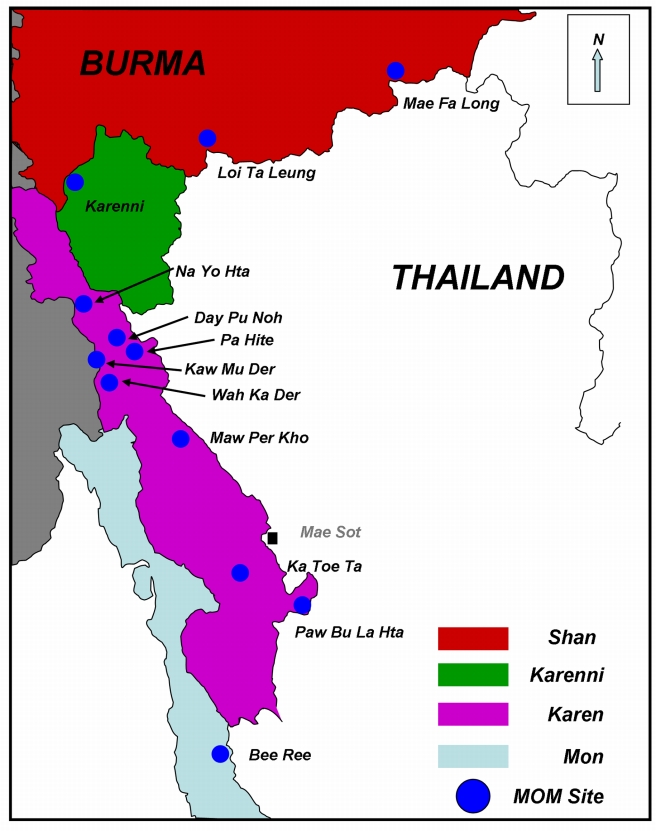
“The pilot project to implement this community-based threetiered network of providers was conducted in a population of approximately 60,000 over four eastern Burma states in a total of 12 communities affected by conflict (Karen [8], Shan [2], Karenni [1], and Mon [1] States; see Figure 1).”
Background
Research works printed but not linked: 1
- Inter-Agency Working Group on Reproductive Health in Crises 2010 Inter-agency field manual on reproductive health in humanitarian settings: 2010 revision for field review. Inter-agency Working Group on Reproductive Health in Crises. Available: http://www.unhcr.org/4c187e5b6.html. Accessed 29 June 2010 26203479
Cited by
Malaria in pregnancy in the Asia-Pacific region
Rijken, M. J., McGready, R., Boel, M. E., Poespoprodjo, R., Singh, N., Syafruddin, D., Rogerson, S., & Nosten, F. (2012) · The Lancet Infectious Diseases · doi:10.1016/s1473-3099(11)70315-2 · Cited by 181
Singh, N. S., Aryasinghe, S., Smith, J., Khosla, R., Say, L., & Blanchet, K. (2018) · BMJ Global Health · doi:10.1136/bmjgh-2017-000682 · Cited by 144
“Myanmar, which included traditional birth attendants, health workers and maternal health workers.(33) With this intervention, the use of modern contraception methods increased from 23.”
Byrne, A., & Morgan, A. (2011) · International Journal of Gynecology & Obstetrics · doi:10.1016/j.ijgo.2011.06.019 · Cited by 129
“TBAs have been able to call for e ambulances in emergencies [54] a conflict zone, TBAs assist SBAs to provide domiciliary care to improve access [38].”
BackgroundInfluentialMcGready, R., Boel, M., Rijken, M. J., Ashley, E. A., Cho, T., Moo, O., Paw, M. K., Pimanpanarak, M., Hkirijareon, L., Carrara, V. I., et al. (2012) · PLoS ONE · doi:10.1371/journal.pone.0040244 · Cited by 101
“[11] Malaria was undoubtedly a significant contributor: in 2008, 56% of pregnant women surveyed in eastern Myanmar, reported that they had a malaria test (rapid test) in their last pregnancy, of which 12% were positive [12].”
BackgroundScott, V. K., Gottschalk, L. B., Wright, K. Q., Twose, C., Bohren, M. A., Schmitt, M. E., & Ortaylı, N. (2015) · Studies in Family Planning · doi:10.1111/j.1728-4465.2015.00028.x · Cited by 119
“If we remove the two studies reporting more than 200 training days (Rosenfield 1974; Mullany et al. 2010), the average length of CHW training was approximately 28 days.”
Metadata
- Authors
- Mullany, L. C., Lee, T. J., Yone, L., Lee, C. I., Teela, K. C., Paw, P., Shwe Oo, E. K., Maung, C., Kuiper, H., Masenior, N. F., & Beyrer, C.
- Affiliations
- Johns Hopkins University (US)
- University of California, Los Angeles (US)
- Myanmar Medical Association (MM)
- Mae Tao Clinic (TH)
- Corresponding author
- Mullany, Luke C.
- Venue
- PLoS Medicine
- Publisher
- Public Library of Science (PLoS)
- Published
- 2010-08-03
- Volume
- 7
- Issue
- 8
- Pages
- e1000317
- ISSN
- 1549-1277 (ISSN-L)
- 1549-1676
- PMC
- PMC2914639
- OpenAlex
- W2074542073
- Cited by
- 92
- References
- 16
- Citations by year
- 2026: 3 · 2025: 1 · 2024: 4 · 2023: 3 · 2022: 6 · 2021: 5 · 2020: 8 · 2019: 9 · 2018: 9 · 2017: 9 · 2016: 4 · 2015: 7 · 2014: 6 · 2013: 7 · 2012: 4
- FWCI
- 5.21
- Type
- journal article
- Language
- en
- Open access
- gold
- doi.org
- Locations
- PLoS Medicine (publishedVersion, cc-by)
- PubMed Central (publishedVersion, cc-by)
- PubMed (publishedVersion)
- RePEc: Research Papers in Economics (submittedVersion)
- DOAJ (DOAJ: Directory of Open Access Journals) (submittedVersion, cc-by-sa)
- Funders
- Johns Hopkins University
- Bill and Melinda Gates Institute for Population and Reproductive Health
- Johns Hopkins Bloomberg School of Public Health
- Topics
- Health Sciences › Medicine › Pediatrics, Perinatology and Child Health › Global Maternal and Child Health
- Health Sciences › Medicine › Pediatrics, Perinatology and Child Health › Maternal and Neonatal Healthcare
- Health Sciences › Medicine › Public Health, Environmental and Occupational Health › Reproductive Health and Contraception
- Keywords
- internally displaced persons, antenatal care coverage, postpartum care, family planning, unmet need for contraception, postpartum hemorrhage management, emergency obstetric care, obstetric care, maternal mortality reduction, malaria screening, anthelmintic treatment
- MeSH terms
- Adolescent, Adult, Myanmar, Feasibility Studies, Female, Health Services Accessibility, Health Surveys, Humans, Maternal Health Services, Maternal Welfare, Middle Aged, Pilot Projects, Pregnancy, Pregnancy Outcome, Community Networks, Vulnerable Populations, Young Adult
About these checks
Registry, retraction, Cites and statistics results are computed, not judged, with one exception: a printed reference that no index lists is read once by a model before it counts as a citation error. Claims are extracted by a model and kept only when their quote appears verbatim in the text; each cited source is then checked, with a model’s help, for whether it says what the claim relies on. Those verdicts can be wrong — read the claim’s quote and the cited source before relying on one.
Statistics and arithmetic are recomputed, not judged.
Confidence bands are shown only for fields calibrated on our annotated test set. None is calibrated yet, so no band is shown.
What counts as a claim ›How we measure confidence ›How we check this ›
Are you an author, or do you see a problem with this page? Request a review
Data sources
Bibliographic data: Semantic Scholar, OpenAlex, Crossref.
Contains information from the Semantic Scholar Academic Graph Datasets, made available under the ODC Attribution License (ODC-BY 1.0).
Semantic Scholar’s data is described in: Kinney, R., et al. (2023). The Semantic Scholar Open Data Platform. arXiv:2301.10140.
