

The DOI matches its Crossref record; 84 of the 84 references it cites were found in a registry or an index.
Adjunctive Atypical Antipsychotic Treatment for Major Depressive Disorder: A Meta-Analysis of Depression, Quality of Life, and Safety Outcomes
Open accessAbstract
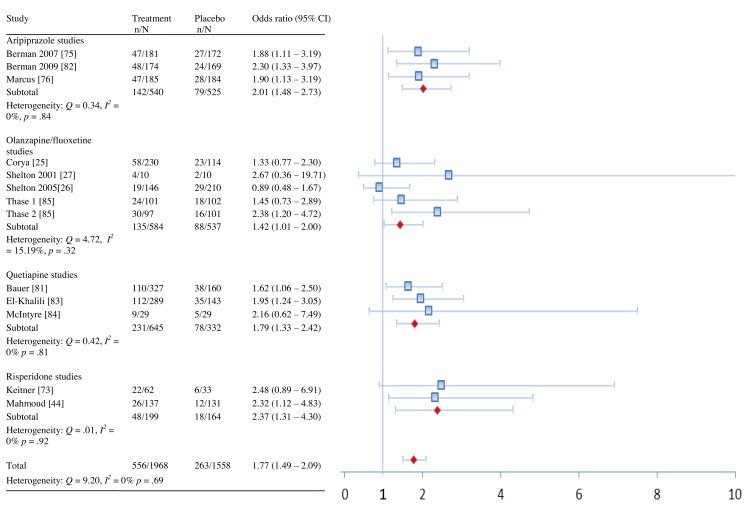
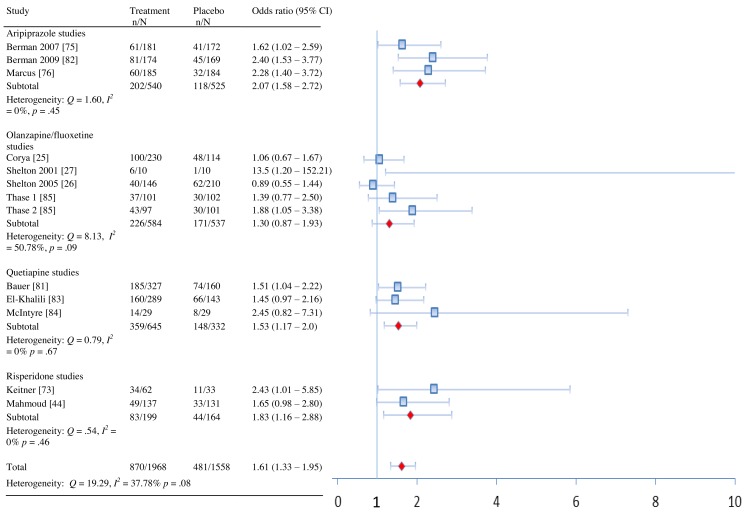
BACKGROUND: Atypical antipsychotic medications are widely prescribed for the adjunctive treatment of depression, yet their total risk-benefit profile is not well understood. We thus conducted a systematic review of the efficacy and safety profiles of atypical antipsychotic medications used for the adjunctive treatment of depression. METHODS AND FINDINGS: We included randomized trials comparing adjunctive antipsychotic medication to placebo for treatment-resistant depression in adults. Our literature search (conducted in December 2011 and updated on December 14, 2012) identified 14 short-term trials of aripiprazole, olanzapine/fluoxetine combination (OFC), quetiapine, and risperidone. When possible, we supplemented published literature with data from manufacturers' clinical trial registries and US Food and Drug Administration New Drug Applications. Study duration ranged from 4 to 12 wk. All four drugs had statistically significant effects on remission, as follows: aripiprazole (odds ratio [OR], 2.01; 95% CI, 1.48-2.73), OFC (OR, 1.42; 95% CI, 1.01-2.0), quetiapine (OR, 1.79; 95% CI, 1.33-2.42), and risperidone (OR, 2.37; 95% CI, 1.31-4.30). The number needed to treat (NNT) was 19 for OFC and nine for each other drug. All drugs with the exception of OFC also had statistically significant effects on response rates, as follows: aripiprazole (OR, 2.07; 95% CI, 1.58-2.72; NNT, 7), OFC (OR, 1.30, 95% CI, 0.87-1.93), quetiapine (OR, 1.53, 95% CI, 1.17-2.0; NNT, 10), and risperidone (OR, 1.83, 95% CI, 1.16-2.88; NNT, 8). All four drugs showed statistically significant effects on clinician-rated depression severity measures (Hedges' g ranged from 0.26 to 0.48; mean difference of 2.69 points on the Montgomery-Asberg Depression Rating Scale across drugs). On measures of functioning and quality of life, these medications produced either no benefit or a very small benefit, except for risperidone, which had a small-to-moderate effect on quality of life (g = 0.49). Treatment was linked to several adverse events, including akathisia (aripiprazole), sedation (quetiapine, OFC, and aripiprazole), abnormal metabolic laboratory results (quetiapine and OFC), and weight gain (all four drugs, especially OFC). Shortcomings in study design and data reporting, as well as use of post hoc analyses, may have inflated the apparent benefits of treatment and reduced the apparent incidence of adverse events. CONCLUSIONS: Atypical antipsychotic medications for the adjunctive treatment of depression are efficacious in reducing observer-rated depressive symptoms, but clinicians should interpret these findings cautiously in light of (1) the small-to-moderate-sized benefits, (2) the lack of benefit with regards to quality of life or functional impairment, and (3) the abundant evidence of potential treatment-related harm. Please see later in the article for the Editors' Summary.
Overview
The claims and statistics of this paper haven’t been checked yet.
Run the check — free, no account needed. It reads the open-access text and checks the sources it cites.
Integrity signals
Registry
Cites
Statistics
Figures
Verification
Claims the paper makes
The claims and statistics of this paper haven’t been checked yet.
Run the check — free, no account needed. It reads the open-access text and checks the sources it cites.
Claims other papers make about this one
Each is checked against this paper’s own text: does it say what the citing paper says it does?
In the citing paper
“Furthermore, there is now increasingly evidence that supervised exercise training (a key component of the DPP) can improve psychiatric symptoms, cognition and functioning across a range of mental disorders 237-239”
From The Lancet Psychiatry Commission: a blueprint for protecting physical health in people with mental illness (2019) · cites this paper as [238]
Self-check
Percentages, sums and reported differences re-computed from the paper’s own numbers.
The self-check needs the paper’s full text.
Citations
Cites
Measuring inconsistency in meta-analyses
Higgins, J. P. T., Thompson, S. G., Deeks, J. J., & Altman, D. G. (2003) · BMJ · doi:10.1136/bmj.327.7414.557 · Cited by 63,139
Meta-analysis in clinical trials
DerSimonian, R., & Laird, N. (1986) · Controlled Clinical Trials · doi:10.1016/0197-2456(86)90046-2 · Cited by 39,552
Quantifying heterogeneity in a meta‐analysis
Higgins, J. P. T., & Thompson, S. G. (2002) · Statistics in Medicine · doi:10.1002/sim.1186 · Cited by 36,763
(1992) · PubMed · Cited by 33,716
Hamilton, M. (1960) · Journal of Neurology, Neurosurgery & Psychiatry · doi:10.1136/jnnp.23.1.56 · Cited by 32,817
The MOS 36-ltem Short-Form Health Survey (SF-36): I. Conceptual Framework and Item Selection
Ware, J. E., & Sherbourne, C. D. (1992) · Medical Care · doi:10.1097/00005650-199206000-00002 · Cited by 30,033
A new depression scale designed to be sensitive to change
Montgomery, S. A., & Åsberg, M. (1979) · British Journal of Psychiatry · doi:10.1192/bjp.134.4.382 · Cited by 13,962
CONSORT 2010 Statement: updated guidelines for reporting parallel group randomised trials
the CONSORT Group, Schulz, K. F., Altman, D. G., & Moher, D. (2010) · BMC Medicine · doi:10.1186/1741-7015-8-18 · Cited by 13,371
Wasserman, S. S., Hedges, L. V., & Olkin, I. (1988) · Journal of Educational Statistics · doi:10.2307/1164953 · Cited by 10,377
A Nonparametric “Trim and Fill” Method of Accounting for Publication Bias in Meta-Analysis
Duval, S., & Tweedie, R. (2000) · Journal of the American Statistical Association · doi:10.1080/01621459.2000.10473905 · Cited by 2,955
Kirsch, I., Deacon, B. J., Huedo-Medina, T. B., Scoboria, A., Moore, T. J., & Johnson, B. T. (2008) · PLoS Medicine · doi:10.1371/journal.pmed.0050045 · Cited by 2,442
Selective publication of antidepressant trials and its influence on apparent efficacy
Turner, E. H., Matthews, A. M., Linardatos, E., Tell, R. A., & Rosenthal, R. (2008) · New England Journal of Medicine · doi:10.1056/nejmsa065779 · Cited by 2,435
Self-citationCONSORT 2010 statement: updated guidelines for reporting parallel group randomised trials
Schulz, K. F., Altman, D. G., Moher, D., & for the CONSORT Group (2010) · PLoS Medicine · doi:10.1371/journal.pmed.1000251 · Cited by 2,296
Gluud, L. L., Villumsen, J., & Gluud, C. N. (2001) · Annals of Internal Medicine · doi:10.7326/0003-4819-135-11-200112040-00010 · Cited by 2,266
Frank, E. (1991) · Archives of General Psychiatry · doi:10.1001/archpsyc.1991.01810330075011 · Cited by 1,959 · cited 7×
“Abbreviations: EPS, extrapyramidal symptoms; FDA, US Food and Drug Administration; HAM-D, Hamilton Depression Rating Scale; HDL, high-density lipoprotein; LDL, low-density lipoprotein; MADRS, Montgomery–Asberg Depression Rating Scale; NDA, New Drug Application; NNH, number needed to harm; NNT, number needed to treat;…”
MethodInfluential(1993) · PubMed · Cited by 1,900
An Assessment of Clinically Useful Measures of the Consequences of Treatment
Laupacis, A., Sackett, D. L., & Roberts, R. S. (1988) · New England Journal of Medicine · doi:10.1056/nejm198806303182605 · Cited by 1,681
Systematic Review of the Empirical Evidence of Study Publication Bias and Outcome Reporting Bias
Dwan, K., Altman, D. G., Arnaiz, J. A., Bloom, J., Chan, A.-W., Cronin, E., Decullier, E., Easterbrook, P. J., Von Elm, E., Gamble, C., et al. (2008) · PLoS ONE · doi:10.1371/journal.pone.0003081 · Cited by 1,546
Sheehan, D. V., Harnett-Sheehan, K., & Raj, B. A. (1996) · International Clinical Psychopharmacology · doi:10.1097/00004850-199606003-00015 · Cited by 1,440
The MOS 36-Item Short Form Health Survey
Russo, J. E., Trujillo, C. A., Wingerson, D. K., Decker, K. P., Ries, R. R., Wetzler, H. P., & Roy‐Byrne, P. (1998) · Medical Care · doi:10.1097/00005650-199805000-00015 · Cited by 1,308
Kirkham, J. J., Dwan, K. M., Altman, D. G., Gamble, C., Dodd, S., Smyth, R., & Williamson, P. R. (2010) · BMJ · doi:10.1136/bmj.c365 · Cited by 1,133
Savović, J., Jones, H. E., Altman, D. G., Harris, R. J., Jüni, P., Pildal, J., Als-Nielsen, B., Balk, E. M., Gluud, C., Gluud, L. L., et al. (2012) · Annals of Internal Medicine · doi:10.7326/0003-4819-157-6-201209180-00537 · Cited by 1,049
Espinosa, J. C. (2004) · Cited by 939
The inventory for depressive symptomatology (IDS): Preliminary findings
Rush, A. J., Giles, D. E., Schlesser, M. A., Fulton, C. L., Weissenburger, J. E., & Burns, C. (1986) · Psychiatry Research · doi:10.1016/0165-1781(86)90060-0 · Cited by 908
Neyeloff, J. L., Fuchs, S. C. P. C., & Moreira, L. B. (2012) · BMC Research Notes · doi:10.1186/1756-0500-5-52 · Cited by 731
National Patterns in Antidepressant Medication Treatment
Olfson, M., & Marcus, S. C. (2009) · Archives of General Psychiatry · doi:10.1001/archgenpsychiatry.2009.81 · Cited by 730
Report by the ACNP Task Force on Response and Remission in Major Depressive Disorder
Rush, A. J., Kraemer, H. C., Sackeim, H. A., Fava, M., Trivedi, M. H., Frank, E., Ninan, P. T., Thase, M. E., Gelenberg, A. J., Kupfer, D. J., et al. (2006) · Neuropsychopharmacology · doi:10.1038/sj.npp.1301131 · Cited by 707 · cited 1×
“Response and remission rates are often used to convey the magnitude of treatment benefit; however, these categorical measures are created arbitrarily from underlying continuous rating scale data [50].”
BackgroundDeeks, J. J. (2002) · Statistics in Medicine · doi:10.1002/sim.1188 · Cited by 660
Eyding, D., Lelgemann, M., Grouven, U., Härter, M. C., Kromp, M., Kaiser, T., Kerekeş, M., Gerken, M., & Wieseler, B. (2010) · BMJ · doi:10.1136/bmj.c4737 · Cited by 600
Nelson, J. C., & Papakostas, G. I. (2009) · American Journal of Psychiatry · doi:10.1176/appi.ajp.2009.09030312 · Cited by 552
Marcus, R. N., McQuade, R. D., Carson, W. H., Hennicken, D., Fava, M., Simon, J. S., Trivedi, M. H., Thase, M. E., & Berman, R. M. (2008) · Journal of Clinical Psychopharmacology · doi:10.1097/jcp.0b013e31816774f9 · Cited by 518
A Novel Augmentation Strategy for Treating Resistant Major Depression
Shelton, R. C., Tollefson, G. D., Tohen, M. F., Stahl, S. M., Gannon, K. S., Jacobs, T. G., Buras, W. R., Bymaster, F. P., Zhang, W., Spencer, K. A., et al. (2001) · American Journal of Psychiatry · doi:10.1176/appi.ajp.158.1.131 · Cited by 512
Montejo-gonzàlez, A. L., Llorca, G., Izquierdo, J. A., Ledesma, A., Bousono, M., Calcedo, A., Carrasco, J. L., Ciudad, J., Daniel, E., De LA Gandara, J., et al. (1997) · Journal of Sex & Marital Therapy · doi:10.1080/00926239708403923 · Cited by 505
Increasing off‐label use of antipsychotic medications in the United States, 1995–2008
Alexander, G. C., Gallagher, S. A., Mascola, A. J., Moloney, R., & Stafford, R. S. (2011) · Pharmacoepidemiology and Drug Safety · doi:10.1002/pds.2082 · Cited by 426
Berman, R. M., Marcus, R. N., Swanink, R., McQuade, R. D., Carson, W. H., Corey-Lisle, P. K., & Khan, A. (2007) · The Journal of Clinical Psychiatry · doi:10.4088/jcp.v68n0604 · Cited by 409
McKnight, P. E., & Kashdan, T. B. (2009) · Clinical Psychology Review · doi:10.1016/j.cpr.2009.01.005 · Cited by 400
Quality of life assessments in major depressive disorder: a review of the literature
Papakostas, G. I., Petersen, T., Mahal, Y., Mischoulon, D., Nierenberg, A. A., & Fava, M. (2004) · General Hospital Psychiatry · doi:10.1016/j.genhosppsych.2003.07.004 · Cited by 331
Efficacy of antidepressants in adults
Moncrieff, J., & Kirsch, I. (2005) · BMJ · doi:10.1136/bmj.331.7509.155 · Cited by 329
Quality of life: The ultimate outcome measure of interventions in major depressive disorder
IsHak, W. W., Greenberg, J. M., Balayan, K., Kapitanski, N., Jeffrey, J., Fathy, H., Fakhry, H., & Rapaport, M. H. (2011) · Harvard Review of Psychiatry · doi:10.3109/10673229.2011.614099 · Cited by 313
Berman, R. M., Fava, M., Thase, M. E., Trivedi, M. H., Swanink, R., McQuade, R. D., Carson, W. H., Adson, D., Taylor, L., Hazel, J., et al. (2009) · CNS Spectrums · doi:10.1017/s1092852900020216 · Cited by 260
Simpson's paradox and calculation of number needed to treat from meta-analysis
Cates, C. J. (2002) · BMC Medical Research Methodology · doi:10.1186/1471-2288-2-1 · Cited by 251
Papakostas, G. I., Shelton, R. C., Smith, J., & D, M. F. M. (2007) · The Journal of Clinical Psychiatry · doi:10.4088/jcp.v68n0602 · Cited by 242
Thase, M. E., Corya, S. A., Osuntokun, O., Case, M., Henley, D. B., Sanger, T. M., Watson, S. B., & Dubé, S. (2007) · The Journal of Clinical Psychiatry · doi:10.4088/jcp.v68n0207 · Cited by 228
Bauer, M., Pretorius, H. W., Constant, E. L., Earley, W. R., Szamosi, J., & Brecher, M. (2009) · The Journal of Clinical Psychiatry · doi:10.4088/jcp.08m04629 · Cited by 210
Hróbjartsson, A., Forfang, E., Haahr, M. T., Als-Nielsen, B. E. T., & Brorson, S. (2007) · International Journal of Epidemiology · doi:10.1093/ije/dym020 · Cited by 206
El-Khalili, N., Joyce, M. A., Atkinson, S. D., Buynak, R. J., Datto, C. J., Lindgren, P., & Eriksson, H. (2010) · The International Journal of Neuropsychopharmacology · doi:10.1017/s1461145710000015 · Cited by 188
Prevention of Recurrent Postpartum Depression
Wisner, K. L., Perel, J. M., Peindl, K., Hanusa, B. H., Findling, R. L., & RAPPORT, D. J. (2001) · The Journal of Clinical Psychiatry · doi:10.4088/jcp.v62n0202 · Cited by 180
Bent, S., Padula, A., & Avins, A. L. (2006) · Annals of Internal Medicine · doi:10.7326/0003-4819-144-4-200602210-00007 · Cited by 177
Second-generation antipsychotics for major depressive disorder and dysthymia
Komossa, K., Depping, A. M., Gaudchau, A., Kissling, W., & Leucht, S. (2010) · Cochrane Database of Systematic Reviews · doi:10.1002/14651858.cd008121.pub2 · Cited by 173
Corya, S. A., Williamson, D., Sanger, T. M., Briggs, S. D., Case, M., & Tollefson, G. (2006) · Depression and Anxiety · doi:10.1002/da.20130 · Cited by 170
SSRI-Associated Sexual Dysfunction
Balon, R. (2006) · American Journal of Psychiatry · doi:10.1176/ajp.2006.163.9.1504 · Cited by 169
Corya, S. A. (2005) · doi:10.4088/jcp.v66n1012 · Cited by 162
Rapaport, M. H., Gharabawi, G. M., Canuso, C. M., Mahmoud, R. A., Keller, M. B., Bossie, C. A., Turkoz, I., Lasser, R. A., Loescher, A., Bouhours, P., et al. (2006) · Neuropsychopharmacology · doi:10.1038/sj.npp.1301113 · Cited by 149
Off-Label Use of Antipsychotic Medications in the Department of Veterans Affairs Health Care System
LESLIE, D. L., Mohamed, S., & Rosenheck, R. A. (2009) · Psychiatric Services · doi:10.1176/ps.2009.60.9.1175 · Cited by 147
McIntyre, A., Gendron, A., & McIntyre, A. (2007) · Depression and Anxiety · doi:10.1002/da.20275 · Cited by 145
Fava, M., Mischoulon, D., Iosifescu, D., Witte, J., Pencina, M., Flynn, M., Harper, L., Levy, M., Rickels, K., & Pollack, M. (2012) · Psychotherapy and Psychosomatics · doi:10.1159/000332050 · Cited by 141 · cited 1×
“recommended 5–10 mg range set by the FDA [42].”
BackgroundRisperidone for Treatment-Refractory Major Depressive Disorder: A Randomized Trial
Mahmoud, R. A., Pandina, G. J., Turkoz, I., Kosik-Gonzalez, C., Canuso, C. M., Kujawa, M. J., & Gharabawi-Garibaldi, G. M. (2007) · Annals of Internal Medicine · doi:10.7326/0003-4819-147-9-200711060-00003 · Cited by 140
Meta-analysis of trials comparing antidepressants with active placebos
Moncrieff, J., Wessely, S. C., & Hardy, R. (1998) · The British Journal of Psychiatry · doi:10.1192/bjp.172.3.227 · Cited by 127
Efficacy and Safety of Agomelatine in the Treatment of Major Depressive Disorder
Zajecka, J., Schatzberg, A. F., Stahl, S. M., Shah, A., Caputo, A., & Post, A. (2010) · Journal of Clinical Psychopharmacology · doi:10.1097/jcp.0b013e3181d420a7 · Cited by 117
Shelton, R. C., & Papakostas, G. I. (2008) · Acta Psychiatrica Scandinavica · doi:10.1111/j.1600-0447.2007.01130.x · Cited by 113
Turner, E. H., Knoepflmacher, D., & Shapley, L. (2012) · PLoS Medicine · doi:10.1371/journal.pmed.1001189 · Cited by 112
Keitner, G. I., Garlow, S. J., Ryan, C. E., Ninan, P. T., Solomon, D. A., Nemeroff, C. B., & Keller, M. B. (2009) · Journal of Psychiatric Research · doi:10.1016/j.jpsychires.2008.05.003 · Cited by 108
Reeves, H., Batra, S., May, R. S., Zhang, R., Dahl, D. C., & Li, X. (2008) · The Journal of Clinical Psychiatry · doi:10.4088/jcp.v69n0805 · Cited by 102
A Research Agenda for Malaria Eradication: Basic Science and Enabling Technologies
The malERA Consultative Group on Basic Science and Enabling Technologies (2011) · PLoS Medicine · doi:10.1371/journal.pmed.1000399 · Cited by 94
Bauer, M., El-Khalili, N., Datto, C. J., Szamosi, J., & Eriksson, H. (2010) · Journal of Affective Disorders · doi:10.1016/j.jad.2010.08.032 · Cited by 90
Bech, P. (2005) · CNS Drugs · doi:10.2165/00023210-200519040-00004 · Cited by 81
Clinical trials and the response rate illusion
Kirsch, I., & Moncrieff, J. (2007) · Contemporary Clinical Trials · doi:10.1016/j.cct.2006.10.012 · Cited by 80
Deshauer, D., Moher, D., Fergusson, D., Moher, E., Sampson, M., & Grimshaw, J. (2008) · Canadian Medical Association Journal · doi:10.1503/cmaj.071068 · Cited by 78
Symptomatic and Functional Improvement in Employed Depressed Patients
Dunlop, B. W., Reddy, S., Yang, L., Lubaczewski, S. L., Focht, K., & Guico‐Pabia, C. J. (2011) · Journal of Clinical Psychopharmacology · doi:10.1097/jcp.0b013e31822c0a68 · Cited by 75
Bech, P., Tanghøj, P., Cialdella, P., Andersen, H. F., & Pedersen, A. G. (2004) · The International Journal of Neuropsychopharmacology · doi:10.1017/s1461145704004365 · Cited by 74
Turner, E. H., & Rosenthal, R. (2008) · BMJ · doi:10.1136/bmj.39510.531597.80 · Cited by 74
Hewett, K., Gee, M., Krishen, A., Wunderlich, H.-P., Clus, A. L., Evoniuk, G. E., & Modell, J. G. (2009) · Journal of Psychopharmacology · doi:10.1177/0269881109106953 · Cited by 65
Double-blindness Procedures, Rater Blindness, and Ratings of Outcome
Başoğlu, M. (1997) · Archives of General Psychiatry · doi:10.1001/archpsyc.1997.01830200078011 · Cited by 58
Hewett, K., Chrzanowski, W., Schmitz, M., Savela, A., Milanova, V, Gee, M., Krishen, A., Millen, L., Leary, M., & Modell, J. (2009) · Journal of Psychopharmacology · doi:10.1177/0269881108089602 · Cited by 57
Use of Antipsychotics Among Older Residents in VA Nursing Homes
Gellad, W. F., Aspinall, S. L., Handler, S. M., Stone, R. A., Castle, N. G., Semla, T. P., Good, C. B., Fine, M. J., Dysken, M. W., & Hanlon, J. T. (2012) · Medical Care · doi:10.1097/mlr.0b013e31825fb21d · Cited by 53
Assuring That Double-Blind Is Blind
Perlis, R. H., Ostacher, M. J., D, M. F. M., Nierenberg, A. A., Sachs, G. S., & Rosenbaum, J. F. (2010) · American Journal of Psychiatry · doi:10.1176/appi.ajp.2009.09060820 · Cited by 50
Tsai, A. C., Rosenlicht, N. Z., Jureidini, J. N., Parry, P. I., Spielmans, G. I., & Healy, D. (2011) · PLoS Medicine · doi:10.1371/journal.pmed.1000434 · Cited by 43
Self-citationUnderrecognition of Clinically Significant Side Effects in Depressed Outpatients
Zimmerman, M. A., Galione, J. N., Attiullah, N., Friedman, M. A., Toba, C., Boerescu, D. A., & Ragheb, M. M. (2010) · The Journal of Clinical Psychiatry · doi:10.4088/jcp.08m04978blu · Cited by 31
Sexual Side Effects of Antidepressant Medications: An Informed Consent Accountability Gap
Bahrick, A. S., & Harris, M. M. (2008) · Journal of Contemporary Psychotherapy · doi:10.1007/s10879-008-9094-0 · Cited by 27
Maintenance Treatment Study Designs in Bipolar Disorder
Goodwin, F. K., Whitham, E. A., & Ghaemi, S. N. (2011) · CNS Drugs · doi:10.2165/11593740-000000000-00000 · Cited by 26
STATISTICAL REVIEW AND EVALUATION
Memo, D. D. (2011) · Cited by 24
Aripiprazole in Refractory Depression?
Carroll, B. J. (2009) · Journal of Clinical Psychopharmacology · doi:10.1097/jcp.0b013e318193c9b1 · Cited by 6
Unclear Clinical Significance of Findings in Adjunctive Aripiprazole for Major Depressive Disorder
Tsai, A. C. (2009) · Journal of Clinical Psychopharmacology · doi:10.1097/jcp.0b013e318194087c · Cited by 3
Self-citationRapaport, M. H., Gharabawi, G. M., Canuso, C. M., Mahmoud, R. A., Keller, M. B., Bossie, C. A., Turkoz, I., Lasser, R. A., Loescher, A., Bouhours, P., et al. (2007) · Neuropsychopharmacology · doi:10.1038/sj.npp.1301322 · Cited by 3
Research works printed but not linked: 4
- E Sigal, 2009, Bristol-Myers Squibb Company Q1 2009 earnings call transcript, Seeking Alpha
- D Healy, 2000, The assessment of outcomes in depression: measures of social functioning, Rev Contemp Pharmacother, 11, 295
- Hedges LV, Olkin I (1985) Statistical methods for meta-analysis. San Diego: Academic Press.
- Cohen J (1988) Statistical power analysis for the behavioral sciences, 2nd edition. Hillsdale (New Jersey): Erlbaum.
Cited by
Sorted by citations
Firth, J., Siddiqi, N., Koyanagi, A., Siskind, D., Rosenbaum, S., Galletly, C., Allan, S., Caneo, C., Carney, R., Carvalho, A. F., et al. (2019) · The Lancet Psychiatry · doi:10.1016/s2215-0366(19)30132-4 · Cited by 1,531
Kennedy, S. H., Lam, R. W., McIntyre, R. S., Tourjman, S. V., Bhat, V., Blier, P., Hasnain, M., Jollant, F., Levitt, A. J., MacQueen, G. M., et al. (2016) · The Canadian Journal of Psychiatry · doi:10.1177/0706743716659417 · Cited by 1,181
Cleare, A., Pariante, C., Young, A., Anderson, I., Christmas, D., Cowen, P., Dickens, C., Ferrier, I., Geddes, J., Gilbody, S., et al. (2015) · Journal of Psychopharmacology · doi:10.1177/0269881115581093 · Cited by 759
Non-communicable disease syndemics: poverty, depression, and diabetes among low-income populations
Mendenhall, E., Kohrt, B. A., Norris, S. A., Ndetei, D., & Prabhakaran, D. (2017) · The Lancet · doi:10.1016/s0140-6736(17)30402-6 · Cited by 556
Singh, J. B., Fedgchin, M., Daly, E., Xi, L., Melman, C., De Bruecker, G., Tadic, A., Sienaert, P., Wiegand, F., Manji, H., et al. (2016) · Biological Psychiatry · doi:10.1016/j.biopsych.2015.10.018 · Cited by 466
Metadata
- Authors
- Spielmans, G. I., Berman, M. I., Linardatos, E., Rosenlicht, N. Z., Perry, A., & Tsai, A. C.
- Affiliations
- Metropolitan State University (US)
- San Francisco VA Medical Center (US)
- Harvard University (US)
- Corresponding author
- Spielmans, Glen I.
- Venue
- PLoS Medicine
- Publisher
- Public Library of Science (PLoS)
- Published
- 2013-03-12
- Volume
- 10
- Issue
- 3
- Pages
- e1001403
- ISSN
- 1549-1277 (ISSN-L)
- 1549-1676
- PMC
- PMC3595214
- OpenAlex
- W2340538438
- Cited by
- 275
- References
- 84
- Citations by year
- 2026: 11 · 2025: 14 · 2024: 16 · 2023: 21 · 2022: 15 · 2021: 17 · 2020: 21 · 2019: 20 · 2018: 16 · 2017: 30 · 2016: 36 · 2015: 26 · 2014: 19 · 2013: 13
- FWCI
- 3.93
- Type
- journal article
- Language
- en
- Open access
- gold
- doi.org
- Locations
- PLoS Medicine (publishedVersion, cc-by)
- Europe PMC (PubMed Central) (publishedVersion, cc-by)
- PubMed Central (publishedVersion, cc-by)
- PubMed Central (publishedVersion)
- PubMed (publishedVersion)
- RePEc: Research Papers in Economics (publishedVersion)
- eScholarship (California Digital Library) (submittedVersion)
- Digital Access to Scholarship at Harvard (DASH) (Harvard University) (submittedVersion, cc-by)
- DOAJ (DOAJ: Directory of Open Access Journals) (submittedVersion, cc-by-sa)
- Funders
- U.S. Department of Veterans Affairs
- National Institute of Mental Health (MH096620, K23MH096620)
- Topics
- Health Sciences › Medicine › Pharmacology (medical) › Treatment of Major Depression
- Health Sciences › Medicine › Psychiatry and Mental health › Schizophrenia research and treatment
- Health Sciences › Medicine › Psychiatry and Mental health › Electroconvulsive Therapy Studies
- Keywords
- adjunctive antipsychotic therapy, treatment-resistant depression, major depressive disorder, aripiprazole, olanzapine-fluoxetine combination, quetiapine, risperidone, remission, response rate, quality of life, adverse drug reactions, risk-benefit profile, antipsychotic safety, number needed to treat
- MeSH terms
- Depression, Major Depressive Disorder, Humans, Quality of Life, Antipsychotic Agents, Treatment Outcome, Publication Bias
About these checks
Registry, retraction, Cites and statistics results are computed, not judged, with one exception: a printed reference that no index lists is read once by a model before it counts as a citation error. Claims are extracted by a model and kept only when their quote appears verbatim in the text; each cited source is then checked, with a model’s help, for whether it says what the claim relies on. Those verdicts can be wrong — read the claim’s quote and the cited source before relying on one.
Statistics and arithmetic are recomputed, not judged.
Confidence bands are shown only for fields calibrated on our annotated test set. None is calibrated yet, so no band is shown.
What counts as a claim ›How we measure confidence ›How we check this ›
Are you an author, or do you see a problem with this page? Request a review
