

The DOI matches its Crossref record; 71 of the 81 references it cites were found in a registry or an index.
Serum Iron Levels and the Risk of Parkinson Disease: A Mendelian Randomization Study
Open accessAbstract
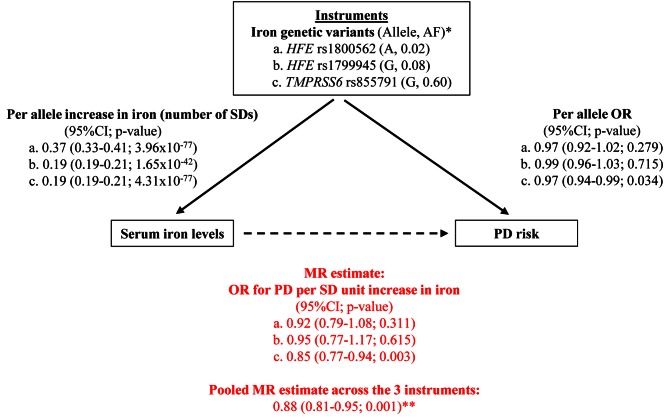
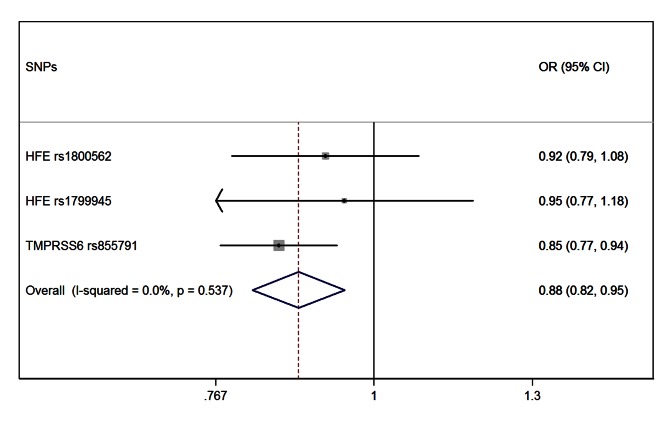
BACKGROUND: Although levels of iron are known to be increased in the brains of patients with Parkinson disease (PD), epidemiological evidence on a possible effect of iron blood levels on PD risk is inconclusive, with effects reported in opposite directions. Epidemiological studies suffer from problems of confounding and reverse causation, and mendelian randomization (MR) represents an alternative approach to provide unconfounded estimates of the effects of biomarkers on disease. We performed a MR study where genes known to modify iron levels were used as instruments to estimate the effect of iron on PD risk, based on estimates of the genetic effects on both iron and PD obtained from the largest sample meta-analyzed to date. METHODS AND FINDINGS: We used as instrumental variables three genetic variants influencing iron levels, HFE rs1800562, HFE rs1799945, and TMPRSS6 rs855791. Estimates of their effect on serum iron were based on a recent genome-wide meta-analysis of 21,567 individuals, while estimates of their effect on PD risk were obtained through meta-analysis of genome-wide and candidate gene studies with 20,809 PD cases and 88,892 controls. Separate MR estimates of the effect of iron on PD were obtained for each variant and pooled by meta-analysis. We investigated heterogeneity across the three estimates as an indication of possible pleiotropy and found no evidence of it. The combined MR estimate showed a statistically significant protective effect of iron, with a relative risk reduction for PD of 3% (95% CI 1%-6%; p = 0.001) per 10 µg/dl increase in serum iron. CONCLUSIONS: Our study suggests that increased iron levels are causally associated with a decreased risk of developing PD. Further studies are needed to understand the pathophysiological mechanism of action of serum iron on PD risk before recommendations can be made.
Overview
The claims and statistics of this paper haven’t been checked yet.
Run the check — free, no account needed. It reads the open-access text and checks the sources it cites.
Integrity signals
Registry
Cites
Statistics
Figures
Verification
Claims the paper makes
The claims and statistics of this paper haven’t been checked yet.
Run the check — free, no account needed. It reads the open-access text and checks the sources it cites.
Claims other papers make about this one
Each is checked against this paper’s own text: does it say what the citing paper says it does?
The cited source says what the claim attributes to it.
In the citing paper
“The previously described MR effects of iron status on risk of Parkinson’s disease and coronary artery disease (coronary atherosclerosis) were not statistically significant after correcting for multiple testing in our current analysis, although the directions of effect were consistent with previous work (S5 Table) [8,9].”
From Associations of genetically determined iron status across the phenome: A mendelian randomization study (2019) · cites this paper as [9]
Self-check
Percentages, sums and reported differences re-computed from the paper’s own numbers.
The self-check needs the paper’s full text.
Citations
Cites
Measuring inconsistency in meta-analyses
Higgins, J. P. T., Thompson, S. G., Deeks, J. J., & Altman, D. G. (2003) · BMJ · doi:10.1136/bmj.327.7414.557 · Cited by 63,139 · cited 1×
“We evaluated the presence and magnitude of heterogeneity across the three instruments with the I(2) statistics, a measure defined as the percentage of total variation in study estimates explained by heterogeneity rather than sampling error [31].”
MethodSpillantini, M. G., Schmidt, M. L., Lee, V. M.-Y., Trojanowski, J. Q., Jakes, R., & Goedert, M. (1997) · Nature · doi:10.1038/42166 · Cited by 8,382
Davey Smith, G., & Ebrahim, S. (2003) · International Journal of Epidemiology · doi:10.1093/ije/dyg070 · Cited by 5,882 · cited 4×
“Genes are randomly allocated at conception, so that genetic effects on the intermediate phenotype cannot be affected by classical confounding, such as lifestyle factors, or reverse causation, as in the situation where the phenotype level is influenced by the presence of the disease [8].”
BackgroundInfluentialA novel MHC class I-like gene is mutated in patients with hereditary haemochromatosis
Feder, J. N., Gnirke, A., Thomas, W., Tsuchihashi, Z., Ruddy, D. A., Basava, A., Dormishian, F., Domingo, R., Ellis, M. C., Fullan, A., et al. (1996) · Nature Genetics · doi:10.1038/ng0896-399 · Cited by 3,664 · cited 1×
“The two variants in the HFE gene are responsible for most cases of hereditary hemochromatosis [59,60], and they are associated with iron overload when present in the homozygous (C282Y/C282Y) or compound heterozygous (C282Y/H63D) state.”
BackgroundPierce, B. L., Ahsan, H., & VanderWeele, T. J. (2010) · International Journal of Epidemiology · doi:10.1093/ije/dyq151 · Cited by 1,848
Iron, brain ageing and neurodegenerative disorders
Zecca, L., Youdim, M. B. H., Riederer, P., Connor, J. R., & Crichton, R. R. (2004) · Nature Reviews Neuroscience · doi:10.1038/nrn1537 · Cited by 1,801 · cited 2×
“accumulation in the brain of PD patients [2,3], epidemiological”
BackgroundGenome-wide association study reveals genetic risk underlying Parkinson's disease
Simón-Sánchez, J., Schulte, C., Bras, J. M., Sharma, M., Gibbs, J. R., Berg, D., Paisan-Ruiz, C., Lichtner, P., Scholz, S. W., Hernandez, D. G., et al. (2009) · Nature Genetics · doi:10.1038/ng.487 · Cited by 1,751 · cited 1×
“The PD GWAS Consortium includes data from five studies: PROGENI/GenePD [26], NIA Phase I [27], NIA Phase II [28], HIHG [29], and NGRC [30].”
Self-citationNeuropathology of Parkinson's Disease
Forno, L. (1996) · Journal of Neuropathology and Experimental Neurology · doi:10.1097/00005072-199603000-00001 · Cited by 1,556 · cited 1×
“PD is characterized by the rather selective loss of dopaminergic neurons [4] and the presence of a-synucleinenriched Lewy body inclusions in the SN [5], and several studies have demonstrated that free iron in the SN can enhance the aggregation of a-synuclein and may thus promote the formation of Lewy bodies [1].”
BackgroundUsing multiple genetic variants as instrumental variables for modifiable risk factors
Palmer, T. M., Lawlor, D. A., Harbord, R. M., Sheehan, N. A., Tobias, J. H., Timpson, N. J., Smith, G. D., & Sterne, J. A. (2012) · Statistical Methods in Medical Research · doi:10.1177/0962280210394459 · Cited by 1,289 · cited 3×
“In a MR study, if all instruments are valid, their MR estimates should differ only as a result of sampling error [10], so that there should be no heterogeneity in the meta-analysis of MR estimates.”
BackgroundMethodInfluentialNalls, M. A. (2011) · The Lancet · doi:10.1016/s0140-6736(10)62345-8 · Cited by 926
Self-citation
Research works printed but not linked: 2
Cited by
Sorted by citations
Mendelian randomization: genetic anchors for causal inference in epidemiological studies
Davey Smith, G., & Hemani, G. (2014) · Human Molecular Genetics · doi:10.1093/hmg/ddu328 · Cited by 4,677
“Biomarkers CRP Coronary heart disease Observational association between CRP and coronary heart disease is a result of confounding and/or reverse causation (18) Serum iron Parkinson’s disease Higher serum iron levels lower the risk of Parkinson’s disease (19) Uric acid Coronary heart disease Observational association b…”
BackgroundThe role of iron in brain ageing and neurodegenerative disorders
Ward, R. J., Zucca, F. A., Duyn, J. H., Crichton, R. R., & Zecca, L. (2014) · The Lancet Neurology · doi:10.1016/s1474-4422(14)70117-6 · Cited by 1,819
Detection and interpretation of shared genetic influences on 42 human traits
Pickrell, J. K., Berisa, T., Liu, J. Z., Ségurel, L., Tung, J. Y., & Hinds, D. A. (2016) · Nature Genetics · doi:10.1038/ng.3570 · Cited by 1,151
Mendelian randomization studies: a review of the approaches used and the quality of reporting
Boef, A. G. C., Dekkers, O. M., & le Cessie, S. (2015) · International Journal of Epidemiology · doi:10.1093/ije/dyv071 · Cited by 610
“One of the reviewed MR studies mentioned that the Wald-type estimator used to estimate an odds ratio was an approximate method.(169) The properties and limitations of these IV methods used to estimate a causal odds ratio deserve more attention in the Mendelian randomization studies in which they are used.”
MethodIron neurochemistry in Alzheimer's disease and Parkinson's disease: targets for therapeutics
Belaidi, A. A., & Bush, A. I. (2015) · Journal of Neurochemistry · doi:10.1111/jnc.13425 · Cited by 594
“have been also proposed as a possible marker for PD in a large Mendelian randomization study (Pichler et al. 2013).”
BackgroundMendelian Randomization: New Applications in the Coming Age of Hypothesis-Free Causality
Evans, D. M., & Smith, G. D. (2015) · Annual Review of Genomics and Human Genetics · doi:10.1146/annurev-genom-090314-050016 · Cited by 529
“Given its potential, two-sample MR has, until recently, been underutilized in the literature to date, with only a handful of studies taking advantage of the approach (91).”
BackgroundFerroptosis and Its Role in Diverse Brain Diseases
Weiland, A., Wang, Y., Wu, W., Lan, X., Han, X., Li, Q., & Wang, J. (2018) · Molecular Neurobiology · doi:10.1007/s12035-018-1403-3 · Cited by 473
Garza-Lombó, C., Posadas, Y., Quintanar, L., Gonsebatt, M. E., & Franco, R. (2018) · Antioxidants and Redox Signaling · doi:10.1089/ars.2017.7272 · Cited by 263
“Previous findings have also suggested a link between Fe deficiency and predisposition to PD, while Fe overload seems to be protective (157, 190, 271).”
BackgroundAlves, F. M., Lane, D. J. R., Nguyen, T. P. M., Bush, A. I., & Ayton, S. (2025) · Signal Transduction and Targeted Therapy · doi:10.1038/s41392-024-02088-5 · Cited by 212
Physiology and pathophysiology of iron in hemoglobin-associated diseases
Coates, T. D. (2014) · Free Radical Biology and Medicine · doi:10.1016/j.freeradbiomed.2014.03.039 · Cited by 184
Morris, G., Berk, M., Carvalho, A. F., Maes, M. H. J., Walker, A. J., & Puri, B. K. (2017) · Behavioural Brain Research · doi:10.1016/j.bbr.2017.12.036 · Cited by 155
Disrupted iron homeostasis causes dopaminergic neurodegeneration in mice
Matak, P., Matak, A., Moustafa, S. M., Aryal, D. K., Benner, E. J., Wetsel, W. C., & Andrews, N. C. (2016) · Proceedings of the National Academy of Sciences · doi:10.1073/pnas.1519473113 · Cited by 136
Iron and Oxidative Stress in Parkinson’s Disease: An Observational Study of Injury Biomarkers
Medeiros, M. S., Schumacher-Schuh, A., Cardoso, A. M., Bochi, G. V., Baldissarelli, J., Kegler, A., Santana, D., Chaves, C. M. M. B. S., Schetinger, M. R. C., Moresco, R. N., et al. (2016) · PLOS ONE · doi:10.1371/journal.pone.0146129 · Cited by 131
“Previous studies suggest that altered iron homeostasis may be involved with PD pathogenesis, where lower levels of serum iron were found in individuals who developed the disease [3, 4].”
BackgroundInfluentialAdult height, coronary heart disease and stroke: a multi-locus Mendelian randomization meta-analysis
Nüesch, E., Dale, C. E., Palmer, T., White, J., Keating, B. J., van Iperen, E. P. A., Goel, A., Padmanabhan, S., Asselbergs, F. W., EPIC-Netherland Investigators, et al. (2015) · International Journal of Epidemiology · doi:10.1093/ije/dyv074 · Cited by 123
Willcox, J. C., Wilkinson, S. A., Lappas, M., Ball, K., Crawford, D. A., McCarthy, E. A., Fjeldsoe, B. S., Whittaker, R., Maddison, R., & Campbell, K. J. (2017) · BJOG An International Journal of Obstetrics & Gynaecology · doi:10.1111/1471-0528.14552 · Cited by 129
Wang, X., Fang, X., Zheng, W., Zhou, J., Song, Z., Xu, M., Min, J., & Wang, F. (2021) · The Journal of Clinical Endocrinology & Metabolism · doi:10.1210/clinem/dgab454 · Cited by 126
Nishi, A., Numata, S., Tajima, A., Kinoshita, M., Kikuchi, K., Shimodera, S., Tomotake, M., Ohi, K., Hashimoto, R., Imoto, I., et al. (2014) · Schizophrenia Bulletin · doi:10.1093/schbul/sbt154 · Cited by 105
Sun, C. J., Stowers, J., Miller, C., Bachmann, L. H., & Rhodes, S. D. (2015) · AIDS and Behavior · doi:10.1007/s10461-014-0942-5 · Cited by 102
Detection and interpretation of shared genetic influences on 40 human traitsPreprint
Pickrell, J. K., Berisa, T., Ségurel, L., Tung, J. Y., & Hinds, D. A. (2015) · bioRxiv (Cold Spring Harbor Laboratory) · doi:10.1101/019885 · Cited by 24
“Mendelian randomization has been used to provide evidence for (or against) a causal role for various clinical variables in disease etiology [De Silva et al., 2011; Granell et al., 2014; Holmes et al., 2014; Lim et al., 2014; Panoutsopoulou et al., 2013; Pichler et al., 2013; Voight et al., 2012].”
Emerging Therapeutic Strategies for Parkinson’s Disease and Future Prospects: A 2021 Update
Gouda, N. A., Elkamhawy, A., & Cho, J. (2022) · Biomedicines · doi:10.3390/biomedicines10020371 · Cited by 112
Is early-life iron exposure critical in neurodegeneration?
Hare, D. J., Arora, M., Jenkins, N. L., Finkelstein, D. I., Doble, P., & Bush, A. I. (2015) · Nature Reviews Neurology · doi:10.1038/nrneurol.2015.100 · Cited by 100
Biological and Clinical Implications of Comorbidities in Parkinson’s Disease
Santiago, J. A., Bottero, V., & Potashkin, J. A. (2017) · Frontiers in Aging Neuroscience · doi:10.3389/fnagi.2017.00394 · Cited by 98
“It has been documented that PD patients exhibit lower serum iron levels (Savica et al., 2009; Pichler et al., 2013; Medeiros et al., 2016).”
BackgroundMeta‐Analysis of Copper and Iron in Parkinson's Disease Brain and Biofluids
Genoud, S., Senior, A. M., Hare, D. J., & Double, K. L. (2019) · Movement Disorders · doi:10.1002/mds.27947 · Cited by 95
“Nevertheless, like the discovery of markedly reduced dopamine levels that motivated the first trials of dopamine replacement therapy in the early 1960s, our findings provide strong empirical evidence of specific changes in the primary region of neurodegeneration in PD, supporting the rationale of current clinical tria…”
BackgroundInfluentialAyton, S., Lei, P., Adlard, P. A., Volitakis, I., Cherny, R. A., Bush, A. I., & Finkelstein, D. I. (2014) · Molecular Neurodegeneration · doi:10.1186/1750-1326-9-27 · Cited by 79
Winchester, L. M., Powell, J. F., Lovestone, S., & Nevado‐Holgado, A. J. (2018) · Genome Medicine · doi:10.1186/s13073-018-0556-z · Cited by 85
Ferroptosis: An emerging therapeutic target in stroke
Liu, Y., Fang, Y., Zhang, Z., Luo, Y., Zhang, A., Lenahan, C., & Chen, S. (2021) · Journal of Neurochemistry · doi:10.1111/jnc.15351 · Cited by 84
“Inhibitors of ferroptosis, such as ferrostatins, are also protective in models of such neurological diseases (Ahmad et al., 2014; Fang, Gao, et al., 2020; Pichler et al., 2013; Tuo et al., 2017).”
BackgroundGenetic comorbidities in Parkinson's disease
Nalls, M. A., Saad, M., Noyce, A. J., Keller, M. F., Schrag, A. E., Bestwick, J., Traynor, B. J., Gibbs, J. R., Hernandez, D. G., Cookson, M., et al. (2013) · Human Molecular Genetics · doi:10.1093/hmg/ddt465 · Cited by 73
Self-citationLiu, H., Wu, H., Zhu, N., Xu, Z., Wang, Y., Qu, Y., & Wang, J. (2019) · Journal of Neurochemistry · doi:10.1111/jnc.14857 · Cited by 74
Parkinson’s Disease: The Mitochondria-Iron Link
Muñoz, Y., Carrasco, C. M., Campos, J., Aguirre, P., & Núñez, M. T. (2016) · Parkinson s Disease · doi:10.1155/2016/7049108 · Cited by 76
Gill, D., Benyamin, B., Moore, L. S. P., Monori, G., Zhou, A., Koskeridis, F., Evangelou, E., Laffan, M., Walker, A. P., Tsilidis, K. K., et al. (2019) · PLOS Medicine · doi:10.1371/journal.pmed.1002833 · Cited by 63
Self-citationHomocysteine and Alzheimer’s Disease: Evidence for a Causal Link from Mendelian Randomization
Hu, Q., Teng, W.-H., Li, J.-J., Hao, F.-F., & Wang, N.-D. (2016) · Journal of Alzheimer's Disease · doi:10.3233/jad-150977 · Cited by 62
Regional siderosis: a new challenge for iron chelation therapy
Cabantchik, Z. I., Münnich, A., Youdim, M. B. H., & Devos, D. (2013) · Frontiers in Pharmacology · doi:10.3389/fphar.2013.00167 · Cited by 70
“…serum iron levels have recently been suggested by genome-wide meta-analysis (GWAS) to be correlated with a decreased risk of developing PD (Pichler et al., 2013), although, as we referred earlier, a direct role of the implicated genes (HFE and TMPRSS) in brain iron metabolism in general…”
BackgroundMethodInfluentialCosta‐Mallen, P., Gatenby, C., Friend, S., Maravilla, K. R., Hu, S., Cain, K. C., Agarwal, P., & Anzai, Y. (2017) · Journal of the Neurological Sciences · doi:10.1016/j.jns.2017.04.035 · Cited by 62
“Interestingly, genetic variants of iron-related proteins that are associated with higher levels of serum iron seem to protect from the risk of developing PD [34].”
BackgroundIron Metabolism Disturbance in a French Cohort of ALS Patients
Veyrat-Durebex, C., Corcia, P., Mucha, A., Benzimra, S., Mallet, C., Gendrot, C., Moreau, C., Devos, D., Piver, E., Pagès, J., et al. (2014) · BioMed Research International · doi:10.1155/2014/485723 · Cited by 59
Numata, S., Kinoshita, M., Tajima, A., Nishi, A., Imoto, I., & Ohmori, T. (2015) · BMC Medical Genetics · doi:10.1186/s12881-015-0197-7 · Cited by 55
“We calculated a Mendelian randomization estimate of the effect of the plasma total homocysteine levels on the risk of schizophrenia (OR scz/hcy) as log OR scz/hcy = (log OR scz/per T-allele)/ beta hcy/per T-allele, as in previous studies [4, 21].”
ResultCartujano‐Barrera, F., Cox, L. S., Arana‐Chicas, E., Ramírez, M., Perales‐Puchalt, J., Valera, P. A., Díaz, F. J., Catley, D., Ellerbeck, E. F., & Cupertino, A. P. (2020) · Frontiers in Public Health · doi:10.3389/fpubh.2020.00269 · Cited by 55
Wang, K., Makond, B., & Wang, K.-M. (2014) · Computers in Biology and Medicine · doi:10.1016/j.compbiomed.2014.02.002 · Cited by 51
Elemental fingerprint as a cerebrospinal fluid biomarker for the diagnosis of Parkinson's disease
Maass, F., Michalke, B., Leha, A., Boerger, M., Zerr, I., Koch, J. C., Tönges, L., Bähr, M., & Lingor, P. (2018) · Journal of Neurochemistry · doi:10.1111/jnc.14316 · Cited by 51
“Alterations in blood iron levels seem to modulate the risk of developing PD as was shown in a Mendelian randomization study (Pichler et al. 2013).”
BackgroundA significant causal association between C-reactive protein levels and schizophrenia
Inoshita, M., Numata, S., Tajima, A., Kinoshita, M., Umehara, H., Nakataki, M., Ikeda, M., Maruyama, S., Yamamori, H., Kanazawa, T., et al. (2016) · Scientific Reports · doi:10.1038/srep26105 · Cited by 42
RetractedEpistemology of causal inference in pharmacology
Landes, J., Osimani, B., & Poellinger, R. (2017) · European Journal for Philosophy of Science · doi:10.1007/s13194-017-0169-1 · Cited by 67
A Multidimensional Investigation of the Effects of Publication Retraction on Scholarly Impact
Shuai, X., Rollins, J., Moulinier, I., Custis, T., Edmunds, M., & Schilder, F. (2017) · Journal of the Association for Information Science and Technology · doi:10.1002/asi.23826 · Cited by 48
Dynamics of Nigral Iron Accumulation in Parkinson's Disease: From Diagnosis to Late Stage
Du, G., Wang, E., Sica, C. T., Chen, H., Jesus, S. D., Lewis, M. M., Kong, L., Connor, J. R., Mailman, R. B., & Huang, X. (2022) · Movement Disorders · doi:10.1002/mds.29062 · Cited by 51
Qingyuan, D., Zhou, X., Chen, J., Pan, M., Gao, H., Zhou, J. W., Wang, D., Chen, Q., Zhang, X., Wang, Q., et al. (2016) · Brain Research · doi:10.1016/j.brainres.2016.11.007 · Cited by 51
Newly Diagnosed Anemia Increases Risk of Parkinson’s disease: A Population-Based Cohort Study
Hong, C., Huang, Y. H., Liu, H. Y., Chiou, H., Chan, L., & Chien, L. (2016) · Scientific Reports · doi:10.1038/srep29651 · Cited by 50
Mcmillan, B., Hickey, E., Patel, M., & Mitchell, C. (2016) · Patient Education and Counseling · doi:10.1016/j.pec.2015.10.023 · Cited by 43
König, L., & Jucks, R. (2019) · International Journal of Educational Technology in Higher Education · doi:10.1186/s41239-019-0132-7 · Cited by 61
Moksnes, M. R., Graham, S. E., Wu, K.-H., Hansen, A. F., Taliun, S. A. G., Zhou, W., Thorstensen, K., Fritsche, L. G., Gill, D., Mason, A. M., et al. (2022) · Communications Biology · doi:10.1038/s42003-022-03529-z · Cited by 41
Using Mendelian Randomization to Study the Role of Iron in Health and Disease
Zeitoun, T., & El‐Sohemy, A. (2023) · International Journal of Molecular Sciences · doi:10.3390/ijms241713458 · Cited by 45
“Distinctively, 2-sample Mendelian randomization research on iron and Parkinson’s disease (PD) shows a protective effect from iron on PD, with a 3% relative reduction in PD risk [67].”
BackgroundKallianpur, A. R., Wang, Q., Jia, P., Hulgan, T., Zhao, Z., Letendre, S. L., Ellis, R. J., Heaton, R. K., Franklin, D. R., Barnholtz‐Sloan, J. S., et al. (2015) · The Journal of Infectious Diseases · doi:10.1093/infdis/jiv754 · Cited by 42
Mendelian randomisation analysis of red cell distribution width in pulmonary arterial hypertension
Ulrich, A., Wharton, J., Thayer, T. E., Swietlik, E. M., Assad, T. R., Desai, A. A., Gräf, S., Harbaum, L., Humbert, M. J. C., Morrell, N. W., et al. (2019) · European Respiratory Journal · doi:10.1183/13993003.01486-2019 · Cited by 42
Bayesian averaging over Decision Tree models for trauma severity scoring
Schetinin, V., Jakaite, L., & Krzanowski, W. J. (2017) · Artificial Intelligence in Medicine · doi:10.1016/j.artmed.2017.12.003 · Cited by 40
Beyond the Single SNP: Emerging Developments in Mendelian Randomization in the “Omics” Era
Brion, M., Benyamin, B., Visscher, P. M., & Smith, G. D. (2014) · Current Epidemiology Reports · doi:10.1007/s40471-014-0024-2 · Cited by 22
Self-citationMendelian randomization: Progressing towards understanding causality
König, I., & Greco, F. M. D. (2018) · Annals of Neurology · doi:10.1002/ana.25293 · Cited by 34
Haptoglobin phenotype modifies serum iron levels and the effect of smoking on Parkinson disease risk
Costa‐Mallen, P., Zabetian, C. P., Agarwal, P., Hu, S., Yearout, D., Samii, A., Leverenz, J. B., Roberts, J. W., & Checkoway, H. (2015) · Parkinsonism & Related Disorders · doi:10.1016/j.parkreldis.2015.07.006 · Cited by 31
Parkinsonism in Inherited Metabolic Disorders: Key Considerations and Major Features
Limphaibool, N., Iwanowski, P. S., Holstad, M. J. V., & Perkowska, K. (2018) · Frontiers in Neurology · doi:10.3389/fneur.2018.00857 · Cited by 19
Otiso, L., McCollum, R., Mireku, M., Karuga, R., de Koning, K. A., & Taegtmeyer, M. (2017) · BMJ Global Health · doi:10.1136/bmjgh-2016-000107 · Cited by 36
Attributable fraction estimation from complex sample survey data.
Heeringa, S., Berglund, P., West, B. T., Mellipilán, E. R., & Portier, K. (2015) · Annals of Epidemiology · doi:10.1016/j.annepidem.2014.11.007 · Cited by 32
Zhou, J., Liu, C., Francis, M., Sun, Y., Ryu, M., Grider, A., & Ye, K. (2020) · Nutrients · doi:10.3390/nu12103174 · Cited by 36
de Farias, C. C., Maes, M. H. J., Bonifácio, K. L., Matsumoto, A. K., Bortolasci, C. C., Souza-Nogueira, A., Brinholi, F. F., Morimoto, H. K., de Melo, L. B., Moreira, E. G., et al. (2017) · CNS & Neurological Disorders - Drug Targets · doi:10.2174/1871527316666170223161004 · Cited by 34
Elbaz, A. (2016) · Revue Neurologique · doi:10.1016/j.neurol.2016.07.001 · Cited by 32
Novel loci affecting iron homeostasis and their effects in individuals at risk for hemochromatosis
Benyamin, B., Esko, T., Ried, J. S., Radhakrishnan, A., Vermeulen, S. H., Traglia, M., Gögele, M., Anderson, D., Broer, L., Podmore, C., et al. (2014) · Nature Communications · doi:10.1038/ncomms5926 · Cited by 30
“…significantly affect iron status, and compilation of genomic scores, will allow Mendelian randomisation studies on the multiple conditions associated with variation in iron load and help to clarify a potential causal role of iron in such conditions (e.g. Parkinson’s 14 or Alzheimer’s 66 diseases).”
Self-citationRole of Iron and Copper in the Pathogenesis of Parkinson’s Disease
Gangania, M. K., Batra, J., Kushwaha, S. S., & Agarwal, R. (2016) · Indian Journal of Clinical Biochemistry · doi:10.1007/s12291-016-0614-5 · Cited by 29
“[11] showed protective role played by increased serum iron levels in PD suggesting that with every 10 lg/dl increase in iron in serum, there is 3 % decrease in risk of PD.”
BackgroundDefining a role for hemoglobin in Parkinson’s disease
Freed, J., & Chakrabarti, L. (2016) · npj Parkinson s Disease · doi:10.1038/npjparkd.2016.21 · Cited by 30
The landscape of urological retractions: the prevalence of reported research misconduct
Mena, J. D., Ndoye, M., Cohen, A. J., Kamal, P., & Breyer, B. N. (2019) · British Journal of Urology · doi:10.1111/bju.14706 · Cited by 35
Mobile health architecture for obesity management using sensory and social data
Harous, S., El Menshawy, M., Serhani, M. A., & Benharref, A. (2018) · Informatics in Medicine Unlocked · doi:10.1016/j.imu.2017.12.005 · Cited by 28
An introduction to Mendelian randomization with applications in neurology
Allman, P., Aban, I., Tiwari, H. K., & Cutter, G. (2018) · Multiple Sclerosis and Related Disorders · doi:10.1016/j.msard.2018.06.017 · Cited by 33
Nigrostriatal iron accumulation in the progression of Parkinson’s disease
López‐Aguirre, M., Balzano, T., Monje, M. H. G., Esteban-García, N., Martínez‐Fernández, R., del Rey, N. L., Ciorraga, M., Sánchez‐Ferro, Á., Trigo‐Damas, I., Blesa, J., et al. (2025) · npj Parkinson s Disease · doi:10.1038/s41531-025-00911-6 · Cited by 22
Ou, Y., Yang, Y., Shen, X., Ma, Y., Chen, S.-D., Dong, Q., Tan, L., & Yu, J. (2021) · Alzheimer s Research & Therapy · doi:10.1186/s13195-021-00782-y · Cited by 33
Analysis of Mitochondrial haemoglobin in Parkinson's disease brain
Shephard, F., Greville‐Heygate, O., Liddell, S., Emes, R. D., & Chakrabarti, L. (2016) · Mitochondrion · doi:10.1016/j.mito.2016.05.001 · Cited by 28
“Since the majority of iron in the body is haemoglobin derived there may be also some connection with observations that serum and brain iron levels change in Parkinson's disease (Pichler et al., 2013).”
M endelian R andomization — the K ey to U nderstanding A spects of P arkinson's D isease C ausation?
Noyce, A. J., & Nalls, M. A. (2015) · Movement Disorders · doi:10.1002/mds.26492 · Cited by 21
“Separately, a group reported observations relating to serum iron and PD, using data from PD GWAS.23 Three genetic variants were used as instrumental variables (HFE rs1800562, HFE rs1799945, and TMPRSS6 rs855791) and were associated with serum iron levels (accounting for 1.7%, 0.9%, and 1.7% of iron total variance, res…”
MethodInfluentialSelf-citationPatton, S. M., Wang, Q., Hulgan, T., Connor, J. R., Jia, P., Zhao, Z., Letendre, S. L., Ellis, R. J., Bush, W. S., Samuels, D. C., et al. (2017) · Fluids and Barriers of the CNS · doi:10.1186/s12987-017-0058-1 · Cited by 24
Fulfilling the promise of Mendelian randomizationPreprint
Pickrell, J. K. (2015) · bioRxiv (Cold Spring Harbor Laboratory) · doi:10.1101/018150 · Cited by 22
“For example, this approach has recently been used to argue that alcohol consumption increases risk of heart disease [16], and that increasing serum iron levels decreases risk of Parkinson’s disease [27].”
Jallow, M. W., Cerami, C., Clark, T. G., Prentice, A. M., & Campino, S. G. (2020) · PLoS ONE · doi:10.1371/journal.pone.0235141 · Cited by 26
Probabilistic modeling of short survivability in patients with brain metastasis from lung cancer
Makond, B., Wang, K., & Wang, K.-M. (2015) · Computer Methods and Programs in Biomedicine · doi:10.1016/j.cmpb.2015.02.005 · Cited by 23
Huang, L., Ou, Y., Yang, Y., Wang, Z.-T., Tan, L., & Yu, J. (2023) · Translational Psychiatry · doi:10.1038/s41398-023-02553-9 · Cited by 28
“If F-statistics are greater than 10, the instrument strength is sufficient for MR analysis [17].”
MethodMerrill, J. E., Boyle, H. K., Barnett, N. P., & Carey, K. B. (2017) · Addictive Behaviors · doi:10.1016/j.addbeh.2017.10.003 · Cited by 27
Smartphone technology and its applications in urology: a review of the literature
Tapiero, S., Yoon, R., Jefferson, F. A., Sung, J., Limfueco, L., Cottone, C., Lu, S., Patel, R., Landman, J., & Clayman, R. (2019) · World journal of urology · doi:10.1007/s00345-019-02960-y · Cited by 21
Boal, A. L., Abroms, L., Simmens, S., Graham, A. L., & Carpenter, K. (2016) · Nicotine & Tobacco Research · doi:10.1093/ntr/ntv249 · Cited by 21
Morbidity, risk of cancer and mortality in 3645 HFE mutations carriers
Hagström, H., Ndegwa, N., Jalmeus, M., Ekstedt, M., Posserud, I., Rorsman, F., Nyhlin, N., Klintman, D., Werner, M., Marschall, H., et al. (2021) · Liver International · doi:10.1111/liv.14792 · Cited by 23
Shen, X., Yang, H., Zhang, D., & Jiang, H. F. (2019) · Frontiers in Neuroscience · doi:10.3389/fnins.2019.00939 · Cited by 21
Xia, J.-J., Xu, H.-M., Jiang, H., & Xie, J.-X. (2015) · Neuroscience Letters · doi:10.1016/j.neulet.2015.04.010 · Cited by 20
Fouad, G. I., El‐Sayed, S. A. M., Mabrouk, M., Ahmed, K. A., & Beherei, H. H. (2022) · Neurotoxicity Research · doi:10.1007/s12640-022-00555-x · Cited by 23
““Fe” plays an essential role in the synthesis of neurotransmitters and acts as a cofactor of tyrosine hydroxylase; thus, the decreased Fe content in CIS-brains is linked to the malfunctioning of neuronal enzymes by contributing to a reduced Fe storage in neurons (Pichler et al. 2013).”
BackgroundAssociation between sex, systemic iron variation and probability of Parkinson's disease
Mariani, S., Ventriglia, M., Simonelli, I., Bucossi, S., Siotto, M., Donno, S., Vernieri, F., & Squitti, R. (2016) · International Journal of Neuroscience · doi:10.3109/00207454.2015.1020113 · Cited by 19
What have we learned from genome-wide association studies (GWAS) in Parkinson's disease?
Fernández‐Santiago, R., & Sharma, M. (2022) · Ageing Research Reviews · doi:10.1016/j.arr.2022.101648 · Cited by 26
“For example, one of the earlier studies using PD GWAS showed a causal relationship between increased iron levels in serum and reduced PD risk (Pichler et al., 2013).”
ResultA novel treatment strategy to prevent Parkinson’s disease: focus on iron regulatory protein 1 (IRP1)
Berry, T. M., & Moustafa, A. A. (2021) · International Journal of Neuroscience · doi:10.1080/00207454.2021.1885403 · Cited by 17
“A meta-analysis of 32 studies indicates that serum/plasma iron levels are significantly reduced in PD [36] A Mendelian randomization study indicates that increased levels of iron in serum are associated with decreased risks of developing PD with a relative risk reduction for PD of 3% per 10 mg/dl increase in serum iro…”
BackgroundAteudjieu, J., Stoll, B., Nguefack‐Tsague, G., Tchangou, C., & Genton, B. (2014) · Vaccine · doi:10.1016/j.vaccine.2014.08.012 · Cited by 15
Risky behaviors and Parkinson disease
Grover, S., Del, G. M. F., Kasten, M., Klein, C., Lill, C. M., & König, I. R. (2019) · Neurology · doi:10.1212/wnl.0000000000008245 · Cited by 48
“For example, a recent MR study reported a significant causal association with a lifelong PD risk reduction of 3% per 10-μg/dL increase in serum iron levels.(12) Most recently, another study further reported a risk reduction of 18% with a lifetime exposure of 5-kg/m(2) higher body mass index.”
BackgroundMethodSelf-citationThe causal association between iron status and the risk of autism: A Mendelian randomization study
Chen, L., Guo, X.-Z., Hou, C.-X., Tang, P., Zhang, X., Chong, L. T., & Li, R. (2022) · Frontiers in Nutrition · doi:10.3389/fnut.2022.957600 · Cited by 15
Takeuchi, H., & Kawashima, R. (2022) · Nutrients · doi:10.3390/nu14214671 · Cited by 15
“However, a Mendelian randomization study suggested that serum iron may protect against PD [10], and anemia due to low iron is associated with increased lifetime risk of PD [11,12].”
BackgroundPang, P.-F., Zhang, S.-R., Fan, X., & Zhang, S. (2024) · Cell Biology International · doi:10.1002/cbin.12118 · Cited by 14
“In addition, the features of ferroptosis, such as GSH depletion, was observed in the substantia nigra of PD patients (Pichler et al., 2013).”
BackgroundWang, T., Cheng, J., & Wang, Y. (2022) · Genes & Nutrition · doi:10.1186/s12263-022-00708-9 · Cited by 19
“Previous MR studies have shown that increased iron status reduces the risk of coronary artery-related diseases [47] and Parkinson’s syndrome [48] and increases the risk of type 2 diabetes Fig.”
BackgroundNo Genetic Overlap Between Circulating Iron Levels and Alzheimer’s Disease
Lupton, M. K., Benyamin, B., Proitsi, P., Nyholt, D. R., Ferreira, M. A. R., Montgomery, G. W., Heath, A. C., Madden, P. A. F., Medland, S. E., Gordon, S. D., et al. (2017) · Journal of Alzheimer s Disease · doi:10.3233/jad-170027 · Cited by 14
“Previously three iron level influencing genetic variants (HFE rs1800562, HFE rs1799945, and TMPRSS6 rs855791) have been shown to be associated with PD risk [22].”
BackgroundMethodResultInfluentialSelf-citationMicronutrients and Risk of Parkinson’s Disease
Sherzai, A. Z., Tagliati, M., Park, K., Pezeshkian, S., & Sherzai, D. (2016) · Gerontology and Geriatric Medicine · doi:10.1177/2333721416644286 · Cited by 18
“The alteration of iron metabolism in the brain has been observed and extensively studied in multiple neurodegenerative diseases and PD in particular (Dusek, Jankovic, & Le, 2012; Pichler et al., 2013; SianHülsmann, Mandel, Youdim, & Riederer, 2011).”
BackgroundIron status and mental disorders: A Mendelian randomization study
Qiu, J., Lian, F., & Fang, X. (2022) · Frontiers in Nutrition · doi:10.3389/fnut.2022.1084860 · Cited by 13
“One previous MR study indicated that increased serum iron levels are causally associated with a decreased risk of developing PD (26).”
BackgroundAssociation between Anemia and Risk of Parkinson Disease
Wang, Y., Huang, A. P., Yuan, S., Huang, C.-Y., Wu, C.-C., Poly, T. N., Atique, S., & Kung, W. (2021) · Behavioural Neurology · doi:10.1155/2021/8360627 · Cited by 12
“Increased serum iron levels are related to decreased risk of PD, and high dietary iron intake reduces PD risk [18, 19].”
BackgroundKim, J. H., Oh, J. K., Wee, J. H., Min, C., Yoo, D. M., & Choi, H. G. (2021) · Brain Sciences · doi:10.3390/brainsci11050623 · Cited by 14
“Some clinical and epidemiological studies have shown that raised serum iron levels are related to decreased PD risk and that abundant dietary iron intake reduces PD risk [30,31].”
BackgroundYe, D., Zhu, Z., Huang, H., Sun, X., Liu, B., Xu, X., He, Z., Li, S., Wen, C., & Mao, Y. (2021) · Journal of Nutrition · doi:10.1093/jn/nxab015 · Cited by 11
Peter, E. L., Nagendrappa, P. B., Kaligirwa, A., Ogwang, P. E., & Sesaazi, D. C. (2020) · Phytotherapy Research · doi:10.1002/ptr.6853 · Cited by 14
Kim, Y., Stahl, M. C., Huang, X., & Connor, J. R. (2020) · Journal of Neurochemistry · doi:10.1111/jnc.15107 · Cited by 14
“Furthermore, in a mendelian randomization modeling study where the effect of multiple iron-related genes on Parkinson's disease was investigated, increased iron levels as determined by genotype of iron-related genes was found to decrease the risk for Parkinson's disease (Pichler et al., 2013).”
BackgroundKrimsky, S., & Schwab, T. (2017) · PLoS ONE · doi:10.1371/journal.pone.0172317 · Cited by 16
Metadata
- Authors
- Pichler, I., Del Greco M., F., Gögele, M., Lill, C. M., Bertram, L., Do, C. B., Eriksson, N., Foroud, T., Myers, R. H., PD GWAS Consortium, Nalls, M., Keller, M. F., International Parkinson's Disease Genomics Consortium, Wellcome Trust Case Control Consortium 2, Benyamin, B., Whitfield, J. B., Genetics of Iron Status Consortium, Pramstaller, P. P., Hicks, A. A., Thompson, J. R., & Minelli, C.
- Affiliations
- Eurac Research (IT)
- Imperial College London (GB)
- Johannes Gutenberg University Mainz (DE)
- Max Planck Institute for Molecular Genetics (DE)
- 23andMe (United States) (US)
- Indiana University School of Medicine (US)
- Boston University (US)
- National Institutes of Health (US)
- The University of Queensland (AU)
- QIMR Berghofer Medical Research Institute (AU)
- Ospedale di Bolzano (IT)
- University of Leicester (GB)
- Corresponding author
- Pichler, Irene
- Minelli, Cosetta
- ORCID
- Venue
- PLoS Medicine
- Publisher
- Public Library of Science (PLoS)
- Published
- 2013-06-04
- Volume
- 10
- Issue
- 6
- Pages
- e1001462
- ISSN
- 1549-1277 (ISSN-L)
- 1549-1676
- PMC
- PMC3672214
- OpenAlex
- W2169823945
- Cited by
- 173
- References
- 81
- Citations by year
- 2026: 2 · 2025: 5 · 2024: 11 · 2023: 9 · 2022: 14 · 2021: 27 · 2020: 13 · 2019: 16 · 2018: 10 · 2017: 14 · 2016: 18 · 2015: 17 · 2014: 15 · 2013: 2
- FWCI
- 11.01
- Type
- journal article
- Language
- en
- Update notices
- correction (2013-06-10)
- Open access
- gold
- doi.org
- Locations
- PLoS Medicine (publishedVersion, cc-by)
- Europe PMC (PubMed Central) (publishedVersion, cc-by)
- Research Portal (King's College London) (publishedVersion, other-oa)
- PubMed Central (publishedVersion, cc-by)
- PubMed (publishedVersion)
- Amsterdam UMC (VU Amsterdam) - Institutional Repository (publishedVersion)
- VU Research Portal (publishedVersion, other-oa)
- Archive ouverte UNIGE (University of Geneva) (publishedVersion, other-oa)
- Data Archiving and Networked Services (DANS) (submittedVersion)
- RePEc: Research Papers in Economics (submittedVersion)
- ArTS Archivio della ricerca di Trieste (University of Trieste https://www.units.it/) (submittedVersion)
- DOAJ (DOAJ: Directory of Open Access Journals) (submittedVersion, cc-by-sa)
- ePrints Soton (University of Southampton) (submittedVersion)
- UCL Discovery (University College London) (submittedVersion)
- Max Planck Digital Library (submittedVersion, other-oa)
- Figshare (submittedVersion)
- Figshare (submittedVersion, cc-by)
- Leicester Research Archive (University of Leicester) (submittedVersion, cc-by)
- Site cant be reached (submittedVersion, cc-by)
- Pure Amsterdam UMC (submittedVersion)
- University of Birmingham Research Portal (University of Birmingham) (submittedVersion, other-oa)
- MPG.PuRe (Max Planck Society) (submittedVersion, other-oa)
- Radboud Repository (Radboud University) (submittedVersion)
- Open Research (University of Surrey) (submittedVersion)
- Archive ouverte UNIGE (University of Geneva) (submittedVersion, cc-by)
- Radboud Repository (Radboud University) (submittedVersion, other-oa)
- Data Archiving and Networked Services (DANS) (submittedVersion, other-oa)
- Funders
- U.S. Department of Defense (W81XWH, Z01-AG000949-02, Z01-ES101986, W81XWH0920128)
- U.S. Department of Health and Human Services (W81XWH-09-2-0128, Z01-ES101986, RR024992, Z01‐AG000949‐02)
- Michael J. Fox Foundation for Parkinson's Research (Z01-ES101986, W81XWH-09-2-0128, Z01-AG000949-02)
- Susan G. Komen for the Cure
- American Association for the Advancement of Science
- Biogen
- American Parkinson Disease Association
- Cure Alzheimer's Fund
- University of Rochester
- University of Dundee
- Queen Mary University of London
- South London and Maudsley NHS Foundation Trust
- Prize4Life
- London School of Hygiene and Tropical Medicine
- National Alliance for Research on Schizophrenia and Depression
- Wellcome Trust (WT089698, 083948/Z/07/Z, WTCCC2, 090532, WTCCC1, NS057105, 083948, WT089698/Z/09/Z)
- University Hospitals Birmingham NHS Foundation Trust
- National Institute for Health and Care Research (NF-SI-0507-10376)
- Parkinson's UK (F-1202, G0909, J-0901, J‐0804)
- Imperial College London
- King's College London
- University College London
- University of Oxford
- European Commission (230596)
- Cardiff University
- University of Aberdeen
- Trinity College Dublin
- Agence Nationale de la Recherche
- Institut National de la Santé et de la Recherche Médicale
- Universiteit Leiden
- Radboud Universiteit
- Vrije Universiteit Amsterdam
- Bundesministerium für Bildung und Forschung (01GR0468, 01GS08134, 01EW0908)
- Centre National de la Recherche Scientifique
- Leids Universitair Medisch Centrum
- Deutsches Zentrum für Neurodegenerative Erkrankungen
- Tartu Ülikool
- Hersenstichting
- Moorfields Eye Hospital NHS Foundation Trust
- Provincia autonoma di Bolzano - Alto Adige
- National Institutes of Health (1z01es101986-03, 5r44hg006981-03, W81XWH, UL1TR000448, W81XWH-09-2-0128, Z01‐AG000949‐02, Z01-ES101986, RR024992, NS057105, Z01-AG000949)
- EMD Serono
- Fidelity Biosciences
- Medical Research Council (MR/K01417X/1, G0700943, WT089698)
- Cambridge Institute for Medical Research, University of Cambridge
- Erasmus Universitair Medisch Centrum Rotterdam
- Diamantina Institute, University of Queensland
- National Institute on Aging (Z01‐ES101986, W81XWH-09-2-0128, K24AG000949, Z01AG000949)
- National Human Genome Research Institute (R44-HG006981)
- National Institute of Neurological Disorders and Stroke (P30NS057105, NS057105, R01NS076843, P50NS071674)
- National Institute of Environmental Health Sciences (Z01-ES 101986)
- National Center for Research Resources (RR-024992, UL1RR024992)
- NIH Clinical Center
- National Center for Advancing Translational Sciences
- Topics
- Health Sciences › Medicine › Clinical Neurology › Parkinson's Disease Mechanisms and Treatments
- Health Sciences › Medicine › Hematology › Iron Metabolism and Disorders
- Life Sciences › Biochemistry, Genetics and Molecular Biology › Genetics › Genetic Associations and Epidemiology
- Keywords
- Parkinson's disease, serum iron, iron levels, disease risk, HFE gene, TMPRSS6, genetic instruments, causal effects, protective effect, biomarkers
- MeSH terms
- Humans, Iron, Parkinson Disease, Risk Factors, Genetic Predisposition to Disease, Genetic Association Studies, Mendelian Randomization Analysis
About these checks
Registry, retraction, Cites and statistics results are computed, not judged, with one exception: a printed reference that no index lists is read once by a model before it counts as a citation error. Claims are extracted by a model and kept only when their quote appears verbatim in the text; each cited source is then checked, with a model’s help, for whether it says what the claim relies on. Those verdicts can be wrong — read the claim’s quote and the cited source before relying on one.
Statistics and arithmetic are recomputed, not judged.
Confidence bands are shown only for fields calibrated on our annotated test set. None is calibrated yet, so no band is shown.
What counts as a claim ›How we measure confidence ›How we check this ›
Are you an author, or do you see a problem with this page? Request a review
