

The DOI matches its Crossref record; 71 of the 81 references it cites were found in a registry or an index.
Serum Iron Levels and the Risk of Parkinson Disease: A Mendelian Randomization Study
Open accessAbstract
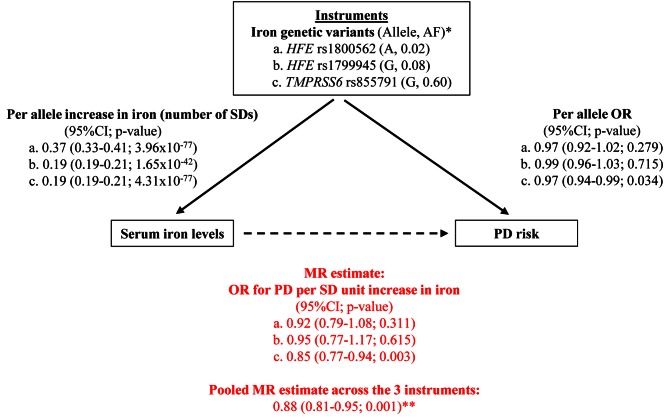
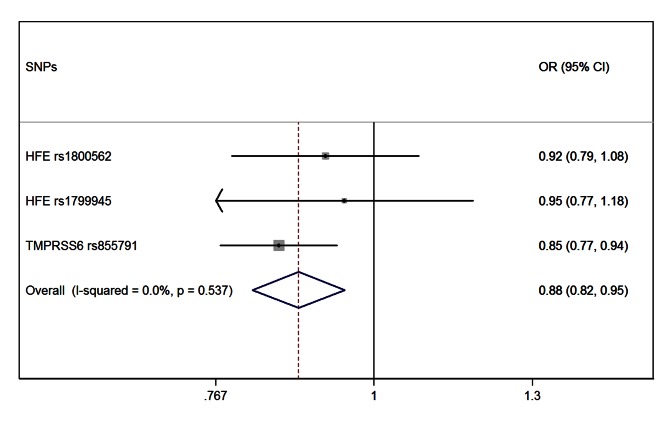
BACKGROUND: Although levels of iron are known to be increased in the brains of patients with Parkinson disease (PD), epidemiological evidence on a possible effect of iron blood levels on PD risk is inconclusive, with effects reported in opposite directions. Epidemiological studies suffer from problems of confounding and reverse causation, and mendelian randomization (MR) represents an alternative approach to provide unconfounded estimates of the effects of biomarkers on disease. We performed a MR study where genes known to modify iron levels were used as instruments to estimate the effect of iron on PD risk, based on estimates of the genetic effects on both iron and PD obtained from the largest sample meta-analyzed to date. METHODS AND FINDINGS: We used as instrumental variables three genetic variants influencing iron levels, HFE rs1800562, HFE rs1799945, and TMPRSS6 rs855791. Estimates of their effect on serum iron were based on a recent genome-wide meta-analysis of 21,567 individuals, while estimates of their effect on PD risk were obtained through meta-analysis of genome-wide and candidate gene studies with 20,809 PD cases and 88,892 controls. Separate MR estimates of the effect of iron on PD were obtained for each variant and pooled by meta-analysis. We investigated heterogeneity across the three estimates as an indication of possible pleiotropy and found no evidence of it. The combined MR estimate showed a statistically significant protective effect of iron, with a relative risk reduction for PD of 3% (95% CI 1%-6%; p = 0.001) per 10 µg/dl increase in serum iron. CONCLUSIONS: Our study suggests that increased iron levels are causally associated with a decreased risk of developing PD. Further studies are needed to understand the pathophysiological mechanism of action of serum iron on PD risk before recommendations can be made.
Overview
The claims and statistics of this paper haven’t been checked yet.
Run the check — free, no account needed. It reads the open-access text and checks the sources it cites.
Integrity signals
Registry
Cites
Statistics
Figures
Verification
Claims the paper makes
The claims and statistics of this paper haven’t been checked yet.
Run the check — free, no account needed. It reads the open-access text and checks the sources it cites.
Claims other papers make about this one
Each is checked against this paper’s own text: does it say what the citing paper says it does?
The cited source says what the claim attributes to it.
In the citing paper
“The previously described MR effects of iron status on risk of Parkinson’s disease and coronary artery disease (coronary atherosclerosis) were not statistically significant after correcting for multiple testing in our current analysis, although the directions of effect were consistent with previous work (S5 Table) [8,9].”
From Associations of genetically determined iron status across the phenome: A mendelian randomization study (2019) · cites this paper as [9]
Self-check
Percentages, sums and reported differences re-computed from the paper’s own numbers.
The self-check needs the paper’s full text.
Citations
Cites
Measuring inconsistency in meta-analyses
Higgins, J. P. T., Thompson, S. G., Deeks, J. J., & Altman, D. G. (2003) · BMJ · doi:10.1136/bmj.327.7414.557 · Cited by 63,139 · cited 1×
“We evaluated the presence and magnitude of heterogeneity across the three instruments with the I(2) statistics, a measure defined as the percentage of total variation in study estimates explained by heterogeneity rather than sampling error [31].”
MethodSpillantini, M. G., Schmidt, M. L., Lee, V. M.-Y., Trojanowski, J. Q., Jakes, R., & Goedert, M. (1997) · Nature · doi:10.1038/42166 · Cited by 8,382
Davey Smith, G., & Ebrahim, S. (2003) · International Journal of Epidemiology · doi:10.1093/ije/dyg070 · Cited by 5,882 · cited 4×
“Genes are randomly allocated at conception, so that genetic effects on the intermediate phenotype cannot be affected by classical confounding, such as lifestyle factors, or reverse causation, as in the situation where the phenotype level is influenced by the presence of the disease [8].”
BackgroundInfluentialA novel MHC class I-like gene is mutated in patients with hereditary haemochromatosis
Feder, J. N., Gnirke, A., Thomas, W., Tsuchihashi, Z., Ruddy, D. A., Basava, A., Dormishian, F., Domingo, R., Ellis, M. C., Fullan, A., et al. (1996) · Nature Genetics · doi:10.1038/ng0896-399 · Cited by 3,664 · cited 1×
“The two variants in the HFE gene are responsible for most cases of hereditary hemochromatosis [59,60], and they are associated with iron overload when present in the homozygous (C282Y/C282Y) or compound heterozygous (C282Y/H63D) state.”
BackgroundPierce, B. L., Ahsan, H., & VanderWeele, T. J. (2010) · International Journal of Epidemiology · doi:10.1093/ije/dyq151 · Cited by 1,848
Iron, brain ageing and neurodegenerative disorders
Zecca, L., Youdim, M. B. H., Riederer, P., Connor, J. R., & Crichton, R. R. (2004) · Nature Reviews Neuroscience · doi:10.1038/nrn1537 · Cited by 1,801 · cited 2×
“accumulation in the brain of PD patients [2,3], epidemiological”
BackgroundGenome-wide association study reveals genetic risk underlying Parkinson's disease
Simón-Sánchez, J., Schulte, C., Bras, J. M., Sharma, M., Gibbs, J. R., Berg, D., Paisan-Ruiz, C., Lichtner, P., Scholz, S. W., Hernandez, D. G., et al. (2009) · Nature Genetics · doi:10.1038/ng.487 · Cited by 1,751 · cited 1×
“The PD GWAS Consortium includes data from five studies: PROGENI/GenePD [26], NIA Phase I [27], NIA Phase II [28], HIHG [29], and NGRC [30].”
Self-citationNeuropathology of Parkinson's Disease
Forno, L. (1996) · Journal of Neuropathology and Experimental Neurology · doi:10.1097/00005072-199603000-00001 · Cited by 1,556 · cited 1×
“PD is characterized by the rather selective loss of dopaminergic neurons [4] and the presence of a-synucleinenriched Lewy body inclusions in the SN [5], and several studies have demonstrated that free iron in the SN can enhance the aggregation of a-synuclein and may thus promote the formation of Lewy bodies [1].”
BackgroundUsing multiple genetic variants as instrumental variables for modifiable risk factors
Palmer, T. M., Lawlor, D. A., Harbord, R. M., Sheehan, N. A., Tobias, J. H., Timpson, N. J., Smith, G. D., & Sterne, J. A. (2012) · Statistical Methods in Medical Research · doi:10.1177/0962280210394459 · Cited by 1,289 · cited 3×
“In a MR study, if all instruments are valid, their MR estimates should differ only as a result of sampling error [10], so that there should be no heterogeneity in the meta-analysis of MR estimates.”
BackgroundMethodInfluentialNalls, M. A. (2011) · The Lancet · doi:10.1016/s0140-6736(10)62345-8 · Cited by 926
Self-citation
Research works printed but not linked: 2
Cited by
Sorted by citations
Items 101–163 of 163
Diagnostics and Treatments of Iron-Related CNS Diseases
Xiong, H., Tuo, Q., Guo, Y., & Lei, P. (2019) · Advances in experimental medicine and biology · doi:10.1007/978-981-13-9589-5_10 · Cited by 14
Why unethical papers should be retracted
Bülow, W., Godskesen, T., Helgesson, G., & Eriksson, S. (2020) · Journal of Medical Ethics · doi:10.1136/medethics-2020-106140 · Cited by 10
Lin, S.-Y., Hsu, W., Lin, C., Lin, C., Yeh, H., & Kao, C. (2019) · Frontiers in Psychiatry · doi:10.3389/fpsyt.2019.00571 · Cited by 13
Multiple Publications: The Main Reason for the Retraction of Papers in Computer Science
Hidabi, M. A., & Teh, P. L. (2018) · Advances in intelligent systems and computing · doi:10.1007/978-3-030-03402-3_35 · Cited by 15
Liu, H., Zhang, X., Zhou, Y., Nguyen, T. N., Zhang, L., Xing, P., Li, Z., Shen, H., Zhang, Y., Hua, W., et al. (2023) · International Journal of Stroke · doi:10.1177/17474930231185695 · Cited by 14
“27 All MR associations between SBP, DBP, PP, and primary outcomes were scaled to 10 mmHg increment in SBP, 5 mmHg in DBP, and 1 mmHg in PP.”
BackgroundCurrent Status and Prospects of Research on Ischemia-Reperfusion Injury and Ferroptosis
Hou, L., Li, X., Su, C., Chen, K., & Qu, M.-X. (2022) · Frontiers in Oncology · doi:10.3389/fonc.2022.920707 · Cited by 11
Ou, Y., Zhao, B. T., Fu, Y., Sheng, Z.-H., Gao, P., Tan, L., & Yu, J. (2022) · Journal of Alzheimer s Disease · doi:10.3233/jad-220649 · Cited by 14
Causal relationship between iron deficiency anemia and asthma: a Mendelian randomization study
Li, M., Chen, Z., Yang, X., & Li, W. (2024) · Frontiers in Pediatrics · doi:10.3389/fped.2024.1362156 · Cited by 9
“For example, previous studies have shown that IDA is associated with an increased risk of autism, Parkinson ’ s disease, and cancer (29, 37 – 39).”
ResultThe Potential of ANK1 to Predict Parkinson’s Disease
Xue, J., Li, F., & Dai, P. (2023) · Genes · doi:10.3390/genes14010226 · Cited by 9
“Intriguingly, increased serum iron may be associated with reduced PD risk, and therefore showing a protective effect of iron against PD [60,61].”
BackgroundPhenotype correlations reveal the relationships of physiological systems underlying human ageing
Hao, M., Zhang, H., Hu, Z., Jiang, X., Song, Q., Wang, X., Wang, J., Liu, Z., Wang, X., Li, Y., et al. (2021) · Aging Cell · doi:10.1111/acel.13519 · Cited by 16
Hicks, D. L., Patterson, D., & Resko, S. M. (2017) · Journal of Forensic Nursing · doi:10.1097/jfn.0000000000000175 · Cited by 10
Luyken, A., Lappe, C., Viard, R., Löhle, M., Kleinlein, H. R., Kuchcinski, G., Langner, S., Wenzel, A.-M., Walter, M., Weber, M. D., et al. (2024) · Journal of Neural Transmission · doi:10.1007/s00702-024-02856-1 · Cited by 8
“…may be surprising in view of the previously proposed negative correlation between serum iron level and the risk of PD (Chen et al. 2024; Pichler et al. 2013), and the report of lower serum iron levels in patients with PD compared with age-and sex-matched controls (Jiménez-Jiménez et…”
Iron Status May Not Affect Amyotrophic Lateral Sclerosis: A Mendelian Randomization Study
Cai, J., Chen, X., Wang, H., Wei, Z., Li, M., Rong, X., Li, X., & Peng, Y. (2021) · Frontiers in Genetics · doi:10.3389/fgene.2021.617245 · Cited by 10
“Mendelian randomization (MR) has been applied to determine the specific causal relationships, and a protective effect of increased iron status on PD has been confirmed by a recent MR study (Pichler et al., 2013; Burgess et al., 2015).”
BackgroundYang, F., Bao, Q., Wang, Z., Ma, M., Shen, J., Ye, F., & Xie, X. (2020) · BioMed Research International · doi:10.1155/2020/6246041 · Cited by 10
“Iron is an important trace element involved in fundamental biochemical activities, such as mitochondrial respiration, oxygen delivery, and DNA synthesis in almost all cell types [19].”
Preventing Malaria among Children in Zambia: The Role of Mother's Knowledge.
Pylypchuk, Y., & Norton, S. (2015) · Health Economics · doi:10.1002/hec.3093 · Cited by 9
Iron-Regulatory Genes are Associated with Neuroimaging Measures in HIV Infection
Fennema-Notestine, C., Thornton-Wells, T., Hulgan, T., Letendre, S., Ellis, R. J., Franklin, D., Anderson, A. M., Heaton, R., Bloss, C., Grant, I., et al. (2019) · Brain Imaging and Behavior · doi:10.1007/s11682-019-00153-0 · Cited by 8
Pieper, D., Li, L., & Büchter, R. B. (2016) · Springer eBooks · doi:10.1007/978-3-319-25655-9_22 · Cited by 3
Estimating transmission probability in schools for the 2009 H1N1 influenza pandemic in Italy
Clamer, V., Dorigatti, I., Fumanelli, L., Rizzo, C., & Pugliese, A. (2016) · Theoretical Biology and Medical Modelling · doi:10.1186/s12976-016-0045-2 · Cited by 7
Wojcicki, A. (2013) · Nature Biotechnology · doi:10.1038/nbt.2771 · Cited by 7
Global Virology II - HIV and NeuroAIDS
Shapshak, P., Levine, A., Foley, B., Somboonwit, C., Singer, E., Chiappelli, F., & Sinnott, J. (2017) · Springer: New York · doi:10.1007/978-1-4939-7290-6 · Cited by 7
“Some studies even indicate abnormal systemic iron status in AD and PD, as well as in ALS [223, 267, 268].”
BackgroundCausal role of immune cells on risk of Parkinson’s disease: a Mendelian randomization study
Gu, J. H., Qiao, Y., & Cong, S. (2024) · Frontiers in Aging Neuroscience · doi:10.3389/fnagi.2024.1368374 · Cited by 8
“Previous studies using two-sample MR had shown a causal link between BMI /serum iron levels and the risk of PD (Pichler et al., 2013; Noyce et al., 2017).”
ResultReligion and health in rural Malawi
Kendall, J. (2019) · Journal of religion and health · doi:10.1007/s10943-019-00804-y · Cited by 6
Necrotizing enterocolitis and high intestinal iron uptake due to genetic variants
for the German Neonatal Network, Göpel, W., Drese, J., Rausch, T. K., Twisselmann, N., Bohnhorst, B., Müller, A., Franz, A. R., Ziegler, A., Härtel, C., et al. (2017) · Pediatric Research · doi:10.1038/pr.2017.195 · Cited by 7
“Mendelian randomization estimates for each polymorphism based on serum iron levels in adults (6) are given in Figure 1.”
BackgroundMethodInfluentialTan, Y., Dong, X., Zhuang, D., Cao, B., Jiang, H., He, Q., & Zhao, M. (2023) · Molecular and Cellular Biochemistry · doi:10.1007/s11010-023-04694-3 · Cited by 5
“…although serum iron levels are found to increase in most PD patients, the association between serum iron levels and PD risk is inconclusive; some studies suggested that increased iron levels are causally associated with PD risks [62, 63], while others reported it just the other way around [64].”
BackgroundAn Evidence-Hierarchical Decision Aid for Ranking in Evidence-Based Medicine
Landes, J. (2020) · Boston studies in the philosophy of science · doi:10.1007/978-3-030-29179-2_11 · Cited by 6
Grover, S., Del, G. M. F., Kasten, M., Klein, C., Lill, C., & König, I. (2018) · bioRxiv · doi:10.1101/446807 · Cited by 5
Self-citationA Mendelian Randomization Study of Plasma Homocysteine and Multiple Myeloma
Yang, X., Li, X., Hu, Z., Teng, Z., & Hu, D. (2016) · Scientific Reports · doi:10.1038/srep25204 · Cited by 6
Two sample Mendelian Randomisation using an outcome from a multilevel model of disease progression
Lawton, M. A., Ben-Shlomo, Y., Gkatzionis, A., Hu, M. T. M., Grosset, D., & Tilling, K. (2023) · European Journal of Epidemiology · doi:10.1007/s10654-023-01093-2 · Cited by 4
“a binary outcome using logistic regression) [2, 3] or a health marker such as blood pressure (i.”
MethodOu, Y., Liu, Y., Wu, B., Tan, L., & Yu, J. (2022) · Annals of Translational Medicine · doi:10.21037/atm-22-1156 · Cited by 5
“Cochran’s Q statistics (P for MR Egger =5.13E-131, P for IVW =2.53E-131) indicated notable heterogeneity across instrument SNP effects for MS ( Table 1 ).”
InfluentialXue, Z., Cheng, Y., Yu, Q., Wang, T., Fan, C.-L., Zou, Z.-Q., & Zhang, X.-H. (2021) · Asia Pacific Journal of Clinical Nutrition · doi:10.6133/apjcn.202106_30(2).0018 · Cited by 4
Evidence-Based Discriminant Analysis
Tripathi, C. B., Gangania, M. K., Kushwaha, S. S., & Agarwal, R. (2021) · Annals of Indian Academy of Neurology · doi:10.4103/aian.aian_419_20 · Cited by 3
“Neurochemical studies have implicated metals in pathogenesis of PD. Objectives: To examine the association of serum iron, transferrin, ferritin, transferrin saturation and UIBC in PD patients and to derive the Discrimination Function with scores of these variables to correctly classify PD cases and healthy controls.”
BackgroundInfluentialYang, Y., Kuo, K., Li, H., Shen, X., Chen, S.-D., Cui, M., Dong, Q., & Yu, J. (2020) · Journal of Alzheimer s Disease · doi:10.3233/jad-200773 · Cited by 3
Lv, L., Long, Z., Tan, X., Qin, L., Yan, W., Zhang, H., Ren, F., & Wang, C. (2024) · Frontiers in Aging Neuroscience · doi:10.3389/fnagi.2024.1423773 · Cited by 4
Dietary Factors Affect Brain Iron Accumulation and Parkinson’s Disease RiskPreprint
Ahern, J., Boyle, M., Sugrue, L. P., Andreassen, O. A., Dale, A. M., Thompson, W. K., Fan, C. C., & Loughnan, R. J. (2024) · medRxiv · doi:10.1101/2024.03.13.24304253 · Cited by 6
“Research has indicated that low peripheral iron and hemoglobin are associated with greater PD risk 11–14 .”
Chen, H., Xie, W., Chang, Z., Zhang, J., & Xie, D. (2024) · Journal of Trace Elements in Medicine and Biology · doi:10.1016/j.jtemb.2024.127430 · Cited by 2
Gan-or, Z., & Wood, N. (2021) · Movement Disorders · doi:10.1002/mds.28765 · Cited by 3
Genome‐Wide Association Studies
Morris, A. P., & Cardon, L. R. (2019) · Wiley eBooks · doi:10.1002/9781119487845.ch21 · Cited by 45
Engelken, J., Altmeyer, M., & FRANKLIN, R. B. (2014) · bioRxiv (Cold Spring Harbor Laboratory) · doi:10.1101/002105 · Cited by 4
Ferroptosis in Nervous System Diseases
Wan, J., Yang, X., & Wang, J. (2019) · Springer eBooks · doi:10.1007/978-3-030-26780-3_10 · Cited by 5
Genetic, Epigenetic, and Transcriptomic Studies of NeuroAIDS
Levine, A. J., Singh, K. K., & Kallianpur, A. R. (2017) · Springer eBooks · doi:10.1007/978-1-4939-7290-6_19 · Cited by 3
Etiology and Pathogenesis of Parkinson’s Disease
Timpka, J., Cenci, M. A., & Odin, P. (2017) · Springer eBooks · doi:10.1007/978-3-7091-1628-9_10 · Cited by 8
Al-Okbi, S., Mabrok, H., Al-Siedy, E. S. K., Mohamed, R., & Ramadan, A. (2021) · Journal of HerbMed Pharmacology · doi:10.34172/jhp.2022.07 · Cited by 2
“Patients in the late stage of PD have a lower serum iron and ferritin than control (14-17).”
BackgroundHeilbron, K., Noyce, A., Fontanillas, P., Alipanahi, B., Nalls, M., & Cannon, P. (2018) · bioRxiv · doi:10.1101/270934 · Cited by 2
Self-citationNutrition et santé : la communication des entreprises auprès des consommateurs
Gurviez, P. (2016) · Cahiers de Nutrition et de Diététique · doi:10.1016/j.cnd.2015.04.005 · Cited by 2
Owumi, S., Odunola, O., Gbadegesin, M. A., Ayoola, B., & Onuchukwu, E. (2014) · Toxicological & Environmental Chemistry Reviews · doi:10.1080/02772248.2015.1029480 · Cited by 2
“In contrast, a report recently suggested that increased Fe levels are causally associated with decreased risk of developing Parkinson’s disease (Pichler et al. 2013).”
BackgroundTrace Elements Dyshomeostasis and Toxic Metals Neurotoxicity in Neurodegenerative Diseases
Tang, M., Fleming, E., Gu, J., Shi, H., Xu, Y., & Gong, X. (2026) · Biological Trace Element Research · doi:10.1007/s12011-026-05187-2 · Cited by 1
“Third, the systematic application of Mendelian randomization to assess metal exposures necessitates careful methodological interpretation, a consideration that has not been widely discussed in prior reviews [27, 28].”
Dušek, P., Subramanian, R. G., Serranová, T., Šonka, K., Růžička, E., & Kuta, J. (2025) · Journal of Parkinson s Disease · doi:10.1177/1877718x251367303 · Cited by 2
“Contrary to previous fi ndings which suggest that high serum iron and hemoglobin levels may protect against PD development, 71,72 we observed higher whole blood Fe levels in PD compared to controls.”
Screening of key immune-related gene in Parkinson's disease based on WGCNA and machine learning.
Huang, Y., Wang, A., Wang, F., Xu, Y., Zhang, W., Shi, F., & Wang, S. (2024) · PubMed Central · doi:10.11817/j.issn.1672-7347.2024.230307 · Cited by 1
“…, CD44 、 ITGAM 与免疫系统激活相关 [34-35] 。研究 [32] 通过富集分析发 现:在生物学功能方面, ANK1 主要与氧转运、中幼 粒细胞发育、气体转运、红细胞分化等相关;在细 胞组成方面,与血红蛋白复合物、触珠蛋白 - 血红蛋 白复合物、皮层细胞骨架等相关;在分子功能方面, ANK1 与氧转运蛋白活性、结合珠蛋白、氧结合、铁 离子结合等有关。本研究结果与上述研究结果一致。 与血红蛋白和铁稳态有关的基因在 ANK1 低表达组中 下调 [36-37] ,而血红蛋白水平与帕金森病呈负相关 [38-39] , 血清铁的增加可能与帕金森病风险降低有关 [16, 40-41]”
Ma, J., Chen, H., Zou, C., & Yang, G. (2023) · Progress in Neuro-Psychopharmacology and Biological Psychiatry · doi:10.1016/j.pnpbp.2023.110929 · Cited by 1
Systematic review of Mendelian randomization studies on Parkinson’s disease
Kappen, S., Bottigliengo, D., Caliebe, A., Fabiola Del Greco, M., & König, I. R. (2022) · Medizinische Genetik · doi:10.1515/medgen-2022-2139
“When R 2 was not given in the article, it was calculated using the formula R 2 = F/(N − 2 + F), where F is the reported F-statistic and N is the sample size of the gene-exposure association [12, 16].”
A Mendelian randomization study of glycemic and anthropometric traits and Parkinson’s diseasePreprint
Grover, S., Graf, R., Klein, C., Bruggemann, N., König, I., M, F. D. G., & Sharma, M. (2020) · bioRxiv · doi:10.1101/2020.03.31.017566 · Cited by 1
Utilization Management in a Large Community Hospital
Kiechle, F. L., & Arcenas, R. C. (2016) · Springer eBooks · doi:10.1007/978-3-319-34199-6_14 · Cited by 1
m ‐Health Computing: m ‐Health 2.0, Social Networks, Health Apps, Cloud, and Big Health Data
Istepanian, R. S. H., & Woodward, B. (2016) · Wiley eBooks · doi:10.1002/9781119302889.ch3 · Cited by 1
Environmental and genetic risk factors for Parkinson's disease
Belbasis, L., Bellou, V., & Evangelou, E. (2020) · Diagnosis and Management in Parkinson's Disease · doi:10.1016/b978-0-12-815946-0.00004-1 · Cited by 1
Muraszko-Kuźma, M., Klahs, K., Nieradka, K., Twardy, P., Wagner, W., Białożyt, J., Dębniak, A., Gutarowicz, M., Modelewski, P., & Armatys, M. (2026) · International Journal of Innovative Technologies in Social Science · doi:10.31435/ijitss.3(51).2026.5973
Salkov, V. N. (2025) · Acta Biomedica Scientia · doi:10.29413/abs.2025-10.1.17
Qin, Y., Jin, H., Sun, X., Ma, M., Li, X., Gu, L., Fu, J., Li, M., & Zhong, B. (2024) · AIP Advances · doi:10.1063/5.0197177
Liu, H., Zhang, X., Zhou, Y., Nguyen, T., Zhang, L., Xing, P., Li, Z., Shen, H., Zhang, Y., Hua, W., et al. (2023) · medRxiv · doi:10.1101/2023.04.09.23288342
“We excluded the SNPs that had F statistics lower than 10 according to standard practice.((26)) All MR associations between SBP, DBP, PP, and primary outcomes were scaled to 10 mm Hg”
MethodValokolaei, S. H. A., Valokolaei, S. H. A., Saadat, P., Ahangar, A. A., & Gholinia, H. (2023) · Romanian Journal of Neurology · doi:10.37897/rjn.2023.1.12
Impaired Systemic Iron Homeostasis and Parkinson's Disease
Gangania, M. K. (2017) · Journal of Medical Science And clinical Research · doi:10.18535/jmscr/v5i4.180
“Furthermore, reduced peripheral iron may decrease ferritin storage in neurons, thus decreasing the pool of iron available for neuronal enzymes and consequently leading to accumulation of free iron in the SN [4] .”
BackgroundIstepanian, R. S. H., & Woodward, B. (2016) · Wiley eBooks · doi:10.1002/9781119302889.ch2
杨, 叶. (2025) · Traditional Chinese Medicine · doi:10.12677/tcm.2025.144265
Pharmacotherapies in Parkinson Disease: Investigating Trends and Adverse Health Outcomes
Crispo, J. A. G. (2016) · uO Research (University of Ottawa) · doi:10.20381/ruor-840
“Oxidative damage to lipids, proteins, and DNA has consistently been observed in post-mortem analyses of affected PD brains [53].”
BackgroundInfluential
Metadata
- Authors
- Pichler, I., Del Greco M., F., Gögele, M., Lill, C. M., Bertram, L., Do, C. B., Eriksson, N., Foroud, T., Myers, R. H., PD GWAS Consortium, Nalls, M., Keller, M. F., International Parkinson's Disease Genomics Consortium, Wellcome Trust Case Control Consortium 2, Benyamin, B., Whitfield, J. B., Genetics of Iron Status Consortium, Pramstaller, P. P., Hicks, A. A., Thompson, J. R., & Minelli, C.
- Affiliations
- Eurac Research (IT)
- Imperial College London (GB)
- Johannes Gutenberg University Mainz (DE)
- Max Planck Institute for Molecular Genetics (DE)
- 23andMe (United States) (US)
- Indiana University School of Medicine (US)
- Boston University (US)
- National Institutes of Health (US)
- The University of Queensland (AU)
- QIMR Berghofer Medical Research Institute (AU)
- Ospedale di Bolzano (IT)
- University of Leicester (GB)
- Corresponding author
- Pichler, Irene
- Minelli, Cosetta
- ORCID
- Venue
- PLoS Medicine
- Publisher
- Public Library of Science (PLoS)
- Published
- 2013-06-04
- Volume
- 10
- Issue
- 6
- Pages
- e1001462
- ISSN
- 1549-1277 (ISSN-L)
- 1549-1676
- PMC
- PMC3672214
- OpenAlex
- W2169823945
- Cited by
- 173
- References
- 81
- Citations by year
- 2026: 2 · 2025: 5 · 2024: 11 · 2023: 9 · 2022: 14 · 2021: 27 · 2020: 13 · 2019: 16 · 2018: 10 · 2017: 14 · 2016: 18 · 2015: 17 · 2014: 15 · 2013: 2
- FWCI
- 11.01
- Type
- journal article
- Language
- en
- Update notices
- correction (2013-06-10)
- Open access
- gold
- doi.org
- Locations
- PLoS Medicine (publishedVersion, cc-by)
- Europe PMC (PubMed Central) (publishedVersion, cc-by)
- Research Portal (King's College London) (publishedVersion, other-oa)
- PubMed Central (publishedVersion, cc-by)
- PubMed (publishedVersion)
- Amsterdam UMC (VU Amsterdam) - Institutional Repository (publishedVersion)
- VU Research Portal (publishedVersion, other-oa)
- Archive ouverte UNIGE (University of Geneva) (publishedVersion, other-oa)
- Data Archiving and Networked Services (DANS) (submittedVersion)
- RePEc: Research Papers in Economics (submittedVersion)
- ArTS Archivio della ricerca di Trieste (University of Trieste https://www.units.it/) (submittedVersion)
- DOAJ (DOAJ: Directory of Open Access Journals) (submittedVersion, cc-by-sa)
- ePrints Soton (University of Southampton) (submittedVersion)
- UCL Discovery (University College London) (submittedVersion)
- Max Planck Digital Library (submittedVersion, other-oa)
- Figshare (submittedVersion)
- Figshare (submittedVersion, cc-by)
- Leicester Research Archive (University of Leicester) (submittedVersion, cc-by)
- Site cant be reached (submittedVersion, cc-by)
- Pure Amsterdam UMC (submittedVersion)
- University of Birmingham Research Portal (University of Birmingham) (submittedVersion, other-oa)
- MPG.PuRe (Max Planck Society) (submittedVersion, other-oa)
- Radboud Repository (Radboud University) (submittedVersion)
- Open Research (University of Surrey) (submittedVersion)
- Archive ouverte UNIGE (University of Geneva) (submittedVersion, cc-by)
- Radboud Repository (Radboud University) (submittedVersion, other-oa)
- Data Archiving and Networked Services (DANS) (submittedVersion, other-oa)
- Funders
- U.S. Department of Defense (W81XWH, Z01-AG000949-02, Z01-ES101986, W81XWH0920128)
- U.S. Department of Health and Human Services (W81XWH-09-2-0128, Z01-ES101986, RR024992, Z01‐AG000949‐02)
- Michael J. Fox Foundation for Parkinson's Research (Z01-ES101986, W81XWH-09-2-0128, Z01-AG000949-02)
- Susan G. Komen for the Cure
- American Association for the Advancement of Science
- Biogen
- American Parkinson Disease Association
- Cure Alzheimer's Fund
- University of Rochester
- University of Dundee
- Queen Mary University of London
- South London and Maudsley NHS Foundation Trust
- Prize4Life
- London School of Hygiene and Tropical Medicine
- National Alliance for Research on Schizophrenia and Depression
- Wellcome Trust (WT089698, 083948/Z/07/Z, WTCCC2, 090532, WTCCC1, NS057105, 083948, WT089698/Z/09/Z)
- University Hospitals Birmingham NHS Foundation Trust
- National Institute for Health and Care Research (NF-SI-0507-10376)
- Parkinson's UK (F-1202, G0909, J-0901, J‐0804)
- Imperial College London
- King's College London
- University College London
- University of Oxford
- European Commission (230596)
- Cardiff University
- University of Aberdeen
- Trinity College Dublin
- Agence Nationale de la Recherche
- Institut National de la Santé et de la Recherche Médicale
- Universiteit Leiden
- Radboud Universiteit
- Vrije Universiteit Amsterdam
- Bundesministerium für Bildung und Forschung (01GR0468, 01GS08134, 01EW0908)
- Centre National de la Recherche Scientifique
- Leids Universitair Medisch Centrum
- Deutsches Zentrum für Neurodegenerative Erkrankungen
- Tartu Ülikool
- Hersenstichting
- Moorfields Eye Hospital NHS Foundation Trust
- Provincia autonoma di Bolzano - Alto Adige
- National Institutes of Health (1z01es101986-03, 5r44hg006981-03, W81XWH, UL1TR000448, W81XWH-09-2-0128, Z01‐AG000949‐02, Z01-ES101986, RR024992, NS057105, Z01-AG000949)
- EMD Serono
- Fidelity Biosciences
- Medical Research Council (MR/K01417X/1, G0700943, WT089698)
- Cambridge Institute for Medical Research, University of Cambridge
- Erasmus Universitair Medisch Centrum Rotterdam
- Diamantina Institute, University of Queensland
- National Institute on Aging (Z01‐ES101986, W81XWH-09-2-0128, K24AG000949, Z01AG000949)
- National Human Genome Research Institute (R44-HG006981)
- National Institute of Neurological Disorders and Stroke (P30NS057105, NS057105, R01NS076843, P50NS071674)
- National Institute of Environmental Health Sciences (Z01-ES 101986)
- National Center for Research Resources (RR-024992, UL1RR024992)
- NIH Clinical Center
- National Center for Advancing Translational Sciences
- Topics
- Health Sciences › Medicine › Clinical Neurology › Parkinson's Disease Mechanisms and Treatments
- Health Sciences › Medicine › Hematology › Iron Metabolism and Disorders
- Life Sciences › Biochemistry, Genetics and Molecular Biology › Genetics › Genetic Associations and Epidemiology
- Keywords
- Parkinson's disease, serum iron, iron levels, disease risk, HFE gene, TMPRSS6, genetic instruments, causal effects, protective effect, biomarkers
- MeSH terms
- Humans, Iron, Parkinson Disease, Risk Factors, Genetic Predisposition to Disease, Genetic Association Studies, Mendelian Randomization Analysis
About these checks
Registry, retraction, Cites and statistics results are computed, not judged, with one exception: a printed reference that no index lists is read once by a model before it counts as a citation error. Claims are extracted by a model and kept only when their quote appears verbatim in the text; each cited source is then checked, with a model’s help, for whether it says what the claim relies on. Those verdicts can be wrong — read the claim’s quote and the cited source before relying on one.
Statistics and arithmetic are recomputed, not judged.
Confidence bands are shown only for fields calibrated on our annotated test set. None is calibrated yet, so no band is shown.
What counts as a claim ›How we measure confidence ›How we check this ›
Are you an author, or do you see a problem with this page? Request a review
