

The DOI matches its Crossref record; 84 of the 84 references it cites were found in a registry or an index.
Psychosocial Interventions for Perinatal Common Mental Disorders Delivered by Providers Who Are Not Mental Health Specialists in Low- and Middle-Income Countries: A Systematic Review and Meta-Analysis
Open accessAbstract
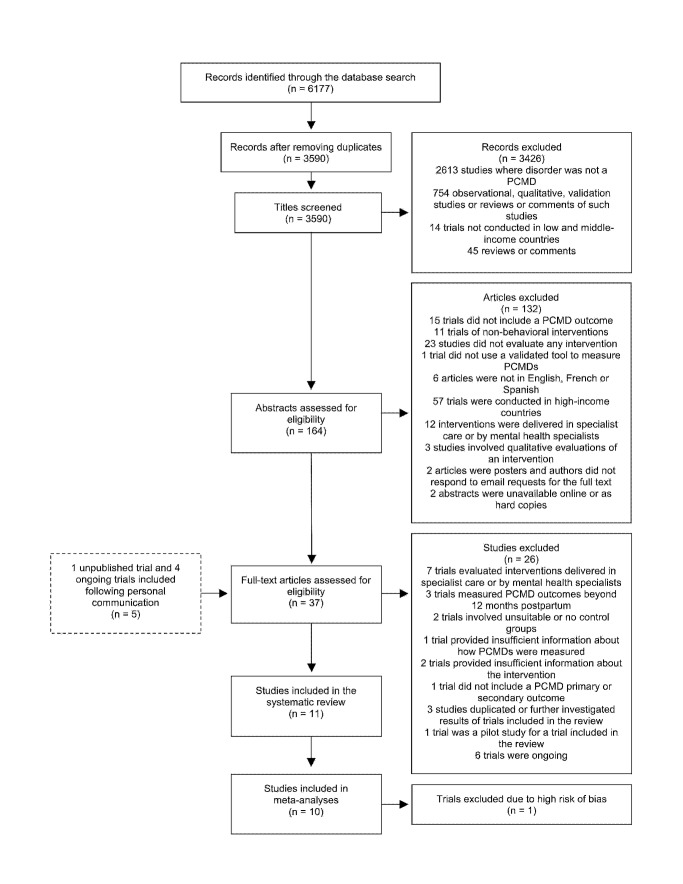
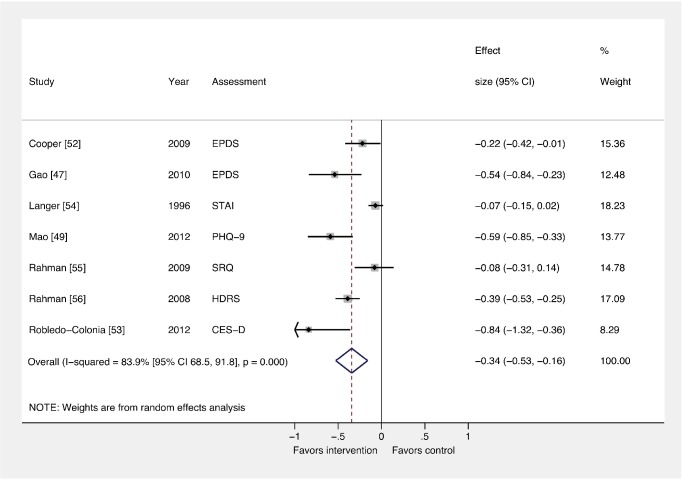
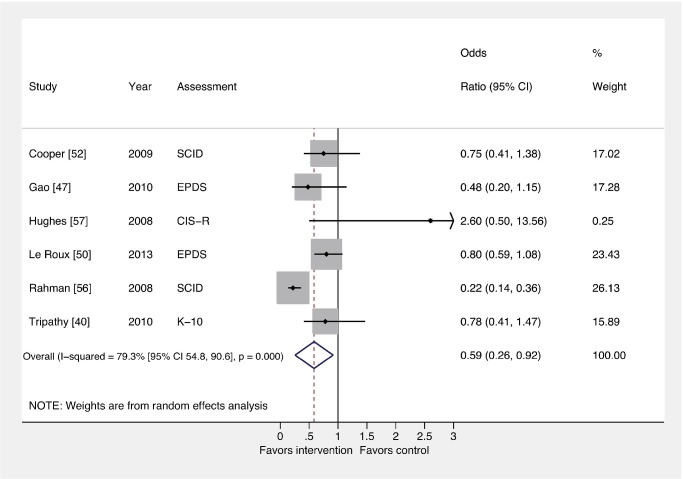
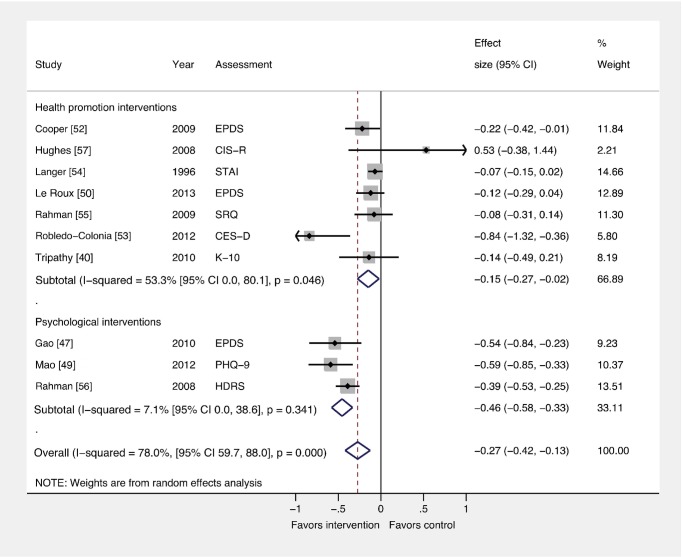
BACKGROUND: Perinatal common mental disorders (PCMDs) are a major cause of disability among women. Psychosocial interventions are one approach to reduce the burden of PCMDs. Working with care providers who are not mental health specialists, in the community or in antenatal health care facilities, can expand access to these interventions in low-resource settings. We assessed effects of such interventions compared to usual perinatal care, as well as effects of interventions based on intervention type, delivery method, and timing. METHODS AND FINDINGS: We conducted a systematic review, meta-analysis, and meta-regression. We searched databases including Embase and the Global Health Library (up to 7 July 2013) for randomized and non-randomized trials of psychosocial interventions delivered by non-specialist mental health care providers in community settings and antenatal health care facilities in low- and middle-income countries. We pooled outcomes from ten trials for 18,738 participants. Interventions led to an overall reduction in PCMDs compared to usual care when using continuous data for PCMD symptomatology (effect size [ES] -0.34; 95% CI -0.53, -0.16) but not binary categorizations for presence or absence of PCMDs (OR 0.62, 95% CI 0.35, 1.080 [corrected]. We found a significantly larger ES for psychological interventions (three studies; ES -0.46; 95% CI -0.58, -0.33) than for health promotion interventions (seven studies; ES -0.15; 95% CI -0.27, -0.02). Both individual (five studies; ES -0.18; 95% CI -0.34, -0.01) and group (three studies; ES -0.48; 95% CI -0.85, -0.11) interventions were effective compared to usual care, though delivery method was not associated with ES (meta-regression β coefficient -0.11; 95% CI -0.36, 0.14). Combined group and individual interventions (based on two studies) had no benefit compared to usual care, nor did interventions restricted to pregnancy (three studies). Intervention timing was not associated with ES (β 0.16; 95% CI -0.16, 0.49). The small number of trials and heterogeneity of interventions limit our findings. CONCLUSIONS: Psychosocial interventions delivered by non-specialists are beneficial for PCMDs, especially psychological interventions. Research is needed on interventions in low-income countries, treatment versus preventive approaches, and cost-effectiveness. Please see later in the article for the Editors' Summary.
Overview
The claims and statistics of this paper haven’t been checked yet.
Run the check — free, no account needed. It reads the open-access text and checks the sources it cites.
Integrity signals
Registry
Cites
Statistics
Figures
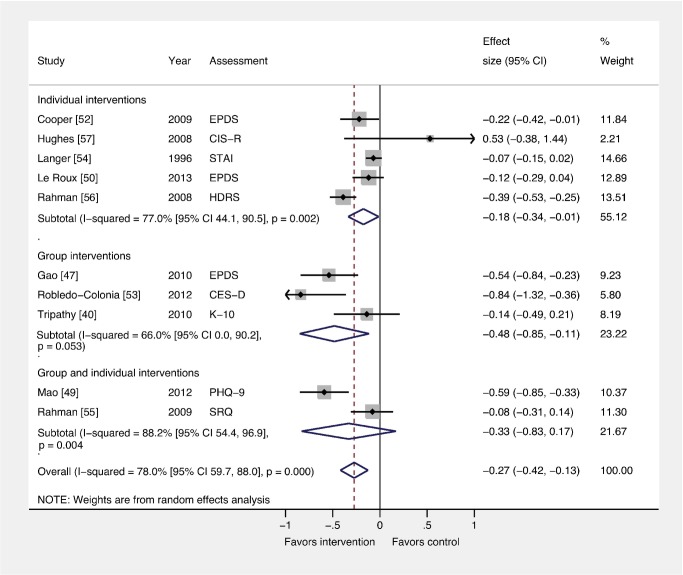
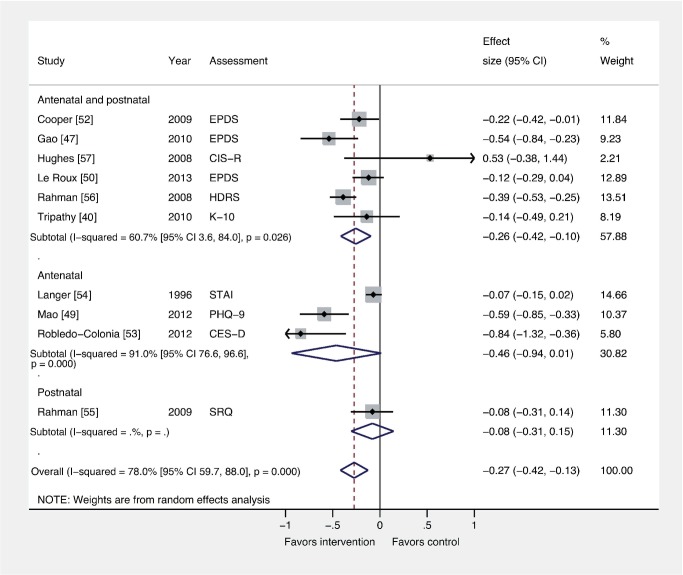
Verification
Claims the paper makes
The claims and statistics of this paper haven’t been checked yet.
Run the check — free, no account needed. It reads the open-access text and checks the sources it cites.
Claims other papers make about this one
Each is checked against this paper’s own text: does it say what the citing paper says it does?
The source backs part of the claim, not all of it — or backs it for a different population, condition or comparison.
In the citing paper
“Existing reviews highlight the effectiveness of a number of interventions for PPD including medication (eg, antidepressant medication), health promotion interventions (eg, educational home visits) and psychological interventions (eg, cognitive–behavioural therapy (CBT) and interpersonal therapy.16–27”
From Effectiveness and acceptability of cognitive-behavioural therapy based interventions for maternal peripartum depression: A systematic review, meta-analysis and thematic synthesis protocol (2019) · cites this paper as [16]
Experimental — accuracy not yet measuredIn the citing paper
“While half the psychiatric outpatients surveyed reported a positive view of mental health apps, only one in four had ever downloaded an app and only one in ten was currently using an app. 644”
From Time for united action on depression: a Lancet–World Psychiatric Association Commission (2022) · cites this paper as [644]
Self-check
Percentages, sums and reported differences re-computed from the paper’s own numbers.
The self-check needs the paper’s full text.
Citations
Cites
Preferred Reporting Items for Systematic Reviews and Meta-Analyses: the PRISMA statement
Moher, D., Liberati, A., Tetzlaff, J., Altman, D. G., & for the PRISMA Group (2009) · BMJ · doi:10.1136/bmj.b2535 · Cited by 83,823
Preferred Reporting Items for Systematic Reviews and Meta-Analyses: The PRISMA Statement
Moher, D., Liberati, A., Tetzlaff, J., Altman, D. G., & The PRISMA Group (2009) · PLoS Medicine · doi:10.1371/journal.pmed.1000097 · Cited by 64,042
Preferred reporting items for systematic reviews and meta-analyses: the PRISMA Statement.
(2009) · PubMed Central · Cited by 44,859
Quantifying heterogeneity in a meta‐analysis
Higgins, J. P. T., & Thompson, S. G. (2002) · Statistics in Medicine · doi:10.1002/sim.1186 · Cited by 36,763
The Cochrane Collaboration's tool for assessing risk of bias in randomised trials
Higgins, J. P. T., Altman, D. G., Gotzsche, P. C., Juni, P., Moher, D., Oxman, A. D., Savovic, J., Schulz, K. F., Weeks, L., Sterne, J. A. C., et al. (2011) · BMJ · doi:10.1136/bmj.d5928 · Cited by 33,817
Detection of Postnatal Depression: Development of the 10-item Edinburgh Postnatal Depression Scale
Cox, J. L., Holden, J. M., & Sagovsky, R. (1987) · British Journal of Psychiatry · doi:10.1192/bjp.150.6.782 · Cited by 14,183
KESSLER, R. C., ANDREWS, G., COLPE, L. J., HIRIPI, E., MROCZEK, D. K., NORMAND, S.-L. T., WALTERS, E. E., & ZASLAVSKY, A. M. (2002) · Psychological Medicine · doi:10.1017/s0033291702006074 · Cited by 10,327
(1988) · NFER-Nelson eBooks · Cited by 5,560
Cochrane Handbook for Systematic Reviews of Interventions Version 5.0.1. The Cochrane Collaboration
Higgins, J., Green, S. R., & Higgins, J. (2008) · Cited by 5,544
Research works printed but not linked: 3
- Goldberg D, Huxley P (1992) Common mental disorders: a biosocial model. London: Tavistock/Routledge.
- L Wu, 2007, Effectiveness of informational support for maternal anxiety and postpartum depression in Chinese mothers of premature infants: a quasi-experimental study, Asian J Nurs, 10, 251
- Hughes MW (2008) A randomised controlled trial of a perinatal psycho-social interventoin for postnatal depression in Goa, India [PhD dissertation]. London: Kings College London.
Cited by
Sorted by citations
Items 101–122 of 122
Biftu, B. B., & Guracho, Y. D. (2020) · doi:10.21203/rs.3.rs-17602/v1
Prinds, C. (2023) · Tidsskrift for Forskning i Sygdom og Samfund · doi:10.7146/tfss.v20i38.131952
Dallison, S., Jenkinson, C. E., Davey, A. F., & O’Mahen, H. (2023) · Journal of Reproductive and Infant Psychology · doi:10.1080/02646838.2023.2280714
McCullough, J. E. M., Gillen, P. A., Miller, P. W., Sinclair, M., Black, R. J., Miller, P. T., & Farrell, D. P. (2024) · Mental Health Science · doi:10.1002/mhs2.59
Ryan, G. K., Bauer, A., Endale, T., Qureshi, O., Doukani, A., Pashoja, A. C., Brar, S. K., Eaton, J., & Bass, J. K. (2021) · Figshare · doi:10.6084/m9.figshare.14478527
Xue, W., Cheng, K. K., Liu, L., Li, Q., Jin, X., Yi, J., & Wenjie, G. (2024) · Figshare · doi:10.6084/m9.figshare.26580509
Ryan, G. K., Bauer, A., Endale, T., Qureshi, O., Doukani, A., Pashoja, A. C., Brar, S. K., Eaton, J., & Bass, J. K. (2021) · Figshare · doi:10.6084/m9.figshare.14478521
Ryan, G. K., Bauer, A., Endale, T., Qureshi, O., Doukani, A., Pashoja, A. C., Brar, S. K., Eaton, J., & Bass, J. K. (2021) · Figshare · doi:10.6084/m9.figshare.14478530
Bhamani, S. S., Van Parys, A.-S., Arthur, D., Letourneau, N. L., Wagnild, G. M., & Degomme, O. (2024) · Figshare · doi:10.6084/m9.figshare.26741321
Tembo, C. P., Portsmouth, L., & Burns, S. K. (2024) · Figshare · doi:10.6084/m9.figshare.26943219
Xue, W., Cheng, K. K., Liu, L., Li, Q., Jin, X., Yi, J., & Wenjie, G. (2024) · Figshare · doi:10.6084/m9.figshare.26580506
Ryan, G. K., Bauer, A., Endale, T., Qureshi, O., Doukani, A., Pashoja, A. C., Brar, S. K., Eaton, J., & Bass, J. K. (2021) · Figshare · doi:10.6084/m9.figshare.14478524
Tembo, C. P., Portsmouth, L., & Burns, S. K. (2024) · Figshare · doi:10.6084/m9.figshare.26839117
Ryan, G. K., Bauer, A., Endale, T., Qureshi, O., Doukani, A., Pashoja, A. C., Brar, S. K., Eaton, J., & Bass, J. K. (2021) · Figshare · doi:10.6084/m9.figshare.14478533
Tembo, C. P., Portsmouth, L., & Burns, S. K. (2024) · Figshare · doi:10.6084/m9.figshare.26839016
Ayton, J., & Hansen, E. (2025) · Springer eBooks · doi:10.1007/978-3-031-40858-8_346-1
Sanctis, T. D., Katuwal, S., Waiyaiya, E., Otieno, M., Wairimu, R. N., Dieteren, C., Tol, W. A., Sidze, E., & Janssens, W. (2026) · npj Women s Health · doi:10.1038/s44294-026-00127-w
Mills, L., Delany‐Moretlwe, S., Ndimande-Khoza, M. N., Chauke, H., Govender, N., Poovan, N., Verhey, R., Chibanda, D., Celum, C., & Velloza, J. (2026) · AIDS and Behavior · doi:10.1007/s10461-025-05007-z
Ayton, J., & Hansen, E. (2026) · Springer eBooks · doi:10.1007/978-3-032-11375-7_346
Kukreti, P., Ransing, R., Raghuveer, P., Mahadevaiah, M., Deshpande, S. N., Triptish Bhatia, A., Puri, M., Pemde, H., Vallamkonda, O. R., Patil, I., et al. (2026) · Indian Journal of Psychiatry · doi:10.4103/indianjpsychiatry_712_24
Andari, D., Vyas, R., Assaf, R. K., Halwani, A., Rodriguez-Rugel, T., Roggiero, G., Chahine, E. M., Annan, B., Persson, M., Ayala, R., et al. (2026) · The Cleft Palate-Craniofacial Journal · doi:10.1177/10556656261486572
Ghráda, Á. N., Larkin, F., Tothová, K., & Dempsey, M. (2026) · Journal of Health Psychology · doi:10.1177/13591053261487118
Metadata
- Authors
- Clarke, K., King, M., & Prost, A.
- Affiliations
- University College London (GB)
- Venue
- PLoS Medicine
- Publisher
- Public Library of Science (PLoS)
- Published
- 2013-10-29
- Volume
- 10
- Issue
- 10
- Pages
- e1001541
- ISSN
- 1549-1277 (ISSN-L)
- 1549-1676
- PMC
- PMC3812075
- OpenAlex
- W2006651096
- Cited by
- 122
- References
- 84
- Citations by year
- 2026: 9 · 2025: 2 · 2024: 15 · 2023: 10 · 2022: 13 · 2021: 14 · 2020: 11 · 2019: 10 · 2018: 10 · 2017: 4 · 2016: 10 · 2015: 5 · 2014: 7 · 2013: 2
- FWCI
- 1.14
- Type
- journal article
- Language
- en
- Update notices
- correction (2014-06-25)
- Open access
- gold
- doi.org
- Locations
- PLoS Medicine (publishedVersion, cc-by)
- Europe PMC (PubMed Central) (publishedVersion, cc-by)
- PubMed Central (publishedVersion, cc-by)
- PubMed (publishedVersion)
- RePEc: Research Papers in Economics (submittedVersion)
- DOAJ (DOAJ: Directory of Open Access Journals) (submittedVersion, cc-by-sa)
- UCL Discovery (University College London) (submittedVersion)
- Figshare (submittedVersion, cc-by)
- Research Portal (King's College London) (submittedVersion, cc-by)
- Funders
- National Institute for Health and Care Research (NF-SI-0611-10210)
- Medical Research Council
- Topics
- Health Sciences › Medicine › Public Health, Environmental and Occupational Health › Maternal Mental Health During Pregnancy and Postpartum
- Health Sciences › Medicine › Psychiatry and Mental health › Mental Health Treatment and Access
- Health Sciences › Medicine › Pediatrics, Perinatology and Child Health › Global Maternal and Child Health
- Keywords
- psychosocial interventions, community-based intervention, prenatal care, low- and middle-income countries, psychological intervention, health promotion interventions, group intervention, individual interventions, intervention timing, access to mental health care, maternal mental health, postpartum depression, postpartum anxiety, perinatal anxiety
- MeSH terms
- Mental Disorders, Humans, Mental Health, Psychotherapy, Global Health
About these checks
Registry, retraction, Cites and statistics results are computed, not judged, with one exception: a printed reference that no index lists is read once by a model before it counts as a citation error. Claims are extracted by a model and kept only when their quote appears verbatim in the text; each cited source is then checked, with a model’s help, for whether it says what the claim relies on. Those verdicts can be wrong — read the claim’s quote and the cited source before relying on one.
Statistics and arithmetic are recomputed, not judged.
Confidence bands are shown only for fields calibrated on our annotated test set. None is calibrated yet, so no band is shown.
What counts as a claim ›How we measure confidence ›How we check this ›
Are you an author, or do you see a problem with this page? Request a review
