

The DOI matches its Crossref record; 84 of the 84 references it cites were found in a registry or an index.
Psychosocial Interventions for Perinatal Common Mental Disorders Delivered by Providers Who Are Not Mental Health Specialists in Low- and Middle-Income Countries: A Systematic Review and Meta-Analysis
Open accessAbstract
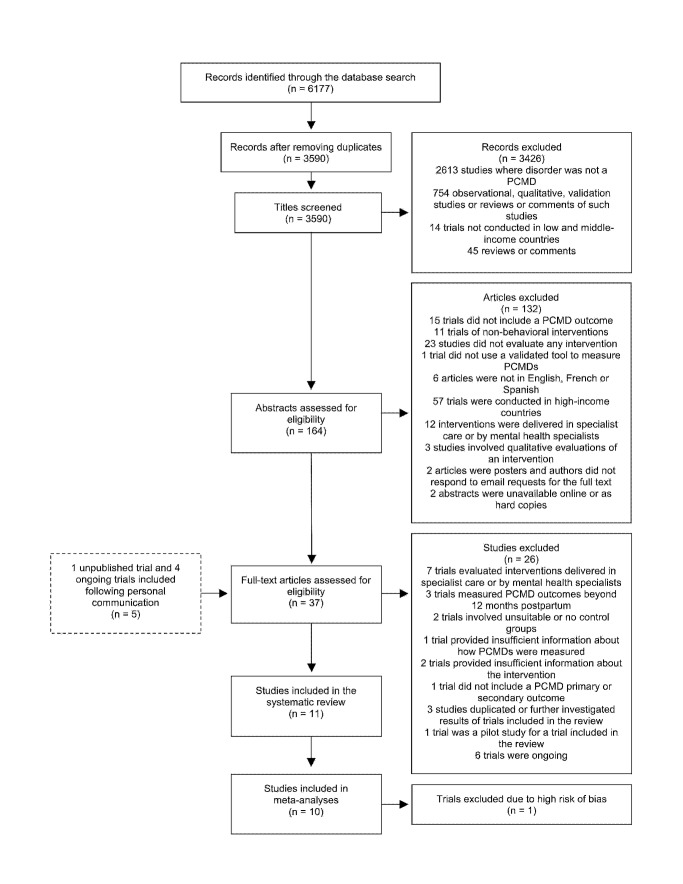
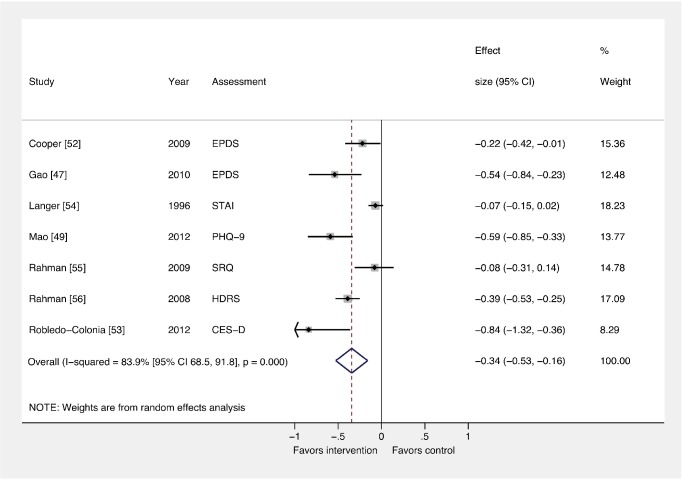
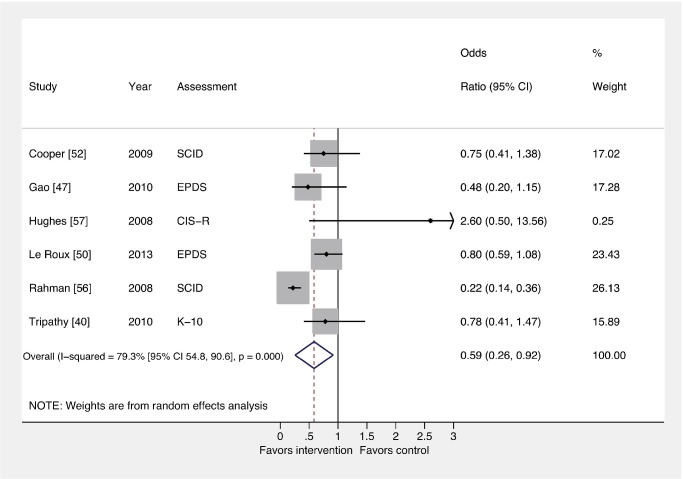
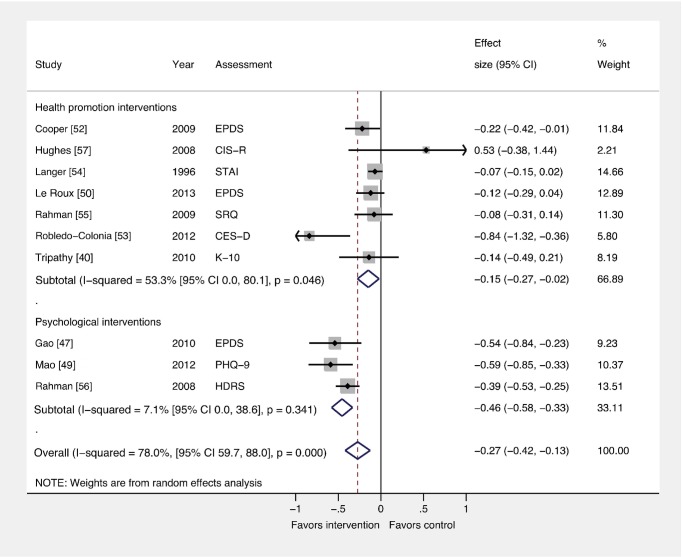
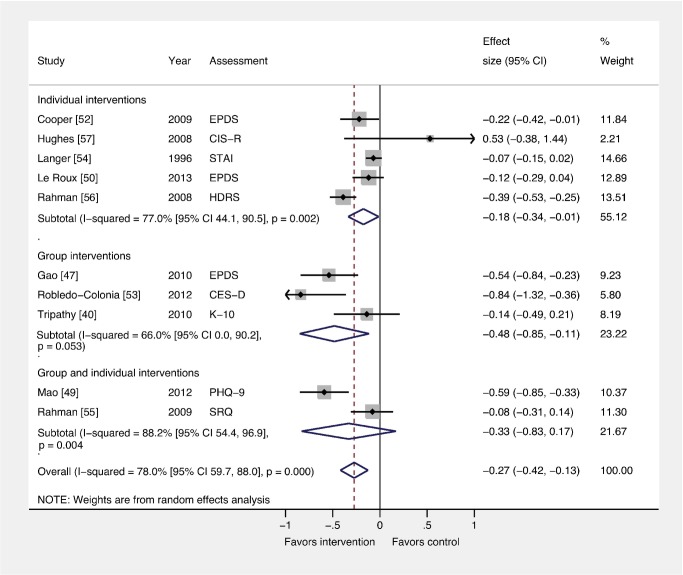
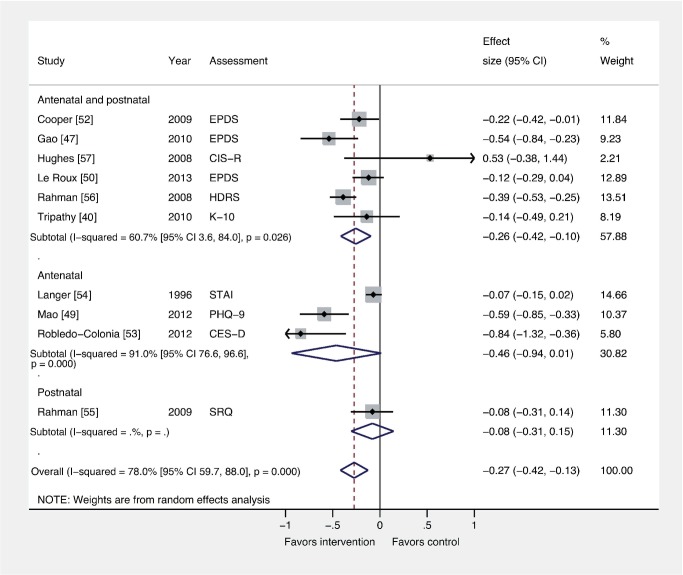
BACKGROUND: Perinatal common mental disorders (PCMDs) are a major cause of disability among women. Psychosocial interventions are one approach to reduce the burden of PCMDs. Working with care providers who are not mental health specialists, in the community or in antenatal health care facilities, can expand access to these interventions in low-resource settings. We assessed effects of such interventions compared to usual perinatal care, as well as effects of interventions based on intervention type, delivery method, and timing. METHODS AND FINDINGS: We conducted a systematic review, meta-analysis, and meta-regression. We searched databases including Embase and the Global Health Library (up to 7 July 2013) for randomized and non-randomized trials of psychosocial interventions delivered by non-specialist mental health care providers in community settings and antenatal health care facilities in low- and middle-income countries. We pooled outcomes from ten trials for 18,738 participants. Interventions led to an overall reduction in PCMDs compared to usual care when using continuous data for PCMD symptomatology (effect size [ES] -0.34; 95% CI -0.53, -0.16) but not binary categorizations for presence or absence of PCMDs (OR 0.62, 95% CI 0.35, 1.080 [corrected]. We found a significantly larger ES for psychological interventions (three studies; ES -0.46; 95% CI -0.58, -0.33) than for health promotion interventions (seven studies; ES -0.15; 95% CI -0.27, -0.02). Both individual (five studies; ES -0.18; 95% CI -0.34, -0.01) and group (three studies; ES -0.48; 95% CI -0.85, -0.11) interventions were effective compared to usual care, though delivery method was not associated with ES (meta-regression β coefficient -0.11; 95% CI -0.36, 0.14). Combined group and individual interventions (based on two studies) had no benefit compared to usual care, nor did interventions restricted to pregnancy (three studies). Intervention timing was not associated with ES (β 0.16; 95% CI -0.16, 0.49). The small number of trials and heterogeneity of interventions limit our findings. CONCLUSIONS: Psychosocial interventions delivered by non-specialists are beneficial for PCMDs, especially psychological interventions. Research is needed on interventions in low-income countries, treatment versus preventive approaches, and cost-effectiveness. Please see later in the article for the Editors' Summary.
Overview
The claims and statistics of this paper haven’t been checked yet.
Run the check — free, no account needed. It reads the open-access text and checks the sources it cites.
Integrity signals
Registry
Cites
Statistics
Figures
Verification
Claims the paper makes
The claims and statistics of this paper haven’t been checked yet.
Run the check — free, no account needed. It reads the open-access text and checks the sources it cites.
Claims other papers make about this one
Each is checked against this paper’s own text: does it say what the citing paper says it does?
The source backs part of the claim, not all of it — or backs it for a different population, condition or comparison.
In the citing paper
“Existing reviews highlight the effectiveness of a number of interventions for PPD including medication (eg, antidepressant medication), health promotion interventions (eg, educational home visits) and psychological interventions (eg, cognitive–behavioural therapy (CBT) and interpersonal therapy.16–27”
From Effectiveness and acceptability of cognitive-behavioural therapy based interventions for maternal peripartum depression: A systematic review, meta-analysis and thematic synthesis protocol (2019) · cites this paper as [16]
Experimental — accuracy not yet measuredIn the citing paper
“While half the psychiatric outpatients surveyed reported a positive view of mental health apps, only one in four had ever downloaded an app and only one in ten was currently using an app. 644”
From Time for united action on depression: a Lancet–World Psychiatric Association Commission (2022) · cites this paper as [644]
Self-check
Percentages, sums and reported differences re-computed from the paper’s own numbers.
The self-check needs the paper’s full text.
Citations
Cites
Preferred Reporting Items for Systematic Reviews and Meta-Analyses: the PRISMA statement
Moher, D., Liberati, A., Tetzlaff, J., Altman, D. G., & for the PRISMA Group (2009) · BMJ · doi:10.1136/bmj.b2535 · Cited by 83,823
Preferred Reporting Items for Systematic Reviews and Meta-Analyses: The PRISMA Statement
Moher, D., Liberati, A., Tetzlaff, J., Altman, D. G., & The PRISMA Group (2009) · PLoS Medicine · doi:10.1371/journal.pmed.1000097 · Cited by 64,042
Preferred reporting items for systematic reviews and meta-analyses: the PRISMA Statement.
(2009) · PubMed Central · Cited by 44,859
Quantifying heterogeneity in a meta‐analysis
Higgins, J. P. T., & Thompson, S. G. (2002) · Statistics in Medicine · doi:10.1002/sim.1186 · Cited by 36,763
The Cochrane Collaboration's tool for assessing risk of bias in randomised trials
Higgins, J. P. T., Altman, D. G., Gotzsche, P. C., Juni, P., Moher, D., Oxman, A. D., Savovic, J., Schulz, K. F., Weeks, L., Sterne, J. A. C., et al. (2011) · BMJ · doi:10.1136/bmj.d5928 · Cited by 33,817
Detection of Postnatal Depression: Development of the 10-item Edinburgh Postnatal Depression Scale
Cox, J. L., Holden, J. M., & Sagovsky, R. (1987) · British Journal of Psychiatry · doi:10.1192/bjp.150.6.782 · Cited by 14,183
KESSLER, R. C., ANDREWS, G., COLPE, L. J., HIRIPI, E., MROCZEK, D. K., NORMAND, S.-L. T., WALTERS, E. E., & ZASLAVSKY, A. M. (2002) · Psychological Medicine · doi:10.1017/s0033291702006074 · Cited by 10,327
(1988) · NFER-Nelson eBooks · Cited by 5,560
Cochrane Handbook for Systematic Reviews of Interventions Version 5.0.1. The Cochrane Collaboration
Higgins, J., Green, S. R., & Higgins, J. (2008) · Cited by 5,544
Health promotion glossary (1998)
Nutbeam, D. (1998) · Health Promotion International · doi:10.1093/heapro/13.4.349 · Cited by 2,229
Reducing Risks for Mental Disorders: Frontiers for Preventive Intervention Research
(1994) · doi:10.17226/2139 · Cited by 2,073
Fisher, J., Cabral de Mello, M., Patel, V., Rahman, A., Tran, T., Holton, S., & Holmes, W. (2012) · Bulletin of the World Health Organization · doi:10.2471/blt.11.091850 · Cited by 1,798
Resources for mental health: scarcity, inequity, and inefficiency
Saxena, S., Thornicroft, G., Knapp, M., & Whiteford, H. (2007) · The Lancet · doi:10.1016/s0140-6736(07)61239-2 · Cited by 1,789 · cited 1×
“Their results may not be generalizable to low-resource settings, where specialists and financial resources for mental health care are scarce [11–13].”
BackgroundNutbeam, D. (1986) · Health Promotion International · doi:10.1093/heapro/1.1.113 · Cited by 1,566
Lewis, G., Pelosi, A. J., Araya, R., & Dunn, G. (1992) · Psychological Medicine · doi:10.1017/s0033291700030415 · Cited by 1,487
Cohort study of depressed mood during pregnancy and after childbirth
Evans, J., Heron, J., Francomb, H., Oke, S., & Golding, J. (2001) · BMJ · doi:10.1136/bmj.323.7307.257 · Cited by 1,273
Rahman, A., Malik, A., Sikander, S., Roberts, C., & Creed, F. (2008) · The Lancet · doi:10.1016/s0140-6736(08)61400-2 · Cited by 993
Bang, A., Bang, R., Baitule, S., Reddy, M., & Deshmukh, M. (1999) · The Lancet · doi:10.1016/s0140-6736(99)03046-9 · Cited by 987
EDITORIAL: Postpartum depression and child development
Murray, L., & Cooper, P. (1997) · Psychological Medicine · doi:10.1017/s0033291796004564 · Cited by 967
Harbord, R. M., & Higgins, J. P. T. (2008) · The Stata Journal: Promoting communications on statistics and Stata · doi:10.1177/1536867x0800800403 · Cited by 897
Manandhar, D. S., Osrin, D., Shrestha, B. P., Mesko, N., Morrison, J., Tumbahangphe, K. M., Tamang, S., Thapa, S., Shrestha, D., Thapa, B., et al. (2004) · The Lancet · doi:10.1016/s0140-6736(04)17021-9 · Cited by 847
Patel, V., Weiss, H. A., Chowdhary, N., Naik, S., Pednekar, S., Chatterjee, S., De Silva, M. J., Bhat, B., Araya, R., King, M., et al. (2010) · The Lancet · doi:10.1016/s0140-6736(10)61508-5 · Cited by 752
Self-citationJewkes, R. K., Nduna, M., Levin, J. B., Jama, N., Dunkle, K., Puren, A. J., & Duvvury, N. (2008) · BMJ · doi:10.1136/bmj.a506 · Cited by 747
Fu, R., Gartlehner, G., Grant, M., Shamliyan, T., Sedrakyan, A., Wilt, T. J., Griffith, L., Oremus, M., Raina, P., Ismaila, A., et al. (2011) · Journal of Clinical Epidemiology · doi:10.1016/j.jclinepi.2010.08.010 · Cited by 730
Group Interpersonal Psychotherapy for Depression in Rural Uganda: A Randomized Controlled Trial
Bolton, P., Bass, J., Neugebauer, R., Verdeli, H., Clougherty, K. F., Wickramaratne, P., Speelman, L., Ndogoni, L., & Weissman, M. (2003) · JAMA · doi:10.1001/jama.289.23.3117 · Cited by 655 · cited 1×
“IPT-based interventions have also shown promise in resourceconstrained settings: two trials in rural Uganda showed strong benefits of group IPT interventions delivered by non-mental health specialists for treating general depression in adults and adolescents [66,67].”
BackgroundBolton, P., Bass, J., Betancourt, T., Speelman, L., Onyango, G., Clougherty, K. F., Neugebauer, R., Murray, L., & Verdeli, H. (2007) · JAMA · doi:10.1001/jama.298.5.519 · Cited by 589
Psychosocial and psychological interventions for preventing postpartum depression
Dennis, C., & Creedy, D. K. (2004) · Cochrane Database of Systematic Reviews · doi:10.1002/14651858.cd001134.pub2 · Cited by 574
Psychosocial and psychological interventions for treating postpartum depression
Dennis, C.-L., & Hodnett, E. D. (2007) · Cochrane Database of Systematic Reviews · doi:10.1002/14651858.cd006116.pub2 · Cited by 565
Sartorius, N., Üstün, T. B., Lecrubier, Y., & Wittchen, H.-U. (1996) · British Journal of Psychiatry · doi:10.1192/s0007125000298395 · Cited by 541 · cited 1×
“We include interventions for all PCMDs since depression and anxiety often coexist, and subcategories of common mental disorder may lack conceptual validity in some cultures [16–18].”
MethodTripathy, P., Nair, N., Barnett, S., Mahapatra, R., Borghi, J., Rath, S., Rath, S., Gope, R., Mahto, D., Sinha, R., et al. (2010) · The Lancet · doi:10.1016/s0140-6736(09)62042-0 · Cited by 497
Self-citationUse of Selective Serotonin-Reuptake Inhibitors in Pregnancy and the Risk of Birth Defects
Alwan, S., Reefhuis, J., Rasmussen, S. A., Olney, R. S., & Friedman, J. M. (2007) · New England Journal of Medicine · doi:10.1056/nejmoa066584 · Cited by 495 · cited 1×
“, non-pharmacological interventions to influence thoughts, behaviors, skills, and associated feelings), given concerns about the safety of pharmacotherapy during the perinatal period and because access to psychotropic drugs and trained personnel to prescribe them can be limited in low-resource settings [19–22].”
BackgroundPsychosocial and psychological interventions for preventing postpartum depression
Dennis, C.-L., & Dowswell, T. (2013) · Cochrane Database of Systematic Reviews · doi:10.1002/14651858.cd001134.pub3 · Cited by 459
Surkan, P. J., Kennedy, C. E., Hurley, K. M., & Black, M. M. (2011) · Bulletin of the World Health Organization · doi:10.2471/blt.11.088187 · Cited by 458
Araya, R., Rojas, G., Fritsch, R., Gaete, J., Rojas, M., Simon, G., & Peters, T. J. (2003) · The Lancet · doi:10.1016/s0140-6736(03)12825-5 · Cited by 450
Evolution of Heterogeneity (I2) Estimates and Their 95% Confidence Intervals in Large Meta-Analyses
Thorlund, K., Imberger, G. L., Johnston, B. C., Walsh, M. W., Awad, T., Thabane, L., Gluud, C. N., Devereaux, P. J., & Wetterslev, J. (2012) · PLoS ONE · doi:10.1371/journal.pone.0039471 · Cited by 448
Cooper, P. J., Tomlinson, M., Swartz, L. M., Landman, M., Molteno, C., Stein, A. L., McPherson, K., & Murray, L. (2009) · BMJ · doi:10.1136/bmj.b974 · Cited by 426
Brockington, I., & Kumar, R. (1982) · Medical Entomology and Zoology · Cited by 424
Post-partum depression and the mother-infant relationship in a South African peri-urban settlement
Cooper, P. J., Tomlinson, M., Swartz, L., Woolgar, M., Murray, L., & Molteno, C. (1999) · British Journal of Psychiatry · doi:10.1192/bjp.175.6.554 · Cited by 422
Rahman, A., Fisher, J., Bower, P., Luchters, S., Tran, T., Yasamy, M. T., Saxena, S., & Waheed, W. (2013) · Bulletin of the World Health Organization · doi:10.2471/blt.12.109819 · Cited by 403
RAHMAN, A., IQBAL, Z., & HARRINGTON, R. (2003) · Psychological Medicine · doi:10.1017/s0033291703008286 · Cited by 396
Improving access to psychological treatments: lessons from developing countries
Patel, V., Chowdhary, N., Rahman, A., & Verdeli, H. (2011) · Behaviour Research and Therapy · doi:10.1016/j.brat.2011.06.012 · Cited by 394 · cited 1×
“Despite these apparent benefits of psychological interventions for common mental disorders, the interventions must be adapted for individual contexts [68].”
BackgroundParsons, C. E., Young, K. S., Rochat, T., Kringelbach, M. L., & Stein, A. L. (2011) · British Medical Bulletin · doi:10.1093/bmb/ldr047 · Cited by 391
Meta-analysis in Stata : an updated collection from the Stata journal
Palmer, T., & Sterne, J. A. C. (2015) · Medical Entomology and Zoology · Cited by 388
Grand Challenges: Integrating Maternal Mental Health into Maternal and Child Health Programmes
Rahman, A., Surkan, P. J., Cayetano, C. E., Rwagatare, P., & Dickson, K. E. (2013) · PLoS Medicine · doi:10.1371/journal.pmed.1001442 · Cited by 369
Miller, L. J. (2002) · JAMA · doi:10.1001/jama.287.6.762 · Cited by 367
Chibanda, D., Mesu, P., Kajawu, L., Cowan, F., Araya, R., & Abas, M. A. (2011) · BMC Public Health · doi:10.1186/1471-2458-11-828 · Cited by 319
Rojas, G., Fritsch, R., Solis, J., Jadresic, E., Castillo, C., González, M., Guajardo, V., Lewis, G., Peters, T. J., & Araya, R. (2007) · The Lancet · doi:10.1016/s0140-6736(07)61685-7 · Cited by 213
Listening to mothers: qualitative studies on motherhood and depression from Goa, India
Rodrigues, M. M., Patel, V., Jaswal, S., & de Souza, N. (2003) · Social Science & Medicine · doi:10.1016/s0277-9536(03)00062-5 · Cited by 213
Psychological treatment of postpartum depression: a meta-analysis.
Cuijpers, P., Brännmark, J. G., & van Straten, A. (2008) · Journal of Clinical Psychology · doi:10.1002/jclp.20432 · Cited by 202
Packages of care for depression in low- and middle-income countries
Patel, V., Simon, G., Chowdhary, N., Kaaya, S., & Araya, R. (2009) · PLoS Medicine · doi:10.1371/journal.pmed.1000159 · Cited by 202
Futterman, D., Shea, J., Besser, M., Stafford, S., Desmond, K., Comulada, W. S., & Greco, E. (2010) · AIDS Care · doi:10.1080/09540121003600352 · Cited by 177
Outcomes of home visits for pregnant mothers and their infants
le Roux, I. M., Tomlinson, M., Harwood, J. M., O’Connor, M. J., Worthman, C. M., Mbewu, N., Stewart, J., Hartley, M., Swendeman, D. T., Comulada, W. S., et al. (2013) · AIDS · doi:10.1097/qad.0b013e3283601b53 · Cited by 168
Bonari, L., Koren, G., Einarson, T. R., Jasper, J. D., Taddio, A., & Einarson, A. (2005) · Archives of Women s Mental Health · doi:10.1007/s00737-005-0094-8 · Cited by 168
Barber, S., & Gertler, P. (2008) · Health Policy and Planning · doi:10.1093/heapol/czn039 · Cited by 165
Impact of a mother–infant intervention in an indigent peri-urban South African context
Cooper, P., Landman, M., Tomlinson, M., Molteno, C., Swartz, L. M., & Murray, L. (2002) · The British Journal of Psychiatry · doi:10.1192/bjp.180.1.76 · Cited by 162
Robledo-Colonia, A. F., Sandoval-Restrepo, N., Mosquera-Valderrama, Y. F., Escobar-Hurtado, C., & Ramírez-Vélez, R. (2012) · Journal of Physiotherapy · doi:10.1016/s1836-9553(12)70067-x · Cited by 156
Lara, M. A., Navarro, C., & Navarrete, L. (2010) · Journal of Affective Disorders · doi:10.1016/j.jad.2009.06.024 · Cited by 146
Screening for postnatal depression in primary care: cost effectiveness analysis
Paulden, M., Palmer, S., Hewitt, C. E., & Gilbody, S. M. (2009) · BMJ · doi:10.1136/bmj.b5203 · Cited by 131
The effect of early stimulation on maternal depression: a cluster randomised controlled trial
Baker‐Henningham, H. (2005) · Archives of Disease in Childhood · doi:10.1136/adc.2005.073015 · Cited by 122
Rahman, A., Iqbal, Z., Roberts, C., & Husain, N. (2008) · Child Care Health and Development · doi:10.1111/j.1365-2214.2008.00897.x · Cited by 106
Selective Serotonin Reuptake Inhibitor Use and Risk of Gestational Hypertension
Toh, S., Mitchell, A. A., Louik, C., Werler, M. M., Chambers, C., & Hernández–Dı́az, S. (2009) · American Journal of Psychiatry · doi:10.1176/appi.ajp.2008.08060817 · Cited by 103
Gao, L., Chan, S. W., & Sun, K. (2011) · International Journal of Nursing Studies · doi:10.1016/j.ijnurstu.2011.09.010 · Cited by 93
The treatment of postnatal depression: A comprehensive literature review
Boath, E., & Henshaw, C. A. (2001) · Journal of Reproductive and Infant Psychology · doi:10.1080/02646830120073224 · Cited by 84
Medhin, G., Hanlon, C., Dewey, M. E., Alem, A., Tesfaye, F., Lakew, Z., Worku, B., Aray, M., Abdulahi, A., Tomlinson, M., et al. (2010) · BMC Psychiatry · doi:10.1186/1471-244x-10-32 · Cited by 82
Gao, L., Chan, S. W., Li, X., Chen, S., & Hao, Y. (2010) · International Journal of Nursing Studies · doi:10.1016/j.ijnurstu.2010.03.002 · Cited by 79
Morris, J. E., JONES, L. M., Berrino, A., Jordans, M. J. D., Okema, L., & Crow, C. (2012) · American Journal of Orthopsychiatry · doi:10.1111/j.1939-0025.2012.01168.x · Cited by 78
Problems with the differentiation of anxiety and depression
Wetzler, S. E., & Katz, M. M. (1989) · Journal of Psychiatric Research · doi:10.1016/0022-3956(89)90013-7 · Cited by 73
Hanlon, C., Whitley, R., Wondimagegn, D., Alem, A., & Prince, M. J. (2009) · Social Science & Medicine · doi:10.1016/j.socscimed.2009.07.043 · Cited by 73
The need for treatment evidence for common mental disorders in developing countries
Patel, V. (2000) · Psychological Medicine · doi:10.1017/s0033291799002147 · Cited by 72
Mao, H., Li, H.-J., Chiu, H. F. K., Chan, W. C., & Chen, S. (2012) · Perspectives In Psychiatric Care · doi:10.1111/j.1744-6163.2012.00331.x · Cited by 66
Maternal depression in low- and middle-income countries
Hanlon, C. (2012) · International Health · doi:10.1093/inthealth/ihs003 · Cited by 66
Cultural Dimensions of Depression in Bangladesh: A Qualitative Study in Two Villages of Matlab
Selim, N. (2010) · Journal of Health Population and Nutrition · doi:10.3329/jhpn.v28i1.4528 · Cited by 59
Effectiveness of a discharge education program in reducing the severity of postpartum depression
Ho, S.-M., Heh, S., Jevitt, C. M., Huang, L., Fu, Y.-Y., & Wang, L. (2009) · Patient Education and Counseling · doi:10.1016/j.pec.2009.01.009 · Cited by 55
Langer, A., Farnot, U., Garcı́a, C., Barros, F. C., Victora, C. G., Belizán, J. M., & Villar, J. (1996) · Social Science & Medicine · doi:10.1016/0277-9536(95)00262-6 · Cited by 49
Hof, E. V., Cuijpers, P. J., Waheed, W., & Stein, D. J. (2011) · African Journal of Psychiatry · doi:10.4314/ajpsy.v14i3.2 · Cited by 49
Psychosocial and psychological interventions for treating postpartum depression
Dennis, C.-L., & HODNETT, E. D. (2006) · Cochrane Database of Systematic Reviews · doi:10.1002/14651858.cd006116 · Cited by 49
McBain, R. K., Norton, D. J., Morris, J. E., Yasamy, M. T., & Betancourt, T. S. (2012) · PLoS Medicine · doi:10.1371/journal.pmed.1001166 · Cited by 45
Ali, N. S., Ali, B. S., Azam, I. S., & Khuwaja, A. K. (2010) · BMC Psychiatry · doi:10.1186/1471-244x-10-57 · Cited by 36
Review of interventions to prevent or treat postnatal depression
Morrell, C. (2006) · Clinical Effectiveness in Nursing · doi:10.1016/j.cein.2006.11.006 · Cited by 31
Patel, V. (1996) · The Lancet · doi:10.1016/s0140-6736(96)90083-5 · Cited by 22
Reduction of maternal depression: much remains to be done
Small, R. E., & Lumley, J. M. (2007) · The Lancet · doi:10.1016/s0140-6736(07)61669-9 · Cited by 9
A PSYCHO-EDUCATIONAL PROGRAMME FOR THE PRIMIGRAVIDAE
K, S. S. S., & G., B. (1998) · Nursing Journal of India · doi:10.48029/nji.1998.lxxxix301 · Cited by 2
A simple method for converting an odds ratio to effect size for use in meta-analysis
Chinn, S. (2000) · Statistics in Medicine · doi:10.1002/1097-0258(20001130)19:22
Research works printed but not linked: 3
- Goldberg D, Huxley P (1992) Common mental disorders: a biosocial model. London: Tavistock/Routledge.
- L Wu, 2007, Effectiveness of informational support for maternal anxiety and postpartum depression in Chinese mothers of premature infants: a quasi-experimental study, Asian J Nurs, 10, 251
- Hughes MW (2008) A randomised controlled trial of a perinatal psycho-social interventoin for postnatal depression in Goa, India [PhD dissertation]. London: Kings College London.
Cited by
Sorted by citations
Non-psychotic mental disorders in the perinatal period
Howard, L. M., Molyneaux, E., Dennis, C.-L., Rochat, T., Stein, A., & Milgrom, J. (2014) · The Lancet · doi:10.1016/s0140-6736(14)61276-9 · Cited by 1,328
Time for united action on depression: a Lancet–World Psychiatric Association Commission
Herrman, H., Patel, V., Kieling, C., Berk, M., Buchweitz, C., Cuijpers, P., Furukawa, T. A., Kessler, R. C., Kohrt, B. A., Maj, M., et al. (2022) · The Lancet · doi:10.1016/s0140-6736(21)02141-3 · Cited by 1,104
Psychological Treatments for the World: Lessons from Low- and Middle-Income Countries
Singla, D. R., Kohrt, B. A., Murray, L. K., Anand, A., Chorpita, B. F., & Patel, V. (2017) · Annual Review of Clinical Psychology · doi:10.1146/annurev-clinpsy-032816-045217 · Cited by 913
Economics and mental health: the current scenario
Knapp, M., & Wong, G. (2020) · World Psychiatry · doi:10.1002/wps.20692 · Cited by 409
Kohrt, B. A., Asher, L., Bhardwaj, A., Fazel, M. S., Jordans, M. J. D., Mutamba, B. B., Nadkarni, A., Pedersen, G. A., Singla, D. R., & Patel, V. (2018) · International Journal of Environmental Research and Public Health · doi:10.3390/ijerph15061279 · Cited by 381
Metadata
- Authors
- Clarke, K., King, M., & Prost, A.
- Affiliations
- University College London (GB)
- Venue
- PLoS Medicine
- Publisher
- Public Library of Science (PLoS)
- Published
- 2013-10-29
- Volume
- 10
- Issue
- 10
- Pages
- e1001541
- ISSN
- 1549-1277 (ISSN-L)
- 1549-1676
- PMC
- PMC3812075
- OpenAlex
- W2006651096
- Cited by
- 122
- References
- 84
- Citations by year
- 2026: 9 · 2025: 2 · 2024: 15 · 2023: 10 · 2022: 13 · 2021: 14 · 2020: 11 · 2019: 10 · 2018: 10 · 2017: 4 · 2016: 10 · 2015: 5 · 2014: 7 · 2013: 2
- FWCI
- 1.14
- Type
- journal article
- Language
- en
- Update notices
- correction (2014-06-25)
- Open access
- gold
- doi.org
- Locations
- PLoS Medicine (publishedVersion, cc-by)
- Europe PMC (PubMed Central) (publishedVersion, cc-by)
- PubMed Central (publishedVersion, cc-by)
- PubMed (publishedVersion)
- RePEc: Research Papers in Economics (submittedVersion)
- DOAJ (DOAJ: Directory of Open Access Journals) (submittedVersion, cc-by-sa)
- UCL Discovery (University College London) (submittedVersion)
- Figshare (submittedVersion, cc-by)
- Research Portal (King's College London) (submittedVersion, cc-by)
- Funders
- National Institute for Health and Care Research (NF-SI-0611-10210)
- Medical Research Council
- Topics
- Health Sciences › Medicine › Public Health, Environmental and Occupational Health › Maternal Mental Health During Pregnancy and Postpartum
- Health Sciences › Medicine › Psychiatry and Mental health › Mental Health Treatment and Access
- Health Sciences › Medicine › Pediatrics, Perinatology and Child Health › Global Maternal and Child Health
- Keywords
- psychosocial interventions, community-based intervention, prenatal care, low- and middle-income countries, psychological intervention, health promotion interventions, group intervention, individual interventions, intervention timing, access to mental health care, maternal mental health, postpartum depression, postpartum anxiety, perinatal anxiety
- MeSH terms
- Mental Disorders, Humans, Mental Health, Psychotherapy, Global Health
About these checks
Registry, retraction, Cites and statistics results are computed, not judged, with one exception: a printed reference that no index lists is read once by a model before it counts as a citation error. Claims are extracted by a model and kept only when their quote appears verbatim in the text; each cited source is then checked, with a model’s help, for whether it says what the claim relies on. Those verdicts can be wrong — read the claim’s quote and the cited source before relying on one.
Statistics and arithmetic are recomputed, not judged.
Confidence bands are shown only for fields calibrated on our annotated test set. None is calibrated yet, so no band is shown.
What counts as a claim ›How we measure confidence ›How we check this ›
Are you an author, or do you see a problem with this page? Request a review
