

The Impact of Pyrethroid Resistance on the Efficacy of Insecticide-Treated Bed Nets against African Anopheline Mosquitoes: Systematic Review and Meta-Analysis
Open accessThe DOI matches its Crossref record; 60 of the 61 references it cites were found in a registry or an index.
Abstract
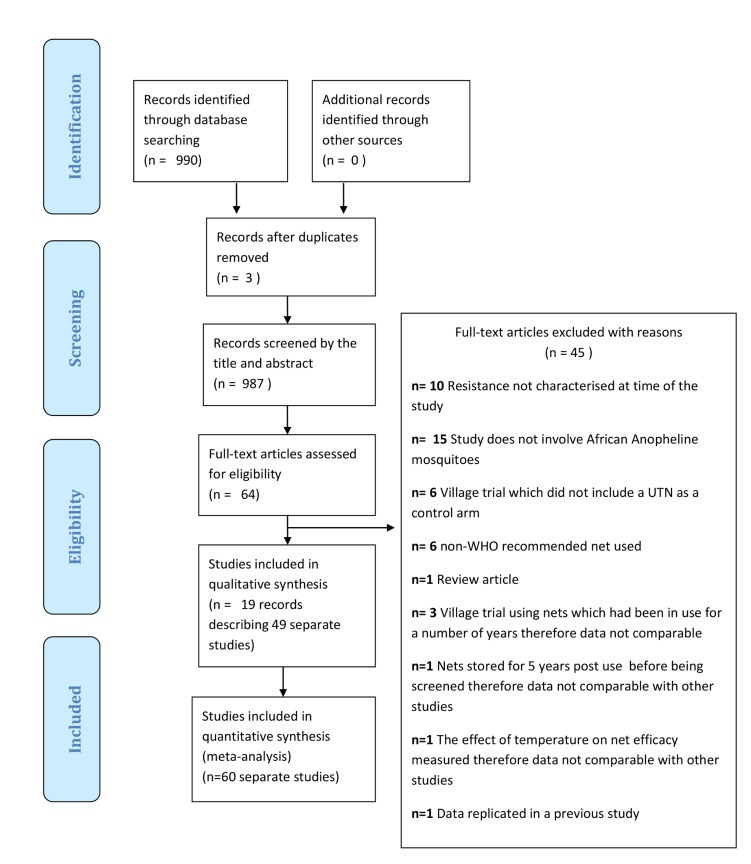
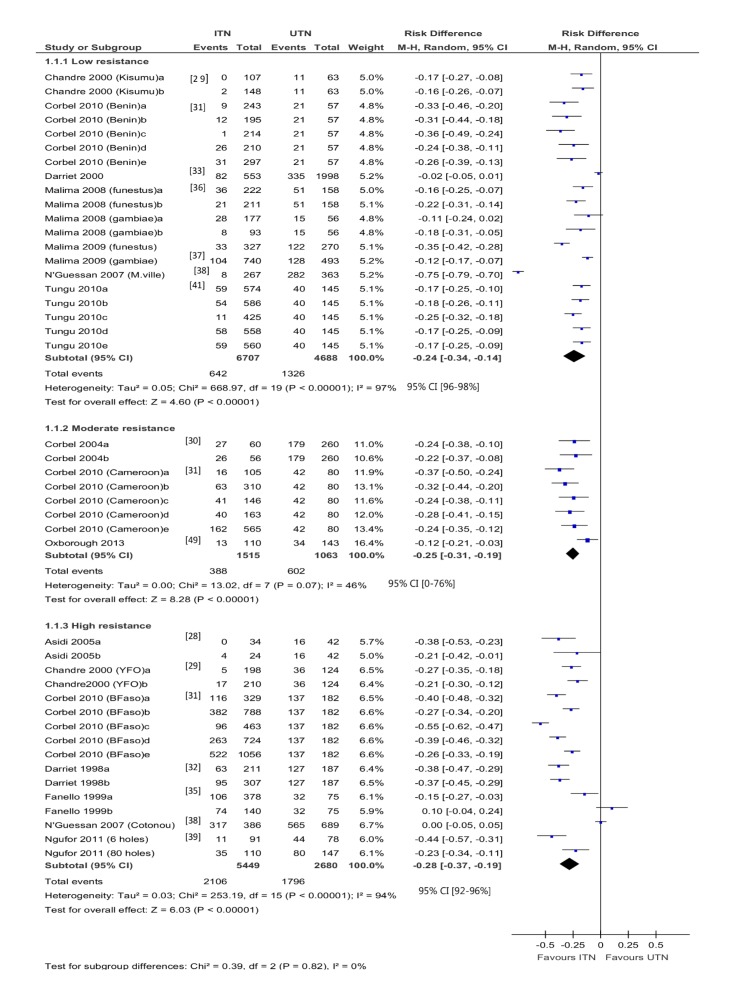
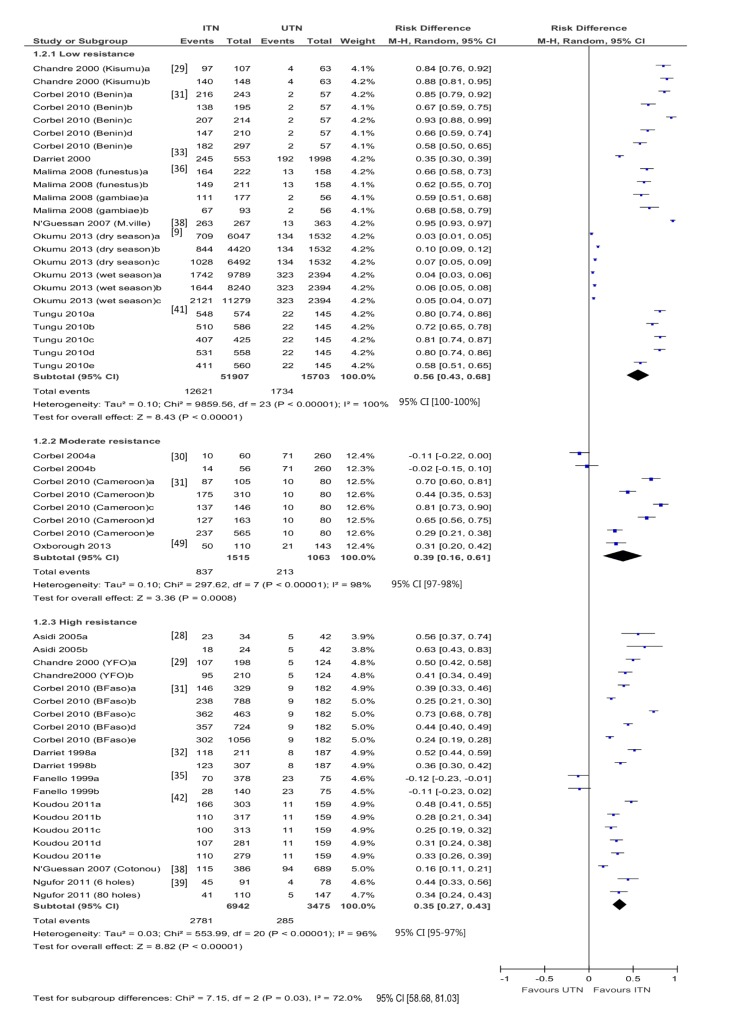
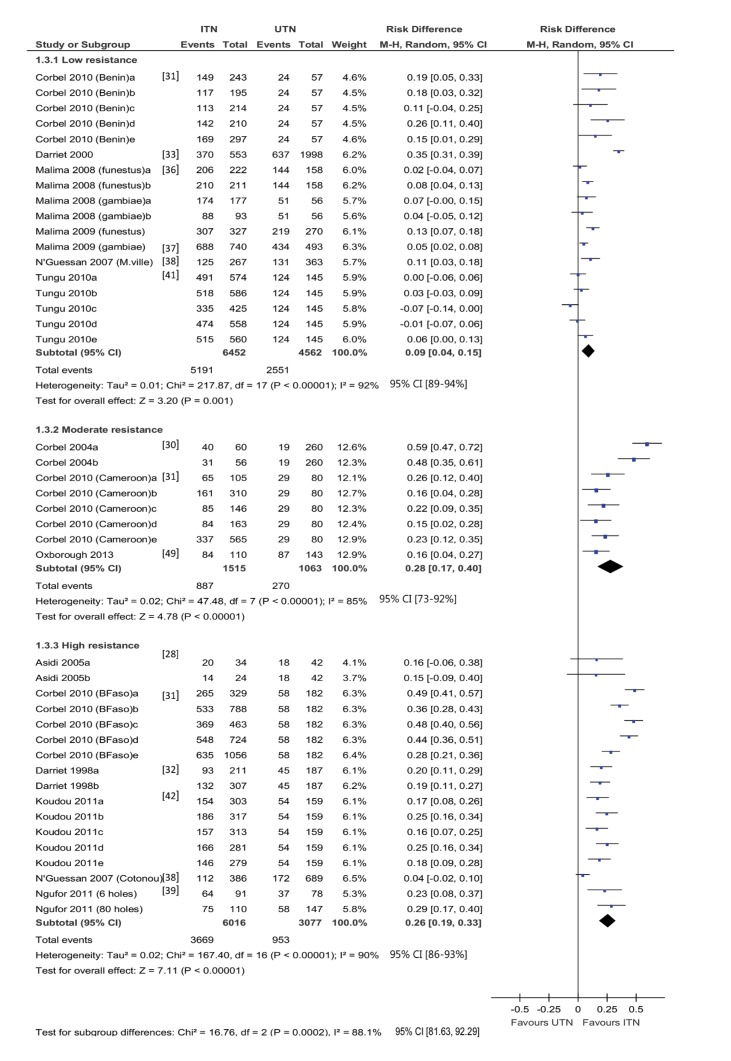
BACKGROUND: Pyrethroid insecticide-treated bed nets (ITNs) help contribute to reducing malaria deaths in Africa, but their efficacy is threatened by insecticide resistance in some malaria mosquito vectors. We therefore assessed the evidence that resistance is attenuating the effect of ITNs on entomological outcomes. METHODS AND FINDINGS: We included laboratory and field studies of African malaria vectors that measured resistance at the time of the study and used World Health Organization-recommended impregnation regimens. We reported mosquito mortality, blood feeding, induced exophily (premature exit of mosquitoes from the hut), deterrence, time to 50% or 95% knock-down, and percentage knock-down at 60 min. Publications were searched from 1 January 1980 to 31 December 2013 using MEDLINE, Cochrane Central Register of Controlled Trials, Science Citation Index Expanded, Social Sciences Citation Index, African Index Medicus, and CAB Abstracts. We stratified studies into three levels of insecticide resistance, and ITNs were compared with untreated bed nets (UTNs) using the risk difference (RD). Heterogeneity was explored visually and statistically. Included were 36 laboratory and 24 field studies, reported in 25 records. Studies tested and reported resistance inconsistently. Based on the meta-analytic results, the difference in mosquito mortality risk for ITNs compared to UTNs was lower in higher resistance categories. However, mortality risk was significantly higher for ITNs compared to UTNs regardless of resistance. For cone tests: low resistance, risk difference (RD) 0.86 (95% CI 0.72 to 1.01); moderate resistance, RD 0.71 (95% CI 0.53 to 0.88); high resistance, RD 0.56 (95% CI 0.17 to 0.95). For tunnel tests: low resistance, RD 0.74 (95% CI 0.61 to 0.87); moderate resistance, RD 0.50 (95% CI 0.40 to 0.60); high resistance, RD 0.39 (95% CI 0.24 to 0.54). For hut studies: low resistance, RD 0.56 (95% CI 0.43 to 0.68); moderate resistance, RD 0.39 (95% CI 0.16 to 0.61); high resistance, RD 0.35 (95% CI 0.27 to 0.43). However, with the exception of the moderate resistance category for tunnel tests, there was extremely high heterogeneity across studies in each resistance category (chi-squared test, p<0.00001, I² varied from 95% to 100%). CONCLUSIONS: This meta-analysis found that ITNs are more effective than UTNs regardless of resistance. There appears to be a relationship between resistance and the RD for mosquito mortality in laboratory and field studies. However, the substantive heterogeneity in the studies' results and design may mask the true relationship between resistance and the RD, and the results need to be interpreted with caution. Our analysis suggests the potential for cumulative meta-analysis in entomological trials, but further field research in this area will require specialists in the field to work together to improve the quality of trials, and to standardise designs, assessment, and reporting of both resistance and entomological outcomes.
Overview
The claims and statistics of this paper haven’t been checked yet.
Free: it reads the open-access text and checks the first 5 claims that cite a source we can check. Create a free account to check every claim.
Integrity signals
Registry
Cites
Statistics
Figures
Verification
Claims the paper makes
The claims and statistics of this paper haven’t been checked yet.
Free: it reads the open-access text and checks the first 5 claims that cite a source we can check. Create a free account to check every claim.
Claims other papers make about this one
Each is checked against this paper’s own text: does it say what the citing paper says it does?
The source backs part of the claim, not all of it — or backs it for a different population, condition or comparison.
In the citing paper
“However, if the trait is in high frequency and especially in combination with metabolic mechanisms, it may then impact the effectiveness of pyrethroid insecticides for malaria vector control as shown in a systematic review with meta-analysis [113].”
From Evolution of insecticide resistance and its mechanisms in Anopheles stephensi in the WHO Eastern Mediterranean Region (2020) · cites this paper as [113]
Experimental — accuracy not yet measured
Self-check
Percentages, sums and reported differences re-computed from the paper’s own numbers.
The self-check needs the paper’s full text.
Citations
Cites
1 retracted
Ndiath, M. O., Sougoufara, S., Gaye, A., Mazenot, C., Konate, L., Faye, O., Sokhna, C., & Trape, J.-F. (2012) · PLoS ONE · doi:10.1371/journal.pone.0031943 · Cited by 47 · cited 4×
“One comparison [22], with high resistance mosquitoes, reported 80% and 20% induced exophily (figures estimated from graph) in the ITN and UTN groups, respectively (RD = 0.”
BackgroundInfluentialRetractedInsecticide-treated bed nets and curtains for preventing malaria
Lengeler, C. (2004) · Cochrane Database of Systematic Reviews · doi:10.1002/14651858.cd000363.pub2 · Cited by 1,700 · cited 1×
“ITNs reduce deaths in children [2] and provide personal protection to the user, and at scale they provide community-wide protection by reducing the number of infective mosquitoes in the vicinity where ITNs are used [3,4].”
BackgroundIncreasing value and reducing waste in research design, conduct, and analysis
Ioannidis, J. P. A., Greenland, S., Hlatky, M. A., Khoury, M. J., Macleod, M. R., Moher, D., Schulz, K. F., & Tibshirani, R. (2014) · The Lancet · doi:10.1016/s0140-6736(13)62227-8 · Cited by 1,597
Ranson, H., N’Guessan, R., Lines, J., Moiroux, N., Nkuni, Z., & Corbel, V. (2011) · Trends in Parasitology · doi:10.1016/j.pt.2010.08.004 · Cited by 1,142 · cited 2×
“It is becoming increasingly clear that metabolic resistance often underpins pyrethroid resistance in mosquitoes, as demonstrated by both gene expression studies of resistant populations [11,17,18,19,20,54] and enzyme characterisation studies [55,56].”
BackgroundThe molecular basis of insecticide resistance in mosquitoes
Hemingway, J., Hawkes, N. J., McCarroll, L., & Ranson, H. (2004) · Insect Biochemistry and Molecular Biology · doi:10.1016/j.ibmb.2004.03.018 · Cited by 1,109 · cited 1×
“Metabolic resistance is caused by the activity of three large multi- gene families (cytochrome P450s, glutathione transferases, and carboxylesterases) that are able to metabolise or sequester the insecticide, thereby preventing it from reaching its target [16].”
BackgroundSelf-citationMartinez‐Torres, D., Chandre, F., Williamson, M. S., Darriet, F., Bergé, J. B., Devonshire, A. L., Guillet, P., Pasteur, N., & Pauron, D. (1998) · Insect Molecular Biology · doi:10.1046/j.1365-2583.1998.72062.x · Cited by 1,040 · cited 1×
“arabiensis is underpinned by a non-silent point mutation (either L1014F or L1014S) in the sodium channel gene, which is referred to as the knock-down resistance (kdr) genotype [14,15].”
BackgroundChan, M. (2010) · Cited by 842
Ranson, H., Jensen, B., Vulule, J. M., Wang, X., Hemingway, J., & Collins, F. H. (2000) · Insect Molecular Biology · doi:10.1046/j.1365-2583.2000.00209.x · Cited by 645 · cited 1×
“arabiensis is underpinned by a non-silent point mutation (either L1014F or L1014S) in the sodium channel gene, which is referred to as the knock-down resistance (kdr) genotype [14,15].”
BackgroundSelf-citationN’Guessan, R., Corbel, V., Akogbéto, M., & Rowland, M. (2007) · Emerging Infectious Diseases · doi:10.3201/eid1302.060631 · Cited by 548
Anopheles funestus resistant to pyrethroid insecticides in South Africa
Hargreaves, K., Koekemoer, L. L., Brooke, B. D., Hunt, R. H., Mthembu, J., & Coetzee, M. (2000) · Medical and Veterinary Entomology · doi:10.1046/j.1365-2915.2000.00234.x · Cited by 530 · cited 1×
“funestus in South Africa [57].”
Cited by
Items 201–278 of 278
Yang, B. K., Liu, H., Xu, Q., Sun, Y., Xu, S., Zhang, H., Tang, J., Zhu, G., Liu, Y., Cao, J., et al. (2021) · Frontiers in Genetics · doi:10.3389/fgene.2021.688606 · Cited by 2
“, 2015; WWARN, 2015) along with vector resistance to insecticides (Dhiman and Veer, 2014; Strode et al., 2014) have the potential to reduce the impact of existing malaria control strategies and make vaccines a public health priority.”
BackgroundMburu, M. M. (2019) · doi:10.18174/471415 · Cited by 7
“Furthermore, a similar challenge applies to LLINs such that resistance of mosquitoes to these insecticides (Ranson et al. 2011, Strode et al. 2014, Hemingway et al. 2016) raises concern on the effectiveness of these tools for malaria control.”
BackgroundInfluentialEchodu, R., Anena, J., Iwiru, T., Mireji, P., Malinga, G. M., Opiyo, E. A., Iga, J., & David, O. (2020) · Research Square · doi:10.21203/rs.3.rs-16734/v1 · Cited by 2
“Despite these significant gains, long-term effectiveness of malaria vector controls using LLINs and IRS is currently being challenged by widespread insecticide resistance in mosquito populations [3, 4].”
BackgroundNelly, O. K., David, E. M., Blessing, A. O., Matthew, E. A., & Michael, O. K. (2019) · International NGO Journal · doi:10.5897/ingoj2019.0341 · Cited by 1
Sharma, S., Gupta, S., Chaudhary, M., Loach, N., & Mohan, L. (2026) · Parasitology International · doi:10.1016/j.parint.2026.103241 · Cited by 1
Guido, G., Totaro, V., Lochoro, P., Ictho, J., Occa, E., Chhaganlal, K. D., Segala, F. V., Dall’Oglio, G., Mechendura, B. F., Gomonda, E. D. S., et al. (2026) · PLoS neglected tropical diseases · doi:10.1371/journal.pntd.0014186 · Cited by 1
“The effectiveness of ITNs and IRS may be compromised by the selective pressure exerted by agriculture-related insecticide use, urban pollution, and widespread pesticide application [117,118].”
Munywoki, D. N., MWANGANGI, J. M., Moise, I. K., Kokwaro, E. D., Odero, J. O., & Muturi, E. J. (2025) · Medical and Veterinary Entomology · doi:10.1111/mve.70042 · Cited by 2
Transcriptional regulation of CYP6M2 gene in the mosquito Anopheles gambiae cell line
Mohammed, B. R., Wilding, C. S., Collier, P. J., & Deeni, Y. (2014) · European Journal of Biotechnology and Bioscience · Cited by 1
Okoh, F. N. (2022) · Zoologist (The) · doi:10.4314/tzool.v20i1.15 · Cited by 1
Literature Review on Malaria in Saudi Arabia
Qudsi, H. M., Almowlad, S. K., Algamdi, S. A., Bakhiet, M. M., Algarni, S. M., Almohammadi, E. L., & Alqahtani, A. H. (2025) · Advances in Infectious Diseases · doi:10.4236/aid.2025.152018 · Cited by 2
Tokponnon, F., Osse, R. A., Sovi, A., Wakpo, A., Aurore, H. O., Sissinto, Y., Adéchoubou, A., Houansou, T., Okè, M., Dorothée, K.-G., et al. (2022) · Advances in Infectious Diseases · doi:10.4236/aid.2022.121005 · Cited by 1
“For example, a meta-analysis found that LLINs provided better protection than untreated nets [18], even in areas where mosquitoes were resistant to pyrethroids.”
BackgroundPokhrel, V., & Ottea, J. A. (2024) · Pesticide Biochemistry and Physiology · doi:10.1016/j.pestbp.2024.105906 · Cited by 1
Echodu, R., Anena, J., Iwiru, T., Mireji, P. O., Malinga, G. M., Opiyo, E. A., Iga, J., & Onanyang, D. (2020) · Research Square · doi:10.21203/rs.3.rs-16734/v2 · Cited by 1
Echodu, R., Oyet, W. S., Iwiru, T., Apili, F., Lutwama, J. J., Opiyo, E. A., & Otim, O. (2020) · Research Square · doi:10.21203/rs.3.rs-74137/v1 · Cited by 1
“As in other studies, malaria has been recorded in areas where there is high intervention of IRS and ITN [34, 35] and this could be attributed to a number of factors among which could be attributed to high mosquito insecticide resistance [47, 48] sharing bed nets that end up reducing the protective e ciency since human…”
ResultMulatier, M. (2018) · theses.fr (ABES) · doi:10.70675/5c1a3ba4z176fz4d21z9720z51b6e066e7d9 · Cited by 4
Sikaala, C. (2015) · University of Liverpool · doi:10.17638/02006479 · Cited by 1
Ngufor, C. (2015) · LSHTM Research Online (London School of Hygiene and Tropical Medicine) · doi:10.17037/pubs.02124338
Pre-erythrocytic Stage of Malaria Infection and the Molecular Targets Available for Interventions
Adah, D., Yang, Y. J., Liu, Q., Qin, L., Qin, L., & Chen, X. (2016) · The Journal of Advances in Parasitology · doi:10.14737/journal.jap/2016/3.4.132.141
Malaria control dynamics may explain inconsistent outcomes from bednet trials: a modeling studyPreprint
Orsborne, J., Walker, T., & Yakob, L. (2018) · bioRxiv (Cold Spring Harbor Laboratory) · doi:10.1101/435438
Falvo, M. L. (2019) · El Servicio de Difusión de la Creación Intelectual (National University of La Plata) · doi:10.35537/10915/73538 · Cited by 1
“Allí se utilizan regularmente cortinas y mosquiteros de cama impregnados con insecticidas sobre los cuales se posa el insecto cuando busca a su hospedador durante la noche (Lindsay et al., 1991; Strode et al., 2014).”
BackgroundHughes, A. (2019) · University of Liverpool · doi:10.17638/03029923
“…of IR on malaria transmission 1.9.1 Personal protection A systematic review and meta-analysis of published results on the impact of pyrethroid resistance on the efficacy of LLINs against anopheline mosquitoes, showed that LLINs can remain effective even when IR has developed (Strode et al. 2014).”
BackgroundInfluentialTabbabi, A., Daaboub, J., Laamari, A., Cheikh, R. B., Feriani, M., Boubaker, C., Jha, I. B., & Cheikh, H. B. (2019) · Journal of the Kansas Entomological Society · doi:10.2317/0022-8567-92.1.351
“Although the link between bioassay data and epidemiological failure of control programs is not well established (Strode et al., 2014), insecticide susceptibility bioassay data are an indicator if targeted mosquitoes respond well to the insecticides in use (Thomsen et al., 2014).”
BackgroundAli, M., Ibrahim, R. A., Alahmadi, S., Alsharif, S. M., Mansour, F., Elshazly, H., & Shawer, D. (2020) · Journal of Taibah University for Science · doi:10.1080/16583655.2020.1836909
Efficacy Of Clarias Alluaudi As A Biocontrol Agent For Anopheles Mosquitoes
Wamukota, P. S. N. (2020) · Cited by 1
THE CHANGING SPATIAL EPIDEMIOLOGY OF MALARIA IN THE DEMOCRATIC REPUBLIC OF THE CONGO
Deutsch-Feldman, M. (2020) · Carolina Digital Repository (University of North Carolina at Chapel Hill) · doi:10.17615/ns9r-r082
Agblonon, T., Aïzoun, N., & Chougourou, D. C. (2022) · Global Journal of Engineering and Technology Advances · doi:10.30574/gjeta.2022.12.1.0113
Esterase Mediated Insecticide Resistance in the Southern House Mosquito, Culex quinquefasciatus
Pokhrel, V. (2022) · Louisiana State University · doi:10.31390/gradschool_dissertations.5990 · Cited by 1
Jannah, I. F., Shari, A., Sari, M. P., Radhina, A., & Arianto, S. (2023) · Indonesian Journal of Health Science · doi:10.54957/ijhs.v3i2a.490
Association of anthelmintic treatment with malaria prevalence in Rural Sussundenga, Mozambique
Akambase, J. A., Ferrao, J. L., Bibe, A. F., Muhiro, V., Novela, A., Earland, D. E., & Searle, K. M. (2023) · Wellcome Open Research · doi:10.12688/wellcomeopenres.19548.1 · Cited by 1
“It is also due to increasing vector resistance to insecticides 7,8 .”
BackgroundThe Limits of Bed Nets, Markets, and Communities
Carson, B. (2023) · Springer eBooks · doi:10.1007/978-3-031-39510-9_10
Mgaya, J. N. (2022) · doi:10.58694/20.500.12479/1517
“However, these efforts are greatly threatened by multiple factors notably insecticide resistance (Kleinschmidt & Rowland, 2021; Strode et al., 2014), changes in human and mosquito behavioural factors (Finda et al., 2019; Monroe et al., 2019; Okumu & Finda, 2021), reduced efficacy of LLINS and IRS…”
BackgroundEtzkorn, F. A. (2019) · Royal Society of Chemistry eBooks · doi:10.1039/bk9781788017985-00091
Adekunle, O. N., Mogaji, O. H., Oladunjoye, R. Y., Adeleke, T. M., Salisu, F. T., Agbolade, O., & Agbolade, M. O. (2022) · African Journal of Pure and Applied Sciences · doi:10.33886/ajpas.v3i2.297
“For now, LLINs usage still remains a positive control measure in curtailing malaria (Strode et al., 2014).”
BackgroundLugenge, A. G., Odufuwa, O. G., Mseti, J. J., Swai, J. K., Skovmand, O., & Moore, S. (2024) · Parasites & Vectors · doi:10.1186/s13071-024-06323-4
“However, due to the increasing resistance of mosquitoes to pyrethroid insecticides [7, 8], dual-active ingredient (AI) ITNs including pyrethroid with additional AI including chlorfenapyr, pyriproxyfen and piperonyl butoxide (PBO) have been developed [9].”
BackgroundImagining the Future of Bed Nets for Malaria Control in Africa
Okumu, F. O., & Kaindoa, E. W. (2024) · CABI eBooks · doi:10.1079/9781789248845.0009
Nkya, T. E. (2025) · East Africa Science · doi:10.24248/easci.v7i1.105 · Cited by 1
Kassupá, J. E. A., Andrade, A. O., Bastos, A. D. S., Moura, G. L. L., Rocha, M. L., do Na, N. M. L., Afonso, E., da Costa, W. D. J., Bargieri, D. Y., Teles, C. B. G., et al. (2026) · PLoS Pathogens · doi:10.1371/journal.ppat.1013531
Wolie, R. Z., Koffi, A. A., Alou, L. P. A., Sternberg, E. D., N’Nan-Alla, O., Dahounto, A., Yapo, F. H. A., Kanh, K. H. M., Camara, S., Oumbouke, W. A., et al. (2021) · Research Square · doi:10.21203/rs.3.rs-637056/v1
Lugenge, A. G., Odufuwa, O. G., Mseti, J. J., Swai, J. K., Skovmand, O., & Moore, S. J. (2024) · Figshare · doi:10.6084/m9.figshare.26724065
Echodu, R., Iga, J., Oyet, W. S., Mireji, P., Anena, J., Onanyang, D., Iwiru, T., Lutwama, J. J., & Opiyo, E. A. (2020) · Figshare · doi:10.6084/m9.figshare.12695991
Lugenge, A. G., Odufuwa, O. G., Mseti, J. J., Swai, J. K., Skovmand, O., & Moore, S. J. (2024) · Figshare · doi:10.6084/m9.figshare.26724044
Additional file 1 of Trends of insecticide resistance monitoring in mainland Tanzania, 2004–2020
Tungu, P., Kabula, B. I., Nkya, T. E., Machafuko, P., Sambu, E., Batengana, B., Sudi, W., Derua, Y. A., Mwingira, V. S., Masue, D., et al. (2023) · Figshare · doi:10.6084/m9.figshare.22625897
Echodu, R., Iga, J., Oyet, W. S., Mireji, P., Anena, J., Onanyang, D., Iwiru, T., Lutwama, J. J., & Opiyo, E. A. (2020) · Figshare · doi:10.6084/m9.figshare.12695994
Lugenge, A. G., Odufuwa, O. G., Mseti, J. J., Swai, J. K., Skovmand, O., & Moore, S. J. (2024) · Figshare · doi:10.6084/m9.figshare.26724053
Madgwick, P. G., Wubs, M., & Kanitz, R. (2024) · Figshare · doi:10.6084/m9.figshare.26621008
Lugenge, A. G., Odufuwa, O. G., Mseti, J. J., Swai, J. K., Skovmand, O., & Moore, S. J. (2024) · Figshare · doi:10.6084/m9.figshare.26724047
Madgwick, P. G., & Kanitz, R. (2022) · Figshare · doi:10.6084/m9.figshare.19418556
Madgwick, P. G., Wubs, M., & Kanitz, R. (2024) · Figshare · doi:10.6084/m9.figshare.26621005
Madgwick, P. G., Wubs, M., & Kanitz, R. (2024) · Figshare · doi:10.6084/m9.figshare.24223887
Echodu, R., Iga, J., Oyet, W. S., Mireji, P., Anena, J., Onanyang, D., Iwiru, T., Lutwama, J. J., & Opiyo, E. A. (2020) · Figshare · doi:10.6084/m9.figshare.12696000
Lugenge, A. G., Odufuwa, O. G., Mseti, J. J., Swai, J. K., Skovmand, O., & Moore, S. J. (2024) · Figshare · doi:10.6084/m9.figshare.26724056
Jones, J., Matope, A., Barreaux, P., Gleave, K., Steen, K., Ranson, H., McCall, P. J., & Foster, G. M. (2024) · Figshare · doi:10.6084/m9.figshare.24572216
Madgwick, P. G., Wubs, M., & Kanitz, R. (2023) · Figshare · doi:10.6084/m9.figshare.24223757
Madgwick, P. G., Wubs, M., & Kanitz, R. (2024) · Figshare · doi:10.6084/m9.figshare.26621011
Madgwick, P. G., & Kanitz, R. (2022) · Figshare · doi:10.6084/m9.figshare.19418550
Koudou, G. B., Monroe, A. C., Irish, S. R., Humes, M., Krezanoski, J. D., Koenker, H. M., Malone, D., Hemingway, J., & Krezanoski, P. J. (2022) · Figshare · doi:10.6084/m9.figshare.19351529
Self-citationEchodu, R., Iga, J., Oyet, W. S., Mireji, P., Anena, J., Onanyang, D., Iwiru, T., Lutwama, J. J., & Opiyo, E. A. (2020) · Figshare · doi:10.6084/m9.figshare.12695997
Grossman, M. K., Oliver, S. V., Brooke, B. D., & Thomas, M. B. (2020) · Figshare · doi:10.6084/m9.figshare.12096321
Madgwick, P. G., & Kanitz, R. (2022) · Figshare · doi:10.6084/m9.figshare.19418553
Lugenge, A. G., Odufuwa, O. G., Mseti, J. J., Swai, J. K., Skovmand, O., & Moore, S. J. (2024) · Figshare · doi:10.6084/m9.figshare.26724059
Jones, J., Matope, A., Barreaux, P., Gleave, K., Steen, K., Ranson, H., McCall, P. J., & Foster, G. M. (2023) · Figshare · doi:10.6084/m9.figshare.24571828
Madgwick, P. G., Wubs, M., & Kanitz, R. (2024) · Figshare · doi:10.6084/m9.figshare.26621002
Lugenge, A. G., Odufuwa, O. G., Mseti, J. J., Swai, J. K., Skovmand, O., & Moore, S. J. (2024) · Figshare · doi:10.6084/m9.figshare.26724062
Lugenge, A. G., Odufuwa, O. G., Mseti, J. J., Swai, J. K., Skovmand, O., & Moore, S. J. (2024) · Figshare · doi:10.6084/m9.figshare.26724050
Kiam, B. C., Bouopda-Tuedom, A. G., Mbida, J. A. M., Ibrahima, I., Nanssong-Vomo, C. T., Abate, L., Feufack-Donfack, L. B., Fotso, B. T., & Nsango, S. E. (2026) · Parasites & Vectors · doi:10.1186/s13071-025-07156-5
“This physical damage is particularly concerning in a high-resistance area like Bertoua, where a hole provides an unimpeded pathway for mosquitoes that are no longer susceptible to the remaining insecticide [9, 51].”
Messenger, L. A., Pelloquin, B., Martin, J., Pantaleo, J., Bernard, E., Tang, A., Matowo, N. S., Vamos, E. E., Jessop, C., Minakawa, N., et al. (2026) · Research Square · doi:10.21203/rs.3.rs-8682736/v1 · Cited by 1
Tungu, P., Sudi, W., Batengana, B., Kisinza, W. N., & Rowland, M. (2026) · Parasites & Vectors · doi:10.1186/s13071-026-07294-4 · Cited by 1
Porciani, A. (2016) · theses.fr (ABES) · doi:10.70675/e64f5307z014bz4444zacb4zd9fe25ee64fa
Nkya, T. E. (2025) · Tanzania journal of health research/Tanzania Journal of Health Research · doi:10.4314/thrb.v26i5.10s
Kouame, K. R., Ouattara, A. F., Gleave, K., Fodjo, B. K., ZahouliZahouli, J. B., Kouame, R. M. A., Small, G. J., Snetselaar, J., & Koudou, B. G. (2026) · Parasites & Vectors · doi:10.1186/s13071-026-07431-z · Cited by 1
“While several studies have investigated the sublethal effects of standard pyrethroid insecticides [24–27], few have explored how sublethal exposure to new-generation insecticides affects mosquito life-history traits and potential pathogen transmission.”
Kolade, T. I., Jafar, A. B., Oyebamiji, D. A., Nnennaya, I. O., Adediran, A. D., Oyekola, O. O., Adeogun, A. O., Latunji, C. A., & Kehinde, O. K. P. (2026) · Parasitology International · doi:10.1016/j.parint.2026.103350
Kipsum, M., Agumba, S., Moshi, V., Muchoki, M., Omondi, S., Wekesa, C. N., Ouma, C., Abong’o, B., & Ochomo, E. (2026) · PLoS ONE · doi:10.1371/journal.pone.0331995 · Cited by 1
“This behavioral response could be due to the irritant or repellent effects of the insecticides, as observed in previous studies [26,27].”
Cyubahiro, B., Sudoi, R., Munyakanage, D., Mazimpaka, P., Muyirukazi, Y., Habanabakize, E., Mutabazi, A., Rukundo, G., Niyituma, E., Misago, X., et al. (2026) · Research Square · doi:10.21203/rs.3.rs-11127486/v1
Bate, F. B. T., Oyebog, F. E., Queenta, E. M., Agbor, E. D., Ali, I. M., Nche, N. N., Velda, E. B., & Mumah, C. A. (2026) · Texila international journal of academic research · doi:10.21522/tijar.2014.13.04.art011
Metadata
- Authors
- Strode, C., Donegan, S., Garner, P., Enayati, A. A., & Hemingway, J.
- Affiliations
- Edge Hill University (GB)
- Liverpool School of Tropical Medicine (GB)
- Corresponding author
- Strode, Clare
- Venue
- PLoS Medicine
- Publisher
- Public Library of Science (PLoS)
- Published
- 2014-03-18
- Volume
- 11
- Issue
- 3
- Pages
- e1001619
- ISSN
- 1549-1277 (ISSN-L)
- 1549-1676
- PMC
- PMC3958359
- OpenAlex
- W1972528017
- Cited by
- 274
- References
- 61
- Citations by year
- 2026: 13 · 2025: 14 · 2024: 14 · 2023: 20 · 2022: 28 · 2021: 20 · 2020: 31 · 2019: 24 · 2018: 24 · 2017: 25 · 2016: 26 · 2015: 27 · 2014: 8
- FWCI
- 4.48
- Type
- journal article
- Language
- en
- Open access
- gold
- doi.org
- Locations
- PLoS Medicine (publishedVersion, cc-by)
- Europe PMC (PubMed Central) (publishedVersion, cc-by)
- PubMed Central (publishedVersion, cc-by)
- PubMed (publishedVersion)
- Edge Hill University Research Information Repository (Edge Hill University) (publishedVersion, cc-by)
- LSTM Online Archive (Liverpool School of Tropical Medicine) (acceptedVersion)
- Edge Hill University (submittedVersion)
- RePEc: Research Papers in Economics (submittedVersion)
- DOAJ (DOAJ: Directory of Open Access Journals) (submittedVersion, cc-by-sa)
- Figshare (submittedVersion, cc-by)
- Funders
- United States Agency for International Development
- Bill and Melinda Gates Foundation
- Department for International Development
- Centers for Disease Control and Prevention
- Medical Research Council (MR/K021435/1)
- Topics
- Health Sciences › Medicine › Public Health, Environmental and Occupational Health › Malaria Research and Control
- Life Sciences › Agricultural and Biological Sciences › Plant Science › Insect Pest Control Strategies
- Life Sciences › Biochemistry, Genetics and Molecular Biology › Molecular Biology › Insect Resistance and Genetics
- Keywords
- pyrethroid resistance, insecticide-treated nets, anopheline mosquitoes, malaria vectors, insecticide resistance, mosquito mortality, knockdown, blood feeding, exophily, deterrence, Africa, malaria control, vector control, insecticide rotation
- MeSH terms
- Africa, Animals, Insecticide Resistance, Insecticides, Malaria, Mosquito Control, Culicidae, Pyrethrins, Insecticide-Treated Bednets
About these checks
Registry, retraction, Cites and statistics results are computed, not judged, with one exception: a printed reference that no index lists is read once by a model before it counts as a citation error. Claims are extracted by a model and kept only when their quote appears verbatim in the text; each cited source is then checked, with a model’s help, for whether it says what the claim relies on. Those verdicts can be wrong — read the claim’s quote and the cited source before relying on one.
Statistics and arithmetic are recomputed, not judged.
Confidence bands are shown only for fields calibrated on our annotated test set. None is calibrated yet, so no band is shown.
What counts as a claim ›How we measure confidence ›How we check this ›
Are you an author, or do you see a problem with this page? Request a review
Data sources
Bibliographic data: Semantic Scholar, OpenAlex, Crossref.
Contains information from the Semantic Scholar Academic Graph Datasets, made available under the ODC Attribution License (ODC-BY 1.0).
Semantic Scholar’s data is described in: Kinney, R., et al. (2023). The Semantic Scholar Open Data Platform. arXiv:2301.10140.
