

The Impact of Pyrethroid Resistance on the Efficacy of Insecticide-Treated Bed Nets against African Anopheline Mosquitoes: Systematic Review and Meta-Analysis
Open accessThe DOI matches its Crossref record; 60 of the 61 references it cites were found in a registry or an index.
Abstract
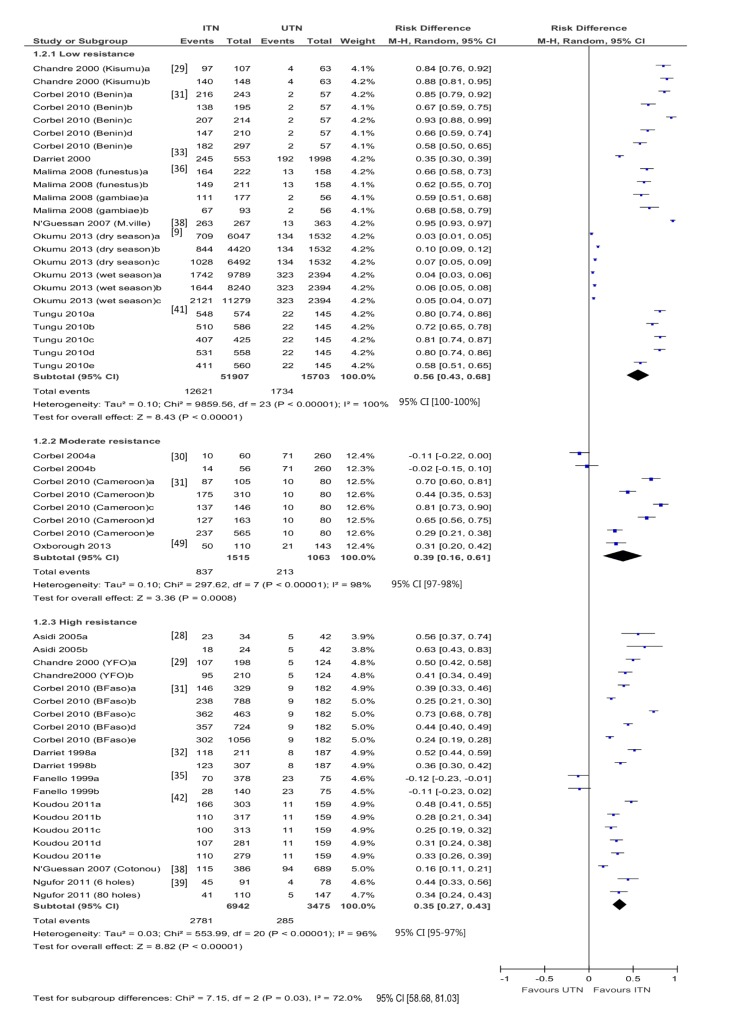
BACKGROUND: Pyrethroid insecticide-treated bed nets (ITNs) help contribute to reducing malaria deaths in Africa, but their efficacy is threatened by insecticide resistance in some malaria mosquito vectors. We therefore assessed the evidence that resistance is attenuating the effect of ITNs on entomological outcomes. METHODS AND FINDINGS: We included laboratory and field studies of African malaria vectors that measured resistance at the time of the study and used World Health Organization-recommended impregnation regimens. We reported mosquito mortality, blood feeding, induced exophily (premature exit of mosquitoes from the hut), deterrence, time to 50% or 95% knock-down, and percentage knock-down at 60 min. Publications were searched from 1 January 1980 to 31 December 2013 using MEDLINE, Cochrane Central Register of Controlled Trials, Science Citation Index Expanded, Social Sciences Citation Index, African Index Medicus, and CAB Abstracts. We stratified studies into three levels of insecticide resistance, and ITNs were compared with untreated bed nets (UTNs) using the risk difference (RD). Heterogeneity was explored visually and statistically. Included were 36 laboratory and 24 field studies, reported in 25 records. Studies tested and reported resistance inconsistently. Based on the meta-analytic results, the difference in mosquito mortality risk for ITNs compared to UTNs was lower in higher resistance categories. However, mortality risk was significantly higher for ITNs compared to UTNs regardless of resistance. For cone tests: low resistance, risk difference (RD) 0.86 (95% CI 0.72 to 1.01); moderate resistance, RD 0.71 (95% CI 0.53 to 0.88); high resistance, RD 0.56 (95% CI 0.17 to 0.95). For tunnel tests: low resistance, RD 0.74 (95% CI 0.61 to 0.87); moderate resistance, RD 0.50 (95% CI 0.40 to 0.60); high resistance, RD 0.39 (95% CI 0.24 to 0.54). For hut studies: low resistance, RD 0.56 (95% CI 0.43 to 0.68); moderate resistance, RD 0.39 (95% CI 0.16 to 0.61); high resistance, RD 0.35 (95% CI 0.27 to 0.43). However, with the exception of the moderate resistance category for tunnel tests, there was extremely high heterogeneity across studies in each resistance category (chi-squared test, p<0.00001, I² varied from 95% to 100%). CONCLUSIONS: This meta-analysis found that ITNs are more effective than UTNs regardless of resistance. There appears to be a relationship between resistance and the RD for mosquito mortality in laboratory and field studies. However, the substantive heterogeneity in the studies' results and design may mask the true relationship between resistance and the RD, and the results need to be interpreted with caution. Our analysis suggests the potential for cumulative meta-analysis in entomological trials, but further field research in this area will require specialists in the field to work together to improve the quality of trials, and to standardise designs, assessment, and reporting of both resistance and entomological outcomes.
Overview
The claims and statistics of this paper haven’t been checked yet.
Free: it reads the open-access text and checks the first 5 claims that cite a source we can check. Create a free account to check every claim.
Integrity signals
Registry
Cites
Statistics
Figures
Verification
Claims the paper makes
The claims and statistics of this paper haven’t been checked yet.
Free: it reads the open-access text and checks the first 5 claims that cite a source we can check. Create a free account to check every claim.
Claims other papers make about this one
Each is checked against this paper’s own text: does it say what the citing paper says it does?
The source backs part of the claim, not all of it — or backs it for a different population, condition or comparison.
In the citing paper
“However, if the trait is in high frequency and especially in combination with metabolic mechanisms, it may then impact the effectiveness of pyrethroid insecticides for malaria vector control as shown in a systematic review with meta-analysis [113].”
From Evolution of insecticide resistance and its mechanisms in Anopheles stephensi in the WHO Eastern Mediterranean Region (2020) · cites this paper as [113]
Experimental — accuracy not yet measured
Self-check
Percentages, sums and reported differences re-computed from the paper’s own numbers.
The self-check needs the paper’s full text.
Citations
Cites
1 retracted
Ndiath, M. O., Sougoufara, S., Gaye, A., Mazenot, C., Konate, L., Faye, O., Sokhna, C., & Trape, J.-F. (2012) · PLoS ONE · doi:10.1371/journal.pone.0031943 · Cited by 47 · cited 4×
“One comparison [22], with high resistance mosquitoes, reported 80% and 20% induced exophily (figures estimated from graph) in the ITN and UTN groups, respectively (RD = 0.”
BackgroundInfluentialRetractedInsecticide-treated bed nets and curtains for preventing malaria
Lengeler, C. (2004) · Cochrane Database of Systematic Reviews · doi:10.1002/14651858.cd000363.pub2 · Cited by 1,700 · cited 1×
“ITNs reduce deaths in children [2] and provide personal protection to the user, and at scale they provide community-wide protection by reducing the number of infective mosquitoes in the vicinity where ITNs are used [3,4].”
BackgroundIncreasing value and reducing waste in research design, conduct, and analysis
Ioannidis, J. P. A., Greenland, S., Hlatky, M. A., Khoury, M. J., Macleod, M. R., Moher, D., Schulz, K. F., & Tibshirani, R. (2014) · The Lancet · doi:10.1016/s0140-6736(13)62227-8 · Cited by 1,597
Ranson, H., N’Guessan, R., Lines, J., Moiroux, N., Nkuni, Z., & Corbel, V. (2011) · Trends in Parasitology · doi:10.1016/j.pt.2010.08.004 · Cited by 1,142 · cited 2×
“It is becoming increasingly clear that metabolic resistance often underpins pyrethroid resistance in mosquitoes, as demonstrated by both gene expression studies of resistant populations [11,17,18,19,20,54] and enzyme characterisation studies [55,56].”
BackgroundThe molecular basis of insecticide resistance in mosquitoes
Hemingway, J., Hawkes, N. J., McCarroll, L., & Ranson, H. (2004) · Insect Biochemistry and Molecular Biology · doi:10.1016/j.ibmb.2004.03.018 · Cited by 1,109 · cited 1×
“Metabolic resistance is caused by the activity of three large multi- gene families (cytochrome P450s, glutathione transferases, and carboxylesterases) that are able to metabolise or sequester the insecticide, thereby preventing it from reaching its target [16].”
BackgroundSelf-citationMartinez‐Torres, D., Chandre, F., Williamson, M. S., Darriet, F., Bergé, J. B., Devonshire, A. L., Guillet, P., Pasteur, N., & Pauron, D. (1998) · Insect Molecular Biology · doi:10.1046/j.1365-2583.1998.72062.x · Cited by 1,040 · cited 1×
“arabiensis is underpinned by a non-silent point mutation (either L1014F or L1014S) in the sodium channel gene, which is referred to as the knock-down resistance (kdr) genotype [14,15].”
BackgroundChan, M. (2010) · Cited by 842
Ranson, H., Jensen, B., Vulule, J. M., Wang, X., Hemingway, J., & Collins, F. H. (2000) · Insect Molecular Biology · doi:10.1046/j.1365-2583.2000.00209.x · Cited by 645 · cited 1×
“arabiensis is underpinned by a non-silent point mutation (either L1014F or L1014S) in the sodium channel gene, which is referred to as the knock-down resistance (kdr) genotype [14,15].”
BackgroundSelf-citationN’Guessan, R., Corbel, V., Akogbéto, M., & Rowland, M. (2007) · Emerging Infectious Diseases · doi:10.3201/eid1302.060631 · Cited by 548
Anopheles funestus resistant to pyrethroid insecticides in South Africa
Hargreaves, K., Koekemoer, L. L., Brooke, B. D., Hunt, R. H., Mthembu, J., & Coetzee, M. (2000) · Medical and Veterinary Entomology · doi:10.1046/j.1365-2915.2000.00234.x · Cited by 530 · cited 1×
“funestus in South Africa [57].”
Cited by
Ranson, H., & Lissenden, N. (2016) · Trends in Parasitology · doi:10.1016/j.pt.2015.11.010 · Cited by 1,008
“A recent systematic review of experimental hut studies evaluating LLIN performance demonstrated a small but significant impact of pyrethroid resistance on these entomological indicators [23], but most studies included in this review were conducted before the most potent pyrethroid-resistance mechanisms were widely est…”
BackgroundAverting a malaria disaster: will insecticide resistance derail malaria control?
Hemingway, J., Ranson, H., Magill, A., Kolaczinski, J., Fornadel, C., Gimnig, J., Coetzee, M., Simard, F., Roch, D. K., Hinzoumbe, C. K., et al. (2016) · The Lancet · doi:10.1016/s0140-6736(15)00417-1 · Cited by 562
Self-citationAshley, E. A., Pyae Phyo, A., & Woodrow, C. J. (2018) · The Lancet · doi:10.1016/s0140-6736(18)30324-6 · Cited by 553
Characterizing, controlling and eliminating residual malaria transmission
Killeen, G. F. (2014) · Malaria Journal · doi:10.1186/1475-2875-13-330 · Cited by 506
Biological Control of Mosquito Vectors: Past, Present, and Future
Benelli, G., Jeffries, C., & Walker, T. (2016) · Insects · doi:10.3390/insects7040052 · Cited by 445
Churcher, T. S., Lissenden, N., Griffin, J. T., Worrall, E., & Ranson, H. (2016) · eLife · doi:10.7554/elife.16090 · Cited by 314
“…why a previous meta-analysis on the impact of pyrethroid resistance on LLIN efficacy in experimental hut trials failed to find a substantial effect (Strode et al., 2014) as resistance was categorised into broad groups (partially based on highly variable bioassay data) unlike here where resistance…”
BackgroundResultKleinschmidt, I., Bradley, J., Knox, T. B., Mnzava, A. P., Kafy, H. T., Mbogo, C., Ismail, B. A., Bigoga, J. D., Adechoubou, A., Raghavendra, K., et al. (2018) · The Lancet Infectious Diseases · doi:10.1016/s1473-3099(18)30172-5 · Cited by 300
Insecticide-treated nets for preventing malaria
Pryce, J., Richardson, M., & Lengeler, C. (2018) · Cochrane Database of Systematic Reviews · doi:10.1002/14651858.cd000363.pub3 · Cited by 244
“Balshem 2011 Balshem H, Helfand M, Schünemann HJ, Oxman AD, Kunz R, Brozek J, et al. GRADE guidelines: 3.”
BackgroundInfluentialLindsay, S. W., Thomas, M. B., & Kleinschmidt, I. (2021) · The Lancet Global Health · doi:10.1016/s2214-109x(21)00216-3 · Cited by 247
Mnzava, A. P., Knox, T. B., Temu, E. A., Trett, A., Fornadel, C., Hemingway, J., & Renshaw, M. (2015) · Malaria Journal · doi:10.1186/s12936-015-0693-4 · Cited by 216
“sioned a systematic review of evidence on the impact of pyrethroid resistance on ITN efficacy and malaria transmission [21].”
BackgroundSelf-citationPrevention Efforts for Malaria
Tizifa, T. A., Kabaghe, A. N., McCann, R. S., van den Berg, H., Van Vugt, M., & Phiri, K. S. (2018) · Current Tropical Medicine Reports · doi:10.1007/s40475-018-0133-y · Cited by 192
Behavioural adaptations of mosquito vectors to insecticide control
Carrasco, D., Lefèvre, T., Moiroux, N., Pennetier, C., Chandre, F., & Cohuet, A. (2019) · Current Opinion in Insect Science · doi:10.1016/j.cois.2019.03.005 · Cited by 173
Gleave, K., Lissenden, N., Chaplin, M., Choi, L., & Ranson, H. (2021) · Cochrane Database of Systematic Reviews · doi:10.1002/14651858.cd012776.pub3 · Cited by 163
Weedall, G. D., Mugenzi, L. M. J., Menze, B. D., Tchouakui, M., Ibrahim, S. S., Amvongo-Adjia, N., Irving, H., Wondji, M. J., Tchoupo, M., Djouaka, R., et al. (2019) · Science Translational Medicine · doi:10.1126/scitranslmed.aat7386 · Cited by 177
“Our findings help to clarify the debate about whether pyrethroid resistance directly affects the efficacy of insecticide-treated bednets (29).”
BackgroundGlobal research priorities for infections that affect the nervous system
John, C. C., Carabin, H., Montano, S. M., Bangirana, P., Zunt, J. R., & Peterson, P. K. (2015) · Nature · doi:10.1038/nature16033 · Cited by 152
Lobo, N. F., Laurent, B. S., Sikaala, C., Hamainza, B., Chanda, J., Chinula, D., Krishnankutty, S. M., Mueller, J. D., Deason, N. A., Hoang, Q. T., et al. (2015) · Scientific Reports · doi:10.1038/srep17952 · Cited by 163
Lindblade, K. A., Mwandama, D., Mzilahowa, T., Steinhardt, L., Gimnig, J., Shah, M., Bauleni, A., Wong, J., Wiegand, R., Howell, P., et al. (2015) · Malaria Journal · doi:10.1186/s12936-015-0554-1 · Cited by 141
“A recent meta-analysis of the entomologic impacts of pyrethroid resistance found that ITNs were significantly more effective at reducing blood feeding, inducing exophily and killing mosquitoes than UTNs despite pyrethroid resistance [20].”
BackgroundMethodResultInfluentialBayoh, M. N., Walker, E. D., Kosgei, J., Ombok, M., Olang, G. B., Githeko, A. K., Killeen, G. F., Otieno, P., Desai, M., Lobo, N. F., et al. (2014) · Parasites & Vectors · doi:10.1186/1756-3305-7-380 · Cited by 138
“Physiological resistance to pyrethroid insecticides used on ITNs has been widely documented [2] although evidence that such resist ance is compromising ITN effectiveness is limited [3].”
BackgroundBousema, T., Stresman, G., Baidjoe, A. Y., Bradley, J., Knight, P., Stone, W., Osoti, V., Makori, E., Owaga, C., Odongo, W., et al. (2016) · PLOS Medicine · doi:10.1371/journal.pmed.1001993 · Cited by 138
“funestus [38,39] but has not reached saturation, as observed in other African settings [40,41], and there is currently no evidence that insecticide resistance affects control efforts in the region [40–42].”
BackgroundEvidence for multiple-insecticide resistance in urban Aedes albopictus populations in southern China
Li, Y., Xu, J., Zhong, D., Zhang, H., Yang, W., Zhou, G., Su, X., Wu, Y., Wu, K., Cai, S., et al. (2018) · Parasites & Vectors · doi:10.1186/s13071-017-2581-y · Cited by 132
“Wide usage of insecticide treated nets (ITNs) and long-lasting insecticidal nets (LLINs) in African countries has been linked to the rapid development of pyrethroids resistance in malaria vector mosquitoes over the past decade [49, 50].”
BackgroundParker, J. E. A., Angarita-Jaimes, N., Abé, M., Towers, C. E., Towers, D. P., & McCall, P. J. (2015) · Scientific Reports · doi:10.1038/srep13392 · Cited by 126
Donnelly, M. J., Isaacs, A. T., & Weetman, D. (2016) · Trends in Parasitology · doi:10.1016/j.pt.2015.12.001 · Cited by 117
“Concluding Remarks and Future Directions While insecticide resistance is viewed as a threat to the efficacy of LLIN and IRS interventions, its effects on entomological outcomes and disease transmission have proved difficult to quantify [57,58].”
BackgroundCharacterizing the insecticide resistance of Anopheles gambiae in Mali
Cisse, M. B. M., Keita, C., Dicko, A., Dengela, D., Coleman, J., Lucas, B., Mihigo, J., Sadou, A., Belemvire, A., George, K., et al. (2015) · Malaria Journal · doi:10.1186/s12936-015-0847-4 · Cited by 106
Malaria Elimination and Eradication
Shretta, R., Liu, J. X., Cotter, C., Cohen, J. M., Dolenz, C., Makomva, K., Newby, G., Ménard, D., Phillips, A. A., Tatarsky, A., et al. (2017) · World Bank, Washington, DC eBooks · doi:10.1596/978-1-4648-0524-0_ch12 · Cited by 123
Gleave, K., Lissenden, N., Richardson, M., Choi, L., & Ranson, H. (2018) · Cochrane Database of Systematic Reviews · doi:10.1002/14651858.cd012776.pub2 · Cited by 109
“Cochrane Database of Systematic Reviews Assessment of risk of bias in included studies Two review authors (KG and NL) independently assessed the risk of bias of each included trial using a set of predetermined criteria specific to each trial type adapted from Strode 2014 (Appendix 4).”
MethodInfluentialHow to Contain Artemisinin- and Multidrug-Resistant Falciparum Malaria
Dondorp, A. M., Smithuis, F., Woodrow, C. J., & von Seidlein, L. (2017) · Trends in Parasitology · doi:10.1016/j.pt.2017.01.004 · Cited by 107
“Reactive case detection has proven successful in the African setting, but its implementation in the GMS will need to be carefully monitored for effectiveness.”
BackgroundInfluentialMessenger, L. A., Shililu, J., Irish, S. R., Anshebo, G. Y., Tesfaye, A. G., Ye-Ebiyo, Y., Chibsa, S., Dengela, D., Dissanayake, G., Kebede, E., et al. (2017) · Malaria Journal · doi:10.1186/s12936-017-2115-2 · Cited by 81
“Discussion The development of pervasive insecticide resistance across sub-Saharan Africa threatens to jeopardize the long-term effectiveness of both IRS and LLINs for malaria control [30, 31].”
BackgroundKleinschmidt, I., Mnzava, A. P., Kafy, H. T., Mbogo, C., Bashir, A. I., Bigoga, J., Adechoubou, A., Raghavendra, K., Knox, T. B., Malik, E. M., et al. (2015) · Malaria Journal · doi:10.1186/s12936-015-0782-4 · Cited by 89
“A recent review [15] concluded that regardless of pyrethroid resistance, ITNs are superior to untreated nets in terms of mosquito mortality in semi-field hut trials and laboratory cone bio-assays.”
BackgroundAwolola, T. S., Adeogun, A., Olakiigbe, A. K., Oyeniyi, T., Olukosi, Y. A., Okoh, H., Arowolo, T., Akila, J., Oduola, A., & Amajoh, C. N. (2018) · PLOS ONE · doi:10.1371/journal.pone.0205230 · Cited by 86
Development of mHealth Applications for Pre-Eclampsia Triage
Dunsmuir, D. T., Payne, B. A., Cloete, G., Petersen, C. L., Gorges, M., Lim, J., von Dadelszen, P., Dumont, G. A., & Mark Ansermino, J. (2014) · IEEE Journal of Biomedical and Health Informatics · doi:10.1109/jbhi.2014.2301156 · Cited by 87
Insect Resistance to Insecticides: Causes, Mechanisms, and Exploring Potential Solutions
Liang, J., Xiao, F., Ojo, J. A., Chao, W. H., Ahmad, B., Alam, A., Abbas, S., Abdelhafez, M. M., Rahman, N., Khan, K. A., et al. (2025) · Archives of Insect Biochemistry and Physiology · doi:10.1002/arch.70045 · Cited by 99
Tyrosine Detoxification Is an Essential Trait in the Life History of Blood-Feeding Arthropods
Sterkel, M., Perdomo, H. D., Guizzo, M. G., Barletta, A. B. F., Nunes, R. D., Dias, F. A., Sorgine, M. H. F., & de Oliveira, P. L. (2016) · Current Biology · doi:10.1016/j.cub.2016.06.025 · Cited by 82
Collins, E., Vaselli, N. M., Sylla, M., Beavogui, A. H., Orsborne, J., Lawrence, G., Wiegand, R. E., Irish, S. R., Walker, T., & Messenger, L. A. (2019) · Scientific Reports · doi:10.1038/s41598-019-45261-5 · Cited by 78
Glunt, K. D., Paaijmans, K. P., Read, A. F., & Thomas, M. B. (2014) · Malaria Journal · doi:10.1186/1475-2875-13-350 · Cited by 80
“Unfortunately, the relationship between the outputs of labbased resistance-monitoring tests and impacts on ultimate control is complex [37].”
BackgroundHuijben, S., & Paaijmans, K. P. (2018) · Evolutionary Applications · doi:10.1111/eva.12530 · Cited by 53
Glunt, K. D., Oliver, S. V., Hunt, R. H., & Paaijmans, K. P. (2018) · Malaria Journal · doi:10.1186/s12936-018-2250-4 · Cited by 80
The fabric of life: what if mosquito nets were durable and widely available but insecticide-free?
Okumu, F. O. (2020) · Malaria Journal · doi:10.1186/s12936-020-03321-6 · Cited by 90
“article [174] that “although some forms of pyrethroid resistance were clearly affecting entomological indicators such as blood-feeding and survival of mosquitoes, the quality of data, variability of experimental designs, and inconsistencies in methods of resistance measurement had made it impossible to assess effects…”
BackgroundGlunt, K. D., Coetzee, M., Huijben, S., Koffi, A. A., Lynch, P. A., N'Guessan, R., Oumbouke, W. A., Sternberg, E. D., & Thomas, M. B. (2018) · Evolutionary Applications · doi:10.1111/eva.12574 · Cited by 74
“Numerous other studies have also shown that LLINs continue to have some impact in experimental huts (Churcher, Lissenden, Griffin, Worrall, & Ranson, 2016; Koffi et al., 2015; Strode et al., 2014).”
BackgroundInfluentialNgufor, C., N’Guessan, R., Fagbohoun, J., Subramaniam, K. S., Odjo, A., Fongnikin, A., Akogbeto, M. C., Weetman, D., & Rowland, M. (2015) · Malaria Journal · doi:10.1186/s12936-015-0981-z · Cited by 74
Anoopkumar, A. N., & Aneesh, E. M. (2021) · Environment Development and Sustainability · doi:10.1007/s10668-021-01792-4 · Cited by 81
“The use of chemical insecticides for mosquito control would develop insecticide resistance and generate toxic effects on nontarget organisms which might cause damages to the environment (Aneesh & Vijayan, 2010; Puthur et al., 2019, 2021; Strode et al., 2014).”
BackgroundAbbasi, E., Vahedi, M., Bagheri, M., Gholizadeh, S., Alipour, H., & Moemenbellah‐Fard, M. D. (2022) · Heliyon · doi:10.1016/j.heliyon.2022.e08830 · Cited by 72
Glunt, K. D., Abílio, A. P., Bassat, Q., Bulo, H., Gilbert, A., Huijben, S., Manaca, M. N., Macete, E., Alonso, P. L., & Paaijmans, K. P. (2015) · Malaria Journal · doi:10.1186/s12936-015-0807-z · Cited by 80
“[6], resistance to a given pyrethroid could be described as ‘low,’ if exposure led to mortality greater than 80%, ‘moderate’ if mortality was between 25 and 80%, and ‘high’ if less than 25% of females were killed by exposure.”
BackgroundInfluentialDambach, P., Bärnighausen, T., Traoré, I., Ouedraogo, S., Sié, A., Sauerborn, R., Becker, N., & Louis, V. R. (2019) · Malaria Journal · doi:10.1186/s12936-019-2951-3 · Cited by 75
Owusu, H. F., Jančáryová, D., Malone, D. J., & Müller, P. (2015) · Parasites & Vectors · doi:10.1186/s13071-015-0971-6 · Cited by 81
“Unfortunately, it is common to find inconsistent testing and reporting of resistance in published data [6], which could be due to several factors including the choice of assay.”
BackgroundResistance, T. M. R. C. P. O. I. A. D. (2017) · PLoS Medicine · doi:10.1371/journal.pmed.1002450 · Cited by 76
“Metabolic resistance has greater implications for malaria vector control because the efficacy of a range of insecticides is usually affected [5,26].”
BackgroundEnayati, A., Hanafi-Bojd, A. A., Sedaghat, M. M., Zaim, M., & Hemingway, J. (2020) · Malaria Journal · doi:10.1186/s12936-020-03335-0 · Cited by 62
Self-citationMzilahowa, T., Chiumia, M., Mbewe, R. B., Uzalili, V. T., Luka-Banda, M., Kutengule, A., Mathanga, D. P., Ali, D., Chiphwanya, J., Zoya, J., et al. (2016) · Malaria Journal · doi:10.1186/s12936-016-1610-1 · Cited by 61
“However, to date, there is limited evidence that pyrethroid resistance is undermining the effectiveness of LLINs [47].”
BackgroundInfluentialShah, M. P., Steinhardt, L. C., Mwandama, D. A., Mzilahowa, T., Gimnig, J. E., Bauleni, A., Wong, J., Wiegand, R. E., Mathanga, D. P., & Lindblade, K. A. (2020) · Malaria Journal · doi:10.1186/s12936-020-3106-2 · Cited by 70
“To date, entomologic evidence from a meta-analysis of laboratory and field studies has shown that the effectiveness of ITNs was not significantly reduced due to insecticide resistance alone [4].”
BackgroundMalaria Vector Control Still Matters despite Insecticide Resistance
Alout, H., Labbé, P., Chandre, F., & Cohuet, A. (2017) · Trends in Parasitology · doi:10.1016/j.pt.2017.04.006 · Cited by 68
Ngufor, C., Fagbohoun, J., Critchley, J., N’Guessan, R., Todjinou, D., Malone, D., Akogbeto, M., & Rowland, M. (2017) · Malaria Journal · doi:10.1186/s12936-017-1987-5 · Cited by 60
“The low mortality rates (24%) achieved with the Interceptor® LN (pyrethroid-only LN) is very typical of most experimental hut studies in pyrethroidresistant areas [11, 18, 19].”
BackgroundThe threat (or not) of insecticide resistance for malaria control
Thomas, M. B., & Read, A. F. (2016) · Proceedings of the National Academy of Sciences · doi:10.1073/pnas.1609889113 · Cited by 55
Hughes, A., Lissenden, N., Viana, M., Toé, K. H., & Ranson, H. (2020) · Parasites & Vectors · doi:10.1186/s13071-019-3872-2 · Cited by 57
Bradley, J., Ogouyèmi-Hounto, A., Cornélie, S., Fassinou, J., de Tove, Y. S. S., Adéothy, A. A., Tokponnon, F. T., Makoutode, P., Adechoubou, A., Legba, T., et al. (2017) · Malaria Journal · doi:10.1186/s12936-017-1873-1 · Cited by 53
“In addition to the physical barrier, a recent meta-analysis found that insecticide treated nets still offered greater protection than untreated nets when local vectors are resistant to pyrethroids [16].”
BackgroundField Evaluation of a Push-Pull System to Reduce Malaria Transmission
Menger, D. J., Omusula, P., Holdinga, M., Homan, T., Carreira, A. S., Vandendaele, P., Derycke, J.-L., Mweresa, C. K., Mukabana, W. R., van Loon, J. J. A., et al. (2015) · PLOS ONE · doi:10.1371/journal.pone.0123415 · Cited by 53
“[59] addressing the risk difference, in terms of mortality, for a mosquito attacking someone sleeping under a non-treated net versus someone sleeping under an ITN, allowed us to reliably estimate this parameter, which we set to 0.”
BackgroundNash, R. K., Lambert, B. C., N’Guessan, R., Ngufor, C., Rowland, M., Oxborough, R. M., Moore, S., Tungu, P., Sherrard-Smith, E., & Churcher, T. S. (2021) · Current Research in Parasitology and Vector-Borne Diseases · doi:10.1016/j.crpvbd.2021.100047 · Cited by 56
“Some EHT studies evaluating ITNs have found higher numbers of mosquitoes caught in intervention huts versus control huts (Strode et al., 2014; Moiroux et al., 2017).”
BackgroundBarnes, K. G., Irving, H., Chiumia, M., Mzilahowa, T., Coleman, M. M., Hemingway, J., & Wondji, C. S. (2016) · Proceedings of the National Academy of Sciences · doi:10.1073/pnas.1615458114 · Cited by 56
“Overall, the predominant role of cytochrome P450s in pyrethroid resistance in Malawi suggests that rolling out the new generation of bed nets that combine pyrethroids and a P450 inhibitors (20) could improve LLIN effectiveness across this region.”
BackgroundSelf-citationStica, C. J., Jeffries, C. L., Irish, S. R., Barry, Y., Camara, D., Yansane, I., Kristan, M., Walker, T., & Messenger, L. A. (2019) · Malaria Journal · doi:10.1186/s12936-019-2875-y · Cited by 56
Corbel, V., Durot, C., Achee, N. L., Chandre, F., Coulibaly, M. B., David, J., Devine, G. J., Dusfour, I., Fonseca, D. M., Grieco, J. P., et al. (2019) · Parasites & Vectors · doi:10.1186/s13071-019-3591-8 · Cited by 51
Vaccine candidate discovery for the next generation of malaria vaccines
Tuju, J., Kamuyu, G., Murungi, L., & Osier, F. H. A. (2017) · Immunology · doi:10.1111/imm.12780 · Cited by 58
Parker, J. E. A., Angarita-Jaimes, N., Gleave, K., Mashauri, F., Abé, M., Martine, J. M., Towers, C. E., Towers, D. P., & McCall, P. J. (2017) · Malaria Journal · doi:10.1186/s12936-017-1909-6 · Cited by 52
Nightly Biting Cycles of Anopheles Species in Rural Northwestern Burkina Faso
Dambach, P., Schleicher, M., Korir, P. J., Ouedraogo, S., Dambach, J., Sié, A., Dambach, M., & Becker, N. (2018) · Journal of Medical Entomology · doi:10.1093/jme/tjy043 · Cited by 59
Obala, A. A., Mangeni, J. N., Platt, A. C., Aswa, D., Abel, L., Namae, J., & O’Meara, W. P. (2015) · PLoS ONE · doi:10.1371/journal.pone.0132778 · Cited by 57
“Other studies have focused on vector resistance to insecticide [53, 54] and effects on vector feeding[55].”
BackgroundTrends of insecticide resistance monitoring in mainland Tanzania, 2004–2020
Tungu, P., Kabula, B. I., Nkya, T. E., Machafuko, P., Sambu, E., Batengana, B., Sudi, W., Derua, Y. A., Mwingira, V. S., Masue, D., et al. (2023) · Malaria Journal · doi:10.1186/s12936-023-04508-3 · Cited by 52
Insecticide resistance in malaria vectors along the Thailand-Myanmar border
Chaumeau, V., Cerqueira, D., Zadrozny, J., Kittiphanakun, P., Andolina, C., Chareonviriyaphap, T., Nosten, F. H., & Corbel, V. (2017) · Parasites & Vectors · doi:10.1186/s13071-017-2102-z · Cited by 53
Kafy, H. T., Ismail, B. A., Mnzava, A. P., Lines, J., Abdin, M. S., Sulieman, J. E., Banaga, A. O., West, P. A., Bradley, J., Cook, J. A., et al. (2017) · Proceedings of the National Academy of Sciences · doi:10.1073/pnas.1713814114 · Cited by 61
“A meta-analysis using entomological data (26) concluded that insecticide treated nets are a more effective form of vector control than untreated nets despite insecticide resistance.”
Self-citationSherrard-Smith, E., Ngufor, C., Sanou, A., Guelbeogo, M. W., N’Guessan, R., Elobolobo, E., Saúte, F., Varela, K., Chaccour, C., Zulliger, R., et al. (2022) · Nature Communications · doi:10.1038/s41467-022-30700-1 · Cited by 50
Kristan, M., Lines, J., Nuwa, A., Ntege, C., Meek, S. R., & Abeku, T. A. (2016) · Parasites & Vectors · doi:10.1186/s13071-016-1384-x · Cited by 46
“However, the impact of this resistance on vector control remains unclear [4].”
BackgroundInsecticide-Treated Net Campaign and Malaria Transmission in Western Kenya: 2003–2015
Zhou, G., Lee, M., Githeko, A. K., Atieli, H., & Yan, G. (2016) · Frontiers in Public Health · doi:10.3389/fpubh.2016.00153 · Cited by 52
Tokponnon, F., Sissinto, Y., Ogouyemi, A., Adéothy, A. A., Adéchoubou, A., Houansou, T., Okè, M., Kindé-Gazard, D. A., Massougbodji, A., Akogbeto, M. C., et al. (2019) · Malaria Journal · doi:10.1186/s12936-019-2656-7 · Cited by 48
“For example, a meta-analysis found that ITNs gave greater protection than untreated nets [24], even in areas where mosquitoes were resistant to pyrethroids.”
ResultLobo, N. F., Achee, N. L., Grieco, J. P., & Collins, F. H. (2017) · Cold Spring Harbor Perspectives in Medicine · doi:10.1101/cshperspect.a025643 · Cited by 51
“Control measures may be profoundly impacted by the development of physiological insecticide resistance (Ranson et al. 2011; Gatton et al. 2013; Strode et al. 2014) and behavioral resistance—the ability of a vector population to change its bionomic characteristics in response to an intervention…”
BackgroundMiR-285 targets P450 (CYP6N23) to regulate pyrethroid resistance in Culex pipiens pallens
Tian, M., Liu, B., Hu, H., Li, X., Guo, Q., Zou, F., Liu, X., Hu, M., Guo, J., Ma, L., et al. (2016) · Parasitology Research · doi:10.1007/s00436-016-5238-4 · Cited by 41
Che‐Mendoza, A., Medina‐Barreiro, A., Koyoc-Cardeña, E., Uc-Puc, V., Contreras‐Perera, Y., Herrera‐Bojórquez, J., Dzul-Manzanilla, F., Morales, F. C., Ranson, H., Lenhart, A. E., et al. (2018) · PLoS neglected tropical diseases · doi:10.1371/journal.pntd.0006283 · Cited by 51
“Many of the studies relating pyrethroid resistance to the bio-efficacy of standard LLINs have been performed on malaria vector populations [61], with contradictory results [61, 62].”
ResultManaging mosquitoes and ticks in a rapidly changing world – Facts and trends
Benelli, G. (2018) · Saudi Journal of Biological Sciences · doi:10.1016/j.sjbs.2018.06.007 · Cited by 48
“applications of chemical pesticides (Strode et al., 2014) as well as microbial ones (e.”
BackgroundMtove, G. A., Mugasa, J. P., Messenger, L. A., Malima, R. C., Mangesho, P. E., Magogo, F. S., Pluciński, M. M., Hashimu, R., Matowo, J., Shepard, D. S., et al. (2016) · BMC Public Health · doi:10.1186/s12889-016-3287-3 · Cited by 40
“Furthermore, increasing mosquito insecticide resistance threatens to jeopardize the longterm effectiveness of both strategies [13–15].”
BackgroundMathanga, D. P., Mwandama, D. A., Bauleni, A., Chisaka, J., Shah, M. P., Landman, K. Z., Lindblade, K. A., & Steinhardt, L. C. (2015) · Malaria Journal · doi:10.1186/s12936-015-0961-3 · Cited by 42
“, mosquito mortality, knockdown, blood feeding, and induced exophily) than untreated bed nets even in areas with high resistance [6].”
Current and Future Prospects for Preventing Malaria Transmission via the Use of Insecticides
Ranson, H. (2017) · Cold Spring Harbor Perspectives in Medicine · doi:10.1101/cshperspect.a026823 · Cited by 46
“Experimental hut studies can measure how personal protection is impacted by resistance (see, for example, Strode et al. 2014) but modeling approaches are needed to extrapolate from this to assess the public health impact of resistance on the entire community.”
Koffi, A. A., Camara, S., Alou, L. P. A., Oumbouke, W. A., Wolie, R. Z., Tia, I. Z., Sternberg, E. D., Yapo, F. H. A., Koffi, F. M., Assi, S.-B., et al. (2023) · Malaria Journal · doi:10.1186/s12936-023-04623-1 · Cited by 50
Effect of Spatial Repellent Exposure on Dengue Vector Attraction to Oviposition Sites
Choi, D. B., Grieco, J. P., Apperson, C. S., Schal, C., Ponnusamy, L., Wesson, D. M., & Achee, N. L. (2016) · PLoS neglected tropical diseases · doi:10.1371/journal.pntd.0004850 · Cited by 40
“It is clear the residual pyrethroids used in insecticide-treated bed nets (ITNs) has contributed to reducing deaths caused by malaria, another mosquito-borne disease [11].”
BackgroundEffects of community-level bed net coverage on malaria morbidity in Lilongwe, Malawi
Escamilla, V., Alker, A. P., Dandalo, L. C., Juliano, J. J., Miller, W. C., Kamthuza, P., Tembo, T. A., Tegha, G., Martinson, F. E. A., Emch, M., et al. (2017) · Malaria Journal · doi:10.1186/s12936-017-1767-2 · Cited by 46
“These results are inconsistent with previous studies and may be due to inaccuracies in selfreporting of bed net type [30].”
ResultMechan, F., Katureebe, A., Tuhaise, V., Mugote, M., Oruni, A., Onyige, I., Bumali, K., Thornton, J., Kilama, M., Kyohere, M., et al. (2022) · Current Research in Parasitology and Vector-Borne Diseases · doi:10.1016/j.crpvbd.2022.100092 · Cited by 37
“The development of target site alterations and metabolic resistance enables mosquitoes to better tolerate insecticide exposure, increasing the probability they will obtain a blood meal and survive the encounter (Irish et al., 2008; Asidi et al., 2012; Strode et al., 2014).”
BackgroundSelf-citationMalaria vector populations across ecological zones in Guinea Conakry and Mali, West Africa
Coulibaly, B., Kone, R., Barry, M. S., Emerson, B., Coulibaly, M. B., Niare, O., Beavogui, A. H., Traore, S. F., Vernick, K. D., & Riehle, M. M. (2016) · Malaria Journal · doi:10.1186/s12936-016-1242-5 · Cited by 40
Abílio, A. P., Marrune, P., de Deus, N., Mbofana, F., Muianga, P., & Kampango, A. (2015) · Malaria Journal · doi:10.1186/s12936-015-0885-y · Cited by 39
Etang, J., Pennetier, C., Piameu, M., Bouraïma, A., Chandre, F., Awono‐Ambene, P., Coosemans, M., & Corbel, V. (2016) · Parasites & Vectors · doi:10.1186/s13071-016-1420-x · Cited by 37
“(25–80 % mortality rate and < 25 % kdr frequency) [34].”
New dimensions in the field of antimalarial research against malaria resurgence
Narula, A. K., Azad, C. S., & Nainwal, L. M. (2019) · European Journal of Medicinal Chemistry · doi:10.1016/j.ejmech.2019.05.043 · Cited by 40
Biological control for One Health
Schaffner, U., Heimpel, G. E., Mills, N. J., Muriithi, B. W., Thomas, M. B., Yubak, D. G., & Wyckhuys, K. A. G. (2024) · The Science of The Total Environment · doi:10.1016/j.scitotenv.2024.175800 · Cited by 38
Venter, N., Oliver, S. V., Muleba, M., Davies, C., Hunt, R. H., Koekemoer, L. L., Coetzee, M., & Brooke, B. D. (2017) · Parasites & Vectors · doi:10.1186/s13071-017-2134-4 · Cited by 35
“[45] concludes that insecticide treated nets (ITNs) can be an effective form of vector control despite insecticide resistance, as indicated by entomological outcomes.”
BackgroundPersistent susceptibility of Aedes aegypti to eugenol
Adhikari, K., Khanikor, B., & Sarma, R. (2022) · Scientific Reports · doi:10.1038/s41598-022-06302-8 · Cited by 38
Amelia-Yap, Z. H., Azman, A. S., AbuBakar, S., & Low, V. L. (2022) · Acta Tropica · doi:10.1016/j.actatropica.2022.106381 · Cited by 34
Pombi, M., Calzetta, M., Guelbeogo, M. W., Manica, M., Perugini, E., Pichler, V., Mancini, E., Sagnon, N., Ranson, H., & della Torre, A. (2018) · Scientific Reports · doi:10.1038/s41598-018-31117-x · Cited by 35
Lorenz, L. M., Overgaard, H. J., Massue, D. J., Mageni, Z. D., Bradley, J., Moore, J. D., Mandike, R., Kramer, K., Kisinza, W. N., & Moore, S. (2014) · BMC Public Health · doi:10.1186/1471-2458-14-1266 · Cited by 39
Ng, M., Colson, K. E., Fullman, N., Dwyer‐Lindgren, L., Achoki, T., Schneider, M., Mulenga, P., Hangoma, P., Masiye, F., & Gakidou, E. E. (2016) · American Journal of Tropical Medicine and Hygiene · doi:10.4269/ajtmh.15-0315 · Cited by 38
Eba, K., Duchateau, L., Olkeba, B. K., Boets, P., Bedada, D., Goethals, P. L. M., Mereta, S. T., & Yewhalaw, D. (2021) · International Journal of Environmental Research and Public Health · doi:10.3390/ijerph18041810 · Cited by 38
“The current status of insecticide resistance in mosquitoes [7,8], the effects of insecticides on nontarget insect species [9,10] and the fact that they remain in the environment for decades [11–13] are major concerns.”
BackgroundMessenger, L. A., & Rowland, M. (2017) · Malaria Journal · doi:10.1186/s12936-017-1867-z · Cited by 35
“In areas with pyrethroid-resistant vector populations, the role of ITPS/ ITWL plus LLINs or IRS to mitigate selection of resistant genotypes was investigated in experimental settings.”
BackgroundInfluentialDambach, P., Jorge, M. M., Traoré, I., Phalkey, R. K., Sawadogo, H., Zabré, P., Kagoné, M., Sié, A., Sauerborn, R., Becker, N., et al. (2018) · BMC Public Health · doi:10.1186/s12889-018-5299-7 · Cited by 39
Behavioral Cost & Overdominance in Anopheles gambiae
Diop, M. M., Moiroux, N., Chandre, F., Martin-Herrou, H., Milesi, P., Boussari, O., Porciani, A., Duchon, S., Labbé, P., & Pennetier, C. (2015) · PLoS ONE · doi:10.1371/journal.pone.0121755 · Cited by 38
“gambiae (see review [36]).”
Thiaw, O. T., Doucouré, S., Sougoufara, S., Bouganali, C., Konaté, L., Diagne, N., Faye, O., & Sokhna, C. (2018) · Malaria Journal · doi:10.1186/s12936-018-2276-7 · Cited by 35
Mandeng, S. E., Awono-Ambene, H. P., Bigoga, J. D., Ekoko, W. E., Binyang, A., Piameu, M., Mbakop, L. R., Fesuh, B. N., Mvondo, N., Tabue, R. N., et al. (2019) · London School of Hygiene & Tropical Medicine · doi:10.1371/journal.pone.0212024
“[41] (<25% mortality rates, < 25% or >80% kdr frequency) in the three study HDs.”
BackgroundInfluentialLwetoijera, D. W., Kiware, S. S., Okumu, F. O., Devine, G. J., & Majambere, S. (2019) · Malaria Journal · doi:10.1186/s12936-019-2803-1 · Cited by 30
Safi, N. H. Z., Ahmadi, A. A., Nahzat, S., Warusavithana, S., Safi, N., Valadan, R., Shemshadian, A., Sharifi, M., Enayati, A., & Hemingway, J. (2019) · Malaria Journal · doi:10.1186/s12936-019-2884-x · Cited by 29
Self-citationKristan, M., Abeku, T. A., & Lines, J. (2018) · Parasites & Vectors · doi:10.1186/s13071-018-3150-8 · Cited by 32
Metadata
- Authors
- Strode, C., Donegan, S., Garner, P., Enayati, A. A., & Hemingway, J.
- Affiliations
- Edge Hill University (GB)
- Liverpool School of Tropical Medicine (GB)
- Corresponding author
- Strode, Clare
- Venue
- PLoS Medicine
- Publisher
- Public Library of Science (PLoS)
- Published
- 2014-03-18
- Volume
- 11
- Issue
- 3
- Pages
- e1001619
- ISSN
- 1549-1277 (ISSN-L)
- 1549-1676
- PMC
- PMC3958359
- OpenAlex
- W1972528017
- Cited by
- 274
- References
- 61
- Citations by year
- 2026: 13 · 2025: 14 · 2024: 14 · 2023: 20 · 2022: 28 · 2021: 20 · 2020: 31 · 2019: 24 · 2018: 24 · 2017: 25 · 2016: 26 · 2015: 27 · 2014: 8
- FWCI
- 4.48
- Type
- journal article
- Language
- en
- Open access
- gold
- doi.org
- Locations
- PLoS Medicine (publishedVersion, cc-by)
- Europe PMC (PubMed Central) (publishedVersion, cc-by)
- PubMed Central (publishedVersion, cc-by)
- PubMed (publishedVersion)
- Edge Hill University Research Information Repository (Edge Hill University) (publishedVersion, cc-by)
- LSTM Online Archive (Liverpool School of Tropical Medicine) (acceptedVersion)
- Edge Hill University (submittedVersion)
- RePEc: Research Papers in Economics (submittedVersion)
- DOAJ (DOAJ: Directory of Open Access Journals) (submittedVersion, cc-by-sa)
- Figshare (submittedVersion, cc-by)
- Funders
- United States Agency for International Development
- Bill and Melinda Gates Foundation
- Department for International Development
- Centers for Disease Control and Prevention
- Medical Research Council (MR/K021435/1)
- Topics
- Health Sciences › Medicine › Public Health, Environmental and Occupational Health › Malaria Research and Control
- Life Sciences › Agricultural and Biological Sciences › Plant Science › Insect Pest Control Strategies
- Life Sciences › Biochemistry, Genetics and Molecular Biology › Molecular Biology › Insect Resistance and Genetics
- Keywords
- pyrethroid resistance, insecticide-treated nets, anopheline mosquitoes, malaria vectors, insecticide resistance, mosquito mortality, knockdown, blood feeding, exophily, deterrence, Africa, malaria control, vector control, insecticide rotation
- MeSH terms
- Africa, Animals, Insecticide Resistance, Insecticides, Malaria, Mosquito Control, Culicidae, Pyrethrins, Insecticide-Treated Bednets
About these checks
Registry, retraction, Cites and statistics results are computed, not judged, with one exception: a printed reference that no index lists is read once by a model before it counts as a citation error. Claims are extracted by a model and kept only when their quote appears verbatim in the text; each cited source is then checked, with a model’s help, for whether it says what the claim relies on. Those verdicts can be wrong — read the claim’s quote and the cited source before relying on one.
Statistics and arithmetic are recomputed, not judged.
Confidence bands are shown only for fields calibrated on our annotated test set. None is calibrated yet, so no band is shown.
What counts as a claim ›How we measure confidence ›How we check this ›
Are you an author, or do you see a problem with this page? Request a review
Data sources
Bibliographic data: Semantic Scholar, OpenAlex, Crossref.
Contains information from the Semantic Scholar Academic Graph Datasets, made available under the ODC Attribution License (ODC-BY 1.0).
Semantic Scholar’s data is described in: Kinney, R., et al. (2023). The Semantic Scholar Open Data Platform. arXiv:2301.10140.
