

The Mistreatment of Women during Childbirth in Health Facilities Globally: A Mixed-Methods Systematic Review
Open accessThe DOI matches its Crossref record; 95 of the 100 references it cites were found in a registry or an index; 75 of the 245 sources its claims cite were checked for support.
Abstract
BACKGROUND: Despite growing recognition of neglectful, abusive, and disrespectful treatment of women during childbirth in health facilities, there is no consensus at a global level on how these occurrences are defined and measured. This mixed-methods systematic review aims to synthesize qualitative and quantitative evidence on the mistreatment of women during childbirth in health facilities to inform the development of an evidence-based typology of the phenomenon. METHODS AND FINDINGS: We searched PubMed, CINAHL, and Embase databases and grey literature using a predetermined search strategy to identify qualitative, quantitative, and mixed-methods studies on the mistreatment of women during childbirth across all geographical and income-level settings. We used a thematic synthesis approach to synthesize the qualitative evidence and assessed the confidence in the qualitative review findings using the CERQual approach. In total, 65 studies were included from 34 countries. Qualitative findings were organized under seven domains: (1) physical abuse, (2) sexual abuse, (3) verbal abuse, (4) stigma and discrimination, (5) failure to meet professional standards of care, (6) poor rapport between women and providers, and (7) health system conditions and constraints. Due to high heterogeneity of the quantitative data, we were unable to conduct a meta-analysis; instead, we present descriptions of study characteristics, outcome measures, and results. Additional themes identified in the quantitative studies are integrated into the typology. CONCLUSIONS: This systematic review presents a comprehensive, evidence-based typology of the mistreatment of women during childbirth in health facilities, and demonstrates that mistreatment can occur at the level of interaction between the woman and provider, as well as through systemic failures at the health facility and health system levels. We propose this typology be adopted to describe the phenomenon and be used to develop measurement tools and inform future research, programs, and interventions.
Overview
CoChat Summary
TL;DR
This mixed-methods systematic review synthesized 65 studies from 34 countries to develop an evidence-based typology of mistreatment of women during childbirth in health facilities. It organizes mistreatment into seven domains spanning physical, sexual, and verbal abuse; stigma and discrimination; failure to meet professional standards; poor rapport; and health system conditions and constraints.
Key findings
- The review included 65 studies from 34 countries and produced a seven-domain typology: physical abuse, sexual abuse, verbal abuse, stigma and discrimination, failure to meet professional standards of care, poor rapport between women and providers, and health system conditions and constraints.
- Quantitative meta-analysis was not possible due to high heterogeneity; among three primary measurement studies, any mistreatment was reported by 19.5% at facility exit and 28.2% at follow-up in Tanzania (Kruk et al.), 14.79% at discharge in Sando et al. (12.2% among HIV-positive vs. 15.0% among HIV-negative women, p < 0.37), and 98.0% in Nigeria (Okafor et al.).
- Specific measures included physical abuse 35.7%, being restrained or tied down during labor 17.3%, being beaten/slapped/pinched 7.2%, and sexual abuse by a health worker 2.0% (Okafor et al.); observed no consent for vaginal examination 81.59% and detention in facility 91.54% (Sando et al. observation).
- Qualitative findings rated high confidence included physical abuse, verbal abuse, discrimination by ethnicity/race/religion and socioeconomic status, neglect/abandonment, skilled attendant absent at delivery, poor communication, lack of supportive care, lack of privacy, and impact on future care-seeking; low-confidence findings included physical restraint, discrimination based on medical conditions, denial of safe traditional practices, detainment in facilities, and unclear fee structures.
Methods
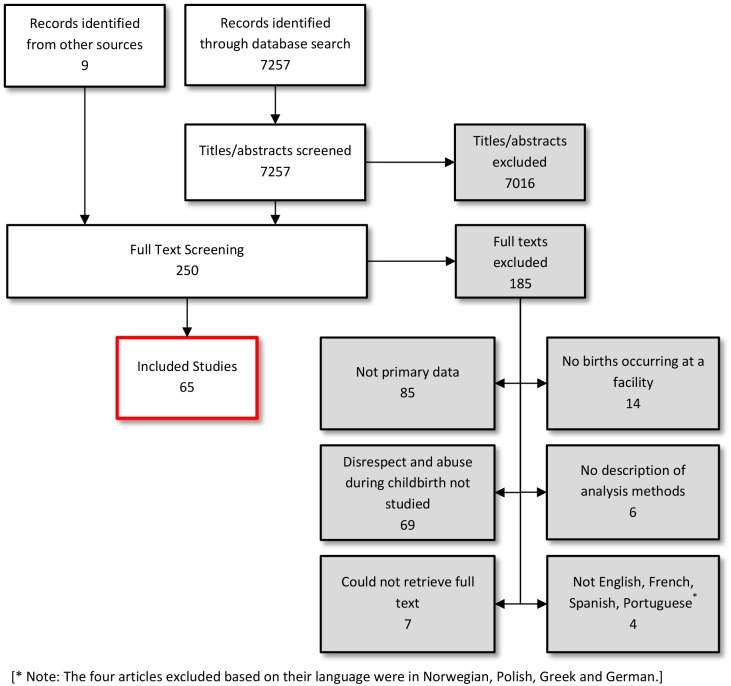
- Systematic searches of PubMed, CINAHL, Embase, and grey literature with no date or language restrictions; 7,257 articles were screened, 250 full texts retrieved, and 65 studies from 34 countries included.
- Qualitative evidence was synthesized using thematic synthesis, with confidence assessed via CERQual and study quality assessed using adapted CASP and STROBE tools; quantitative synthesis was planned but meta-analysis was not possible due to heterogeneity, so findings are described narratively.
- Inclusion criteria required primary data analysis, qualitative data collection and analysis, discussion of poor treatment during childbirth, facility-based childbirth, and publication in English, French, Spanish, or Portuguese.
Limitations
- Stated: the review could not differentiate between levels of health facilities; it excluded home birth studies; it may have missed relevant human rights or legal reports and other articles; and although no language filters were used, four studies were excluded because they were not published in English, French, Spanish, or Portuguese.
- Stated/evident: only three quantitative studies explored mistreatment as a primary objective, and high heterogeneity in identification criteria and operational definitions prevented meta-analysis; several qualitative findings had low CERQual confidence and limited data, such as physical restraint, detainment in facilities, and unclear fee structures.
- Evident: many qualitative findings were predominantly from sub-Saharan Africa or specific settings, limiting global generalizability for some domains; the paper also notes it could not identify existing systematic reviews of interventions or strategies to improve women’s experiences of care during childbirth.
Model-written summary. Check it against the paper before relying on it.
Integrity signals
Registry
Cites
Statistics
Figures
Verification
Claims the paper makes
45 Valid · 5 Not valid · 42 Not checked · 41 Own results and interpretations
At least one cited source doesn’t support this claim or points to a different paper, and none confirmed it — see the verdicts below.
In the paper
“Pinching, hitting, and slapping, either with an open hand or an instrument, were the most commonly reported specific acts of physical violence.”
§ The Mistreatment of Women during Childbirth in Health Facilities Globally: A Mixed-Methods Systematic Review > Results > Qualitative Synthesis
What the sources say
- Not checked yetcites [6] Chadwick RJ, Cooper D, Harries J. Narratives of distress about birth in South African public maternity settings: a qualitative study. Midwifery. 2014; 30: 862– 868. 10.1016/j.midw.2013.12.014 24456659 source
- Disputedcites [9] McMahon SA, George AS, Chebet JJ, Mosha IH, Mpembeni RN, Winch PJ. Experiences of and responses to disrespectful maternity care and abuse during childbirth; a qualitative study with women and men in Morogoro Region, Tanzania. BMC Pregnancy Childbirth. 2014; 14: 268 10.1186/1471-2393-14-268 25112432 PMC4261577 sourceExperimental — accuracy not yet measured
Our copy contradicts the claim on two counts. Results > Types of abuse states that 'Physical abuse was rarely mentioned, was discussed by women only and was identified as insufficiently probed during data analysis', with the most common negative experience being feeling ignored or neglected; Results > Physical abuse adds that physical abuse 'entailed a fear of abuse rather than enacted violence' (one woman fearing she would get hit or beaten, one forced into an uncomfortable position, two reports of fears of being slapped heard from others). Pinching and use of an instrument appear nowhere in our copy, and the Discussion explicitly says Bowser's categories of physical abuse 'did not emerge as strongly in this study'. So attributing pinching/hitting/slapping with open hand or instrument as the most commonly reported specific acts of physical violence to McMahon et al. 2014 runs counter to what the paper reports. (LLM, conf=0.82)
Checked by a reasoning model — may be wrong.
- Not checked yetcites [10] Moyer CA, Adongo PB, Aborigo RA, Hodgson A, Engmann CM. ‘They treat you like you are not a human being’: maltreatment during labour and delivery in rural northern Ghana. Midwifery. 2014; 30: 262– 268. 10.1016/j.midw.2013.05.006 23790959 source
plain- Asserted: passes — The authors put it forward as true.
- Checkable: passes — It can be checked against evidence.
- Load-bearing: unclear — It is unclear whether the paper’s conclusions depend on it.
- Based: passes — The paper gives a reason why it holds.
Some cited sources support this claim and some don’t — read each source’s verdict below.
In the paper
“Some women in Kenya and South Africa believed that their positive HIV status contributed to the provision of substandard care, including delays in receiving essential interventions, avoidance of patient contact, and fewer vaginal examinations.”
§ The Mistreatment of Women during Childbirth in Health Facilities Globally: A Mixed-Methods Systematic Review > Results > Qualitative Synthesis
What the sources say
- Partly supportedcites [11] Turan JM, Miller S, Bukusi EA, Sande J, Cohen CR. HIV/AIDS and maternity care in Kenya: how fears of stigma and discrimination affect uptake and provision of labor and delivery services. AIDS Care. 2008; 20: 938– 945. 10.1080/09540120701767224 18777222 PMC6788285 sourceExperimental — accuracy not yet measured
The Results section 'Differential treatment of HIV-positive women' does describe exactly the listed behaviours — 'fewer vaginal examinations (VEs) and avoidance or delays in performing necessary procedures' — but these are reported by maternity WORKERS in Kisumu, Kenya, and framed as things that 'had occurred in the past or might still occur at other maternity hospitals', not as beliefs held by HIV-positive women about their own care; the paper's own women participants described fears of testing, disclosure and confidentiality rather than substandard care (Results, 'Fears of being tested...' and 'Fears of unwanted disclosure...'). The South Africa component is not this study: South Africa appears only via a cited reference (Etiebet, Fransman, Forsyth, Coetzee, & Hussey, 2004) invoked in the Introduction for women avoiding ANC clinics because of fears of compulsory testing and unwanted disclosure, not for substandard care. So the behaviours are supported while the attribution to women's beliefs and to Kenya-and-South-Africa data is not. (LLM, conf=0.75)
- Not checked yetcites [13] Human Rights Watch. “Stop making excuses”: accountability for maternal health care in South Africa. New York: Human Rights Watch; 2011.
- Disputedcites [27] Sando D, Kendall T, Lyatuu G, Ratcliffe H, McDonald K, Mwanyika-Sando M, et al Disrespect and abuse during childbirth in Tanzania: are women living with HIV more vulnerable? J Acquir Immune Defic Syndr. 2014; 67 (Suppl 4): S228– S234. 10.1097/QAI.0000000000000378 25436822 PMC4251905 sourceExperimental — accuracy not yet measured
Split into 2 atoms — 0 confirmed, 0 partially supported, 1 disputed, 0 misattributed, 1 unverifiable. Expand the claim to see per-atom verdicts.
Checked by a reasoning model — may be wrong.
plain- Asserted: passes — The authors put it forward as true.
- Checkable: passes — It can be checked against evidence.
- Load-bearing: unclear — It is unclear whether the paper’s conclusions depend on it.
- Based: passes — The paper gives a reason why it holds.
- Partly supported
Some cited sources support this claim and some don’t — read each source’s verdict below.
In the paper
“In several settings, women reported the need to pay bribes to different workers throughout health facilities, including to doctors, nurses, midwives, receptionists, and guards.”
§ The Mistreatment of Women during Childbirth in Health Facilities Globally: A Mixed-Methods Systematic Review > Results > Qualitative Synthesis
What the sources say
- Partly supportedcites [8] Janevic T, Sripad P, Bradley E, Dimitrievska V. “There’s no kind of respect here”. A qualitative study of racism and access to maternal health care among Romani women in the Balkans. Int J Equity Health. 2011; 10: 53 10.1186/1475-9276-10-53 22094115 PMC3226439 sourceExperimental — accuracy not yet measured
The Results (Domains and themes; page unavailable) say women in all focus groups cited bribes as a problem and describe a perceived need to pay doctors. They also recount a nurse receiving a gift, but do not report bribes to midwives, receptionists, or guards, or establish the claimed range of workers throughout facilities. (LLM, conf=0.86)
- Disputedcites [9] McMahon SA, George AS, Chebet JJ, Mosha IH, Mpembeni RN, Winch PJ. Experiences of and responses to disrespectful maternity care and abuse during childbirth; a qualitative study with women and men in Morogoro Region, Tanzania. BMC Pregnancy Childbirth. 2014; 14: 268 10.1186/1471-2393-14-268 25112432 PMC4261577 sourceExperimental — accuracy not yet measured
The Results section (“Payments, lodging a complaint, assaulting a provider”; page unavailable) says only men described paying bribes or fees, contrary to the claim that women reported needing to pay bribes. It describes a bribe demanded by a doctor, but does not report bribes to the full range of workers listed. (LLM, conf=0.86)
Checked by a reasoning model — may be wrong.
- Not checked yetcites [13] Human Rights Watch. “Stop making excuses”: accountability for maternal health care in South Africa. New York: Human Rights Watch; 2011.
plain- Asserted: passes — The authors put it forward as true.
- Checkable: passes — It can be checked against evidence.
- Load-bearing: passes — The paper’s conclusions depend on it.
- Based: passes — The paper gives a reason why it holds.
- Partly supported
The sources with a verdict support this claim; the rest weren’t checked yet, have no full text we could read, or their verdicts aren’t rated yet.
In the paper
“Therefore, mistreatment during childbirth can represent a violation of women’s fundamental human rights [17–20] and can serve as a powerful disincentive for women to seek care in facilities for their subsequent deliveries [4,6,10,21].”
§ The Mistreatment of Women during Childbirth in Health Facilities Globally: A Mixed-Methods Systematic Review > Introduction
What the sources say
- Supportedcites [4] Bohren MA, Hunter EC, Munthe-Kaas HM, Souza JP, Vogel JP, Gulmezoglu AM. Facilitators and barriers to facility-based delivery in low- and middle-income countries: a qualitative evidence synthesis. Reprod Health. 2014; 11: 71 10.1186/1742-4755-11-71 25238684 PMC4247708 source
The Conclusion states that 'mistreatment, abuse, and neglect by health workers has fostered dissatisfaction, distrust, and avoidance of facility-based delivery care in many contexts,' and the GRADE table (finding 33) lists 'Barrier: Mistreatment and abuse by health workers' at high confidence across many studies and settings. The specific 'subsequent deliveries' qualifier is carried by the 'Previous birth experiences' section and finding 14, which state that 'previous negative experiences with facility births may deter women from delivering at a facility during a future birth.' The Discussion likewise frames the synthesis as illustrating 'the impact of disrespect and abuse on delivery care-seeking behaviors,' so the paraphrase is supported; 'powerful' is a mild intensifier of the paper's high-confidence barrier rating. (LLM, conf=0.85)
- Not checked yetcites [6] Chadwick RJ, Cooper D, Harries J. Narratives of distress about birth in South African public maternity settings: a qualitative study. Midwifery. 2014; 30: 862– 868. 10.1016/j.midw.2013.12.014 24456659 source
- Not checked yetcites [10] Moyer CA, Adongo PB, Aborigo RA, Hodgson A, Engmann CM. ‘They treat you like you are not a human being’: maltreatment during labour and delivery in rural northern Ghana. Midwifery. 2014; 30: 262– 268. 10.1016/j.midw.2013.05.006 23790959 source
- Not checked yetcites [21] El-Nemer A, Downe S, Small N. ‘She would help me from the heart’: an ethnography of Egyptian women in labour. Soc Sci Med. 2006; 62: 81– 92. 16005133 source
plainstates a cause- Asserted: passes — The authors put it forward as true.
- Checkable: passes — It can be checked against evidence.
- Load-bearing: passes — The paper’s conclusions depend on it.
- Based: passes — The paper gives a reason why it holds.
- Supported
The cited sources support only part of this claim — read each source’s verdict below.
In the paper
“A recent qualitative evidence synthesis [4] and several recent studies [6–11] and reports [12,13] clearly indicate that many women globally experience poor treatment during childbirth, including abusive, neglectful, or disrespectful care.”
§ The Mistreatment of Women during Childbirth in Health Facilities Globally: A Mixed-Methods Systematic Review > Introduction
What the sources say
- Partly supportedcites [4] Bohren MA, Hunter EC, Munthe-Kaas HM, Souza JP, Vogel JP, Gulmezoglu AM. Facilitators and barriers to facility-based delivery in low- and middle-income countries: a qualitative evidence synthesis. Reprod Health. 2014; 11: 71 10.1186/1742-4755-11-71 25238684 PMC4247708 sourceExperimental — accuracy not yet measured
The synthesis reports abusive and disrespectful treatment by providers, as well as neglect during facility-based childbirth (Perceived quality of care at facilities; page not provided). It draws on studies in low- and middle-income countries, so it does not establish the claim’s global scope; the Discussion also notes that prevalence needs further research. (LLM, conf=0.84)
- Not checked yetcites [6] Chadwick RJ, Cooper D, Harries J. Narratives of distress about birth in South African public maternity settings: a qualitative study. Midwifery. 2014; 30: 862– 868. 10.1016/j.midw.2013.12.014 24456659 source
- Partly supportedcites [7] D’Ambruoso L, Abbey M, Hussein J. Please understand when I cry out in pain: women’s accounts of maternity services during labour and delivery in Ghana. BMC Public Health. 2005; 5: 140 16372911 PMC1343547 sourceExperimental — accuracy not yet measured
The Results (‘Women’s accounts of care’; page not supplied) describe disrespectful and neglectful treatment during childbirth in Ghana. The Discussion (‘Recommendations’; page not supplied) explicitly calls some accounts serious neglect and abuse. This supports the types of poor treatment claimed, but the study does not establish that many women experience them globally. (LLM, conf=0.86)
- Partly supportedcites [8] Janevic T, Sripad P, Bradley E, Dimitrievska V. “There’s no kind of respect here”. A qualitative study of racism and access to maternal health care among Romani women in the Balkans. Int J Equity Health. 2011; 10: 53 10.1186/1475-9276-10-53 22094115 PMC3226439 sourceExperimental — accuracy not yet measured
The Results (Domains and themes; page unavailable) document neglectful and disrespectful care during childbirth reported by Romani women in Serbia and Macedonia. This study supports the citing sentence as a regional example, but its findings alone do not establish how many women experience such treatment globally. (LLM, conf=0.84)
- Partly supportedcites [9] McMahon SA, George AS, Chebet JJ, Mosha IH, Mpembeni RN, Winch PJ. Experiences of and responses to disrespectful maternity care and abuse during childbirth; a qualitative study with women and men in Morogoro Region, Tanzania. BMC Pregnancy Childbirth. 2014; 14: 268 10.1186/1471-2393-14-268 25112432 PMC4261577 sourceExperimental — accuracy not yet measured
The Results and Discussion (pages not specified in our copy) report neglect, verbal abuse and other disrespectful care among respondents in rural Tanzania. The Background also notes studies in several other countries, but this qualitative study does not establish how many women experience such treatment globally. (LLM, conf=0.82)
- Not checked yetcites [10] Moyer CA, Adongo PB, Aborigo RA, Hodgson A, Engmann CM. ‘They treat you like you are not a human being’: maltreatment during labour and delivery in rural northern Ghana. Midwifery. 2014; 30: 262– 268. 10.1016/j.midw.2013.05.006 23790959 source
- Partly supportedcites [11] Turan JM, Miller S, Bukusi EA, Sande J, Cohen CR. HIV/AIDS and maternity care in Kenya: how fears of stigma and discrimination affect uptake and provision of labor and delivery services. AIDS Care. 2008; 20: 938– 945. 10.1080/09540120701767224 18777222 PMC6788285 sourceExperimental — accuracy not yet measured
The Discussion (page unavailable) says women of unknown HIV status in the Kenyan facilities studied may be treated poorly, including being tested or having their status disclosed without consent. The Results also document gaps in counseling. These findings support the poor-treatment aspect, but this local, HIV-related study does not establish that many women globally experience abusive, neglectful, or disrespectful childbirth care. (LLM, conf=0.88)
- Not checked yetcites [12] Bowser D, Hill K. Exploring evidence for disrespect and abuse in facility-based childbirth: report of a landscape analysis. Washington (District of Columbia): United States Agency for International Development; 2010.
- Not checked yetcites [13] Human Rights Watch. “Stop making excuses”: accountability for maternal health care in South Africa. New York: Human Rights Watch; 2011.
boosted- Asserted: passes — The authors put it forward as true.
- Checkable: passes — It can be checked against evidence.
- Load-bearing: passes — The paper’s conclusions depend on it.
- Based: passes — The paper gives a reason why it holds.
- Partly supported
63 more claims · 37 with their cited sources checked
Create a free account to see all 133 claims and to verify the 170 references still open.
- Probably not a substantial claim. 37
- It may state two separate claims as one. 39
Claims other papers make about this one
Each is checked against this paper’s own text: does it say what the citing paper says it does?
The cited source says what the claim attributes to it.
In the citing paper
“While there is a potential link with this to the mistreatment of women during childbirth [83], we are unable to establish this here.”
From What Prevents Quality Midwifery Care? A Systematic Mapping of Barriers in Low and Middle Income Countries from the Provider Perspective (2016) · cites this paper as [83]
In the citing paper
“Disrespect and abuse, non-evidence-based practices and over-medicalisation during childbirth have been frequently reported and observed [3–10].”
From Health workers’ perspectives on the quality of maternal and newborn health care around the time of childbirth: Results of the Improving MAternal Newborn carE in the EURO Region (IMAgiNE EURO) project in 12 countries of the World Health Organization European Region (2024) · cites this paper as [4]
Self-check
Percentages, sums and reported differences re-computed from the paper’s own numbers.
Each contradiction between two passages listed here was confirmed by an independent check.
Rated minor: it would not touch a result — a value no result rests on, a p-value that stays on the same side of the significance level, or a conflict that is clerical, resolved elsewhere in the paper, or outside its own findings.
In the paper
§ The Mistreatment of Women during Childbirth in Health Facilities Globally: A Mixed-Methods Systematic Review > Results > Qualitative Synthesis
“Some women in Kenya also avoided or feared facility-based delivery due to anxiety about being tested for HIV without their consent.”
§ The Mistreatment of Women during Childbirth in Health Facilities Globally: A Mixed-Methods Systematic Review > Results > Failure to Meet Professional Standards of Care
“Some women in South Africa avoided or feared facility-based delivery due to anxiety about HIV tests given without consent [11].”
Citations
Cites
Using thematic analysis in psychology
Braun, V., & Clarke, V. (2006) · Qualitative Research in Psychology · doi:10.1191/1478088706qp063oa · Cited by 194,414
Basics of Qualitative Research: Grounded Theory Procedures and Techniques.
Ellis, C., Strauss, A., & Corbin, J. (1992) · Contemporary Sociology · doi:10.2307/2074814 · Cited by 29,249
von Elm, E., Altman, D. G., Egger, M., Pocock, S. J., Gøtzsche, P. C., Vandenbroucke, J. P., & Initiative, F. T. S. (2007) · PLoS Medicine · doi:10.1371/journal.pmed.0040296 · Cited by 23,020
von Elm, E., Altman, D. G., Egger, M., Pocock, S. J., Gøtzsche, P. C., & Vandenbroucke, J. P. (2007) · The Lancet · doi:10.1016/s0140-6736(07)61602-x · Cited by 21,320
Basics of Qualitative Research: Grounded Theory Procedures and Techniques
Long, D. R., Strauss, A., & Corbin, J. (1993) · The Modern Language Journal · doi:10.2307/328955 · Cited by 17,576
(2014) · Cited by 15,747
Methods for the thematic synthesis of qualitative research in systematic reviews
Thomas, J., & Harden, A. (2008) · BMC Medical Research Methodology · doi:10.1186/1471-2288-8-45 · Cited by 9,312
The Universal Declaration of Human Rights
Asamoah, O. Y. (1966) · The Legal Significance of the Declarations of the General Assembly of the United Nations · doi:10.1007/978-94-011-9495-2_14 · Cited by 4,474
The Millennium Development Goals Report
(2018) · Human Rights Documents Online · doi:10.1163/2210-7975_hrd-9927-2015002 · Cited by 3,592
Enhancing transparency in reporting the synthesis of qualitative research: ENTREQ
Tong, A., Flemming, K., McInnes, E., Oliver, S., & Craig, J. (2012) · BMC Medical Research Methodology · doi:10.1186/1471-2288-12-181 · Cited by 3,569 · cited 21×
“Search Strategy The published literature was systematically searched in PubMed (S2 Table), CINAHL (S3 Table), and Embase (S4 Table) using controlled vocabulary and free-text terms combining two main components: (a) maternal health, perinatal health, or childbirth and (b) mistreatment of women.”
MethodInfluential
Research works printed but not linked: 3
- Muhr T. ATLAS/ti-computer aided text interpretation and theory building, release 1.1E User’s manual. 2nd edition Berlin: Thomas Muhr; 1994.
- Munthe-Kaas HM. Assessing how much confidence to place in the evidence from reviews of qualitative research. developing and evaluating communication strategies to support informed decisions and practice based on evidence [abstract]. International Conference of the Royal College of Physicians of Edinburgh; 2–4 Jun 2014; Edinburgh, UK.
- Jomeen J, Redshaw M. Black and minority ethnic women’s experiences of contemporary maternity care in England. J Reprod Infant Psychol. 2011; 29: e9.
Cited by
Items 401–500 of 1,002
Amare, Y., Scheelbeek, P., Schellenberg, J., Berhanu, D., & Hill, Z. E. (2018) · BMC Public Health · doi:10.1186/s12889-018-5922-7 · Cited by 27
“There is much attention now being paid to the disrespect and abuse of women in facilities [29, 30]: there is also the potential for this to occur during home visits.”
BackgroundMaternal Mortality: An Eco-Social Phenomenon that Calls for Systemic Action
Souza, J. P., Bellissimo‐Rodrigues, F., & dos Santos, L. L. (2020) · Revista Brasileira Ginecologia e Obstetrícia · doi:10.1055/s-0040-1710041 · Cited by 25
Self-citationMistreatment of Women during Childbirth and Associated Factors in Northern West Bank, Palestine
Dwekat, I. M. M., Ismail, T. A. T., Ibrahim, M. I., Ghrayeb, F. A., & Abbas, E. (2022) · International Journal of Environmental Research and Public Health · doi:10.3390/ijerph192013180 · Cited by 28
“Denial of companionship during childbirth was shown to cause women to feel disempowered and lonely [7].”
BackgroundResultInfluentialSokol‐Hessner, L., Kane, G. J., Annas, C. L., Coletti, M. H., Lee, B. S., Thomas, E. J., Bell, S. K., & Folcarelli, P. H. (2018) · International Journal for Quality in Health Care · doi:10.1093/intqhc/mzy231 · Cited by 30
Agha, S., Fitzgerald, L., Fareed, A., Rajbhandari, P., Rahim, S., Shahid, F., Williams, E., Javed, W., & Currie, S. (2019) · PLoS ONE · doi:10.1371/journal.pone.0223701 · Cited by 36
“Increasing global attention to RMC sheds light on the critical importance of measures of quality that capture attitudinal dimensions of care [25,26].”
BackgroundA Multi-Methods Qualitative Study of the Delivery Care Experiences of Congolese Refugees in Uganda
Nara, R., Banura, A., & Foster, A. M. (2020) · Maternal and Child Health Journal · doi:10.1007/s10995-020-02951-1 · Cited by 26
Hirai, M., Morris, J. F., Luoto, J., Ouda, R., Atieno, N., & Quick, R. E. (2020) · BMC Pregnancy and Childbirth · doi:10.1186/s12884-020-03130-4 · Cited by 28
Manu, A. A., Zaka, N., Bianchessi, C., Maswanya, E., Williams, J. E., & Arifeen, S. E. (2021) · BMJ Open · doi:10.1136/bmjopen-2020-039616 · Cited by 28
Hajizadeh, K., & Mirghafourvand, M. (2021) · Annals of General Psychiatry · doi:10.1186/s12991-021-00331-9 · Cited by 27
Morris, T., Robinson, J. H., Spiller, K., & Gomez, A. (2021) · Social Problems · doi:10.1093/socpro/spab024 · Cited by 33
Hazfiarini, A., Zahroh, R. I., Akter, S., Homer, C., & Bohren, M. A. (2022) · Midwifery · doi:10.1016/j.midw.2022.103291 · Cited by 26
Self-citationCometto, G., Samuel, A., Geta, A., Kifle, M., Tunçalp, Ö., Syed, S. B., Kleine-Bingham, M., Nyoni, J., & Ajuebor, O. (2022) · BMJ Global Health · doi:10.1136/bmjgh-2021-008007 · Cited by 31
Self-citationViolencia obstétrica en Chile: percepción de las mujeres y diferencias entre centros de salud
Castro, M. C., & Rates, S. S. (2022) · Revista Panamericana de Salud Pública · doi:10.26633/rpsp.2022.24 · Cited by 47
“Se trata de una realidad que se ha hecho visible en diversos contextos (29-32) y que puede tener consecuencias graves en la salud psíquica y física de las mujeres que la experimentan.”
BackgroundPerson-Centered Maternity Care and Health Outcomes at 1 and 6 Months Postpartum
Attanasio, L. B., Ranchoff, B. L., Paterno, M. T., & Kjerulff, K. H. (2022) · Journal of Women s Health · doi:10.1089/jwh.2021.0643 · Cited by 30
Ruder, B., Cheyney, M. J., & Emasu, A. (2018) · Qualitative Health Research · doi:10.1177/1049732317754084 · Cited by 23
“Several recent studies that have reviewed decades of research on disrespectful and abusive maternity care (Bohren et al., 2015; Bowser & Hill, 2010; Bradley, McCourt, Rayment, & Parmar, 2016; Freedman et al., 2014), and along with the Universal Rights of Childbearing Women Charter (White Ribbon Alliance, 2011) and the…”
BackgroundInformal social accountability in maternal health service delivery: A study in Northern Malawi
Lodenstein, E., Ingemann, C., Molenaar, J. M., Dieleman, M. A., & Broerse, J. E. W. (2018) · PLoS ONE · doi:10.1371/journal.pone.0195671 · Cited by 26
Lodenstein, E., Pedersen, K., Botha, K., Broerse, J. E. W., & Dieleman, M. A. (2018) · International Journal for Equity in Health · doi:10.1186/s12939-018-0848-3 · Cited by 30
Arnold, R., van Teijlingen, E., Ryan, K., & Holloway, I. (2019) · BMC Pregnancy and Childbirth · doi:10.1186/s12884-019-2420-6 · Cited by 30
“Many studies have highlighted that health systems have failed women during pregnancy and childbirth [4].”
BackgroundRoga, E. Y., Moti, G., Bekele, G. G., Creedy, D. K., Gabriel, L., & Hastie, C. R. (2024) · BMC Pregnancy and Childbirth · doi:10.1186/s12884-024-06574-0 · Cited by 29
Balint groups in undergraduate medical education: a systematic review
Monk, A., Hind, D., & Crimlisk, H. (2017) · Psychoanalytic Psychotherapy · doi:10.1080/02668734.2017.1405361 · Cited by 29
“Quality assessment was not used to exclude studies from analysis, but to inform confidence in their findings (Bohren et al., 2015).”
MethodLavender, T., Bedwell, C., Kasengele, C., Kimaro, D., Kuzenza, F., Lyangenda, K., Mills, T., Nsemwa, L., Shayo, H., Tuwele, K., et al. (2021) · BMJ Global Health · doi:10.1136/bmjgh-2020-004725 · Cited by 17
Nimako, K., Gage, A., Benski, A. C., Roder‐DeWan, S., Ali, K., Kandie, C., Mohamed, A., Odeny, H., Olutende, O. M., Otieno, J. T. B., et al. (2021) · Global Health Science and Practice · doi:10.9745/ghsp-d-20-00684 · Cited by 27
Sheffel, A., Heidkamp, R. A., Mpembeni, R. N. M., Bujari, P., Gupta, J., Niyeha, D., Aung, T., Bakengesa, V., Msuya, J. M., Munos, M. K., et al. (2019) · Journal of Global Health · doi:10.7189/jogh.09.011101 · Cited by 23
Dzomeku, V. M., Mensah, A. B. B., Nakua, E. K., Agbadi, P., Okyere, J., Donkor, P., & Lori, J. R. (2022) · BMC Pregnancy and Childbirth · doi:10.1186/s12884-022-04786-w · Cited by 33
“This is owing to the fact that when women are denied the respect that they deserve, they are less inclined to return to health facilities for future births [6, 7, 11].”
BackgroundIge, W. B., & Cele, W. B. (2022) · International Journal of Africa Nursing Sciences · doi:10.1016/j.ijans.2022.100449 · Cited by 35
Diamond‐Smith, N., Lin, S., Peca, E., & Walker, D. M. (2022) · Midwifery · doi:10.1016/j.midw.2022.103488 · Cited by 27
Midwives’ knowledge and practice of Respectful Maternity Care: a survey from Iran
Moridi, M., Pazandeh, F., & Potrata, B. (2022) · BMC Pregnancy and Childbirth · doi:10.1186/s12884-022-05065-4 · Cited by 38
Poli‐Neto, O. B., Tawasha, K. A. S., Romão, A. P. M. S., Hisano, M. K., Moriyama, A., dos Reis, F. J. C., Silva, J. C. R. E., & Nogueira, A. A. (2017) · Journal of Psychosomatic Obstetrics & Gynecology · doi:10.1080/0167482x.2017.1306515 · Cited by 26
Development and Assessment of Respectful Maternity Care Questionnaire in Iran.
Taavoni, S., Goldani, Z., Gouran, N. R., & Haghani, H. (2018) · PubMed Central · Cited by 34
Kanengoni, B., Andajani-Sutjahjo, S., & Holroyd, E. A. (2019) · Midwifery · doi:10.1016/j.midw.2019.06.003 · Cited by 27
de Kok, B. C., Uny, I., Imamura, M., Bell, J. S., Geddes, J., & Phoya, A. (2019) · Qualitative Health Research · doi:10.1177/1049732319880538 · Cited by 31
“The articulation of this new set of childbirth-related rights coincided with the development of “D&A” typologies—categories of behaviors which violate women’s rights (Bohren et al., 2015; Bowser & Hill, 2010; Shakibazadeh et al., 2018).”
BackgroundAfaya, A., Dzomeku, V. M., Baku, E. A., Afaya, R. A., Ofori, M., Agyeibi, S., Boateng, F., Gamor, R. O., Gyasi-Kwofie, E., & Mwini-Nyaledzigbor, P. P. (2020) · BMC Pregnancy and Childbirth · doi:10.1186/s12884-019-2698-4 · Cited by 33
Costa, R., Rodrigues, C., Dias, H., Covi, B., Mariani, I., Valente, E. P., Zaigham, M., Vik, E. S., Grylka‐Baeschlin, S., Arendt, M., et al. (2022) · International Journal of Gynecology & Obstetrics · doi:10.1002/ijgo.14472 · Cited by 22
Optimal intrapartum care in the twenty-first century
Gülmezoglu, A. M., & Oladapo, O. T. (2020) · Best Practice & Research Clinical Obstetrics & Gynaecology · doi:10.1016/j.bpobgyn.2020.06.009 · Cited by 22
Self-citationGuure, C. B., Aviisah, P. A., Adu‐Bonsaffoh, K., Mehrtash, H., Aderoba, A. K., Irinyenikan, T. A., Baldé, M. D., Adeyanju, O. A., Maung, T. M., Tunçalp, Ö., et al. (2023) · BMJ Global Health · doi:10.1136/bmjgh-2023-011705 · Cited by 33
Self-citationGlover, A., Holman, C., & Boise, P. (2024) · BMC Pregnancy and Childbirth · doi:10.1186/s12884-024-06491-2 · Cited by 47
“Mistreatment in maternity care ranges in intensity from a lack of supportive care, discrimination, denial of autonomy, to instances of physical and verbal abuse [11].”
BackgroundHazel, E., Mohan, D., Chirwa, E. W., Phiri, M., Kachale, F., Msukwa, P., Katz, J., & Marx, M. A. (2021) · BMC Health Services Research · doi:10.1186/s12913-021-06353-z · Cited by 26
Currie, S., Natiq, L., Anwari, Z., & Tappis, H. (2021) · Health Care For Women International · doi:10.1080/07399332.2021.1932890 · Cited by 21
“We added additional interview questions to examine maternity care provider views on drivers and barriers to RMC and their working conditions, based on a review of tools from RMC studies in other settings (Bohren et al., 2015; Filby et al., 2016; Maung et al., 2020).”
MethodMapumulo, S., Haskins, L., Luthuli, S., & Horwood, C. M. (2021) · PLoS ONE · doi:10.1371/journal.pone.0261204 · Cited by 32
“However, we did not document incidences of physical abuse including slapping, pinching or restraining women, that have been described in other settings [13, 33].”
BackgroundFerede, W. Y., Gudayu, T. W., Gessesse, D. N., & Erega, B. B. (2022) · Women s Health · doi:10.1177/17455057221116505 · Cited by 31
Fuentes, F. F. A., Arteaga-Cruz, E., & Sebastiån, M. S. (2022) · BMC Women s Health · doi:10.1186/s12905-022-01998-2 · Cited by 36
“Denial of care, lack of privacy, refusal of treatment and admission to health facilities and threats of child apprehension have also been described as examples of this type of violence [2, 4, 9, 10].”
BackgroundWomen's experiences of childbirth in Middle Eastern countries: A narrative review
Hussein, S. A. A. A., Dahlen, H. G., Ogunsiji, O., & Schmied, V. A. (2017) · Midwifery · doi:10.1016/j.midw.2017.12.010 · Cited by 30
Wallace, H. J., McDonald, S., Belton, S., Miranda, A. I., da Costa, E., Matos, L. D. C., Henderson, H., & Taft, A. (2018) · Midwifery · doi:10.1016/j.midw.2018.05.013 · Cited by 31
Disrespectful treatment in primary care in rural Tanzania: beyond any single health issue
Larson, E., Mbaruku, G. M., Kujawski, S. A., Mashasi, I., & Kruk, M. E. (2019) · Health Policy and Planning · doi:10.1093/heapol/czz071 · Cited by 21
Kaphle, S., Vaughan, G. A., & Subedi, M. S. (2022) · International Journal of Women s Health · doi:10.2147/ijwh.s341907 · Cited by 30
“A growing recognition of the extent of mistreatment, abuse, disrespect and neglect of women during childbirth has in turn led to demands for an urgent response to address these concerns.(10,11) Experiences of abuse and disrespect among women giving birth in health institutions create barriers for women seeking health…”
BackgroundPatel, S. J., Truong, S., DeAndrade, S., Jacober, J., Medina, M., Diouf, K., Meadows, A. R., Nour, N. M., & Schantz-Dunn, J. (2024) · Maternal and Child Health Journal · doi:10.1007/s10995-023-03893-0 · Cited by 28
“Disrespectful and low-quality care of pregnant people can impact future decision-making to seek care and ultimately contribute to worse maternal and fetal outcomes (Bohren et al., 2015, Liambila et al. 2014).”
Benyamini, Y., Delicate, A., Ayers, S., Dikmen‐Yildiz, P., Gouni, O., Jónsdóttir, S. S., Karlsdóttir, S. I., Akik, B. K., Leinweber, J., Tighe, S. M., et al. (2024) · PLoS ONE · doi:10.1371/journal.pone.0299151 · Cited by 32
The influence of quality and respectful care on the uptake of skilled birth attendance in Tanzania
Hulsbergen, M., & van der Kwaak, A. (2020) · BMC Pregnancy and Childbirth · doi:10.1186/s12884-020-03278-z · Cited by 33
“Repeated interviews some weeks after delivery found higher prevalence than at discharge, suggesting that after women had further reflected on their care after returning home, they appraised it more negatively [31, 66].”
BackgroundExperience of care of hospitalized newborns and young children and their parents: A scoping review
Ndwiga, C., Warren, C., Okondo, C., Abuya, T., & Sripad, P. (2022) · PLoS ONE · doi:10.1371/journal.pone.0272912 · Cited by 29
“Mistreatment of newborns is described by Sacks [15] who expands on a typology for mistreatment during labour and delivery outlined by Bohren et al [10].”
MethodAdvancement in Partograph: WHO’s Labor Care Guide
Ghulaxe, Y., Tayade, S. A., Huse, S., & Chavada, J. (2022) · Cureus · doi:10.7759/cureus.30238 · Cited by 36
“Regularly overused interventions include early amniotomy, oxytocin for augmentation, and continuous fetal monitoring [12].”
BackgroundVedeler, C., Eri, T. S., Nilsen, R. M., Blix, E., Downe, S. M., van der Wel, K. A., & Nilsen, A. B. V. (2023) · Sexual & Reproductive Healthcare · doi:10.1016/j.srhc.2023.100850 · Cited by 31
Mackintosh, N. J., Rance, S., Carter, W., & Sandall, J. (2017) · BMC Pregnancy and Childbirth · doi:10.1186/s12884-017-1401-x · Cited by 24
“The effects of workload and resources on provider motivation are recognised as important contributors to disrespect and abuse in childbirth [55].”
BackgroundPERCEPÇÃO DA ENFERMEIRA OBSTETRA ACERCA DA VIOLÊNCIA OBSTÉTRICA
Leal, S. Y. P., Lima, V. L. D. A., da Silva, A. F., Soares, P. D. F. L., Santana, L. R., & Pereira, Á. (2018) · Cogitare Enfermagem · doi:10.5380/ce.v23i1.52473 · Cited by 22
Landrian, A. S., Phillips, B. S., Singhal, S., Mishra, S., Kajal, F., & Sudhinaraset, M. (2020) · Health Policy and Planning · doi:10.1093/heapol/czaa008 · Cited by 23
“Qualitative studies have also demonstrated a belief among women that the payment of a bribe will translate to the receipt of better, more timely care (Bohren et al., 2015; Sudhinaraset et al., 2016a).”
BackgroundResultSacks, E., & Peca, E. (2020) · BMC Pregnancy and Childbirth · doi:10.1186/s12884-020-02894-z · Cited by 22
Roder‐DeWan, S., Baril, N. C., Belanoff, C. M., Declercq, E. R., & Langer, A. (2021) · Journal of Midwifery & Women s Health · doi:10.1111/jmwh.13240 · Cited by 23
Dignity and respect in midwifery education in the UK: A survey of Lead Midwives of Education
Hall, J., & Mitchell, M. (2016) · Nurse Education in Practice · doi:10.1016/j.nepr.2016.09.003 · Cited by 24
Commentary: Creating a definition for global midwifery centers
Stevens, J., & Alonso, C. (2020) · Midwifery · doi:10.1016/j.midw.2020.102684 · Cited by 24
Gender, Judging and the Courts in Africa: Selected Studies
Dawuni, J. J. (2021) · Routledge eBooks · doi:10.4324/9780429327865 · Cited by 22
When complications arise during birth: LBTQ people's experiences of care
Klittmark, S., Malmquist, A., Karlsson, G., Ulfsdotter, A., Grundström, H., & Nieminen, K. (2023) · Midwifery · doi:10.1016/j.midw.2023.103649 · Cited by 33
Crowther, S., Stephen, A. I., & Hall, J. (2019) · Journal of Reproductive and Infant Psychology · doi:10.1080/02646838.2019.1616680 · Cited by 21
“Unfortunately, disrespectful care occurs, and this has been described elsewhere (Birthrights, 2013; Bohren et al., 2015; Kirkup, 2015).”
BackgroundOkedo‐Alex, I. N., Akamike, I. C., & Okafor, L. C. (2020) · Women and Birth · doi:10.1016/j.wombi.2020.09.015 · Cited by 25
Silva-Dreyer, A. M., Pantoja, F., Millón, Y., Hidalgo, V., Stojanova, J., Marcelo Arancibia, M., Papuzinski, C., Sánchez, L., & Campos, M. (2020) · Medwave · doi:10.5867/medwave.2020.09.8047 · Cited by 20
Dwekat, I. M. M., Ismail, T. A. T., Ibrahim, M. I., Ghrayeb, F. A., Hanafi, W. S. W. M., & Ghazali, A. K. (2021) · Midwifery · doi:10.1016/j.midw.2021.103076 · Cited by 23
Ige, W. B., & Cele, W. B. (2021) · International Journal of Africa Nursing Sciences · doi:10.1016/j.ijans.2021.100354 · Cited by 28
Rost, M., Stuerner, Z., Niles, P. M., & Arnold, L. S. (2022) · SSM - Qualitative Research in Health · doi:10.1016/j.ssmqr.2022.100077 · Cited by 23
“Applying a critical lens, our analysis focused on a description and exploration of statements which indicate attitudes or perceptions that might impede decision-making (Bohren et al., 2015).”
BackgroundMethodInfluentialBirth, love, and fear: Physiological networks from pregnancy to parenthood
Grant, A. D., & Erickson, E. N. (2022) · Comprehensive Psychoneuroendocrinology · doi:10.1016/j.cpnec.2022.100138 · Cited by 37
Valente, E. P., Mariani, I., Covi, B., & Lazzerini, M. (2022) · International Journal of Environmental Research and Public Health · doi:10.3390/ijerph19127166 · Cited by 27
“The lack of informed consent is one of the typologies of mistreatment during childbirth [49,50].”
BackgroundPappu, N. I., Öberg, I., Byrskog, U., Raha, P. R., Moni, R., Akhtar, S., Barua, P., Das, S. R., De, S., Jyoti, H. J., et al. (2023) · PLoS ONE · doi:10.1371/journal.pone.0271867 · Cited by 20
“However, a lack of respectful and woman-centred care makes community acceptance difficult [30].”
BackgroundKhan, B., Hameed, W., & Avan, B. I. (2023) · PLoS ONE · doi:10.1371/journal.pone.0285209 · Cited by 27
“Disrespect and lack of psychosocial support in health facilities during childbirth are common phenomena in low- and middle-income countries [1].”
BackgroundMuriithi, F. G., Banke-Thomas, A. O., Forbes, G., Gakuo, R. W., Thomas, E., Gallos, I. D., Devall, A., Coomarasamy, A., & Lorencatto, F. (2024) · PLOS Global Public Health · doi:10.1371/journal.pgph.0002950 · Cited by 28
Downe, S. M., Finlayson, K. W., Tunçalp, Ö., & Gülmezoglu, A. M. (2016) · Cochrane Database of Systematic Reviews · doi:10.1002/14651858.cd012392 · Cited by 31
Self-citationEducating student midwives around dignity and respect
Hall, J., & Mitchell, M. (2017) · Women and Birth · doi:10.1016/j.wombi.2017.04.007 · Cited by 23
Jikijela, T. P., James, S., & Sonti, B. S. (2018) · Curationis · doi:10.4102/curationis.v41i1.1804 · Cited by 29
Yevoo, L. L., Agyepong, I. A., Gerrits, T., & van Dijk, H. (2018) · BMC Pregnancy and Childbirth · doi:10.1186/s12884-018-1916-9 · Cited by 24
La violence obstétricale dans les soins de santé : une analyse conceptuelle1
Lévesque, S., Bergeron, M., Fontaine, L., & Rousseau, C. (2018) · Recherches féministes · doi:10.7202/1050662ar · Cited by 41
Provider perceptions of lack of supportive care during childbirth: A mixed methods study in Kenya
Buback, L., Kinyua, J., Akinyi, B., Walker, D. M., & Afulani, P. A. (2021) · Health Care For Women International · doi:10.1080/07399332.2021.1961776 · Cited by 20
“…in prior studies, researchers have documented women’s experiences of neglect and abandonment during childbirth, often resulting in women delivering alone without skilled attendants within health facilities, and without pain control (Balde et al., 2017; Bohren et al., 2015; D’Ambruoso et al., 2005).”
Result‘It was horrible to watch, horrible to be a part of’: Midwives’ perspectives of obstetric violence
Collins, E., Burns, E., & Dahlen, H. G. (2024) · Women and Birth · doi:10.1016/j.wombi.2024.101631 · Cited by 27
Obstetric violence: Comparing medical student perceptions in India and the UK
Gray, T. G., Mohan, S., Lindow, S. W., Pandey, U., & Farrell, T. J. (2021) · European Journal of Obstetrics & Gynecology and Reproductive Biology · doi:10.1016/j.ejogrb.2021.04.013 · Cited by 25
Barata, C. C. C. A. (2022) · Societies · doi:10.3390/soc12030078 · Cited by 34
Dahan, O., & Shabot, S. C. (2022) · Mind Culture and Activity · doi:10.1080/10749039.2022.2110262 · Cited by 23
“I was a passive patient, instead of an active participant” (Boucher et al., 2009, p. 122).”
BackgroundYalley, A. A. (2022) · Women · doi:10.3390/women3010002 · Cited by 30
Obstetric violence: A public health concern
Edward, M. M., & Kibanda, Z. (2022) · Health Science Reports · doi:10.1002/hsr2.1026 · Cited by 19
Stierman, E. K., Zimmerman, L. A., Shiferaw, S., Seme, A., Ahmed, S., & Creanga, A. A. (2022) · AJOG Global Reports · doi:10.1016/j.xagr.2022.100140 · Cited by 18
Reppen, K., Henriksen, L., Schei, B., Magnussen, E. B., & Infanti, J. J. (2023) · BMC Pregnancy and Childbirth · doi:10.1186/s12884-023-05725-z · Cited by 22
Rubashkin, N. A., Szebik, I., Baji, P., Szántó, Z., Susánszky, É., & Vedam, S. (2017) · Reproductive Health · doi:10.1186/s12978-017-0413-3 · Cited by 22
“However, in a systematic review of 65 studies across 34 countries Bohren and colleagues confirmed that few tools exist to measure the experience of respect or mistreatment in maternity care [6].”
BackgroundHow Should Trainees Respond in Situations of Obstetric Violence?
Rubashkin, N. A., & Minckas, N. (2018) · The AMA Journal of Ethic · doi:10.1001/journalofethics.2018.20.3.ecas2-1803 · Cited by 26
“Types of physical abuse identified in literature reviews include women being beaten, slapped, kicked, or physically restrained to the bed during delivery [14].”
Backgroundde Kok, B. C. (2018) · Social Science & Medicine · doi:10.1016/j.socscimed.2018.09.036 · Cited by 21
Understanding mistreatment during institutional delivery in Northeast Nigeria: a mixed-method study
Umar, N., Wickremasinghe, D., Hill, Z. E., Usman, U. A., & Marchant, T. (2019) · Reproductive Health · doi:10.1186/s12978-019-0837-z · Cited by 28
Oliveira, C. D. F., Ribeiro, A., Luquine, C. D., et al. (2020) · Revista Panamericana de Salud Pública · doi:10.26633/rpsp.2020.132 · Cited by 19
“Na dimensão da gestão dos serviços e sistemas de saúde, a falta de medicamentos e outros insumos é uma barreira para a assistência adequada ao parto (13, 16, 17, 20, 21, 29).”
BackgroundInfluentialOliveira, C. D. F., Ribeiro, A., Luquine, C. D., et al. (2021) · Revista Panamericana de Salud Pública · doi:10.26633/rpsp.2021.7 · Cited by 19
“In terms of the workplace, the safety measures that are adopted may focus on basic conditions for professionals and fail to consider the women (13, 16).”
BackgroundInfluentialMiller, P. N., Afulani, P. A., Musange, S., Sayingoza, F., & Walker, D. M. (2021) · BMC Pregnancy and Childbirth · doi:10.1186/s12884-021-03747-z · Cited by 28
“Past research demonstrates that age, socioeconomic background and empowerment are associated with person-centered care during childbirth [19, 33, 34].”
BackgroundResultRozée, V., & Schantz, C. (2022) · Santé Publique · doi:10.3917/spub.215.0629 · Cited by 42
Yoseph, A., Teklesilasie, W., Guillén‐Grima, F., & Astatkie, A. (2024) · PLoS ONE · doi:10.1371/journal.pone.0312484 · Cited by 22
Adatara, P., Strümpher, J., & Ricks, E. J. (2019) · BMC Pregnancy and Childbirth · doi:10.1186/s12884-019-2337-0 · Cited by 24
Respectful maternity care: A national landscape review
Yeravdekar, R., & Ansari, H. (2019) · The National Medical Journal of India · doi:10.4103/0970-258x.295957 · Cited by 27
Oosthuizen, S. J., Bergh, A., Grimbeek, J., & Pattinson, R. C. (2020) · African Journal of Primary Health Care & Family Medicine · doi:10.4102/phcfm.v12i1.2560 · Cited by 21
Michlig, G. J., Warren, N., Berhe, M., & Johnson‐Agbakwu, C. E. (2021) · International Journal of Environmental Research and Public Health · doi:10.3390/ijerph18073733 · Cited by 21
“Framework for maternal and newborn health [25] and qualitatively derived experiences of mistreatment among women in obstetric care [26].”
BackgroundMethodLeinweber, J., Jung, T., Hartmann, K., & Limmer, C. (2021) · Public Health Forum · doi:10.1515/pubhef-2021-0040 · Cited by 20
Crepinsek, M., Bell, R., GRAHAM, I. W., & Coutts, R. (2022) · Women and Birth · doi:10.1016/j.wombi.2022.05.001 · Cited by 24
Metadata
- Authors
- Bohren, M. A., Vogel, J. P., Hunter, E. C., Lutsiv, O., Makh, S. K., Souza, J. P., Aguiar, C., Saraiva Coneglian, F., Diniz, A. L. A., Tunçalp, Ö., Javadi, D., Oladapo, O. T., Khosla, R., Hindin, M. J., & Gülmezoglu, A. M.
- Affiliations
- World Bank (US)
- World Health Organization (CH)
- Johns Hopkins University (US)
- McGill University (CA)
- Population Services International (US)
- Universidade de São Paulo (BR)
- Corresponding author
- Bohren, Meghan A.
- Vogel, Joshua P.
- Hunter, Erin C.
- Lutsiv, Olha
- Makh, Suprita K.
- Souza, João Paulo
- Aguiar, Carolina
- Diniz, Alex Luíz Araújo
- Tunçalp, Özge
- Javadi, Dena
- Oladapo, Olufemi T.
- Khosla, Rajat
- Hindin, Michelle J.
- Gülmezoglu, A. Metin
- ORCID
- Venue
- PLOS Medicine
- Publisher
- Public Library of Science (PLoS)
- Published
- 2015-06-30
- Volume
- 12
- Issue
- 6
- Pages
- e1001847
- ISSN
- 1549-1277 (ISSN-L)
- 1549-1676
- PMC
- PMC4488322
- OpenAlex
- W1924661502
- Semantic Scholar
- afa79083c48a5860d9db6a6a2f323e59c6c48bfa
- Cited by
- 1,656
- References
- 100
- Citations by year
- 2026: 191 · 2025: 190 · 2024: 187 · 2023: 189 · 2022: 187 · 2021: 195 · 2020: 136 · 2019: 119 · 2018: 116 · 2017: 74 · 2016: 53 · 2015: 15
- FWCI
- 12.71
- Type
- journal article
- Language
- en
- Open access
- gold
- doi.org
- Licence
- Locations
- PLoS Medicine (publishedVersion, cc-by)
- Europe PMC (PubMed Central) (publishedVersion, cc-by)
- PubMed Central (publishedVersion, cc-by)
- PubMed (publishedVersion)
- Minerva Access (University of Melbourne) (submittedVersion, cc-by)
- RePEc: Research Papers in Economics (submittedVersion)
- DOAJ (DOAJ: Directory of Open Access Journals) (submittedVersion, cc-by-sa)
- Figshare (submittedVersion, cc-by)
- Funders
- United States Agency for International Development
- World Health Organization
- UNICEF
- Johns Hopkins University
- Topics
- Health Sciences › Medicine › Obstetrics and Gynecology › Maternal and Perinatal Health Interventions
- Health Sciences › Medicine › Pediatrics, Perinatology and Child Health › Global Maternal and Child Health
- Health Sciences › Medicine › Pediatrics, Perinatology and Child Health › Maternal and fetal healthcare
- Keywords
- physical abuse, sexual abuse, verbal abuse, stigma and discrimination, health system constraints, maternal health, healthcare facilities
- MeSH terms
- Female, Humans, Pregnancy, Stress Disorders, Post-Traumatic, Stress, Psychological, Violence, Global Health, Parturition, Delivery, Obstetric, Postpartum Period
About these checks
Registry, retraction, Cites and statistics results are computed, not judged, with one exception: a printed reference that no index lists is read once by a model before it counts as a citation error. Claims are extracted by a model and kept only when their quote appears verbatim in the text; each cited source is then checked, with a model’s help, for whether it says what the claim relies on. Those verdicts can be wrong — read the claim’s quote and the cited source before relying on one.
The claim verdicts this report counts are experimental: their accuracy is not yet measured.
A language model drew the claims from the paper on 2026-10-10, under version 3 of the claim definition (model deepseek-v4.1-flash, prompt extract-v3).
A second model labelled each claim on 2026-10-10 (model jev-1.13-20260917, definition revision gold-guideline-v0.2).
Cited sources are checked with a language model’s help (qwen3.8-omni-flash and gpt-6-sol).
Statistics and arithmetic are recomputed, not judged.
Confidence bands are shown only for fields calibrated on our annotated test set. None is calibrated yet, so no band is shown.
What counts as a claim ›How we measure confidence ›How we check this ›
Are you an author, or do you see a problem with this page? Request a review
Data sources
Bibliographic data: Semantic Scholar, OpenAlex, Crossref.
Contains information from the Semantic Scholar Academic Graph Datasets, made available under the ODC Attribution License (ODC-BY 1.0).
Semantic Scholar’s data is described in: Kinney, R., et al. (2023). The Semantic Scholar Open Data Platform. arXiv:2301.10140.
