

The Mistreatment of Women during Childbirth in Health Facilities Globally: A Mixed-Methods Systematic Review
Open accessThe DOI matches its Crossref record; 95 of the 100 references it cites were found in a registry or an index; 75 of the 245 sources its claims cite were checked for support.
Abstract
BACKGROUND: Despite growing recognition of neglectful, abusive, and disrespectful treatment of women during childbirth in health facilities, there is no consensus at a global level on how these occurrences are defined and measured. This mixed-methods systematic review aims to synthesize qualitative and quantitative evidence on the mistreatment of women during childbirth in health facilities to inform the development of an evidence-based typology of the phenomenon. METHODS AND FINDINGS: We searched PubMed, CINAHL, and Embase databases and grey literature using a predetermined search strategy to identify qualitative, quantitative, and mixed-methods studies on the mistreatment of women during childbirth across all geographical and income-level settings. We used a thematic synthesis approach to synthesize the qualitative evidence and assessed the confidence in the qualitative review findings using the CERQual approach. In total, 65 studies were included from 34 countries. Qualitative findings were organized under seven domains: (1) physical abuse, (2) sexual abuse, (3) verbal abuse, (4) stigma and discrimination, (5) failure to meet professional standards of care, (6) poor rapport between women and providers, and (7) health system conditions and constraints. Due to high heterogeneity of the quantitative data, we were unable to conduct a meta-analysis; instead, we present descriptions of study characteristics, outcome measures, and results. Additional themes identified in the quantitative studies are integrated into the typology. CONCLUSIONS: This systematic review presents a comprehensive, evidence-based typology of the mistreatment of women during childbirth in health facilities, and demonstrates that mistreatment can occur at the level of interaction between the woman and provider, as well as through systemic failures at the health facility and health system levels. We propose this typology be adopted to describe the phenomenon and be used to develop measurement tools and inform future research, programs, and interventions.
Overview
CoChat Summary
TL;DR
This mixed-methods systematic review synthesized 65 studies from 34 countries to develop an evidence-based typology of mistreatment of women during childbirth in health facilities. It organizes mistreatment into seven domains spanning physical, sexual, and verbal abuse; stigma and discrimination; failure to meet professional standards; poor rapport; and health system conditions and constraints.
Key findings
- The review included 65 studies from 34 countries and produced a seven-domain typology: physical abuse, sexual abuse, verbal abuse, stigma and discrimination, failure to meet professional standards of care, poor rapport between women and providers, and health system conditions and constraints.
- Quantitative meta-analysis was not possible due to high heterogeneity; among three primary measurement studies, any mistreatment was reported by 19.5% at facility exit and 28.2% at follow-up in Tanzania (Kruk et al.), 14.79% at discharge in Sando et al. (12.2% among HIV-positive vs. 15.0% among HIV-negative women, p < 0.37), and 98.0% in Nigeria (Okafor et al.).
- Specific measures included physical abuse 35.7%, being restrained or tied down during labor 17.3%, being beaten/slapped/pinched 7.2%, and sexual abuse by a health worker 2.0% (Okafor et al.); observed no consent for vaginal examination 81.59% and detention in facility 91.54% (Sando et al. observation).
- Qualitative findings rated high confidence included physical abuse, verbal abuse, discrimination by ethnicity/race/religion and socioeconomic status, neglect/abandonment, skilled attendant absent at delivery, poor communication, lack of supportive care, lack of privacy, and impact on future care-seeking; low-confidence findings included physical restraint, discrimination based on medical conditions, denial of safe traditional practices, detainment in facilities, and unclear fee structures.
Methods
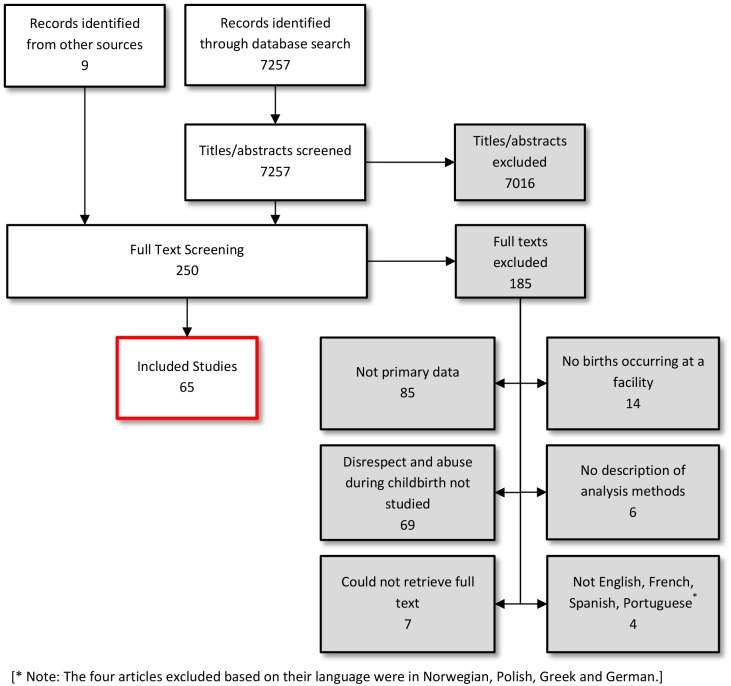
- Systematic searches of PubMed, CINAHL, Embase, and grey literature with no date or language restrictions; 7,257 articles were screened, 250 full texts retrieved, and 65 studies from 34 countries included.
- Qualitative evidence was synthesized using thematic synthesis, with confidence assessed via CERQual and study quality assessed using adapted CASP and STROBE tools; quantitative synthesis was planned but meta-analysis was not possible due to heterogeneity, so findings are described narratively.
- Inclusion criteria required primary data analysis, qualitative data collection and analysis, discussion of poor treatment during childbirth, facility-based childbirth, and publication in English, French, Spanish, or Portuguese.
Limitations
- Stated: the review could not differentiate between levels of health facilities; it excluded home birth studies; it may have missed relevant human rights or legal reports and other articles; and although no language filters were used, four studies were excluded because they were not published in English, French, Spanish, or Portuguese.
- Stated/evident: only three quantitative studies explored mistreatment as a primary objective, and high heterogeneity in identification criteria and operational definitions prevented meta-analysis; several qualitative findings had low CERQual confidence and limited data, such as physical restraint, detainment in facilities, and unclear fee structures.
- Evident: many qualitative findings were predominantly from sub-Saharan Africa or specific settings, limiting global generalizability for some domains; the paper also notes it could not identify existing systematic reviews of interventions or strategies to improve women’s experiences of care during childbirth.
Model-written summary. Check it against the paper before relying on it.
Integrity signals
Registry
Cites
Statistics
Figures
Verification
Claims the paper makes
45 Valid · 5 Not valid · 42 Not checked · 41 Own results and interpretations
At least one cited source doesn’t support this claim or points to a different paper, and none confirmed it — see the verdicts below.
In the paper
“Pinching, hitting, and slapping, either with an open hand or an instrument, were the most commonly reported specific acts of physical violence.”
§ The Mistreatment of Women during Childbirth in Health Facilities Globally: A Mixed-Methods Systematic Review > Results > Qualitative Synthesis
What the sources say
- Not checked yetcites [6] Chadwick RJ, Cooper D, Harries J. Narratives of distress about birth in South African public maternity settings: a qualitative study. Midwifery. 2014; 30: 862– 868. 10.1016/j.midw.2013.12.014 24456659 source
- Disputedcites [9] McMahon SA, George AS, Chebet JJ, Mosha IH, Mpembeni RN, Winch PJ. Experiences of and responses to disrespectful maternity care and abuse during childbirth; a qualitative study with women and men in Morogoro Region, Tanzania. BMC Pregnancy Childbirth. 2014; 14: 268 10.1186/1471-2393-14-268 25112432 PMC4261577 sourceExperimental — accuracy not yet measured
Our copy contradicts the claim on two counts. Results > Types of abuse states that 'Physical abuse was rarely mentioned, was discussed by women only and was identified as insufficiently probed during data analysis', with the most common negative experience being feeling ignored or neglected; Results > Physical abuse adds that physical abuse 'entailed a fear of abuse rather than enacted violence' (one woman fearing she would get hit or beaten, one forced into an uncomfortable position, two reports of fears of being slapped heard from others). Pinching and use of an instrument appear nowhere in our copy, and the Discussion explicitly says Bowser's categories of physical abuse 'did not emerge as strongly in this study'. So attributing pinching/hitting/slapping with open hand or instrument as the most commonly reported specific acts of physical violence to McMahon et al. 2014 runs counter to what the paper reports. (LLM, conf=0.82)
Checked by a reasoning model — may be wrong.
- Not checked yetcites [10] Moyer CA, Adongo PB, Aborigo RA, Hodgson A, Engmann CM. ‘They treat you like you are not a human being’: maltreatment during labour and delivery in rural northern Ghana. Midwifery. 2014; 30: 262– 268. 10.1016/j.midw.2013.05.006 23790959 source
plain- Asserted: passes — The authors put it forward as true.
- Checkable: passes — It can be checked against evidence.
- Load-bearing: unclear — It is unclear whether the paper’s conclusions depend on it.
- Based: passes — The paper gives a reason why it holds.
Some cited sources support this claim and some don’t — read each source’s verdict below.
In the paper
“Some women in Kenya and South Africa believed that their positive HIV status contributed to the provision of substandard care, including delays in receiving essential interventions, avoidance of patient contact, and fewer vaginal examinations.”
§ The Mistreatment of Women during Childbirth in Health Facilities Globally: A Mixed-Methods Systematic Review > Results > Qualitative Synthesis
What the sources say
- Partly supportedcites [11] Turan JM, Miller S, Bukusi EA, Sande J, Cohen CR. HIV/AIDS and maternity care in Kenya: how fears of stigma and discrimination affect uptake and provision of labor and delivery services. AIDS Care. 2008; 20: 938– 945. 10.1080/09540120701767224 18777222 PMC6788285 sourceExperimental — accuracy not yet measured
The Results section 'Differential treatment of HIV-positive women' does describe exactly the listed behaviours — 'fewer vaginal examinations (VEs) and avoidance or delays in performing necessary procedures' — but these are reported by maternity WORKERS in Kisumu, Kenya, and framed as things that 'had occurred in the past or might still occur at other maternity hospitals', not as beliefs held by HIV-positive women about their own care; the paper's own women participants described fears of testing, disclosure and confidentiality rather than substandard care (Results, 'Fears of being tested...' and 'Fears of unwanted disclosure...'). The South Africa component is not this study: South Africa appears only via a cited reference (Etiebet, Fransman, Forsyth, Coetzee, & Hussey, 2004) invoked in the Introduction for women avoiding ANC clinics because of fears of compulsory testing and unwanted disclosure, not for substandard care. So the behaviours are supported while the attribution to women's beliefs and to Kenya-and-South-Africa data is not. (LLM, conf=0.75)
- Not checked yetcites [13] Human Rights Watch. “Stop making excuses”: accountability for maternal health care in South Africa. New York: Human Rights Watch; 2011.
- Disputedcites [27] Sando D, Kendall T, Lyatuu G, Ratcliffe H, McDonald K, Mwanyika-Sando M, et al Disrespect and abuse during childbirth in Tanzania: are women living with HIV more vulnerable? J Acquir Immune Defic Syndr. 2014; 67 (Suppl 4): S228– S234. 10.1097/QAI.0000000000000378 25436822 PMC4251905 sourceExperimental — accuracy not yet measured
Split into 2 atoms — 0 confirmed, 0 partially supported, 1 disputed, 0 misattributed, 1 unverifiable. Expand the claim to see per-atom verdicts.
Checked by a reasoning model — may be wrong.
plain- Asserted: passes — The authors put it forward as true.
- Checkable: passes — It can be checked against evidence.
- Load-bearing: unclear — It is unclear whether the paper’s conclusions depend on it.
- Based: passes — The paper gives a reason why it holds.
- Partly supported
Some cited sources support this claim and some don’t — read each source’s verdict below.
In the paper
“In several settings, women reported the need to pay bribes to different workers throughout health facilities, including to doctors, nurses, midwives, receptionists, and guards.”
§ The Mistreatment of Women during Childbirth in Health Facilities Globally: A Mixed-Methods Systematic Review > Results > Qualitative Synthesis
What the sources say
- Partly supportedcites [8] Janevic T, Sripad P, Bradley E, Dimitrievska V. “There’s no kind of respect here”. A qualitative study of racism and access to maternal health care among Romani women in the Balkans. Int J Equity Health. 2011; 10: 53 10.1186/1475-9276-10-53 22094115 PMC3226439 sourceExperimental — accuracy not yet measured
The Results (Domains and themes; page unavailable) say women in all focus groups cited bribes as a problem and describe a perceived need to pay doctors. They also recount a nurse receiving a gift, but do not report bribes to midwives, receptionists, or guards, or establish the claimed range of workers throughout facilities. (LLM, conf=0.86)
- Disputedcites [9] McMahon SA, George AS, Chebet JJ, Mosha IH, Mpembeni RN, Winch PJ. Experiences of and responses to disrespectful maternity care and abuse during childbirth; a qualitative study with women and men in Morogoro Region, Tanzania. BMC Pregnancy Childbirth. 2014; 14: 268 10.1186/1471-2393-14-268 25112432 PMC4261577 sourceExperimental — accuracy not yet measured
The Results section (“Payments, lodging a complaint, assaulting a provider”; page unavailable) says only men described paying bribes or fees, contrary to the claim that women reported needing to pay bribes. It describes a bribe demanded by a doctor, but does not report bribes to the full range of workers listed. (LLM, conf=0.86)
Checked by a reasoning model — may be wrong.
- Not checked yetcites [13] Human Rights Watch. “Stop making excuses”: accountability for maternal health care in South Africa. New York: Human Rights Watch; 2011.
plain- Asserted: passes — The authors put it forward as true.
- Checkable: passes — It can be checked against evidence.
- Load-bearing: passes — The paper’s conclusions depend on it.
- Based: passes — The paper gives a reason why it holds.
- Partly supported
The sources with a verdict support this claim; the rest weren’t checked yet, have no full text we could read, or their verdicts aren’t rated yet.
In the paper
“Therefore, mistreatment during childbirth can represent a violation of women’s fundamental human rights [17–20] and can serve as a powerful disincentive for women to seek care in facilities for their subsequent deliveries [4,6,10,21].”
§ The Mistreatment of Women during Childbirth in Health Facilities Globally: A Mixed-Methods Systematic Review > Introduction
What the sources say
- Supportedcites [4] Bohren MA, Hunter EC, Munthe-Kaas HM, Souza JP, Vogel JP, Gulmezoglu AM. Facilitators and barriers to facility-based delivery in low- and middle-income countries: a qualitative evidence synthesis. Reprod Health. 2014; 11: 71 10.1186/1742-4755-11-71 25238684 PMC4247708 source
The Conclusion states that 'mistreatment, abuse, and neglect by health workers has fostered dissatisfaction, distrust, and avoidance of facility-based delivery care in many contexts,' and the GRADE table (finding 33) lists 'Barrier: Mistreatment and abuse by health workers' at high confidence across many studies and settings. The specific 'subsequent deliveries' qualifier is carried by the 'Previous birth experiences' section and finding 14, which state that 'previous negative experiences with facility births may deter women from delivering at a facility during a future birth.' The Discussion likewise frames the synthesis as illustrating 'the impact of disrespect and abuse on delivery care-seeking behaviors,' so the paraphrase is supported; 'powerful' is a mild intensifier of the paper's high-confidence barrier rating. (LLM, conf=0.85)
- Not checked yetcites [6] Chadwick RJ, Cooper D, Harries J. Narratives of distress about birth in South African public maternity settings: a qualitative study. Midwifery. 2014; 30: 862– 868. 10.1016/j.midw.2013.12.014 24456659 source
- Not checked yetcites [10] Moyer CA, Adongo PB, Aborigo RA, Hodgson A, Engmann CM. ‘They treat you like you are not a human being’: maltreatment during labour and delivery in rural northern Ghana. Midwifery. 2014; 30: 262– 268. 10.1016/j.midw.2013.05.006 23790959 source
- Not checked yetcites [21] El-Nemer A, Downe S, Small N. ‘She would help me from the heart’: an ethnography of Egyptian women in labour. Soc Sci Med. 2006; 62: 81– 92. 16005133 source
plainstates a cause- Asserted: passes — The authors put it forward as true.
- Checkable: passes — It can be checked against evidence.
- Load-bearing: passes — The paper’s conclusions depend on it.
- Based: passes — The paper gives a reason why it holds.
- Supported
The cited sources support only part of this claim — read each source’s verdict below.
In the paper
“A recent qualitative evidence synthesis [4] and several recent studies [6–11] and reports [12,13] clearly indicate that many women globally experience poor treatment during childbirth, including abusive, neglectful, or disrespectful care.”
§ The Mistreatment of Women during Childbirth in Health Facilities Globally: A Mixed-Methods Systematic Review > Introduction
What the sources say
- Partly supportedcites [4] Bohren MA, Hunter EC, Munthe-Kaas HM, Souza JP, Vogel JP, Gulmezoglu AM. Facilitators and barriers to facility-based delivery in low- and middle-income countries: a qualitative evidence synthesis. Reprod Health. 2014; 11: 71 10.1186/1742-4755-11-71 25238684 PMC4247708 sourceExperimental — accuracy not yet measured
The synthesis reports abusive and disrespectful treatment by providers, as well as neglect during facility-based childbirth (Perceived quality of care at facilities; page not provided). It draws on studies in low- and middle-income countries, so it does not establish the claim’s global scope; the Discussion also notes that prevalence needs further research. (LLM, conf=0.84)
- Not checked yetcites [6] Chadwick RJ, Cooper D, Harries J. Narratives of distress about birth in South African public maternity settings: a qualitative study. Midwifery. 2014; 30: 862– 868. 10.1016/j.midw.2013.12.014 24456659 source
- Partly supportedcites [7] D’Ambruoso L, Abbey M, Hussein J. Please understand when I cry out in pain: women’s accounts of maternity services during labour and delivery in Ghana. BMC Public Health. 2005; 5: 140 16372911 PMC1343547 sourceExperimental — accuracy not yet measured
The Results (‘Women’s accounts of care’; page not supplied) describe disrespectful and neglectful treatment during childbirth in Ghana. The Discussion (‘Recommendations’; page not supplied) explicitly calls some accounts serious neglect and abuse. This supports the types of poor treatment claimed, but the study does not establish that many women experience them globally. (LLM, conf=0.86)
- Partly supportedcites [8] Janevic T, Sripad P, Bradley E, Dimitrievska V. “There’s no kind of respect here”. A qualitative study of racism and access to maternal health care among Romani women in the Balkans. Int J Equity Health. 2011; 10: 53 10.1186/1475-9276-10-53 22094115 PMC3226439 sourceExperimental — accuracy not yet measured
The Results (Domains and themes; page unavailable) document neglectful and disrespectful care during childbirth reported by Romani women in Serbia and Macedonia. This study supports the citing sentence as a regional example, but its findings alone do not establish how many women experience such treatment globally. (LLM, conf=0.84)
- Partly supportedcites [9] McMahon SA, George AS, Chebet JJ, Mosha IH, Mpembeni RN, Winch PJ. Experiences of and responses to disrespectful maternity care and abuse during childbirth; a qualitative study with women and men in Morogoro Region, Tanzania. BMC Pregnancy Childbirth. 2014; 14: 268 10.1186/1471-2393-14-268 25112432 PMC4261577 sourceExperimental — accuracy not yet measured
The Results and Discussion (pages not specified in our copy) report neglect, verbal abuse and other disrespectful care among respondents in rural Tanzania. The Background also notes studies in several other countries, but this qualitative study does not establish how many women experience such treatment globally. (LLM, conf=0.82)
- Not checked yetcites [10] Moyer CA, Adongo PB, Aborigo RA, Hodgson A, Engmann CM. ‘They treat you like you are not a human being’: maltreatment during labour and delivery in rural northern Ghana. Midwifery. 2014; 30: 262– 268. 10.1016/j.midw.2013.05.006 23790959 source
- Partly supportedcites [11] Turan JM, Miller S, Bukusi EA, Sande J, Cohen CR. HIV/AIDS and maternity care in Kenya: how fears of stigma and discrimination affect uptake and provision of labor and delivery services. AIDS Care. 2008; 20: 938– 945. 10.1080/09540120701767224 18777222 PMC6788285 sourceExperimental — accuracy not yet measured
The Discussion (page unavailable) says women of unknown HIV status in the Kenyan facilities studied may be treated poorly, including being tested or having their status disclosed without consent. The Results also document gaps in counseling. These findings support the poor-treatment aspect, but this local, HIV-related study does not establish that many women globally experience abusive, neglectful, or disrespectful childbirth care. (LLM, conf=0.88)
- Not checked yetcites [12] Bowser D, Hill K. Exploring evidence for disrespect and abuse in facility-based childbirth: report of a landscape analysis. Washington (District of Columbia): United States Agency for International Development; 2010.
- Not checked yetcites [13] Human Rights Watch. “Stop making excuses”: accountability for maternal health care in South Africa. New York: Human Rights Watch; 2011.
boosted- Asserted: passes — The authors put it forward as true.
- Checkable: passes — It can be checked against evidence.
- Load-bearing: passes — The paper’s conclusions depend on it.
- Based: passes — The paper gives a reason why it holds.
- Partly supported
63 more claims · 37 with their cited sources checked
Create a free account to see all 133 claims and to verify the 170 references still open.
- Probably not a substantial claim. 37
- It may state two separate claims as one. 39
Claims other papers make about this one
Each is checked against this paper’s own text: does it say what the citing paper says it does?
The cited source says what the claim attributes to it.
In the citing paper
“While there is a potential link with this to the mistreatment of women during childbirth [83], we are unable to establish this here.”
From What Prevents Quality Midwifery Care? A Systematic Mapping of Barriers in Low and Middle Income Countries from the Provider Perspective (2016) · cites this paper as [83]
In the citing paper
“Disrespect and abuse, non-evidence-based practices and over-medicalisation during childbirth have been frequently reported and observed [3–10].”
From Health workers’ perspectives on the quality of maternal and newborn health care around the time of childbirth: Results of the Improving MAternal Newborn carE in the EURO Region (IMAgiNE EURO) project in 12 countries of the World Health Organization European Region (2024) · cites this paper as [4]
Self-check
Percentages, sums and reported differences re-computed from the paper’s own numbers.
Each contradiction between two passages listed here was confirmed by an independent check.
Rated minor: it would not touch a result — a value no result rests on, a p-value that stays on the same side of the significance level, or a conflict that is clerical, resolved elsewhere in the paper, or outside its own findings.
In the paper
§ The Mistreatment of Women during Childbirth in Health Facilities Globally: A Mixed-Methods Systematic Review > Results > Qualitative Synthesis
“Some women in Kenya also avoided or feared facility-based delivery due to anxiety about being tested for HIV without their consent.”
§ The Mistreatment of Women during Childbirth in Health Facilities Globally: A Mixed-Methods Systematic Review > Results > Failure to Meet Professional Standards of Care
“Some women in South Africa avoided or feared facility-based delivery due to anxiety about HIV tests given without consent [11].”
Citations
Cites
Using thematic analysis in psychology
Braun, V., & Clarke, V. (2006) · Qualitative Research in Psychology · doi:10.1191/1478088706qp063oa · Cited by 194,414
Basics of Qualitative Research: Grounded Theory Procedures and Techniques.
Ellis, C., Strauss, A., & Corbin, J. (1992) · Contemporary Sociology · doi:10.2307/2074814 · Cited by 29,249
von Elm, E., Altman, D. G., Egger, M., Pocock, S. J., Gøtzsche, P. C., Vandenbroucke, J. P., & Initiative, F. T. S. (2007) · PLoS Medicine · doi:10.1371/journal.pmed.0040296 · Cited by 23,020
von Elm, E., Altman, D. G., Egger, M., Pocock, S. J., Gøtzsche, P. C., & Vandenbroucke, J. P. (2007) · The Lancet · doi:10.1016/s0140-6736(07)61602-x · Cited by 21,320
Basics of Qualitative Research: Grounded Theory Procedures and Techniques
Long, D. R., Strauss, A., & Corbin, J. (1993) · The Modern Language Journal · doi:10.2307/328955 · Cited by 17,576
(2014) · Cited by 15,747
Methods for the thematic synthesis of qualitative research in systematic reviews
Thomas, J., & Harden, A. (2008) · BMC Medical Research Methodology · doi:10.1186/1471-2288-8-45 · Cited by 9,312
The Universal Declaration of Human Rights
Asamoah, O. Y. (1966) · The Legal Significance of the Declarations of the General Assembly of the United Nations · doi:10.1007/978-94-011-9495-2_14 · Cited by 4,474
The Millennium Development Goals Report
(2018) · Human Rights Documents Online · doi:10.1163/2210-7975_hrd-9927-2015002 · Cited by 3,592
Enhancing transparency in reporting the synthesis of qualitative research: ENTREQ
Tong, A., Flemming, K., McInnes, E., Oliver, S., & Craig, J. (2012) · BMC Medical Research Methodology · doi:10.1186/1471-2288-12-181 · Cited by 3,569 · cited 21×
“Search Strategy The published literature was systematically searched in PubMed (S2 Table), CINAHL (S3 Table), and Embase (S4 Table) using controlled vocabulary and free-text terms combining two main components: (a) maternal health, perinatal health, or childbirth and (b) mistreatment of women.”
MethodInfluential
Research works printed but not linked: 3
- Muhr T. ATLAS/ti-computer aided text interpretation and theory building, release 1.1E User’s manual. 2nd edition Berlin: Thomas Muhr; 1994.
- Munthe-Kaas HM. Assessing how much confidence to place in the evidence from reviews of qualitative research. developing and evaluating communication strategies to support informed decisions and practice based on evidence [abstract]. International Conference of the Royal College of Physicians of Edinburgh; 2–4 Jun 2014; Edinburgh, UK.
- Jomeen J, Redshaw M. Black and minority ethnic women’s experiences of contemporary maternity care in England. J Reprod Infant Psychol. 2011; 29: e9.
Cited by
Items 601–700 of 1,002
Amathullah, A. S., Rishard, M., & Walpita, Y. N. (2023) · International Journal of Gynecology & Obstetrics · doi:10.1002/ijgo.14811 · Cited by 13
Pittalis, C., Sackey, C., Okeny, P. K., Nandi, B., & Gajewski, J. (2023) · BMJ Quality & Safety · doi:10.1136/bmjqs-2023-016823 · Cited by 25
Straneo, M., Hanson, C., van den Akker, T., Afolabi, B. B., Asefa, A., Délamou, A., Dennis, M. L., Gadama, L. A., Mahachi, N., Mlilo, W., et al. (2024) · BMJ Global Health · doi:10.1136/bmjgh-2023-013029 · Cited by 20
da Conceição, H. N., & Madeiro, A. P. (2024) · Cadernos de Saúde Pública · doi:10.1590/0102-311xpt008024 · Cited by 78
Cichowitz, C., Watt, M. H., & Mmbaga, B. T. (2018) · AIDS · doi:10.1097/qad.0000000000001860 · Cited by 14
“In addition, women in SSA experience high rates of mistreatment during labor, including physical abuse, verbal abuse, stigma, discrimination, and neglect [10].”
BackgroundCheruiyot, J. C., & Brysiewicz, P. (2019) · International Journal of Africa Nursing Sciences · doi:10.1016/j.ijans.2019.100160 · Cited by 28
Cowgill, K. D., & Ntambue, A. M. (2019) · Reproductive Health · doi:10.1186/s12978-019-0777-7 · Cited by 17
“Where noted, subheadings refer to themes in the “Typology of the mistreatment of women during childbirth” [39].”
BackgroundMethodInfluentialSchantz, C., Aboubakar, M., TRAORE, B. A., Ravit, M., de Loenzien, M., & Dumont, A. (2020) · Reproductive Biomedicine & Society Online · doi:10.1016/j.rbms.2019.12.001 · Cited by 18
“Research on violence during childbirth intensified in the 2010s, and has been documented in terms of disrespect and abuse, mistreatment of women during childbirth and obstetric violence (Bohren et al., 2015, 2019; Bowser and Hill, 2010; Freedman et al., 2014; Sadler et al., 2016).”
BackgroundMethodInfluentialThe impact of human trafficking in relation to maternity care: A literature review
Collins, C., & Skarparis, K. (2020) · Midwifery · doi:10.1016/j.midw.2020.102645 · Cited by 14
Mucio, B. D., Binfa, L., Ortiz, J., & Portela, A. G. (2020) · Revista Panamericana de Salud Pública · doi:10.26633/rpsp.2020.19 · Cited by 17
Indigenous Birth as Ceremony and a Human Right.
Hayward, A., & Cidro, J. (2021) · Health and Human Rights · Cited by 45
Madeira, S. P., Pileggi, V. N., & Souza, J. P. (2017) · Systematic Reviews · doi:10.1186/s13643-017-0516-5 · Cited by 13
“To better understand the phenomenon of interest, the following table contains the types of abuse and disrespect that will be included in this systematic review [1]—see Additional file 1: Table S1.”
BackgroundSelf-citationSpencer, N., Preez, A. D., & Minnie, K. (2018) · Health SA Gesondheid · doi:10.4102/hsag.v23i0.1068 · Cited by 24
“Although best practices for continuous support during childbirth are known, they are not generally implemented, either internationally (Bohren et al. 2017) or in South Africa (Brown et al. 2007; Maputle & Nolte 2008). According to Brown et al. (2007), the level of care in South African is not ideal because most women…”
BackgroundThe role of the respectful maternity care model in São Paulo, Brazil: A cross‐sectional study
Giordano, J. C., & Surita, F. G. (2019) · Birth · doi:10.1111/birt.12448 · Cited by 17
Krishnasamy, C., Ong, S. Y., Yock, Y., Lim, I., Rees, R. W., & Car, J. (2016) · Systematic Reviews · doi:10.1186/s13643-016-0354-x · Cited by 20
“The purpose of using the CERQual approach is to assess and describe how much confidence can be placed in findings from systematic reviews of qualitative evidence [29, 30].”
MethodGuerrón-Gomez, G., Rojas-Fierro, M., Parra-Medina, R. S., Mosquera, A., & Suarez, M. G. (2025) · International Journal for Equity in Health · doi:10.1186/s12939-025-02457-8 · Cited by 17
“As a result, these women often received treatment at more advanced stages of the disease [23] [24].”
Mirzania, M., Shakibazadeh, E., Maleki, A., Noorafrooz, M., Karimi, N., Mayra, K., Dashtkoohi, M., & Hantoushzadeh, S. (2025) · Reproductive Health · doi:10.1186/s12978-025-02119-6 · Cited by 41
“…during childbirth” was proposed as a more inclusive term by WHO researchers, including physical abuse, sexual abuse, verbal abuse, stigma and discrimination, failure to meet professional standards of care, poor rapport between women and providers, and health system conditions and constraints [23].”
Exploring social and health care representations about home birth: An Integrative Literature Review
Rodríguez‐Garrido, P., Pino‐Morán, J. A., & Tricas, J. G. (2020) · Public Health Nursing · doi:10.1111/phn.12724 · Cited by 21
Sialubanje, C., Kaiser, J. L., Ngoma, T., Mwananyanda, L. M., Fong, R. M., Hamer, D. H., & Scott, N. (2023) · BMC Pregnancy and Childbirth · doi:10.1186/s12884-023-05350-w · Cited by 23
“[45] concluded that experiences of mistreatment during PNC visits have far-reaching consequences for women and communities outside of the direct woman–provider interaction and that experiences and perceptions of mistreatment, low expectations of the care provided at facilities, and poor reputations of”
BackgroundHameed, S., Mureed, S., Chaudhri, R., Khan, S. A., & Khan, M. S. (2023) · BMC Pregnancy and Childbirth · doi:10.1186/s12884-023-05362-6 · Cited by 16
“On the other hand, PCMC helps in identifying and addressing disrespect, abuse and mistreatment [16].”
BackgroundSchoene, B. E. F., Oblasser, C., Stoll, K. H., & Groß, M. M. (2023) · Midwifery · doi:10.1016/j.midw.2023.103626 · Cited by 14
Rubashkin, N. A. (2023) · Medical Anthropology Quarterly · doi:10.1111/maq.12784 · Cited by 22
Vallely, L. H., Shalit, A., Nguyen, R., Althabe, F., Pingray, V., Bonet, M., Armari, E., Bohren, M. A., Homer, C., & Vogel, J. P. (2023) · BMJ Open · doi:10.1136/bmjopen-2022-069081 · Cited by 24
“8 32 While more attention on these issues is welcomed, the diversity of measures identified for respectful maternity care reflects a lack of consensus regarding the most appropriate measures of, and methods for, measuring respectful maternity care.”
BackgroundSelf-citationMidwives: Essential guardians in the climate crisis journey
Ganapathy, D., Tzeli, M., & Vivilaki, V. G. (2024) · European Journal of Midwifery · doi:10.18332/ejm/188196 · Cited by 20
Häggsgård, C., Rubertsson, C., Teleman, P. M., & Edqvist, M. (2024) · PLoS ONE · doi:10.1371/journal.pone.0304418 · Cited by 16
Moore, L., Foley, S., & Larkin, F. (2024) · Autism · doi:10.1177/13623613241274518 · Cited by 18
“This perception of limited choice appears to be a common phenomenon for women in maternity care (Bohren et al., 2015).”
Causes of moral distress among midwives: A scoping review
Rost, M., Montagnoli, C., & Eichinger, J. (2024) · Nursing Ethics · doi:10.1177/09697330241281498 · Cited by 24
“90 In the included studies, the following domains of interpersonal mistreatment during birth are reported to elicit moral distress among midwives, since they violate service users ’ reproductive rights: physical abuse (e.g., violence), 71,80,86 verbal abuse (e.g., harsh language, lies, and…”
Assessment of the person-centered maternity care scale: a global systematic review
Odiase, O. J., Smith, K., Ogunfunmi, G., & Afulani, P. A. (2025) · EClinicalMedicine · doi:10.1016/j.eclinm.2025.103145 · Cited by 15
“…70 In addition, although earlier studies focused on overt mistreatment such as disrespect and abuse (captured under the dignity and respect domain), which was necessary to draw attention to the problem, 14,15 we fi nd more signi fi cant gaps across settings in the communication and autonomy domain.”
InfluentialEN-BIRTH Study Group, Ruysen, H., Rahman, A. E., Gordeev, V. S., Hossain, M. T., Basnet, O., Shirima, K., Rahman, Q. S.-U., Zaman, S. B., Rana, N., et al. (2021) · BMC Pregnancy and Childbirth · doi:10.1186/s12884-020-03426-5 · Cited by 13
Fares, K. K., & Ahmed, H. M. (2021) · Pakistan Journal of Medical and Health Sciences · doi:10.53350/pjmhs211592692 · Cited by 20
Bayou, N. B., Grant, L., Riley, S. C., & Bradley, E. H. (2022) · BMC Pregnancy and Childbirth · doi:10.1186/s12884-022-04850-5 · Cited by 13
“The lack of response may indicate a lack of accountability, and an undermining of women’s rights to seek justice for their mistreatment or malpractice [45].”
BackgroundArunda, M. O., Agardh, A., Larsson, M. Å., & Asamoah, B. O. (2022) · Global Health Action · doi:10.1080/16549716.2022.2101731 · Cited by 20
“Also, studies have reported mistreatment and discrimination of adolescent mothers during births which could be a deterring factor to seek care even during pregnancy [74].”
BackgroundValdez, J. J., Jackson, A. V., & Marshall, C. J. (2023) · BMC Pregnancy and Childbirth · doi:10.1186/s12884-023-05526-4 · Cited by 18
Wahdan, Y., & Abu-Rmeileh, N. M. E. (2023) · BMC Pregnancy and Childbirth · doi:10.1186/s12884-023-05811-2 · Cited by 16
LeFevre, A. E., Scott, K., Mohan, D., Shah, N., Bhatnagar, A., Labrique, A. B., Dhar, D., Chamberlain, S., & Ved, R. R. (2019) · JMIR Research Protocols · doi:10.2196/12173 · Cited by 13
“Building off of this definition and a 2010 landscape analysis by Bowser and Hill [21], Bohren et al outlined 7 categories of disrespectful and abusive care during childbirth: (1) physical abuse; (2) sexual abuse; (3) verbal abuse; (4) stigma and discrimination; (5) failure to meet professional standards of care; (6) p…”
Honikman, S., Field, S., & Cooper, S. (2019) · Transcultural Psychiatry · doi:10.1177/1363461519844640 · Cited by 18
“Globally, self-reported rates of mistreatment during the perinatal period, range from 19.5% to 98% from selected studies included in a global systematic review; of these rates, 3–36% included physical abuse (Bohren et al., 2015).”
BackgroundInfluentialUncovered and disrespected. A qualitative study of Jordanian women’s experience of privacy in birth
Hussein, S. A. A. A., Dahlen, H. G., Ogunsiji, O., & Schmied, V. A. (2019) · Women and Birth · doi:10.1016/j.wombi.2019.10.006 · Cited by 17
Anger, H. A., Durocher, J. M., Dabash, R., Hassanein, N., Ononge, S., Burkhardt, G., Frye, L. J., Diop, A., Diop, S. B. M. B., Darwish, E. A. E., et al. (2021) · PLoS ONE · doi:10.1371/journal.pone.0245988 · Cited by 16
Turkish validity and reliability study for the person‐centered maternity care scale
Özşahin, Z., Altıparmak, S., Derya, Y. A., Tetik, B. K., & İnceoğlu, F. (2021) · Journal of obstetrics and gynaecology research · doi:10.1111/jog.14913 · Cited by 12
“Every woman has the right to receive sexual and reproductive health services with dignity and respect, which is also valid during the delivery process.(3,13)”
BackgroundInfluentialTaneja, G., Sarin, E., Bajpayee, D., Chaudhuri, S., Verma, G., Parashar, R., Chaudhry, N., Mohanty, J. S., Bisht, N., Gupta, A. K., et al. (2021) · Global Health Science and Practice · doi:10.9745/ghsp-d-20-00368 · Cited by 19
Nelson, J., Gren, L. H., Dickerson, T., Benson, L. S., Manortey, S., Ametepey, R., Avorgbedor, Y. E., & Alder, S. C. (2021) · Journal of Global Health Reports · doi:10.29392/001c.29883 · Cited by 18
Abu-Rmeileh, N. M., Wahdan, Y., Mehrtash, H., Hamad, K. A., Awad, A., & Tunçalp, Ö. (2022) · BMC Pregnancy and Childbirth · doi:10.1186/s12884-022-05265-y · Cited by 12
Self-citationRespectful maternity care and breastfeeding
Ansari, H., & Yeravdekar, R. (2021) · Global Health Promotion · doi:10.1177/1757975920984216 · Cited by 12
Obstetric violence: perspectives from mothers, midwives, and obstetricians
Reyes-Amargant, Z., Fuentes‐Pumarola, C., Roqueta-Vall-llosera, M., Garre‐Olmo, J., Ferrando, D. B., & Rascón‐Hernán, C. (2025) · Frontiers in Global Women s Health · doi:10.3389/fgwh.2025.1609632 · Cited by 25
Alnabilsy, R., & Sharon, D. (2023) · Qualitative Health Research · doi:10.1177/10497323231173814 · Cited by 13
“These examinations were perceived as too frequent, painful, usually without their consent, and often in an environment that did not afford privacy (Bohren et al., 2015).”
BackgroundInfluentialMeasuring women’s experiences during antenatal care (ANC): scoping review of measurement tools
Mehrtash, H., Stein, K., Barreix, M., Bonet, M., Bohren, M. A., & Tunçalp, Ö. (2023) · Reproductive Health · doi:10.1186/s12978-023-01653-5 · Cited by 17
“1: physical abuse, verbal abuse, stigma and/ or discrimination, failure to meet professional standards, poor rapport with healthcare providers, and health system conditions and constraints [11].”
BackgroundMethodInfluentialSelf-citationFactors intervening in the childbirth experience: a mixed-methods study
Paes, L. B. D. O., Fabbro, M. R. C., Toso, B. R. G. D. O., Bussadori, J. C. D. C., Ruiz, M. T., Salim, N. R., Wernet, M., Silveira, A. O., & de Abreu, F. C. P. (2024) · BMC Pregnancy and Childbirth · doi:10.1186/s12884-023-06175-3 · Cited by 14
“However, the descriptions found indicate care with excessive use or underutilization of interventions, immersed in disrespectful and abusive professional behaviors at the time of delivery [4, 5].”
BackgroundObstetric violence in the context of community violence: The case of Mexico
Torrisi, O., Svallfors, S., & Gargiulo, M. (2024) · Social Science & Medicine · doi:10.1016/j.socscimed.2024.117348 · Cited by 15
Garcia, L. M., Jones, J., Scandlyn, J. N., Thumm, E. B., & Shabot, S. C. (2024) · International Journal of Nursing Studies · doi:10.1016/j.ijnurstu.2024.104911 · Cited by 17
“Don't push!” experiences of obstetric violence in U.S. hospital settings
Church, A. C. (2024) · Social Science & Medicine · doi:10.1016/j.socscimed.2024.117497 · Cited by 13
Disability justice and collective access to labour and delivery care: a qualitative study
Evans, M., Tarasoff, L. A., Lunsky, Y., Welsh, K., Proulx, L., Havercamp, S. M., Parish, S. L., & Brown, H. K. (2024) · BMC Pregnancy and Childbirth · doi:10.1186/s12884-024-07036-3 · Cited by 15
“Pregnant people in general are subject to mistreat-ment during childbirth by providers as well as by peri-natal health systems [64], and obstetric violence is a widespread phenomenon broadly defined as abuse and mistreatment during childbirth [65–68].”
Arnold, L. S., Völkel, M., Rosendahl, J., & Rost, M. (2025) · Health Psychology and Behavioral Medicine · doi:10.1080/21642850.2025.2456032 · Cited by 12
Østergaard, L. R. (2015) · Social Science & Medicine · doi:10.1016/j.socscimed.2015.10.062 · Cited by 19
Health care in the prenatal and childbirth context from puerperal women’s perspective
Monteiro, B. R., de Souza, N. L., Silva, P. P., Pinto, É. S. G., de França, D. F., de Andrade, A. C. A., & de Oliveira, A. A. V. (2020) · Revista Brasileira de Enfermagem · doi:10.1590/0034-7167-2019-0222 · Cited by 11
“Hence, they remain submissive to the health system current model(9-10).”
BackgroundResultInfluentialRespectful Maternity Care Interventions: A Systematic Literature Review.
Namusonge, L. N., & Ngachra, J. O. (2021) · East African Journal of Health and Science · doi:10.37284/eajhs.3.1.330 · Cited by 11
“A typology needs to be proposed and adopted to describe the phenomena and be used to develop measurement tools and inform research programs and interventions (Bohren et al., 2015).”
BackgroundInfluentialFors, M. M., Falcón, K., Brandão, T., et al. (2021) · International Journal of Women s Health · doi:10.2147/ijwh.s305741 · Cited by 11
Tello, H. J., Téllez, D. J., & Gonzales, J. E. (2022) · MCN The American Journal of Maternal/Child Nursing · doi:10.1097/nmc.0000000000000811 · Cited by 13
Rethinking trust in the context of mistreatment of women during childbirth: a neglected focus
Govender, V., Topp, S. M., & Tunçalp, Ö. (2022) · BMJ Global Health · doi:10.1136/bmjgh-2022-009490 · Cited by 13
Self-citationDiamond‐Smith, N., Walker, D. M., Afulani, P. A., Donnay, F. A., Lin, S., Peca, E., & Stanton, M. E. (2023) · Global Health Science and Practice · doi:10.9745/ghsp-d-22-00278 · Cited by 11
Azzam, O. A., Sindiani, A., Eyalsalman, M. M., Odeh, M. K., Abedal-Kareem, K., Albanna, S. A., Abdulrahman, E. M., Abukhadrah, W. Q., Hazaimeh, H., Zaghloul, A. A. Z., et al. (2023) · Healthcare · doi:10.3390/healthcare11050654 · Cited by 24
“Furthermore, it is under effects of legal and political issues when women are not given long maternity leave for supporting their babies emotionally, physically and to breastfed them during the first six month of life [21].”
BackgroundAlghamdi, R., Perra, O., Boyle, B., & Stockdale, J. (2023) · Midwifery · doi:10.1016/j.midw.2023.103714 · Cited by 14
Avan, B. I., Hameed, W., Khan, B., Asim, M., Saleem, S., & Siddiqi, S. (2023) · Global Health Science and Practice · doi:10.9745/ghsp-d-22-00513 · Cited by 20
“Yet, in most low- andmiddle-income countries, women face denigrating attitudes from service providers, lack of emotional support, and discriminatory treatment during intrapartum care at health facilities.(2) The likely consequences of Department of Population Health, London School of Hygiene & Tropical Medicine, Londo…”
BackgroundMethodInfluentialAsres, G. D. (2018) · Journal of Public Health and Epidemiology · doi:10.5897/jphe2018.1013 · Cited by 15
“This finding was related to accessibility as explained by other similar studies (Tayelgn et al., 2011; Bohren et al., 2015).”
ResultViolence against older women: a protocol for a systematic review of qualitative literature
Meyer, S. R., Lasater, M. E., & Garcia‐Moreno, C. (2019) · BMJ Open · doi:10.1136/bmjopen-2018-028809 · Cited by 14
Bir Kadın Hakkı İhlali: Obstetrik Şiddet
Erciyas, Ş. K., Bozkurt, Ö. D., & Saruhan, A. (2020) · Arşiv Kaynak Tarama Dergisi · doi:10.17827/aktd.535574 · Cited by 15
Hagen, R. V., & Scelza, B. A. (2020) · Evolution Medicine and Public Health · doi:10.1093/emph/eoaa029 · Cited by 12
Avan, B. I., Hameed, W., Khan, B., Asim, M., Saleem, S., & Siddiqi, S. (2022) · PLoS ONE · doi:10.1371/journal.pone.0263635 · Cited by 15
“Subsequently, they released a revised framework for quality of maternal and newborn healthcare that put special emphasis on women’s experience of care (dignity, effective community and emotional support) [13], followed by another framework to aid understanding of different forms mistreatments encountered by women duri…”
BackgroundInfluentialOptimising mHealth helpdesk responsiveness in South Africa: towards automated message triage
Engelhard, M., Copley, C., Watson, J., Pillay, Y. G., Barron, P., & LeFevre, A. E. (2018) · BMJ Global Health · doi:10.1136/bmjgh-2017-000567 · Cited by 16
“Keywords were identified based on frequent typologies of abuse reported in the literature.(3) 5 6 8–10 Those matching any of the keywords were flagged for examination, and the presence of one of the typologies listed in the table was manually confirmed.”
BackgroundInfluentialPhanwichatkul, T., Schmied, V., Liamputtong, P., & Burns, E. (2022) · Women and Birth · doi:10.1016/j.wombi.2021.07.003 · Cited by 10
Werdofa, H. M., Lindahl, A. K., Lulseged, B., & Thoresen, L. (2022) · Sexual and Reproductive Health Matters · doi:10.1080/26410397.2022.2088058 · Cited by 12
“The implication of the experience of women in this study for their rejection of institutional deliveries is consistent with prior reports in Ethiopia and other countries.(10,12,15) In future large-scale quantitative studies, it would be important to measure the magnitude of such a perception and its contributors.”
BackgroundMethodResultInfluentialAfulani, P. A., Okiring, J., Aborigo, R., Nutor, J. J., Kuwolamo, I., Dorzie, J. B. K., Semko, S., Okonofua, J. A., & Mendes, W. B. (2023) · BMC Health Services Research · doi:10.1186/s12913-023-09261-6 · Cited by 14
Downe, S. M., Nowland, R. A., Clegg, A. J., Akooji, N., Harris, C., Farrier, A., Gondo, L. T., Finlayson, K. W., Thomson, G., Kingdon, C., et al. (2023) · PLOS Global Public Health · doi:10.1371/journal.pgph.0001594 · Cited by 17
“In 2015, WHO published a review that classified disrespect and abuse into seven domains, under the overall typology of ‘mistreatment during childbirth’ [2].”
BackgroundMethodSelf-citationDisrespect and abuse during childbirth and postpartum depression: a scoping review
da Conceição, H. N., Gonçalves, C. F. G., Mascarenhas, M. D. M., Rodrigues, M. T. P., & Madeiro, A. P. (2023) · Cadernos de Saúde Pública · doi:10.1590/0102-311xen236922 · Cited by 10
Manu, A. A., Pingray, V., Billah, S. M., Williams, J. E., Kilima, S. P., Yeji, F., Gohar, F., Wobil, P., Karim, F., Muganyizi, P. S., et al. (2023) · BMJ Global Health · doi:10.1136/bmjgh-2023-012673 · Cited by 13
Manalai, P., Ansari, N., Tappis, H., Kim, Y. M., Stekelenburg, J., van Roosmalen, J., & Currie, S. (2024) · BMC Pregnancy and Childbirth · doi:10.1186/s12884-023-06234-9 · Cited by 14
“Bohren’s 2015 systematic review of mistreatment identifies physical, sexual and verbal abuse, stigma and discrimination, substandard care, poor provider-recipient rapport and health system conditions and constraints [11].”
BackgroundNgarmbatedjimal, A., Abdelaziz, M., Allambademel, V. D. P., Diarra, A., Djerambete, V., Kodjimadje, T., Luketa, S., Madjigoto, R., Miangotar, Y., Ndingayande, A., et al. (2024) · BMC Pregnancy and Childbirth · doi:10.1186/s12884-024-06424-z · Cited by 14
“Further while these health systems issues may provide context for women’s experiences of disrespect, they should not allow dismissal of women’s feelings of mistreatment, despite the positive attitudes and intentions of the providers [7].”
BackgroundInfluentialConsent for interventions during childbirth: A national population‐based study
Jacques, M., Chantry, A. A., Evrard, A., Lelong, N., Ray, C. L., & the ENP2021 Study Group (2024) · International Journal of Gynecology & Obstetrics · doi:10.1002/ijgo.15830 · Cited by 18
Doherty, T., Horwood, C. M., Mapumulo, S., Haskins, L., Manda, S., Penn‐Kekana, L., Luthuli, S., & Filippi, V. (2024) · BMJ Public Health · doi:10.1136/bmjph-2024-001086 · Cited by 15
Dmello, B. S., Housseine, N., Kidanto, H. L., Maaløe, N., van Roosmalen, J., Meyrowitsch, D. W., van den Akker, T., Muniro, Z., Polin, E., Ambokile, N., et al. (2024) · Global Health Action · doi:10.1080/16549716.2024.2403972 · Cited by 11
Building Resiliency in Community Development: The Experiences of Women in Rural Communities in Ghana
Gyan, C., & Kwakye, J. (2025) · Social Inclusion · doi:10.17645/si.8705 · Cited by 16
“In the context of community psychology, emotional satisfaction and a strong sense of belonging are critical factors supporting the resilience of women in rural communities in Ghana (Adu et al., 2018; Bohren et al., 2015).”
Quattrocchi, P. (2022) · Current Sexual Health Reports · doi:10.1007/s11930-022-00354-7 · Cited by 10
Jacobs, C. N., Michelo, C., & Hyder, A. A. (2023) · Frontiers in Global Women s Health · doi:10.3389/fgwh.2022.916826 · Cited by 16
Nabirye, R. C., Mbalinda, S. N., Epuitai, J., Nawagi, F., Namyalo, S., Nove, A., Bazirete, O., Hughes, K., Lopes, S. C., Turkmani, S., et al. (2024) · Women and Birth · doi:10.1016/j.wombi.2024.101612 · Cited by 12
Doria, S., Diba, F., Susanti, S. S., et al. (2019) · BMC Pregnancy and Childbirth · doi:10.1186/s12884-019-2625-8 · Cited by 10
Episiotomy: a medicolegal vicious cycle
Zaami, S., Zupi, E., Lazzeri, L., et al. (2021) · Panminerva Medica · doi:10.23736/s0031-0808.20.03946-4 · Cited by 10
Noya, A., Oguro, M., & Horiuchi, S. (2021) · Japan Journal of Nursing Science · doi:10.1111/jjns.12456 · Cited by 10
Disrespect and abuse during facility-based childbirth in Pokhara metropolitan city
Thapaliya, R., Paudel, K., & Shrestha, S. (2021) · Journal of Gandaki Medical College-Nepal · doi:10.3126/jgmcn.v14i1.30572 · Cited by 14
Laterra, A., Callahan, T., Msiska, T., Woelk, G. B., Chowdhary, P., Gullo, S., Mwale, P. M., Modi, S., Chauwa, F., Kayira, D., et al. (2020) · BMC Health Services Research · doi:10.1186/s12913-020-05538-2 · Cited by 14
Measuring experience of and satisfaction with newborn care: a scoping review of tools and measures
Minckas, N., Kharel, R., Ryan-Coker, M., Lincetto, O., Tunçalp, Ö., Sacks, E., Muzigaba, M., & Portela, A. G. (2023) · BMJ Global Health · doi:10.1136/bmjgh-2022-011104 · Cited by 14
Self-citationViolence against women’s health in international law
Vido, S. D. (2020) · Manchester University Press eBooks · doi:10.7765/9781526124982 · Cited by 16
Austad, K., Juarez, M., Shryer, H., Hibberd, P. L., Drainoni, M., Rohloff, P. J., & Chary, A. N. (2021) · BMC Pregnancy and Childbirth · doi:10.1186/s12884-021-03842-1 · Cited by 11
Nedberg, I. H., Vik, E. S., Kongslien, S., Mariani, I., Valente, E. P., Covi, B., Lazzerini, M., & the IMAgiNE EURO study group (2022) · International Journal of Gynecology & Obstetrics · doi:10.1002/ijgo.14460 · Cited by 10
Sarwal, T., Sarwal, Y., Tyagi, S., & Sarwal, R. (2023) · BMC Pregnancy and Childbirth · doi:10.1186/s12884-022-05327-1 · Cited by 25
“Despite this progress, many women face disrespectful treatment from healthcare providers in the form of physical, verbal and emotional abuse, neglect and disrespect [7, 8] leading to a low satisfaction among women birthing in public health institutions [9, 10].”
BackgroundHagaman, A. K., Rodriguez, H. G., Egger, E. E., Bitewulign, B., Case, H., Kiflie, A., Rhodes, E., Estifanos, A. S., Singh, K., Keraga, D. W., et al. (2023) · Social Science & Medicine · doi:10.1016/j.socscimed.2023.116073 · Cited by 11
van der Waal, R., & van Nistelrooij, I. (2024) · PLoS ONE · doi:10.1371/journal.pone.0297968 · Cited by 16
Respectful Maternity Care during Childbirth among Women in a Rural Area of Northern India
Kaur, R., Singh, T., Kalaivani, M., Yadav, K., Gupta, S., & Kant, S. (2024) · Indian Journal of Community Medicine · doi:10.4103/ijcm.ijcm_839_23 · Cited by 9
“[8] There are a limited number of studies available from India, particularly among rural women.”
Collins, E., Burns, E., Keedle, H., & Dahlen, H. G. (2025) · Journal of Advanced Nursing · doi:10.1111/jan.70055 · Cited by 17
“Obstetric violence is complex, occurring at the interpersonal level at the hands of midwives, nurses and doctors (Bohren et al. 2015) and at the broader structural and systemic levels.”
Gardiner, E., Lai, J. F., Khanna, D., Meza, G., de Wildt, G., & Taylor, B. (2021) · PLoS ONE · doi:10.1371/journal.pone.0257135 · Cited by 15
Kwezi, H. A., Mselle, L. T., Leshabari, S., Hanson, C., & Pembe, A. B. (2021) · BMJ Open · doi:10.1136/bmjopen-2020-045514 · Cited by 13
Ogbuabor, D. C., & Okoronkwo, I. (2021) · PLoS ONE · doi:10.1371/journal.pone.0261147 · Cited by 15
Metadata
- Authors
- Bohren, M. A., Vogel, J. P., Hunter, E. C., Lutsiv, O., Makh, S. K., Souza, J. P., Aguiar, C., Saraiva Coneglian, F., Diniz, A. L. A., Tunçalp, Ö., Javadi, D., Oladapo, O. T., Khosla, R., Hindin, M. J., & Gülmezoglu, A. M.
- Affiliations
- World Bank (US)
- World Health Organization (CH)
- Johns Hopkins University (US)
- McGill University (CA)
- Population Services International (US)
- Universidade de São Paulo (BR)
- Corresponding author
- Bohren, Meghan A.
- Vogel, Joshua P.
- Hunter, Erin C.
- Lutsiv, Olha
- Makh, Suprita K.
- Souza, João Paulo
- Aguiar, Carolina
- Diniz, Alex Luíz Araújo
- Tunçalp, Özge
- Javadi, Dena
- Oladapo, Olufemi T.
- Khosla, Rajat
- Hindin, Michelle J.
- Gülmezoglu, A. Metin
- ORCID
- Venue
- PLOS Medicine
- Publisher
- Public Library of Science (PLoS)
- Published
- 2015-06-30
- Volume
- 12
- Issue
- 6
- Pages
- e1001847
- ISSN
- 1549-1277 (ISSN-L)
- 1549-1676
- PMC
- PMC4488322
- OpenAlex
- W1924661502
- Semantic Scholar
- afa79083c48a5860d9db6a6a2f323e59c6c48bfa
- Cited by
- 1,656
- References
- 100
- Citations by year
- 2026: 191 · 2025: 190 · 2024: 187 · 2023: 189 · 2022: 187 · 2021: 195 · 2020: 136 · 2019: 119 · 2018: 116 · 2017: 74 · 2016: 53 · 2015: 15
- FWCI
- 12.71
- Type
- journal article
- Language
- en
- Open access
- gold
- doi.org
- Licence
- Locations
- PLoS Medicine (publishedVersion, cc-by)
- Europe PMC (PubMed Central) (publishedVersion, cc-by)
- PubMed Central (publishedVersion, cc-by)
- PubMed (publishedVersion)
- Minerva Access (University of Melbourne) (submittedVersion, cc-by)
- RePEc: Research Papers in Economics (submittedVersion)
- DOAJ (DOAJ: Directory of Open Access Journals) (submittedVersion, cc-by-sa)
- Figshare (submittedVersion, cc-by)
- Funders
- United States Agency for International Development
- World Health Organization
- UNICEF
- Johns Hopkins University
- Topics
- Health Sciences › Medicine › Obstetrics and Gynecology › Maternal and Perinatal Health Interventions
- Health Sciences › Medicine › Pediatrics, Perinatology and Child Health › Global Maternal and Child Health
- Health Sciences › Medicine › Pediatrics, Perinatology and Child Health › Maternal and fetal healthcare
- Keywords
- physical abuse, sexual abuse, verbal abuse, stigma and discrimination, health system constraints, maternal health, healthcare facilities
- MeSH terms
- Female, Humans, Pregnancy, Stress Disorders, Post-Traumatic, Stress, Psychological, Violence, Global Health, Parturition, Delivery, Obstetric, Postpartum Period
About these checks
Registry, retraction, Cites and statistics results are computed, not judged, with one exception: a printed reference that no index lists is read once by a model before it counts as a citation error. Claims are extracted by a model and kept only when their quote appears verbatim in the text; each cited source is then checked, with a model’s help, for whether it says what the claim relies on. Those verdicts can be wrong — read the claim’s quote and the cited source before relying on one.
The claim verdicts this report counts are experimental: their accuracy is not yet measured.
A language model drew the claims from the paper on 2026-10-10, under version 3 of the claim definition (model deepseek-v4.1-flash, prompt extract-v3).
A second model labelled each claim on 2026-10-10 (model jev-1.13-20260917, definition revision gold-guideline-v0.2).
Cited sources are checked with a language model’s help (qwen3.8-omni-flash and gpt-6-sol).
Statistics and arithmetic are recomputed, not judged.
Confidence bands are shown only for fields calibrated on our annotated test set. None is calibrated yet, so no band is shown.
What counts as a claim ›How we measure confidence ›How we check this ›
Are you an author, or do you see a problem with this page? Request a review
Data sources
Bibliographic data: Semantic Scholar, OpenAlex, Crossref.
Contains information from the Semantic Scholar Academic Graph Datasets, made available under the ODC Attribution License (ODC-BY 1.0).
Semantic Scholar’s data is described in: Kinney, R., et al. (2023). The Semantic Scholar Open Data Platform. arXiv:2301.10140.
