

The DOI matches its Crossref record; 58 of the 59 references it cites were found in a registry or an index.
Biodiversity Can Help Prevent Malaria Outbreaks in Tropical Forests
Open accessAbstract
BACKGROUND: Plasmodium vivax is a widely distributed, neglected parasite that can cause malaria and death in tropical areas. It is associated with an estimated 80-300 million cases of malaria worldwide. Brazilian tropical rain forests encompass host- and vector-rich communities, in which two hypothetical mechanisms could play a role in the dynamics of malaria transmission. The first mechanism is the dilution effect caused by presence of wild warm-blooded animals, which can act as dead-end hosts to Plasmodium parasites. The second is diffuse mosquito vector competition, in which vector and non-vector mosquito species compete for blood feeding upon a defensive host. Considering that the World Health Organization Malaria Eradication Research Agenda calls for novel strategies to eliminate malaria transmission locally, we used mathematical modeling to assess those two mechanisms in a pristine tropical rain forest, where the primary vector is present but malaria is absent. METHODOLOGY/PRINCIPAL FINDINGS: The Ross-Macdonald model and a biodiversity-oriented model were parameterized using newly collected data and data from the literature. The basic reproduction number ([Formula: see text]) estimated employing Ross-Macdonald model indicated that malaria cases occur in the study location. However, no malaria cases have been reported since 1980. In contrast, the biodiversity-oriented model corroborated the absence of malaria transmission. In addition, the diffuse competition mechanism was negatively correlated with the risk of malaria transmission, which suggests a protective effect provided by the forest ecosystem. There is a non-linear, unimodal correlation between the mechanism of dead-end transmission of parasites and the risk of malaria transmission, suggesting a protective effect only under certain circumstances (e.g., a high abundance of wild warm-blooded animals). CONCLUSIONS/SIGNIFICANCE: To achieve biological conservation and to eliminate Plasmodium parasites in human populations, the World Health Organization Malaria Eradication Research Agenda should take biodiversity issues into consideration.
Overview
The claims and statistics of this paper haven’t been checked yet.
Run the check — free, no account needed. It reads the open-access text and checks the sources it cites.
Integrity signals
Registry
Cites
Statistics
Figures
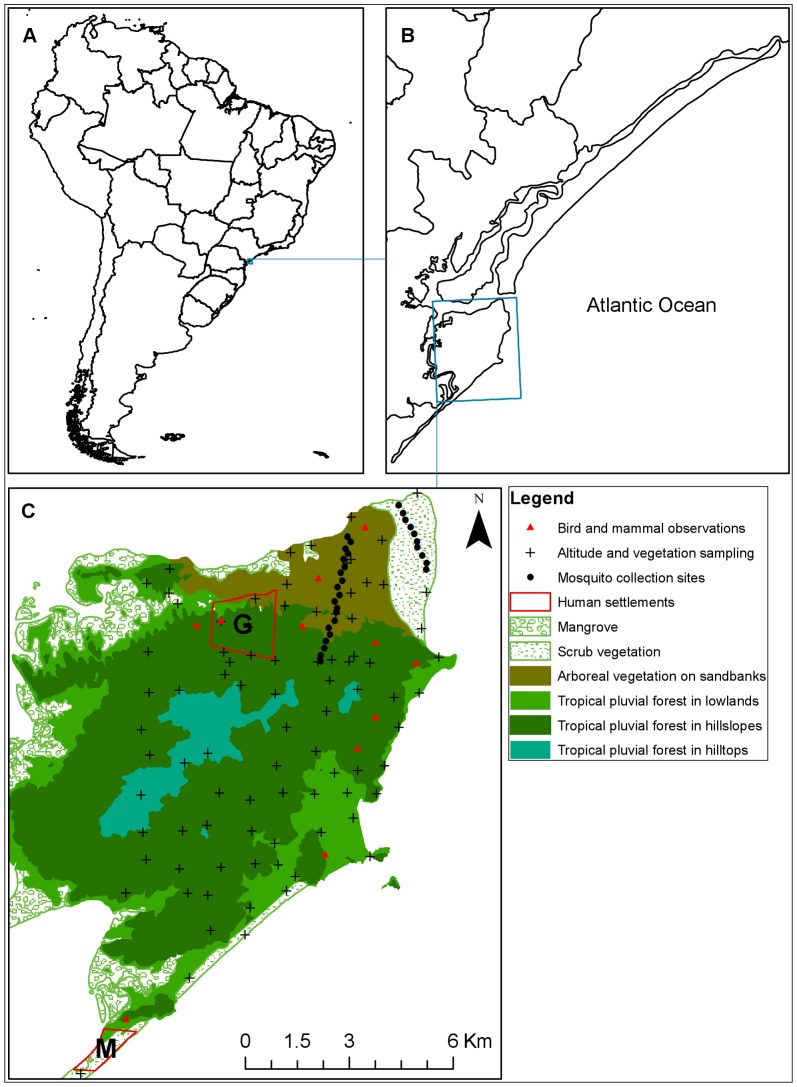
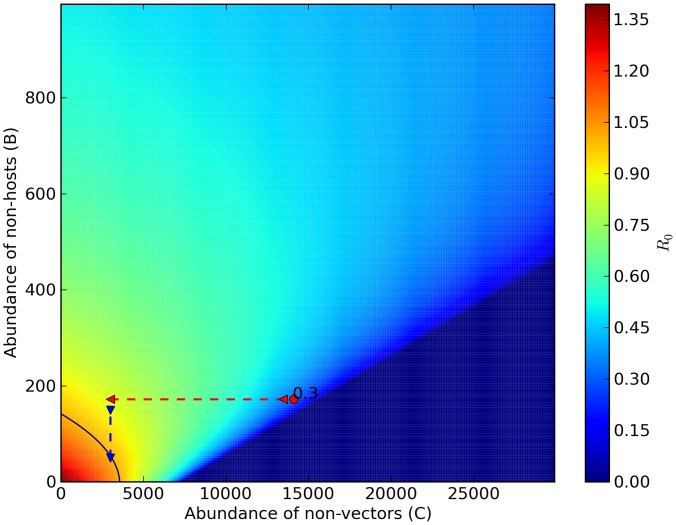
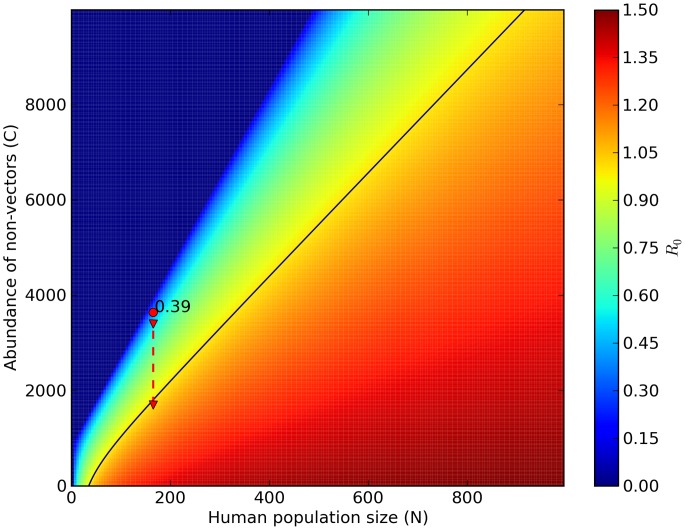
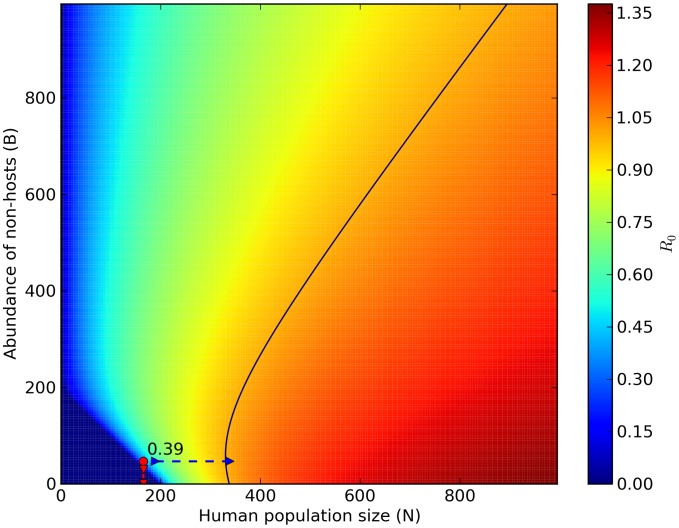
Verification
Claims the paper makes
The claims and statistics of this paper haven’t been checked yet.
Run the check — free, no account needed. It reads the open-access text and checks the sources it cites.
Claims other papers make about this one
Each is checked against this paper’s own text: does it say what the citing paper says it does?
The source backs part of the claim, not all of it — or backs it for a different population, condition or comparison.
In the citing paper
“In more complex systems, notably zoonotic mosquito-borne pathogens with many vectors and many hosts, transmission patterns are affected by the diversity of less-competent or non-competent hosts.91”
From Recasting the theory of mosquito-borne pathogen transmission dynamics and control (2014) · cites this paper as [91]
Experimental — accuracy not yet measuredThe source backs part of the claim, not all of it — or backs it for a different population, condition or comparison.
In the citing paper
“Other frameworks have been developed more recently that show how heterogeneous transmission arises and these lay the foundations for a systematic study of the way these factors vary across systems.91,97”
From Recasting the theory of mosquito-borne pathogen transmission dynamics and control (2014) · cites this paper as [91]
Experimental — accuracy not yet measured
Self-check
Percentages, sums and reported differences re-computed from the paper’s own numbers.
The self-check needs the paper’s full text.
Citations
Cites
Infectious Diseases of Humans: Dynamics and Control
(1992) · Annals of Internal Medicine · doi:10.7326/0003-4819-117-2-174_4 · Cited by 7,819
Infectious Diseases of Humans: Dynamics and Control
Anderson, R. M., & May, R. M. (1991) · doi:10.1093/oso/9780198545996.001.0001 · Cited by 6,179
Weltgesundheitsorganisation (2005) · Cited by 3,799
The diversity–stability debate
McCann, K. S. (2000) · Nature · doi:10.1038/35012234 · Cited by 3,220
Modeling Infectious Diseases in Humans and Animals
Keeling, M. J., & Rohani, P. (2008) · Princeton University Press eBooks · doi:10.1515/9781400841035 · Cited by 2,822
Modeling Infectious Diseases in Humans and Animals
Keeling, M. J., & Rohani, P. (2011) · Princeton University Press eBooks · doi:10.2307/j.ctvcm4gk0 · Cited by 2,771
Impacts of biodiversity on the emergence and transmission of infectious diseases
Keesing, F., Belden, L. K., Daszak, P., Dobson, A., Harvell, C. D., Holt, R. D., Hudson, P., Jolles, A., Jones, K. E., Mitchell, C. E., et al. (2010) · Nature · doi:10.1038/nature09575 · Cited by 2,043
Chitnis, N., Hyman, J. M., & Cushing, J. M. (2008) · Bulletin of Mathematical Biology · doi:10.1007/s11538-008-9299-0 · Cited by 1,839
Global malaria mortality between 1980 and 2010: a systematic analysis
Murray, C. J., Rosenfeld, L. C., Lim, S. S., Andrews, K. G., Foreman, K. J., Haring, D., Fullman, N., Naghavi, M., Lozano, R., & Lopez, A. D. (2012) · The Lancet · doi:10.1016/s0140-6736(12)60034-8 · Cited by 1,452
Niche Overlap and Diffuse Competition
Pianka, E. R. (1974) · Proceedings of the National Academy of Sciences · doi:10.1073/pnas.71.5.2141 · Cited by 1,255
Research works printed but not linked: 8
- RDA Couto, 2010, Autochthonous malaria notified in the State of São Paulo: clinical and epidemiological characteristics from 1980 to 2007, Rev Soc Bras Med Trop, 43, 52
- A Lutz, 1903, Waldmosquitos und waldmalaria, Centralbl Bakt, 33, 282
- LB Smith, 1953, Bromeliad Malaria, Rep Smithson Inst, 1952, 385
- Sawyer DR, Sawyer DO (1992) The malaria transition and the role of social science research. In: Cheng LC, editor. Advancing the Health in Developing Countries: The Role of Social Research. Westport: Auburn House. pp. 105–122.
- Wilson EO (1988) Biodiversity. Washington: National Academy Press. 657 p.
- K Suguiu, 1973, Stratigraphy of the Iguape-Cananéia lagoonal region sedimentary deposits, São Paulo State, Brazil, Bol Inst Geo, 4, 1
- JVE Bernardi, 2005, Spatial study of the vegetation gradient from Cardoso Island State Park, SP, Brazil, Holos Environ, 5, 1
- AP Almeida, 1946, Memória histórica da Ilha do Cardoso, Rev Arq Municipal, 111, 19
Cited by
Sorted by citations
Sandifer, P. A., Sutton‐Grier, A. E., & Ward, B. (2015) · Ecosystem Services · doi:10.1016/j.ecoser.2014.12.007 · Cited by 1,275
Aerts, R., Honnay, O., & Van Nieuwenhuyse, A. (2018) · British Medical Bulletin · doi:10.1093/bmb/ldy021 · Cited by 521
Human health impacts of ecosystem alteration
Myers, S. S., Gaffikin, L., Golden, C. D., Ostfeld, R. S., H. Redford, K., H. Ricketts, T., Turner, W. R., & Osofsky, S. A. (2013) · Proceedings of the National Academy of Sciences · doi:10.1073/pnas.1218656110 · Cited by 501
Connecting Global Priorities: Biodiversity and Human Health, a State of Knowledge Review
Romanelli, C., Cooper, D., Campbell-Lendrum, D. H., Maiero, M., Karesh, W. B., Hunter, D., & Golden, C. D. W. (2015) · CGSPace A Repository of Agricultural Research Outputs (Consultative Group for International Agricultural Research) · doi:10.13140/rg.2.1.3679.6565 · Cited by 421
Parham, P. E., Waldock, J., Christophides, G. K., Hemming, D. L., Agusto, F. B., Evans, K. J., Fefferman, N. H., Gaff, H. D., Gumel, A. B., LaDeau, S. L., et al. (2015) · Philosophical Transactions of the Royal Society B Biological Sciences · doi:10.1098/rstb.2013.0551 · Cited by 344
Metadata
- Authors
- Laporta, G. Z., Prado, P. I. K. L. D., Kraenkel, R. A., Coutinho, R. M., & Sallum, M. A. M.
- Affiliations
- Universidade de São Paulo (BR)
- Universidade Estadual Paulista (Unesp) (BR)
- Corresponding author
- Laporta, Gabriel Zorello
- ORCID
- Venue
- PLoS Neglected Tropical Diseases
- Publisher
- Public Library of Science (PLoS)
- Published
- 2013-03-21
- Volume
- 7
- Issue
- 3
- Pages
- e2139
- ISSN
- 1935-2727 (ISSN-L)
- 1935-2735
- PMC
- PMC3605282
- OpenAlex
- W2084885779
- Cited by
- 108
- References
- 59
- Citations by year
- 2026: 4 · 2025: 4 · 2024: 17 · 2023: 3 · 2022: 10 · 2021: 13 · 2020: 12 · 2019: 10 · 2018: 8 · 2017: 3 · 2016: 4 · 2015: 10 · 2014: 8 · 2013: 2
- FWCI
- 8.18
- Type
- journal article
- Language
- en
- Open access
- gold
- doi.org
- Locations
- PLoS neglected tropical diseases (publishedVersion, cc-by)
- Europe PMC (PubMed Central) (publishedVersion, cc-by)
- PubMed Central (publishedVersion, cc-by)
- PubMed (publishedVersion)
- LA Referencia (Red Federada de Repositorios Institucionales de Publicaciones Científicas) (publishedVersion, other-oa)
- Acervo Digital da Universidade Estadual Paulista (Universidade Estadual Paulista) (submittedVersion, other-oa)
- Americanae (AECID Library) (submittedVersion, other-oa)
- DOAJ (DOAJ: Directory of Open Access Journals) (submittedVersion, cc-by-sa)
- Figshare (submittedVersion, cc-by)
- Funders
- Fundação de Amparo à Pesquisa do Estado de São Paulo (05/53973-0)
- Topics
- Health Sciences › Medicine › Public Health, Environmental and Occupational Health › Malaria Research and Control
- Physical Sciences › Mathematics › Applied Mathematics › Mathematical and Theoretical Epidemiology and Ecology Models
- Health Sciences › Medicine › Public Health, Environmental and Occupational Health › Mosquito-borne diseases and control
- Keywords
- malaria transmission, Plasmodium vivax, biodiversity, dilution effect, dead-end hosts, diffuse competition, tropical rainforest, Ross-Macdonald model, basic reproduction number, malaria eradication, wildlife hosts, mathematical modeling
- MeSH terms
- Animals, Brazil, Disease Outbreaks, Female, Humans, Models, Theoretical, Trees, Tropical Climate, Malaria, Vivax, Disease Transmission, Infectious, Biodiversity
About these checks
Registry, retraction, Cites and statistics results are computed, not judged, with one exception: a printed reference that no index lists is read once by a model before it counts as a citation error. Claims are extracted by a model and kept only when their quote appears verbatim in the text; each cited source is then checked, with a model’s help, for whether it says what the claim relies on. Those verdicts can be wrong — read the claim’s quote and the cited source before relying on one.
Statistics and arithmetic are recomputed, not judged.
Confidence bands are shown only for fields calibrated on our annotated test set. None is calibrated yet, so no band is shown.
What counts as a claim ›How we measure confidence ›How we check this ›
Are you an author, or do you see a problem with this page? Request a review
